Submitted 1 June 2015 Accepted 18 July 2015 Published20 August 2015
Corresponding author
Robert W. Heckman, [email protected]
Academic editor
Zhihong Xu
Additional Information and Declarations can be found on page 11
DOI10.7717/peerj.1166
Copyright
2015 Heckman and Carr
Distributed under
Creative Commons CC-BY 4.0
OPEN ACCESS
The e
ff
ects of leaf litter nutrient pulses on
Alliaria petiolata
performance
Robert W. Heckman1,3and David E. Carr1,2
1Department of Environmental Sciences, University of Virginia, Charlottesville, VA, USA 2Blandy Experimental Farm, University of Virginia, Boyce, USA
3Current affiliation: Department of Biology, University of North Carolina, Chapel Hill, NC, USA
ABSTRACT
Nutrient pulses can facilitate species establishment and spread in new habitats, particularly when one species more effectively uses that nutrient pulse. Biological differences in nutrient acquisition between native and exotic species may facilitate invasions into a variety of habitats including deciduous forest understories.Alliaria petiolata(Bieb.) Cavara & Grande is an important invader of deciduous forest understories throughout much of North America. These understory communities contain many species which perform the majority of their growth and reproduction before canopy closure in spring. BecauseA. petiolatais a wintergreen biennial that can be active during autumn and winter, it may utilize nutrients released from decaying leaf litter before its competitors. To investigate this we manipulated the timing of leaf litter addition (fall or spring) and experimentally simulated the nutrient pulse from decaying leaves using artificial fertilizer. To determine whether
A. petiolataaffected the abundance of understory competitors, we also removed
A. petiolatafrom one treatment.A. petiolatathat received early nutrients exhibited greater growth. Treatments receiving fall leaf litter or artificial nutrients had greater A. petiolataadult biomass than plots receiving spring nutrient additions (leaf litter or artificial nutrients). However, fall leaf litter addition had no effect on the richness of competitor species. Thus, wintergreen phenology may contribute to the spread ofA. petiolatathrough deciduous forest understories, but may not explain community-level impacts ofA. petiolatain deciduous forests.
Subjects Ecology, Ecosystem Science, Environmental Sciences, Plant Science
Keywords Deciduous forest understory, Garlic mustard, Phenology, Nutrient release, Invasive plant
INTRODUCTION
In many terrestrial ecosystems, leaf litter decay is an important source of previously unavailable nutrients (Sayer, 2006;Klotzbucher et al., 2012). The cycling of nutrients from leaf litter can have important implications for these systems (Staelens et al., 2011; Klotzbucher et al., 2012). Long-term litter removal can deplete soil nutrients, especially in plant-available forms (Sayer, 2006;Leffet al., 2012), or cause strong fluctuations in soil nutrient availability (Mo et al., 2003). Nutrient release from decomposing leaf litter may enhance seedling growth (Brearley, Press & Scholes, 2003) and increase seedling survival (Sayer, 2006). Leaf litter differentially affects seedling success—suppressing shade-intolerant species while having little effect on shade-tolerant seedlings (Sydes & Grime, 1981). Although there is ample evidence for the importance of leaf litter in nutrient cycling and plant productivity (e.g.,Sayer, 2006), few studies have examined the effects of leaf litter on species invasions. Most of these studies have focused on leaf litter as a physical barrier to germination and establishment (Meekins & McCarthy, 2001;Bartuszevige, Hrenko & Gorchov, 2007), yet nutrient release from leaf litter could increase the success of established invasive species (Belote & Jones, 2009).
Nutrient release and uptake are not always coupled temporally (Muller & Bormann, 1976;Anderson & Eickmeier, 2000), allowing species that are active when nutrients become available to exploit the pulse (James, Aanderud & Richards, 2006). Nutrient uptake in temperate ecosystems varies seasonally, with little winter resource utilization (Nadelhoffer, Aber & Melillo, 1984;Judd, Likens & Groffman, 2007). Thus, nutrients released during this period may remain unused for long periods (Nadelhoffer, Aber & Melillo, 1984). Wintergreen plants—herbaceous species that retain their leaves during the winter—may be able to use these nutrient pulses earlier than other species.
MATERIALS AND METHODS
Alliaria petiolata
A. petiolatais an invasive understory plant in the family Brassicaceae that is native to Eurasian temperate forests and is an obligate biennial in North America (Cavers, Heagy & Kokron, 1979;Dhillion & Anderson, 1999).A. petiolatawas first recorded in North America in 1868 on Long Island, New York (Nuzzo, 1991). In Virginia, seedlings germinate in March and form a non-reproductive rosette consisting of several small leaves. The plant overwinters as a rosette, growing slowly until early spring when stems elongate rapidly with each individual shoot producing numerous small flowers, each of which produces a silique (Cavers, Heagy & Kokron, 1979). Silique maturation and seed set occurs primarily in June and plants senesce by late summer. Flowers are usually insect pollinated but can be self-pollinated (Anderson, Dhillion & Kelley, 1996;Cruden, McClain & Shrivastava, 1996). Seeds can remain dormant in the seedbank for up to five years (Baskin & Baskin, 1992), allowingA. petiolatato quickly exploit disturbances, especially along forest edges and flood plains (Nuzzo, 1999;Meekins & McCarthy, 2000;Stinson et al., 2006). Allelopathic root exudates may giveA. petiolataan advantage over native species (Roberts & Anderson, 2001; Callaway et al., 2008).
Study site
The 17-hectare, second growth woodlot at Blandy Experimental Farm in Boyce, Virginia, USA (39◦
05′ N,78◦
03′
W) had a well-established population ofA. petiolata. This 100-year old forest had a canopy dominated by deciduous species, mainlyCarya tomentosa,Celtis occidentalis,Quercus alba,Quercus rubra,Nyssa sylvatica,Prunus serotinaandLiriodendron tulipifera. The shrub layer consisted predominantly ofCornus florida,Asimina triloba, Viburnum prunifolium,Sassafras albidumandLindera benzoin. Several exotic species, includingLonicera maackiiandLigustrumspp., were also abundant. The herbaceous understory contained many perennial spring ephemeral species that perform most of their growth and reproduction between snowmelt and canopy closure (Rothstein, 2000). These spring ephemerals may be affected by shading fromA. petiolata—which can reach 1.25 m in height (Cavers, Heagy & Kokron, 1979)—during this time of otherwise high light to the forest understory.
Nutrient manipulation
On 22 October 2006 we established 90 plots, each 0.5 m×0.94 m, in a naturalA. petiolata
population. Naturally establishedA. petiolatarosette density ranged from 8 to 76 rosettes m−2within the plots. We surrounded each plot with a 15 cm high barrier using
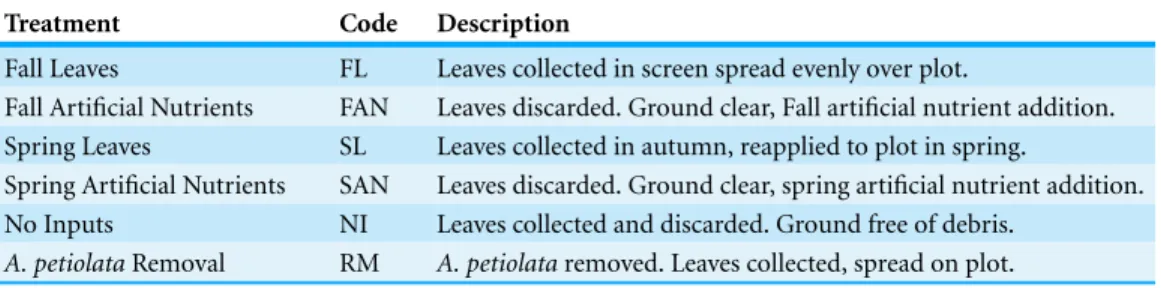
Table 1 A. petiolatatreatment manipulations.
Treatment Code Description
Fall Leaves FL Leaves collected in screen spread evenly over plot.
Fall Artificial Nutrients FAN Leaves discarded. Ground clear, Fall artificial nutrient addition. Spring Leaves SL Leaves collected in autumn, reapplied to plot in spring.
Spring Artificial Nutrients SAN Leaves discarded. Ground clear, spring artificial nutrient addition. No Inputs NI Leaves collected and discarded. Ground free of debris.
A. petiolataRemoval RM A. petiolataremoved. Leaves collected, spread on plot.
The experiment comprised six treatments. Five of these varied in the type and timing of nutrient addition: fall leaves (FL), fall artificial nutrients (FAN), spring leaves (SL), spring artificial nutrients (SAN), no inputs (NI) (Table 1). The sixth treatment (RM) was used as a control to determine the effects ofA. petiolataon the abundance and diversity of other understory species. In RM plots we removed allA. petiolatarosettes. Forest floor leaf litter was left undisturbed in FL and RM plots, and litter caught above these plots was distributed evenly across the plot. Supplemental litter was added as required to match the leaf litter depth immediately outside the plot (typically 2.5–5 cm in depth) and was consistent among plots within a spatial block. Replicates of the four treatments that did not receive autumn leaf litter (FAN, SL, SAN and NI) were cleared of leaf litter beginning in October and continuing until leaf fall ceased in late November 2006. In FAN and SAN plots, artificial fertilizer was used to mimic the natural loss of nutrients from leaf litter decomposition and leaching. Artificial nutrients were added to plots to isolate the effects of nutrient addition from other properties of leaf litter that may positively or negatively affect plant growth (e.g., mutualistic or pathogenic bacteria or fungi associated with leaf litter). These nutrients were provided from slow release Osmocote®fertilizer (13-13-13 NPK, Scotts Company, Marysville, Ohio, USA) at 0.994 g per plot on FAN and SAN plots on 19 November 2006 and 24 March 2007, respectively. This nitrogen addition was similar to the amount (0.283 g N m−2
yr−1
) released from leaf litter in a mixed deciduous forest (Cromack & Monk, 1974). Litter that we collected in the fall 2006 and stored dry over the winter was applied to SL plots on 24 March 2007. NI plots were maintained without leaf litter or nutrient addition throughout the experiment. For each treatment in which leaves were removed (FAN, SAN, SL, and NI), we introduced artificial leaves into the plots in November 2006 to mimic physical properties of litter that may have had both positive (e.g., moisture retention and insulation) and negative (e.g., shading) effects on plant growth. We added∼20 of these artificial leaves (∼20×20 cm squares), cut from
landscaping fabric (Greenscapes General Purpose Landscape Fabric) to each plot. As with natural leaves, these artificial leaves were placed haphazardly within each plot. We carefully removed most artificial leaves from SAN plots prior to fertilization, however some leaves were left in place to avoid disturbing the vegetation.
temperature was above 0◦
C nearly every day (113 times) and above 10◦
C nearly half of the days (60 times). Blandy received 55 cm of snow during this period, most of which occurred in small events that melted rapidly and did not coverA. petiolatafor long periods. Thus, 60 or more of the days between our fall and spring nutrient additions were likely conducive to at least minimalA. petiolatagrowth.
Initial measurements
We calculated A. petiolatarosette density on 28 and 29 October 2006, prior to any manipulations. These served as base measurements from which to compare individuals after manipulations.
Adult growth and reproduction
In June 2007 we harvested and separated plants into above-ground (vegetative) and reproductive biomass. Above-ground biomass was oven dried and weighed.A. petiolata plant density and above-ground biomass per plot were calculated. We harvested siliques from adult plants to quantify per capita and per plot silique production.
Competitor richness
To determine the impact ofA. petiolataon its competitors we identified all herbaceous species in each plot (Table S1). We quantified species richness and the number of individuals of all species in each plot.
Statistical analyses
We tested all data for normality and homogeneity of variances. Competitor stem density was square root transformed to meet these assumptions. We performed repeated measures ANOVAs using PROC MIXED in SAS (SAS Institute Inc. Cary, NC Version 9.2) onA.
petiolataplant density in October and June with nutrient treatment and time as fixed
effects and block as a random effect. AutumnA. petiolatadensity (October, 2006) differed significantly among treatments (P=0.031), although pairwise comparisons performed
with Ryan’sQfailed to detect significant differences among any pairs of treatments. Nonetheless, we retained initial density as a covariate for subsequent analyses. We analyzed above-ground biomass and siliques per plot with ANCOVAs using SAS 9.2 PROC GLM with treatment as a fixed effect, block as a random effect and OctoberA. petiolata density as a covariate. Plot above-ground biomass and siliques per plot were the only response variables for which the covariate effect had significant explanatory value. Because initial density did not contribute significantly to adult plant density or per capita silique production (i.e., ANCOVA was not appropriate), we performed two-way ANOVAs in SAS 9.2 using a general linear model with block as a random effect and nutrient treatment as a fixed effect on garlic mustard density, per capita silique production, and competitor species richness and plant abundance.
Table 2 Results of analysis of covariance.(A) AdultA. petiolataabove-ground biomass, (B) Silique production per plot. October juvenile rosette density was used as a covariate.
Source (A) Biomass (B) Siliques
df MS F df MS F
Treatment 4 323.08 5.74* 4 56,705.99 3.45* Covariate 1 1,195.13 21.23* 1 506,256.62 30.81*
Block 14 448.92 7.97 14 101,404.99 6.17
Error 53 56.31 – 53 16,431.70 –
Notes.
*Denotes significant effect atP=0.05.
Table 3 Results of analysis of variance.(A) Adult plants per plot at senescence in June, (B) Silique production per adult plant.
Source (A) Adult plant density (B) Siliques/Plant
df MS F df MS F
Treatment 4 50.42 1.05 4 304.72 3.77*
Block 14 158.26 3.29 14 351.95 4.36
Error 54 48.12 – 54 80.81 –
Notes.
*Denotes significant treatment effect atP=0.05.
inputs; Spring nutrients (SAN and SL) vs. no inputs; Fall nutrients (FAN and FL) vs. Spring nutrients (SAN and SL). We maintained a 5% experiment-wise error rate in each analysis with the Dunn-Sidak adjustment (5 contrasts,α′ =0.01021). In addition to
these five contrasts, we performed a sixth contrast for competitor analyses:A. petiolata removal (RM) vs. all other plots. Thus, the adjustedα′
for all competitor contrasts (6 contrasts) was 0.00851. When no contrasts showed significant differences among groups for a given response variable (e.g., silique production per plot), we performed all pairwise comparisons using the Tukey-Kramer test due to unequal sample sizes (data were lost for treatments FL and SL in Block 12).
RESULTS
Above-ground biomass
Figure 1 Above-ground biomass ofA. petiolata(mean+95% CI) harvested after seed maturation in June 2007.Treatments included: FL, fall leaves; FAN, fall artificial nutrients; SL, spring leaves; SAN, spring artificial nutrients; NI, no inputs. We performed five planned comparisons with alpha adjusted using the Dunn-Sidak method (α′=0.01274): FL differed significantly from SL; NI differed significantly from SAN+SL; FAN+FL differed significantly from SAN+SL; FAN did not differ significantly from
SAN; NI did not differ significantly from FAN+FL.
Reproductive output
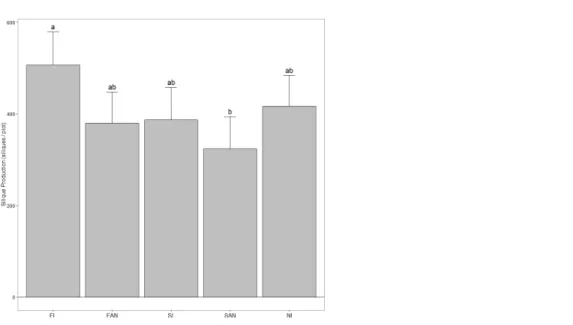
Plots receiving FL had significantly higher per capita silique production than SAN plots (FL, 30.45 siliques/plant; SAN, 17.50 siliques/plant) (P=0.009), while SL, FAN and NI plots had approximately equal per capita silique production (Fig. 2). There was a significant treatment effect on silique production per plot when treating initial density as a covariate (P=0.014) (Table 2B), however none of the planned contrasts showed
significant differences among groups (Fig. 3). When examining all pairwise comparisons, FL plots produced significantly more siliques than SAN plots (FL, 510.4 siliques/plot; SAN, 328.1 siliques/plot).
Competitor analyses
We found no treatment effects on competitor species richness in this study. However, competitor abundance (stem density,Fig. 4) was significantly affected byA. petiolata treatment (Table 4); plots from whichA. petiolatawas removed contained a significantly greater number of stems of competitor species (45.97) than plots receiving spring leaf-litter (24.70). There were no significant differences among any other treatments.
DISCUSSION
Figure 2 Per capita silique production inA. petiolata(mean+95% CI) harvested in June 2007. Treat-ments included: FL, fall leaves; FAN, fall artificial nutrients; SL, spring leaves; SAN, spring artificial nutrients; NI, no inputs. Plots receiving fall leaf litter had significantly greater silique output per plant than spring artificial nutrient treatment. Shared letters denote no significant difference atα=0.05. Pairwise comparisons were performed using the Tukey-Kramer method.
Figure 3 The number ofA. petiolatasiliques produced within a plot in June 2007 (mean+95%
CI).Treatments included: FL, fall leaves; FAN, fall artificial nutrients; SL, spring leaves; SAN, spring artificial nutrients; NI, no inputs. Although the overall ANCOVA showed a significant treatment effect, no contrasts produced significant differences among treatments. Shared letters denote no significant difference atα=0.05. Pairwise comparisons were performed using the Tukey-Kramer method.
Figure 4 The total abundance (number of stems) ofA. petiolata’s competitors in each plot (mean
+95% CI).Treatments included: FL, fall leaves; FAN, fall artificial nutrients; SL, spring leaves; SAN, spring artificial nutrients; NI, no inputs; RM,A. petiolataremoved. Shared letters denote no significant difference atα=0.05.
Table 4 Results of analysis of variance.(A) Richness of understory competitor species, (B) Total number of individuals of all competitor species within a plot.
Source (A) Species richness (B) Competitor density
df MS F df MS F
Treatment 5 1.20 0.70 5 6.22 2.64*
Block 14 9.15 5.32 14 41.39 17.59
Error 70 1.72 – 70 2.35 –
Notes.
*Denotes significant treatment effect atP=0.05.
species including trees and larger shrubs.Leger et al. (2007)found that native species in unfertilized plots were more successful than native species in fertilized plots through a combination of competition with invasive species and increased herbivory on more palatable (higher tissueN) plants.
Annual fecundity is an important demographic rate forA. petiolatapopulations (Davis et al., 2006). Populations that produce fewer seeds spread less rapidly and are more easily controlled than more fecund populations (Pardini et al., 2009). Sparse satellite populations should benefit more from increased silique production per individual plant, shortening the time from initial establishment to dominance (Pardini et al., 2009); furthermore, increases in total silique production per area may have a greater impact on the rate ofA.
petiolataspread and community dominance (Davis et al., 2006). Despite the importance
Variation among treatments in the initial density ofA. petiolatarosettes may have obscured some differences among treatments in final abundance and reproductive measures in our experimental plots. The plots to which the SAN treatment was applied had higher initial density ofA. petiolatathan other treatments. We used initial density as a covariate in the analyses, but treatment effects could have been obscured if density effects were nonlinear—especially if very high densities began to suppress individual growth. In a similar experiment, extremely high density ofA. petiolatasuppressed per capita biomass, reproduction, and response to fertilization (Meekins & McCarthy, 2000). Likewise, biomass and per capita reproduction increased in experimentally thinned populations in another study (Rebek & O’Neil, 2006). However,A. petiolatadensities in these studies were 2–3 times the typical density in our plots, so it is unlikely that substantial density-dependent reductions in per capita biomass or reproduction occurred in our study.
A. petiolatadid not affect understory richness in this study. Although we chose areas with moderately denseA. petiolatapopulations, any declines in species richness attributable toA. petiolatalikely occurred decades ago. Furthermore, removingA. petiolata from small plots would not have opened enough space for species most affected by competition withA. petiolatato reestablish.A. petiolataremoval modestly increased competitor abundance, supporting the results of another study (Carlson & Gorchov, 2004).A. petiolataremoval may, however, increase competitor richness over longer time scales than this short-term experiment (Meekins & McCarthy, 1999), althoughA. petiolata removal did not increase competitor richness in other studies (Hochstedler et al., 2007; Davis et al., 2014).
CONCLUSIONS
Our results indicated that A. petiolatawas capable of using fall nutrient inputs to increase growth. Relative to spring inputs or no inputs, fall nutrient inputs increased biomass. Although these results suggest that early acquisition of nutrients benefited A. petiolata, we were unable to detect negative effects of nutrient addition on other understory species. These nutrients benefitedA. petiolatawithout directly increasing its impact on competitors. Thus, although wintergreen phenology may have facilitated the establishment ofA. petiolatain North American forests, it appeared insufficient to explain the community-level effects ofA. petiolatain deciduous forest understories. It is critical to more fully understand the implications for communities invaded by species possessing unique life-history traits because these traits may facilitate establishment and spread.
ACKNOWLEDGEMENTS
ADDITIONAL INFORMATION AND DECLARATIONS
Funding
This study was supported by a research fellowship from Blandy Experimental Farm and an Exploratory Award from the University of Virginia’s Department of Environmental Sciences to RWH. The funders had no role in study design, data collection and analysis, decision to publish, or preparation of the manuscript.
Grant Disclosures
The following grant information was disclosed by the authors: Blandy Experimental Farm.
University of Virginia’s Department of Environmental Sciences.
Competing Interests
The authors declare there are no competing interests.
Author Contributions
• Robert W. Heckman conceived and designed the experiments, performed the
experi-ments, analyzed the data, contributed reagents/materials/analysis tools, wrote the paper, prepared figures and/or tables, reviewed drafts of the paper.
• David E. Carr conceived and designed the experiments, performed the experiments,
analyzed the data, contributed reagents/materials/analysis tools, wrote the paper, reviewed drafts of the paper.
Supplemental Information
Supplemental information for this article can be found online athttp://dx.doi.org/ 10.7717/peerj.1166#supplemental-information.
REFERENCES
Anderson RC, Dhillion SS, Kelley TM. 1996. Aspects of the ecology of an invasive plant,
garlic mustard (Alliaria petiolata), in central Illinois.Restoration Ecology4:181–191
DOI 10.1111/j.1526-100X.1996.tb00118.x.
Anderson W, Eickmeier WG. 2000.Nutrient resorption inClaytonia virginicaL.: implications for
deciduous forest nutrient cycling.Canadian Journal of Botany-Revue Canadienne De Botanique 78:832–839DOI 10.1139/cjb-78-6-832.
Augspurger C. 2008.Early spring leaf out enhances growth and survival of saplings in a temperate
deciduous forest.Oecologia156:281–286DOI 10.1007/s00442-008-1000-7.
Augspurger CK, Cheeseman JM, Salk CF. 2005.Light gains and physiological capacity of
understorey woody plants during phenological avoidance of canopy shade.Functional Ecology 19:537–546DOI 10.1111/j.1365-2435.2005.01027.x.
Bartuszevige AM, Hrenko RL, Gorchov DL. 2007.Effects of leaf litter on establishment, growth
Baskin JM, Baskin CC. 1992.Seed-germination biology of the weedy biennialAlliaria petiolata. Natural Areas Journal12:191–197.
Belote RT, Jones RH. 2009.Tree leaf litter composition and nonnative earthworms influence
plant invasion in experimental forest floor mesocosms.Biological Invasions11:1045–1052
DOI 10.1007/s10530-008-9315-1.
Brearley FQ, Press MC, Scholes JD. 2003.Nutrients obtained from leaf litter can improve the
growth of dipterocarp seedlings.New Phytologist160:101–110
DOI 10.1046/j.1469-8137.2003.00851.x.
Callaway RM, Cipollini D, Barto K, Thelen GC, Hallett SG, Prati D, Stinson K, Klironomos J.
2008.Novel weapons: invasive plant suppresses fungal mutualists in America but not in its
native Europe.Ecology89:1043–1055DOI 10.1890/07-0370.1.
Carlson AM, Gorchov DL. 2004.Effects of herbicide on the invasive biennialAlliaria petiolata
(garlic mustard) and initial responses of native plants in a southwestern Ohio forest.Restoration Ecology12:559–567DOI 10.1111/j.1061-2971.2004.00373.x.
Cavers PB, Heagy MI, Kokron RF. 1979.Biology of Canadian weeds. 35.Alliaria petiolata(M.
Bieb) Cavara and Grande.Canadian Journal of Plant Science59:217–229
DOI 10.4141/cjps79-029.
Cromack K, Monk CD. 1974.Litter production, decomposition, and nutrient cycling in a mixed
hardwood watershed and a white pine watershed. In: Howell FG, Gentry JB, Smith MH, eds.Mineral cycling in southeastern ecosystems. Springfield, VA, USA: National Technical Information Service, 609–624.
Cruden RW, McClain AM, Shrivastava GP. 1996.Pollination biology and breeding system
of Alliaria petiolata(Brassicaceae). Bulletin of the Torrey Botanical Club123:273–280
DOI 10.2307/2996775.
Davis AS, Landis DA, Nuzzo V, Blossey B, Gerber E, Hinz HL. 2006.Demographic models
inform selection of biocontrol agents for garlic mustard (Alliaria petiolata).Ecological Applications16:2399–2410DOI 10.1890/1051-0761(2006)016[2399:DMISOB]2.0.CO;2.
Davis MA, Grime JP, Thompson K. 2000.Fluctuating resources in plant communities: a general
theory of invasibility.Journal of Ecology88:528–534DOI 10.1046/j.1365-2745.2000.00473.x. Davis MA, MacMillen C, LeFevre-Levy M, Dallavalle C, Kriegel N, Tyndel S, Martinez Y,
Anderson MD, Dosch JJ. 2014.Population and plant community dynamics involving garlic
mustard (Alliaria petiolata) in a Minnesota Oak Woodland: a four year study.Journal of the Torrey Botanical Society141:205–216DOI 10.3159/TORREY-D-13-00062.1.
Dhillion SS, Anderson RC. 1999. Growth and photosynthetic response of first-year garlic
mustard (Alliaria petiolata) to varied irradiance.Journal of the Torrey Botanical Society126:9–14
DOI 10.2307/2997250.
Hewins DB, Hyatt LA. 2010.Flexible N uptake and assimilation mechanisms may assist biological
invasion byAlliaria petiolata.Biological Invasions12:2639–2647
DOI 10.1007/s10530-009-9671-5.
Hochstedler WW, Slaughter BS, Gorchov DL, Saunders LP, Stevens MHH. 2007.Forest floor
plant community response to experimental control of the invasive biennial,Alliaria petiolata (garlic mustard).Journal of the Torrey Botanical Society134:155–165
DOI 10.3159/1095-5674(2007)134[155:FFPCRT]2.0.CO;2.
Huenneke LF, Hamburg SP, Koide R, Mooney HA, Vitousek PM. 1990.Effects of soil resources
James JJ, Aanderud ZT, Richards JH. 2006.Seasonal timing of N pulses influences N capture in a saltbush scrub community.Journal of Arid Environments67:688–700
DOI 10.1016/j.jaridenv.2006.03.014.
Judd KE, Likens GE, Groffman PM. 2007.High nitrate retention during winter in soils of the
Hubbard Brook Experimental Forest.Ecosystems10:217–225DOI 10.1007/s10021-007-9027-x.
Klotzbucher T, Kaiser K, Stepper C, Van Loon E, Gerstberger P, Kalbitz K. 2012.Long-term
litter input manipulation effects on production and properties of dissolved organic matter in the forest floor of a Norway spruce stand.Plant and Soil355:407–416
DOI 10.1007/s11104-011-1123-1.
Knight TM, Dunn JL, Smith LA, Davis J, Kalisz S. 2009.Deer facilitate invasive plant success in a
Pennsylvania forest understory.Natural Areas Journal29:110–116DOI 10.3375/043.029.0202.
LeffJW, Wieder WR, Taylor PG, Townsend AR, Nemergut DR, Grandy AS, Cleveland CC. 2012.
Experimental litterfall manipulation drives large and rapid changes in soil carbon cycling in a wet tropical forest.Global Change Biology18:2969–2979
DOI 10.1111/j.1365-2486.2012.02749.x.
Leger EA, Howe KM, Gurevitch J, Woo E, Hickman J, Ashton IW, Lerdau M. 2007. The
interaction between soil nutrients and leaf loss during early establishment in plant invasion. Forest Science53:701–709.
Mack RN, SimberloffD, Lonsdale WM, Evans H, Clout M, Bazzaz FA. 2000.Biotic invasions:
causes, epidemiology, global consequences, and control.Ecological Applications10:689–710
DOI 10.1890/1051-0761(2000)010[0689:BICEGC]2.0.CO;2.
Meekins JF, McCarthy BC. 1999.Competitive ability ofAlliaria petiolata(garlic mustard,
Brassicaceae), an invasive, nonindigenous forest herb.International Journal of Plant Sciences 160:743–752DOI 10.1086/314156.
Meekins JF, McCarthy BC. 2000.Responses of the biennial forest herbAlliaria petiolatato
variation in population density, nutrient addition and light availability.Journal of Ecology 88:447–463DOI 10.1046/j.1365-2745.2000.00461.x.
Meekins JF, McCarthy BC. 2001.Effect of environmental variation on the invasive success of a
nonindigenous forest herb.Ecological Applications11:1336–1348
DOI 10.1890/1051-0761(2001)011[1336:EOEVOT]2.0.CO;2.
Mo HM, Brown S, Peng SL, Kong G. 2003.Nitrogen availability in disturbed, rehabilitated and
mature forests of tropical China.Forest Ecology and Management175:573–583
DOI 10.1016/S0378-1127(02)00220-7.
Morghan KJR, Rice KJ. 2006.Variation in resource availability changes the impact of invasive
thistles on native bunchgrasses.Ecological Applications16:528–539
DOI 10.1890/1051-0761(2006)016[0528:VIRACT]2.0.CO;2.
Muller RN, Bormann FH. 1976.Role ofErythronium americanumKer. in energy-flow and
nutrient dynamics of a northern hardwood forest ecosystem.Science193:1126–1128
DOI 10.1126/science.193.4258.1126.
Myers CV, Anderson RC. 2003.Seasonal variation in photosynthetic rates influences success of
an invasive plant, garlic mustard (Alliaria petiolata).American Midland Naturalist150:231–245
DOI 10.1674/0003-0031(2003)150[0231:SVIPRI]2.0.CO;2.
Myers CV, Anderson RC, Byers DL. 2005.Influence of shading on the growth and leaf
Nadelhoffer KJ, Aber JD, Melillo JM. 1984.Seasonal patterns of ammonium and nitrate uptake in 9 temperate forest ecosystems.Plant and Soil80:321–335DOI 10.1007/BF02140039.
Nuzzo VA. 1991.Experimental control of garlic mustardAlliaria petiolataBieb. Cavara and Grande
in northern Illinois USA using fire, herbicide and cutting.Natural Areas Journal11:158–167.
Nuzzo V. 1999.Invasion pattern of the herb garlic mustard (Alliaria petiolata) in high quality
forests.Biological Invasions1:169–179DOI 10.1023/A:1010009514048.
Olson BE, Blicker PS. 2003.Response of the invasiveCentaurea maculosaand two native grasses
toN-pulses.Plant and Soil254:457–467DOI 10.1023/A:1025536100535.
Pardini EA, Drake JM, Chase JM, Knight TM. 2009.Complex population dynamics and control
of the invasive biennialAlliaria petiolata(garlic mustard).Ecological Applications19:387–397
DOI 10.1890/08-0845.1.
Pimentel D, Zuniga R, Morrison D. 2005.Update on the environmental and economic costs
associated with alien-invasive species in the United States.Ecological Economics52:273–288
DOI 10.1016/j.ecolecon.2004.10.002.
Rebek KA, O’Neil RJ. 2006.The effects of natural and manipulated density regimes onAlliaria
petiolatasurvival, growth and reproduction.Weed Research46:345–352
DOI 10.1111/j.1365-3180.2006.00516.x.
Roberts KJ, Anderson RC. 2001.Effect of garlic mustard (Alliaria petiolata(Bieb. Cavara &
Grande)) extracts on plants and arbuscular mycorrhizal (AM) fungi.American Midland Naturalist146:146–152DOI 10.1674/0003-0031(2001)146[0146:EOGMAP]2.0.CO;2.
Rodgers VL, Stinson KA, Finzi AC. 2008.Ready or not, garlic mustard is moving in:Alliaria
petiolataas a member of eastern North American forests.Bioscience58:426–436
DOI 10.1641/B580510.
Rothstein DE. 2000.Spring ephemeral herbs and nitrogen cycling in a northern hardwood
forest: an experimental test of the vernal dam hypothesis.Oecologia 124:446–453
DOI 10.1007/PL00008870.
Sayer EJ. 2006.Using experimental manipulation to assess the roles of leaf litter in the functioning
of forest ecosystems.Biological Reviews81:1–31DOI 10.1017/S1464793105006846. Staelens J, Nachtergale L, De Schrijver A, Vanhellemont M, Wuyts K, Verheyen K. 2011.
Spatio-temporal litterfall dynamics in a 60-year-old mixed deciduous forest.Annals of Forest Science68:89–98DOI 10.1007/s13595-011-0010-5.
Stinson KA, Campbell SA, Powell JR, Wolfe BE, Callaway RM, Thelen GC, Hallett SG, Prati D,
Klironomos JN. 2006.Invasive plant suppresses the growth of native tree seedlings by
disrupting belowground mutualisms.PLoS Biology4:727–731
DOI 10.1371/journal.pbio.0040140.
Stinson K, Kaufman S, Durbin L, Lowenstein F. 2007.Impacts of garlic mustard invasion on a
forest understory community.Northeastern Naturalist14:73–88
DOI 10.1656/1092-6194(2007)14[73:IOGMIO]2.0.CO;2.
Sydes C, Grime JP. 1981.Effects of tree leaf litter on herbaceous vegetation in deciduous woodland
1.Field Investigations Journal of Ecology69:237–248.
Welk E, Schubert K, Hoffmann MH. 2002. Present and potential distribution of invasive
garlic mustard (Alliaria petiolata) in North America.Diversity and Distributions8:219–233