187
Metallurgy and materials
Metalurgia e materiais
Archaeometry of ferrous
artefacts from Luso-Brazilian
archaeological sites near
Ipanema River, Brazil
Arqueometria de peças de ferro de sítios
arqueológicos luso-brasileiros localizados
próximos do Rio Ipanema, Brasil
Rafael Rocha Maia
Doutorando e técnico do Laboratório de Caracterização Microestrutural Hubertus Colpaert Escola Politécnica da Universidade de São Paulo Dep. de Engenharia Metalúrgica e de Materiais São Paulo - São Paulo – Brazil
Marcelli Susaki Dias
Estudante de Graduação
Escola Politécnica da Universidade de São Paulo Dep. de Engenharia Metalúrgica e de Materiais São Paulo - São Paulo – Brazil
Cesar Roberto de Farias Azevedo
Professor Doutor
Escola Politécnica da Universidade de São Paulo Dep. de Engenharia Metalúrgica e de Materiais São Paulo - São Paulo – Brazil
Fernando José Gomes Landgraf
Professor Associado
Escola Politécnica da Universidade de São Paulo Dep. de Engenharia Metalúrgica e de Materiais e Presidente do Instituto de Pesquisas Tecnológicas do Estado de São Paulo S.A.
São Paulo - São Paulo – Brazil [email protected]
Abstract
The present investigation analysed iron artefacts collected in two sites around Araçoaiaba Hill. A known methodology was adapted to investigate several samples collected at the Royal Iron Factory of São João do Ipanema and Sardinha sites. EDX microanalysis results of non-metallic inclusions were plotted in bivariate graphs. Lin-ear regression (with and without the zero-intercept constraint) and line intercept sig-niicance tests were applied to interpret these results. The analysis did not allow the identiication of the provenance of the production systems of Sardinha and Ipanema sites. The presence of Ti-rich inclusions was an unambiguous attribute of the samples collected at the Sardinha site.
Keywords: archaeometry, inclusion, linear regression, intercept signiicance test.
Resumo
A presente investigação analisou artefatos de ferro coletados em dois sítios ar-queológicos na Montanha de Araçoaiaba. Uma metodologia conhecida foi adapta-da para investigar várias amostras coletaadapta-das na Real Fábrica de Ferro de São João do Ipanema e no sítio de Sardinha. Resultados de microanálise EDX de inclusões não metálicas foram inseridos em gráicos bivariantes. Regressão linear (com e sem a restrição de intersecção pela origem) e testes de signiicância do intercepto da reta foram usados para interpretar esses resultados. Essa análise não permitiu identiicar a assinatura dos sistemas produtivos de Sardinha e Ipanema. A presença de inclusões ricas em Ti foi uma característica típica dos artefatos coletados no sítio de Sardinha.
Palavras-chave: arqueometria, inclusões, regressão linear, teste signiicância do intercepto.
http://dx.doi.org/10.1590/0370-44672015680151
1. Introduction
In the late 16th century, Afonso Sardinha discovered magnetitic iron ore in Araçoiaba Hill, located one hundred kilo-metres from São Paulo city. The existence
of water and iron ore in this site enabled him to establish a bloomery there (Lemes 1954; Rodrigues 1966). The ruins of this enterprise were discovered in 1977 by
Ze-quini 2006). In the 1980s, Prof. Margarida Andreatta excavated this site and the results of the thermoluminescence dating of a few European style pottery fragments found there indicated they were 520 ± 75 years old (Zequini 2006). In 1807, when Napoleon´s army invaded Portugal, the Portuguese court was forced to lee to Brazil and Rio de Janeiro became the capital of the Portu-guese empire. In 1809, the PortuPortu-guese king, João VI, launched three large projects to construct ironmaking facilities, two in the State of Minas Gerais and one in the State of São Paulo. The latter, located near the same iron ore occurrence of Araçoiaba Hill, gave rise to a public-private enterprise named as “Royal Iron Factory of São João do Ip-anema”, which built twin blast furnaces in Brazil similar to the ones being operated at that time in Portugal (Rogers 1962; Cam-pos and Solórzano 2004; Zequini 2006; Medeiros 2009; Landgraf et al. 1995). The
technical dificulties during the operation of the blast furnace and inery of the Royal Iron Factory of Ipanema created a situation where both direct and indirect iron reduc-tion processes coexisted in the same factory for the production of iron artefacts (Araújo
et al. 2010). The slag inclusions from the
ferrous artefacts produced by the direct pro-cess featured higher P2O5 and FeO contents when compared to the slag inclusions from artefacts produced by the direct process. Additionally, the slag inclusions from the
ferrous artefacts manufactured by the direct process featured higher contents of Al2O3, MgO and K2O (Dillmann and L'Heritier 2007). The analysis of microstructure and chemical composition of slag inclusions of iron artefacts has been used in an attempt to identify their manufacturing process, such as direct or indirect reduction, and the "signature" of their production system (Rostoker and Dvorak 1990; Gordon 1997; Buchwald and Wivel 1998; Starley 1999; Dillmann and L'Héritier 2007; Desaulty et al. 2008; Blakelock et al. 2009; Maia 2014).
For instance, Dillmann and L'Héritier (Dillmann and L'Héritier 2007) studied the microanalysis of numerous non metallic inclusions of ferrous artefacts. They plotted bivariate graphs (SiO2 content versus Al2O3 content; CaO content versus K2O content; MgO content versus Al2O3 content) and applied a constrained linear regression model (line going through zero), deleting ‘‘abnormal data’’ from these bivariate graphs in iterative steps until the coeficient of determination (R2) became higher than 0.7. The provenance of various iron artefacts was identiied by comparing the resulting constant ratios of these bivariate graphs. Ac-cording to authors (Dillmann and L'Heritier 2007; Disser et al. 2014), data reining
pro-cedure was aimed to remove the abnormal slag compositions from the bulk analysis, which may occur due to use of additives dur-ing forgdur-ing, and the chemical compositions
of small inclusions, which might be biased by a local concentration effect. Blakelock et al. (Blakelock et al. 2009) reproduced
exper-iments of direct reduction and reinement of iron to explore the relationship between the chemical composition of the slag inclusions and the chemical compositions of iron ore, furnace lining, luxes and reducing agents. They tested the proposed constrained linear regression model (Dillmann and L'Héritier 2007) to analyse non metallic inclusions in iron objects produced under experi-mental conditions. Even under controlled experimental conditions, they explained they would have to apply the data cleaning process to up to 50% of the non metallic inclusions to obtain an acceptable value for the coeficient of determination (R2 > 0.7). They pointed out that this practice could distort their results and observed patterns. Sophisticated multivariate statistical meth-ods have been applied since 2009 to analyse the microanalysis results and investigate the production provenance of iron artefacts (Blakelock et al. 2009, Charlton et al. 2012,
Disser et al. 2014). The present investigation
will explore a methodology based on previ-ous investigation (Dillmann and L'Héritier 2007) to compare the constraint linear regression model (CLRM) and unconstraint linear regression model (ULRM) during the investigation of the provenance of several samples collected at the Royal Iron Factory of São João do Ipanema and Sardinha sites.
2. Materials and methods
Six ferrous artefacts (one bar, three nails, one hinge and one plate) from An-dreatta’s collection (Zequini 2006) were selected for characterization. Three of the iron artefacts (identiied as I82, I84 and I99) were collected at the Ipanema site and the remaining three (identiied as S106, S107 and S111) at the Sardinha site. Metallographic samples were pre-pared and characterized by conventional microscopy, scanning electron micros-copy (SEM) and energy dispersive x-ray spectroscopy microanalysis (Saphire Si(Li) – SUTW EDAX EDX detector) on at least 30 inclusions for each ferrous artefact, using 15 kV, area mode and acquisition time of at least 60 s. Micro-analyses on the non-metallic inclusions with length and width larger than 5 μm were performed in area mode, covering areas larger than 25 um2, imposing as a constraint that all the elements in the non metallic inclusions were in the form of stoichiometric oxide (see average results
in Table 1). All the artefacts presented a predominant ferritic microstructure with inclusions occupying area frac-tion from 4 to 13%. The results of non metallic inclusion microanalysis were used to plot bivariate graphs, such as FeO versus SiO2 content, SiO2 content versus Al2O3 content; CaO content ver-sus K2O content; MgO content versus Al2O3 content; and P2O5 content versus the [(Al2O3 + MgO + K2O)/ FeO]) ratio, as proposed by Dillmann and L’Heritier (Dillmann and L’Heritier, 2007) for the partial discrimination of direct and indirect reduction products. Two linear regression models (CLRM and ULRM) were applied without any data-cleansing (due to the larger size of inclusions used in the present investigation) to investigate the strength of the correlation for various bivariate graphs. Additionally, the calcu-lation of the surface weighing the average composition for each object (giving more weight to large inclusions and less to
smaller ones) was not performed in the present investigation, as suggested else-where (Dillmann and L'Heritier 2007). In the irst scenario, the linear regressions (CLRM) were forced to pass through the origin (b=0), while in the second sce-nario they were performed without any constraint. Student t-test and Student's t-cumulative distribution function were used to evaluate the signiicance of the intercept of the line equation in the cases when b ≠ 0. The |t| value of the Student t-test and the Student's t-cumulative distribution function were calculated via Origin Lab 8.5 software and analysed in accordance with Manson et al. (Manson
et al. 2003). If |t|> 2 and p < 0.05 (95%
189
Table1 Average EDX microanalysis of slag inclu-sions (% weight) of the samples collected
at the Royal Iron Factory of São João do Ipanema (I) and Sardinha sites (S).
3. Results
Samples MgO Al2O3 SiO2 P2O5 K2O CaO TiO2 V2O5 MnO FeO
I82 0.9 ± 0.6 2.1 ± 0.5 14.6 ± 4.7 2.1 ± 2.3 0.5 ± 0.1 1.5 ± 0.5 0.4 ± 0.1 0.3 ± 0.2 1.6 ± 0.8 75.7 ± 5.6
I84 1.3 ± 0.6 1.6 ± 0.5 10.1 ± 4.0 4.9 ± 3.7 0.3 ± 0.2 1.5 ± 1.1 0.4 ± 0.3 0.5 ± 0.4 2.3 ± 1.6 76.6 ± 9.5
I99 1.8 ± 0.4 2.6 ± 0.8 28.7 ± 9.5 3.2 ± 1.5 2.5 ± 1.3 9.5 ± 4.1 0.4 ± 0.2 0.5 ± 0.2 0.7 ± 0.2 49.7 ± 7.2
S106 1.1 ± 0.2 1.9 ± 0.5 13.8 ± 4.6 1.0 ± 0.4 1.1 ± 1.1 2.5 ± 0.9 5.7 ± 1.6 - 0.8 ± 0.2 72.1 ± 7.2
S107 3.6 ± 1.6 2.2 ± 0.8 33.1 ± 14.5 3.7 ± 0.4 2.3 ± 1.2 12.9 ± 6.9 1.6 ± 0.8 1.6 ± 1.1 1.9 ± 0.7 36.6 ± 23.1
S111 1.1 ± 0.3 1.8 ± 0.6 11.8 ± 6.7 1.0 ± 0.7 0.9 ± 0.9 2.3 ± 1.9 6.9 ± 3.5 1.5 ± 0.7 0.8 ± 0.2 71.6 ± 10.7
The microstructure of the Sardinha site inclusions differ signiicantly as they all presented a phase non present in the Ipanema artefacts inclusions, a Ti-rich phase. The average microanalyses results
of the non metallic inclusions of each iron artefact are given in Table 1 and they in-dicated that the main difference between the non metallic inclusions of both sites is the TiO2 content, which is much higher in
the samples collected at the Sardinha site. Additionally, samples I99 and S107 showed comparatively lower average values for the FeO content and a more detailed analysis of these results will be shown in Figures 2 and 3.
The microstructural characteriza-tion of non metallic inclusions is shown in Figures 1-a and 1-b. Figure 1-a shows a typical multiphase non metallic inclusion found in the artefacts found in the Royal Iron Factory of São João do Ipanema, showing dendrites of wustite (FeO) in a SiO2-rich matrix. Figure 1-b shows two types of inclusions, both richer in Ti: dendrites of wustite (FeO) and polygonal ilmenite (FeTiO3) in a SiO2-rich matrix (centre); and dendrites of wustite (FeO),
polygonal ilmenite (FeTiO3) and fayalite (2FeO.SiO2) in a SiO2-rich matrix. Bivari-ate graphs showing the various relation-ships between the main constituents of the non metallic inclusions found in each one of the ferrous artefacts are shown in Figures 2-a to 2-d (FeO versus %SiO2; %SiO2 versus %Al2O3; %Al2O3 versus %MgO; and %CaO versus %K2O). Figure 2-a illustrates the inverse relation-ship between FeO and SiO2 in the slag inclusions, while Figures 2-b to 2-d show
an apparent direct relationship between the contents of SiO2 and Al2O3, CaO and K2O, Al2O3 and MgO, respectively. A subsequent qualitative analysis by visual assessment of Figures 2-b to 2-d could not separate distinct clusters representing the Ipanema and Sardinha sites, but this same evaluation suggested that I99 sample was different from the other artefacts from Ipanema site and that S107 sample was also similarly different from the other artefacts from Sardinha site.
Figure 1 a) Detail of a slag inclusion of an artefact
Figure 2
Bivariate graphs of the chemical composi-tion of the non metallic inclusions for both sites of Araçoiaba Hill (S: Sardinha in red and I: Ipanema in blue):
a) Graph showing the content of FeO versus SiO2;
b) Graph showing the content of SiO2 and Al2O3;
c) Graph showing the content of CaO and K2O;
d) Graph showing the content of MgO versus Al2O3.
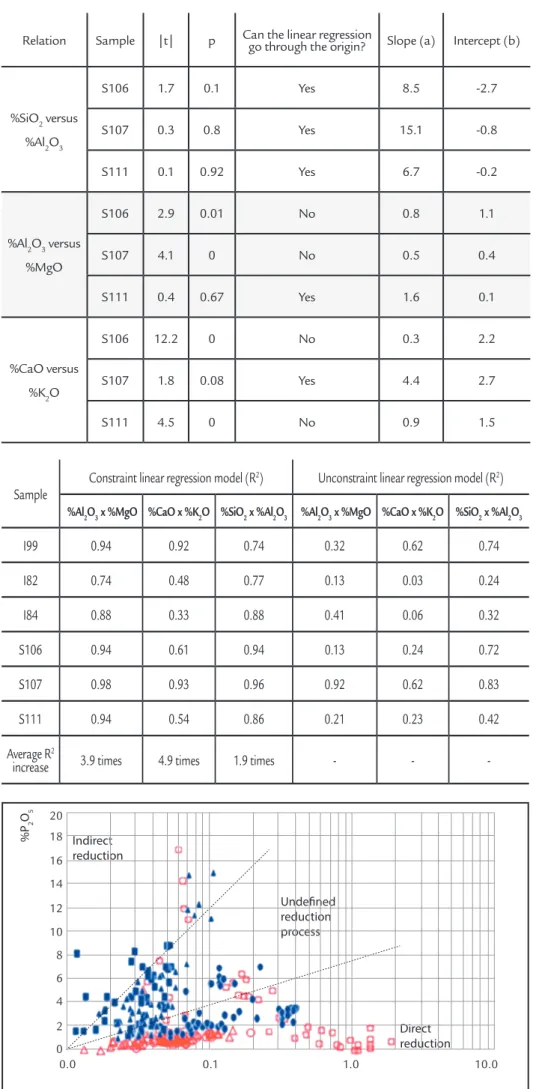
The results of the statistical tests for the signiicance of the intercept are shown in Tables 2 and 3. The statistical test results for the artifacts collected at the Royal Iron Factory of São João do Ipanema (see Table 2) indicated that the CLRM without data-cleansing was not valid for 7 out of the 9 samples. The results for the artifacts collected at the Sardinha site (see Table 3) indicated that the CLRM was valid for 5 out of the 9 samples. These results indicated that CLRM without data-cleansing was not suitable for the present investigation. Additionally, Table 4 compares the values of the coeficients of determination (R2) for both regression
models. The CLRM presented R2 ≥ 0.7 (indicative of an acceptable value for the strength of the linear relationship) for 77.7% of the individual results, while the ULRM showed suitable values of R2 for only 22% of the individual results. This simple comparison showed that the use of the zero intercept model (CLRM) increased the values of the coeficients of determination in 95% of the samples by an average value of 260%.
Fi n a l ly, F i g u r e 3 show s a graph of the P2O5 content in the non metallic inclusions versus the [(Al2O3+ MgO+ K2O) / FeO]) ratio for each one of the ferrous artefacts. This
graph was proposed by Dillmann and L’Heritier (Dillmann and L’Heritier, 2007) for partial discrimination of direct and indirect reduction products. This igure shows that most of the iron artefacts found in the Sardinha site are located in the direct reduction ield (ex-cept sample S107), but this same igure could not identify the reduction process for the iron artefacts found in the Royal Iron Factory de São João de Ipanema, which were mostly located within the “undeined reduction process” ield, with the exception of sample I99, for which most points are located in the direct reduction ield.
Table 2
Samples of the Royal Iron Factory of São João do Ipanema: test of significan-ce of the intersignifican-cept for the linear regression (y= ax + b).
Relation Sample |t| p Can the linear regression go through the origin? Slope (a) Intercept (b) %SiO2 versus
%Al2O3
I99 0 0.97 Yes 10.8 -0.1 I82 1.9 0.07 Yes 7.2 11 I84 4.8 0 No 4.2 3.6 %Al2O3 versus
%MgO
I99 2.3 0.03 No 0.9 1 I82 7.4 0 No 0.3 1.2 I84 9.4 0 No 0.5 1 %CaO versus
%K2O
I99 4.5 0 No 0.4 1.6 I82 5.9 0 No -0.9 1.1 I84 6.6 0 No -1 1.8
100 90 80 70 60
60 50
50 40
40 30
30 20
20 10
10 0
15 25
20
10
0
60
50
40
30
20
10
0
0 1 2 3 4 5
0
0 0 1
1
2
2
3
3
4
4
5
5
5
6 1 2 3 4 5 6 7 8
0
%F
eO
%SiO2
%K2O %MgO
%CaO %Al
2
O3
%Al2O3
%SiO
2
199 184 182 S 106 S 107 S 111
199 184 182 S 106 S 107 S 111 199 184 182 S 106 S 107 S 111
199 184 182 S 106 S 107 S 111
(a) (b)
191
Table3 Samples of the Sardinha site: test of significance of the intercept for the linear regression (y= ax + b).
Relation Sample |t| p Can the linear regression go through the origin? Slope (a) Intercept (b) %SiO2 versus
%Al2O3
S106 1.7 0.1 Yes 8.5 -2.7 S107 0.3 0.8 Yes 15.1 -0.8 S111 0.1 0.92 Yes 6.7 -0.2 %Al2O3 versus
%MgO
S106 2.9 0.01 No 0.8 1.1 S107 4.1 0 No 0.5 0.4 S111 0.4 0.67 Yes 1.6 0.1 %CaO versus
%K2O
S106 12.2 0 No 0.3 2.2 S107 1.8 0.08 Yes 4.4 2.7 S111 4.5 0 No 0.9 1.5
Sample
Constraint linear regression model (R2) Unconstraint linear regression model (R2)
%Al2O3 x %MgO %CaO x %K2O %SiO2 x %Al2O3 %Al2O3 x %MgO %CaO x %K2O %SiO2 x %Al2O3
I99 0.94 0.92 0.74 0.32 0.62 0.74
I82 0.74 0.48 0.77 0.13 0.03 0.24
I84 0.88 0.33 0.88 0.41 0.06 0.32
S106 0.94 0.61 0.94 0.13 0.24 0.72
S107 0.98 0.93 0.96 0.92 0.62 0.83
S111 0.94 0.54 0.86 0.21 0.23 0.42
Average R2
increase 3.9 times 4.9 times 1.9 times - -
-Table 4 Comparison of the linear correlation coefficients (R2)
for the linear regression models.
199 20
18
16
14
12
10
8
6
4
2
0
0.0 0.1 1.0 10.0
182 184
S 106 S 107 S 111
%P
2
O5
( %Al2O3+ %MgO + %K2O )/%FeO
Undefined reduction process Indirect
reduction
Direct reduction Figure 3
4. Discussion
5. Conclusions
6. Acknowledgments
The present results (see Tables 2 and 3) indicated that the constrained linear regression model was valid for only seven out of eighteen bivariate relationships. The present investigation, however, did not use any data cleansing to improve this result, as proposed elsewhere (Dill-mann and L'Heritier, 2007) due to the large size of the investigated inclusions. Additionally, the low values for the coef-icient of determination (R2 < 0.7) for the unconstrained regression model (see Table 4) when compared with the constrained linear regression model indicated that the hypothesis of forcing the linear regression passing through the origin, as proposed by other authors (Coustures et al. 2003; Dillmann and L'Heritier, 2007), should be used with care, as this assumption drastically changes the values of the lin-ear correlation parameters. The results in Tables 2 and 3 indicated that the CLRM without data-cleansing was not valid for 78% of the bivariate relationships on the artefacts collected at the Ipanema site and for 45% of the bivariate relationships on
the artefacts collected at the Sardinha site. As a matter of fact, the use of the zero intercept model (CLRM) increased the values of the coeficients of determination in 95% of the samples by an average value of 260%, which may lead to the “unre-alistic” identiication of the provenance of iron artefacts. As a result, the present investigation could not identify the signa-ture of the productive systems of Sardinha and Ipanema sites using any of the linear regression models.
However, a qualitative analysis of Figures 2-a to 2-d suggested that I99 sample was different from the other ob-jects collected at the Ipanema site, and that S107 sample may also be different from the other objects collected at the Sardinha site. This simple observation indicated that the number of investigated artefacts from Ipanema and Sardinha sites must be increased to produce more meaning-ful conclusions about the provenance of these iron artefacts. For instance, Figure 3 showed that most of the iron artefacts found in the Sardinha site are located in
the direct reduction ield (except sample S107), but this igure did not show any information for the iron artefacts found in the Royal Iron Factory de São João de Ipanema (direct and indirect reduction), which were mostly located within the “un-deined reduction process” ield, with the exception of sample I99, for which most points are located in the direct reduction ield. As a matter of fact, a large number of points of Ipanema samples fall into the very large overlap region occupied by objects with different technological origins (direct or indirect reduction) in the graph proposed by Dillmann and L’Heritier (Dillmann and L’Heritier, 2007).
Finally, another important attribute of the inclusions of the samples collected at the Sardinha site when compared to the samples collected at the Ipanema site was its higher TiO2 content associated with the presence of polygonal ilmenite (FeTiO3) in the microstructure. In this case, the microstructural characterization was able to differentiate the artefacts collected at Sardinha and Ipanema sites.
• The present investigation could
not identify by linear regression models the signature of the productive systems of Sardinha and Ipanema sites. The number of investigated artefacts from Ipanema and Sardinha sites should be increased in order to produce stronger conclusions about the provenance of the iron artefacts collected at these sites.
• The constrained linear regres
-sion model (CLRM) without data-cleansing must be used with extreme care, as the assumption of having a line
passing through the origin of the bivari-ate graphs increased the coeficients of determination (R2) in 95% of the samples by an average value of 260% when compared to the unconstrained linear regression model (ULRM).
• The graph of the P2O5 content
versus the [(Al2O3+ MgO+ K2O) / FeO]) ratio in the non metallic inclusions indi-cates that that most of the iron artefacts found in the Sardinha site are located in the direct reduction ield (except sample S107). This same graph could not identify
the reduction process for the iron artefacts found in the Royal Iron Factory de São João de Ipanema.
• Another particular attribute of
the inclusions of the ferrous artefacts from Sardinha site, when compared to the samples of Ipanema site, was their higher TiO2 content associated with the presence of polygonal ilmenite (FeTiO3) in their microstructure. In this case, the microstructural characterization was useful to differentiate the ferrous artifacts collected at Sardinha and Ipanema sites.
The authors would like to thank: Ministério do Meio Ambiente do Brasil; Instituto Brasileiro do Meio Ambiente e dos Recursos Naturais Renováveis; and
Instituto Chico Mendes de Conservação da Biodiversidade for allowing the use of the iron artifacts from Andreatta collection; Santander Undergraduate
University Grant; Dr. L. B. Regalado; Prof. A. C. Neiva and Dr. M. Andreatta for their valuable support.
7. References
ARAÚJO, P.E.M., SPORBACK, S.-G., LANDGRAF, F. J. G. Start up da siderurgia brasileira. Metalurgia & Materiais, v. 66, n. 2, p. 197-202, 2010.
BLAKELOCK, E., MARTINÓN-TORRES, M., VELDHUIJZEN H. A., YOUNG T. Slag inclusions in iron objects and the quest for provenance: an experiment and a case study. Journal of Archaeological Science, v. 36, n. 8, p. 1745-1757, 2009.
193 Received: 14 August 2014 - Accepted: 21 January 2015.
p. 73-96, 1998.
CAMPOS, G. N., SOLÓRZANO, I.G. Microanalytical study of a ferrous agricul-tural tool recovered from a historical site in Rio de Janeiro. Applied Physics A: Materials Science & Processing, v. 79, n. 2, p. 315-318, 2004.
CHARLTON, M. F., BLAKELOCK, E,. MARTINÓN-TORRES, M., YOUNG T. Investigating the production provenance of iron artifacts with multivariate metho-ds. Journal of Archaeological Science, v. 39, n. 7, p. 2280-2293, 2012.
COUSTURES, M. P., BÉZIAT, D., TOLLON, F., DOMERGUE, C., LONG, L., RE-BISCOUL, A. The use of trace element analysis of entrapped slag inclusions to es-tablish ore-bar links: examples from two Gallo-Roman iron-making sites in France (Les Martys, Montagne Noire, and Les Ferrys, Loiret). Archaeometry, v. 45, n. 4,
p. 599–613, 2003.
DESAULTY A.-M., MARIET C., DILLMANN P., JORON J. L., FLUZIN, P. A provenance study of iron archaeological artefacts by Inductively Coupled Plasma--Mass Spectrometry multi-elemental analysis. Spectrochimica Acta Part B: Ato-mic Spectroscopy, v. 63, n. 11, p. 1253-1262, 2008.
DILLMANN, P., L'HÉRITIER, M. Slag inclusion analyses for studying ferrous alloys employed in French medieval buildings: supply of materials and diffusion of smel-ting processes. Journal of Archaeological Science, v. 34, n. 11, p. 1810-1823, 2007.
GORDON, R. B. Process deduced from ironmaking wastes and artefacts. Journal of Archaeological Science, v. 24, n. 1, p. 9-18, 1997.
LANDGRAF, F. J. G., TSCHIPTSCHIN, A. P., GOLDENSTEIN, H. G. Notas so-bre a história da metalurgia no Brasil (1500-1850). In: VARGAS, M. História da Técnica e da Tecnologia no Brasil. São Paulo: Editora da Universidade Estadual
Paulista, cap.5, p.107-130.414 p.
LEMES, P. T. A. P. Notícias das minas de São Paulo e dos sertões da mesma Capita-nia. São Paulo: Itatiaia, 1954. 240 p.
MAIA, R.R. Análise de inclusões de escória em amostras metálicas da Fábrica de Ferro de Ipanema. São Paulo: Escola Politécnica da Universidade de São Paulo,
2014. 209 p. 2014. (Masters of Engineering Dissertation)
MANSON, R. L., GUNST, R. F., HESS, J. L. Statistical design and analysis of expe-riments, with applications to engineering and science. Second Edition. New Jersey: John Wiley & Sons, 2003. cap. 14, p. 461-485. 728 p. (Linear regression with One Predictor Variable).
MEDEIROS, L. A Ferraria da Foz do Alge: elemento patrimonial submerso. Aponta-mentos de Arqueologia e Patrimônio, v. 4, p. 71-76, 2009.
RODRIGUES, L. M. P. As minas de ferro em Araçoiaba (São Paulo, séculos XVI--XVII-XVIII). In: SIMPÓSIO DOS PROFESSORES UNIVERSITÁRIOS DE HISTÓRIA, 3 Anais..., Franca: 1966. p. 171-25
ROGERS, E. J. The iron and steel industry in Colonial and Imperial Brazil. The Ame-ricas, v. 19, n. 2, p. 172-184, 1962. (http://www.jstor.org/stable/978891)
ROSTOKER, W., DVORAK J. R. Wrought irons: distinguishing between processes.
Archaeomaterials, v. 4, p. 153-166, 1990.
SALAZAR, J. M. O. Esconderijo do Sol: a história da Fazenda Ipanema, desde a primeira forja do Brasil até a Real Fábrica de Ferro. Brasília: Ministério da
Agri-cultura, Brasília, 1982. 132 p.
STARLEY, D. Determining the technological origins of iron and steel. Journal of Ar-chaeological Science, v. 26, n. 8, p. 1127-1133, 1999.