201
Metallurgy and materials
Metalurgia e materiais
Tempering effect on
the localized corrosion
of 13Cr4Ni0.02C and
13Cr1Ni0.15C steels in a
synthetic marine environment
Efeito do revenido na corrosão localizada
dos aços 13Cr4Ni0.02C e 13Cr1Ni0.15C
em ambiente marinho sintético
Renato de Mendonça
Doutor em Engenharia de Materiais Bolsista/Pesquisador
Universidade Federal de Alfenas, Instituto de Ciência e Tecnologia Poços de Caldas - Minas Gerais - Brazil [email protected]
Neide Aparecida Mariano
Doutora em Engenharia Metalúrgica Docente/Pesquisadora
Universidade Federal de Alfenas, Instituto de Ciência e Tecnologia Poços de Caldas - Minas Gerais - Brazil [email protected]
Abstract
Primarily, tempering is used in martensitic stainless steels with low carbon in order to change their mechanical properties. However, it also modiies the cor-rosion properties; usually depending on the temperature and duration of the heat treatment. This work investigated the impact of tempering on the corrosion of 13Cr4Ni0.02C and 13Cr1Ni0.15C (% weight) steels. Samples were tempered at 650º, 700º and 750ºC, characterized by optical microscopy and cyclic anodic po-larization tests in a synthetic marine environment. The results showed differences in the microstructure of the 13Cr4Ni0.02C tempered samples, which changed from lath to lamellar with precipitates in the prior austenite grain boundaries. On the other hand, tempering did not affect the 13Cr1Ni0.15C microstructure. The anodic polarization tests showed that the pitting potential of the 13Cr4Ni0.02C samples decreased with the tempering temperature increasing. Similar values of pitting potential were found with the 13Cr1Ni0.15C tempered samples, which were lower than the 13Cr4Ni0.02C samples after tempering. It shows that even though the corrosion resistance of the 13Cr4Ni0.02C reduces when the tempering temperature was increased, it is better than that presented by 13Cr1Ni0.15C.
Keywords: corrosion, marine environment, martensite, polarization tests. http://dx.doi.org/10.1590/0370-44672015680040
1. Introduction
Martensitic stainless steels with low carbon concentration have been employed in hydraulic turbines, pumps and high pressure pipes in the energy and petrochemical industries (Song et al., 2010; Bilmes et al., 2001; Wang et al., 2010; Zhang et al., 2005).
Usu-ally, they are exposed to environments where the corrosion and cavitation-erosion resistances are important prop-erties (Wang et al., 2010; Gervasi et al.,
2011; Lai et al., 2012). In the chemical
composition of these steels, the
chro-mium is for increasing the corrosion resistance and the nickel, for stabilizing austenite and inhibiting delta ferrite (δ), the formation of which increases brittleness (Liu et al., 2010; Balan et al.,
1998; Dawood et al., 2004; Calliari et al., 2008; Ma et al., 2012).
Tempering treatments are often used to change the toughness and brittleness of this family of steels. It also modiies the microstructure. Observed alterations include a reduction in the dis-location density created during
quench-ing, microstructural transformations and nucleation of new phases or compounds (Mendonça et al., 2014; Calliari et al.,
2008; Ma et al., 2012; Park et al., 2007;
Choi et al., 2007). Commonly, tempering
also incurs the formation of chromium carbides, such as Cr23C, which have del-eterious effects on the corrosion proper-ties (Qin et al., 2008; Sedriks et al., 1996;
Dexter, 2006).
202 REM: R. Esc. Minas, Ouro Preto, 68(2), 201-206, apr. jun. | 2015
offshore oil production facilities (Maria-no et al., 2007). The marine environment
is complex because of the wide variety of chemical compositions, dependent on both, the geographic position and the depth. For instance, the literature (Dex-ter, 2006; Grifin, 2006) reports variable concentration of chlorides in marine water, which is signiicant because
chlo-rides increase the degradation processes of stainless steels by localized corrosion.
The inluence of tempering low-carbon stainless steels on the corrosion resistance in marine environments is not well-understood, even though the importance of these steels and the micro-structural transformations observed after heat treatments are well-known (Calliari
et al., 2008; Ma et al., 2012; Bilmes et al., 2001; Wang et al., 2010). This
paper presents a study that uses cyclic potentiodynamic polarization tests in a synthetic marine environment to investi-gate and compare the effect of tempering on corrosion for two steels with differ-ent nickel and carbon concdiffer-entrations: 13Cr4Ni0.02C and 13Cr1Ni0.15C.
2. Methods
The steels were produced in an electric arc furnace with argon-oxygen decarburization (AOD). The chemical composition of the steels
in weight percentage is presented in Table 1. In order to realize the temper-ing, the samples were loaded into an electrical furnace (Teklabor-Model
200FM) already at the tempering temperature (650, 700 and 750ºC) and removed 1 hour later to be cooled in air.
Sample %C %Si %Mn %Cr %Ni %Mo
13Cr4Ni0.02C 0.025 1.000 0.700 13.000 4.120 0.720
13Cr1Ni0.15C 0.153 1.020 0.750 13.000 1.030 0.080
Table 1
Chemical composition of the samples (wt %).
The microstructure of the tem-pered samples was characterized using optical microscopy, and surface etching was achieved with modiied Behara (0.2 l/HCl + 1l/H2O + 1g/K2S2O3) at room temperature.
Corrosion behavior was evalu-ated using a replicevalu-ated electrochemical cyclic potentiodynamic polarization method. The electrodes were produced from stainless steel sheets, machined in
cylindrical forms (base area: 0.5 cm2),
insulated with a slow-cure epoxy resin to prevent the formation of air bubbles at the resin-metal interface.
In preparation for the tests, all samples were polished mechanically with grade 600 SiC sandpaper, rinsed in alcohol and dried. Two measure-ments were taken at room temperature (25°C) for each sample with a model Autolab/PGSTART302
potentiostat-galvanostat device, using a conventional three-electrode cell. A saturated calomel electrode (SCE) was used as a reference electrode for the tests, while a Pt plate was employed as counter-electrode. The potentiodynamic curves were measured at a potential scan rate of 1 mV/s in a synthetic seawater environment pre-pared according to ASTM D 1141. The standard chemical composition of the seawater is presented in Table 02.
Compound Concentration, g/L
NaCl 24.530
MgCl2 5.200
Na2SO4 4.090
CaCl2 1.160
KCl 0.695
NaHCO3 0.201
KBr 0.101
H3BO3 0.027
SrCl2 0.025
NaF 0.003
Table 2
203
3. Results and discussion
3.1. Influence of tempering on the microstructure
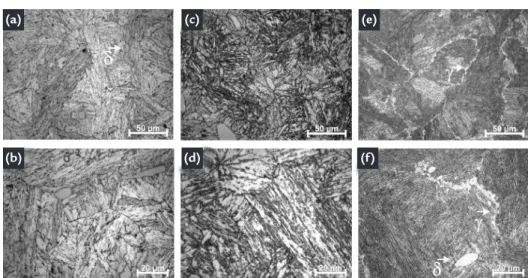
Figure 1 shows the microstructure of the tempered 13Cr4Ni0.02 steel at three different temperatures. In the sample tempered at 650°C (Figure 1(a,b)), the typical martensitic structure of low-carbon steel with laths and the delta fer-rite as previously found by Mariano et al.
(2007) are observed. In the sample tem-pered at 700°C, the matrix is similar to the one in the sample tempered at 650°C,
martensite laths and delta ferrite (Figure 1(c,d)). On the other hand, the sample tempered at 750°C presented a different matrix, with a lamellar morphology, delta ferrite and precipitates in the prior austen-ite grain boundaries (Figure 1(e,f)). Ac-cording to Bilmes et al. (2001) and Song et al. (2010), this latter microstructure,
with austenite in the grain boundaries and lamellae, is the result of martensite
decomposition, at temperatures slightly under the austenitization temperature by diffusion processes. Furthermore Bilmes
et al. (2001) proposed that the tempered
microstructure is composed of tempered martensite, carbides and austenite. Equa-tions (1) and (2) represent the reaction where martensite could become austenite (1) and/or ferrite (2). Both equations also indicate carbides formation.
α’ (martensite) →γ (austenite) + MxCy (carbides).
(a)
(b)
(c) (e)
(f) (d)
Figure 1 Microstructure of the 13Cr4Ni0.02C samples tempered at 650°C (a,b), 700°C (c,d) and 750°C (e,f).
By comparison, Figure 2 pres-ents the m icrostruct u res of the 13Cr1Ni0.15C samples after tempering. The morphology observed is similar in all tempered samples: delta ferrite in a martensitic matrix is observed and there
is no evidence of a tempering effect on the microstructure. The relatively low concentration of Ni is considered a cru-cial point in this result because it is the element employed to stabilize the aus-tenite and is reported to facilitate reverse
austenite formation in martensitic steel (Song et al., 2010; Bojack et al., 2012).
Therefore, it is probable that the lower amount of Ni in the 13Cr1Ni0.15C samples would limit this steel’s ability to present reverse austenite.
Figure 2 Microstructure of the 13Cr1Ni0.15C samples tempered at 650°C (a), 700°C (b) and 750°C (c).
3.2. Influence of tempering on cyclic anodic polarization curves
Cyclic polarization curves are shown in Figure 3. The presence of closed cycles indicates pitting corrosion on the samples which were visually conirmed after the tests. Thompson and Payer (1998) discussed in details the cyclic an-odic polarization curves and pointed out that, during reversion of the potential, active pits formed in the transpassive region can further increase the current density preventing the overlap of the
points on the curve and providing the hysteresis loop. The curves show similar values for the corrosion potential (ECORR) - potential of a corroding surface in the electrolyte - and different values for the pitting potential (EPIT) - the lowest value of oxidizing potential at which pits nucle-ate and grow - as summarized in Table 3 and indicated in the Figure (3a).
The tempered 13Cr4Ni0.02C samples have similar ECORR values.
However, the results of EPIT are dis-tinct; the highest value is from the sample tempered at 650°C. The values of protection potential (EPROT) - the most noble potential where pitting corrosion will not propagate - show a signiicant difference for the sample tempered at 750ºC. This result indicates that the repassivation process on this surface is slower and consequently it is more sus-ceptible to corrosion. In contrast, for the
(a) (b) (c)
(1)
204 REM: R. Esc. Minas, Ouro Preto, 68(2), 201-206, apr. jun. | 2015
13Cr1Ni0.15C samples, the EPIT values are similar, and the instability of the cur-rent close to the EPIT (Figure 3) indicates
the formation of metastable pits that are quickly passivated during the tests of the 13Cr1Ni0.15C samples. The EPROT values
can be considered similar because the spread is lower than 50 mV (Thompson and Payer, 1998).
Figure 3
Cyclic anodic polarization curves for 13Cr4Ni0.02C (a) and 13Cr1Ni0.15C (b) after tempering at 650º, 700º and 750º C.
The different morphology ex-hibited by the 13Cr4Ni0.02C sample tempered at 750°C is related to its lower EPIT values and consequently to its low corrosion resistance. Inluenced by high Ni concentration and characterized by the martensite changes, the phase transformations indicate the complex carbide formation in these steels that are associated with low corrosion re-sistance (Gervasi et al., 2011; Qin et al., 2008). Previous works (Song et al.,
2010; Tabatabae et al., 2011; Ma et al., 2012; Camillo et al., 2010) showed
that the formed carbides could cause localized chromium depletion, changing the corrosion properties of low-carbon martensitic steels.
The 13Cr4Ni0.02C sample tem-pered at 700°C presented no important change in the observed microstructure but showed a lower EPIT. It suggests that transformations which are not noted in the microstructure, such as carbide
precipitation, occur and change the cor-rosion resistance.
Comparative analysis of the cyclic polarization curves of the two tempered steels shows similar ECORR but a differ-ent EPIT. Lower values of the pitting potential show that the 13Cr1Ni0.15C tempered steels are more susceptible to corrosion in marine environments. This susceptibility is mainly due to the molybdenum and carbon compositions: molybdenum plays a role in the growth
(a)
205
5. Acknowledgments
The authors acknowledge the inan-cial support of CAPES (Coordenação de
Aperfeiçoamento de Pessoal Ensino Supe-rior) and the valuable comments of Mark
Vankeerberghen and Tamara Djikanovic from Belgian Nuclear Research Centre.
6. References
BALAN, K. P., VENUGOPAL, R. A., SARMA, D. S. Austenite precipitation during tempering in 16Cr-2Ni martensitic stainless steels. Scripta Materialia, v.39, p.
901-905, 1998.
BILMES, P. D., SOLARI, M., LIORENTE, C. L. Characteristics and effects of auste-nite resulting from tempering of 13Cr-NiMo martensitic steel weld metals. Mate-rials Characterization. v.46, p. 285-296, 2001.
BOJACK, A., ZHAO, L., MORRIS, P. F, SIETSMA, J. In-situ determination of aus-tenite and martensite formation in 13Cr6Ni2Mo supermartensitic stainless steel.
Materials Characterization, v.71, 77-86, 2012.
CALLIARI, I., ZANESCO, M., DABALÀ, M., BRUNELLI, K., RAMOUS, E. In-vestigation of microstructure and properties of a Ni-Mo martensitic stainless steel.
Materials and Design, v.29, p. 246-250, 2008.
CAMILLO, A. P. C, ROVERE, C. A. D., AQUINO, J. M., KURI, S. E. Efeito do revenido na resistência à corrosão dos aços inoxidáveis supermatensíticos. Revista da Escola de Minas, v.63, p.117–122, 2010.
CHOI, Y-S, KIM, J-G, PARK, Y-S, PARK, J-Y. Austenitizing treatment inluence on the electrochemical corrosion behavior of 0.3C-14Cr-3Mo martensitic stainless steel. Materials Letters, v.61, p.244-247, 2007.
DAWOOD, M. A., MAHALLAWAI, I. S. E., ABD EL AZIM, M. E., KOUSSY, M. R.
4. Conclusions
I n su m m a r y, t he cor rosion of tempered 13Cr4Ni0.02C and 13Cr1Ni0.15C steels was investigated by means of electrochemical cyclic potentiodynamic polarization in a syn-thetic marine environment.
Tempering at 750°C for 1 hour clearly modiied the 13Cr4Ni0.02C steel microstructure. Typical martensitic mi-crostructure constituted of laths became
lamellar due to the nickel concentration that induces the formation of austen-ite. This lamellar microstructure of the 13Cr4Ni0.02C steel demonstrated lower pitting potential in marine en-vironments and consequently reduced corrosion resistance.
O n t h e o t h e r h a n d , t h e 13Cr1Ni0.15C steel did not present sig-niicant microstructural or changes in
the pitting potential, and consequently in the corrosion resistance, with increas-ing of the temperincreas-ing temperature.
The comparison of the pitting potential values of the two tempered steels shows that the corrosion resis-tance of 13Cr4Ni0.02C steel is better than 13Cr1Ni0.15C steel, mainly due to difference in the carbon and molyb-denum concentrations.
650ºC 700ºC 750ºC 650ºC 700ºC 750ºC
13Cr4Ni0.02C 13Cr1Ni0.15C
ECORR (mV)SCE -395.1±20.0 -415.3±21.0 -395.1±20.0 -347.9±17.5 -375.7±19.0 -385.5±19.5
EPIT (mV)SCE 189.0±10.0 10.4±20.0 5.0±15.0 160.3±20.6 157.9±16.0 170.6±17.0
EPROT (mV)SCE - 245.8 - 192.8 - 359.4 - 261.6 - 322.4 - 277.5
Table 3 Potential Corrosion (ECORR), Pitting Poten-tial (EPIT) and Protection Potential (EPROT)
obtained from the polarization curves.
of a stable passive oxide, preventing the pits formation; and carbon increases the propensity for the formation of chromium carbides related to the lower corrosion (Grubb et al., 2005). The
mechanism used to understand the carbide effect is connected with the af-inity of chromium to carbon, producing chromium carbides and decreasing the amount of dissolved chromium, which
206 REM: R. Esc. Minas, Ouro Preto, 68(2), 201-206, apr. jun. | 2015
Received: 13 March 2014 - Accepted: 07 April 2015.
Thermal aging of 16Cr-5Ni-1Mo stainless steel Part 1 – microstructural analysis.
Materials Science and Technology, v.40, p. 363-369, 2004.
DEXTER, S. C. Corrosion in seawater. In: CRAMER, S. D., COVINO Jr. B. S. Cor-rosion: environments and industries. Ohio: ASM Handbook, 2006. v.13C, p.27–
41. 1137p.
GERVASI, C . A., MENDEZ, C. M., BILMES, P. D., LIORENTE, C. L. Analysis of the impact of alloy microstructural properties on passive ilms formed on low-C 13CrNiMo martensitic stainless steels. Materials Chemistry and Physics, v.126,
p. 178-182, 2011.
GRIFFIN, R. B. Corrosion in marine atmospheres. In: CRAMER, S. D., COVINO Jr., B. S. Corrosion: environments and industries. Ohio: ASM Handbook, v.13C,
2006. 1137 p., p. 42–60.
GRUBB, J. F., DEBOLD, T. FRITZ, J. D. Corrosion of wrought stainless steels. In: CRAMER, S. D., COVINO Jr., B. S. Corrosion: materials. Ohio: ASM
Hand-book, 2006. v.13B, p.54–77. 703 p.
LAI, J. K. L. L., SHEK, C.H., HO LO CHSK. Stainless steels: an introduction and their recent developments. Benthan Science Publishers, 2012. 173p.
LIU, Y-R., YE, D., YONG, Q-L., SU, J., ZHAO, K-Y., WEN, J. Effect of heat tre-atment on microstructure and property of Cr13 supermartensitic stainless steel.
Journal of iron and steel research international, v.18, p. 60-66, 2010.
MA, X. P., WANG, L. J., LIU, C. M., SUBRAMANIAN, S. V. Microstructure and properties of 13Cr5Ni1Mo0.025Nb0.09V0.06N supermartensitic stainless steel.
Materials Science and Engineering A, v.539, p.271-279, 2012.
MARIANO, N. A., PEREIRA, V. F., RODRIGUES, C. A. D., LORENZO, P. L., ROLLO, J. M. D. A. Caracterização da temperabilidade e das curvas de transfor-mação de fases de aços inoxidáveis martensíticos do tipo FeCrN. Revista da Escola de Minas, v.60, p. 163-167, 2007.
MENDONÇA, R., ARDISSON, J. D., MELO, M. L. N. M., MARIANO, N. A. Study of the tempering effect in phase transformations of 13Cr1Ni0.15C and 13Cr2Ni0.1C steels. Materials Science Forum, v.775-776, p. 130-135, 2014.
PARK, J-Y., PARK, Y-S. The effects of heat treatment parameters on corrosion resis-tance and phase transformation of 14Cr-3Mo martensitic stainless steel. Materials Science and Engineering A, 449-451, p. 1131-1134, 2007.
QIN, B., WANG, Z. Y., SUN, Q. S. Effect of tempering temperature on properties of 00Cr16Ni5Mo stainless steel. Materials Characterization, v.59, p. 1096-1100,
2008.
SEDRIKS, A. J. Corrosion of Stainless Steels. New York: John Wiley e Sons, 1996.
437p.
SONG, Y. Y., LI, X. Y., RONG, L. J., PING, D. H., YIN, F. X., LI, Y. Y. Formation of the reversed austenite during intercritical tempering in a Fe-13%Cr-4%Ni-Mo martensitic stainless steel. Materials Letters, v.64, p.1411-1414, 2010.
TABATABAE, B. A., ASHRAFIZADEH, F., HASSANLI, A. M. Inluence of retained austenite on the mechanical properties of low carbon martensitic stainless steel castings. ISIJ International, v.51, p.471-475, 2011.
THOMPSON, N. G., PAYER, J. H. DC Electrochemical Test Methods. Houston:
NACE International, 1998. 124p.
WANG, P., LU, N. M., XIAO, N. M., LI, D. Z., LI, Y. Y. Effect of delta ferrite on impact properties of low carbon 13Cr-4Ni martensitic stainless steel. Materials Science and Engineering A, v.527, p. 3210-3216, 2010.