Chronic Physical Conditions, Multimorbidity, and Mild
Cognitive Impairment in Low- and Middle-Income Countries
Ai Koyanagi, MD,
abElvira Lara, PhD,
bcBrendon Stubbs, PhD,
defAndre F. Carvalho, PhD,
gHans Oh, PhD,
hAndrew Stickley, PhD,
iNicola Veronese, PhD,
jkand Davy Vancampfort, PhD
lmOBJECTIVES: To assess the association between chronic physical conditions and multimorbidity and mild cognitive impairment (MCI) in low- and middle-income countries (LMICs).
DESIGN: Nationally representative, cross-sectional, com-munity-based study.
SETTING: Six countries that participated in the World Health Organization Study on Global Ageing and Adult Health.
PARTICIPANTS: Individuals aged 50 and older
(N532,715; mean age 62.1615.6; 51.7% female).
MEASUREMENTS: The definition of MCI was based on the recommendations of the National Institute on Ageing and Alzheimer’s Association. Ten chronic conditions were assessed (angina pectoris, arthritis, asthma, cataract, chronic lung disease, diabetes mellitus, edentulism, hearing problems, hypertension, stroke). Multivariable logistic regression analysis was conducted to assess the association
between chronic physical conditions, multimorbidity (2
chronic conditions), and MCI.
RESULTS: The prevalence of multimorbidity was 49.8% (95% confidence interval (CI)548.1–51.5%) and of MCI was 15.3% (95% CI514.4–16.3%). After adjustment for potential confounders, edentulism (odds ratio (OR)51.24), arthritis (OR51.24), chronic lung disease (OR51.29), cataract (OR51.33), stroke (OR51.94), hear-ing problems (OR52.27), and multimorbidity (OR51.40) were significantly associated with MCI. There was a grad-ual increase in the likelihood of MCI (1 condition: OR51.21, 95% CI51.03–1.42;4 conditions: OR52.07, 95% CI51.70–2.52).
CONCLUSION:These results highlight the need to inves-tigate the underlying mechanisms linking chronic condi-tions and MCI and whether prevention or treatment of chronic conditions or multimorbidity can reduce the onset of cognitive decline and subsequent dementia, especially in LMICs.J Am Geriatr Soc 66:721–727, 2018.
Key words: mild cognitive impairment; chronic physical conditions; multimorbidity; low- and middle-income countries
T
he world population is aging at an unprecedented speed because of increasing life expectancy. The num-ber of individuals aged 65 and older is projected to increase from 524 million in 2010 to 1.5 billion by 2050, with most of the increase occurring in low- and middle-income countries (LMICs).1Increases in noncommunicable diseases (NCDs) such as heart disease, cancer, and diabe-tes mellitus1 and neuropsychiatric disorders such as dementia2 will inevitably accompany this demographic change. In particular, dementia is projected to increase sharply because the incidence of dementia doubles with every 6.3-year increase in age in the older population.3 The number of people living with dementia is projected to increase from current figures of 46 million to 131.5From theaResearch and Development Unit, Parc Sanitari Sant Joan de
Deu, Universitat de Barcelona, Fundacio Sant Joan de Deu, Barcelona, Spain;bInstituto de Salud Carlos III, Centro de Investigaci
on Biomedica en Red de Salud Mental, Madrid, Spain;cDepartment of Psychiatry,
Universidad Autonoma de Madrid, Madrid, Spain; dPhysiotherapy
Department, South London and Maudsley National Health Service Foundation Trust, Denmark Hill, London, United Kingdom;eHealth
Service and Population Research Department, Institute of Psychiatry, Psychology and Neuroscience, King’s College London, London, United Kingdom;fFaculty of Health, Social Care and Education, Anglia Ruskin
University, Chelmsford, United Kingdom;gDepartment of Clinical
Medicine and Translational Psychiatry Research Group, Faculty of Medicine, Federal University of Ceara, Fortaleza, Brazil;hSchool of Social
Work, University of Southern California, Los Angeles, California;
iStockholm Center for Health and Social Change, S €
odert€orn University, Huddinge, Sweden;jGeriatrics Unit, Department of Geriatric Care,
OrthoGeriatrics and Rehabilitation, E.O. Galliera Hospital, National Relevance and High Specialization Hospital, Genova, Italy;kNational
Research Council, Neuroscience Institute, Aging Branch, Padova, Italy;
lDepartment of Rehabilitation Sciences, Katholieke Universiteit Leuven,
Leuven, Belgium; and themUniversity Psychiatric Center, Katholieke
Universiteit Leuven, Leuven-Kortenberg, Belgium.
Address correspondence to Ai Koyanagi, MD, MSc, PhD, Research and Development Unit, Parc Sanitari Sant Joan de Deu, Universitat de Barce-lona, Fundacio Sant Joan de D eu, Dr. Antoni Pujadas, 42, Sant Boi de Llobregat, Barcelona, Spain. E-mail: [email protected]
DOI: 10.1111/jgs.15288
JAGS 66:721–727, 2018
VC 2018, Copyright the Authors
million by 2050.3The proportion of people with dementia residing in LMICs is expected to increase from current rates of 58% to 68% in 2050.3
Dementia is one of the major causes of disability and dependency in older adults and has significant social and economic effects,4but there are no drugs to cure dementia or to modify its clinical course, and symptomatic medica-tion has only modest effects.5,6 Thus, identifying modifi-able risk factors of the precursory stage of dementia to establish interventions to prevent or delay the onset of dementia is a priority. Specifically, mild cognitive impair-ment (MCI) is considered to be a preclinical transitional state of dementia7for which targeted interventions may be feasible. The conversion rate of MCI to dementia has been estimated to be 12% at 1 year, 20% at 3 years, and 50% at 5 years.8Previously reported potentially modifiable risk factors for MCI include factors such as low physical activ-ity, obesactiv-ity, diabetes mellitus, and hypertension.9
In terms of single chronic physical diseases, most pre-vious studies have focused on cardiometabolic diseases,10 but studies of other chronic conditions are limited. Fur-thermore, there is a notable paucity of data on the associa-tion between multimorbidity (coexistence of 2 chronic
conditions) and MCI. Multimorbidity is highly prevalent in the older population and is an important risk concept because it is associated with greater disability, poorer quality of life, polypharmacy, premature mortality, and higher healthcare costs.11,12
To our knowledge, only a few studies have specifically focused on the association between multimorbidity and MCI in the general population.13,14One U.S. longitudinal study found that individuals aged 70 and older with multi-morbidity had a risk of MCI or dementia that was 1.38 (95% confidence interval (CI)51.05–1.82) times as high than in those without multimorbidity (N52,176). Another cross-sectional study from Sweden found that individuals aged 75 and older with 2 or 3 chronic conditions are 3.03 (95% CI51.20–7.64) times as likely to have MCI as those with no conditions (N51,435).14 These studies were con-ducted in limited locations in single high-income countries with a focus on elderly adults. Thus, it is unknown whether these results are applicable to other age groups or settings. Assessment of cognitive function and its risk factors at ear-lier ages is important from the point of view of prevention of dementia because cognitive dysfunction appears up to 10 years before dementia diagnosis,15 and it is important to intervene in midlife.16–18 Also, data on this topic from LMICs are particularly important given that increasing trends in cardiovascular diseases coupled with epidemics of obesity and increasing hypertension can result in upward trends in dementia prevalence and incidence in this setting.3 Furthermore, the association between multimorbidity and MCI may differ in LMICs because of different disease pro-files, population age structure, and healthcare systems, as well as higher prevalence of poverty and low education and suboptimal treatment of chronic conditions.19
Thus, the main aim of the current study was to assess the association between multimorbidity and MCI in adults aged 50 and older in 6 LMICs using data from the World Health Organization (WHO) Study on Global Ageing and Adult Health (SAGE).
METHODS
The Survey
Data from the SAGE survey were analyzed. This survey was undertaken in China, Ghana, India, Mexico, Russia, and South Africa between 2007 and 2010. Based on the World Bank classification at the time of the survey, all of these countries were LMICs. Details of the survey method-ology have been published elsewhere.20In brief, to obtain nationally representative samples, a multistage clustered sampling design method was used. The sample consisted of adults aged 18 and older, with oversampling of those aged 50 and older. Trained interviewers conducted face-to-face interviews using a standard questionnaire. Stand-ard translation procedures were undertaken to ensure comparability between countries. Those who were unable to undertake the interview because of limited cognitive function were not included in the current study. Survey response rates were: 93% for China, 81% for Ghana, 68% for India, 53% for Mexico, 83% for Russia, and 75% for South Africa. Sampling weights were constructed to adjust for the population structure as reported by the United Nations Statistical Division. Ethical approval was obtained from the WHO Ethical Review Committee and local ethics research review boards. Written informed con-sent was obtained from all participants.
MCI (Outcome)
MCI was ascertained based on the recommendations of the National Institute on Aging and Alzheimer’s Associa-tion.21 We applied algorithms identical to those used in previous publications using a dataset with the same survey questions to identify MCI.9,22Briefly, individuals fulfilling all of the following conditions were considered to have MCI.
Concern about a change in cognition
Individuals who replied “bad” or “very bad” to the ques-tion, “How would you best describe your memory at pre-sent?” and those who answered “worse” to the question, “Compared with 12 months ago, would you say your memory is now better, the same, or worse then it was then?” were considered to have this condition.
Objective evidence of impairment in one or more cog-nitive domains
Preservation of independence in select functional abil-ities (absence of severe or extreme activity of daily liv-ing difficulties)
This was assessed using questions on self-reported difficul-ties with basic actividifficul-ties of daily living (ADLs) in the past 30 days.25 Specific questions were: “How much difficulty did you have in getting dressed?” and “How much diffi-culty did you have with eating (including cutting up your food)?” Answer options were none, mild, moderate, severe, and extreme (cannot do). Those who answered none, mild, or moderate to both of these questions were considered to have preservation of independence in ADLs. Although these questions were about difficulty with ADLs rather than dependence, we assumed that those with severe or extreme levels of difficulty performing these tasks were highly unlikely to be independent in functional abilities. All other individuals were deleted from the analy-sis (935 individuals aged 50).
No dementia
Individuals with a level of cognitive impairment severe enough that they could not take the survey were not included in the study.
Chronic Conditions and Multimorbidity (Exposures)
We included all 10 chronic physical conditions (angina pectoris, arthritis, asthma, cataract, chronic lung disease, diabetes mellitus, edentulism, hearing problems, hyperten-sion, stroke), assessed according to self-report of diagnosis, symptoms, interviewer observation, and blood pressure measurement (see Supplementary Table S1 for details), for which data were available in SAGE. These conditions have been reported to be associated with poor cognitive performance.9,26–33 The total number of chronic condi-tions was calculated and categorized as 0, 1, 2, 3, and 4 or more. Multimorbidity was defined as 2 or more chronic conditions.34
Control Variables
The analysis adjusted for a number of potential confound-ers that have been reported to be linked with MCI and chronic physical conditions.9,35,36 Sociodemographic con-trol variables included age, sex, education (no formal, some primary, secondary completed), and wealth
quin-tiles based on country-specific income. Other variables included health behavior (smoking (never, current, for-mer), alcohol consumption (never, nonheavy, heavy), physical activity), body mass index (BMI) based on meas-ured weight and height (<18.5, 18.5–24.9, 25.0–29.9, 30 kg/m2), and depression. (See Supplementary Table S2 for details on these variables.)
Statistical Analysis
Statistical analysis was performed using Stata version 14.1 (Stata Corp LP, College Station, TX). The analysis was restricted to those aged 50 and older. The difference in the prevalence of multimorbidity or MCI according to sample
characteristics was tested using chi-square tests. Tet-rachoric correlations between each chronic condition were calculated in those with MCI.
We conducted multivariable logistic regression analy-sis to assess the association between number of chronic conditions, including multimorbidity (2 chronic
condi-tions), or each of the 10 individual chronic conditions (exposure variables) and MCI (outcome) using the overall sample (aged 50) and according to age group (50–64,
65) because previous studies have shown that risk fac-tors for MCI may differ between mid- and late life.9,37 Finally, to assess the degree of between-country heteroge-neity in the association between multimorbidity and MCI, based on country-wise estimates, we calculated Higgin’s I2, which represents the degree of heterogeneity that sam-pling error does not explain; a value of 25% is often con-sidered as a low level of heterogeneity, 50% as moderate, and 75% as high.38
The regression analyses were all adjusted for age, sex, education, wealth, smoking, alcohol consumption, physi-cal activity, BMI, depression, and country, with the excep-tion of the country-wise analysis, which did not adjust for country. When the individual chronic conditions were the exposure variable, the models were also adjusted for the presence of other chronic illnesses to account for comorbid chronic conditions. This variable included information on whether the individual had any of the other 9 chronic con-ditions. Country adjustment was done by including dummy variables for each country. Less than 5% of the data was missing for the variables used in the analysis. All variables were included in the models as categorical varia-bles, with the exception of age when used as a continuous variable. Complete-case analysis was performed. Sample weighting and the complex study design were taken into account in the analyses. Results from the regression analy-ses are presented as odds ratios (ORs) with 95% confi-dence intervals (CIs). The level of statistical significance was set at P<.05.
RESULTS
The final analytical sample consisted of 32,715 individuals aged 50 and older (China, n512,815; Ghana, n54,201; India, n56,191; Mexico, n52,070; Russia, n53,766; South Africa, n53,672). Mean age was 62.1, and 51.7% were female. The prevalence (95% CI) of multimorbidity was 49.8% (95% CI548.1–51.5%) and of MCI was 15.3% (95% CI514.4–16.3%). The country-wise preva-lence of individual chronic physical conditions is provided in Supplementary Table S3. Older age, female sex, lower levels of education and wealth, former smoking, low phys-ical activity, BMI of 30 kg/m2 or more, and depression were associated with greater prevalence of multimorbidity (Table 1).
pectoris and chronic lung disease, asthma and chronic lung disease, diabetes mellitus and hypertension, edentu-lism and hearing problems, and stroke and hypertension (Supplementary Table S4).
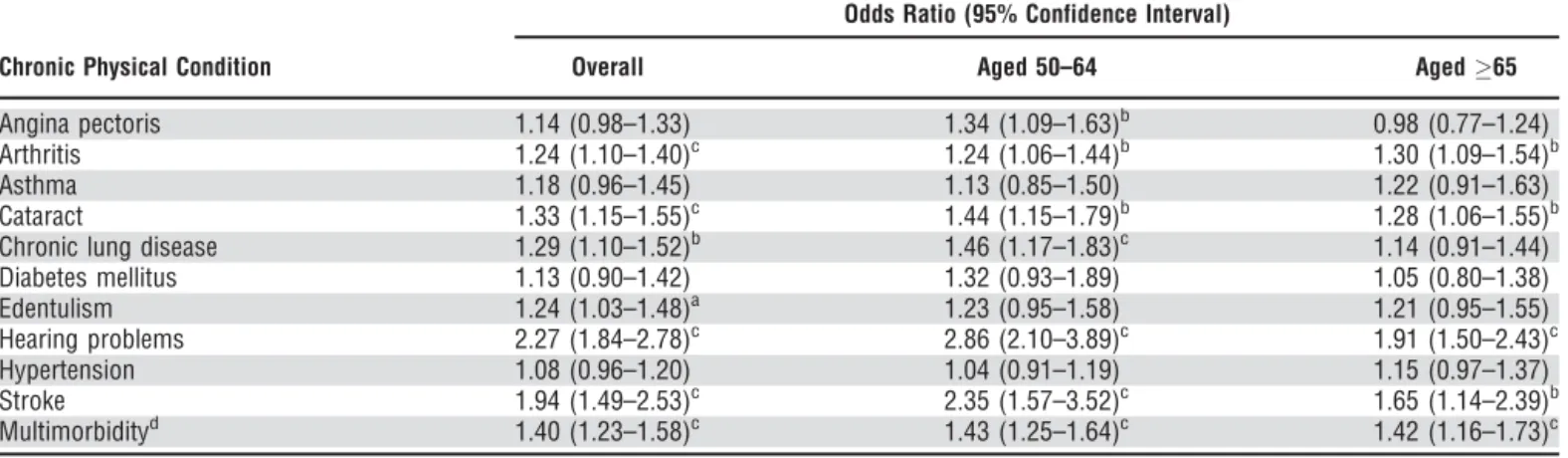
In the overall sample, multivariable regression analysis showed that all individual chronic conditions are associated with higher odds of MCI, but statistical significance was reached only for arthritis (OR51.24), cataract (OR51.33), chronic lung disease (OR51.29), edentulism (OR51.24), hearing problems (OR52.27), and stroke (OR51.94). The OR for multimorbidity was 1.40 (95% CI51.23–1.58) (Table 3). These associations were similar in the two age groups with the exception of angina pectoris and chronic lung disease, which were significantly associated with MCI only in the younger group. The association between MCI and multimorbidity showed a moderate level of between-country heterogeneity (Higgin’s I2564%, 95% CI512%–85%) (Supplementary Figure S1). There was a gradual increase in the odds of MCI with increasing number of conditions in the overall sample (1 condition: OR51.21,
95% CI51.03–1.42; 4 conditions: OR52.07, 95% CI51.70–2.52) (Table 4). In terms of other potentially mod-ifiable risk factors for MCI, in the overall sample, smoking, low physical activity, and obesity (BMI30.0 kg/m2) were also associated with higher odds of MCI independent of the number of chronic conditions, although some of these fac-tors were not significantly associated with MCI in one of the age groups (Table 4).
DISCUSSION
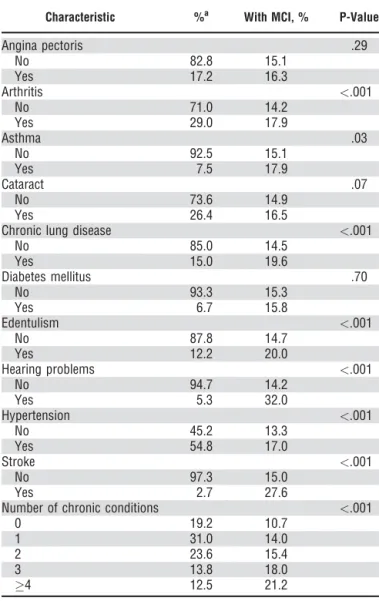
Several chronic conditions and multimorbidity were sig-nificantly associated with higher odds of MCI. There was also a gradual increase in the odds of MCI with increasing number of chronic conditions. The strength of the study includes the large sample size and the use of nationally representative samples from 6 countries, which comprise nearly half of the world population.20 Our study results expand understanding of the effects of modifiable risk factors on development of MCI and Table 2. Prevalence of Chronic Conditions and Propor-tion of Individuals with Mild Cognitive Impairment (MCI) According to Presence of Chronic Conditions
Characteristic %a With MCI, % P-Value
Angina pectoris .29
No 82.8 15.1
Yes 17.2 16.3
Arthritis <.001
No 71.0 14.2
Yes 29.0 17.9
Asthma .03
No 92.5 15.1
Yes 7.5 17.9
Cataract .07
No 73.6 14.9
Yes 26.4 16.5
Chronic lung disease <.001
No 85.0 14.5
Yes 15.0 19.6
Diabetes mellitus .70
No 93.3 15.3
Yes 6.7 15.8
Edentulism <.001
No 87.8 14.7
Yes 12.2 20.0
Hearing problems <.001
No 94.7 14.2
Yes 5.3 32.0
Hypertension <.001
No 45.2 13.3
Yes 54.8 17.0
Stroke <.001
No 97.3 15.0
Yes 2.7 27.6
Number of chronic conditions <.001
0 19.2 10.7
1 31.0 14.0
2 23.6 15.4
3 13.8 18.0
4 12.5 21.2
Percentage is based on weighted sample.
aDenominator ranges from 31,940 to 32,662. Table 1. Prevalence of Multimorbidity According to
Sample Characteristic
Characteristic %a With Multimorbidity, % P-Value
Age <.001
50–59 47.3 37.6
60–69 30.2 53.1
70–79 17.7 70.2
80 4.8 74.6
Sex <.001
Female 51.7 54.9
Male 48.3 44.4
Education <.001
No formal 28.5 54.3
Primary 28.2 46.6
Secondary completed 43.3 49.0
Wealth .005
Poorest 16.9 53.2
Poorer 18.9 53.1
Middle 19.4 50.0
Richer 21.5 48.0
Richest 23.3 46.3
Smoking <.001
Never 58.7 51.0
Current 34.9 46.4
Former 6.4 57.4
Alcohol consumption <.001
Never 66.7 49.0
Nonheavy 29.1 52.6
Heavy 4.2 39.8
Low physical activity <.001
No 77.6 47.8
Yes 22.4 56.8
Body mass index, kg/m2
<18.5 16.2 52.1 <.001
18.5–24.9 47.8 44.2
25.0–29.9 24.5 51.4
30 11.5 67.5
Depression <.001
No 94.5 48.3
Yes 5.5 76.5
Percentage is based on weighted sample.
dementia by showing for the first time that multimorbid-ity is associated with MCI in midlife and in LMICs. This is an important finding because previous studies have suggested that strategies to address risk factors for dementia should take place in midlife.16–18Furthermore, our study has important implications for public health in LMICs, where MCI and dementia are often underdiag-nosed,39 health care is suboptimal,19 and there is urgent need for strategies to address and manage the growing epidemic of chronic diseases,40 which are also risk fac-tors for MCI and dementia.
Angina pectoris (only in those aged 50–64), edentu-lism, arthritis, chronic lung disease, cataract, stroke, and
hearing problems were significantly associated with higher odds of MCI. All these conditions have been observed to be associated with poor cognitive performance, even in study populations from LMICs,26,28–30,32,33,41–43although with mixed results for some conditions.32,44,45 Similar to some previous studies, we did not observe a significant association between diabetes mellitus or hypertension and MCI.46,47 These two conditions have been recognized as potentially modifiable risk factors for dementia.16 Thus, further studies from LMICs are warranted to assess whether our results are corroborated. In particular, the results on diabetes mellitus may have differed if objective data such as blood glucose had been available.
Table 3. Associations Between Physical Health Conditions and Multimorbidity and Mild Cognitive Impairment, Estimated Using Multivariable Logistic Regression
Odds Ratio (95% Confidence Interval)
Chronic Physical Condition Overall Aged 50–64 Aged65
Angina pectoris 1.14 (0.98–1.33) 1.34 (1.09–1.63)b 0.98 (0.77–1.24)
Arthritis 1.24 (1.10–1.40)c 1.24 (1.06–1.44)b 1.30 (1.09–1.54)b
Asthma 1.18 (0.96–1.45) 1.13 (0.85–1.50) 1.22 (0.91–1.63)
Cataract 1.33 (1.15–1.55)c 1.44 (1.15–1.79)b 1.28 (1.06–1.55)b
Chronic lung disease 1.29 (1.10–1.52)b 1.46 (1.17–1.83)c 1.14 (0.91–1.44)
Diabetes mellitus 1.13 (0.90–1.42) 1.32 (0.93–1.89) 1.05 (0.80–1.38)
Edentulism 1.24 (1.03–1.48)a 1.23 (0.95–1.58) 1.21 (0.95–1.55)
Hearing problems 2.27 (1.84–2.78)c 2.86 (2.10–3.89)c 1.91 (1.50–2.43)c
Hypertension 1.08 (0.96–1.20) 1.04 (0.91–1.19) 1.15 (0.97–1.37)
Stroke 1.94 (1.49–2.53)c 2.35 (1.57–3.52)c 1.65 (1.14–2.39)b
Multimorbidityd 1.40 (1.23–1.58)c 1.43 (1.25–1.64)c 1.42 (1.16–1.73)c
Models were adjusted for age, sex, education, wealth, body mass index, smoking, alcohol consumption, physical activity, depression, other physical ill-ness, and country, with the exception of multimorbidity, which was not adjusted for other physical illness.
p<a.05,b.01,c.001.
d2 physical health conditions.
Table 4. Association Between Number of Chronic Physical Conditions and Other Modifiable Factors and Mild Cognitive Impairment, Estimated Using Multivariable Logistic Regression
Odds Ratio (95% Confidence Interval)
Characteristic Overall Aged 50–64 Aged65
Number of chronic conditions (reference 0)
1 1.21 (1.03–1.42)a 1.23 (1.02–1.48)a 1.14 (0.83–1.55)
2 1.37 (1.14–1.63)c 1.40 (1.14–1.73)b 1.33 (0.91–1.95)
3 1.75 (1.43–2.14)c 1.91 (1.45–2.51)c 1.66 (1.21–2.27)b
4 2.07 (1.70–2.52)c 2.41 (1.76–3.29)c 1.85 (1.36–2.50)c
Smoking (reference never)
Current 1.20 (1.01–1.43)a 1.23 (1.00–1.50)a 1.24 (0.91–1.69)
Former 1.20 (0.97–1.50) 1.16 (0.86–1.58) 1.22 (0.88–1.69)
Alcohol consumption (reference never)
Non-heavy 0.97 (0.82–1.15) 1.03 (0.85–1.26) 0.95 (0.73–1.23)
Heavy 1.22 (0.93–1.61) 1.18 (0.81–1.72) 1.31 (0.86–2.00)
Low physical activity 1.24 (1.08–1.43)b 0.83 (0.69–1.00) 1.72 (1.40–2.11)c
Body mass index, kg/m2(reference 18.5–24.9)
<18.5 1.21 (1.00–1.47) 1.44 (1.11–1.87)b 0.95 (0.67–1.34)
25.0–29.9 0.93 (0.81–1.06) 1.07 (0.90–1.27) 0.78 (0.64–0.95)a
30.0 1.30 (1.02–1.65)a 1.54 (1.12–2.11)b 1.06 (0.76–1.49)
Depression 0.93 (0.69–1.24) 0.87 (0.61–1.25) 0.90 (0.57–1.44)
Our study results are in line with those of previous stud-ies reporting high risk of MCI in individuals with multiple chronic conditions.13,14,48 One study found that faster accu-mulation of chronic conditions was associated with greater decline in cognitive function.48Multimorbidity may reflect an age-related multisystem failure, which can also be accompa-nied by neurodegeneration or cognitive decline.48Some com-binations of chronic conditions may act synergistically to accelerate cognitive decline, as in the case of heart disease and cerebrovascular disease, whereas polypharmacy and drug interactions may also increase the risk of cognitive decline in individuals with multimorbidity.13One study found that sev-eral health problems not individually recognized as risk fac-tors for dementia were associated with greater risk of dementia when combined into a frailty index.49 This finding, together with increasing evidence that multimorbidity is related to poor cognitive performance, reinforces the notion that promoting overall health of the population might miti-gate the burden of late-life dementia.50 Finally, a moderate level of between-country heterogeneity in the association between multimorbidity and MCI was found. Although the reason for this heterogeneity is not clear, it may be related to factors such as access to health care and quality of care (e.g., availability of drugs). This is an area for future research.
If confirmed with longitudinal and interventional stud-ies, the key to prevention of MCI and subsequent dementia may be to strengthen a multidisciplinary approach simultane-ously targeting lifestyle factors and physical health outcomes (e.g., chronic diseases, multimorbidity). Health promotion can specifically target risk factors contributing to chronic physical conditions and ultimately multimorbidity, which might include diet, exercise, and smoking cessation, all of which are also considered to be important for dementia pre-vention even in the absence of chronic physical conditions.16
To address chronic diseases in LMICs, the WHO Innovative Care for Chronic Conditions framework pro-vides a health systems roadmap, but it does not incorpo-rate the complexity associated with multimorbidity.51 In LMICs, there is a particular need to enhance integration of care and capacity building and to improve quality of services to address multimorbidity.52
The study results should be interpreted in the light of several limitations. First, although we included a wide variety of important chronic conditions, we lacked data on diseases such as hypercholesterolemia and human immunodeficiency virus infection. Second, symptom-based algorithms were used to define some chronic conditions to minimize underdiagno-sis, but there may still be some level of misclassification, and underdiagnosis is likely to have occurred for diseases based solely on self-report (diabetes mellitus, stroke). For example, chronic lung diseases and asthma are not easy to differentiate for the overlapping symptoms, especially in older popula-tions.53 Third, because the study was not designed to gener-ate clinical diagnoses of dementia, some individuals with mild dementia may have been included in our analytical sam-ple, although the prevalence of MCI in our study was within previously reported figures.54Furthermore, in line with previ-ous publications,9,22we used a definition for preservation of independence in functional abilities based on only 2 ADL domains so as not to overexclude MCI cases with disability not related to their cognitive ability. There is no consensus in
terms of the acceptable level of functional impairment that individuals with MCI could have,55but it is reassuring that the results were similar even when applying a different defini-tion of disability (impairment in all 6 ADL domains25). Fur-thermore, we lacked data on dietary factors, medication, and past alcohol drinking patterns, which may also explain the link between chronic conditions and MCI. Next, the response rate for the SAGE survey was comparable with or higher than that of other national surveys on aging in most of the countries included in our study. Nevertheless, there was some between-country variability, and the response rate for Mexico was low. Finally, because this was a cross-sectional study, causality cannot be inferred, and the possibility of reverse causality cannot be dismissed.
In conclusion, several chronic conditions and multi-morbidity were found to be associated with MCI. Our study results highlight the need to investigate the underly-ing mechanisms linkunderly-ing chronic conditions and MCI and whether prevention or treatment of chronic conditions or multimorbidity can reduce the onset of cognitive decline and subsequent dementia, especially in LMICs.
ACKNOWLEDGMENTS
Financial Disclosure: AK’s work was supported by the Miguel Servet contract financed by the CP13/00150 and PI15/00862 projects, integrated into the National R1D1I and funded by the ISCIII—General Branch Evaluation and Promotion of Health Research—and the European Regional Development Fund. BS receives funding from the National Institutes of Health (NIH) Research Collaboration for Lead-ership in Applied Health Research & Care Funding scheme. HO receives funding from Grant T32AA014125 from the National Institute on Alcohol Abuse and Alcoholism (NIAAA) of NIH. The content is solely the responsibility of the authors and does not necessarily represent the official views of National Health Service, the National Institute for Health Research, Department of Health, NIAAA, or NIH.
Conflict of Interest: None.
Author Contributions: AK: study concept. AK, EL, BS, DV: data analysis and interpretation. AK: writing main body of text. All authors: manuscript preparation, data interpreta-tion, comments on intellectual content. All authors read and approved the final manuscript.
Sponsor’s Role: None of the funders had any role in the conduct of the study; collection, management, analysis, or interpretation of the data; or preparation, review, or approval of the manuscript.
REFERENCES
1. Global Health and Ageing. Geneva, Switzerland: World Health Organiza-tion, 2011.
2. Mathers CD, Loncar D. Projections of global mortality and burden of dis-ease from 2002 to 2030. PLoS Med 2006;3:e442.
3. World Alzheimer Report. London, UK: Alzheimer Disease International, 2015.
4. Wimo A, Guerchet M, Ali GC et al. The worldwide costs of dementia 2015 and comparisons with 2010. Alzheimers Dement 2017;13:1–7. 5. Cummings JL. Treatment of Alzheimer’s disease: Current and future
thera-peutic approaches. Rev Neurol Dis 2004;1:60–69.
7. Petersen RC, Smith GE, Waring SC, Ivnik RJ, Tangalos EG, Kokmen E. Mild cognitive impairment: Clinical characterization and outcome. Arch Neurol 1999;56:303–308.
8. Solfrizzi V, Panza F, Colacicco AM et al. Vascular risk factors, incidence of MCI, and rates of progression to dementia. Neurology 2004;63:1882–1891. 9. Lara E, Koyanagi A, Olaya B et al. Mild cognitive impairment in a Spanish
representative sample: Prevalence and associated factors. Int J Geriatr Psy-chiatry 2016;31:858–867.
10. Biessels GJ, Staekenborg S, Brunner E, Brayne C, Scheltens P. Risk of demen-tia in diabetes mellitus: A systematic review. Lancet Neurol 2006;5:64–74. 11. Marengoni A, Angleman S, Melis R et al. Aging with multimorbidity: A
systematic review of the literature. Ageing Res Rev 2011;10:430–439. 12. Violan C, Foguet-Boreu Q, Flores-Mateo G et al. Prevalence, determinants
and patterns of multimorbidity in primary care: A systematic review of observational studies. PLoS One 2014;9:e102149.
13. Vassilaki M, Aakre JA, Cha RH et al. Multimorbidity and risk of mild cognitive impairment. J Am Geriatr Soc 2015;63:1783–1790.
14. Frisoni GB, Fratiglioni L, Fastbom J, Guo Z, Viitanen M, Winblad B. Mild cognitive impairment in the population and physical health: Data on 1,435 indi-viduals aged 75 to 95. J Gerontol A Biol Sci Med Sci 2000;55A:M322–M328. 15. Amieva H, Jacqmin-Gadda H, Orgogozo JM et al. The 9 year cognitive
decline before dementia of the Alzheimer type: A prospective population-based study. Brain 2005;128:1093–1101.
16. World Alzheimer Report. London, UK: Alzheimer Disease International, 2014. 17. Kivipelto M, Ngandu T, Laatikainen T, Winblad B, Soininen H, Tuomilehto J. Risk score for the prediction of dementia risk in 20 years among middle aged people: A longitudinal, population-based study. Lancet Neurol 2006;5:735–741.
18. Gottesman RF, Albert MS, Alonso A et al. Associations between midlife vascular risk factors and 25-year incident dementia in the Atherosclerosis Risk in Communities (ARIC) cohort. JAMA Neurol 2017;74:1246–1254 19. G. B. D. Healthcare Access Quality Collaborators. Healthcare Access and
Quality Index based on mortality from causes amenable to personal health care in 195 countries and territories, 1990–2015: A novel analysis from the Global Burden of Disease Study 2015. Lancet 2017;390:231–266. 20. Kowal P, Chatterji S, Naidoo N et al. Data resource profile: The World
Health Organization Study on global AGEing and adult health (SAGE). Int J Epidemiol 2012;41:1639–1649.
21. Albert MS, DeKosky ST, Dickson D et al. The diagnosis of mild cognitive impairment due to Alzheimer’s disease: Recommendations from the National Institute on Aging-Alzheimer’s Association workgroups on diagnostic guide-lines for Alzheimer’s disease. Alzheimers Dement 2011;7:270–279. 22. Lara E, Koyanagi A, Domenech-Abella J, Miret M, Ayuso-Mateos JL,
Haro JM. The impact of depression on the development of mild cognitive impairment over 3 years of follow-up: A population-based study. Dement Geriatr Cogn Disord 2017;43:155–169.
23. Morris JC, Heyman A, Mohs RC et al. The Consortium to Establish a Regis-try for Alzheimer’s Disease (CERAD). Part I. Clinical and neuropsychological assessment of Alzheimer’s disease. Neurology 1989;39:1159–1165. 24. The WAIS III-WMS III Updated Technical Manual. San Antonio, TX: The
Psychological Corporation, 2002.
25. Katz S, Ford AB, Moskowitz RW, Jackson BA, Jaffe MW. Studies of illness in the aged. The index of ADL: A standardized measure of biological and psychosocial function. JAMA 1963;185:914–919.
26. Fortunato S, Forli F, Guglielmi V et al. A review of new insights on the association between hearing loss and cognitive decline in ageing. Acta Oto-rhinolaryngol Ital 2016;36:155–166.
27. Caldera-Alvarado G, Khan DA, Defina LF, Pieper A, Brown ES. Relation-ship between asthma and cognition: The Cooper Center Longitudinal Study. Allergy 2013;68:545–548.
28. Cerutti-Kopplin D, Feine J, Padilha DM et al. Tooth loss increases the risk of diminished cognitive function. JDR Clin Translat Res 2016;1:10–19. 29. Singh B, Parsaik AK, Mielke MM et al. Chronic obstructive pulmonary
disease and association with mild cognitive impairment: The Mayo Clinic Study of Aging. Mayo Clin Proc 2013;88:1222–1230.
30. Veeranki SP, Downer B, Jupiter D, Wong R. Arthritis and risk of cognitive and functional impairment in older Mexican adults. J Aging Health 2017;29:454–473. 31. Sierra C, Domenech M, Camafort M, Coca A. Hypertension and mild
cog-nitive impairment. Curr Hypertens Rep 2012;14:548–555.
32. Eggermont LH, de Boer K, Muller M, Jaschke AC, Kamp O, Scherder EJ. Cardiac disease and cognitive impairment: A systematic review. Heart 2012;98:1334–1340.
33. Jefferis JM, Mosimann UP, Clarke MP. Cataract and cognitive impairment: A review of the literature. Br J Ophthalmol 2011;95:17–23.
34. Garin N, Koyanagi A, Chatterji S et al. Global multimorbidity patterns: A cross-sectional, population-based, multi-country study. J Gerontol A Biol Sci Med Sci 2016;71A: 205–214.
35. World Health Organization. Chronic Diseases and Their Common Risk Factors [on-line] Available at http://www.who.int/chp/chronic_disease_ report/media/Factsheet1.pdf Accessed 31 August 2017.
36. Voinov B, Richie WD, Bailey RK. Depression and chronic diseases: It is time for a synergistic mental health and primary care approach. Prim Care Companion CNS Disord 2013;15.
37. Baumgart M, Snyder HM, Carrillo MC, Fazio S, Kim H, Johns H. Summary of the evidence on modifiable risk factors for cognitive decline and dementia: A population-based perspective. Alzheimers Dement 2015;11:718–726. 38. Higgins JP, Thompson SG, Deeks JJ, Altman DG. Measuring inconsistency
in meta-analyses. BMJ 2003;327:557–560.
39. mhGAP Intervention Guide for Mental, Neurological and Substance Use Disorders in Non-Specialized Health Settings. Geneva, Switzerland: World Health Organization, 2017.
40. Gaziano TA, Pagidipati N. Scaling up chronic disease prevention interven-tions in lower- and middle-income countries. Annu Rev Public Health 2013;34:317–335.
41. Gorelick PB, Scuteri A, Black SE et al. Vascular contributions to cognitive impairment and dementia: A statement for healthcare professionals from the American Heart Association/American Stroke Association. Stroke 2011; 42:2672–2713.
42. Verghese J, Annweiler C, Ayers E et al. Motoric cognitive risk syndrome: Multicountry prevalence and dementia risk. Neurology 2014;83:718–726. 43. Prince M, Acosta D, Ferri CP et al. The association between common
physical impairments and dementia in low and middle income countries, and, among people with dementia, their association with cognitive function and disability. A 10/66 Dementia Research Group population-based study. Int J Geriatr Psychiatry 2011;26:511–519.
44. Hong T, Mitchell P, Burlutsky G, Liew G, Wang JJ. Visual impairment, hear-ing loss and cognitive function in an older population: Longitudinal findhear-ings from the Blue Mountains Eye Study. PLoS One 2016;11:e0147646. 45. Dodd JW. Lung disease as a determinant of cognitive decline and
demen-tia. Alzheimers Res Ther 2015;7:32.
46. Hebert LE, Scherr PA, Bennett DA et al. Blood pressure and late-life cogni-tive function change: A biracial longitudinal population study. Neurology 2004;62:2021–2024.
47. Panza F, Capurso C, D’Introno A et al. Impact of depressive symptoms on the rate of progression to dementia in patients affected by mild cognitive impairment. The Italian Longitudinal Study on Aging. Int J Geriatr Psychi-atry 2008;23:726–734.
48. Fabbri E, An Y, Zoli M et al. Association between accelerated multimorbid-ity and age-related cognitive decline in older Baltimore Longitudinal Study of Aging participants without dementia. J Am Geriatr Soc 2016;64:965–972. 49. Song X, Mitnitski A, Rockwood K. Nontraditional risk factors combine to
predict Alzheimer disease and dementia. Neurology 2011;77:227–234. 50. Fratiglioni L, Paillard-Borg S, Winblad B. An active and socially integrated lifestyle
in late life might protect against dementia. Lancet Neurol 2004;3:343–353. 51. Oni T, McGrath N, BeLue R et al. Chronic diseases and multi-morbidity—
a conceptual modification to the WHO ICCC model for countries in health transition. BMC Public Health 2014;14:575.
52. Navickas R, Petric VK, Feigl AB, Seychell M. Multimorbidity: What do we know? What should we do? J Comorb 2016;6:8.
53. To T, Stanojevic S, Moores G et al. Global asthma prevalence in adults: Findings from the cross-sectional World Health Survey. BMC Public Health 2012;12:204. 54. Petersen RC. Mild cognitive impairment. Continuum (Minneap Minn)
2016;22:404–418.
55. Lindbergh CA, Dishman RK, Miller LS. Functional disability in mild cog-nitive impairment: A systematic review and meta-analysis. Neuropsychol Rev 2016;26:129–159.
SUPPORTING INFORMATION
Additional Supporting Information may be found in the online version of this article.
Table S1. Details of variables and additional analyses