The Escitalopram versus Electric Current Therapy for
Treating Depression Clinical Study (ELECT-TDCS):
rationale and study design of a non-inferiority, triple-arm,
placebo-controlled clinical trial
Estudo clínico Escitalopram
versus
Eletroterapia no Tratamento da Depressão
(ELECT-TDCS): racional e desenho de estudo de um ensaio de não inferioridade,
de três braços, placebo-controlado
André Russowsky Brunoni
I, Bernardo Sampaio-Junior
II, Adriano Henrique Mofa
III, Lucas Borrione
IV,
Barbara Schwair Nogueira
III, Luana Vanessa Marotti Aparício
V, Beatriz Veronezi
VI, Marina Moreno
VI, Raquel Albano Fernandes
VI,
Diego Tavares
VII, Priscila Vilela Silveira Bueno
VII, Ole Seibt
VIII, Marom Bikson
IX, Renerio Fraguas
X, Isabela Martins Benseñor
XIFaculdade de Medicina da Universidade de São Paulo (FMUSP), São Paulo, Brazil
ABSTRACT
CONTEXT AND OBJECTIVE: Major depressive disorder (MDD) is a common psychiatric condition, mostly treated with antidepressant drugs, which are limited due to refractoriness and adverse efects. We describe the study ratio-nale and design of ELECT-TDCS (Escitalopram versus Electric Current Therapy for Treating Depression Clinical Study), which is investigating a non-pharmacological treatment known as transcranial direct current stimulation (tDCS).
DESIGN AND SETTING: Phase-III, randomized, non-inferiority, triple-arm, placebo-controlled study, ongoing in São Paulo, Brazil.
METHODS: ELECT-TDCS compares the eicacy of active tDCS/placebo pill, sham tDCS/escitalopram 20 mg/day and sham tDCS/placebo pill, for ten weeks, randomizing 240 patients in a 3:3:2 ratio, respectively. Our primary aim is to show that tDCS is not inferior to escitalopram with a non-inferiority margin of at least 50% of the es-citalopram efect, in relation to placebo. As secondary aims, we investigate several biomarkers such as genetic polymorphisms, neurotrophin serum markers, motor cortical excitability, heart rate variability and neuroimaging.
RESULTS: Proving that tDCS is similarly efective to antidepressants would have a tremendous impact on clinical psychiatry, since tDCS is virtually devoid of adverse efects. Its ease of use, portability and low price are further compelling characteristics for its use in primary and secondary healthcare. Multimodal investigation of biomark-ers will also contribute towards undbiomark-erstanding the antidepressant mechanisms of action of tDCS.
CONCLUSION: Our results have the potential to introduce a novel technique to the therapeutic arsenal of treat-ments for depression.
CLINICAL TRIAL REGISTRATION: ClinicalTrials.Gov NCT01894815.
RESUMO
CONTEXTO E OBJETIVO: O transtorno depressivo maior (TDM) é uma condição psiquiátrica comum, tratada com me-dicamentos antidepressivos, os quais são limitados devido à refratariedade e efeitos adversos. Descrevemos o racional e o desenho do Estudo Clínico Escitalopram versus Eletroterapia no Tratamento da Depressão (ELECT-TDCS), que in-vestiga um tratamento não farmacológico, conhecido como estimulação transcraniana por corrente contínua (ETCC).
DESENHO E LOCAL: Ensaio de fase III, randomizado, de não inferioridade, de três braços, placebo-controlado, em execução em São Paulo, Brasil.
MÉTODOS: O estudo compara a eicácia da ETCC ativa/pílula placebo, ETCC simulada/escitalopram 20 mg/dia e ETCC simulada/pílula placebo durante 10 semanas, randomizando 240 pacientes em uma proporção 3:3:2, res-pectivamente. O objetivo principal é demostrar que a ETCC não é inferior ao escitalopram com uma margem de não inferioridade de pelo menos 50% do efeito de escitalopram em relação ao placebo. Como objetivos secun-dários, investigamos biomarcadores como polimorismos genéticos, marcadores séricos, excitabilidade cortical motora, variabilidade da frequência cardíaca e neuroimagem.
RESULTADOS: Provar que ETCC é igualmente eicaz a antidepressivos teria um tremendo impacto na psiquiatria clíni-ca, uma vez que a ETCC é praticamente isenta de efeitos adversos. Sua facilidade de uso, portabilidade e preço baixo são outras características atraentes para uso na atenção primária e secundária de saúde. A investigação multimodal de biomarcadores também contribuirá para a compreensão dos mecanismos de ação antidepressivos da ETCC.
CONCLUSÃO: Os nossos resultados podem introduzir uma nova técnica no arsenal terapêutico do tratamento da depressão.
REGISTRO DE ENSAIO CLÍNICO: ClinicalTrials.Gov NCT01894815.
IMD, PhD. Attending Physician, Interdisciplinary
Neuromodulation Service, Interdisciplinary Center for Applied Neuromodulation, Hospital Universitário (HU), and Service of Interdisciplinary Neuromodulation, Laboratory of Neurosciences (LIM-27), Department and Institute of Psychiatry, Universidade de São Paulo (USP), São Paulo, Brazil.
IIMD. Interdisciplinary Neuromodulation
Service, Interdisciplinary Center for Applied Neuromodulation, HU, and Service of Interdisciplinary Neuromodulation, Laboratory of Neurosciences (LIM-27), Department and Institute of Psychiatry, USP, São Paulo, Brazil.
IIIBA, MSc. Interdisciplinary Center for Applied
Neuromodulation, HU, USP, São Paulo, Brazil.
IVMD, MSc. Interdisciplinary Center for Applied
Neuromodulation, HU and Department and Institute of Psychiatry, USP, São Paulo, Brazil.
VMD, MSc. Interdisciplinary Center for Applied
Neuromodulation, HU, USP, São Paulo, Brazil.
VIPsychology Student, Interdisciplinary Center for Applied
Neuromodulation, HU, USP, São Paulo, Brazil.
VIIMD. Medical Resident and Student, Interdisciplinary
Neuromodulation Service, Interdisciplinary Center for Applied Neuromodulation, HU and Department and Institute of Psychiatry, USP, São Paulo, Brazil.
VIIIMSc. Researcher, Department of Biomedical
Engineering, City College of City University of New York, New York, USA.
IXPhD. Head, Department of Biomedical Engineering, City
College of City University of New York, New York, USA.
XMD, PhD. Assistant Professor, HU and Department
and Institute of Psychiatry, USP, São Paulo, Brazil.
XIMD, PhD. Assistant Professor, HU, USP, São Paulo, Brazil.
KEY WORDS:
Depressive disorder, major. Electric stimulation therapy. Citalopram.
Randomized controlled trial. Biological markers.
PALAVRAS-CHAVE:
Transtorno depressivo maior. Terapia por estimulação elétrica. Citalopram.
INTRODUCTION
Major depressive disorder (MDD) is a psychiatric condition with high prevalence and recurrence worldwide,1 and it is pro-jected to be the second greatest cause of disability worldwide in 2020.2 However, antidepressant drugs are only moderately efective for MDD treatment.3 Moreover, common adverse efects can lead to treatment discontinuation and recrudescence of symptoms.4 For these reasons, novel treatment strategies are continuously pursued.
In this context, non-invasive brain stimulation therapies (electroceuticals) have been increasingly investigated as non-pharmacological MDD treatments, such as repetitive transcra-nial magnetic stimulation (rTMS), a technique that discharges potent electromagnetic ields through a coil placed over the patient’s head.5 Repetitive TMS is an efective treatment for MDD,6,7 although issues such as high cost of application, discom-fort and specialized technology limit widespread adoption.8
Transcranial direct current stimulation (tDCS) is a neuro-modulatory technique that presents low cost, high portability and a benign proile of adverse efects and is relatively simple to use.9,10 It consists of applying a low-intensity electric current across the patient’s head using two electrodes on the scalp. In a seminal study in 2000, Nitsche and Paulus demonstrated that anodal and cathodal tDCS applied over the motor cortex respec-tively increased and decreased motor cortical excitability, as mea-sured by means of TMS motor-evoked potentials,11 thereby show-ing that tDCS could alter cortical excitability.12 Its efects depend not only on the polarity of the current, but also on other factors, such as baseline cortical activity, neuronal orientation and deliv-ered current intensity and duration.13-15
he use of tDCS for MDD is based on indings from neuroimaging studies (such as Mayberg et al.16), which suggest that the depressive state is associated with hypoactivity of prefrontal areas, particularly the let dorsolateral prefrontal cortex (DLPFC), and that it can be resolved through an increase in the activity of this area. herefore, treatment strategies that increase let DLPFC activity might treat depressive symptoms. his approach has been adopted and validated in studies using high-frequency (excitatory) rTMS6 and anodal tDCS over the DLPFC.17 Alternatively, some trials have applied the cathode over the right DLPFC (such as Ferrucci et al.18), or have used low-frequency (inhibitory) rTMS over this region,19 in accordance with the prefrontal asymmetry theory of depression that states that the right DLPFC presents abnormally high activity during depressive episodes.20
Several non-controlled and controlled studies using tDCS for MDD have been published, from 2006 onwards.17 In the irst randomized clinical trial (RCT) in this ield, Fregni et al.21 showed the eicacy of active tDCS versus sham for ameliorating
depressive symptoms, in a pilot study on 10 patients. More recent RCTs enrolling larger samples22,23 have shown that active tDCS was an efective treatment for MDD. Its eicacy was corroborated by a recent meta-analysis.24 However, exhaustive RCTs address-ing tDCS eicacy are still needed, since some results from RCTs have been non-signiicant,25-27 the total number of subjects inves-tigated is still low and the optimal parameter protocols for tDCS in MDD remain to be determined.
In a recent factorial, placebo-controlled trial named SELECT-TDCS (Sertraline versus Electric Current Therapy for Treating Depression Clinical Study),we assessed the effi-cacy of tDCS combined and compared with sertraline 50 mg/ day for treating 120 depressed patients.28 After two weeks of treatment and at the endpoint, the combined treatment was statistically superior to the other groups in terms of depression improvement and response and remission rates. Transcranial DCS was also superior to the other groups at the endpoint and not statistically diferent from sertraline23 (Figure 1). he main indings from this study were the synergistic efects of the com-bination of tDCS and sertraline and the eicacy of tDCS as monotherapy. However, although sertraline and tDCS eicacy did not statistically difer, we could not extend these results to claim similar eicacy for tDCS and antidepressant pharmaco-therapy, because of study limitations such as the low dose of sertraline used, the relatively short trial duration, the inding that the sertraline group was not superior to placebo and the relatively underpowered comparison of tDCS versus sertraline.
Figure 1. Main results of the SELECT-TDCS trial. The igure shows the primary outcome of the Sertraline versus Electric Current Therapy for Treating Depression Clinical Study (SELECT-TDCS).23 The x-axis represents depression scores
measured using the Montgomery-Asberg depression rating scale (MADRS). The y-axis shows changes in depression scores over time according to the treatment group. Adapted from Brunoni et al.23
M
ADRS
Baseline Week 2 Week 4 Week 6 35
30
25
20
15
10
5
0
Sham tDCS - Placebo
Sham tDCS - Sertraline
Active tDCS - Placebo
Active tDCS - Sertraline
* *
OBJECTIVE
herefore, whereas we showed in SELECT-TDCS that tDCS combined with pharmacotherapy could enhance improvement of depression, the main study aim of ELECT-TDCS (Escitalopram versus Electric Current herapy for Treating Depression Clinical Study) is to compare the eicacy of tDCS with a fully dosed, irst-line antidepressant treatment (escitalopram 20 mg/day).
In this paper, we describe the rationale, design and meth-odology of the ongoing ELECT-TDCS trial. he trial started in October 2013 and plans to enroll 240 patients by January 2017. As of November 2014, approximately 130 patients had already been recruited.
METHODS
Overview
he ELECT-TDCS trial randomizes patients into: sham-tDCS/ placebo-pill (placebo group), sham-tDCS/escitalopram (esci-talopram group) and active-tDCS/placebo-pill (tDCS group). It was approved by the Local and National Ethics Committee (CAAE:10173712.3.0000.0076) of the University Hospital and Clinics Hospital of the University of São Paulo and is registered in clinicaltrials.gov (NCT01894815). All study participants pro-vide written, informed consent for participation in the study.
Our null hypothesis is that the improvement, i.e. the difer-ence in eicacy between baseline and endpoint measurements of the tDCS group (μtDCS) will be less than or equal to 50% (reten-tion frac(reten-tion f ≤ 50%) of the diference in the improvement between escitalopram and placebo (μdrug – μplacebo). he study’s primary aim is to prove the alternative hypothesis, i.e. that this diference is greater than 50% (f > 50%).
Ho: μtDCS – μplacebo ≤ 50% (μdrug – μplacebo) or
Ho: μtDCS – 0.5 μplacebo - 0.5 μdrug≤ 0
HA: μtDCS – μplacebo > 50% (μdrug – μplacebo) or
HA: μtDCS – 0.5 μplacebo - 0.5 μdrug > 0
In a non-inferiority triple-arm trial, there are three rel-evant comparisons: (1) experimental treatment versus active comparator (i.e. tDCS versus escitalopram); (2) experimen-tal treatment versus placebo; and (3) active comparator versus placebo. Authors such as Koch and Röhmel29 have considered that the third comparison is not strictly necessary if the former two were signiicant, but in their approach, two or three null hypotheses would have to be independently rejected (thereby decreasing the Pvalue), or the trial would only be valid if all hypotheses were rejected.30 herefore, we use here an alterna-tive model presented by Pigeot et al.31 and already used in the
literature,32 in which the study aim can be presented in a sin-gle H0, which simultaneously tests the non-inferiority between active treatments and their superiority against placebo, thereby decreasing the number of multiple comparisons.
Our secondary aims are to explore the clinical improvement in terms of response status (more than 50% of improvement from baseline to endpoint) and remission status (HDRS-17 ≤ 7 at endpoint). We will also explore improvement in depression using the MADRS and the BDI. Finally, we will also investigate whether any early improvement (week 3) was observed between the groups.
We also aim to identify several predictors and mediators of tDCS response, as described below.
Participants
We are recruiting patients of both genders, aged 18 to 75 years who have been diagnosed with major depressive disorder dur-ing an acute depressive episode, in accordance with the DSM-5 criteria (Diagnostic and Statistical Manual of Mental Disorders, 5th edition).
he eligibility criteria include the presence of a depressive episode of at least moderate intensity (corresponding to a score ≥ 17 on the 17-item Hamilton Depression Rating Scale, HDRS-17), ability to read and understand Portuguese, at least eight years of schooling and availability to adhere to the study protocol. he exclusion criteria are: 1) other neuropsychiatric conditions, such as bipolar disorder, schizophrenia, substance dependence, dementia, traumatic brain injury, epilepsy and so forth (although participants with anxiety disorders can be included if the pri-mary diagnosis is MDD); 2) high suicide risk (i.e. score > 2 in the Hamilton suicide question); 3) pregnancy; 4) speciic contraindi-cations against tDCS, such as electronic or metal implants in the cephalic segment; 5) speciic contraindications against escitalo-pram; 6) severe/life-threatening clinical conditions; or 7) previ-ous participation in other tDCS trials.
Participants will have to be either drug-naïve or drug-free regarding the use of antidepressant drugs (we considered an “anti-depressant drug” to be any medication approved for treating MDD by the United States Food and Drug Administration as of the time of onset of the trial). A minimum period of 3 weeks (5 weeks for luoxetine) will be set aside for drug washout. Benzodiazepine drugs will be allowed, although only at low doses (less than 20 mg/day of diazepam or equivalent). Also, since escitalopram is our active comparator, patients using (or who have used) escitalo-pram in the current depressive episode will not be included, since they would be escitalopram-resistant.
study phase and up to two missed visits during the weekly tDCS phase; reminders for patients regarding their appointments; and ofering active tDCS ater the endpoint to non-responder patients who received sham tDCS.
Interventions
We are using Soterix Medical tDCS devices specially custom-ized for our study (Soterix Medical, New York, NY, USA, Model 1x1 tDCS-CT). For tDCS, the anode is placed over the let and the cathode over the right dorsolateral prefrontal cortex. he electrode positioning is based on the “Omni-Lateral-Electrode” (OLE) system, which is a simple, reproducible, and practical method for positioning the electrodes using a headband (Figures 2A and 2B). Moreover, the OLE method optimizes electric
cur-rent densities across the DLPFC, in comparison with other non-neuronavigated methods for tDCS electrode placement, such as the EEG international 10-20 system and the 5-5 cm rule (Seibt, Brunoni, Huang and Bikson, under review), taking into consid-eration inter-subject variability in head anatomy (Figure 2C).
he stimulation parameters are: current intensity of 2 mA, electrode size of 25 cm2; session duration of 30 minutes (exclud-ing the fade-in and fade-out periods of 15 seconds); and total number of 22 sessions, with 15 sessions applied consecutively once a day (except for weekends), and ater that, seven more ses-sions applied once per week until the study endpoint at week 10. For operational reasons, these sessions are held on either Tuesdays or hursdays, according to the patient’s preference and always respecting the one-week interval.
Sham tDCS is delivered using the same procedure as active tDCS, but using a period of only 30 seconds of active stimula-tion at 2 mA (or an overall active period of 60 seconds, taking into account the 15 seconds for both the fade-in and fade-out
periods), with the stimulator remaining active but not generat-ing current for 30 minutes, for the purpose of double blindgenerat-ing. his method, adapted from Gandiga et al.,33 has been used in sev-eral tDCS protocols34 and had the same blinding eicacy as the placebo pill in SELECT-TDCS.35 We are using fully automated devices that perform active or sham tDCS according to a ran-domized stimulation code.
he pharmacological intervention starts simultaneously with tDCS and consists of 10 mg pills of escitalopram oxalate or placebo. Patients receive 10 mg/day of escitalopram/placebo for the irst 3 weeks and 20 mg/day for the remaining 7 weeks. Escitalopram was chosen because it is an efective antidepressant treatment with few adverse efects36 and its full dose (20 mg/day) is relatively easier to achieve than those of other antidepressant drugs. hus, maximum dose-up titration can be done in the beginning of the trial. herefore, we are able to compare tDCS against a full dose of an efective antidepressant without compro-mising blinding due to adverse efects.
he escitalopram pills are from Libbs (São Paulo, Brazil), a Brazilian pharmaceutical drug company that produces Reconter (escitalopram oxalate), which is a generic drug product com-parable to the brand reference Lexapro (Lundbeck Brasil Ltda., Rio de Janeiro, Brazil). In Brazil, all generic drug products have their bioequivalence tested and certiied by the Brazilian Health Surveillance Agency (ANVISA). We also independently assessed whether Reconterwould be comparable to Lexaproin terms of dosage, strength and quality by testing both drugs in the Clinical Analysis Laboratory of the School of Pharmaceutical Sciences of the University of São Paulo. hey achieved the same perfor-mance regarding their physical-chemical properties. he School of Pharmaceutical Sciences also produces the placebo pills, which are identical to the Reconter pills in terms of shape, color,
A
B
C
weight and taste. Escitalopram and placebo pills are put in iden-tical opaque bottles, identiied solely by a number corresponding to the patient’s code. Adherence to the drug intervention will be veriied by means of a pill count at the end of the study.
Procedures
Participants are randomized in accordance with a computer-generated list at www.randomization.com. For allocation, we use opaque sealed envelopes containing the code corresponding to the group assigned for each participant. his code is entered into the tDCS device that automatically delivers either active or sham stimulation.
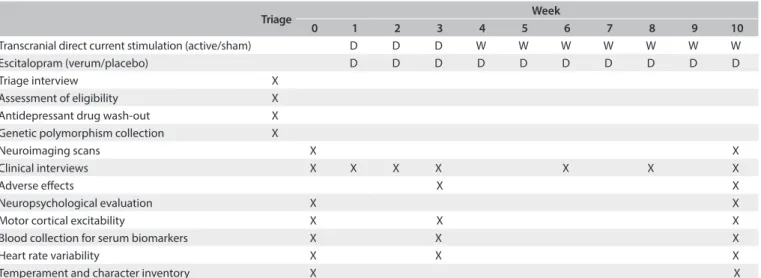
Diagnoses are made by certiied psychiatrists or clinical psy-chologists and are conirmed through the Mini-International Neuropsychiatric Interview (M.I.N.I.). he data collected include diagnosis subtype (melancholic, atypical or depressive with mixed fea-tures), duration of illness and number of failed antidepressant treat-ments during the current episode. he Hamilton Depression Rating Scale (HDRS-17), the Montgomery-Asberg Depression Rating Scale (MADRS), the Positive and Negative Afect Scale (PANAS) and the STAI (State-Trait Anxiety Inventory) are applied at diferent time points (Table 1).
To assess adverse efects, we use the Systematic Assessment for Treatment of Emergent Efects (SAFTEE)37 and the tDCS adverse events questionnaire.10 We apply the Young Mania Rating Scale (YMRS) to assess hypomanic symptoms, which have already been described ater tDCS antidepressant treatment.38-41 Also, we include neuropsychological assessments in our study, primarily to verify that tDCS will not be associated with cognitive impairment, using the Montreal Cognitive Assessment (MOCA), the Wechsler Adult Intelligence Scale-III digit span (forward and backward) and digit symbol coding subtests, the Verbal Fluency
Test (FAS and animal/fruit categories) and the Trail Making test. he Temperament and Character Inventory (TCI) is being col-lected at baseline and endpoint to assess the personality traits associated with and modiied by the antidepressant treatment. We also assess blinding performance by asking patients to guess their own treatment allocation group at week 3 and at the end-point, and ask interviewers to make the same guesses regarding these patients’ treatment.
Furthermore, we are investigating several biomarkers, including:
a) Heart rate variability (HRV), which becomes lower in cases of depression42 and possibly relects the disrupted sympathovagal balance observed in MDD. However, recent evidence suggests that this alteration is primarily driven by the direct efects of antidepressant drug treatment.43 In our SELECT-TDCS trial, we did not observe that either tDCS or sertraline changed HRV levels, which were lower than in matched healthy controls.44 In ELECT-TDCS, we assess HRV values over a larger timeframe (of 10 weeks) and in a larger sample size.
b) Genetic polymorphisms: (i) he serotonin transporter gene (5HTTLPR, SLC6A4) is related to antidepressant response.45,46 Two out of three rTMS studies also found that it was associated with antidepressant response.47-49 In SELECT-TDCS we also found that it was associated with a larger active-sham diference.50 (ii) he 5HT2A receptor gene (rs6311 and rs6313) was asso-ciated with a larger active-sham diference51 and antidepres-sant response.52 Although a meta-analysis was inconclusive regarding its association with antidepressant response,46 it was identiied as associated with citalopram antidepressant response in the STAR*D trial.53 (iii) TPH1 polymorphism was associated with citalopram antidepressant response in
Triage Week
0 1 2 3 4 5 6 7 8 9 10
Transcranial direct current stimulation (active/sham) D D D W W W W W W W
Escitalopram (verum/placebo) D D D D D D D D D D
Triage interview X
Assessment of eligibility X
Antidepressant drug wash-out X
Genetic polymorphism collection X
Neuroimaging scans X X
Clinical interviews X X X X X X X
Adverse efects X X
Neuropsychological evaluation X X
Motor cortical excitability X X X
Blood collection for serum biomarkers X X X
Heart rate variability X X X
Temperament and character inventory X X
Table 1. Study schedule for the ELECT-TDCS
the STAR*D trial. he A allele was associated with lower syn-thesis of serotonin54 and a recent meta-analysis46 showed that this allele was associated with worse antidepressant response. (iv) Brain-derived neurotrophic factor (BDNF) polymor-phism (rs6265) is a neurotrophin associated with synaptic plasticity.55,56 Two meta-analyses showed that Met/Met and Val/Met were associated with antidepressant response,46,57 while one rTMS study found that Val/Val determined a bet-ter antidepressant response.58 In SELECT-TDCS, this poly-morphism was not associated with antidepressant response.50 c) Motor cortical excitability for tDCS has been used since
the reappraisal of tDCS by Nitsche and Paulus in 2000.11 Currently, one important line of tDCS research involves measurement of motor cortex excitability ater use of tDCS in combination with psychoactive drugs.59 his procedure allows indirect measurement of the GABAergic activity (ICI and CSP) and glutamatergic activity (ICF) of the motor sys-tem.60 hese neurotransmitters are involved in the patho-physiology of depression.61 Recent studies observed that in relation to healthy subjects, the ICI, ICF and CSP indi-ces are altered in depressed subjects,62-64 although their role as predictors of antidepressant response was not suiciently investigated.
d) Brain imaging by means of MRI will be collected in approxi-mately half of the sample (120 patients) at baseline and end-point, and this imaging will include voxel-based morphom-etry (VBM), difusion tensor imaging (DTI) and resting-sate functional MRI. Regarding VBM, one consistent inding observed in depressed patients is that the volume of the grey matter in the prefrontal and anterior cingulate cortex bilat-erally is lower,65-67 and that there is an increase in gray mat-ter in the let DLPFC amat-ter successful antidepressant treat-ment.68 hese brain areas will be explored as predictors of tDCS response. On DTI, the fractional anisotropy (FA) of the prefrontal cortex (bilaterally), right temporal lobe and right fusiform gyrus were found to be lower in MDD patients.69 Studies on repetitive TMS found an increase in FA in the let frontal-medial gyrus ater successful antidepressant treat-ment,70,71 and these regions are explored in our study. For resting-state fMRI, we explore changes in the default-mode network (DMN) and anticorrelated network (AC) ater tDCS treatment. Previous studies observed that depressed patients present greater DMN activity and lower AC activity72 and that antidepressant treatment can change the brain activity of these regions.73
e) BDNF levels in blood are lower in depressed subjects than in healthy subjects and increase ater successful pharmacologi-cal treatment.74,75 Nonetheless, recent meta-analyses showed that ECT increases BDNF levels in blood, but not rTMS or
tDCS.76,77 he possible explanations for this are the low num-ber of rTMS/tDCS studies that used non-optimal treat-ment protocols and the lower period of observation between measurements. In ELECT-TDCS, BDNF levels in blood are assessed at baseline, week 3 and the endpoint.
Design and sample size determination
ELECT-TDCS uses a non-inferiority, triple-arm, placebo-con-trolled design, with 3:3:2 permuted block randomization in which participants are respectively assigned to escitalopram, tDCS or placebo. Our aim is to prove that tDCS is non-inferior (i.e. that it has similar or superior eicacy) to escitalopram. he placebo group is used for the following purposes. (1) To ensure assay sensitivity. he placebo ascertains that a similar result between escitalopram and tDCS occurred not due to a false-pos-itive inding caused by methodological issues such as insuicient sample size, sample bias, poor blinding, etc., but in fact due to true equivalence between treatments. (2) To allow direct (superi-ority) comparisons between the pharmacological treatment and placebo, which is critical, since up to 50% of antidepressant drug trials fail to detect superiority between the active treatment and placebo.78 (3) To allow direct comparisons between the experi-mental treatment and placebo, given that evidence of tDCS ei-cacy is still being established. (4) To avoid setting up an arbitrary eicacy margin, which would be a problematic approach because the active comparator in the trial will not necessarily have the same eicacy as previous indings in the literature.79 For these reasons, the non-inferiority design with a placebo group is con-sidered to be the gold standard for this type of trial according to the US Food and Drug Administration (FDA) and the European Medical Agency (EMA).80
The M2 margin (relative efficacy of the experimental treat-ment to the active comparator) is based on a fraction reten-tion factor (f) of the M1, given that the relative efficacy of the experimental treatment to the active comparator could only be larger than the efficacy with placebo if the active com-parator is worse than placebo. The fraction retention
var-ies according to the condition investigated: for instance, in studies focusing on vaccines and oncology, the f value should
herefore, in our trial, M2/M1 = 0.5, although M1 is based on the diference between the active comparator and placebo and it will be known only when the study has been inished. Although this approach indexes the relative eicacy of tDCS versus escita-lopram according to the placebo response of the study, it is the-oretically possible that the escitalopram-placebo diference is too large, thus producing a large M2 value that could favor a inding that comparison between escitalopram and tDCS does not show any signiicant diference, even if escitalopram clinically outper-forms tDCS. To avoid this issue, we will only consider that tDCS was non-inferior to escitalopram if the mean diference between escitalopram and tDCS is less than 3 points on the HDRS-17. he threshold of 3 points was chosen considering the National Institute for Health and Clinical Excellence (NICE) guidelines, which estab-lish that this is a clinically meaningful diference in eicacy.82
To determine the sample size, we irst needed to establish the randomization proportions between the groups. Pigeot et al.31 recommended a 1:1:kp ratio, where kp is determined according to the fraction retention factor, as shown below:
kplacebo = [(1 – f) √2 + 2f]/(1 + f2)
According to this formula, for f = 0.5, kp is 0.69. herefore the
optimal proportion for allocation between the groups is 1:1:0.69, or approximately 3:3:2, as used in ELECT-TDCS.
We estimated our sample size in accordance with the sugges-tion of Pigeot et al.31 for non-inferiority, triple-arm trials:
Narm≥ (t1-α, 3n-3 + t1-β, 3n-3)2 * (1 + f2 + (1 - f)2) *[(σ/ μ
DRUG – μPLACEBO)/ (r - f)]2*
his formula shows that the sample size is a product of three factors (in parentheses). he factor in the irst parentheses take into account the values of α and β, which were, respectively 0.025 (one-tailed) and 0.2. he factor in the second parentheses is the
f value (the higher the f value is, the larger the necessary sample
size will be), which was determined as 0.5 for our study. he fac-tor in the last parentheses involves the standard deviation and efect sizes of the interventions. We took the value of the standard deviation to be a function of the diference in eicacy between the active comparator and the placebo:31
σ = ε (μDRUG – μPLACEBO)
he ε value indicates that the standard deviation is associated with the mean diference values observed in the study. It ranges from 0.2 to 2, and values > 1 are considered conservative. In the
present study, we took the ε value to be 1.5, i.e. the standard devi-ation would be 1.5 times the value of the diference in eicacy between the active intervention and the placebo, which is compat-ible with depression studies in which the variance is usually high.† herefore, considering an attrition rate of 13% (similar to SELECT-TDCS), β = 0.2, αone-tailed = 0.025, f = 0.5 and ε = 1.5, a total sample of 240 patients will be necessary in order to reject our null hypothesis. For 3:3:2 randomization, this means that in the end, 90, 90 and 60 patients will be respectively allocated to the tDCS, escitalopram and placebo groups.
Statistical analysis
In accordance with the recommendations of Pigeot et al.31 and Rothmann et al.,79 we use a modiied t test to address our primary study hypothesis (i.e. that tDCS is non-inferior to escitalopram). A t test involves obtaining a T value, which should be higher than
(in a one-tailed test, as in our study) or diferent to (in a two-tailed test) a critical t value. he T value is obtained by dividing the diference in the means by the mean error (obtained accord-ing to the variance and sample size). For this analysis, the T value will be obtained as follows:
T = (μtDCS – 0.5μPLACEBO – 0.5μDRUG )/σ √(1/nTDCS + 0.25/nDRUG + 0.25/nPLACEBO) or
T = 7.44 (μtDCS – 0.5μPLACEBO – 0.5 μDRUG )/σ (considering that the n values are known)
his T value should be higher than the critical t, which for a one
tailed α of 0.025 and 237 (N-3) degrees of freedom would be 1.97. We will also perform exploratory analyses to identify whether a signiicant diference between the groups is observed over time. herefore, we will perform mixed-model analyses of variance (ANOVAs) with one independent, within-subject vari-able (time, with three levels: baseline, week 3 and endpoint) and one independent, between-subject variable (group, with three levels). he dependent variables will be the scores from HDRS, MADRS or BDI. To determine whether a statistical significance is observed at a two-tailed p value of 0.05 or less, post-hoc analyses will be performed to analyze the main and interac-tion efects of our interveninterac-tions. Exploratory analyses will also be performed to identify the inluence of clinical, demographic and biological variables on the outcome. In addition, logistic regressions will be performed using response or remission as dependent variables and the group as an independent vari-able. Adverse efects will be assessed by counting the number
*Where σ is the standard deviation of the study and r = (μtDCS - μPLACEBO)/
(μDRUG - μPLACEBO). If μtDCS = μDRUG, then r = 1.
†For comparative purposes, these values were as follows in
SELECT-TDCS: μtDCS = 7.7, μPLACEBO = 3.6 and σ = 6.3 for the HDRS-17.
of events in each group at each evaluation time. he chi-square test will be used to compare the frequency of adverse efects between the treatment groups.
For non-inferiority trials, it is unclear which approach (intention-to-treat, ITT; or per protocol, PP) should be used. ITT imputes data from study drop-outs and, although con-servative for superiority trials, it can favor the hypothesis of lack of diference between groups in a non-inferiority design and, therefore, beneit (instead of penalizing) a non-inferior-ity design with methodological laws. Nonetheless, neither the FDA83 nor the EMA84 clearly recommend the optimal approach and they suggest that both ITT and PP should be used. Mulla et al.85 also suggested that ITT should be used because it has the additional beneit of being more robust in relation to bias, compared with PP analysis. herefore, missing data will be han-dled using an ITT approach and the indings will be conirmed through PP analysis. Finally, we will perform additional anal-yses according to the patients’ adherence to the study, using the categories of “fully adherent sample” (patients who missed or rescheduled two visits or fewer) and “completer sample” (patients who completed the study in accordance with the pro-tocol). his approach was also used by George et al.6
DISCUSSION
ELECT-TDCS will be the largest trial to date assessing the ei-cacy of tDCS and the irst designed to speciically compare the eicacy of tDCS with a full dose of escitalopram. Demonstrating that tDCS presents eicacy similar to that of a pharmacologi-cal treatment is important, because antidepressant drugs present several relative and some absolute contraindications against use. herefore, tDCS could increase the therapeutic arsenal for use among depressed patients who cannot or are not willing to use antidepressant drugs, e.g. pregnant women,86 HIV patients87 and patients presenting clinical conditions in which the pharmacoki-netic interactions are problematic.88
Our study is also interesting from a cost-eicacy perspective, since tDCS is an afordable, portable and ease-to-use therapy. he cost of antidepressant therapy consisting of tDCS might, in fact, be comparable to that of antidepressant drugs, if it is taken into consideration that one tDCS device can be used to perform sev-eral applications per day and that one operator can deliver tDCS to two to three patients simultaneously. Finally, tDCS is a tech-nique with few adverse efects.10 here are at present no reports of seizures or other severe life-threatening events. he most serious adverse efect reported hitherto is skin burn at the application site, and this has been an uncommon inding.89
Another key aspect of ELECT-TDCS is that several biomark-ers will be assessed in a multimodal approach. tDCS does not seem to induce peripheral efects in cases of depression, such as
changes to blood neurotrophic factors.77,90,91 However, it increases central neuroplasticity as indexed by paired associative stimula-tion,92 modulates cortical activity as indexed by electroencephalog-raphy93 and improves working memory and afective processing.94-96 Finally, since the same analyses will be performed in the esci-talopram group, we will also explore whether the biological predictors and mediators are different between tDCS and esci-talopram responders.
Our study protocol was designed by drawing on our experi-ence from our earlier SELECT-TDCS trial and other advances observed in the ield. he choice of using escitalopram at a dose of 20 mg/day represents an advance over the 50 mg/day dose of sertraline used in SELECT-TDCS. he decision to increase the total number of sessions from 12 to 22 was based on indings from a meta-analysis24 that suggested that a higher tDCS “dose” would be associated with a larger improvement in depression. Other changes in relation to SELECT-TDCS include: a lon-ger wash-out period to ensure that the subjects were truly “anti-depressant drug-free”; an increase in the maximum age of partic-ipants in order to improve recruitment; use of automated tDCS devices for sham stimulation, so as to improve blinding; a longer study duration to address the efects of tDCS over a longer time frame; and use of HDRS-17 (instead of MADRS) as the primary outcome measurement, given that in SELECT-TDCS, HDRS-17 presented lower variance and greater psychometric validity (Cronbach’s alpha and intraclass correlation) than MADRS, and was also more sensitive towards detecting between-group difer-ences (data not published).
Nonetheless, most aspects of the SELECT-TDCS trial were maintained, such as recruitment of unipolar depressed patients with diferent degrees of refractoriness in an acute episode of at least moderate severity; enrollment of antidepressant-free patients; inclusion of patients using benzodiazepine drugs, since we considered that exclusion of these patients could harm recruitment and, in fact, be inefective given that participants can retain information regarding use of these drugs; bilateral (let-right) DLPFC stimulation; and comparison with a placebo arm, which is crucial, given that as the eicacy of active versus sham tDCS is still under investigation.
Limitations
CONCLUSIONS
he ELECT-TDCS trial is a 10-week, phase-III, non-inferior-ity, triple-arm, placebo-controlled study that is investigating whether tDCS is non-inferior (i.e. whether it has similar or supe-rior eicacy) to 20 mg/day of escitalopram. he results from our trial have the potential to introduce a novel technique into the therapeutic arsenal for depression treatment, particularly in pri-mary care contexts or among patients who cannot tolerate or are not willing to use antidepressant drugs. Our multimodal investi-gation of biomarkers will also contribute towards understanding the antidepressant mechanisms of the efects of tDCS.
REFERENCES
1. Bromet E, Andrade LH, Hwang I, et al. Cross-national epidemiology of DSM-IV major depressive episode. BMC Med. 2011;9:90.
2. Murray CJ, Lopez AD. Alternative projections of mortality and disability by cause 1990-2020: Global Burden of Disease Study. Lancet. 1997;349(9064):1498-504.
3. Rush AJ, Trivedi MH, Wisniewski SR, et al. Acute and longer-term outcomes in depressed outpatients requiring one or several treatment steps: a STAR*D report. Am J Psychiatry. 2006; 163(11):1905-17.
4. Anderson IM, Ferrier IN, Baldwin RC, et al. Evidence-based guidelines for treating depressive disorders with antidepressants: a revision of the 2000 British Association for Psychopharmacology guidelines. J Psychopharmacol. 2008;22(4):343-96.
5. Rosa MA, Lisanby SH. Somatic treatments for mood disorders. Neuropsychopharmacology. 2012;37(1):102-16.
6. George MS, Lisanby SH, Avery D, et al. Daily left prefrontal transcranial magnetic stimulation therapy for major depressive disorder: a sham-controlled randomized trial. Arch Gen Psychiatry. 2010;67(5):507-16. 7. Schutter DJ. Antidepressant eicacy of high-frequency transcranial
magnetic stimulation over the left dorsolateral prefrontal cortex in double-blind sham-controlled designs: a meta-analysis. Psychol Med. 2009;39(1):65-75.
8. Priori A, Hallett M, Rothwell JC. Repetitive transcranial magnetic stimulation or transcranial direct current stimulation? Brain Stimul. 2009;2(4):241-5.
9. Brunoni AR, Nitsche MA, Bolognini N, et al. Clinical research with transcranial direct current stimulation (tDCS): challenges and future directions. Brain Stimul. 2012;5(3):175-95.
10. Brunoni AR, Amadera J, Berbel B, et al. A systematic review on reporting and assessment of adverse efects associated with transcranial direct current stimulation. Int J Neuropsychopharmacol. 2011;14(8):1133-45.
11. Nitsche MA, Paulus W. Excitability changes induced in the human motor cortex by weak transcranial direct current stimulation. J Physiol. 2000;527 Pt 3:633-9.
12. Purpura DP, McMurtry JG. Intracellular activities and evoked potential changes during polarization of motor cortex. J Neurophysiol. 1965;28:166-85.
13. Radman T, Ramos RL, Brumberg JC, Bikson M. Role of cortical cell type and morphology in subthreshold and suprathreshold uniform electric field stimulation in vitro. Brain Stimul. 2009;2(4): 215-28, 228. e1-3.
14. Batsikadze G, Moliadze V, Paulus W, Kuo MF, Nitsche MA. Partially non-linear stimulation intensity-dependent efects of direct current stimulation on motor cortex excitability in humans. J Physiol. 2013;591(Pt 7):1987-2000.
15. Rahman A, Reato D, Arlotti M, et al. Cellular efects of acute direct current stimulation: somatic and synaptic terminal efects. J Physiol. 2013;591(Pt 10):2563-78.
16. Mayberg HS, Brannan SK, Tekell JL, et al. Regional metabolic efects of luoxetine in major depression: serial changes and relationship to clinical response. Biol Psychiatry. 2000;48(8):830-43.
17. Mofa AH, Valiengo L, Shiozawa P, Brunoni AR. Novas neuroterapêuticas em psiquiatria: racional e uso da estimulação transcraniana por corrente contínua no transtorno depressivo maior [Novel neurotherapeutics in psychiatry: use and rationale of transcranial direct current stimulation in major depressive disorder]. Rev Psiquiatr Clín. (Sao Paulo). 2014;41(1):15-20.
18. Ferrucci R, Bortolomasi M, Brunoni A, et al. Comparative beneits of transcranial direct current stimulation (tDCS) treatment in patients with mild/moderate vs. severe depression. Clinical Neuropsychiatry. 2009;6(6):246-51. Available from: http://www.clinicalneuropsychiatry. org/pdf/03%20ferrucci.pdf. Accessed in 2015 (Jan 7).
19. Schutter DJ. Quantitative review of the eicacy of slow-frequency magnetic brain stimulation in major depressive disorder. Psychol Med. 2010;40(11):1789-95.
20. Brunoni AR, Ferrucci R, Fregni F, Boggio PS, Priori A. Transcranial direct current stimulation for the treatment of major depressive disorder: a summary of preclinical, clinical and translational indings. Prog Neuropsychopharmacol Biol Psychiatry. 2012;39(1):9-16.
21. Fregni F, Boggio PS, Nitsche MA, et al. Treatment of major depression with transcranial direct current stimulation. Bipolar Disord. 2006;8(2):203-4.
22. Loo CK, Alonzo A, Martin D, et al. Transcranial direct current stimulation for depression: 3-week, randomised, sham-controlled trial. Br J Psychiatry. 2012;200(1):52-9.
23. Brunoni AR, Valiengo L, Baccaro A, et al. The sertraline vs. electrical current therapy for treating depression clinical study: results from a factorial, randomized, controlled trial. JAMA Psychiatry. 2013;70(4):383-91.
25. Loo CK, Sachdev P, Martin D, et al. A double-blind, sham-controlled trial of transcranial direct current stimulation for the treatment of depression. Int J Neuropsychopharmacol. 2010;13(1):61-9.
26. Palm U, Schiller C, Fintescu Z, et al. Transcranial direct current stimulation in treatment resistant depression: a randomized double-blind, placebo-controlled study. Brain Stimul. 2012;5(3):242-51. 27. Blumberger DM, Tran LC, Fitzgerald PB, Hoy KE, Daskalakis ZJ. A
randomized double-blind sham-controlled study of transcranial direct current stimulation for treatment-resistant major depression. Front Psychiatry. 2012;3:74.
28. Brunoni AR, Valiengo L, Baccaro A, et al. Sertraline vs. ELectrical Current Therapy for Treating Depression Clinical Trial--SELECT TDCS: design, rationale and objectives. Contemp Clin Trials. 2011;32(1):90-8. 29. Koch A, Roch AJ. Hypothesis testing in the “gold standard” design for
proving the eicacy of an experimental treatment relative to placebo and a reference. J Biopharm Stat. 2004;14(2):315-25.
30. Gamalo MA, Muthukumarana S, Ghosh P, Tiwari RC. A generalized p-value approach for assessing noninferiority in a three-arm trial. Stat Methods Med Res. 2013;22(3):261-77.
31. Pigeot I, Schafer J, Rohmel J, Hauschke D. Assessing non-inferiority of a new treatment in a three-arm clinical trial including a placebo. Stat Med. 2003;22(6):883-99.
32. Binkley N, Bolognese M, Sidorowicz-Bialynicka A, et al. A phase 3 trial of the eicacy and safety of oral recombinant calcitonin: the Oral Calcitonin in Postmenopausal Osteoporosis (ORACAL) trial. J Bone Miner Res. 2012;27(8):1821-9.
33. Gandiga PC, Hummel FC, Cohen LG. Transcranial DC stimulation (tDCS): a tool for double-blind sham-controlled clinical studies in brain stimulation. Clin Neurophysiol. 2006;117(4):845-50.
34. Nitsche MA, Cohen LG, Wassermann EM, et al. Transcranial direct current stimulation: State of the art 2008. Brain Stimul. 2008;1(3):206-23. 35. Brunoni AR, Schestatsky P, Lotufo PA, Benseñor IM, Fregni F.
Comparison of blinding efectiveness between sham tDCS and placebo sertraline in a 6-week major depression randomized clinical trial. Clin Neurophysiol. 2014;125(2):298-305.
36. Cipriani A, Furukawa TA, Salanti G, et al. Comparative eicacy and acceptability of 12 new-generation antidepressants: a multiple-treatments meta-analysis. Lancet. 2009;373(9665):746-58.
37. Rabkin JG, Markowitz JS, Ocepek-Welikson K, Wager SS. General versus systematic inquiry about emergent clinical events with SAFTEE: implications for clinical research. J Clin Psychopharmacol. 1992;12(1):3-10.
38. Baccaro A, Brunoni AR, Benseñor IM, Fregni F. Hypomanic episode in unipolar depression during transcranial direct current stimulation. Acta Neuropsychiatrica. 2010;22(6):316-8. Available from: http:// onlinelibrary.wiley.com/doi/10.1111/j.1601-5215.2010.00495.x/ abstract. Accessed in 2015 (Jan 7).
39. Brunoni AR, Valiengo L, Zanao T, et al. Manic psychosis after sertraline and transcranial direct-current stimulation. J Neuropsychiatry Clin Neurosci. 2011;23(3):E4-5.
40. Arul-Anandam AP, Loo C, Mitchell P. Induction of hypomanic episode with transcranial direct current stimulation. J ECT. 2010;26(1):68-9. 41. Gálvez V, Alonzo A, Martin S, et al. Hypomania induction in a patient
with bipolar II disorder by transcranial direct current stimulation (tDCS). J ECT. 2011;27(3):256-8.
42. Kemp AH, Quintana DS, Gray MA. Impact of depression and antidepressant treatment on heart rate variability: a review and meta-analysis. Biol Psychiatry. 2010;67(11):1067-74.
43. Kemp AH, Brunoni AR, Santos IS, et al. Efects of depression, anxiety, comorbidity, and antidepressants on resting-state heart rate and its variability: an ELSA-Brasil cohort baseline study. Am J Psychiatry. 2014;171(2):1328-34.
44. Brunoni AR, Kemp AH, Dantas EM, et al. Heart rate variability is a trait marker of major depressive disorder: evidence from the sertraline vs. electric current therapy to treat depression clinical study. Int J Neuropsychopharmacol. 2013;16(9):1937-49.
45. Crisafulli C, Fabbri C, Porcelli S, et al. Pharmacogenetics of antidepressants. Front Pharmacol. 2011;16;2:6.
46. Kato M, Serretti A. Review and meta-analysis of antidepressant pharmacogenetic indings in major depressive disorder. Mol Psychiatry. 2010;15(5):473-500.
47. Zanardi R, Magri L, Rossini D, et al. Role of serotonergic gene polymorphisms on response to transcranial magnetic stimulation in depression. Eur Neuropsychopharmacol. 2007;17(10):651-7. 48. Bocchio-Chiavetto L, Bagnardi V, Zanardini R, et al. Serum and plasma
BDNF levels in major depression: a replication study and meta-analyses. World J Biol Psychiatry. 2010;11(6):763-73.
49. Malaguti A, Rossini D, Lucca A, et al. Role of COMT, 5-HT(1A), and SERT genetic polymorphisms on antidepressant response to Transcranial Magnetic Stimulation. Depress Anxiety. 2011;28(7):568-73.
50. Brunoni AR, Kemp AH, Shiozawa P, et al. Impact of 5-HTTLPR and BDNF polymorphisms on response to sertraline versus transcranial direct current stimulation: implications for the serotonergic system. Eur Neuropsychopharmacol. 2013;23(11):1530-40.
51. Du L, Bakish D, Lapierre YD, Ravindran AV, Hrdina PD. Association of polymorphism of serotonin 2A receptor gene with suicidal ideation in major depressive disorder. Am J Med Genet. 2000;96(1):56-60. 52. Van Oekelen D, Luyten WH, Leysen JE. 5-HT2A and 5-HT2C receptors
and their atypical regulation properties. Life Sci. 2003;72(22):2429-49. 53. McMahon FJ, Buervenich S, Charney D, et al. Variation in the gene
encoding the serotonin 2A receptor is associated with outcome of antidepressant treatment. Am J Hum Genet. 2006;78(5):804-14. 54. Jonsson EG, Goldman D, Spurlock G, et al. Tryptophan hydroxylase and
catechol-O-methyltransferase gene polymorphisms: relationships to monoamine metabolite concentrations in CSF of healthy volunteers. Eur Arch Psychiatry Clin Neurosci. 1997;247(6):297-302.
56. Kuipers SD, Trentani A, Den Boer JA, Ter Horst GJ. Molecular correlates of impaired prefrontal plasticity in response to chronic stress. J Neurochem. 2003;85(5):1312-23.
57. Domschke K, Lawford B, Laje G, et al. Brain-derived neurotrophic factor (BDNF) gene: no major impact on antidepressant treatment response. Int J Neuropsychopharmacol. 2010;13(1):93-101.
58. Bocchio-Chiavetto L, Miniussi C, Zanardini R, et al. 5-HTTLPR and BDNF Val66Met polymorphisms and response to rTMS treatment in drug resistant depression. Neurosci Lett. 2008;437(2):130-4. 59. Stagg CJ, Nitsche MA. Physiological basis of transcranial direct current
stimulation. Neuroscientist. 2011;17(1):37-53.
60. Kobayashi M, Pascual-Leone A. Transcranial magnetic stimulation in neurology. Lancet Neurol. 2003;2(3):145-56.
61. Hasler G, Northof G. Discovering imaging endophenotypes for major depression. Mol Psychiatry. 2011;16(6):604-19.
62. Bajbouj M, Lisanby SH, Lang UE, et al. Evidence for impaired cortical inhibition in patients with unipolar major depression. Biol Psychiatry. 2006;59(5):395-400.
63. Levinson AJ, Fitzgerald PB, Favalli G, et al. Evidence of cortical inhibitory deicits in major depressive disorder. Biol Psychiatry. 2010;67(5):458-64.
64. Croarkin PE, Nakonezny PA, Husain MM, et al. Evidence for increased glutamatergic cortical facilitation in children and adolescents with major depressive disorder. JAMA Psychiatry. 2013;70(3):291-9. 65. Lai CH. Gray matter volume in major depressive disorder: a
meta-analysis of voxel-based morphometry studies. Psychiatry Res. 2013;211(1):37-46.
66. Du MY, Wu QZ, Yue Q, et al. Voxelwise meta-analysis of gray matter reduction in major depressive disorder. Prog Neuropsychopharmacol Biol Psychiatry. 2012;36(1):11-6.
67. Bora E, Fornito A, Pantelis C, Yucel M. Gray matter abnormalities in Major Depressive Disorder: a meta-analysis of voxel based morphometry studies. J Afect Disord. 2012;138(1-2):9-18.
68. Smith R, Chen K, Baxter L, Fort C, Lane RD. Antidepressant efects of sertraline associated with volume increases in dorsolateral prefrontal cortex. J Afect Disord. 2013;146(3):414-9.
69. Liao Y, Huang X, Wu Q, et al. Is depression a disconnection syndrome? Meta-analysis of difusion tensor imaging studies in patients with MDD. J Psychiatry Neurosci. 2013;38(1):49-56.
70. Kozel FA, Johnson KA, Nahas Z, et al. Fractional anisotropy changes after several weeks of daily left high-frequency repetitive transcranial magnetic stimulation of the prefrontal cortex to treat major depression. J ECT. 2011;27(1):5-10.
71. Peng H, Zheng H, Li L, et al. High-frequency rTMS treatment increases white matter FA in the left middle frontal gyrus in young patients with treatment-resistant depression. J Afect Disord. 2012;136(3):249-57. 72. Wang L, Hermens DF, Hickie IB, Lagopoulos J. A systematic review
of resting-state functional-MRI studies in major depression. J Afect Disord. 2012;142(1-3):6-12.
73. Posner J, Hellerstein DJ, Gat I, et al. Antidepressants normalize the default mode network in patients with dysthymia. JAMA Psychiatry. 2013;70(4):373-82.
74. Brunoni AR, Lopes M, Fregni F. A systematic review and meta-analysis of clinical studies on major depression and BDNF levels: implications for the role of neuroplasticity in depression. Int J Neuropsychopharmacol. 2008;11(8):1169-80.
75. Molendijk ML, Spinhoven P, Polak M, et al. Serum BDNF concentrations as peripheral manifestations of depression: evidence from a systematic review and meta-analyses on 179 associations (N=9484). Mol Psychiatry. 2014;19(7):791-800.
76. Brunoni AR, Baeken C, Machado-Vieira R, Gattaz WF, Vanderhasselt MA. BDNF blood levels after electroconvulsive therapy in patients with mood disorders: a systematic review and meta-analysis. World J Biol Psychiatry. 2014;15(5):411-8.
77. Brunoni AR, Machado-Vieira R, Zarate CA Jr., et al. BDNF plasma levels after antidepressant treatment with sertraline and transcranial direct current stimulation: results from a factorial, randomized, sham-controlled trial. Eur Neuropsychopharmacol. 2014;24(7):1144-51. 78. Turner EH, Matthews AM, Linardatos E, Tell RA, Rosenthal R. Selective
publication of antidepressant trials and its inluence on apparent eicacy. N Engl J Med. 2008;358(3):252-60.
79. Rothmann MD, Wiens BL, Chan ISF. Design and analysis of non-inferiority trials. Boca Raton: Taylor & Francis Group; 2012.
80. Huitfeldt B, Hummel J, European Federation of Statisticians in the Pharmaceutical Industry (EFSPI). The draft FDA guideline on non-inferiority clinical trials: a critical review from European pharmaceutical industry statisticians. Pharm Stat. 2011;10(5):414-9. 81. Nutt D, Allgulander C, Lecrubier Y, Peters T, Wittchen U. Establishing
non-inferiority in treatment trials in psychiatry: guidelines from an Expert Consensus Meeting. J Psychopharmacol. 2008;22(4):409-16. 82. Middleton H, Shaw I, Hull S, Feder G. NICE guidelines for the
management of depression. BMJ. 2005;330(7486):267-8.
83. Guidance for Industry Non-Inferiority Clinical Trials; 2010. Available from: http://www.fda.gov/downloads/Drugs/ GuidanceComplianceR egulator yI nfor mation/Guidances/ UCM202140.pdf. Accessed in 2015 (Jan 7).
84. European Medicines Agency. Pre-authorisation Evaluation of Medicines for Human Use. Guideline on the choice of the non-inferiority margin; 2004. Available from: http://www.emea.europa. eu/docs/en_GB/document_library/Scientific_guideline/2009/09/ WC500003636.pdf. Accessed in 2015 (Jan 7).
85. Mulla SM, Scott IA, Jackevicius CA, You JJ, Guyatt GH. How to use a noninferiority trial: users’ guides to the medical literature. JAMA. 2012;308(24):2605-11.
87. Knotkova H, Rosedale M, Strauss SM, et al. Using Transcranial Direct Current Stimulation to Treat Depression in HIV-Infected Persons: The Outcomes of a Feasibility Study. Front Psychiatry. 2012;3:59.
88. Valiengo LC, Benseñor IM, Lotufo PA, Fraguas R Jr, Brunoni AR. Transcranial direct current stimulation and repetitive transcranial magnetic stimulation in consultation-liaison psychiatry. Braz J Med Biol Res. 2013;46(10):815-23.
89. Palm U, Keeser D, Schiller C, et al. Skin lesions after treatment with transcranial direct current stimulation (tDCS). Brain Stimul. 2008;1(4):386-7.
90. Palm U, Fintescu Z, Obermeier M, et al. Serum levels of brain-derived neurotrophic factor are unchanged after transcranial direct current stimulation in treatment-resistant depression. J Afect Disord. 2013;150(2):659-63.
91. Brunoni AR, Machado-Vieira R, Zarate CA Jr., et al. Assessment of non-BDNF neurotrophins and GDNF levels after depression treatment with sertraline and transcranial direct current stimulation in a factorial, randomized, sham-controlled trial (SELECT-TDCS): An exploratory analysis. Prog Neuropsychopharmacol Biol Psychiatry. 2015;56:91-6.
92. Player M, Taylor J, Weickert CS, et al. Increase in PAS-induced neuroplasticity after a treatment course of transcranial direct current stimulation for depression. J Afect Disord. 2014;167:140-7.
93. Powell TY, Boonstra TW, Martin DM, Loo CK, Breakspear M. Modulation of cortical activity by transcranial direct current stimulation in patients with afective disorder. PLoS One. 2014;9(6):e98503. 94. Wolkenstein L, Plewnia C. Amelioration of cognitive control in
depression by transcranial direct current stimulation. Biol Psychiatry. 2013;73(7):646-51.
95. Oliveira JF, Zanao TA, Valiengo L, et al. Acute working memory improvement after tDCS in antidepressant-free patients with major depressive disorder. Neurosci Lett. 2013;537:60-4.
96. Zanao TA, Mofa AH, Shiozawa P, et al. Impact of Two or Less Missing Treatment Sessions on tDCS Clinical Eicacy: Results From a Factorial, Randomized, Controlled Trial in Major Depression. Neuromodulation. 2014;17(8):737-742.
Acknowledgements: ELECT-TDCS is funded by a FAPESP Young Researcher grant from the São Paulo State Foundation (FAPESP, grant number 20911-5). ARB is also supported by a 2013 NARSAD Young Investigator grant from the Brain & Behavior Research Foundation (grant number 20493) and a 2013 National Council for Scientiic and Technological Development grant (CNPq, grant number 470904). BSPJ is supported by a fellowship from the Brain & Behavior Research Foundation (grant number 20493). BV and MM are supported by Scientiic Initiation fellowships from FAPESP (2013/19759-7 and 2013/19566-4, respectively). AHM and BSN are supported by CNPq Master’s fellowships. The authors are grateful to the following staf members who are being of invaluable help in implementing the study:
Cibele Soares, Shirley L. Santos and Amanda Campos (study nurses) and Roberta F. de Mello (study coordinator). The authors are also grateful to Geraldo Busatto, MD, PhD, and Edson Amaro Jr., MD, PhD, who are responsible for the neuroimaging aspects of the study; Paulo A. Lotufo, MD, PhD, for the administrative support; Humberto Ferraz, PhD, who is the head of the laboratory in charge of manufacturing the placebo pills; Alexandre Pereira, MD, PhD, who is responsible for the genetic analysis of the study; Ligia Maria Fedeli, BSc, and Stephany Vidal, BSc, who are responsible for storing the blood samples; and Marie-Anne Vanderhasselt, PhD, for thoughtful discussion on some aspects of the study and providing expertise in neuropsychological assessments
Authors’ contributions: ARB, RF and IMB were responsible for the design and conception of the study. BSPJ, AHM, LB, BSN, LAA, BV, MM, RAF, DT and PVSB participated in data collection (recruitment, clinical interviews, motor cortical excitability and brain scans). MB and OS were responsible for the design of the sham intervention and for the new method regarding electrode positioning. All authors were critically involved in drafting parts of the manuscript and reviewing it as a whole. All authors gave inal approval for the version to be published and agree to be accountable for all aspects of the ongoing trial
Sources of funding: None
Conlict of interest: None
Submitted: November 24, 2014
Last updated: December 17, 2014
Accepted: December 17, 2014
Address for correspondence:
André Russowsky Brunoni, MD, PhD
Av. Prof. Lineu Prestes, 2.565 — 3o andar — Centro de Pesquisas Clínicas
Hospital Universitário (USP)
Cidade Universitária — São Paulo (SP) — Brasil CEP 05508-000