PHYSICAL EDUCATION OF STUDENTS
PEDAGOGICAL ASPECTS OF EFFECTIVE USE OF SIMULATOR "STRAPS WITH RING" DURING THE FORMATION MOTOR SKILLS OF PUPILS OF 10 CLASSES DURING THE SKIING TRAINING IN THE
LESSONS OF PHYSICAL CULTURE Lazarenko M.G.
Chernigov National Pedagogical University
Annotation. Purpose: to develop a system of ski training exercises using a functional simulator at physical training lessons. Material: The study took 90 young men attended 10 class. To determine the level of formation of motor skills of pupilswere tested on 7 indicators: skiing skating style 5 km; skiing classic style 3 km; pulling up on the bar; long jump with space, running 60 meters, running 3 miles, 4x9 meters shuttle run. A year after the first experiment was conducted a second experiment. Results: The developed and adapted to the physical education class simulator exercises which compounded the gravity load and moving straps with rings. The test results confirmed that the proposed method makes it possible to more effectively shape the motor skills of pupilsin the process of ski training at physical training lessons. Conclusions: It is recommended to the lessons of physical training on use of ski training complex of 22 exercises that will most effectively influence the formation of motor skills of pupils.
Keywords: simulator, pupils, motor, skills, ski training.
Introduction1
Motion skills are rather important in educational process because the main in them is active creative thinking, oriented on analysis and synthesis of movements. Just senior pupils (10th-11th forms) are characterized by formation of
schoolchildren’s physical development. Especially it is necessary to note that in schoolchildren’s physical education movements’ technique takes one of the most important places [2, 6, 7, 9, 10, 11]. Among different kinds of sports we can call skiing in this aspect. Skiing training with application of technical aids facilitates successful formation of schoolchildren’s skills, which will be used further in life, as well as in mental, moral, aesthetic, labor and patriotic education [1, 3, 4, 7, 12, 13].
There are different approaches to training of movements’ techniques and designs of technical aids, oriented on different aspects of young organism’s development. All they have sufficient scientific foundation however it is difficult to speak about their equal effectiveness and purposefulness [5, 8, 14, 15]. That is why it is necessary to work out new methods and methodic for improvement of schoolchildren’s skills with the help of new TA. In this aspect it is necessary to regard effectiveness of simulator “Straps with rings” in formation of motion skills of 10 form pupils at physical culture lessons (skiing). The offered device belongs to functional simulators and system of exercises, known as Suspension Training (http://ironflex.com.ua/stati/trx-remni; Eugeny Gogolevskiy. Rubber simulators//Sports in school. 2007. Issue 5 (408). - C.2.), which was improved and adapted for school physical culture lessons.
The research was fulfilled in compliance with combined plan of scientific and research works of Chernigov national pedagogic university, named after T.G. Shevchenko “Didactic principles of motion function’s formation of persons, who practice physical education and sports” (state registration number 0108U000854, dt. February 19, 2008).
Purpose, tasks of the work, material and methods
The purpose of the research is to determine pedagogic aspects of effectiveness of simulator “Straps with rings” in formation of motion skills of 10 form pupils at physical culture lessons (skiing training).
The tasks of the research:
1. Fulfill analysis of literature, devoted to the topic of our research work.
2. Carry out analysis of pedagogic aspects of simulator “Straps with rings” effectiveness in formation of motion skills of 10 form pupils at physical culture lessons (skiing trainings).
3. Work out system of skiing training exercises with the help of simulator “Straps with rings” at physical culture lessons.
Organization of the research:
Our researches were conducted during 2012-2014on the base of Chernigov National pedagogic university, named after T.G. Shevchenko and four comprehensive schools. For determination of level of motion skills’ formation pupils were tested by 7 indicators: skiing by skating style – 5 km; classic style skiing – 3 km; chin ups; long jump from the spot; 60 meters’ run; 3 km run; shuttle run 4х9 meters (see table 1).
© Lazarenko M.G., 2014
Differences in indicators of model group (MG) pupils and general group (GG) by level of formation of motion skills in first experiment
As a result we observed differences between MG and GG: quantity of chin ups– 22.6 in MG and 16.4 in GG; long jump from the spot – 2.68 m in MG and 2.63 in GG; 60 meters’ run – 10.22 sec. in MG and 10.26 sec. in GG; shuttle run 4х9 meters – 8.3 sec. in MG and 8.6 sec. in GG; 3 km run– 9.27 min. in MG and 10.37 min. in GG; 3 km classic style skiing, – 9.16 min. in MG and 10.13 min. in GG; skating style skiing - 14.30 min. in MG and 15.32 min. in GG.
After processing of this research’s results we formed model group of 30 pupils, who had better indicators; other 60 pupils composed two groups: one experimental group and one control group (30 pupils in each of them). The received results were processed with common methods of mathematical statistics.
Experimental group started to work by author’s methodic, which was worked out considering didactic principles of teaching. In compliance with author’s methodic formation of motion skills and methods of senior pupils in skiing training was conducted in three stages: formation (creation) of skill, fixing and perfection of the skill. Sequence of pupils training was realized by schema: explanation. Demonstration – fulfillment.
Verbal method dominates in the work. Pedagogue stimulates verbally pupils to work consciously and persistently. He uses methods of encouragement6, stimulation. Pedagogue shall find something positive in every pupil and praise him for it, stimulating pupil for active work. At first classes task is to teach pupils to keep balance during transferring body mass on supporting leg, when skiing.
In order to ski well it is necessary to powerfully and frequently push off and for this purpose it is necessary to have strong muscles. That is why it is necessary to multiply repeat exercises for strength, flexibility, endurance, dexterity and quickness because development of motion skills is closely connected with these qualities.
For this purpose, author worked out and manufactured special simulator “Straps with rings” (see fig.1). Execution of exercises on this simulator is complicated by gravitational load and straps with rings, which are constantly move.
Fig.1. Diagram of simulator
At this simulator it is possible to fulfill required special exercises for strength of neck, upper girdle, back, abdomen; for strength, flexibility, dexterity and special endurance.
Experimental group started to train by author’s methodic, which was worked out considering didactic Description of
test
Group
Quantity of chin ups
Long jump from the spot, meters
60 meters’ run, sec.
Shuttle run 4х9 meters,
sec.
3 km run, min.
3 km classic style skiing,
min.
5 km skating style skiing,
min.
Model group 22.6 2.68 10.22 8.3 9.27 9.16 14.30
PHYSICAL EDUCATION OF STUDENTS
principles of teaching. In compliance with this methodic formation of motion skills of senior pupils in process of skiing training was conducted in three stages: formation (creation) of skill, fixing and improvement of the skill.
Sequence of 10 form pupils was realized bu schema: explanation – demonstration – fulfillment. They fulfilled only required muscles without loading of muscles-antagonists. Exercises on simulator were fulfilled at physical culture lessons after warming up and then, repeatedly, after finishing of main part of the lesson.
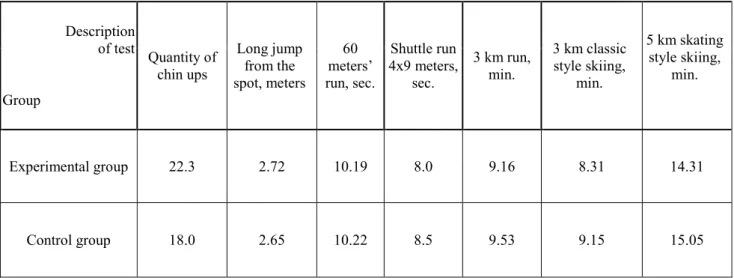
In one year after first experiment we fulfilled second experiment based on the same 7 tests. Testing results proved that the offered methodic permits to more effectively form motion skills in process of skiing training at physical culture lessons (see table 2).
Table 2 Differences in indicators of model group (EG) pupils and control group (CG) by level of formation of motion skills in
second experiment after one year
As a result we observed differences between EG and CG: quantity of chin ups– 22.3 in EG and 18.0 in CG; long jump from the spot – 2.72 m in EG and 2.65 in CG; 60 meters’ run – 10.19 sec. in EG and 10.22 sec. in CG; shuttle run 4х9 meters – 8.31 sec. in EG and 8.5 sec. in CG; 3 km run– 9.16 min. in EG and 9.53 min. in CG; 3 km classic style skiing, – 8.31 min. in EG and 9.15 min. in CG; skating style skiing - 14.31 min. in EG and 15.05 min. in CG.
Owing to fulfillment of exercise on simulator “Straps with rings” 10 form pupils of experimental group were able to quickly master actions with complex coordination, exactly fulfill them in compliance with requirements of skiing technique and reconstruct movements depending on situation. That is, they can quickly adapt to permanent changes of situations and choose the most effective means of skiing; they feel space and time quite well. Also owing to high and precise coordination of muscles’ relaxation and contraction they can quickly and precisely fulfill movements and demonstrate high results in skiing.
Conclusions:
1. We have fulfilled analysis of literature sources, devoted to the problems of our research.
2. We have determined pedagogic aspects, didactic principles for effectiveness of application of simulator “Straps with rings”.
3. Effectiveness of simulator “Straps with rings” in formation of motion skills at physical culture lessons (skiing trainings) has been proved.
4. We have recommended 22 necessary exercises for effective application of simulator “Straps with rings”. In the future it is necessary to continue such researches, because their results will give recommendations for formation of motion skills of 10 form pupils that will facilitate breeding of young healthy generation and improvement of results in skiing.
References:
1. Azhippo O.Iu. Teoriia ta metodika fizichnogo vikhovannia [Theory and methods of physical education], 2008, vol.9, pp. 46-51.
2. Antonik V. I., Antonik I. P. , Andrianov V. Ie. Anatomiia, fiziologiia ditej z osnovami gigiieni ta fizichnoyi kul'turi [Anatomy and physiology of children with the basics of hygiene and physical education], Kiev, Publishing house "Professional", Center educational literature, 2009, 336 p.
3. Vlasenko S.O. Lizhnij sport z metodikoiu vikladannia [Ski sport with the method of teaching], Chernigov, 2002, 356 p.
4. Lazarenko M.G. Naukovo-pedagogichni problemi fizichnoyi kul'turi [Scientific and pedagogical problems of physical culture], 2014, vol.45(14), pp. 98-103.
5. Lazarenko N.G. Fizicheskaia kul'tura, sport i turizm [Physical culture, sports and tourism], 2014, vol.11(2), pp. 95-101. Description of test Group Quantity of chin ups Long jump from the spot, meters 60 meters’ run, sec. Shuttle run 4х9 meters, sec.
3 km run, min.
3 km classic style skiing,
min.
5 km skating style skiing,
min.
Experimental group 22.3 2.72 10.19 8.0 9.16 8.31 14.31
State Pedagogical University], 2013, vol.112, pp. 186-188.
7. Litovchenko G.O., Kozeruk Iu.V., Lazarenko M.G., Troianovs'ka M.M. Osnovi fizichnogo vikhovannia liudej riznogo viku [Basics of physical education of people of all ages], Chernigov, 2012, 230 p.
8. Nosko M.O. Teoretichni ta metodichni osnovi formuvannia rukhovoyi funkciyi u molodi pid chas zaniat' fizichnoiu kul'turoiu ta sportom [Theoretical and methodological basis for the formation of motor function in young people during physical training and sports], Dokt. Diss., Chernigov, 2003, 434 p.
9. Nosko M.O. Pedagogika, psihologia ta mediko-biologicni problemi fizicnogo vihovanna i sportu [Pedagogics, psychology, medical-biological problems of physical training and sports], 2001, vol.17, pp. 7-9.
10. Nosko M.O. Sinigovec' V.I. Pedagogika, psihologia ta mediko-biologicni problemi fizicnogo vihovanna i sportu [Pedagogics, psychology, medical-biological problems of physical training and sports], 2001, vol.13, pp. 25-31.
11. Nosko N.A., Sinigovec V.I. Pedagogika, psihologia ta mediko-biologicni problemi fizicnogo vihovanna i sportu [Pedagogics, psychology, medical-biological problems of physical training and sports], 2001, vol.9, pp. 59-62.
12. Pen'kovec' V.I. Teoretichni aspekti lizhnogo sportu [Theoretical aspects of ski sport], Chernigov, 2008, pp. 77-168.
13. Fomin S.K. Lyzhnyj sport [Skiing sports], Kiev, The Soviet school, 1988, 176 p.
14. Arkhipov A. A. Video computer Modeling of Technique for Elite Athletes. TISU, CESU Conference. The 18th Universidad 1995, Tukuoka. Creating a New Vision. 24 – 26.09.1995, pp 370-371.