Vol. 3, No. 3, Pp. 130-135 ISSN: 2087-3956 (electronic) November 2011
Variation in oil contents, and seed and seedling characteristics of
Jatropha curcas
of West Nusa Tenggara selected genotypes and their
first improved population
BAMBANG BUDI SANTOSO♥
Faculty of Agriculture, University of Mataram, Jl. Majapahit No. 62 Mataram, 83125, West Nusa Tenggara, Indonesia. Tel. +62-0370 621435, Fax. +62-0370 640189, ♥email: [email protected]
Manuscript received: 20 July 2011. Revision accepted: 11 September 2011.
ABSTRACT
Abstract. Santoso BS. 2011. Variation in oil contents, and seed and seedling characteristics of Jatropha curcas of West Nusa Tenggara selected genotypes and their first improved population. Nusantara Bioscience 3: 130-135. This study describes variation in seed and seedling characters of Jatropha curcas Linn. of West Nusa Tenggara selected genotypes. Exploration was conducted in several areas where large population of this species grown as fences was found. Five selected genotypes were then grown in experimental fields to let mass selection to obtain the first improved population for each genotype. Seeds of wild population (P0) and those of selected trees as the first improved population (IP-1) were subjected to this study. Seed and seedling characteristics were measured. The result indicated that considerable genetic variability existed among the five J. curcas of West Nusa Tenggara selected genotypes and within each genotype population for seed and seedling characteristics. Genotypes of West Lombok, Sumbawa, and Bima performed exceedingly better than those of Central Lombok and East Lombok. Therefore, this study has suggestions for identifying potential seed sources of J. curcas and these existing genetic variability provides breeders with materials in crop improvement program.
Keywords: genetic variability, seeds, seedling, selection.
Abstrak. Santoso BS. 2011. Keragaman kandungan minyak, serta karakteristik biji dan bibit genotipe terpilih Jatropha curcas Nusa Tenggara Barat dan populasi pertamanya yang diperkaya. Nusantara Bioscience 3: 130-135. Kajian ini menjelaskan keragaman karakteristik benih dan bibit Jatropha curcas Linn. Nusa Tenggara Barat dari genotipe terpilih. Eksplorasi dilakukan di beberapa daerah dimana populasi-populasi besar jenis ini ditemukan sebagai tanaman pagar. Lima genotipe yang terpilih kemudian ditanam di lahan percobaan untuk memulai seleksi massal untuk mendapatkan populasi yang diperkaya pertama pada setiap kenotipe. Benih dari populasi liar (P0) dan pohon-pohon yang dipilih sebagai populasi yang diperkaya pertama (IP-1) menjadi subyek penelitian ini. Karakteristik benih dan bibit diukur. Hasilnya menunjukkan adanya variabilitas genetik yang cukup tinggi di antara lima genotipe terpilih J. curcas
Nusa Tenggara Barat dan karakteristik benih dan bibit dari setiap populasi genotipe. Genotipe dari Lombok Barat, Sumbawa, dan Bima memiliki penampilan yang jauh lebih baik dari pada genotipe dari Lombok Tengah dan Lombok Timur. Hasil penelitian ini dapat menjadi acuan dalam mengidentifikasi potensi sumber benih J. curcas dan menunjukkan adanya variabilitas genetik yang diperlukan penangkar sebagai bahan untuk program pemuliaan tanaman.
Kata kunci: variabilitas genetik, benih, pembibitan, seleksi.
INTRODUCTION
Physic nut (Jatropha curcas L.) is presently grown throughout arid and semi arid tropical and sub-tropical regions including Indonesia. In Indonesia, it is found in semi-wild condition as fences in the villages and well adapted to various kinds of critical soil conditions and commonly called jarak pagar (Santoso, 2008; Hasnam, 2006). Jatropha curcas has gained interest all over the world in comparison to other tree-borne oil seed crops because of its better adaptation to a wide range of environmental conditions, low cost of oil seed production, high oil content, small gestation period and smaller plant size that makes the seeds harvested easier (Sujatha 2006;
Sujatha et al. 2008). To reduce the dependence on crude oil and to achieve energy independence, J. curcas has been promoted to be developed as an alternative energy source.
J. curcas has attracted conciderable attention as a source of seed oil (Openshaw 2000; Jongschaap 2008; Kumar and Sharma 2008). However, growth and management of this crop have been poorly documented and little results of field experiments have been shared amongst farmersUntil now this crop has not been fully domesticated. Success in establishment and management of this crop plantation is largerly determined by factors of plant varieties used and the sources of seed within species.
Jatropha curcas has a high degree of reproductivity and naturally pollinated out crossing mating system, that
ensures large amount of heterozygosity and considerable genetic variability (Ginwal et al. 2004; Das et al. 2010; Parthiban et al. 2011; Zhang et al. 2011). No report on genetic improvement aspect of this species has been published so far in Indonesia, but restricted to few publications at the global level. Studies on genetic basis of
J. curcas came mostly from India and China researchers. However, early exploration in several locations in Indonesia found that there was variation owing to differences in location creating certain ecotypes such as colours of stem, leaf and shoot, forms of capsule, and number of seeds per capsule (Hasnam 2006). Makkar et al. (1997) reported that from 18 provenances in West Africa, North and Central America, and Asia there was variation in seed weight, kernel weight, crude protein, and oil content. Heller (1996) also found that, from 11 provenances of Sinegal there was variation in weight of capsule, weight of seeds per trees, and weight of 100 seeds. Therefore, those variations can be used as the basis for selection and development of high yielding genotypes.
For West Nusa Tenggara region that has a wide range of dry land and large variations in wild genotype of J. curcas, regional or local crop improvement programs will be successful only after assessing local native genetic strength and possible options toward yield improvement. Furthermore, screening of existing populations for oil yield is needed to select the best producing genotypes. It can be used for profitable production before systematic crop improvement program can yield good cultivation and it can also serve as a source for crop improvement material.
Because seed is an important material for plant propagation, and seed containing oil is very important for economic aspect for this crop development, it is necessary to know more about seed and seedling characteristics. Kumar and Sharma (2008) stated that, genetic variation in seed morphology and oil content of J. curcas is a great
potential in tree improvement programs. Callahan (1999) suggested that several other characters should be taken into consideration for provenance description and breeding propose. This article describes variation in seed, oil content, and seedling characteristics of J. curcas of West Nusa Tenggara selected genotypes and their first improved population.
MATERIALS AND METHODS
Plant materials
Exploration of plant material was done from May until June 2006 in West Nusa Tenggara (NTB), Indonesia where large population of Jatropha curcas grown as garden fences was found. Seeds from each genotype were obtained from tree stand showing good growth and development and representative for each region.
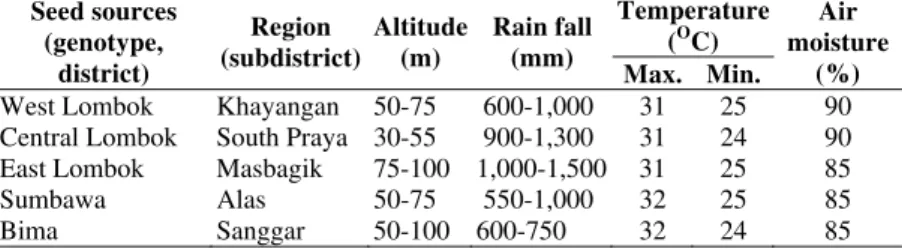
Seeds of J. curcas were collected at least from 25 parental plants with a minimum of 10 capsules per cluster (inflorescence) were chosen from each population of eachgenotype. Those parental plants were grown as fence 100 m in length, and seeds from those plants were collected and labeled; the seeds were then prepared for seed analysis, nursery, field experiment, and storage in seed storage room. Seed sources and their climate condition are given in Table 1.
Cultivation area
Study in cultivation areas was conducted at Amor-Amor Village, Subdistrict Khayangan, North Lombok, West Nusa Tenggara, during 2006-2007. The area has semi-arid climate with mean annual rainfall of 600-1,000 mm, minimum temperature of 25OC, maximum temperature of 25OC, relative air moisture of 90%, and altitude of 25 m above sea level. Climatic conditions at cultivation site during experiment are given in Table 2.
A uniform pre-treatment was given to the seeds prior to sowing by soaking them in warm water (50OC) for two hours, let it cool and kept soaking for 24 hours. Seed were sown directly in black polythene bags containing media mixture of soil, sand and manure with a ratio of 1:1:1 (by volume). Seedlings were grown into 2.5 month oldsaplings.
Two and half month –old saplings of each genotype were planted in the field experiment using Randomized Complete Block design at 2x2 m2 spacing. Three replicates of genotypes, each consisting of 24 were applied.
Crop maintenance
Saplings received fertilizers as follows: manure as much as 2 kg.tree-1 and urea 25 kg ha-1 (10 g.tree-1), SP36 150 kg.ha-1 (60 g.tree-1), and KCl 30 kg.ha-1 (12 g.tree-1) at the time of planting. The second urea was Table 1. Region of seeds’ sources and their climatic condition.
Seed sources (genotype,
district)
Region (subdistrict)
Altitude (m)
Rain fall (mm)
Temperature (OC)
Air moisture
(%) Max. Min.
West Lombok Khayangan 50-75 600-1,000 31 25 90 Central Lombok South Praya 30-55 900-1,300 31 24 90 East Lombok Masbagik 75-100 1,000-1,500 31 25 85
Sumbawa Alas 50-75 550-1,000 32 25 85
Bima Sanggar 50-100 600-750 32 24 85
Table 2. Climate condition of experimental site during 2006-2007
Climate component 2006 2007
Rainfall (mm) 965 716
Rainy month (months) 5 5
Rainy day (days) 56 59
Air temperature (OC) min. 24.7 25
Air temperature (OC) max. 31 32
applied 2 months after planting with a dose of 25 kg.ha-1 (10 g.tree-1) (Mahmud et al.2006). Irrigation was from rainfall only. At the second year of cultivation, the trees were fertilized with the same dose as that of the first year, except for manure fertilisation.
Mass selection to meet the first Improved Population (IP-1)
Selection for improved population in this study is to change the population composition with individuals which have higher average value. Selection was based on yield characteristics such as number of capsules per inflorescence and number of capsules per tree identified during generative phase of growth. Intensity of selection was 25% of trees with higher number of capsules per inflorescence (about 15-20 capsules) during the first production cycle. Seeds collected from selected tree as IP-1 were prepared for studying the seedling characteristics.
Parameters observed
Physical characters of seed and seed viabilities were measured and seed oil content was analyzed. Seed length and seed width were measured using a caliper. Seed weight and weight of 100 seeds were measured using an electronic balance. Separate weights of seed coat and kernels, after the seed coat was removed,
were measured to calculate kernel weight percentage. Analysis of seed oil content was carried out using extraction the method of Folch et al. (1957) modified by Sudarmadji et al. (1997). Seed viabilities were measured by daily germination observation until 21 days in three replications, each having 100 seeds. Then, seedling growth parameters were measured for two months..
Data analyses
Data were subjected to analysis of mean and standard deviation, analysis of variance and Least Significant Difference test using a Minitab-14 computer program.
RESULTS AND DISCUSSION
Jatropha curcas’ seed and seedling characteristics varied among five genotypes of Jatropha from West Nusa Tenggara. Variations were also observed among regions where those genotypes were collected.
Seed characters Seed length
Mean performance of five J. curcas of West Nusa Tenggara selected genotypeswith respect to seed length is prsented in Table 3. Seeds collected from the five regions of West Nusa Tenggara province varied in their seed length. A higher variation was also found within each wild genotypes population (P0) than that in the first Improved Population (IP-1). Standard deviation of seed length in P0 was higher than in IP-1.
Seed width
Variations among genotypes and within each wild genotype population (P0) as that observed in seed length also occured in seed width (Table 3). Variation dcreased after the first mass selection (IP-1) of wild population (P0).
Seed weight
Seed weight ranged from 0.60g to 0.74 g in different genotypes within the wild population (P0). West Lombok and Sumbawa genotypes had the maximum seed weight, in Tabel 3. Physical characters of Jatropha curcas seeds of West Nusa Tenggara genotypes.
Genotypes
Seed size component
Length (cm) Wide (cm) Weight (g)
P0 IP-1 P0 IP-1 P0*) IP-1
West Lombok 1.82±0.09 1.85±0.01 0.83±0.05 0.85±0.02 0.74 a 0.78 Central Lombok 1.81±0.08 1.83±0.02 0.85±0.06 0.86±0.03 0.64 ab 0.73 East Lombok 1.82±0.10 1.83±0.02 0.85±0.08 0.85±0.05 0.60 b 0.74 Sumbawa 1.79±0.09 1.81±0.03 0.86±0.06 0.86±0.04 0.70 a 0.78 Bima 1.78±0.24 1.80±0.05 0.80±0.06 0.83±0.01 0.68 ab 0.77
LSD 5% - - - - 0.09 ns
Note for Table 3 until 6: P0: seed from wild plant population, IP-1: seed from the first improved population, *): numbers in the column with the same letter did not differ significantly at P<0.05, ns: not significant ±: value of standard deviation
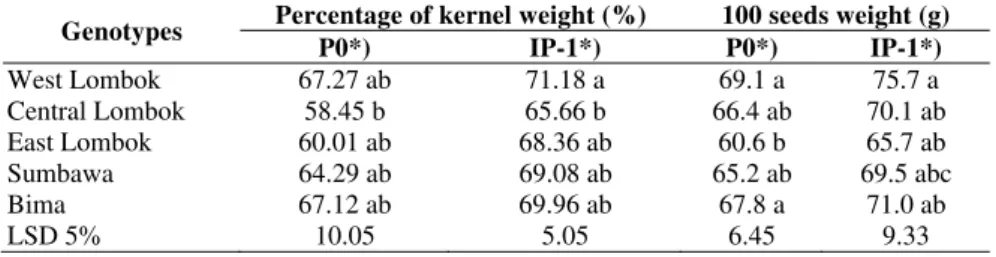
Tabel 4. Percentage of kernel weight to total seed weight and 100 seed weight of Jatropha curcas seeds of West Nusa Tenggara genotypes
Genotypes Percentage of kernel weight (%) 100 seeds weight (g)
P0*) IP-1*) P0*) IP-1*)
West Lombok 67.27 ab 71.18 a 69.1 a 75.7 a Central Lombok 58.45 b 65.66 b 66.4 ab 70.1 ab East Lombok 60.01 ab 68.36 ab 60.6 b 65.7 ab Sumbawa 64.29 ab 69.08 ab 65.2 ab 69.5 abc
Bima 67.12 ab 69.96 ab 67.8 a 71.0 ab
LSD 5% 10.05 5.05 6.45 9.33
Tabel 5. Kernel oil content of Jatropha curcas of West Nusa Tenggara genotypes
Genotypes
Kernel oil content (% b/b)
P0 *) IP-1
Rainy season Dry season
West Lombok 41.7 ab 43.7 44.6
Central Lombok 42.3 a 42.6 43.1
East Lombok 38.8 b 41.9 42.9
Sumbawa 42.9 a 43.6 44.3
Bima 41.1 ab 43.4 44.3
contrast, East Lombok had the minimum. However, there were no significant difference in seed weight of IP-1 (Table 3).
Kernel weight percentage
Analysis of variance indicated that different genotype had a significant effect (P<0.05) on the percentage of kernel weight to total seed weight (Table 4). The maximum
kernel weight was found in West Lombok, East Lombok, Sumbawa, and Bima, while the minimum was in Central Lombok. However, after mass selection, it was found that West Lombok had the maximum kernel weight, and Central Lombok possessed the minimum.
100 seed weight (seed index)
The same phenomena as that found in kernel weight percentage was observed in 100 seed weight. The maximum 100 seed weight was found in West Lombok, East Lombok, Sumbawa, and Bima, while the minimum was observed in Central Lombok. After mass selection, it was found that West Lombok had the maximum 100 seed weight with Central Lombok having the minimum (Table 4).
Kernel oil content
Selected genotypes within West Nusa Tenggara province had a significant effect on kernel oil content. However, after mass selection, the five J. curcas West Nusa Tenggara selected genotypes showed no variation or no significant difference in the kernel oil content (Table 5).
Seed viabilities
Seed viability component of J. curcas seed of West Nusa Tenggara genotypes are given in Table 6. There were no significantly effects of genotypes on seed germination, germination rate, and vigourity of seed. However, seed viabilities were better after mass selection (IP-1) than the wild genotypes.
Seedling characters Seedling height
Seedling height ranged from 15.2 cm to 19.1 cm for one month old seedlings and from 20.1 cm to 22.9 cm for two month old seedlings in different genotype within their wild population (P0). Within their first improved population (IP-1), seedling height also varied among different genotypes, eventhough there was a decrease in variation within each genotype. The highest (22.9 cm for P0 and 23.7 cm for IP-1) seedling height was found in West Lombok genotype and the lowest (20.1 cm for P0 and 21.2 cm for IP-1) was found in East Lombok genotype.
Tabel 6. Seed viabilities of Jatropha cyrcas seeds of West Nusa Tenggara genotypes
Genotypes
Germination (%)
Germination rate (day)
Seed vigourity (%)
Dry weight of 3 weeks old sapling (g) P0 IP-1 P0 IP-1 P0 IP-1 P0*) IP-1
West Lombok 84.3 88.9 11.40 10.07 89.93 90.06 0.58 a 0.59 Central Lombok 79.3 86.7 12.97 11.03 82.50 85.76 0.45 b 0.52 East Lombok 82.0 85.9 12.49 11.56 89.37 90.35 0.48 ab 0.53 Sumbawa 81.7 87.4 12.67 10.22 89.70 90.54 0.55 ab 0.56 Bima 80.9 88.2 12.40 11.01 86.83 89.88 0.53 b 0.54
LSD 5% ns ns ns ns ns ns 0.12 ns
Table 7. Seedling height, number of leaves, and collar diameter of Jatropha curcas of West Nusa Tenggara Genotypes of wild population (P0) and Improved Population- 1 (IP-1)
Genotypes
Seedling height
(cm) Number of leaves
Collar diameter (cm) 1 month
old
2 month old
1 month old
2 month old
1 month old
2 month old
P0
West Lombok 15.7±1.078 22.9±0.893 4.6±0.925 8.9±0.908 1.1±1.142 1.3±0.877 Central Lombok 18.3±1.694 21.2±1.132 4.7±1.106 8.2±1.062 0.9±1.333 1.0±0.992 East Lombok 15.2±1.426 20.1±1.426 5.1±1.077 7.8±1.016 0.8±1.434 1.1±0.902 Sumbawa 19.1±1.148 22.2±0.926 5.4±0.945 9.1±0.921 1.0±1.024 1.3±0.743 Bima 17.5±0,992 21.8±0.901 3.8±0.982 7.2±0.933 1.1±1.872 1.4±0.967 IP-1
West Lombok 17.4±0.789 23.7±0.656 5.2±0.819 9.5±0.445 1.1±0.763 1.4±0.428 Central Lombok 18.9±0.992 22.4±0.793 5.6±0.925 8.9±0.545 1.0±0.784 1.1±0.457 East Lombok 17.3±0.905 21.2±0.885 5.7±0.961 8.7±0.607 0.9±0.825 1.1±0.724 Sumbawa 18.5±0.902 23.6±0.776 5.6±0.786 9.6±0.416 1.0±0.641 1.3±0.409 Bima 17.8±0.814 22.4±0.664 5.1±0.807 8.9±0.378 1.0±0.706 1.3±0.513 Note for Table 7 and 8: P0: seed from wild plant population, IP-1: seed from the first improved population, ±: value of standard deviation
Table 8. Dry weight of seedling shoot and seedling root of J. curcas of West Nusa Tenggara Genotypes of wild population (P0) and Improved Population-1 (IP-1)
Genotypes Seedling shoot (g) Seedling root (g) 1 month old 2 month old 1 month old 2 month old
P0
West Lombok 4.95±1.798 7.33±1.233 0.94±1.595 1.74±1.013 Central Lombok 3.55±1.882 6.88±1.372 0.63±1.551 1.35±1.154 East Lombok 3.92±1.908 6.91±1.501 0.66±1.462 1.43±1.096 Sumbawa 4.71±1.636 7.16±1.362 0.79±1.357 1.58±1.005
Bima 4.32±1.872 7.43±1.239 0.88±1.623 1.66±1.102
IP-1
West Lombok 5.79±1.124 9.01±0.863 1.23±1.026 1.95±0.902 Central Lombok 4.95±1.132 8.28±0.994 0.96±1.147 1.69±1.006 East Lombok 5.19±1.164 8.76±0.907 1.12±1.115 1.71±1.021 Sumbawa 5.46±1.087 9.12±0.821 1.29±1.076 1.98±0.942
Bima 5.24±1.139 8.95±0.879 1.22±1.083 2.02±0.879
Number of leaves
Number of leaves varied within five genotypes and it ranged from 7.8 to 9.1 in the wild population (P0) and from 8.7 to 9.6 in the first improved population (IP-1) (Table 7). There was improvement of homogenosity or decreased of variation due to mass selection.
Collar diameter
Table 7 showed that genotype had different effect on collar diameter. It ranged from 1.0 cm to 1.4 cm within the wild population (P0), and 1.1 cm to 1.4 cm within their first improved population (IP-1). The variation within each genotype decreased after mass selection of the wild population.
Discussion
This study showed that seed and seedling characteristics of J. curcas varied among different selected genotypes of West Nusa Tenggara province. Genotype had genotypic characters according to their location of seed sources. Seed sources varied in their growing habitat with respect to altitude, temperature, and rain fall. The sources used in this study had mean annual rain fall (550-1.500 mm), temperature (24-32OC), and altitude (30-100 m). Sumbawa, Bima, and West Lombok are drier than Central Lombok and East Lombok (Table 1). Therefore, variation in sources with respect to seed and seedling characteristicss are mainly due to the fact that those genotypes grow over a wide range of climatic conditions in West Nusa Tenggara.
When the genotypes were grown in experimental field at Amor-Amor, Subdistrict Kayangan, West Lombok they were influenced by local climatic condition affecting seed and seedling performance such as reduction in their variability, especially within IP-1 population). Ginwal et al. (2004), Ginwal et al. (2005) and Kaushik et al. (2007) reported significant variations in seed morphology and seedling growth variables like seedling height, collar diameter, leaves, seed weight, and 100 seed weight in 10 accessions of J. curcas.
Since there was no different phenomenon of the influence of genotype within P0 and IP-1, it means that various climatic factors affected the vegetation collectively, but not individually. Considering this fact, genotypes may possess different climatic features that caused genotype variations. The present results are similar with the finding of Zang et al. (2011), that genetic variation among genotype or provenance may be due to geographical separation.
West Lombok’s genotypes followed by Sumbawa’s, and Bima’s were the best genotypes compared to Central Lombok and East Lombok with respect to their seed and seedling caharacteristics. There is correlation between good seed characteristic and good seedling characteristic. As Isik (1986) stated, that seed size and seed weight were two important characteristics for improving seedling productivity,hence, it was clear that seeds with greater seed weight produced seedlings with greater shoot and root growth. This may be due to greater nutrient reserves in larger seeds (Bhat and Chauhan 2002; Gonzales, 1993).
The purpose for genotype testing is to measure the value of genetic variation and to aid further selection of better adapted and highly productive seed sources or genotypes. Variation in seed and seedling characteristics of
J. curcas of West Nusa Tenggara genotypes is an indicator of the possibility of selecting the best performance or the highest seed yield of the tree for further crop improvement programs. Due to the fact that no different phenomenon of genetic variability of five J. curcas of West Nusa Tenggara selected genotypes both in wild population (P0) and first improved population (IP-1), it can be said that those variability caused by genetic factor with minor effect of environment. Therefore, as Gohil and Pandya (2009) state, that if variability is largerly due to genetic cause with least environment effect, probability of isolating superior genotype is a precondition for obtaining higher yield.
The variability in seed, oil content, and seedling characteristic along with variability in early growth performance indicates that economic benefits may be obtained. Although, Parthiban et al. (2011) reported that in India, few native Jatropha species were utilized in their improvement program with limited success; the results of this study will be valuable for strategies for conservation of genetic variation, prospects of improvement and assessment of the potential of locally adapted seed sources. As Boe (2003) mentions, that since seed is the main product of trees selection for increasing seed weight and their content (seed-oil concentration), it may become important selection criterion for new cultivar development.
CONCLUSION
J. curcas improvement program will be successful only after assessing our native genetic strength and the possible option toward yield improvement. Result of the present study revealed that considerable genetic variability existed among the five J. curcas West Nusa Tenggara selected genotypes and within each genotype population for seed and seedling characteristics. Genotypes of West Lombok, Sumbawa, and Bima performed exceedingly better than that of Central Lombok and East Lombok in terms of seed and seedling characteristics. These variations could occur from genetic diversity that needs to be studied in detail for their performance on seed production potential and for further J. curcas improvement program.
REFERENCES
Bhat GS, Chauhan PS. 2002. Provenance variation in seed and seedling traits of Albizia lebbeck Benth. J Tree Sci 21:52-57.
Boe A. 2003. Genetic and environmental effect on seed weight and seed yield in switchgrass. Crop Sci 43:63-67.
Callaham RZ. 1999. Provenance Research: investigation of genetic diversity associated with geography. FAO Corporate Document Repository - FAO/IUFRO Meeting on Forest Genetic, Rome. Das S, Mirsa RC, Mahapatra AK, Gantayat BP, Pattnaik RK. 2010.
Genetic variability, character association and path analysis in
Jatropha curcas. World Appl Sci J 8 (11): 1304-1308.
Ginwal HS, Phartyal SS, Rawat PS, Srivastava RL. 2005. Seed source variation in morphology, germination, and seedling growth of
Jatropha curcas Linn. In Central Asia. Silvae Genetica 54:76-80. Gohil RH, Pandya JB. 2009. Genetic evaluation of Jatropha (Jatropha
curcas Linn) genotypes. J Agric Res 47(3): 221-228.
Gonzales JF. 1993. Effect of seed size on germination and seedling vigor of Virola koschyni Warb. Forest Ecol Manag 57: 275-281.
Hasnam. 2006. Variation in Jatropha L. Info-Tek of Physic Nut (Jatropha curcas L). Puslitbangbun, Badan Penelitian dan Pengembangan Pertanian 1 (2):3. [Indonesian]
Heller J. 1996. Physic Nut, Jatropha curcas L. - Promoting the conservation and use of underutilized and neglected crop 1. International Plant Genetic Resources Institute. Rome.
Isik K. 1986. Altitudinal variation in Pinus brutia: Seed and seedling characteristics. Silvae Genetica 35:58-67.
Jongschaap REE. 2008. A to Z of Jatropha curcas L. claims and facts on
Jatropha curcas L. Plant Research International, Wageningen, The Netherlands.
Kaushik N, Kumar K, Kumar S, Roy N. 2007. Genetic variability and divergence studies in seed traits and oil content of Jatropha (Jatropha curcas L.) accession. Biomass Bioener 31: 497-502.
Kumar A, Sharma S. 2008. An evaluation of multipurpose oil seed crop for industrial uses (Jatropha curcas L.): A review. Industrial Crops Prod 28: 1-10.
Mahmud Z, Rivaie AA, Allorerung D. 2006. Technical Intruction on
Jatropha curcas L. cultivation. Pusat Penelitian dan Pengembangan
Perkebunan, Badan Penelitian dan Pengembangan Pertanian. Second Edition. Jakarta. Deptan. 35p. [Indonesian]
Makkar HPS, Becker K, Sporer F, Wink M. 1997. Studies on nutritive potential and toxic constituents of different provenances of Jatropha curcas. J Agric Food Chem 45:3152-3157.
Openshaw K. 2000). A review of Jatropha curcas: an oil plant of unfulfilled promise. Biomass Bioener 19: 1-15.
Parthiban KT, Kirubashankkar R, Paramathma M, Subbulakshmi V, Thiyagarajan P, Vennila S, Sujatha M, Durairasu P. 2011. Genetic association studies among growth attributes of Jatropha hybrid genetic resources. Intl J Pl Breed Genet 5 (2): 159-167.
Santoso, BS. 2008. Characterization of morphological and agronomical aspects of physic nut (Jatropha curcas L.) ecotypes at West Nusa Tenggara. 225p. (Desertation). [Indonesian]
Sudarmadji S, Haryono B, Suhardi. 1997. Analysisi Prosedure forr Food and Agriculture. Fourth Edition. Liberty, Yogyakarta. [Indonesian] Sujatha M. 2006. Genetic improvement of Jatropha curcas L. possibilities
and prospects. India J Agroforest 8: 58-65.
Sujatha, M, Reddy TP, Mahasi MJ. 2008. Role of biotechnological interventions in the improvement of castor (Ricinus communis L.) and
Jatropha curcas L. Biotechnol Adv 26: 424-435.
Zhang, Z, Guo X, Liu B, Tang L, Chen F. 2011. Genetic diversity and genetic relationship of Jatropha curcas between China and Southeast Asian revealed by amplified fragment length polymorphisms. African J Biotechnol 10 (15): 2825-2832.