Short Report
J. Braz. Chem. Soc., Vol. 20, No. 10, 1921-1924, 2009. Printed in Brazil - ©2009 Sociedade Brasileira de Química 0103 - 5053 $6.00+0.00
*e-mail: [email protected]
Megastimanes and Ergostane Type Steroid from Leaves
Cratylia mollis
(Leguminosae)
Luciano S. Lima,a Marcos V. B. Lima,b Juceni P. David,b Ana M. Giulietti,c
Luciano P. de Queirozc and Jorge M. David*,a
aInstituto de Química and bFaculdade de Farmácia, Universidade Federal da Bahia,
40170-290 Salvador-BA, Brazil
cDepartamento de Ciências Biológicas, Universidade Estadual de Feira de Santana,
44031-460 Feira de Santana-BA, Brazil
Do extrato metanólico das folhas de Cratylia mollis, foram isolados através de técnicas cromatográicas, (3S,5S,6S,9R)-3,6-di-hidróxi-5,6-diidro-β-ionol (1)eum novo nor-isoprenóide identiicado como (4S*, 6S*)-4-but-1E-enil-4,6-diidróxi-3,5,5-trimetil-ciclo-hex-2-enona (2) além do 5α,8α-epidioxiergosta-6,22-dien-3-β-ol. As estruturas foram elucidadas por meio da análise dos dados de EM, IV, RMN 1H e 13C.
From the methanolic extract of the leaves of Cratylia mollis were obtained by chromatographic techniques (3S,5S,6S,9R)-3,6-dihydroxy-5,6-dihydro-β-ionol (1),and a new bis-norisoprenoid named (4S*, 6S*)-4-but-1E-enyl-4,6-dihydroxy-3,5,5-trimethyl-cyclohex-2-enone (2) as well as 5α,8α-epidioxyergosta-6,22-dien-3-β-ol. The structures of the pure compounds were elucidated based on MS, 1H and 13C NMR spectroscopic data analyses.
Keywords: megastimanes, Leguminosae, Cratylia mollis
Introduction
Cratylia is one of 670 genera belonging to Leguminosae
family,1 it is included in the Phaseolae tribe (subtribe
Diocleinae)2 and this position is maintained until the most
recent classiications.3 This genus comprises only ive
species, C. argentea (Desvaux) O. Kuntze, C. bahiensis
L. P. de Queiroz, C. hypargyrea Martius ex Benth., C.
intermedia (Hassler) L. P. de Queiroz and C. mollis Martius ex Benth. From chemical point of view the subtribe genera can be characterized by the presence of the non-proteic
aminoacids, especially canavanine.4 However, there are
no data of the occurrence of this aminoacid in Cratylia
species. On the other hand, other chemical characteristic of Cratylia is the presence of lectins in their seeds which shows great similarity with the lectins isolated from seeds
of other species of same tribe.5
Cratilya mollis is a legume shrub native to the Northeast
semi-arid region of Brazil, especially in “caatinga”.This
species is popularly known as “camaratuba” or “camaratu”
and is highly resistant to desiccation. The leaves have been an alternative source of nutrition for cattle, being recommended to be employed by locals as forage to improve cattle’s nutrition, especially during the dry seasons,
contributing to regional development of the semi-arid.6
However, in spite of studies the about of the biological
activities of this and related species7 to date there are no
phytochemical studies regarding C. mollis.
In the present work it is described the phytochemical
study of leaves of Cratylia mollis led to isolation of
two bis-norisoprenoids (1 and 2) besides the 5α,8α
-epidioxyergosta-6,22-dien-3-β-ol (3).
Results and Discussion
The Cl3-norisoprenoid (1) is known as
3,6-dihydroxy-5,6-dihydro-β-ionol. Itwas identiied by analysis of ESIMS,
IR, optical rotation, 1H and 13C NMR and comparison with
data previously published in the literature.8 Moreover,
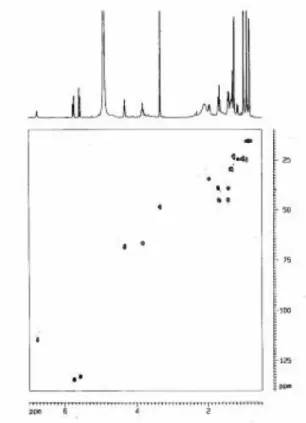
HMQC, HMBC and COSY spectra permitted to attribute
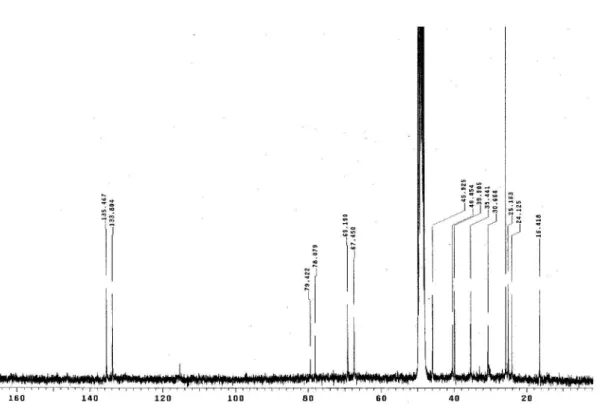
unequivocally all the NMR signals. The 13C NMR data
Megastimanes and Ergostane Type Steroid from Leaves Cratylia mollis (Leguminosae) J. Braz. Chem. Soc. 1922
(3S,5R,6S,9R)-3,6-dihydroxy-5,6-dihydro-β-ionol obtained
from Apollonias barbujana (Lauraceae)8 except for C-1.
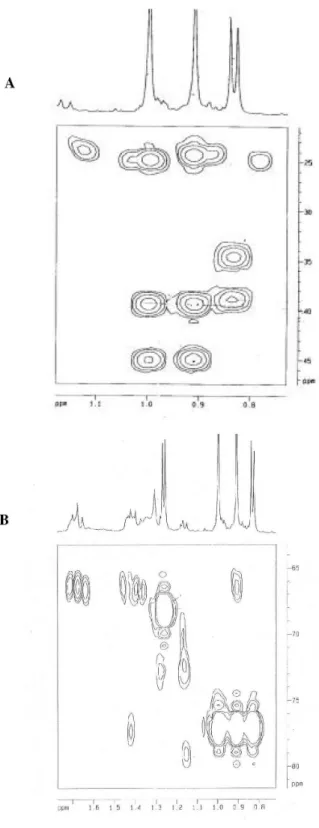
However, the HMQC and HMBC of 1 permitted to attribute
the peak at d 16.4 to C-13 by the observed correlations of one
doublet at d 0.79 and this carbon in the HMQC and C-4 (d
39.9) and C-6 (d 78.1) observed in the HMBC experiment.
This indings permitted to determinate an axial position of
CH3-13 instead of equatorial as previously proposed and,
concluded compound 1 is (3S,5S,6S,9R
)-3,6-dihydroxy-5,6-dihydro-β-ionol. Thus, it is a must a revision of 13C NMR data
and structure of the megastimane isolated from A. barbujana.
The 13C NMR spectra (including DEPT experiments)
of 2 showed signals were assigned to four methyls, four
methines, one methylene and four non-hydrogenated
carbons. These indings besides the protonedmolecular
ion [M-H]+ observed at m/z 223.1330 in the negative
HRESIMS permitted to propose molecular formula
C13H20O3 (requires 223.1334) which was indicative of a
C13-norisoprenoid derivative. The signals at d 198.5, 126.7
and 163.4 observed in the 13C NMR spectra, and the singlet
at d 5.95 in the 1H NMR spectra were indicative of presence
of a α,β-unsaturated ketone group. These indings together
with the additional chemical shifts indicated the structural
similarity of 2 and the known megastigmane glycosides
4 and 5.9 The HMQC spectrum was elucidative once it
permitted to identify the correlations of closer hydrogen signals with respective carbon resonances. However, the analysis of HMBC spectral data was conclusive to conirm
the structure of compound 2. Briely, the correlations of H-4
(d 5.95), H-7 (d 5.79) and the C-6 (d 78.9) and, H-10 (d
1.22) and C-9 (d 49.6) and C-8 (d 135.6) were indicative
the E-butenyl group is attached at C-6 (Table 1).
Figure 1. Isolates of leaves of Cratylia mollis and other megastimanes.
Table 1. 1H and 13C NMR assignments for the compounds 1 and 2 (500/300 and 125/75 MHz)
Position
1a 2b
dH dC dH dC HMBC(H → C)
1 2 3 4 5 6 7 8 9 10 11 12 13 -1.65 (m) 1.40 (m) 3.78 (m) 1.65 (m) 1.40(m) 1.95(m) -5.52 (d, 15.6) 5.69 (dd, 15.6, 6.3 )
4.40 (m)
1.23(d, 6.3) 0.97 (s) 0.83 (s) 0.79 (d, 6.9 )
40.5 45.9 67.4 39.9 35.4 78.1 135.4 133.8 69.1 24.1 25.3 25.2 16.4 -4.38(m) -5.95 (s) -5.79 (d,15.6) 5.81 (ddd, 15.6, indt, indt)
2.43 (ddt, 8.1, indt, indt ) 2.37 (ddt, 8.1, 6.6)
1.22 (t, 6.6) 0.92 (s) 0.95 (s) 1.90(s) 41.1 68.0 198.5 126.7 163.4 78.9 129.0 135.6 49.6 23.6 23.9 22.8 19.1 -C-6 -C-6, C-13 -C-8, C-9 C-2 C-2 C-2, C-3, C-4
aRecorded in CD 3OD;
bCDCl
Lima et al. 1923 Vol. 20, No. 10, 2009
The relative configuration of compound 2 was
determinate by phase-sensitive NOESY, once the spatial interactions of H-7 and H-2 were indicative the butenyl group and H-2 were in same face (Figure 2). The proposed relative stereochemistry was also conirmed by analysis of
coupling constant of derivative 2a, obtained as main product
of reduction of 2 by NaBH4/MeOH. The 1H NMR spectrum
of 2a showed the peak of H-3 as a double doublet at d 3.4 (J
12.9 6.5 Hz) revealing pseudodiaxial coupling of H-3 and
H-2, which allowed to conirm the relative coniguration
of compound 2.
The APCI-MS, 1H NMR and 13C NMR spectra
of compound 3 and comparison with data previously
describe in literature10 permitted to identify this steroid.
However correlations observed in COSY, HMQC and
HMBC experiments indicated the values of 13C NMR data
previously established for C-6 and C-7 must be changed. This is the irst occurrence of the megastimane 4-but-1-enyl-4,6-dihydroxy-3,5,5-trimethyl-cyclohex-2-enone
(2).Compound 1was previously isolated from Apollonias
barbujana (Lauraceae)8 but this is the first time it is
being reported in Leguminosae family. Compound 3 was
previously isolated from fungus Lactarium volemus,
Schinopsis brasiliensis and Typha latifolia.10 However the
detailed analysis of correlations observed in HMQC and HMBC experiments permitted to attribute unequivocally the C-13 NMR data for this steroid.
Experimental
General procedures
1H (300 MHz); 13C NMR and DEPT (75 MHz)
experiments were carried out in a Varian mod. Gemini 2000. HMQC, NOESY and HMBC were run on a Varian
INOVA 500: chemical shifts were recorded in d (ppm)
from the solvent peak relative to TMS; APCI and ESIMS were obtained on Shimadzu LCMS-2010; HRESIMS was recorded on Bruker micrOTOF II, IR spectra were taken on a Varian mod. 640-IR spectrophotometer and optical
rotations were measured with a Perkin Elmer polarimeter mod. 341.
Column chromatography was carried out on silica gel 60 (Akros 0.04-0.073 mm) and, silica gel TLC plates were used to monitor the chromatographic fractionment employing iodine fumes, Libermann-Bouchard spray reagent, and UV light (254/366 nm).
Plant material
Botanical material of C. mollis was collected at
Jacobina, Bahia State, a region where “caatinga” vegetation is prevalent. A voucher is deposited at Herbarium of Universidade Estadual de Feira de Santana under number LP5119.
Extraction and isolation
The powdered leaves (4.1 Kg) were repeatedly extracted with MeOH at room temperature. The leaf crude extract was
immediately partitioned with CHCl3/MeOH:H2O (6:4), and
after the evaporation of CHCl3 under vacuum, the extract
(73.2 g) obtained was partitioned with hexane/MeOH:H2O
(9:1). The hydromethanolic partition phase (28.89 g) was submitted to CC using Silica gel as adsorvent and eluted
with mixtures CHCl3:MeOH with gradient of polarity
(95:5 →3:2). The fractions (1.88 g) eluted with CHCl3:MeOH
(9:1) were jointed and submitted to another CC on silica
gel which was eluted with mixtures of CHCl3:MeOH
(95:5 and 9:1). The fractions (88.8 mg) eluted with the
system CHCl3:MeOH (95:5) were subjected to PTLC and
developed with a mixture of CHCl3:MeOH:HOAc (90:9:1).
This procedure permitted to obtain compound 1 (15.0 mg).
The fractions (175 mg) eluted with CHCl3:MeOH (9:1)
were rechromatographed on Sephadex LH-20 column with
Hex:CH2Cl2 (2:8) as eluent to yield compound 2 (25.0 mg).
The hexane partition phase (42.9 g) was submitted to a CC on Si gel 60 with mixtures of Hex:EtOAc. The fractions (4.5 g) eluted with Hex:EtOAc (95:5) were further submitted to a lash CC on silica gel eluted with
CHCl3:MeOH (98:2) affording compound 3 (7.2 mg).
(1S,4S,6S)-1-(3-Hydroxy-but-1E -enyl)-2,2,6-trimethyl-cyclohexane-1,4-diol or (3S,5S,6S,9R)-3,6-Dihydroxy-5,6-dihydro-β-ionol (1)
Colorless syrup. [α]D20−7.0° (c 0.48, MeOH),1H and
13C NMR: Table 1.
(4S*, 6S*)-4-But-1E -enyl-4,6-dihydroxy-3,5,5-trimethyl-cyclohex-2-enone (2)
Oil. [α]D20 + 56.0° (c 1.47, MeOH) ESIMS(m/z)223
Megastimanes and Ergostane Type Steroid from Leaves Cratylia mollis (Leguminosae) J. Braz. Chem. Soc. 1924
[M-H]−, and 255 [M-H+MeOH],IR ν
max/cm
-1:3200-3600
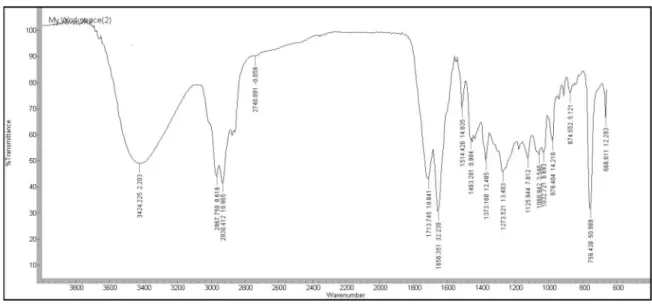
(OH), 1713 (C=O), 1656 (C=C),1H and 13C NMR: Table 1.
Reaction of reduction of compound 2
Compound 2 (5 mg) was dissolved em MeOH (2.0 mL)
and added a suspension containing NaBH4 in MeOH. The
mixture was stirred at room temperature during 30 min. After the solvent was evaporated the residue was dissolved
in CHCl3 and 2a (3.5 mg) was obtained.
Acknowledgments
The authors are grateful to Conselho Nacional de Desenvolvimento Científico e Tecnológico (CNPq, Brazil), IMSEAR (CNPq/MCT), FAPESB and Fundação Coordenação de Aperfeiçoamento de Pessoal de Nível Superior (CAPES) for fellowship support and grants.
Supplementary Information
Supplementary information for compounds 1-3 is
available free of charge at http://jbcs.sbq.org.br, as a PDF ile.
References
1. Joly, A. B.; Botânica- Introdução à Taxonomia Vegetal, Cia Editora Nacional: São Paulo, Brasil, 1998.
2. Bentham, G.; Commentationes de Leguminosarum Generibus, Sollingeri, J. B., ed., Vienna, 1837.
3. Hutchinson, J.; The Genera of Flowering Plants, vol. 1, Claredon Press: Oxford, 1964; Baudet, J. C.; Bull. Jard. Bot. Nat. Belg. 1978, 48, 183; Lackey, J. A. In Advances in Legume Systematics, part 1, Polhill, R. M.; Raven, P. H., eds., Kew Royal Botanic Gardens: England, 1981.
4. Turner, B. L.; Harborne, J. B.; Phytochemistry 1967, 6, 863. 5. Moreira, R. A.; Barros A. C. H.; Oliveira, J. T. A.; Braz. Arch.
Biol. Technol. 1985, 28, 172.
6. Paiva, P. M. G.; Oliva; M. L. V.; Fritz, H.; Coelho, L. C. B. B.; Sampaio, C. A. M.; Phytochemistry 2006, 67, 545.
7. Andrade, C. A. S.; Correia, M. T. S.; Coelho, L. C. B. B.; Nascimento, S. C.; Santos-Magalhães, N. S.; Int. J. Pharm. 2004, 278, 435; Maciel, E. V. M.; Araujo-Filho, V. S.; Nakazawa, M.; Gomes, Y. M.; Coelho, L. C. B. B.; Correia, M. T. S.; Biologicals 2004, 32, 57; Paiva, P. M. G.; Souza, A. F.; Oliva, M. L. V.; Kennedy, J. F.; Cavalcanti, M. S. M.; Coelho, L. C. B. B.; Sampaio, C. A. M.; Bioresour. Technol. 2003, 88, 75; Barreiros, A. L. B. S.; David, J. P.; Queiroz, L. P. de; David, J. M.; Phytochemistry 2000, 55, 805.
8. Wirth, J.; Guo, W.; Baumes, R.; Gunata, Z.; J. Agric. Food Chem. 2001, 49, 2917; Perez, C.; Trujillo, J.; Almonacid, L. N.; Trujillo, J.; Navarro E.; Alonso, S. J.; J. Nat. Prod. 1996, 59, 69.
9. Kanchanapoom, T.; Chumsri, P.; Kasai, R.; Otsuka, H.; Yamasaki, K.; Phytochemistry 2003, 63, 985.
10. Yue, J-M.; Chen, S-M.; Lin, Z-W.; Phytochemistry 2001, 56, 801; Cardoso, M. P.; David, J. M.; David, J. P.; Nat. Prod. Res. 2005, 19, 431; Greca, M. D.; Mangoni, L.; Molinaro, A.; Monaco, P.; Previtera, L.; Gazz. Chim. Ital. 1990, 120, 391.
Received: November 25, 2008
Supplementary Information
J. Braz. Chem. Soc., Vol. 20, No. 10, S1-S14, 2009. Printed in Brazil - ©2009 Sociedade Brasileira de Química 0103 - 5053 $6.00+0.00
*e-mail: [email protected]
Megastimanes and Ergostane Type Steroid from Leaves
Cratylia mollis
(Leguminosae)
Luciano S. Lima,a Marcos V. B. Lima,b Juceni P. David,b Ana M. Giulietti,c
Luciano P. de Queirozc and Jorge M. David*,a
aInstituto de Química and bFaculdade de Farmácia, Universidade Federal da Bahia,
40170-290 Salvador-BA, Brazil
cDepartamento de Ciências Biológicas, Universidade Estadual de Feira de Santana,
44031-460 Feira de Santana-BA, Brazil
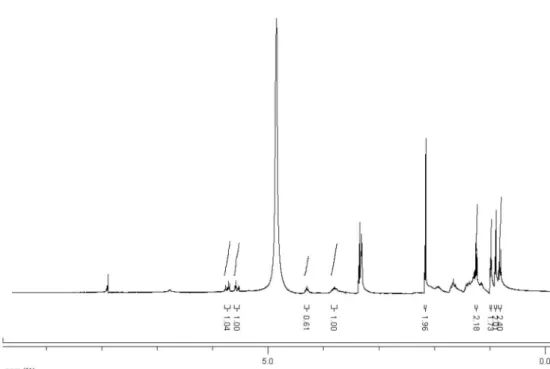
Figure S1. 1H NMR spectrum of compound 1 (CD
Megastimanes and Ergostane Type Steroid from Leaves Cratylia mollis (Leguminosae) J. Braz. Chem. Soc.
S2
Figure S2. Expansion of 1H NMR spectrum of compound 1 (CD
3OD, 300 MHz).
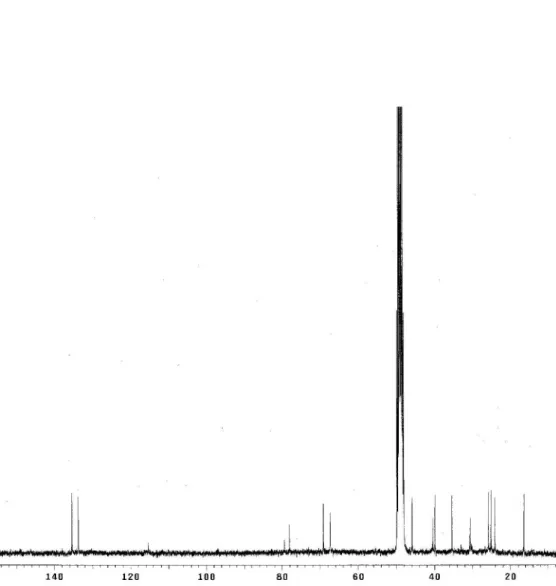
Figure S3. 13C spectrum of compound 1 (CD
Lima et al. S3 Vol. 20, No. 10, 2009
Figure S4. Expansion of 13C NMR spectrum of compound 1 (CD
Megastimanes and Ergostane Type Steroid from Leaves Cratylia mollis (Leguminosae) J. Braz. Chem. Soc.
S4
Figure S5. Expansions of the gHMBC spectrum of compound 1 (CD3OD, 500 MHz).
Lima et al. S5 Vol. 20, No. 10, 2009
Figure S7. gHMQC spectrum of compound 1 (CD3OD, 500 MHz).
Megastimanes and Ergostane Type Steroid from Leaves Cratylia mollis (Leguminosae) J. Braz. Chem. Soc.
S6
Figure S9. COSYGS spectrum of compound 1 (CD3OD, 500 MHz).
Lima et al. S7 Vol. 20, No. 10, 2009
Figure S11. Negative HRESIMS of compound 2.
Figure S12. IR spectrum of compound 2 (ilm).
Megastimanes and Ergostane Type Steroid from Leaves Cratylia mollis (Leguminosae) J. Braz. Chem. Soc.
S8
Figure S14. Expansion of 1H NMR spectrum of compound 2 (CDCl
3, 300 MHz).
Figure S15. 13C NMR spectrum of compound 2 (CDCl
Lima et al. S9 Vol. 20, No. 10, 2009
Figure S16. Expansion of 13C NMR spectrum of compound 2 (CDCl
3, 75 MHz).
Megastimanes and Ergostane Type Steroid from Leaves Cratylia mollis (Leguminosae) J. Braz. Chem. Soc.
S10
Figure S18. Expansion of the gHMBC spectrum compound 2.
Figure S19. NOESY spectrum compound 2.
Lima et al. S11 Vol. 20, No. 10, 2009
Figure S21. Expansion of 1H NMR spectrum of product reduction of compound 2 (C
5D4N, 300 MHz).
Figure S22. 1H NMR spectrum of compound 3 (CDCl
Megastimanes and Ergostane Type Steroid from Leaves Cratylia mollis (Leguminosae) J. Braz. Chem. Soc.
S12
Figure S23. 13C NMR spectrum of compound 3 (CDCl
3, 75 MHz).
Lima et al. S13 Vol. 20, No. 10, 2009
Figure S26. Expansion of gHSQC of compound 3 (CDCl3).
Megastimanes and Ergostane Type Steroid from Leaves Cratylia mollis (Leguminosae) J. Braz. Chem. Soc.
S14
Figure S28. gHSQC of compound 3 (CDCl3).
Figure S29. Expansion of gHSQC of compound 3 (CDCl3).