ABSTRACT
http://dx.doi.org/10.1590/1678-775720150383
Effect s of epicat echin, a crosslinking agent , on
h u m an den t al pu lp cells cu lt u r ed in collagen
scaffolds
Eun-Su LIM1, Myung-Jin LIM1, Kyung-San MIN1,2, Young-Sun KWON1<XQ&KDQ+:$1*30L.\XQJ<81&KDQ8L +21*4, Kwang-Won LEE1,2
1- Department of Conservative Dentistry, School of Dentistry and Institute of Oral Bioscience, Chonbuk National University, Jeonju, Korea.
2- Research Institute of Clinical Medicine of Chonbuk National University, Biomedical Research Institute of Chonbuk National University Hospital, Jeonju, Korea. 3- Department of Conservative Dentistry, School of Dentistry, Chonnam National University, Gwangju, Korea.
4- Department of Conservative Dentistry, School of Dentistry, Dankook University, Cheonan, Korea.
&RUUHVSRQGLQJDGGUHVV Kyung-San Min - Professor of the Department of Conservative Dentistry - School of Dentistry, Chonbuk National University - 567 Baekje-daero - Deokjin-gu - Jeonju-si - Jeollabuk-do - Korea - 561-756 - Phone: +82 63 270 4982 - Fax: +82 63 270 4004 - e-mail: [email protected]
6XEPLWWHG6HSWHPEHU0RGL¿FDWLRQ1RYHPEHU$FFHSWHG-DQXDU\
O
bj ect ive: The purpose of t his st udy was t o invest igat e t he biological effect s of epicat echin ( ECN) , a crosslinking agent , on hum an dent al pulp cells ( hDPCs) cult ured in collagen scaffolds. Mat erial and Met hod: To evaluat e t he effect s of ECN on t he proliferat ion of hDPCs,FHOOFRXQWLQJZDVSHUIRUPHGXVLQJRSWLFDODQGÀXRUHVFHQWPLFURVFRS\0HDVXUHPHQWVRI
alkaline phosphat ase ( ALP) act ivit y, alizarin red st aining, and real- t im e polym erase chain react ions w ere perform ed t o assess odont ogenic different iat ion. The com pressive st rengt h and set t ing t im e of collagen scaffolds cont aining ECN were m easured. Different ial scanning calorim et ry was perform ed t o analyze t he t herm al behavior of collagen in t he presence of ECN. Result s: Epicat echin increased ALP act ivit y, m ineralized nodule form at ion, and t he
P51$H[SUHVVLRQRIGHQWLQVLDORSKRVSKRSURWHLQ'633DVSHFL¿FRGRQWRJHQLFUHODWHG
m arker. Furt herm ore, ECN upregulat ed t he expression of DSPP in hDPCs cult ured in collagen scaffolds. Epicat echin act ivat ed t he ext racellular signal- regulat ed kinase ( ERK) and t he t reat m ent w it h an ERK inhibit or ( U0126) blocked t he expression of DSPP. The com pressive st rengt h was increased and t he set t ing t im e was short ened in a dose- dependent m anner.
7KH QXPEHU RI FHOOV FXOWXUHG LQ WKH (&1WUHDWHG FROODJHQ VFDIIROGV ZDV VLJQL¿FDQWO\
increased com pared t o t he cells in t he unt reat ed cont rol group. Conclusions: Our result s revealed t hat ECN prom ot ed t he proliferat ion and different iat ion of hDPCs. Furt herm ore, t he different iat ion was regulat ed by t he ERK signaling pat hway. Changes in m echanical propert ies are relat ed t o cell fat e, including proliferat ion and different iat ion. Therefore, our st udy suggest s t he ECN t reat m ent m ight be desirable for dent in- pulp com plex regenerat ion.
Ke yw or ds: Cat echin. Collagen. Different iat ion. Dent al pulp. Scaffold.
I N TROD UCTI ON
Ap ex i f i cat i o n h as b een u sed t o t r eat p u l p pat hosis in im m at ure t eet h w it h open apices. The
GLVDGYDQWDJH RI DSH[L¿FDWLRQ LV WKDW LW QHLWKHU
allow s t he r oot wall t o t hicken nor cont inuously develops t he im m at ure root19. To overcom e t hese
d i sa d v a n t a g e s o f a p e x i f i ca t i o n , r e g e n e r a t i v e en d o d o n t i c t h er ap y w as i n t r o d u ced1 0. I n t h i s
appr oach, a blood clot ser v es as a scaffold for t h e g r o w t h an d d i f f er en t i at i o n o f st em cel l s. How ev er, t h er e h av e been m any con t r ov er sies
over r egenerat ive endodont ic t herapy r egar ding t h e n at u r e o f t h e r eg en er at ed t i ssu e an d i t s predict abilit y22. Meanw hile, as biot echnology has
dev eloped t h er e h av e been m any at t em pt s t o r egen er at e pu lp- den t in com plex es u sin g t issu e engineering concept s.
an d u sef u l scaf f o l d . I n p ar t i cu l ar, t h e d en t i n organic m at rix is described as a m acrom olecular com plex of w hich approxim at ely 90% is com posed of collagen6. I n addit ion, collagen is available as a
hydrogel scaffold, w hich can be applied in a sm all and narrow prepared root canal space. This feat ure of collagen hydrogels suggest s t he appropriat eness for it s use in regenerat ive endodont ic t herapy18.
I n t his r espect , a collagen hy dr ogel scaffold is considered useful for t he regenerat ion of t he pulp-dent in com plex. Alt hough collagen is suit able for regenerat ive t herapy, it has disadvant ages such as weak physical propert ies and rapid biodegradat ion. Therefore, various crosslinking agent s have been used t o overcom e t hese short com ings; one of t hem is glut araldehyde. Glut araldehyde is cheaper and has a quicker react ion t im e t han collagen but causes severe t oxicit y at t he sit e of applicat ion because of t he release of unreact ed aldehydes9. Thus, less t oxic
crosslinking agent s m ust be invest igat ed.
Ep i cat ech i n ( ECN) i s a n at u r al l y p r o d u ced
ÀDYDQROIRXQGLQFDFDRDQGJUHHQWHDDQGKDVEHHQ
orally ingest ed safely by hum ans for m any cent uries ( Figure 1A) 17. Epicat echin and it s derivat ives are
NQRZQWRKDYHJUHDWSRWHQWLDOIRUDQWLLQÀDPPDWRU\7
and ant i- cancer effect s4,8. Furt herm ore, t hey are
also used as crosslinking agent s3,15. However, t here
have been no st udies regarding t he effect of ECN on hum an dent al pulp cells ( hDPCs) or on t he cells cult ured in a collagen hydrogel scaffold. Therefore, t he aim of t his st udy was t o invest igat e t he effect s of ECN on t he proliferat ion and different iat ion of hDPCs and t he physical propert ies of collagen, as well as it s suit abilit y as a scaffold for regenerat ive
HQGRGRQWLFWKHUDS\:HDOVREULHÀ\H[DPLQHGWKH
role of ext racellular signal- regulat ed kinase ( ERK) as a m ediat or of ECN- induced differ ent iat ion in hDPCs.
M ATERI AL AN D M ETH OD S
Pr im a r y cu lt u r e of h D PCs
Fr esh ly ex t r act ed h u m an t h ir d m olar s w er e obt ained fr om t he Chonbuk Nat ional Univ er sit y Dent al Hospit al in Jeonj u, Korea. The t eet h w ere sect ioned, and dent al pulp t issue w as r em oved asep t ically. Th e t issu e w as m in ced in t o sm all fragm ent s, w hich w ere t hen cult ured in m inim al
HVVHQWLDOPHGLXPĮ+\&ORQH/DERUDWRULHV/RJDQ
UT, USA) cont aining 10% of fet al bov ine ser um ( I nv it r ogen, Car lsbad, CA, USA) along w it h 100 U/ m L of penicillin and of 100 U/ m L st rept om ycin ( I nvit rogen) . Cult ures w ere incubat ed at 37° C in
DKXPLGL¿HGDWPRVSKHUHRI&22 and 95% air.
&HOOFXOWXUHVEHWZHHQWKHWKLUGDQG¿IWKSDVVDJHV
were used in t his st udy. All experim ent al procedures w ere approved by t he I nst it ut ional Review Board.
Ce ll via bilit y t e st s
The hDPCs were seeded in 24- well cult ure plat es at a densit y of 2× 10⁴ cells per w ell and incubat ed
in grow t h m edium for 24 h. Then, t he cells w ere exposed t o various concent rat ions ( 0, 0.01, 0.05, 0.1, and 1 m M) of ECN ( Sigm a- Aldrich, St . Louis, MO, USA) for up t o 14 day s. Cell v iabilit y w as evaluat ed using t he 3 ( 4,5 dim et hylt hiazol 2 yl) -2 , 5 - d ip h en y lt et r azoliu m b r om id e ( MTT) assay.
%ULHÀ\P/RI077VROXWLRQPJP/LQ3%6
was added t o each well and t he wells were incubat ed for 2 h. Subsequent ly, 200 m L of dim et hyl sulfoxide ( DMSO; Am resco, Solon, OH, USA) was added t o each well. The plat es were shaken unt il t he cryst als had dissolved and t he solut ion in each w ell was t ransferred t o a 96-well t issue cult ure plat e. Reduced MTT was t hen m easured spect rophot om et rically at 540 nm in a m icroplat e reader ( SPECTROst ar Nano, BMG Labt ech, Ort enberg, Germ any) .
Alk a lin e ph osph a t a se ( ALP) a ct ivit y
Th e h DPCs w er e seed ed in six - w ell cu lt u r e plat es at a densit y of 2× 10⁴ cells per w ell and w ere
incubat ed for 24 h for t he init ial at t achm ent . Aft er t he cells w ere incubat ed for one, t hree, or seven day s in t he pr esence of var ious concent rat ions of ECN ( 0 , 0 . 0 1 , 0 . 0 5 or 0 . 1 m M) , t h ey w er e scraped int o cold PBS ( HyClone Laborat ories) . The ALP act iv it y in t he super nat ant was det er m ined accor ding t o t he SensoLy t e pNPP ALP Assay Kit
$QD6SHF,QF)UHPRQW&$86$XVLQJDPRGL¿HG
m et h od est ablish ed in a pr ev iou s st u dy1 6. Th e
absor ban ce w as m easu r ed at 4 0 5 n m u sin g a m icroplat e reader ( SPECTROst ar Nano) .
Aliz a r in r e d S st a in in g
The hDPCs w ere dist ribut ed in a 24- w ell cult ure plat e at a densit y of 2× 10⁴ and cult ured for 24
h . Th en , t h e cells w er e t r eat ed w it h d if f er en t con cen t r at ion s of ECN f or t h e d u r at ion of t h e ex per im ent . Aft er t he hDPCs w er e cult ur ed for 14, 21, and 28 days, t he cells w ere washed w it h PBS and react ed w it h 40 m m ol/ L of alizarin red S solut ion ( Sigm a- Aldrich) adj ust ed t o a pH of 4.2 w it h am m onium hy dr ox ide. Aft er being w ashed w it h dist illed wat er, t he sam ples w ere react ed w it h 1 0 % cet y lpy r idin iu m ch lor ide solu t ion ( Sigm a-Aldrich) at room t em perat ure for 15 m in t o dissolve t h e st ai n . Th e con t en t s f r om each w el l w er e t ransferred t o a 96- w ell plat e and w ere m easured sp ect r op h ot om et r ically in a m icr op lat e r ead er ( SPECTROst ar Nano) .
Ge n e e x p r e ssi o n a n a l y si s o f r e a l - t i m e polym e r a se ch a in r e a ct ion ( PCR)
chloroform ext ract ion, t he t ot al RNA was recovered f r om t h e aqu eou s ph ase an d pr ecipit at ed w it h isopropanol and RNAase- free dist illed wat er. Then, reverse t ranscript ion of RNA was perform ed using a Superscript First- St rand Synt hesis kit ( I nvit rogen) . Ther eaft er, t he r ev er se t ranscr ipt ase- generat ed
¿UVWVWUDQG'1$ZDVDPSOL¿HG
React ions for real- t im e PCR w ere prepared as
IROORZV NjO RI 4XDQWL7HFW 6<%5 *UHHQ 3&5
m ast er m ix ( Qiagen, Hilden, NRW, Germ any) , 2.5
NjORIHDFKSULPHUDQGNjORIGLVWLOOHGZDWHUZHUH
used per NjO UHDFWLRQ YROXPH 7ZR PLFUROLWHUV of t em plat e w er e added t o each of t h e t u bes. Sam ples w ere always m easured in t riplicat e, w hile st andard curve sam ples were only single m easured as t riplicat e dilut ion series w ere prepared. Prim ers u sed f or r eal- t im e PCR w er e p u r ch ased f r om Qiagen: dent in sialophosphoprot ein ( DSPP; cat alog # QT00061887) , dent in m at rix prot ein 1 ( DMP1; cat alog # QT00022078) , ost eonect in ( ON; cat alog # QT00018620) , and glyceraldehyde 3- phosphat e dehydrogenase ( GAPDH; cat alog # QT00079247) . Real- t im e PCR was perform ed in a Rot or- Gene Q r eal- t im e PCR m achine ( Qiagen) in t he 72- w ell r ot or. The t her m ocy cling pr ogram for r eal- t im e PCR was as follow s: 5 m in at 95° C for t he init ial denat urat ion, followed by 40 cycles of 10 s at 95° C, 10 s at 60° C, and 20 s at 72° C. Finally, a m elt ing curve ranging from 75 t o 95° C was perform ed w it h increm ent s of 1° C.
W e st e r n blot t in g
The hDPCs w ere dist ribut ed in 60 m m plat es wit h consist ent densit y. Cells were t hen incubat ed in t he presence of ECN ( 0.1 m M) for 0,10, 30, 60, or 120 m in. Cells w ere washed using 1× PBS ( Hyclone Labor at or ies) an d w er e scr aped u sin g t h e cell scraper. A prot ein lysis buffer was used for 10 m in on ice t o solubilize t he cells. The resolved solut ions w ere cent rifuged at 13,000 rpm for 10 m in, and t he supernat ant s w ere t ransferred t o ot her t ubes. Prot ein concent rat ions w ere m easured using t he Bradford reagent ( Bio- Rad Laborat ories, Hercules, CA, USA) . Analyzed prot eins w ere separat ed w it h 9 % sodiu m dodecy l su lf at e- poly acr y lam ide gel elect r ophor esis and t ransfer r ed t o nit r ocellulose m em branes ( Pr ot ran; What m an, Dassel, Low er Saxony, NI , Germ any) . Mem branes w ere blocked w it h 5 % sk im m ilk in Tr is- bu f f er ed salin e an d Tween 20 for 30 m in at room t em perat ure. Aft er being washed t hree t im es, t he m em branes w ere incubat ed overnight at 4° C wit h prim ary ant ibodies against p- ERK ( Cell Signaling Technology, Danvers, MA, USA) or ERK ( Cell Sign alin g Tech n ology ) , followed by incubat ion wit h horseradish peroxidase-co n j u g a t ed seperoxidase-co n d a r y a n t i b o d i es. Sep a r a t ed pr ot ein s w er e det ect ed u sin g t h e ECL West er n Blot t ing Lum inol agent ( Sant a Cruz Biot echnology,
Sant a Cruz, CA, USA) .
Effe ct of ERK in h ibit ion on e x pr e ssion of odon t obla st ic/ ost e obla st ic m a r k e r s
The hDPCs w ere cult ured in 60 m m plat es for
GD\V ZLWK RU ZLWKRXW Nj0 8 3URPHJD
Madison, WI , USA) , an inhibit or of p- ERK. Cells were pre- incubat ed w it h U0126 for 1 h before t reat m ent wit h ECN. The inhibit or was dissolved in DMSO, and cont r ol cells w er e pr e- incubat ed w it h equivalent am ount s of DMSO alone.
Pr e pa r a t ion of colla ge n sca ffolds
The collagen scaffold was pr epar ed by using t h e m et h o d d escr i b ed p r ev i o u sl y1 3. Br i ef l y, a
SXUL¿HGERYLQHFROODJHQVROXWLRQ3XU&RO$GYDQFHG
BioMat rix I nc., Tucson, AZ, USA) and 10× PBS were m ixed in an 8: 1 rat io and adj ust ed t o a pH of 7.4 w it h 1 m L of sodium hydroxide ( 1 M) ( Bio Basic Canada I nc., Markham , ON, Canada) . The m ixt ure was incubat ed at 37° C for 2 h furt her.
Ce ll n u m be r m e a su r e m e n t
Six- w ell cult ure plat es w ere coat ed w it h 1.5 m L of collagen solut ion w it h or w it hout ECN ( n= 10) . Aft er collagen gelat ion, t he hDPCs ( 1× 10⁵) w ere
seed ed o n t o t h e sp eci m en s an d cu l t u r ed f o r 3 day s. The cells cult ur ed in half of t he plat es w er e st ained w it h 4’,6- diam idino- 2- pheny lindole ( DAPI ) ( I nvit rogen) . Then, t he cell num bers w ere det erm ined under an opt ical ( Leica, Solm s, Hessen,
+( *HUPDQ\ Q RU ÀXRUHVFHQW PLFURVFRSH
( Carl Zeiss, Jena, Thuringia, Germ any) ( n= 5) by t w o calibrat ed exam iner s w ho did not have any
LQIRUPDWLRQ UHJDUGLQJ WKH H[SHULPHQW %ULHÀ\ D
rect angle was inscribed in a round six- well plat e and divided int o nine equal areas. Then, t hree im ages w ere acquired from each area, and t he num ber of cells [ m ean ± st andard deviat ion ( SD) ] in each area was count ed by t he exam iners.
Se t t in g t im e
Th e set t in g t im es of t h e collag en scaf f old s w ere m easured using t he t ilt ing m et hod described previously183XUL¿HGERYLQHFROODJHQVROXWLRQZDV
m ixed w it h 10× PBS at a rat io of 8: 1 ( volum e) . The pH was adj ust ed t o 7.4 by adding 1 m L of sodium hydroxide ( 1 M) ( Bio Basic Canada I nc., Markham , ON, Canada) . Then, t he m ixt ure was t reat ed w it h
RUNj0RI(&1DQGLQVHUWHGLQWRDQ(SSHQGRUI
t ube. We considered t he hydrogel collagen t o be
VHWLILWGLGQRWÀRZZKHQWKHWXEHZDVWLOWHG&
The sam ples ( n= 5) w ere t est ed j ust before t heir ant icipat ed set t ing t im es and at 30 s int ervals.
Com pr e ssive st r e n gt h
poly m er ized collagen sam ples ( 1 m m × 2.5 m m ) t reat ed w it h ECN ( 0, 0.01, 0.05, or 0.1 m M) w ere prepared ( n= 5) . Then, t heir com pressive st rengt hs w ere m easured using a universal t est ing m achine ( TMS- Pr o; Food Technology Cor p., St er ling, VA, USA) w it h a 0.5- N load cell m oving at a crosshead speed of 1 m m / m in.
D iffe r e n t ia l sca n n in g ca lor im e t r y ( D SC)
A differ ent ial scanning calor im et er ( Q20; TA I nst rum ent s, New Cast le, DE, USA) was used t o det erm ine t he t herm al behavior of t he crosslinked collagen scaffolds. Th e collagen scaffolds w er e ex am i n ed u n d er w et co n d i t i o n s. Th e h eat i n g was car r ied out at 10° C/ m in under nit r ogen air in a t em perat ur e range fr om 30 t o 330° C. The d en at u r at ion t em p er at u r e w as d et er m in ed as t he peak value of t he corresponding endot herm ic phenom ena and t he denat urat ion ent halpy w as calculat ed as t he area of t he peak regarding t he w eight of collagen.
St a t ist ica l a n a lysis
St at ist ical analy sis w as per for m ed using t he St udent ’s t- t est or t he one- way analysis of variance ( ANOVA) , follow ed by a m ult iple- com parison t est ( Tukey’s t est ) . A p- value sm aller t han 0.05 was
FRQVLGHUHGVWDWLVWLFDOO\VLJQL¿FDQW
RESULTS
Ce ll via bilit y t e st
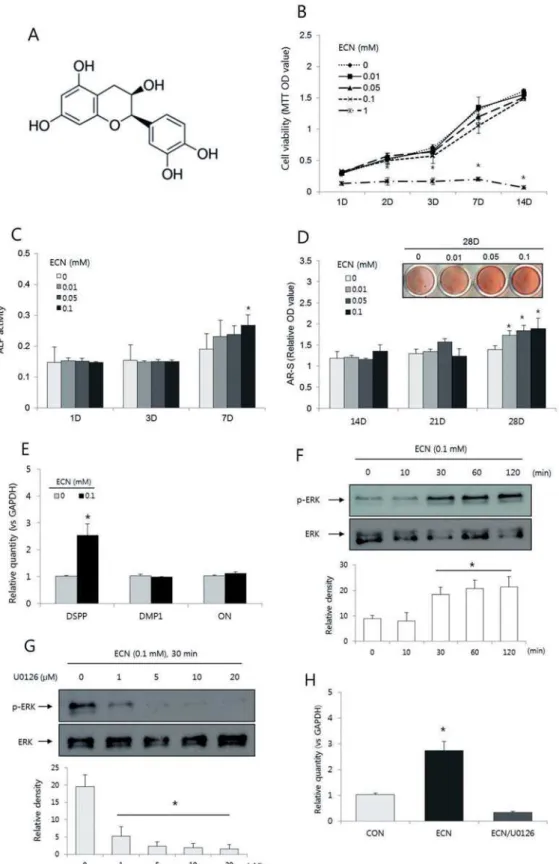
We evaluat ed t he effect s of ECN on cell viabilit y using an MTT assay. As show n in Figure 1B, hDPCs t r eat ed w it h 0.01, 0.05, or 0.1 m M of ECN did
QRWVKRZDQ\VWDWLVWLFDOO\VLJQL¿FDQWGLIIHUHQFHLQ
viabilit y com pared t o t he cells in t he cont rol group ( p> 0.05) . How ever, t he cells t reat ed w it h 1 m M of
(&1VKRZHGVLJQL¿FDQWO\ORZHUYLDELOLW\S
Based on t his result , w e select ed t he concent rat ion of 0.1 m M for use in t his st udy.
Alk a lin e ph osph a t a se ( ALP) a ct ivit y
Alk aline phosphat ase act iv it y w as m easur ed as an early m arker of odont ogenic different iat ion
RI K'3&V 7KHUH ZHUH QR VLJQL¿FDQW GLIIHUHQFHV
bet w een t he ECN- t r eat ed cells and cont r ol cells t hrough day 3 ( p> 0.05) . How ever, on day 7, t he ALP act ivit y increased in t he cells t reat ed w it h 0.1 m M of ECN ( p< 0.05) ( Figure 1C) .
Aliz a r in r e d S st a in in g
We e v a l u a t e d t h e m i n e r a l i z a t i o n o f t h e ext racellular m at rix using alizarin red S st aining. The form at ion of m ineralized nodules in t he
ECN-WUHDWHGFHOOVZDVVLJQL¿FDQWO\KLJKHUWKDQWKDWLQWKH
cont rol group cells on day 28 ( p< 0.05; Figure 1D) .
Ex p r e ssi o n o f o d o n t o g e n i c m a r k e r s i n h D PCs p e r se
Den t in sialop h osp h op r ot ein , DMP1 , an d ON served as odont ogenic m arkers. As shown in Figure 1E, t he expression of DSPP m RNA increased in t he presence of 0.1 m M of ECN on day 7.
Effe ct of t h e ERK in h ibit or on ECN - in du ce d odon t oge n ic m a r k e r e x pr e ssion
Epicat echin ( 0.1 m M) caused t he accum ulat ion of p- ERK in hDPCs w it hin 30 m in of t r eat m ent
)LJXUH)$VVKRZQLQ)LJXUH*Nj0RI8
effect ively blocked t he expression of p- ERK aft er 3 0 m in . To addr ess w h et h er t h e ERK pat h w ay
LQÀXHQFHV RGRQWRJHQLF GLIIHUHQWLDWLRQ UHDOWLPH
PCR was perform ed on hDPCs t reat ed w it h 0.1 m M
(&1LQPHGLXPZLWKRUZLWKRXWNj08IRU
days. The result s show ed t he expression of DSPP
GHFUHDVHG VLJQL¿FDQWO\ ZLWK 8 WUHDWPHQW LQ
ECN- t reat ed hDPCs ( Figure 1H) .
Ce ll n u m be r m e a su r e m e n t
Cell n u m b er s w er e m easu r ed u n d er op t ical
)LJXUHV$DQG%DQGÀXRUHVFHQFHPLFURVFRSHV
( Figures 2C and D) . The num ber of cells in t he
ECN-WUHDWHGFURVVOLQNHGJURXSZDVVLJQL¿FDQWO\KLJKHU
t han t hat of t he unt reat ed cont rol group ( p< 0.05; Figure 2E) .
Ex p r e ssi o n o f o d o n t o g e n i c m a r k e r s i n h D PCs cu lt u r e d in colla ge n sca ffolds
We assessed w het her t he collagen crosslinking using ECN prom ot ed t he expression of odont ogenic m arkers in hDPCs cult ured in collagen scaffolds. As shown in Figure 2F, t he expression of DSPP m RNA was higher in t he cells cult ured in t he ECN- t reat ed collagen com pared t o t he cells in t he cont rol group ( p< 0.05) .
Se t t in g t im e a n d com pr e ssive st r e n gt h
The set t ing t im es of t he ECN- t reat ed collagens
ZHUHVLJQL¿FDQWO\ORZHUWKDQWKRVHRIWKHXQWUHDWHG
cont r ols ( p< 0. 05; Figur e 3A) . The com pr essiv e st rengt h of t he cross- linked collagen increased in a dose- dependent m anner. How ever, only t he 0.1
P0(&1JURXSH[KLELWHGDVLJQL¿FDQWGLIIHUHQFHLQ
com pressive st rengt h com pared t o t he unt reat ed cont rol group ( p< 0.05; Figure 3B) .
D iffe r e n t ia l sca n n in g ca lor im e t r y
Different ial scanning calorim et ry st udies w ere u n d er t ak en t o ev alu at e t h e t h er m al b eh av ior of collagen scaffolds, and t he t her m ogram s ar e displayed in Figur e 3C. The t her m ogram of t he uncrosslinked collagen exhibit ed an endot herm ic shar p peak at 75.41° C due t o it s denat urat ion,
ZKHUHDVWKHFROODJHQFURVVOLQNHGZLWKNj0(&1
Figure 1- Effects of epicatechin (ECN) on odontogenic differentiation of human dental pulp cells (hDPCs). (A) Chemical structure of ECN. Effects of ECN on cell viability measured by the MTT assay (B), the ALP activity (C), and the formation
RIFDOFL¿FDWLRQQRGXOHV'LQK'3&V$VLJQL¿FDQWGLIIHUHQFHFRPSDUHGZLWKWKHFRQWUROZDVGHWHUPLQHGDWS(
Effects of ECN on the expression of DSPP, DMP1, and ON mRNA in hDPCs cultured for 7 days. (F) p-ERK expression
LQFUHDVHGZLWKLQPLQXWHV*S(5.H[SUHVVLRQZDVHIIHFWLYHO\EORFNHGE\ȝ0RI8+7KHH[SUHVVLRQOHYHORI '633P51$LQGXFHGE\(&1P0ZDVEORFNHGE\8ȝ0DIWHUGD\V7KHUHODWLYHOHYHOVRIJHQHH[SUHVVLRQ ZHUHQRUPDOL]HGDJDLQVW*$3'+DQGWKHFRQWUROOHYHOZDVVHWDV6LJQL¿FDQWGLIIHUHQFHFRPSDUHGZLWKWKHFRQWURO
D I SCUSSI ON
Crosslinking of collagen scaffolds is considered a favorable t echnique because it enhances m any
EHQH¿FLDOSURSHUWLHVRIWKHVFDIIROGDQGPD\SURYLGH
som e advant ages concerning cell grow t h and fat e. Recent ly, several nat uropat hic m edicines are gaining at t ent ion for collagen crosslinking because of t heir low cyt ot oxicit y com pared t o glut araldehyde2,3,5,11,13.
Am ong t hese, ECN and it s derivat ives have been report ed for having various pharm acologic funct ions
LQFOXGLQJDQWLLQÀDPPDWRU\DQGDQWLFDQFHUHIIHFWV
Ho w ev er, t h er e w a s n o p r ev i o u s i n f o r m a t i o n regarding t he odont ogenic effect of ECN in pulp cells for dent in- pulp com plex engineering. Therefore, we invest igat ed w het her ECN, a collagen cross- linking agen t , pr om ot ed odon t ogen ic differ en t iat ion of
hDPCs.
We e x a m i n e d t h e e f f e ct s o f ECN o n t h e odont ogenic different iat ion of hDPCs in t his st udy. Tr eat m en t w it h 0 . 1 m M of ECN in cr eased ALP act ivit y, calcium nodule form at ion, and expression
RI '633 P51$ ZKLFK LV FRQVLGHUHG D VSHFL¿F
b ioch em ical m ar k er of f u n ct ion al od on t ob last s ( Figure 1C- E) .1 Zeng, et al.23 ( 2014) dem onst rat ed
t h e ECN p r o m o t e d o st e o b l a st d i f f e r e n t i a t i o n
DQG PLJKW KDYH EHQH¿FLDO HIIHFWV RQ ERQH ORVV
prevent ion. Wei, et al.21 ( 2011) also show ed t he
cat echin st im ulat es ost eogenesis in m esenchym al st em cells. Fu r t h er m or e, Kw on , et al.1 3 ( 2 0 1 5 )
r ecen t ly in t r od u ced g en ip in , an ot h er collag en crosslinking agent , w hich has st im ulat ory effect s on odont ogenic different iat ion, and suggest ed t hat cross- linking of collagen m ay be advant ageous for pulp- denin com plex regenerat ion. I n t his respect , Figure 2- Proliferation analysis of human dental pulp cells (hDPCs) cultured in collagen scaffolds. Optical microscopic views of hDPCs cultured in untreated (A) and epicatechin (ECN)-treated collagen matrices (B) (×200). Representative
ÀXRUHVFHQFHPLFURVFRS\LPDJHVîVKRZLQJK'3&VVWDLQHGZLWK'$3,JURZLQJLQWKHFROODJHQVFDIIROGDIWHUGD\VRI
culture in the absence (C) or presence (D) of epicatechin. (E) Effects of ECN-induced crosslinking on proliferation of hDPCs
FXOWXUHGLQFROODJHQ20RSWLFDOPLFURVFRSH)0ÀXRUHVFHQFHPLFURVFRSH)7KHHIIHFWVRI(&1RQWKHH[SUHVVLRQRI
DSPP, DMP1, and ON mRNAs in hDPCs cultured in collagen scaffold for 7 days. The relative gene expression levels were
WKHDSSOLFDWLRQRI(&1PLJKWEHEHQH¿FLDOIRUWKH
odont ogenic different iat ion of hDPCs incorporat ed in collagen scaffolds for use in regenerat ive t herapy.
Then, we invest igat ed t he m echanism of ECN for t he different iat ion of hDPCs. Since t he ERK pat hway has been r epor t ed as an im por t ant m echanism for odont ogenic differ ent iat ion in hDPCs12- 14, w e
SRVWXODWHGWKDW(5.PLJKWSOD\DVLJQL¿FDQWUROH
in ECN- in du ced odon t ogen ic dif f er en t iat ion . As show n in Figure 1F, 0.1 m M of ECN increased t he phosphorylat ion of ERK wit hin 30 m in. Furt herm ore,
WKHEORFNLQJRIWKH(5.VLJQDOLQJE\8DVSHFL¿F
ant agonist of ERK, inhibit ed t he expression of DSPP, t he odont ology- relat ed gene t hat was upregulat ed by t reat m ent wit h ECN ( Figure 1H) . Based on t hese experim ent al result s, it is reasonable t o assum e t he ERK is a regulat or of t he ECN- induced odont ogenic different iat ion of hDPCs.
Next , w e evaluat ed t he effect of ECN t reat m ent on t he proliferat ion and different iat ion of hDPCs cult ured in collagen hydrogel scaffolds. As show n i n Fi g u r e 2 A- E, t h e n u m b e r o f ce l l s i n t h e cr osslin k ed gr ou p w as st at ist ically h igh er t h an t hat of t he uncr osslinked cont r ol gr oup. Sim ilar t o t he aforem ent ioned real- t im e PCR result s, t he ex pr ession of DSPP w as in cr eased in t h e cells cult ur ed in ECN- t r eat ed collagen com par ed w it h t he cells in unt reat ed collagen ( Figure 2F) . I n t his st udy, t wo different t ypes of m icroscopes were used t o accurat ely count t he cell num bers. Act ually, it is
Figure 3- Setting time (A) and compressive strength (B) of collagen in the presence of various concentrations of epicatechin
(&1 & 'LIIHUHQWLDO VFDQQLQJ FDORULPHWULF FXUYHV RI XQFURVVOLQNHG DQG FURVVOLQNHG FROODJHQ VFDIIROGV 6LJQL¿FDQW
difference compared with control (p<0.05)
GLI¿FXOWWRFRXQWFHOOVFXOWXUHGLQFROODJHQVFDIIROGV
using opt ical m icroscopes because of t he overlying collagen. To solve t his problem , t hese cells w ere st ained w it h DAPI t o increase t heir cont rast w it h t he scaffolds. We double- checked t he effect of ECN on t he proliferat ion of hDPCs using t w o different m icroscopes, and t he result s were sim ilar. Alt hough t he effect of ECN on t he different iat ion of hDPCs was predict able, t he reason for t he increasing in cell grow t h is not clear.
We h y p o t h esi zed t h a t t h e q u i ck er set t i n g t im e and enhanced m echanical propert ies of t he crosslinked collagen cont ribut ed t o t he increased cell proliferat ion. To verify t his hypot hesis, set t ing t im es and com pressive st rengt hs were assessed as m echanical propert ies. We found t he set t ing t im e
ZDVVLJQL¿FDQWO\VKRUWHQHGE\WUHDWLQJWKHFROODJHQ
w it h ECN ( Figure 3A) . The gel phase of hydrogel provides a m ore suit able environm ent for cells t o at t ach and grow com pared t o t he sol phase. The fast er conversion of collagen hydrogel int o t he gel phase m ight pr ov ide m or e oppor t unit ies for t he cells t o at t ach t o t he subst rat e. Furt herm ore, t he com pr essiv e st r en gt h s of ECN- t r eat ed collagen scaffolds w ere higher t han t hose of t he unt reat ed collagen, increasing in a dose- dependent m anner ( Figure 3B) . Mechanical propert ies are im port ant for m aint aining a t hree- dim ensional archit ect ure for cell at t achm ent and m igrat ion20. Zoldan, et al.24
im port ant role in st em cell different iat ion. As t he addit ion of m or e cr osslin k in g agen t s im pr ov es t he m echanical pr oper t ies of collagen scaffolds, t h is m ig h t con t r ib u t e t o cell p r olif er at ion an d different iat ion13. According t o t he previous st udies
and t he current result s, w e suggest t hat a quicker set t ing t im e and increased com pressive st rengt h of collagen scaf f olds, w h ich w er e ach iev ed by
(&1LQGXFHG FURVVOLQNLQJ DUH EHQH¿FLDO WR WKH
proliferat ion and different iat ion of hDPCs.
Last ly, DSC m easur em ent w as per for m ed t o in v est ig at e t h e t h er m al b eh av ior of collag en scaf f olds. Th e den at u r at ion poin t is a phy sical p a r a m e t e r u se d t o i d e n t i f y t h e n a t u r e o f a subst ance. As show n in DSC result s ( Figure 3C) ,
WKH HQWKDOS\ RI VDPSOHV GHQDWXUDWLRQ ¨+ ZDV
det er m ined by t he peak in t he DSC cur ve. The higher m elt ing peak in t he cr osslinked collagen sam ples indicat es t he sam ples consum ed m or e ener gy for denat urat ion t han t he uncr osslinked collagen sam ples. Ther efor e, t he applicat ion of ECN in t o t h e scaf f olds st abilizes t h e su bst r at e based on t he m olecular int eract ion bet w een t he collagen and ECN, and t his st abilizat ion increases cell pr oliferat ion along w it h t he afor em ent ioned m echanism s. I n addit ion, t his propert y m ight be
EHQH¿FLDOIRUSUHYHQWLQJWKHGHJUDGDWLRQRIFROODJHQ
scaffolds used in fut ure in vivo st udies.
CON CLUSI ON S
Collect ively, our result s suggest t he crosslinking o f co l l a g e n w i t h ECN p o si t i v e l y a f f e ct s t h e at t achm ent , pr oliferat ion, and differ ent iat ion of hDPCs cult ured in collagen scaffolds, and t hat t his differ ent iat ion is r egulat ed by t he ERK signaling p at h w ay. Fu r t h er m or e, t h e en h an ced p h y sical propert ies of collagen hydrogel scaffolds induced by t he ECN t reat m ent m ight play im port ant roles in cell fat e such as proliferat ion and different iat ion. Ther efor e, w it hin t he lim it at ions of t he cur r ent st udy, t he crosslinking of collagen w it h ECN seem s t o b e b en ef i ci al f or t i ssu e en g i n eer i n g - b ased regenerat ive endodont ic t herapy.
ACKN OW LED GM EN TS
This paper was suppor t ed by t he Biom edical Re se a r ch I n st i t u t e o f t h e Ch o n b u k Na t i o n a l Universit y Hospit al in 2014.
7KHDXWKRUVGHQ\DQ\FRQÀLFWVRILQWHUHVW
Lim ES and Lim MJ cont ribut ed equally t o t his
ZRUNDV¿UVWDXWKRUV
Min KS and Lee KW cont ribut ed equally t o t his w ork as corresponding aut hors.
REFEREN CES
1- D’Souza RN, Bachm an T, Baum gardner KR, But ler WT, Lit z M. Charact erizat ion of cellular responses involved in reparat ive dent inogenesis in rat m olars. J Dent Res. 1995; 74: 702- 9. 2- Del Gaudio C, Baiguera S, Boieri M, Mazzant i B, Ribat t i D, Bianco A, et al. I nduct ion of angiogenesis using VEGF releasing g en ip in - cr osslin k ed elect r osp u n g elat in m at s. Biom at er ials. 2013; 34: 7754- 65.
3- Fat him a NN, Dhat hat hreyan A, Ram asam i T, Krägel J, Miller R. Degree of crosslinking of collagen at int erfaces: adhesion and shear rheological indicat ors. I nt J Biol Macrom ol. 2011; 48: 67- 73.
)UDJD&*2WHL]D3,'LHWDU\ÀDYRQRLGVUROHRIHSLFDWHFKLQ
and relat ed procyanidins in cell signaling. Free Radic Biol Med. 2011; 51: 813- 23.
5- Frohbergh ME, Kat sm an A, Bot t a GP, Lazarovici P, Schauer CL, Wegst UG, et al. Elect rospun hydroxyapat it e- cont aining chit osan
QDQR¿EHUVFURVVOLQNHGZLWKJHQLSLQIRUERQHWLVVXHHQJLQHHULQJ
Biom at erials. 2012; 33: 9167- 78.
6 - Gol d b er g M, Ku l k ar n i AB, You n g M, Bosk ey A. Den t i n : st ruct ure, com posit ion and m ineralizat ion. Front Biosci ( Elit e Ed) . 2011; 3: 711- 35.
7- Gut ierrez- Salm ean G, Ciaraldi TP, Nogueira L, Barboza J, Taub PR, Hogan MC, et al. Effect s of ( - ) - epicat echin on m olecular m odulat ors of skelet al m uscle grow t h and different iat ion. J Nut r Biochem . 2014; 25: 91- 4.
8- Henning SM, Aronson W, Niu Y, Conde F, Lee NH, Seeram NP, et
DO7HDSRO\SKHQROVDQGWKHDÀDYLQVDUHSUHVHQWLQSURVWDWHWLVVXH
of hum ans and m ice aft er green and black t ea consum pt ion. J Nut r. 2006; 136: 1839- 43.
9- Huang GP, Shanm ugasundaram S, Masih P, Pandya D, Am ara S, Collins G, et al. An invest igat ion of com m on crosslinking agent s on t he st abilit y of elect rospun collagen scaffolds. J Biom ed Mat er Res A. 2015; 103: 762- 71.
1 0 - I w ay a SI , I k aw a M, Ku b ot a M. Rev ascu lar izat ion of an im m at ure perm anent t oot h w it h apical periodont it is and sinus t ract . Dent Traum at ol. 2001; 17: 185- 7.
11- Jaiswal M, Gupt a A, Agrawa AK, Jassal M, Dinda AK, Koul
9 %LOD\HU FRPSRVLWH GUHVVLQJ RI JHODWLQ QDQR¿EURXV PDW DQG
poly vinyl alcohol hydrogel for drug delivery and w ound healing applicat ion: in- vit ro and in- vivo st udies. J Biom ed Nanot echnol. 2013; 9: 1495- 508.
12- Karanxha L, Park SJ, Son WJ, Nör JE, Min KS. Com bined effect s of sim vast at in and enam el m at r ix der ivat ive on odont oblast ic different iat ion of hum an dent al pulp cells. J Endod. 2013; 39: 76-82.
13- Kwon YS, Lim ES, Kim HM, Hwang YC, Lee KW, Min KS. Genipin, a cr oss- linking agent , pr om ot es odont ogenic differ ent iat ion of hum an dent al pulp cells. J Endod. 2015; 41: 501- 7.
14- Lee YM, Shin SY, Jue SS, Kwon I K, Cho EH, Cho ES, et al. The role of PI N1 on odont ogenic and adipogenic different iat ion in hum an dent al pulp st em cells. St em Cells Dev. 2014; 23: 618- 30. 15- Liu Y, Bai X, Li S, Liu Y, Keight ley A, Wang Y. Molecular w eight and galloylat ion affect grape seed ext ract const it uent s’ abilit y t o cross- link dent in collagen in clinically relevant t im e. Dent Mat er. 2015; 31: 814- 21.
16- Low ry OH, Robert s NR, Wu ML, Hixon WS, Crawford EJ. The quant it at ive hist ochem ist ry of brain. I I . Enzym e m easurem ent s. J Biol Chem . 1954; 207: 19- 37.
17- Nakanishi T, Mukai K, Yum ot o H, Hirao K, Hosokawa Y, Mat suo
7$QWLLQÀDPPDWRU\HIIHFWRIFDWHFKLQRQFXOWXUHGKXPDQGHQWDO
pulp cells affect ed by bact eria- derived fact ors. Eur J Oral Sci. 2010; 118: 145- 50.
18- Park SJ, Li Z, Hwang I N, Huh KM, Min KS. Glycol chit in- based t herm oresponsive hydrogel scaffold supplem ent ed w it h enam el m at rix derivat ive prom ot es odont ogenic different iat ion of hum an dent al pulp cells. J Endod. 2013; 39: 1001- 7.
20- Tierney CM, Haugh MG, Liedl J, Mulcahy F, Hayes B, O’Brien FJ. The effect s of collagen concent rat ion and crosslink densit y on t he biological, st ruct ural and m echanical propert ies of collagen-GAG scaffolds for bone t issue engineering. J Mech Behav Biom ed Mat er. 2009; 2: 202- 9.
21- Wei YJ, Tsai KS, Lin LC, Lee YT, Chi CW, Chang MC, et al. Cat echin st im ulat es ost eogenesis by enhancing PP2A act ivit y in hum an m esenchym al st em cells. Ost eoporos I nt . 2011; 22: 1469-79.
22- Wigler R, Kaufm an AY, Lin S, St einbock N, Hazan- Molina H, Torneck CD. Revascularizat ion: a t reat m ent for perm anent t eet h wit h necrot ic pulp and incom plet e root . J Endod. 2013; 39: 319- 26.
23- Zeng X, Tian J, Cai K, Wu X, Wang Y, Zheng Y, et al. Prom ot ing
RVWHREODVWGLIIHUHQWLDWLRQE\WKHÀDYDQHVIURP+XDQJVKDQ0DRIHQJ
t ea is linked t o a reduct ion of oxidat ive st ress. Phyt om edicine. 2014; 21: 217- 24.
24- Zoldan J, Karagiannis ED, Lee CY, Anderson DG, Langer R,
/HYHEHUJ 6 7KH LQÀXHQFH RI VFDIIROG HODVWLFLW\ RQ JHUP OD\HU