
ABSTRACT
I n f lu en ce of pH, bleach in g agen t s, an d acid
et ching on surface w ear of bovine enam el
Ana Flávia SOARES1, Juliana Fraga Soares BOMBONATTI1 0DULQD 6WXGDUW $/(1&$51 (ODLQH &ULVWLQD &2162/0$*121+HLWRU0DUTXHV+21Ï5,22, Rafael Francisco Lia MONDELLI2
1- Universidade de São Paulo, Faculdade de Odontologia de Bauru, Departamento de Dentística, Endodontia e Materiais Odontológicos, Bauru, SP, Brasil. 2- Universidade de São Paulo, Faculdade de Odontologia de Bauru, Departamento de Odontopediatria, Ortodontia e Saúde Coletiva, Bauru, SP, Brasil.
&RUUHVSRQGLQJDGGUHVVRafael Francisco Lia Mondelli - Al. Dr. Octávio Pinheiro Brisolla, 9-75 - Bauru - SP - 17012-901 - C.P. 73 - Brazil - Phone: 55xx 14 3235-8265 - 55xx 14 98156-4686 - e-mail: [email protected]
6XEPLWWHG-XQH0RGL¿FDWLRQ6HSWHPEHU$FFHSWHG6HSWHPEHU
D
HYHORSPHQW RI QHZ PDWHULDOV IRU WRRWK EOHDFKLQJ MXVWL¿HV WKH QHHG IRU VWXGLHV WRevaluat e t he changes in t he enam el surface caused by different bleaching prot ocols. Obj ect ive: The aim of t his st udy was t o evaluat e t he bovine dent al enam el w ear in funct ion of different bleaching gel prot ocols, acid et ching and pH variat ion. Mat erial and Met hods: Sixt y fragm ent s of bovine t eet h w ere cut , obt aining a cont rol and t est areas. I n t he t est area, one half received et ching follow ed by a bleaching gel applicat ion, and t he ot her half, only t he bleaching gel. The fragm ent s w ere random ly divided int o six groups ( n= 10) ,HDFKRQHUHFHLYHGRQHEOHDFKLQJVHVVLRQZLWK¿YHK\GURJHQSHUR[LGHJHODSSOLFDWLRQVRI
m in, act ivat ed w it h hybrid light , diode laser/ blue LED ( HL) or diode laser/ violet LED ( VHL)
H[SHULPHQWDO&RQWURO&7RWDO%ODQF2I¿FH7%2+//DVH3HUR[LGH6HQV\
( LPS35HL) ; 25% Lase Peroxide Sensy I I ( LPS25HL) ; 15% Lase Peroxide Lit e ( LPL15HL) ; and 10% hydrogen peroxide ( experim ent al) ( EXP10VHL) . pH values w ere det erm ined
E\DS+PHWHUDWWKHLQLWLDODQG¿QDOWLPHSHULRGV6SHFLPHQVZHUHVWRUHGVXEMHFWHGWR VLPXODWHGEUXVKLQJF\FOHVDQGWKHVXSHU¿FLDOZHDUZDVGHWHUPLQHGNjP$129$DQG
Tukey´ s t est s w ere applied (D= 0.05) . Result s: The pH show ed a slight decrease, except for Group LPL15HL. Group LPS25HL show ed t he highest degree of w ear, w it h and w it hout
HWFKLQJ&RQFOXVLRQ7KHUHZDVDGHFUHDVHIURPWKHLQLWLDOWRWKH¿QDOS+'LIIHUHQWEOHDFKLQJ
gels w ere able t o increase t he surface w ear values aft er sim ulat ed brushing. Acid et ching before bleaching increased surface w ear values in all groups.
Ke yw or ds: Toot h bleaching. Dent al acid et ching. Hydrogen- ion concent rat ion. Toot h wear.
I N TROD UCTI ON
Am ong t he t echniques t o reest ablish t he good aest het ics for discolor ed v it al t eet h, v it al t oot h bleaching is a m ore conservat ive and less invasive alt er nat ive t han dir ect and indir ect convent ional rest orat ion t echniques and has been w ell accept ed am ong pat ient s because t hey consider it a safe and effect ive t echnique22. The effect iveness of dent al EOHDFKLQJ LV LQÀXHQFHG E\ VHYHUDO IDFWRUV VXFK
as t he bleaching sy st em used, bleaching agent concent rat ion, applicat ion t im e and t he applicat ion of light1,16,26.
Lig h t sou r ces can b e u sed t o op t im ize t h e bleach in g pr ocedu r e in an at t em pt t o in cr ease t he rat es of peroxide dissociat ion and reduce t he
bleaching session2,7,16. Analyzing t he bovine enam el
w ear caused by different bleaching t echniques, t he
XVH RI D OLJKW VRXUFH GLG QRW LQÀXHQFH WKH WRRWK
enam el wear because sim ilar result s were obt ained wit h and wit hout light sources13,23. I n addit ion t o t he
above- m ent ioned fact ors, t he pH of t he bleaching agent s19 and acid et ching before t reat m ent6,12,16,25 DUH DOVR IDFWRUV WKDW FDQ GLUHFWO\ LQÀXHQFH WKH
w hit ening process. At t he present , m anufact urers have show n concern about t he acidit y of bleaching gels because a pH below t he crit ical point ( pH 5.5 t o 6.5)21 m ay result in t he dissolut ion of enam el,
m icrohardness alt erat ions14, increased sensit ivit y,
increased enam el w ear and surface roughness13,23.
bleaching gel and, consequent ly, t oot h bleaching16,
t he acid et ching t echnique can be used befor e t he bleaching pr ocedur e6. This t echnique w or k s
by pr oducing changes in t he enam el sur face in t w o dist in ct w ay s. Fir st , t h e acid r em ov es t h e surface layer and, consequent ly, t he plaque and a cq u i r ed f i l m a r e r em ov ed a n d , seco n d , t h e rem aining enam el wit h a m ore porous surface layer is also r em oved20.A gr eat er abilit y for per ox ide
penet rat ion was obt ained w hen t he previous acid et ching was per for m ed w it h a light sour ce6. An
increasing num ber of t oot h- bleaching product s are com m ercially available w it h different com posit ions and concent rat ions11, and now aday s, t her e is a
t rend t owards decreasing t he gels’ concent rat ion values and diver sify ing t heir for m ulat ions1,3,23,24. 7KHGHYHORSPHQWRIWKHVHQHZPDWHULDOVMXVWL¿HV
t he need for st udies t o evaluat e t he changes in t he enam el surface caused by different bleaching prot ocols.
Th u s, t h e aim of t h is in v it r o st u dy w as t o evaluat e t he bovine dent al enam el wear in funct ion of different bleaching gel prot ocols, t he acid et ching and pH variat ion.
M ATERI AL AN D M ETH OD S
This is an in v it r o st udy, and t he experim ent al design for pH analisys was divided int o t w o st udy
IDFWRUVEOHDFKLQJDJHQW>LQ¿YHOHYHOVEOHDFKLQJ
agent s based on hydrogen peroxide ( H2O2) , t w o at 35% , one at 25% , one at 15% , and one at 10% ] and t im e periods ( at t w o levels: before and aft er bleaching) . Wear analysis consist ed of one st udy
fact or: t reat m ent [ in 11 levels: Cont rol ( did not receive t he acid et ching and bleaching gel) , and t w o at H2O2 35% , one at 25% , one at 15% , and one at 10% , wit h or wit hout acid et ching] . Different
OLJKWVRXUFHVHPSOR\HGZHUHQRWFODVVL¿HGDVVWXG\
f act or s becau se dif f er en t bleach in g t r eat m en t s use different light sources follow ing t he prot ocol indicat ed by t he m anufact urer. The cont rol group
DQG ¿YH H[SHULPHQWDO JURXSV DUH GHVFULEHG LQ
Figure 1.
M a t e r ia l
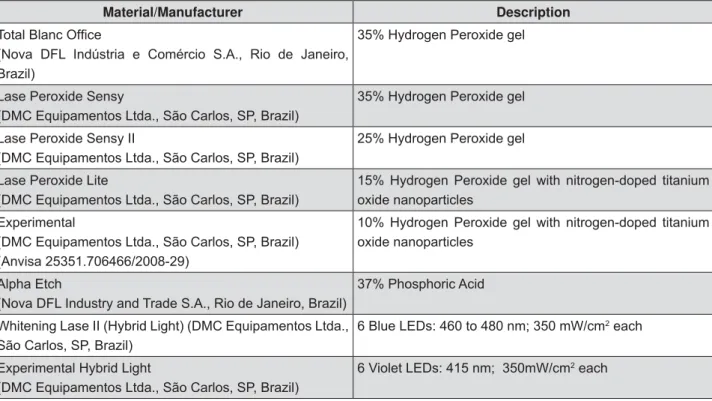
The m at er ials and equipm ent s used for t his st udy are out lined in Figure 1.
M e t h ods
Spe cim e n pr e pa r a t ion
A t ot al of 60 bovine m andibular cent ral incisors w er e chosen for t he st udy. They w er e cut int o rect angular shapes and em bedded in slow- set t ing
DFU\OLF UHVLQ EORFNV [[ PP $ ÀDW HQDPHO
surface was produced by w et polishing w it h 320, 400, 600 and 1200- gr it silicon car bide abrasive papers. To cont rol t he individual variat ion in t he enam el surface charact erist ics am ong t he t est ed t eet h, each specim en was divided int o t w o halves, pr ov idin g a con t r ol ar ea an d a t est ar ea1 3 , 1 8 , 2 3.
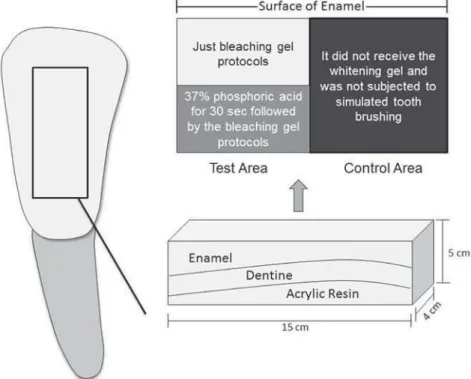
The t est area was furt her divided, w it h one- half receiving 37% phosphoric acid ( Alpha Et ch; Nova DFL I ndúst r ia e Com ér cio S. A., Rio de Janeir o, Brazil) for 30 seconds follow ed by t he bleaching gel prot ocols, and t he ot her half receiving only t he bleaching gel prot ocols ( Figure 3) .
Material/Manufacturer Description
(Nova DFL Indústria e Comércio S.A., Rio de Janeiro, Brazil)
35% Hydrogen Peroxide gel
Lase Peroxide Sensy
(DMC Equipamentos Ltda., São Carlos, SP, Brazil)
35% Hydrogen Peroxide gel
Lase Peroxide Sensy II
(DMC Equipamentos Ltda., São Carlos, SP, Brazil)
25% Hydrogen Peroxide gel
Lase Peroxide Lite
(DMC Equipamentos Ltda., São Carlos, SP, Brazil)
15% Hydrogen Peroxide gel with nitrogen-doped titanium oxide nanoparticles
Experimental
(DMC Equipamentos Ltda., São Carlos, SP, Brazil) (Anvisa 25351.706466/2008-29)
10% Hydrogen Peroxide gel with nitrogen-doped titanium oxide nanoparticles
Alpha Etch
(Nova DFL Industry and Trade S.A., Rio de Janeiro, Brazil)
37% Phosphoric Acid
Whitening Lase II (Hybrid Light) (DMC Equipamentos Ltda., São Carlos, SP, Brazil)
6 Blue LEDs: 460 to 480 nm; 350 mW/cm2 each
Experimental Hybrid Light
(DMC Equipamentos Ltda., São Carlos, SP, Brazil)
6 Violet LEDs: 415 nm; 350mW/cm2 each
Ble a ch in g pr oce du r e
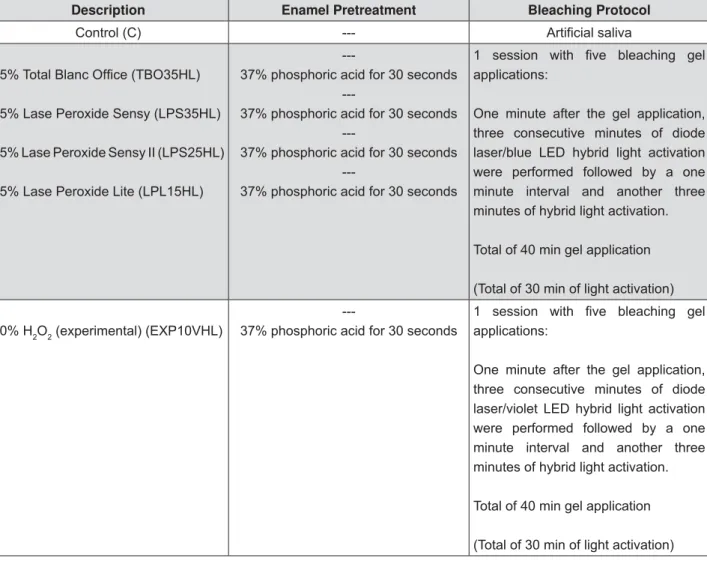
The specim ens w ere random ly divided int o six groups ( n= 10) described in Figure 2.
M e a sur e m e nt of pH le ve ls of ble a ching ge ls
To analyze t he pH levels of t he bleaching gels, a port able pHm et er wit h a digit al display ( Model 1001 Sent ron, Sent ron, WA, USA) was used. This device has an elect rode of sm all dim ensions, com pat ible w it h t he size of t he specim en. I t could m ake a readout w it h an accuracy of 0.01 in a few seconds and w it h m inim al wast e of bleaching gel. Before beginning each gr oup of r eadout s, t he pHm et er was calibrat ed w it h double st andar d subst ances
S+DQG7KHLQLWLDODQG¿QDOS+OHYHOVRI
t he bleaching gels w ere obt ained from t he average
RIUHDGLQJVIRUHDFKRIWKH¿YHDSSOLFDWLRQVRIWKH EOHDFKLQJJHOWRWKHWRRWKVXUIDFH7KH¿UVWUHDGRXW
was t aken 30 seconds aft er t he cont act bet w een t he bleaching gel and t he bov ine enam el, and, t he second readout , 30 seconds aft er t he end of t he t im e used, w it h act ivat ion w it h a hybrid light source23.
Br u sh in g a br a sion
All t est ar eas, of t h e 6 0 st u died specim en s
( d i v i d ed i n t o si x g r o u p s) , w er e su b j ect ed t o sim u lat ed t oot h b r u sh in g . Th e t oot h - b r u sh in g m ach in e r em ain ed in a con t r olled t em per at u r e o f 3 7 ± 2 ° C w i t h so f t n y l o n b r i st l e s ( Co l g a t e Classic CLEAN, Colgat e Palm olive I ndust rial Lt da., Osasco, SP, Brazil) , applying a load of 300 gram s on t he sam ples. Slur r y was pr epar ed by m ixing 2: 1 of deionized wat er and Colgat e MFP ( Colgat e Palm olive, Osasco, SP, Brazil) dent ifrice by w eight im m ediat ely before t est ing. One hundred t housand brushing st rokes were perform ed for each specim en and t he br ist les w er e changed at t he half- cycle point . Aft er t est ing, t he specim ens w er e r insed under running wat er and cleaned in a sonic device ( Crist ófoli Biosafet y Equipm ent Lt da., Londrina, PR, Brazil) in deionized wat er for 10 m inut es, and t hen st ored in fresh deionized wat er ( 37± 2° C)13,15,18,23.
W e a r de t e r m in a t ion
:HDUZDVTXDQWL¿HGE\PHDQVRIDURXJKQHVV
m e t e r ( H o m m e l w e r k e Gm b H r e f. # 2 4 0 8 5 1 , Schwenningen, Germ any) connect ed t o a PC w it h
DVSHFL¿FVRIWZDUHSURJUDPWRSURYLGHWKHSUR¿OHV
of t he surfaces t est ed. For each segm ent of t he specim en, six m easurem ent s w ere carried out at
Description Enamel Pretreatment Bleaching Protocol
Control (C)
---35% Lase Peroxide Sensy (LPS35HL)
25% Lase Peroxide Sensy II (LPS25HL)
15% Lase Peroxide Lite (LPL15HL)
---37% phosphoric acid for 30 seconds
---37% phosphoric acid for 30 seconds
---37% phosphoric acid for 30 seconds
---37% phosphoric acid for 30 seconds
applications:
One minute after the gel application, three consecutive minutes of diode laser/blue LED hybrid light activation were performed followed by a one minute interval and another three minutes of hybrid light activation.
Total of 40 min gel application
(Total of 30 min of light activation)
10% H2O2 (experimental) (EXP10VHL)
---37% phosphoric acid for 30 seconds applications:
One minute after the gel application, three consecutive minutes of diode laser/violet LED hybrid light activation were performed followed by a one minute interval and another three minutes of hybrid light activation.
Total of 40 min gel application
(Total of 30 min of light activation)
random , t hree readout s w ere perform ed on each por t ion ( w it h or w it h ou t acid et ch in g) an d t h e m ean w ear value was calculat ed ( Figure 3) . These
SUR¿ORPHWULFWUDFHVZHUHWDNHQIURPWKHUHIHUHQFH
su r f a ce ( p r o t ect ed a r ea ) o n o n e si d e t o t h e opposit e one, crossing t he surface exposed t o t he experim ent al procedures. Thus, t he w ear readout
ZDVSHUIRUPHGE\WKHVXUIDFHSUR¿OHPHDVXULQJ
t he dist ance in m icr om et er s bet w een t he graph m idline, corresponding t o t he specim en plane line ( int act area) and t he deepest valley corresponding t o t he ground area8,13,18,23.
St a t ist ica l a n a lysis
For correlat ion analyses bet w een pH and w ear,
t h e Pear son cor r elat ion t est w as u sed. For pH an aly sis, t w o- w ay r ep eat ed m easu r es ANOVA follow ed by t he Tukey` s t est w ere used. For w ear, one- way ANOVA follow ed by t he Tukey’s t est w ere
SHUIRUPHG 7KH OHYHO RI VLJQL¿FDQFH RI ZDV
adopt ed.
RESULTS
Th er e w as n o cor r elat ion b et w een p H an d w ear. When analyzing t he pH values ( Table 1) , a
VWDWLVWLFDOO\VLJQL¿FDQWGHFUHDVHEHWZHHQWKHLQLWLDO DQG¿QDOS+ZDVQRWHGH[FHSWLQWKH/DVH
Peroxide Lit e act ivat ed w it h hybrid light group. The low est values w er e found in t he 35% hydr ogen
Groups Time of measurement Mean ± Standard Deviation*
TBO35HL Initial
Final
6.42±0.27A
6.01±0.11B
LPS35HL Initial
Final
7.08±0.25C
6.11±0.11B
LPS25HL Initial
Final
7.12±0.05C
6.42±0.08A
LPL15HL Initial
Final
7.59±0.08D
7.47±0.07D
EXP10VHL Initial
Final
9.23±0.05E
8.99±0.07F
Tukey´s method
Table
peroxide Groups act ivat ed w it h hybrid light at t he end of t he bleaching agent applicat ion. The group t hat show ed m ore alkaline was t he experim ent al 10% hydrogen peroxide Group wit h nit rogen- doped t it anium oxide nanopart icles, act ivat ed w it h violet hybrid light , w hich had a low er concent rat ion of
K\GURJHQ SHUR[LGH IRU ERWK WKH LQLWLDO DQG ¿QDO
m easurem ent s.
The one- w ay ANOVA t est for evaluat ing t he su r f a ce w e a r sh o w e d st a t i st i ca l l y si g n i f i ca n t differences bet w een t he t est ed groups ( p< 0.05) . Next , t he Tukey’s t est was applied for t he values obt ained ( Table 2) . All groups, except t he 35% Tot al
%ODQF 2I¿FH *URXS KDG D VWDWLVWLFDOO\ VLJQL¿FDQW
i n cr e a se w h e n a ci d e t ch i n g w a s p r e v i o u sl y perform ed. The low est w ear value was found in cont rol group ( Group C) , w hich did not undergo t he acid et ching and dent al bleaching, and t he 25% Lase Peroxide Sensy I I Group ( LPS25HL) w it h prior acid et ching show ed t he highest w ear value. The Group LPS25HL w it hout acid et ching show ed sim ilar result s ( p< 0.05) t o t he ot her groups w here t he et ching was done ( Figure 4) .
D I SCUSSI ON
Most st udies on dent al bleaching invest igat es t he m orphological changes in t he enam el10,13,14,23 and
t he pulp dam age5,17 caused by different t echniques,
how ever, t he changes caused by differences of t he bleaching gels’ pH is st ill cont r over sial23. I n t his
st udy w hen observing t he result s obt ained by pH analysis of bleaching agent s, one could conclude t hat t here was a t rend t owards a decrease in t he
PHDQS+YDOXHVEHWZHHQWKHLQLWLDODQG¿QDOWLPH
per iods, except for t he 15% Lase Per ox ide Lit e Group act ivat ed w it h hybrid light [diode laser/ blue
/('+//3/+/@ZKLFKVKRZHGQRVLJQL¿FDQW
differences ( Table 1) . Anot her im port ant fact t hat has already been described in t he lit erat ure23,27 and
corroborat es w it h t his st udy, is t hat t he higher t he concent rat ion of hydrogen peroxide, t he m ore acidic is t he pH in t he bleaching gels.
I n t h is st u d y, t h e EXP1 0 VHL ex p er im en t al gr ou p ( gel w it h n it r ogen - doped t it an iu m ox ide nanopar t icles) act ivat ed w it h hybr id light [ diode laser/ violet LED ( VHL) ( experim ent al) ] , present ed t he highest pH values in com parison t o t he ot her gr oups evaluat ed. The HL and VHL hy br id light so u r ce s e m p l o y e d t o a ct i v a t e t h e b l e a ch i n g gels pr esen t ed a m in im u m in cr ease ( less t h an 2 ° C) in p u lp ch am b er t em p er at u r e1, assu r in g
Figure 4- Graphic of mean (μm) and standard deviation of wear of the groups (C - without etching and without bleaching - and other groups with only bleaching or acid etching prior to bleaching)
Groups Mean ± Standard
Deviation*
C (no bleaching) 4.86±1.28A
TBO35HLB 10.47±1.58BD
TBO35HLA 12.49±1.60CDE
LPS35HLB 9.97±1.42BD
LPS35HLA 14.21±0.83C
LPS25HLB 13.85±1.71C
LPS25HLA 23.67±3.93F
LPL15HLB 9.80±1.52B
LPL15HLA 13.51±1.38CE
EXP10VHLB 11.13 ±0.82BDE
EXP10VHLA 14.70±0.40C
difference between lines, at the level of 5% calculated by the Tukey´s method
effect ive dent al bleaching w it h low pulp risk6. The
values obt ained for t he pH of hydrogen peroxide, regardless of t he group st udied, rem ained above t he level considered crit ical for enam el dissolut ion ( pH 5.5 t o 6.5)21. How ever, it was not ed t hat as t he
concent rat ion of t he gel dim inished, it s pH increased ( Table 1) . Therefore, t he pH of t hese bleaching gels is unlikely t o cause severe m orphological changes on t he surface of t he enam el.
Aci d co n d i t i o n i n g p r i o r t o b l e a ch i n g i s a procedure st ill used in dent al pract ice, how ever,
ERWKLWVHI¿FLHQF\DQGGDPDJHWRWKHWRRWKVWUXFWXUH
DUHVWLOOQRWFODUL¿HG$UHFHQWVWXG\6 show ed t hat
t here is no difference in t he color analysis w hen acid con dit ion in g is pr ev iou sly don e, added t o t his, t his st udy show ed an increased w ear due t o t he acid condit ioning w hen t he sam e bleaching gel concent rat ion was analyzed. Only t he Group TBO35HL show ed no increased w ear in t he area w it h acid et ching, in com par ison w it h t he ar ea t hat received only t he bleaching gel ( Table 2) . I n t he com parison bet w een groups, Group LPS25HL show ed t he highest w ear for t he area w it h acid et ching ( Table 2) .
Com paring t he cont rol group, w hich underw ent brushing cycles only, w it h t he ot her groups, it was
REVHUYHGWKDWWKHFRQWUROJURXSVKRZHGVLJQL¿FDQWO\
less w ear ( Table 2) t han t he experim ent al groups in t h e ar ea t r eat ed w it h bot h t h e acid et ch in g and bleaching gel and t he area t reat ed only w it h bleaching gel. Cert ainly, t hese differences in w ear are due t o t he changes caused by t he bleaching ag en t s on t h e d en t al en am el, r esu lt s alr ead y found in t he lit erat ure, in w hich t oot h- bleaching t ech n iqu es led t o in cr eased su r f ace r ou gh n ess and w ear if subj ect ed t o sim ulat ed t oot h brushing, w hen com pared w it h t he cont rol group t hat was only brushed13,16,23.
Not e t hat in t his st udy t he dent al bleaching m ay have left t he surface of t he bovine enam el m ore suscept ible t o wear caused by t he 100,000 sim ulat ed brushing cycles, w hich is in agreem ent w it h t he
¿QGLQJVLQWKHOLWHUDWXUHZKLFKFODLPVWKDWZKLWHQLQJ
m ak es t he enam el sur face m or e suscept ible t o a b r a si o n a n d m o r p h o l o g i ca l ch a n g es1 , 9 , 1 3 , 2 3 , 2 8.
The adopt ed sim ulat ed t oot h br ushing ( 100,000 sim ulat ed brushing cycles) caused w ear bet w een
NjPDQGNjPWKDWLVQRWFOLQLFDOO\VLJQL¿FDQW
because ot her fact ors cont ribut e t o t he loss of t his st ruct ure. These cycles are equivalent , on average, t o t w o years of brushing in v iv o4,15, a period t hat
was adopt ed for being considered as a safe int erval bet w een bleaching sessions.
The analysis of t his research’s result s, associat ed
ZLWK WKH ¿QGLQJV RI WKH OLWHUDWXUH DOORZHG WKH
evaluat ion t hat , in general, t he 25% Lase Peroxide Sensy I I Gr oup act ivat ed w it h hy br id light ( HL) ( diode laser/ blue LED) present ed t he highest w ear
values, causing gr eat er aggr ession t o t he t oot h st ruct ure. The acid et ching was m ore severe in all
JURXSVH[FHSWIRUWKH7RWDO%ODQF2I¿FH+/
Group. Alt hough a direct correlat ion was not found w it h t he result s of w ear, it was observed t hat t he low er t he bleaching gel concent rat ion, t he m ore alkaline it t ended t o be.
Acid et ching prior t o bleaching can be indicat ed
LQ FOLQLFDO VLWXDWLRQV ZKHUH WKHUH LV GLI¿FXOW\ LQ
obt aining sat isfact or y r esult s aft er at t em pt s by con v en t ion al w h it en in g t ech n iq u es, esp ecially in pat ient s w it h a high degr ee of pigm ent at ion, seek ing a gr eat er penet rat ion of t he gel t o t he e n a m e l . Ho w e v e r, f e w st u d i e s e v a l u a t e t h i s procedure and it s consequences, t hus j ust ifying t he obj ect ive of t his st udy, w hich, despit e being an in v it r o st udy, seeks t o answ er quest ions t hat m ay
assist in t he clinical pract ice of t he procedure. The result s of t his st udy show t hat et ching w it h 37% phosphoric acid can lead t o increased enam el wear, and should not be used as a rout ine procedure, only w hen necessary in an at t em pt t o avoid m ore invasive procedures such as cavit y preparat ion and product ion of indirect rest orat ions.
How ever, furt her st udies relat ed t o t he effect s of acid et ching, pH, and different concent rat ions
RI EOHDFKLQJ JHOV XVHG LQ RI¿FH DUH UHTXLUHG WR
ext rapolat e t he result s t o t he clinical cont ext .
CON CLUSI ON S
Wit hin t he lim it at ions of t his in v it r o st udy, t he following conclusions can be draw n:
There was a t rend t owards a decrease in t he init ial pH at t he end, except in t he Lase Peroxide Lit e 15% Group. There was no direct correlat ion bet w een t he values of pH and surface w ear.
Differ ent bleaching gels ar e able t o incr ease t he surface w ear values aft er sim ulat ed brushing, m ainly in t he Lase Peroxide Sensy 25% Group.
Acid et ch in g befor e bleach in g in cr eased t h e surface w ear values in all groups.
ACKN OW LED GEM EN TS
Th e au t h or s t h an k t h e Nat ion al Cou n cil f or
6FLHQWL¿FDQG7HFKQRORJLFDO'HYHORSPHQW&13T IRUWKH¿QDQFLDOVXSSRUW3URFHVV1R
7) .
REFEREN CES
1- Andreat t a LM, Soares AF, Bom bonat t i JF, Furuse AY, Mondelli 5),QÀXHQFHRIZKLWHQLQJJHODQGOLJKWVRXUFHRQSXOSFKDPEHU t em perat ure. RSBO. 2015; 12( 2) : 185- 90.
3 - Bor t olat t o JF, Pr et el H, Flor os MC, Luizzi AC, Dant as AA, )HUQDQGH] ( HW DO /RZ FRQFHQWUDWLRQ +27L2B1 LQ RI¿FH bleaching: a random ized clinical t r ial. J Dent Res. 2014; 93( 7 Suppl) : 66S- 71S.
4- Buchalla W, At t in T, Hellw ig E. Br ushing abrasion of lut ing cem en t s u n d er n eu t r al an d aci d i c co n d i t i o n s. Op er D en t . 2000; 25( 6) : 482- 7.
5- Cart agena AF, Parreiras SO, Loguercio AD, Reis A, Cam panha 1+,QRI¿FHEOHDFKLQJHIIHFWVRQWKHSXOSÀRZDQGWRRWKVHQVLWLYLW\ - case series. Braz Oral Res. [ I nt ernet ] . 2015 [ cit ed 2015 Oct 2 7 ] ; 2 9 ( 1 ) : 1 - 6 . Av ailable f r om : h t t p: / / w w w. scielo. br / scielo. php?scr ipt = sci_ar t t ex t &pid= S1806- 83242015000100223&lng= en&nrm = iso&t lng= en.
6- Cost a RC, Soares D, Sant os PD, Cint ra L, Briso A. Effect of different light sources and enam el precondit ioning on color change, H2O2 penet rat ion, and cyt ot oxicit y in bleached t eet h. Oper Dent . [ I nt ernet ] . 2015 [ cit ed 2015 Oct 27] . Available from : ht t p: / / www. j opdent online.org/ doi/ pdf/ 10.2341/ 14- 364- L.
7 - D'Ar ce MB, Lim a DA, Ag u iar FH, Am b r osan o GM, Mu n in E, Lov ad in o JR. Ev alu at ion of u lt r asou n d an d lig h t sou r ces as bleaching cat aly st s - an in v it r o st udy. Eur J Est het Dent . 2012; 7( 2) : 176- 84.
8- Honório HM, Rios D, Abdo RC, Machado MA. Effect of different prophylaxis m et hods on sound and dem ineralized enam el. J Appl Oral Sci. 2006; 14( 2) : 117- 23.
9- Josey AL, Meyer s I A, Rom aniuk K, Sy m ons AL. The effect of a v it al bleaching t echnique on enam el sur face m or phology and t he bonding of com posit e resin t o enam el. J Oral Rehabil. 1996; 23( 4) : 244- 50.
.ODULü ( 0DUFLXV 0 5LVWLü 0 6HYHU , 3UVNDOR . 7DUOH = Surface changes of enam el and dent in aft er t wo different bleaching procedures. Act a Clin Croat . 2013; 52( 4) : 419- 29.
11- Maj eed A, Farooq I , Grobler SR, Moola MH. I n v it r o evaluat ion of variances bet ween real and declared concent rat ion of hydrogen peroxide in various t oot h- whit ening product s. Act a Odont ol Scand. 2015: 73( 5) : 387- 90.
12- Mat is BA, Cochran MA, Franco M, Al- Am m ar W, Eckert GJ, 6WURSHV0(LJKWLQRI¿FHWRRWKZKLWHQLQJV\VWHPVHYDOXDWHGin v iv o: a pilot st udy. Oper Dent . 2007; 32( 4) : 322- 7.
13- Mondelli RF, Azev edo JF, Francisconi PA, I shik ir iam a SK, Mon d elli J. Wear an d su r f ace r ou g h n ess of b ov in e en am el subm it t ed t o bleaching. Eur J Est het Dent . 2009; 4( 4) : 396- 403. 14- Mondelli RF, Garrido Gabriel TR, Piola Rizzant e FA, Magalhães AC, Soares Bom bonat t i JF, I shikiriam a SK. Do different bleaching p r o t o co l s a f f e ct t h e e n a m e l m i cr o h a r d n e ss? Eu r J D e n t . 2015; 9( 1) : 25- 30.
15- Mondelli RF, Wang L, Garcia FC, Prakki A, Mondelli J, Franco EB, et al. Evaluat ion of w eight loss and sur face r oughness of com pom ers aft er sim ulat ed t oot hbrushing abrasion t est . J Appl Oral Sci. 2005; 13( 2) : 131- 5.
16- Mondelli RF, Alm eida CM, Toledo FL, Freit as CA, I shikiriam a SK. 3XOSHGWHHWKLQRI¿FHGHQWDOEOHDFKLQJZLWKDQGZLWKRXWSUHYLRXV enam el acid et ching: clinical case report . Rev Dent al Press Est ét . 2009; 6( 2) : 42- 51.
17- Pint ado- Palom ino K, Peit l Filho O, Zanot t o ED, Tirapelli C. A clinical, random ized, cont rolled st udy on t he use of desensit izing agent s during t oot h bleaching. J Dent . 2015; 43( 9) : 1099- 105. 18- Prakki A, Cilli R, Mondelli RF, Kalachandra S. I n v it r o w ear, su r face r ou gh n ess an d h ar dn ess of pr opan al- con t ain in g an d diacet yl- cont aining novel com posit es and copolym ers based on bis- GMA analogs. Dent Mat er. 2008; 24( 3) : 410- 7.
19- Sa Y, Chen D, Liu Y, Wen W, Xu M, Jiang T, et al. Effect s of WZRLQRI¿FHEOHDFKLQJDJHQWVZLWKGLIIHUHQWS+YDOXHVRQHQDPHO surface st ruct ure and color: an in sit uv s. in v it r o st udy. J Dent . 2012; 40( Suppl 1) : e26- 34.
20- Silverst one LM. Fissure sealant s. Laborat ory st udies. Caries Res. 1974; 8( 1) : 2- 26.
21- Suliem an M, Addy M, Macdonald E, Rees JS. A safet y st udy in YLWURIRUWKHHIIHFWVRIDQLQRI¿FHEOHDFKLQJV\VWHPRQWKHLQWHJULW\ of enam el and dent ine. J Dent . 2004; 32( 7) : 581- 90.
22- Sun L, Liang S, Sa Y, Wang Z, Ma X, Jiang T, et al. Surface alt erat ion of hum an t oot h enam el subj ect ed t o acidic and neut ral 30% hydrogen peroxide. J Dent . 2011; 39( 10) : 686- 92.
23- Trent ino AC, Soares AF, Duart e MA, I shikiriam a SK, Mondelli RF. Evaluat ion of pH levels and surface roughness aft er bleaching and abrasion t est s of eight com m ercial product s. Phot om ed Laser Surg. 2015; 33( 7) : 372- 7.
24- Vano M, Derchi G, Barone A, Genovesi A, Covani U. Toot h bleach in g w it h hy dr ogen per ox ide an d n an o- hy dr ox yapat it e: a 9- m ont h follow- up random ized clinical t rial. I nt J Dent Hyg. 2015; 13( 4) : 301- 7.
2 5 - Walt on RE, O' Dell NL, My er s DL, Lak e FT, Sh im p RG. Ext ernal bleaching of t et racycline st ained t eet h in dogs. J Endod. 1982; 8( 12) : 536- 42.
:DQJ:=KX</L-/LDR6$L+(I¿FDF\RIFROGOLJKWEOHDFKLQJ using different bleaching t im es and t heir effect s on hum an enam el. Dent Mat er J. 2013; 32( 5) : 761- 6.
2 7 - Wei g er R, Ku h n A, Lö st C. Ef f ect o f v ar i o u s t y p es o f sodiu m per bor at e on t h e pH of bleach in g agen t s. J En dod. 1993; 19( 5) : 239- 41.
28- Worschech CC, Rodrigues JA, Mart ins LR, Am brosano GM.
![Table 2- Means ( μ m) and standard deviation of wear of the groups studied, comparing the two treatments [bleaching (B) and acid etching + bleaching (A)] and the control group](https://thumb-eu.123doks.com/thumbv2/123dok_br/14984219.511497/5.892.88.794.839.1119/standard-deviation-studied-comparing-treatments-bleaching-etching-bleaching.webp)
