Relationship between oral health and
its impact on quality of life among
adolescents
Abstract: The aim of this study was to assess oral health status and its relationship with quality of life. A household population, cross-sectional study was carried out; participants were between 15 and 17 years of age (n = 247) and were examined by two calibrated dentists. Socio-economic status was classiied according to ANEP-ABIPEME criteria. Clinical ex-aminations to observe DMFT, CPI and Dean indices were performed as per WHO criteria. The Signiicant Caries Index (SiC) was used to evalu-ate polarization of the occurrence of caries among participants of the tercile with higher DMF-T. The OHIP instrument was used to measure quality of life. The Spearman and Mann-Whitney tests were used for as-sessing correlations (5% signiicance level). Examinations were carried out in 117 (47.37%) females and in 130 (52.63%) males. Of the exam-ined participants, 45.75% were classiied as belonging to socio-economic class C. Caries occurrence was observed in 218 subjects (88.26%); the mean DMFT was 5.40. The SiC index was 9.97. Almost half (47.77%) of the participants examined did not present sextants affected by peri-odontal disease. Of the participants examined, 80.16% presented ab-sence of luorosis. The mean OHIP was 3.95. The following correlations were observed: a positive and statistically signiicant correlation between the highest score in the OHIP and decayed teeth; a positive correlation with threshold signiicance between OHIP and DMFT; an inverse cor-relation between intact teeth and OHIP; and a positive and non statis-tically signiicant correlation between SiC and OHIP (correlation coef-icient = 0.13, p = 0.245). Association between the mean OHIP and the terciles was not signiicant (p = 0.146); there were also no associations between periodontal condition and OHIP nor were there associations be-tween the presence of luorosis and mean OHIP.
Descriptors: Oral health; Teen health; Quality of life. Maria Gabriela Haye Biazevic(a)
Renata Regina Rissotto(b) Edgard Michel-Crosato(c) Leila Amorim Mendes(d)
Maria Odete Amorim Mendes(e)
(a)Post-Doctoral Student; (c)Assistant
Professor – Department of Social Dentistry, School of Dentistry, University of São Paulo.
(b)Undergraduate Student; (d)MSc, Professor –
School of Dentistry, Oeste de Santa Catarina University.
(e)DDS, Municipality of Água Doce - SC.
Corresponding author:
Maria Gabriela Haye Biazevic Faculdade de Odontologia da USP Departamento de Odontologia Social Av. Prof. Lineu Prestes, 2227 São Paulo - SP - Brazil CEP: 05508-000 E-mail: [email protected]
Introduction
Certain recent epidemiological studies indicate a reduction in the occurrence of caries in Latin Amer-ica,1,2 which is in line with the trend observed in
in-dustrialized countries in the last decades.3 Despite
this reduction, a polarized distribution of the dis-ease has been observed.4
In adolescents and adults, the reduction observed has been less pronounced, with great concern being maintained for the occurrence of caries in other age groups above the age of 12.5
Due to changes in the pattern of distribution of this disease, other aggravating circumstances in oral health have gained prominence, among them the concern with periodontal disease6 whose prevalence
has increased.3
In addition to the prevalence of oral diseases, the physical and psychological inluence of these aggra-vating circumstances in the lives of individuals must be considered, concerning their joy of living, pos-sibility of speaking, capability of chewing and social insertion.7
Epidemiological studies in dentistry should mon-itor the population trends for the several aggravat-ing circumstances to oral health and its interference in the quality of life. These studies should further aid in the planning of oral health programs to ad-dress the health needs observed.1
Clinical indicators are important for the assess-ment of oral health and treatassess-ment needs, neverthe-less their limitations must be considered.8 The
as-sociated clinical and subjective indicators deine a multi-dimensional assessment of the oral health condition.9 The quality of life indicators related to
oral health were deined as the measurements of how dental problems and oral disorders interfere in the normal functioning of an individual’s life.10
Despite the fact that dental caries is one of the most commonly studied oral diseases, most popula-tion studies in Brazil are concentrated in school-age children, and there is insuficient data about the preva-lence of dental caries and other oral diseases in adoles-cents2 and its impact on quality of life. Hence, the aim
of this study was to assess the oral health status and its relation to quality of life in adolescents in the town-ship of Água Doce, State of Santa Catarina, Brazil.
Material and Methods
Type of study
This is a household, cross-sectional population study.
Location
The township of Água Doce is located in the Mid West of Santa Catarina State, 430 km from the state’s capital. The city’s estimated population in 2005 was 6,876 inhabitants and the major econom-ic activity is farming and cattle raising. Fluoridation of water has been performed since 1989.
Reference population
Every adolescent between the ages of 15 and 17 were examined. At the moment of the examina-tions, the town had 2,409 dwellings, 799 of them with adolescents. Twenty residences had more than one participant in this study.
Data gathering
A household Census was performed in 2005. The adolescents were examined by two calibrated den-tists after obtaining an appropriate kappa (> 0.80). Socio-economic status was classiied according to criteria from the Brazilian Association of Market Survey Institutes (ANEP – ABIPEME).11
Further-more, the interviewees were asked if they had chil-dren and if they lived in a stable union.
The clinical examinations used for observation of the average number of decayed, missing or illed teeth (DMFT Index), periodontal condition (CPI index) and luorosis (Dean Index) were performed according to criteria established by the World Health Organization handbook.12 The Signiicant
Caries Index (SiC) was used to measure the polar-ization of the occurrence of caries among partici-pants of the tercile with higher DMF-T; the index was calculated according to World Health Orga-nization recommendations.13 The instrument used
to determine quality of life associated with oral health was the Oral Health Impact Proile (OHIP), Brazilian version.14
cor-relation tests were used to assess possible associa-tions between oral condiassocia-tions and their impact on daily activities (the level of signiicance adopted was 5%).
Ethical issues
The project was submitted to and approved by the Research Ethics Committee, Oeste de Santa Ca-tarina University (UNOESC).
Results
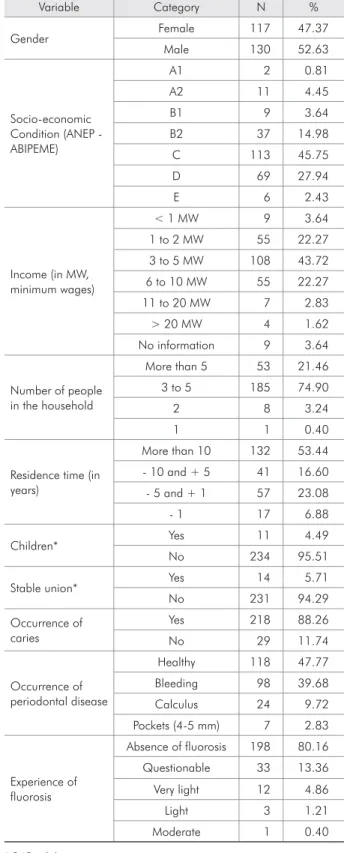
Two hundred and forty seven adolescents took part in the study, 117 (47.37%) of which were of the female gender and 130 (52.63%) were of the male gender (Table 1).
The socio-economic status assessment indicated that 45.75% of the participants were classiied in class C; the family income was analyzed in terms of number of minimum wages (MW). The study pre-sented an average of 3 to 5 MW in 43.72% of the population, and 1 to 2 MW in 22.27% of the popu-lation. The largest number of persons found in the household varied from 3 to 5 persons, in a total of 74.90% of the population. Just over half of the stud-ied population (53.44%) occupstud-ied their homes for a period greater than 10 years, and 23.08% of the population has lived in the same residence for a pe-riod of more than 1 and less than 5 years. Further-more, 95.51% of the studied population informed not having children, and 94.29% do not live in a stable union (Table 1).
Occurrence of caries was observed in 218 (88.26%) of the participants (Table 1).
The mean DMFT was 5.40, showing a greater index in the illed teeth of 3.40 and with an average of 22.33 for intact teeth. In the 3rd tercile of the
dis-tribution of caries occurrence, the DMFT was 9.97 (SD 3.15) (Table 2).
In relation to the occurrence of periodontal dis-ease measured by the CPI, 7 (2.83%) participants presented pockets (4-5 mm), 24 (9.72%) present-ed calculus, 98 (39.68%) adolescents had gingi-val bleeding and, inally, 118 (47.77%) presented healthy sextants (Table 1).
Table 1 also shows that 49 participants (19.83%) presented various degrees of luorosis (from
ques-Table 1 - Distribution of participants according to socio-economic data (gender, socio-socio-economic status, income, number of people in the household, residence time, number of children and stable union) and the occurrence of oral dis-eases, Água Doce - SC, 2005.
Variable Category N %
Gender Female 117 47.37
Male 130 52.63
Socio-economic Condition (ANEP -ABIPEME)
A1 2 0.81
A2 11 4.45
B1 9 3.64
B2 37 14.98
C 113 45.75
D 69 27.94
E 6 2.43
Income (in MW, minimum wages)
< 1 MW 9 3.64
1 to 2 MW 55 22.27
3 to 5 MW 108 43.72
6 to 10 MW 55 22.27
11 to 20 MW 7 2.83
> 20 MW 4 1.62
No information 9 3.64
Number of people in the household
More than 5 53 21.46
3 to 5 185 74.90
2 8 3.24
1 1 0.40
Residence time (in years)
More than 10 132 53.44
- 10 and + 5 41 16.60
- 5 and + 1 57 23.08
- 1 17 6.88
Children* Yes 11 4.49
No 234 95.51
Stable union* Yes 14 5.71
No 231 94.29
Occurrence of caries
Yes 218 88.26
No 29 11.74
Occurrence of periodontal disease
Healthy 118 47.77
Bleeding 98 39.68
Calculus 24 9.72
Pockets (4-5 mm) 7 2.83
Experience of fluorosis
Absence of fluorosis 198 80.16
Questionable 33 13.36
Very light 12 4.86
Light 3 1.21
Moderate 1 0.40
tionable to moderate), while 198 (80.16%) showed an absence of this condition.
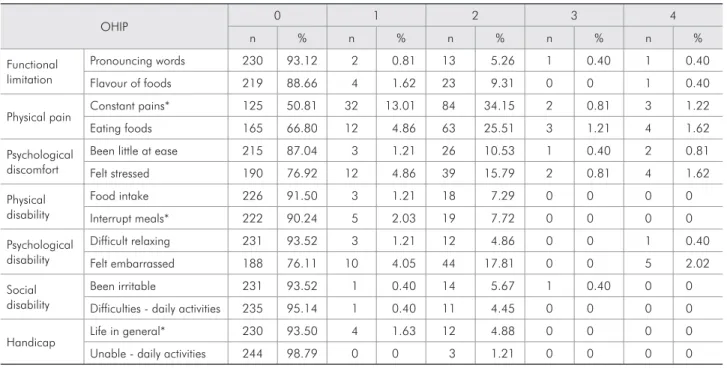
The mean OHIP was 3.95 (SD = 4.88). With re-gard to the oral impact related by the OHIP, vary-ing from 0 to 4, the largest percentage in 0 (never) prevailed, indicating that oral problems had little interference in the daily activities of the population (Table 3). The impact that interfered most in the daily activities was feeling moderate, but constant, pain in the mouth (OHIP item 3), reported by 89 participants (36.18%); OHIP item 4 (having felt any discomfort while eating foods) was present in 70
re-ports (28.34%) (Table 3).
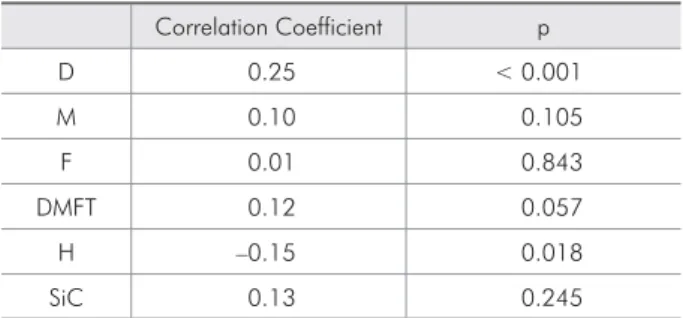
By correlating the impact of the oral condition on the daily activities of the participants with the occurrence of caries of the adolescents, positive and statistically signiicant correlation was ob-served between the highest OHIP scoring item and decayed teeth (D) (Table 4). A positive correlation with threshold signiicance was observed between OHIP and DMFT Index; and inally, as expected, an inverse correlation between the number of intact teeth and the OHIP was observed. This means that, the larger the amount of intact teeth that an indi-vidual possesses, the smaller were the limitations re-ported for performing daily activities as a result of oral problems (Table 4). A positive correlation with no statistical signiicance between the SiC and the OHIP was also observed.
Table 5 shows a threshold signiicance between DMFT Index and OHIP. The same table shows that, despite the fact that the mean OHIP is infe-rior in the 1st and 2nd terciles, in comparison with
the 3rd tercile, this was not a signiicant association
(p = 0.146). Furthermore, no association was ob-served between the periodontal condition or pres-ence of luorosis and OHIP (Table 5).
Table 2 - Average number of permanent decayed (D), missing (M), filled (F), intact (H) teeth, DMFT and mean sig-nificant caries index (SiC) among participants of the study, Água Doce - SC, 2005.
N Average SD Min Max
D 247 1.59 2.05 0 11
M 247 0.31 0.71 0 3
F 247 3.40 3.18 0 17
H 247 22.33 4.22 9 36
DMFT 247 5.40 4.09 0 26
SiC 82 9.97 3.15 7 26
Table 3 - Frequency of the impact related in each OHIP item among the participants of the study, Água Doce - SC, 2005.
OHIP 0 1 2 3 4
n % n % n % n % n %
Functional limitation
Pronouncing words 230 93.12 2 0.81 13 5.26 1 0.40 1 0.40
Flavour of foods 219 88.66 4 1.62 23 9.31 0 0 1 0.40
Physical pain Constant pains* 125 50.81 32 13.01 84 34.15 2 0.81 3 1.22 Eating foods 165 66.80 12 4.86 63 25.51 3 1.21 4 1.62
Psychological discomfort
Been little at ease 215 87.04 3 1.21 26 10.53 1 0.40 2 0.81
Felt stressed 190 76.92 12 4.86 39 15.79 2 0.81 4 1.62
Physical disability
Food intake 226 91.50 3 1.21 18 7.29 0 0 0 0
Interrupt meals* 222 90.24 5 2.03 19 7.72 0 0 0 0
Psychological disability
Difficult relaxing 231 93.52 3 1.21 12 4.86 0 0 1 0.40
Felt embarrassed 188 76.11 10 4.05 44 17.81 0 0 5 2.02
Social disability
Been irritable 231 93.52 1 0.40 14 5.67 1 0.40 0 0
Difficulties - daily activities 235 95.14 1 0.40 11 4.45 0 0 0 0
Handicap Life in general* 230 93.50 4 1.63 12 4.88 0 0 0 0 Unable - daily activities 244 98.79 0 0 3 1.21 0 0 0 0
Discussion
The prevalence of caries in the studied popula-tion was 88.26%, which is similar to the results ob-served by Gushi et al.2 (2005). The observed DMFT
was 5.40; this inding was in line with nationwide and regional epidemiological studies in this age group,2,5 but was higher than that observed in
inter-national studies and recommendations.1,4
By separately discriminating the occurrence of caries in the participants according to the compo-nents (decayed, missing or illed), the past experi-ence in caries, observed through the higher average of illed teeth (F) was observed. This demonstrates the access the population has to dental health ser-vices.3
The high percentage of intact teeth among the participants is in line with local and international
indings in which the population had access to sys-temic luorine.
The DMFT Index has traditionally been used to measure the occurrence of caries, but it provides an incomplete view of this condition in situations of polarized distribution; the SiC Index4 can provide
important additional information about the impact of caries on those individuals most affected.2 By
an-alyzing the 82 participants the mean DMFT found was 9.97. Considering the global decline in the oc-currence of caries, associated with the ococ-currence of polarization groups (few individuals responsible for a greater occurrence of caries and many indi-viduals with most of their teeth intact), the use of the SiC index in this study conirmed this tendency. The 9.97 value for the SiC was high, if compared to those found by Marthaler et al.4 (2005), who found
a SiC of 4.31 at the age of 15, nevertheless, it was inferior to the value observed among adolescents aged between 15 and 19 in the State of São Paulo.2
The authors4 suggest that a target SiC of 5.0 be
ad-opted for the age of 15. An interesting inding in this group was that OHIP did not show variations, indicating that for some degree of disease, the qual-ity of life was not considered poorer as oral health became worse.
The occurrence of periodontal disease may vary from 10 to 90% depending on etiological factors in-volved.15,16 Our study found the presence of this
con-dition in 52.23% of the population, which is similar to the result found by a nationwide epidemiological study in adolescents.5
The prevalence of dental luorosis was 19.83%. This inding is compatible with epidemiological studies performed in Brazil in locations that offer optimum levels of luorine in the water.6,17
The mean OHIP was 3.95, indicating that oral conditions had little interference in the performance of daily activities. This inding was also observed in other studies.14 The presence of moderate, but
con-stant pains in the mouth (OHIP 3) and discomfort in eating certain foods (OHIP 4) were the most fre-quently reported impacts.
It was observed that decayed teeth were associ-ated with a greater impact measured by the OHIP; this fact was also pointed out elsewhere.7
Table 5 - Distribution of the occurrence of caries, fluorosis and periodontal condition and mean OHIP. Adolescents in Água Doce - SC, 2005.
Mean OHIP p
Occurrence of caries (DMFT)
Absent 2.31
0.058 Present 4.17
Occurrence of caries (DMFT)
1st & 2nd terciles 3.80
0.146 3rd tercile (SiC) 4.26
Fluorosis w/o fluorosis 3.75 0.171 with fluorosis 4.81
CPI w/o disease 3.24 0.053 with disease 4.60
W/o = without. CPI = Periodontal Condition.
Table 4 - Correlation coefficients between decayed (D), missing (M), filled (F), occurrence of caries (DMFT), intact (H) teeth and significant caries index (SiC) with the OHIP, among adolescents in Água Doce - SC, 2005.
Correlation Coefficient p
D 0.25 < 0.001
M 0.10 0.105
F 0.01 0.843
DMFT 0.12 0.057
H –0.15 0.018
Access to health services is necessary to turn the present occurrence of caries (decayed teeth) into past occurrence (illed teeth), thus reducing the impact of the occurrence of caries in any given moment in the daily lives of the participants. Inverse correlation was found between the number of intact teeth and the impact to the daily activities: the absence of the occurrence of caries can be correlated to the absence of limitations in the daily activities resulting from oral problems.
Assessing the occurrence of caries measured by the SiC and the OHIP, no correlation was found between them; these indings suggest that, despite the 3rd tercile having presented a mean OHIP higher
than that of the 1st and 2nd terciles, no impact was
observed for the individuals that reported greater occurrence of caries.
No association of the OHIP with dental luoro-sis was observed. Probably this inding is due to the low prevalence of the disease in the studied popu-lation; other authors6,17 state that luorosis in this
standard of distribution does not correspond to a public health problem since it has little impact on the quality of life.
Although the prevalence of periodontal disease
was elevated, its severity was low, not presenting im-pact to the quality of life of the participants.
The limitation of this study is that it is a cross-sectional study in which the analytical capability is lower than in other types of surveys, but it is very appropriate for the study of prevalence and for the initial indication of a possible cause-effect associa-tion. Another limitation could be that the partici-pants were considered independently of their rela-tionship, and the inluence of neighborhood and similarities in data analysis has been discussed.
Conclusion
The epidemiological distribution of dental car-ies was elevated, and continues to be a public health problem; the prevalence of periodontal disease and luorosis were compatible with that of epidemiologi-cal indings in Brazil.
The largest impact on the performance of daily activities was related to the number of decayed teeth and a higher DMFT. Participants with a higher av-erage of intact teeth presented less impact on the performance of their daily activities. Fluorosis and periodontal condition did not present any relation-ship in this situation.
References
1. Casanova-Rosado AJ, Medina-Solis CE, Casanova-Rosado JF, Vallejos-Sanchez AA, Maupome G, Avila-Burgos L. Dental caries and associated factors in Mexican schoolchildren aged 6-13 years. Acta Odontol Scand. 2005;63(4):245-51. 2. Gushi LL, Soares MC, Forni TIB, Vieira V, Wada RS, Sousa
MLR. Cárie Dentária em adolescentes de 15 a 19 anos de ida-de no Estado ida-de São Paulo, Brasil, 2002. Cad Saúida-de Pública. 2005;21(5):1383-91.
3. Petersen PE, Bourgeois D, Ogawa H, Estupinan-Day S, Ndiaye C. The global burden of oral diseases and risks to oral health. Bull World Health Organ. 2005;83(9):661-9.
4. Marthaler T, Menghini G, Steiner M. Use of the Significant Caries Index in quantifying changes in caries in Switzer-land from 1964 to 2000. Community Dent Oral Epidemiol. 2005;33(3):159-66.
5. Brasil. Ministério da Saúde. Projeto SB Brasil 2003. Condições de saúde bucal da população brasileira 2002-2003. Resultados principais. Brasília; 2004.
6. Moysés SJ, Moysés ST, Allegretti ACV, Argenta M, Werneck R. Fluorose Dental: ficção epidemiológica? Rev Panam Salud Públi. 2002;12(5):339-46.
7. Sheiham A. Oral health, general health and quality of life. Bull World Health Organ. 2005;83(9):644.
8. Locker D. Issues in measuring change in self-perceived oral health status. Community Dent Oral Epidemiol. 1998;26(1):41-7. 9. Biazevic MGH. Indicadores subjetivos em saúde bucal: revisão
sistemática [Dissertação de Mestrado]. São Paulo: Faculdade de Odontologia da USP; 2001.
10. Locker D, Miller Y. Subjectively reported oral health status in an adult population. Community Dent Oral Epidemiol. 1994;22(6):425-30.
11. Jannuzzi PM. Indicadores sociais no Brasil. Campinas: Alínea; 2001.
12. OMS - Organização Mundial da Saúde. Levantamentos Básicos em Saúde Bucal. 4ª ed. São Paulo: Santos; 1999.
13. Nishi M, Bratthall D, Stjernswärd J. How to calculate the Significant Caries Index (SiC Index). WHO Collaborating Centre/Faculty of Odontology, University of Malmö, Sweden; 2001.
15. Albandar JM. Periodontal diseases in North America. Peri-odontol 2000. 2002;29(1):31-69.
16. Baelum V, Scheutz F. Periodontal diseases in Africa. Periodon-tol 2000. 2002;29(1):79-103.