Lexical analysis of the Code of Medical Ethics of the Federal
Council of Medicine
EDSONDE OLIVEIRA ANDRADE JR.1, EDSONDE OLIVEIRA ANDRADE2*
1Fundação de Medicina Tropical Doutor Heitor Vieira Dourado, Pediatrics, Manaus, Amazonas, AM, Brazil 2Universidade Federal do Amazonas, Faculdade de Medicina, Internal Medicine, Manaus, AM, Brazil
S
UMMARYStudy conducted at Universidade Federal do Amazonas, Faculdade de Medicina,
Clínica Médica, Manaus, AM, Brazil
Article received: 1/18/2016
Accepted for publication: 1/27/2016
*Correspondence:
Address: Universidade Federal do Amazonas – Faculdade de
Medicina, Clínica Médica Av. Apurinã, 1053, Praça 14
Manaus, AM – Brazil Postal code: 69020-160
http://dx.doi.org/10.1590/1806-9282.62.02.123
Introduction: The Code of Medical Ethics (CME) of the Federal Council of Med-icine is the legal document that exposes the moral discourse of Brazilian physi-cians to society and the profession. It is a set of propositions based on which doctors say they are committed to values of conduct aimed at fair and proper professional practice.
Objectives: To verify through lexical analysis of the CME corpus if the goals pre-sented in the arguments of the resolution that established the code are proper-ly addressed in these regulations.
Methods: This is a quantitative and qualitative study of descriptive nature, aim-ing at a lexical analysis of the CME. The lexical analysis was performed usaim-ing a method of Top-Down Hierarchical Classification of vocabulary, as described by Reinert in 1987, assuming that words used in similar contexts are associated with a single lexical world. In addition to the analysis of results, an improved represen-tation of the charts related with Factorial and Similitude Analyses was made.
Results: Six clusters were extracted, leading to the identification of three major branches: health care, professional practice and research. These branches revolve around the figures of physician and patient. The similitude analysis revealed a complementarity status between these two figures.
Conclusion: The lexical analysis showed that the purposes contained in the res-olution that established the CME were adequately represented in the document body.
Keywords: medical ethics, code of ethics, lexical analysis, Iramuteq.
I
NTRODUCTIONA code of professional ethics constitutes the moral discourse of a profession in face of society. This is how a profession-al category positions itself regarding the rights and respon-sibilities that should be observed for proper practice, so that the objectives of that specific craft can be achieved.
The Code of Medical Ethics (CME)1 of the Federal
Council of Medicine that is currently in force was estab-lished by the Federal Council of Medicine (CFM, Consel-ho Federal de Medicina) resolution no. 1931/2009, and states the following:
WHEREAS the Councils of Medicine are simultaneously judges and discipliners of the medical class, with a respon-sibility to ensure and work, by all means in their power, to promote the perfect ethical practice of Medicine, as well as
the prestige and good reputation of those legally practicing the profession;
[...]
CONSIDERING the search of a better relationship with the patient, guaranteeing greater personal autonomy accord-ing to his or her will;
CONSIDERING the proposals made over the years 2008 and 2009 by the Regional Councils of Medicine, Medical Entities, physicians, research entities and universities to re-view the current Code of Medical Ethics;
of Medical Ethics with the participation of representative physicians from all over Brazil.
Thus, some fundamental features in this normative doc-ument can be identified: the defense of the perfect ethi-cal practice of medicine; the patient as the primary ob-ject of the document; and the democratic character of its construction, characterized by extensive consultation at the time of its preparation.
The manner in which the CME was drafted is not the subject of this study, although this would further rein-force the idea that these norms represent the ethical and moral discourse of the profession to society. This is not a document that was imposed or declared, but a docu-ment that was built over time and upon reflection of med-ical professionals throughout the country. The discourse delivered, the substance, is what interests us.
But does the discourse really express such commit-ment to the patient? How is it possible to answer this question based on the analysis of twenty-five fundamen-tal principles and one hundred and eighteen articles? In order to answer these questions, the authors choose to perform a discourse (CME) analysis using lexical analy-sis followed by text content analyanaly-sis.
This study aimed to verify the consistency between what was promised in the resolution that established the CME and what is written in the norm. Paraphrasing Chi-co Buarque in a song entitled “Fado tropical”, to verify if there is distance between intention and gesture.2
T
HEORETICAL BACKGROUNDHistory of the Brazilian codes of medical ethics3
According to the Federal Council of Medicine, in the his-tory of Brazilian medicine, there had been five codes of ethics officially acknowledged by physicians. The 2009 code is the sixth. Before these formal codes were in force, some initiatives promoted the development of the theme in Brazil.
• Translations – In 1867, the Medical Gazette of Bahia published a translation of the Code of the American Medical Association, largely influenced by the work of Thomas Percival.
• Over sixty years later, in 1929, the Brazilian Medical Association published the Medical Moral Code, a translation of the Medical Moral Code approved in the Fourth Latin American Medical Congress. • The first Brazilian document – A code adapted to the
Brazilian reality, with the participation of physicians and medical entities, began to be written during the
1st Syndicalist Medical Congress of 1931, year in which
the Code of Medical Deontology was approved, al-though without legal status.
• Codes acknowledged – The first code officially ack-nowledged in Brazil was the Code of Medical Deon-tology, approved in October 1944 at the Fourth Syn-dicalist Medical Congress.
In 1953, the Brazilian Medical Association (AMB, Associa-ção Médica Brasileira) produces a Code of Medical Deon-tology that was later adopted by the Federal Council of Medicine and remodeled to become a regulatory author-ity and ethics court according to law no 3268/1957.
The Federal Council of Medicine then took on the task of voting and amending the Code of Medical Deon-tology. The work was consolidated in the Congress of Re-gional Medical Councils in 1963. In that year, the Code of Medical Ethics was published, being in force in Janu-ary 1965 after a few modifications.
The 1965 Code was valid until 1984, when the Bra-zilian Code of Medical Deontology was established. The following code would appear in 1988 as part of the coun-try’s re-democratization process. The text was written during the First National Conference of Medical Ethics held on November 24-28, 1987 in Rio de Janeiro.
The current Code of Medical Ethics came into force on April 13, 2010. Revised more than 20 years after the previous code, it included novelties such as the predic-tion of palliative care, patient autonomy, and rules for assisted reproduction. The document comprised 25 fun-damental principles of medical practice, 10 diceologic norms, 118 deontological norms, and four general dis-positions.
The discourse
According to Orlandi,4 discourse is the dynamic
expres-sion of words aiming at intermediating men and their natural and social reality, which can, however, present it-self with different faces and meanings.5 Foucault,6 in his
lecture on The Order of Discourse, establishes that dis-courses are dispersed and it is a role of discourse analy-sis to seek the formation rules governing its construction in a given context.
But discourse is beyond grammar; it always has a speaker and a listener; it deals with concrete enunciations; it is contextualized and built on a network of other dis-courses.
under-stand how a discourse functions. It is built in the process of interacting relationships, i.e., when a speaker interacts with another or with others by means of language.7
But would an ethics code be a kind of discourse? Habermas,8 the great theoretician of “discourse
eth-ics”, considers that there is no distinction between the moral principle and the discursive principle, since the lat-ter is grounded on symmetric conditions of recognition of life forms communicatively structured.
According to him, in moral discourses, the discursive principle takes on a character of universalization, where moral becomes a rule of argument.
The philosopher proposes that, in communicative actions, the legitimate right only harmonizes with a type of legal coercion that guarantees the right of the recipi-ent to obey it or not.
In general, in order for a discourse to be valid, includ-ing the moral discourse contained in the CME, some prin-ciples are to be met, which he calls “validity expectations” (Geltungsansprüche), namely: a) understanding of the con-tent; b) true interlocutors; c) true contents; d) valid rea-sons to express the discourse. If any of these assumptions is disturbed, the discourse, and in this case the code, can be challenged to its core. The problematized statement should be discussed in a theoretical discourse; and the norm, problematized in a practical discourse.9
The manner in which the CME was built as a moral discourse, based on a legitimate motivation characterized by the need for social protection, and with clear writing and valid content, all seem to meet the philosopher’s pre-cautions.
It is acceptable to say, for perfect clarification, that for Habermas the difference between ethics and moral is that the first fits into a first-person perspective, of who one is and who one wants to become later in life, while the latter deals with what should or should not be done regarding others with the purpose of treating them as free and rational beings who deserve respect. For Haber-mas, moral has priority and functions as a limit for eth-ics: I have to plan what is good or valuable to me (ethical dimension) without running over what is right or fair to the other (moral dimension). This is how a professional code of ethics, properly constructed, should be.
According to Nunes Junior,10 in terms of rights, the
brilliance in Habermas’ theory is in
replacing a practical reason (act guided by one’s own ends) with a communicative reason, an individual who, using his or her own judgment, reaches a norm through communi-cative rationality based on a group that guides its own
ac-tion by discursive procedures, also reaching the norm. Thus, the reasoning of the Law, its measure of legitimacy, is de-fined by the logic of the best argument. As emanation of the discursive will of free and equal citizens, the Law is able to accomplish the great aspiration of reality, that is, the real-ization of justice.
According to Godoi,11 “the communicative rationality
proposed by Habermas differs substantially from the prac-tical rationality, previously supported by the philosophy of law or the philosophy of history. While the practical rationality sought to be a source of prescriptions for the social role of the individual, or even the State, communi-cative rationality seeks only to define the procedural con-ditions of the discourse in which social subjects can reach a legitimate understanding that generates social integra-tion and shared expectaintegra-tions” (1999, p. 67). As it was writ-ten in a plural form, the CME also seems to meet the com-municative rationality proposed by Habermas.
Normative discourse
The normative discourse is that of the legislator, an agent invested with competence and power to carry out a social task, in this case the regulation of conducts. It is the al-leged reason for study of the other types of discourse. The legislator performs its discursive paper addressing the community that receives the texts it created.12
According to Eduardo Bittar,12,13 the norm, its
cre-ation, is a state of relationship between two subjects aim-ing at somethaim-ing of value. It is a discourse constructed with arguments, defense, dissent and consensuses.
Thus, as stated by Edvaldo Brito,14 the rule of law
should not be addressed solely as a prescriptive proposi-tion. It should include the analysis of figures such as the enunciator (emitter), and be regarded as a communicative phenomenon assessing emitter- receptor-emitter relations, thus fitting into Habermas’ “communicative action”.
Eduardo Bittar13 points out the importance of the
adjuvants, that is, external influences to normative dis-course, such as social political and cultural pressure. The opponent is also under the spotlight, which is the resis-tance offered by the legal statute itself, in the case of the CME, represented by ethics to be replaced.
self-correcting mechanisms, as in the case of a special law that prevails over a general rule, or a supervening law that over-rules the previous, etc.
Last, Bittar warns that normative emanations do not necessarily respond to the factual claims, and there is a “huge gap between the sense idealized in a norm and the sense achieved as social practice”.13 Such concern is a
pos-teriori of this study’s subject matter, which seeks to un-derstand if the motivators expressed in the CME are ef-fectively contained there. If they are not, there will be an impediment of the code’s effect in the social practice.
The norm of ethics
Ethics norms are a kind of cultural norm. Their purpose is not to understand or explain cultural phenomena but to determine or control them in the sense of allowing val-ue realization.
Considering that the norms of ethics arise in cultur-al societies, their objective is to specify human behaviors that are allowed, prohibited or mandatory, limiting the possibilities of transformation or the existence of facts to those allowing the realization of social values.
Some human behaviors can result in socially unde-sirable situations and are, therefore, prohibited by ethics norms; conversely, other behaviors may be indispensable for the realization of social values, which makes them mandatory.
Even though there are ethics norms of many kinds, including legal, religious and social norms, one can say that they all have common features, such as: authorita-tiveness (indicative of social normality – “what should be”), violability (possibility of breaking the norm, which is therefore followed by sanction) and counterfactuality (the ethical norm should not submit to the facts, but the opposite).
Bentham’s theory of “ethical minimum”, apud Reale,15
consists in saying that the law represents only the mor-al minimum declared as mandatory so that society can subsist. Since not everyone can or want to comply spon-taneously with moral obligations, it is essential to strengthen certain ethical principles, so that society does not perish.
M
ETHODSThis is a quantitative and qualitative descriptive study aimed at performing a lexical analysis of the code of med-ical ethics of the Brazilian Federal Council of Medicine.
Lexical analysis was conducted using a method of Top-Down Hierarchical Classification of vocabulary, as described by Reinert, assuming that words used in
simi-lar contexts are associated with a single lexical world.16
The criterion for including elements in their respective classes is a higher frequency compared to the average oc-currence in the corpus, as well as an association with the class determined by chi-square value equal to or higher than 3.84. This gives an error margin < .05 (for a liberty degree = 1).
In order to achieve that, the authors used Iramuteq (Interface de R pour analyses Multidimensionnelles de Textes et de Questionneires) software,17 specific for text analysis
ac-cross large corpora, complementing the assessment of re-sults with enhanced representation of graphs related to Factorial and Similitude Analyses.18,19
Hypothesis
• H0: The CME text corpus is concordant with the con-siderations found in CFM Resolution no. 1931/2009. • H1: The CME text corpus is in disagreement with the considerations found in CFM Resolution no. 1931/2009.
Data analysis
The text corpus gathered from the CME was subjected to Top-Down Hierarchical Classification (DHC) using Ira-muteq software, which performed quantitative analyses of textual data providing contexts and classes of the con-tents based on vocabulary similarity.
Factor analysis performed by the software allows us to describe the main components of CME, focusing on the occurrence in the norm’s text of the most common subjects, verbs and adjectives. This technique enables the identification of the number of clusters in the text. Here, cluster is defined as a set of words that tend to appear close to one another in the text, forming a specific seg-ment. Based on these clusters, central points of the text can be pointed out, as well as how the terms are associat-ed with one another.
These classes or clusters represent the environment of sense of the words, and can indicate social representa-tions or elements of social representarepresenta-tions concerning the social object under study.20
In addition, to identify co-occurrences and connec-tivity among words, a similarity analysis was performed (Iramuteq) based on the theory of graphs, which aids the identification of the representation structure.
R
ESULTS“physician” and “patient”, 90 and 75 times, respectively. The verb most used was “let”, 44 times, followed by “should/ must” in 19 opportunities. The adjectives found more of-ten were “professional” (39) and “legal” (21).
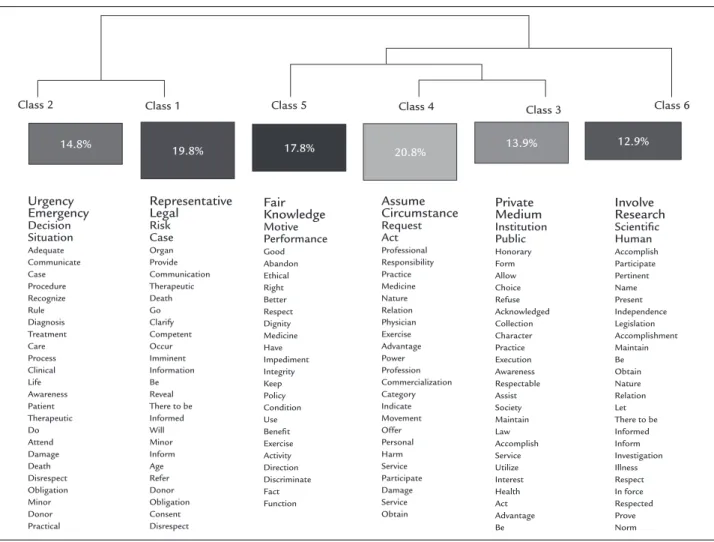
Factorial analysis (FCA) identified six clusters or class-es of words as a whole. The tclass-est also indicatclass-es the degree of statistical significance of the words that occur most often in each cluster. The presence of statistical signifi-cance indicates that certain terms tended to appear in a certain cluster, while the lack of significance shows that the terms were present in several groups. Therefore, the higher the significance of the presence of a certain term, more specific it is in that group. Figure 1 below shows the composition of each cluster to describe the sets within the discourse. The largest cluster is in class 4, represent-ing 20.8% of the discourse. Followrepresent-ing is class 1, with 19.6%, and class 5, with 17.8%. The remaining classes make up less than 15% of the discourse each. Classes 1 and 2 de-rive from the same branch and, therefore, tend to
pres-ent greater connection with each other. The same is true for the other branch, which includes classes 3 and 4.
The analysis of clusters 1 and 2 (34.6%) demonstrates that they report physician and patient autonomy in a pro-cess of shared decision concerning care to be delivered; due respect to the confidentiality of the information received; as well as the physician’s obligation to always use the best of medical science for the benefit of his/her patient.
Respect for patient autonomy is one of the main ad-vances of the CME. This is a change in the Hippocratic paradigm of paternalism of the doctor-patient relation-ship. A study conducted at Hospital das Clínicas, Univer-sity of São Paulo, revealed that 86% of the female and 76.6% of the male patients would like to have active par-ticipation in the therapeutic decisions to be made.21 The
results above were obtained before the launching of the new CME, and the full inclusion of this matter in the nor-mative body of the code demonstrates that legislators were aware of this demand.
FIGURE 1 Dendogram of top-down hierarchical classification of the “Code of Medical Ethics” corpus.
Class 2 Class 1 Class 5 Class 4 Class 3 Class 6
17.8% 20.8% 13.9% 12.9%
Clusters 3, 4 and 5 (42.5%) refer to professional behav-ior regarding market relations in the practice exercised in both public and private spaces. They contain the rights and duties arising out of the profession in interactions be-yond the doctor-patient relationship, despite being a re-sult of or affecting this relationship. They also contain the formal obligations to the Council of Medicine.
Cluster 6 is one that appeared more isolated in the factor extraction process. It expresses a class of obliga-tions aimed at medical research that often occur in the context of health care, imposing a very specific character that sets it apart from other classes.
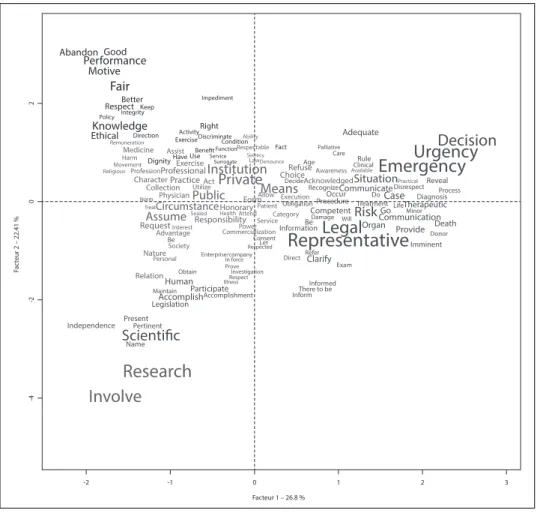
Thus, using a factorial analysis of components (Fig-ure 2), it is possible to divide the discourse of the CME into three major branches: health care, professional prac-tice and research. These branches revolve around the fig-ures of doctor and patient.
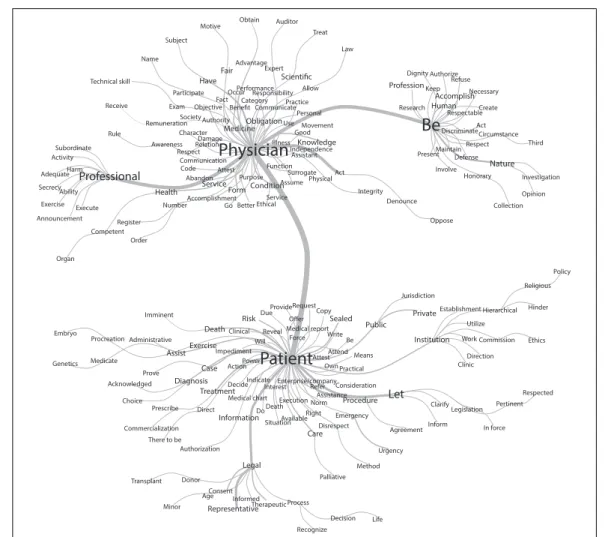
To view the representation structure in the CME and confirm the centrality of elements, a co-occurrence anal-ysis was made based on categories developed from each word evoked.22 Therefore, a similitude analysis was
ap-plied, allowing the connection among elements of the representation to be viewed, as shown in Figure 3.
Lon-ger words in bold demonstrate their relevance for the con-nection of elements – the longer the word, the higher the frequency and contribution to form connection trees.23
As we can see in the similarity tree, the CME is divided into two poles: physician and patient; each with an array of attributes, duties and competences to characterize them.
D
ISCUSSIONThe question of characterization of a normative discourse, subject to lexical or content analysis, is something that discourse theorists state as possible.6-8,12,24,25 The search for
the validity of this discourse9 prompts a brief comment
on the form and the mechanisms used in its preparation. The CME constitutes a normative and moral discourse.24
Precepts described as valid, whether logical-semantic or ethical, were apparently observed when the document was drafted. Of these, broad and democratic manner in which the norm was written is noted. Consultation of society was quite extensive, beyond corporate boundaries, which is reflected in the importance given to the autonomy of the patient in the doctrinal corpus.
The regulatory and supervisory character of the Coun-cil of Medicine is represented in the discourse analyzed
FIGURE 2 Factorial plan of the
most significant words in the CME.
Facteur 1 – 26.8 % -2
-4
-2
0
2
-1 0 1 2 3
Fac
teur 2 – 22.41 %
Abandon Good
Performance Motive
Fair
Better Impediment
Respect Keep Integrity Policy
Knowledge Right
Activity Adequate
Ethical Direction Discriminate Ability
Remuneration Exercise Condition Decision
Fact Palliative
Respectable
Function
Medicine Assist Benefit Care
Urgency
Secrecy Service Use Have
Harm Dignity Exercise Surrogate LawDenounce Age Rule
Movement Clinical
Emergency
Institution RefuseProfessionProfessional AwarenessAvailable Religious
Choice
Private Situation Practice
Character Acknowledged
Recognize
Act Decide Practical
Disrespect
Collection Utilize Means Communicate RevealProcess Allow Occur DoCase
PhysicianPublic Execution Diagnosis
NormTreatAssumeCircumstanceSealed HealthHonoraryAttendFormPatientCategoryObligationCompetentDamageProcedure RiskTreatmentCommunicationGoLifeTherapeuticMinor Responsibility Service Be Will Death RequestInterest CommercializationPower Information
Legal
Organ ProvideAdvantage Donor
Consent
BeSociety Let
Representative
ImminentRespected
Refer Nature Enterprise/company
In force Prove
Direct
Personal Clarify
Exam Obtain Investigation
Relation Respect
Human Illness Informed
Participate There to be
Maintain
Accomplishment Inform
Accomplish
Legislation
Present Pertinent Independence
ScientificName
FIGURE 3 Maximum similitude tree. Professional Subordinate Activity Harm Adequate SecrecyAbility Exercise Execute Announcement Oppose
Physician
MedicineObligationUse
Personal Movement Good Character
Damage
Relation Illness Knowledge
Independence Assistant Respect Communication Code Attest Purpose Function Surrogate PhysicalAct Abandon Service
FormConditionAssume
Accomplishment Go Better Ethical
Service IntegrityDenounce Authority Law Treat Auditor Obtain Motive Subject Name Technical skill Receive Rule Organ Competent Register Order Health Number Allow Expert Advantage Fair Have Participate Exam Remuneration Awareness Responsibility Performance Occur Fact
Objective CategoryCommunicatePractice Society Collection
Be
Dignity Authorize Refuse ProfessionKeep AccomplishNecessary Research Human RespectableCreate Act DiscriminateCircumstance Respect Third Maintain Present Defense Nature Involve Honorary Investigation OpinionPatient
Embryo Genetics Procreation Medicate Imminent Administrative Prove Acknowledged Choice Prescribe Commercialization There to beTransplant Minor Assist Diagnosis Authorization Donor Death Exercise Case Treatment Direct Consent Age Clinical Impediment Action Decide Medical chart Information Representative Risk Will Power Indicate Medical report Do Legal Informed Due Reveal Interest Death Situation Therapeutic Provide Force Enterprise/company Execution Available Process Request Attest Refer Norm Right Care Recognize Copy Sealed Write Attend Own Practical Consideration Assistance Disrespect Palliative Decision Be Means Procedure Emergency Method Life Public Let Urgency Jurisdiction Private Institution Agreement Clarify Inform Establishment Utilize Work Clinic Legislation Hierarchical Commission Direction Pertinent In force Religious Hinder Ethics Respected Policy
in our study by what we call the legis-professional branch, included in the branch of professional practice. That’s where the most formal and bureaucratic requirements are concentrated. It is the jurisdictional face of the dis-course.
The attention given to modern concerns about the role of medical research for professional practice explains the importance of the issue in the CME. This class of mor-al obligations represents a concern that is more and more frequent in medical practice due to the increasing rele-vance of trials within the context of medical care. The ab-sorption by the CME of the normative content of CFM resolution no 1885/2008 was the consolidation of a
po-sition contrary to the Declaration of Helsinki developed by the World Medical Association regarding the use of placebo in scientific experiments if there is any effective treatment to be compared with the new drug that is be-ing tested.26,27
Finally, we need to reflect on what the similarity tree shows. There seems to be two opposite poles in the CME
discourse: On one side stands the physician and, on the other, the patient.
To be an ethical physician is to be professional. To be a patient is to be cared for, respected and protected.
The expressions used in the discourse are not isolat-ed or autonomous, quite the contrary, since discourse is only realized through the relation between these poles. The figure does not display antagonism, but complemen-tarity, indicating the existence of a dialogical unit repre-sented by the doctor-patient relationship.
C
ONCLUSIONcom-petent professional practice. Whether this occurs in daily life, and the impact of the code, are causes for fur-ther studies.28
R
ESUMOAnálise lexical do Código de Ética Médica do Conselho Federal de Medicina
Introdução: o Código de Ética Médica do Conselho Fe-deral de Medicina (CEM) é o documento normativo que expõe o discurso moral dos médicos brasileiros para a so-ciedade e a profissão. Ele constitui um conjunto de pro-posições a partir do qual os médicos dizem que se com-prometem com valores de condutas visando a uma justa e correta prática profissional.
Objetivo: verificar através da análise lexical do corpus do CEM se os propósitos constantes nos considerandos da resolução que o instituiu estão devidamente contempla-dos nos normativos nele contido.
Método: estudo quanti e qualitativo de caráter descri-tivo que realiza uma análise léxica do CEM. A análise léxica foi efetuada pelo método de Classificação Hierár-quica Descendente do vocabulário, descrito por Reinert (1987), assumindo que as palavras usadas em contexto similares estão associadas a um mesmo mundo lexical. Associada à análise de resultados com representação
aprimorada dos gráficos referentes às análises fatoriais e de similitude.
Resultados: foram extraídos seis clusters, a partir dos quais foram identificados três grandes ramos: o assistencial, o profissional e o pesquisador. Todos giram em torno das figuras do médico e do paciente. A análise de similitude mostrou o estado de complementaridade das figuras do médico e do paciente.
Conclusão: a análise lexical mostrou que os propósitos contidos na resolução que instituiu o CEM foram ade-quadamente representados em seu corpo normativo.
Palavras-chave: ética médica, código de ética, análise le-xical, Iramuteq.
R
EFERENCES1. Res. CFM n. 1931/2009 – Código de Ética Médica. Conselho Federal de Medicina do Brasil, 2009.
2. Buarque de Holanda F. Calabar [record]. Rio de Janeiro: Philips, 1973. Track 7, Fado Tropical.
3. Conselho Federal de Medicina. Breve histórico do Código de Ética Médica. 2010 [cited 2015 Dec 12]. Available from: http://www.portalmedico.org.br/ novocodigo/comofoielaborado.asp.
4. Orlandi EP. Análise do discurso. Campinas: Pontes, 2009.
5. Maingueneau D. Novas tendências em análise do discurso. 3.ed. Campinas: Pontes, 1997.
6. Foucault M. A ordem do discurso. São Paulo: Loyola, 2015.
7. Brandão HHN. Análise do discurso: um itinerário histórico. In: Pereira HBC, Atik MLG (eds.). Língua, literatura, cultura em diálogo. São Paulo: Ed. Mackenzie, 2003.
8. Habermas J. Direito e democracia. Entre a facticidade e a validade. Rio de Janeiro: Tempo Brasileiro, 1997.
9. Habermas J. Consciência moral e o agir comunicativo. Rio de Janeiro: Tempo Brasileiro, 1989.
10. Nunes Junior AT. As modernas teorias da justiça. Revista de Informação Legislativa. 2002; 39(156):53-62.
11. Godoi MS. Justiça, igualdade e direito tributário. São Paulo: Dialética, 1999. 12. Pessoa FMG. A realidade do direito como linguagem: o discurso jurídico e
suas espécies. Evocati Revista. 2008; 36.
13. Bittar ECB. Linguagem jurídica. 6.ed. São Paulo: Saraiva, 2015. 14. Brito E. Limites da revisão constitucional. Porto Alegre: Fabris, 1993. 15. Reale M. Lições preliminares de direito. São Paulo: Saraiva, 2001. 16. Reinert M. Classification descendante hiérarchique et analyse lexicale par
contexte: application au corpus des poésies d’Arthur Rimbaud. Bulletin de méthodologie sociologique. 1987; 13:53-90.
17. Marchand P, Ratinaud P. L’analyse de similitude appliquée aux corpus textueles: les primaires socialistes pour l’élection présidentielle française. JADT. 2012; 687-99. 18. Camargo BV, Justo AM. IRAMUTEQ: um software gratuito para análise de
dados textuais. Temas Psicol. 2013; 21(2).
19. Camargo BV, Justo AM. Tutorial para uso do software de análise textual Iramuteq. 2015 [cited 2015 Mar 03]. Available from: http://www.iramuteq. org/documentation/fichiers/tutoriel-en-portugais.
20. Nascimento-Schulze CM, Camargo EV. Psicologia social, representações sociais e métodos. Temas em Psicologia. 2000; 8(3):287-99.
21. Gulinelli A, Aisawa RK, Konno SN, Morinaga CV, Costardi WL, Antonio RO, et al. Desejo de informação e participação nas decisões terapêuticas em caso de doenças graves em pacientes atendidos em um hospital universitário. RAMB. 2004; 50(1):41-7.
22. Bardin L. Análise de conteúdo. São Paulo: Ed. 70, 2011.
23. Vergés P, Bouriche B. L’analyse des données par les graphes de similitude. Auxerre: Sciences Humaines; 2001.
24. Ferreira A. Normas éticas: caracteres gerais. 2011 [cited 2015 Dec 20]. Available from: http://introducaoaodireito.info/wpid/?p=191.
25. Ferreira FGA. O discurso jurídico como discurso prático: aspectos do debate entre Robert Alexy e Jürgen Habermas. Revista da Faculdade de Direito de Campos. 2006; 9:85-101.
26. Resolução n. 1.885 – Veda ao médico participar de pesquisa envolvendo seres humanos utilizando placebo quando existir tratamento disponível eficaz já conhecido. Conselho Federal de Medicina, 2008.
27. Schlemper Junior BR. O placebo e a Declaração de Pachuca: letras mortas? Revista Bioética. 2014; 22(3):462-70.