BOAVENTURA CS ETAL.
116 REV ASSOC MED BRAS 2016; 62(2):116-119
IMAGE IN MEDICINE
Synchronous gynecologic cancer and the use of imaging for
diagnosis
C
ÂNCER GINECOLÓGICO SINCRÔNICO E O USO DA IMAGEMPARA SEU DIAGNÓSTICOCAMILA SILVA BOAVENTURA1*, JOSÉ LUCAS SCARPINETTI GALVÃO2, GIOVANNA MILANES BEGO SOARES2, ALMIR GALVÃO VIEIRA BITEN
-COURT3, RUBENS CHOJNIAK4, SHENIA LAUANNA REZENDE BRINGEL5, LOUISE DE BROT6
1Student MSc in Oncology from Fundação Antonio Prudente, Radiologist, Full Professor of the Imaging Department, A.C. Camargo Cancer Center, São Paulo, SP, Brazil. 2Medical Student, 6th semester, Universidade Nove de Julho, São Paulo, SP, Brazil
3PhD in Oncology from Fundação Antônio Prudente. Supervisor of the Graduate Course at Fundação Antônio Prudente. Radiologist, Full Professor of the Imaging Department, A.C. Camargo Cancer Center, São Paulo, SP, Brazil 4MSc and PhD in Oncology from Fundação Antônio Prudente. Supervisor of the Graduate Course at Fundação Antônio Prudente. Radiologist, Director of the Imaging Department, A.C. Camargo Cancer Center, São Paulo, SP, Brazil 53rd-year Resident Physician in Pathology, A.C. Camargo Cancer Center, São Paulo, SP, Brazil
6PhD in Oncology from Fundação Antônio Prudente. Pathologist, Full Professor at the Pathology Department, A.C. Camargo Cancer Center, São Paulo, SP, Brazil
Study conducted at the A.C. Camargo Cancer Center, São Paulo, SP, Brazil
Article received: 3/23/2015 Accepted for publication: 5/4/2015
*Correspondence: Address: Depto. de Imagem Rua Professor Antonio Prudente, 211 Liberdade São Paulo, SP – Brazil Postal code: 01509-010 [email protected] Phone: (+55 11) 2189-5000
http://dx.doi.org/10.1590/1806-9282.62.02.116
S
UMMARYEndometrial and cervical cancers are the most prevalent gynecologic neoplasms. While endometrial cancer occurs in older women, cervical cancer is more preva-lent in young subjects. The most common clinical manifestation in these two gynecological cancers is vaginal bleeding. In the first case, diagnosis is made based on histological and imaging evaluation of the endometrium, while cervi-cal cancers are diagnosed clinicervi-cally, according to the International Federation of Gynecology and Obstetrics (FIGO). The authors present a case of synchro-nous gynecological cancer of the endometrium and cervix diagnosed during staging on MRI and confirmed by histological analysis of the surgical specimen.
Keywords: Magnetic resonance imaging, endometrial neoplasms, uterine cer-vical neoplasms, uterine neoplasms.
I
NTRODUCTIONCervical and endometrial cancers are, respectively, the third and fourth most common cancers in women.1,2
While endometrial cancer affects women in perimeno-pause, cervical cancer affects young women of lower so-cioeconomic status.1,3 The histologic types most
com-monly found are adenocarcinomas followed by sarcomas in endometrial cancer, and squamous cell (80%) and mu-cinous carcinomas in cervical cancers.
The most common clinical manifestation in these two gynecologic cancer is vaginal bleeding, although cer-vical cancer is usually asymptomatic due to a slow pro-gression.4 When endometrial cancer is clinically
suspect-ed, diagnosis is made based on histological and imaging evaluation of the endometrium, while cervical cancers are diagnosed clinically, according to the International Fed-eration of Gynecology and Obstetrics (FIGO).5 The
au-thors report a case of synchronous tumors of endometri-al and cervicendometri-al cancers in an oncologicendometri-al reference center that was suspected clinically and evidenced on magnetic
resonance imaging (MRI) of the pelvis, discussing the rel-evant finding for diagnosis.
C
ASE REPORTFemale 83-year old patient, G3P3AO, menopaused for 33 years, homemaker, born in the state of São Paulo, city of Osasco, admitted in an oncological reference center in May 2012 referring menstrual bleeding 4-5 months before. Per-sonal history includes chronic constipation treated with laxatives regularly, recurrent urinary tract infection, insu-lin-dependent diabetes mellitus, high blood pressure and
dys-lipidemia. In the family history, the patient mentioned lung cancer in first-degree relatives who were smokers. Phys-ical examination revealed a friable and bleeding lesion on the cervix. As part of the diagnostic workup, the patient underwent pelvic ultrasound, which showed endometrial echo measuring 4 mm, uterine volume of 12.5 cm3 and
com-SYNCHRONOUSGYNECOLOGICCANCERANDTHEUSEOFIMAGINGFORDIAGNOSIS
REV ASSOC MED BRAS 2016; 62(2):116-119 117
pared to the myometrium, with peripheral enhancement to the contrast dye, measuring approximately 42 x 39 x 37 mm (length x width x AP diameter). There were signs of invasion of the myometrial wall on the right side of the uterus (invasion depth greater than 50% of its thick-ness, but without evidence of involvement of the uterine serosa) (Figure 1). MRI also showed a second lesion with
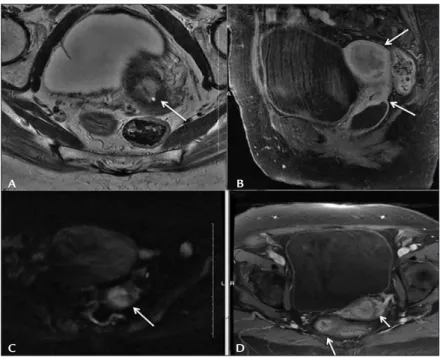
signal intensity and contrast-enhanced of similar char-acteristics to those in the cervical primary site, which went unnoticed on gynecological examination (Figure 2).
Diagnosed with synchronous tumors of endome-trium and cervix, the patient underwent hysterectomy with bilateral salpingo-oophorectomy and pelvic lymph-adenectomy.
FIGURE 1 Imaging findings: T2-weighted MRI sequence on sagittal (A) and axial (B) views shows endometrial cavity occupied by slightly hyperintense mass compared to the myometrium, and extension to the right lateral wall of the uterine body (arrow).
FIGURE 2 Imaging findings: T2-weighted MRI sequence on axial (A) view shows slightly hyperintense lesion occupying the cervix (arrow); T1-weighted MRI sequence with fat saturation after gadolinium injection, sagittal (B) view, two lesions occupying the endometrial (large arrow) cavity and cervix (small arrow) with peripheral enhancement after contrast administration; DWI-weighted (C) T1-weighted sequences with fat saturation after contrast injection (D) reveal lesion with restricted diffusion in the uterine cervix.
A
A
B
B
BOAVENTURA CS ETAL.
118 REV ASSOC MED BRAS 2016; 62(2):116-119
Histological analysis revealed a moderately differen-tiated endometrial serous adenocarcinoma (IB) (Figure 3) and a poorly differentiated squamous cell carcinoma of the cervix (IB) (Figure 3), as well as metastasis to lymph nodes in the pelvic chains (surgical stage IIIC) (Figure 3), with right-sided involvement of endometrial adenocarci-noma and squamous cell carciadenocarci-noma on the left side.
D
ISCUSSIONEndometrial cancer is surgically staged.6,7 MRI, however,
is the tool normally used to refine staging and treatment planning, given that findings of myometrial invasion or uterine extension may modify the surgical indication.3,5
Synchronic tumors are infrequent findings, and the most common gynecologic cancers are those of the ova-ry and uterus. In this case report, a cervical tumor is pres-ent simultaneously with endometrial cancer and could be mistaken for an extension of the latter, since endome-trial cancer may extend to the cervix.
There are two possible interpretations for these find-ings: synchronism between IB endometrial carcinoma and IB cervical carcinoma, or stage IIB endometrial carcinoma. Note the importance of correct staging to establish the best approach for each patient. Stage IIB endometrial
car-cinoma has no surgical indication and, therefore, incor-rect staging would affect the treatment choice.
Detection of gynecological tumors is not a role of MRI, but in this case it was important to highlight a clin-ically unsuspected cervical lesion. Cervical lesions may have endophytic growth, and eventually go unnoticed in the gynecological examination. This explains why the le-sion was detected only on MRI in the preoperative exam-ination.8
Diffusion weighted imaging (DWI) technique was used, which has recent applications in oncology including tu-mor detection. It consists in enhancing tissues where there is less mobility of water molecules, such as neoplasms. The imaging study contributed by revealing the lesion in the cervix, another primary tumor in addition to the endome-trial tumor previously detected on ultrasound.3,5,6,8
Other rare events include: synchronic gynecological tu-mors, clinically occult cervical tumor and detection of cer-vical tumor only on MRI.
R
ESUMOCâncer ginecológico sincrônico e o uso da imagem para seu diagnóstico
FIGURE 3 Findings of pathological anatomy: (A) Serous adenocarcinoma, papillary pattern. The surface is composed of tiny papillary structures with high nuclear grade; (B) Typical squamous cell carcinoma and in situ adenocarcinoma with minimal stratification, hyperchromasia
and nuclear enlargement; (C) p53 immunohistochemistry positive for lymph node metastasis. A
C
B
SYNCHRONOUSGYNECOLOGICCANCERANDTHEUSEOFIMAGINGFORDIAGNOSIS
REV ASSOC MED BRAS 2016; 62(2):116-119 119
Os cânceres de endométrio e cervical são as neoplasias gi-necológicas mais prevalentes. Enquanto o primeiro ocor-re em mulheocor-res mais velhas, o segundo é mais pocor-revalen- prevalen-te em mulheres jovens. A manifestação clínica mais comum nestas duas neoplasias ginecológicas é o sangramento va-ginal. O diagnóstico do câncer de endométrio é feito a partir da avaliação histológica do endométrio e da ava-liação por imagem, enquanto o câncer cervical é diagnos-ticado clinicamente, de acordo com a Federação Interna-cional de Ginecologia e Obstetrícia (FIGO). Apresentamos um caso de câncer ginecológico sincrônico de endomé-trio e cervical diagnosticado durante estadiamento por ressonância magnética e confirmado pela análise histo-lógica da peça cirúrgica.
Palavras-chave: imagem por ressonância magnética, plasias do endométrio, neoplasias do colo do útero, neo-plasias uterinas.
R
EFERENCES1. Lin G, Ng KK, Chang CJ, Wang JJ, Ho KC, Yen TC, et al. Myometrial invasion in endometrial cancer: diagnostic accuracy of diffusion-weighted 3.0-T MR imaging – initial experience. Radiology. 2009; 250(3):784-92.
2. Zamani F, Gooddarzi S, Hallaji F, Zamiri A, Deilami T, Malek M, et al. Diagnostic value of pelvic MRI for assessment of the depth of myometrial invasion and cervical involvement in endometrial cancer: comparison of new versus old FIGO staging. Iran J Radiol. 2012; 9(4):202-8.
3. Haldorsen IS, Salvensen HB. Staging of endometrial carcinomas with MRI using traditional and novel MRI techniques. Clin Radiol. 2012; 67(1):2-12. 4. Brand A, Dubuc-Lissoir J, Ehlen TJ, Plante M. Diagnosis of endometrial cancer in women with abnormal vaginal bleeding. SOGC Clinical Practice Guidelines. 2000; 86.
5. Beddy P, O’Neill AC, Yamamoto AK, Addley HC, Reinhold C, Sala E. FIGO staging system for endometrial cancer: added benefits of MR imaging. Radiographics. 2012; 32(1):241-54.
6. Wolff LPG, Monte AA, Atti ACS, Monteiro IMU. Avaliação de morfologia e histologia endometrial de mulheres após a menopausa. Rev Assoc Med Bras. 2010; 56(6):711-4.
7. Tirumani SH, Shanbhogue AK, Prasad SR. Current concepts in the diagnosis and management of endometrial and cervical carcinomas. Radiol Clin North Am. 2013; 51(6):1087-110.