Rev. Bras. Saúde Matern. Infant., Recife, 17 (4): 801-815 out. / dez., 2017 801 ORIGINAL ARTICLES
http://dx.doi.org/10.1590/1806-93042017000400011
Assessment of infant mortality surveillance: case study
Conceição Maria de Oliveira 1
Paulo Germano de Frias 2
Cristine Vieira do Bonfim 3
Verônica Cristina Sposito Antonino 4
Joana D’arc Tavares do Nascimento 5
Zulma Maria Medeiros 6
1,4,5Secretaria de Saúde do Recife. Av. Visconde de Suassuna, nº 658. Santo Amaro. Recife, PE, Brasil. CEP: 50.050-540. E-mail: [email protected]
2Instituto de Medicina Integral Prof. Fernando Figueira. Recife, PE, Brasil. 3Fundação Joaquim Nabuco. Recife, PE, Brasil.
6Centro de Pesquisas Aggeu Magalhães. Fundação Oswaldo Cruz. Recife, PE, Brasil.
Abstract
Objectives: assess the implementation of child mortality surveillance in Recife/PE. Methods: an analytical evaluative study was conducted on its implementation. It was a single-case study that correlated degree of implementation with the of the result indicators surveillance. A logic model on this strategy and a matrix of indicators and judgments according to model components were drawn up. The degree of implementation was obtained from structure and process indicators and this was then correlated with result indicators, in a deductive approach based on intervention theory.
Results: the structure approach presented superior results to the process in all evaluated components. This strategy was considered to have been partially implemented (75.7%), however, the components of ‘identification of deaths’ (85.7%), ‘epidemiological research' (88.1%) and 'referral of proposals for promotion and health care and correction of official statistics' (95.8%) were classified implemented. Regarding the relation of the degree of implantation of the surveillance and its results with the logical model, only one of the 17 indicators was considered inconsistent.
Conclusions: this strategy was considered to have been partially implemented. The model of child mortality surveillance and its assessment were shown to be adequate for signaling the consistency of the interrelations between the activities proposed and the effects expected, and would be reproducible within other scenarios.
Introduction
Infant death is a sentinel event of the quality of healthcare given the early and often preventable nature of these events.1In view of the magnitude and transcendence of infant mortality, in 2000, the United Nations established the reduction of these deaths by 2/3 by 2015 as one of the Millennium Development Goals.2Although Brazil achieved this goal in 2012, some countries did not reach the goal despite their efforts, leading to an extension of the deadline to 2030.3,4
Several nations have acknowledged the need to associate the epidemiological profile of mortality with quality assessments of care provided to women and children during their trajectory, and have perfected strategies to facilitate greater unde-rstanding of social and care-related determinants of the deaths, including the mortality surveillance.5,6
In the inspection and investigation of child deaths, international experiences have produced several configurations based on availability of infor-mation and the supply of more or less complex health services.5,7,8The investigation of deaths can explain the circumstances in which they occurred and the results should be notified to managers and any interested people so they may act on various levels of the health system to improve access and quality of care provided during pregnancy, labour, childbirth, and child and mother follow-up.5,7,8
In Brazil, a similar strategy was implemented by the Ministry of Health (MH) in 2010, with the publi-cation of a normative base of Infant Death and Foetal Surveillance,9although municipal and state initiatives with different conformations have existed for some years.10-15
In Recife, since 2003, infant mortality surveil-lance was implemented to investigate and discuss all infant deaths (except those caused by congenital malformations) of mothers living in Brazil. Cases are discussed with healthcare workers, inspectors, and managers in order to identify preventable deaths caused by medical errors, to use this information for reflection and planning, and to adopt measures to reduce infant mortality.10
In the surveillance assessments conducted in Brazil, the strategy is considered a management tool capable of providing information to health teams, generating critical awareness on the offered care, and enhancing information systems.11,16,17 Moreover, it can be used to plan interventions for the main problems and barriers of the care system and to reduce preventable deaths and iniquities.6Given its potential, mortality surveillance generates special
interest for the monitoring actions required to achieve the Sustainable Development Goals.2,3
Despite the relevance and scope of national infant mortality surveillance and the guidelines adopted by Brazilian states and municipalities, no publications assessing the implementation of this strategy in Brazil were identified. A case study, with its high potential for internal validity, provides va-luable insight for managers, technicians, and researchers. The aim of this paper is to assess the implementation of infant mortality surveillance in a capital city from northeastern Brazil.
Methods
This is an evaluative analysis of qualitative research of infant mortality surveillance. The methodological strategy is a single case study to relate the degree of implementation to the result indicators of interven-tion in the city of Recife,18,19northeastern Brazil, thestate capital of Pernambuco with the fourth largest urban concentration in the country. The city covers an area of 218.5 km2 and its population, according to the Brazilian Institute of Geography and Statistics, is estimated at 1,617,260 inhabitants (2015).20The mother and child healthcare network consists of 17 maternity hospitals, 275 family health teams (60% coverage), 21 family health support centres, 22 health centres, and 12 polyclinics.
A logical intervention model was initially prepared to clarify how the components work together using activities and available resources to achieve the expected results. The following docu-ments were used for the model: infant mortality surveillance implementation project;21MS Ordinan-ce No. 116/2009 that regulates data collection, flow and periodicity of data on deaths and live births submitted to the information systems; MS Ordinance No. 72/2010 establishing the obligation of infant and foetal mortality surveillance; and the manual of foetal and infant mortality surveillance and infant and foetal death prevention.22The listed intervention components were: 'identification of deaths', 'epi-demiological investigation', 'discussion of deaths’, and ‘submission of health promotion and care proposals and correction of official statistics' (Figure 1).
R e v . B ra s. S a ú d e M a te rn . I n fa n t. , R e ci fe , 1 7 ( 4 ): 8 0 1 -8 1 5 o u t. / d e z ., 2 0 1 7 8 0 3 A ss e ss m e n t o f in fa n t m o rt a lit y s u rv e ill a n ce : c a se s tu d y Figure 1
Logical model of infant mortality surveillance in Recife.
Components Inputs Activities Short/Medium Term Results
Identification of deaths
Epidemiological investigation
Discussion of deaths
Submission of health promotion and care proposals and correction of official statistics
In fa n t M o rt a li ty S u rv e il la n ce ( IM S ) Human resources Financial resources Office supplies Computer
Printer or copier
Internet
Phone/Fax
Transport
Form to validate home address
Confidential infant death enquiry form
Infant death summary sheet
Hospital Epidemiology Unit (HEU)
Family Health Strategy (FHS)
Community Health Agent Programme (PACS)
Meeting room
Mortality Information System - Online (MIS)
- Collection of Death Certificates (DC)
- Entry and feedback of death certifi-cates on MIS
- Sorting of infant death certificates - Selection of the eligible deaths for enquiry
- Location of Live Birth Certificates (BC)
- Submission of death and live birth certificated to the sanitary district (SD)
- On-site validation of home address - Sending the form with the valida-tion of the residence address to the central level (NC)
- Home investigation at childcare units (since pregnancy) and autop-sy services
- Preparation of the death report - Summons and participation of Technical - Managing Group of the MIS in the discussion of death - Coordination and moderation of the discussion
- Identification and recommenda-tion of the health promorecommenda-tion and care measures
- Avoidability classification of the death
- Completion of summary sheet -Preparation and submission of reports with propositions of the healthcare sector to the sectors responsible
- Corrections to the information sys-tems
- Typing of the summary sheet in the SIM-Online
- Identification of all infant deaths of mothers living in Recife - Knowledge of sanitary districts on the deaths of mothers residing in the cover area
- Deaths with validated home address
- Deaths with home investigation at child care units (since pregnan-cy) and autopsy services
- Deaths investigated with report prepared and printed with a sum-mary of the obtained information - Technical - Management Group of the MIS invited and participat-ing in discussion of death - Deaths discussed with identifica-tion and recommendaidentifica-tion of health promotion measure, classi-fication of avoidability, and com-pleting of summary sheet
- Deaths discussed with the proposition report prepared and sent to the respon-sible areas
- Improving the quality of information systems
Table 1
Matrix of indicators and parameters by component and approaches of infant mortality surveillance in Recife.
continue Degree of implementation parameter/score
- Results in the proportions 80-100%=1; 60-79%=0.75; 40-59%=0.5; 20-39%=0.25, and <20%=0. Yes=1 or No=0.
- Computer capacity: dual core or above=1; 1 to 2 Gigahertz (GHz) with dual core=0.75; 1 to 2 GHz with single core=0.5; 1 GHz or less with dual core=0.25; 1 GHz or less with single core=0.
- Internet capacity: above 15 Megabytes second (Mbps)=1; 11 to 15 Mbps=0.75; 6 to 10 Mbps=0.5; 1 to 5 Mbps=0.25; 1 Mbps or less=0. - Meeting record Minute=1 or other document=0
DC=death certificate; BC=live birth certificate; SD=sanitary district; NC=central level; MIS= Mortality Information System; HEU=hospital epidemiology unit; FHS=family health strategy; PACS=Community Health Agent Programme; IMS=infant mortality surveillance; Sinasc=Live Births Information System.
Components
Transport available for MIS activities
Technician competent to provide feedback on death certificates Processing power of computers used in SIM activities
Internet speed installed at central level Printer or copier available for MISactivities Paper available for MIS activities
Technician competent to sort the children’s death certificates Number of technicians responsible for IMS at central level Transport available for IMS activities at central level Number of technicians responsible for IMS in sanitary district
Persons responsible for IMS in sanitary district participated in training, lectures, courses or sought to increase awareness on surveillance
Sufficient number of specific forms to validate home addresses in the sanitary district
Regularity of death certificate collection Regularity of typing infant death certificates
Median days between the death notification and epidemiological surveillance at central level
% of deaths with corresponding birth certificates located in Sinasc
Regularity of submission of copies of death and birth certificate to sanitary district Median days between death and notification to the sanitary district
Use of address validation form to confirm the mother’s residence % of ESF professionals that validate home address of deaths % of PACS professionals that validate home address of deaths
SIM coverage
Coverage of deaths of mothers living in Recife % of deaths with validated home address
Persons responsible for IMS at central level participated in training, lectures, courses or sought to increase awareness on surveillance
Sufficient number of confidential record of death investigation in sanitary district Transport available for IMS activities in sanitary district
% of ESF team members trained for IMS % of PACS workers trained for IMS
% of NEH trained to investigate deaths at the hospital
% of technicians responsible for IMS at central level with competence to investigate deaths at the necropsy services
80 to 100% Yes Dual core or above
Over 15 Mbps 80 to 100% 80 to 100%
Yes At least 2 technicians
80 to 100% At least 1 technicians
Yes
Yes
52 SE 52 SE 2 days
80 to 100% 52 SE 2 days Yes 80 to 100% 80 to 100%
80 to 100% 80 to 100% 80 to 100%
Yes
Yes 80 to 100% 80 to 100% 80 to 100% 80 to 100% 80 to 100%
Approach Indicators Parameters
Id
e
n
ti
fi
ca
ti
o
n
o
f
d
e
a
th
s
E
p
id
e
m
io
lo
g
ic
a
l
in
v
e
st
ig
a
ti
o
n
S
tr
u
ct
u
re
P
ro
ce
ss
R
e
su
lt
S
tr
u
ct
u
Rev. Bras. Saúde Matern. Infant., Recife, 17 (4): 801-815 out. / dez., 2017 805 Assessment of infant mortality surveillance: case study
Table 1 continuation
Matrix of indicators and parameters by component and approaches of infant mortality surveillance in Recife.
continue Degree of implementation parameter/score
- Results in the proportions 80-100%=1; 60-79%=0.75; 40-59%=0.5; 20-39%=0.25, and <20%=0. Yes=1 or No=0.
- Computer capacity: dual core or above=1; 1 to 2 Gigahertz (GHz) with dual core=0.75; 1 to 2 GHz with single core=0.5; 1 GHz or less with dual core=0.25; 1 GHz or less with single core=0.
- Internet capacity: above 15 Megabytes second (Mbps)=1; 11 to 15 Mbps=0.75; 6 to 10 Mbps=0.5; 1 to 5 Mbps=0.25; 1 Mbps or less=0. - Meeting record Minute=1 or other document=0
DC=death certificate; BC=live birth certificate; SD=sanitary district; NC=central level; MIS= Mortality Information System; HEU=hospital epidemiology unit; FHS=family health strategy; PACS=Community Health Agent Programme; IMS=infant mortality surveillance; Sinasc=Live Births Information System.
Components
Use of confidential death enquiry sheet
% of FHS teams that investigate deaths at the homes % of FHS teams that investigate outpatient deaths % of PACS teams that investigate deaths at the homes % of PACS teams that investigate outpatient deaths
% of NEH sending hospital death investigation occurred in their facilities % of deaths with hospital investigation reports submitted by NEH % of NEH facilitating access to medical records for investigation % of deaths with proper home investigation
% of deaths with appropriate investigation at the prenatal healthcare facility % of deaths with appropriate investigation at the maternity unit where the
expectant mother received care for delivery
% of deaths with appropriate investigation at the facilities where the child was assisted
% of deaths with appropriate investigation at the healthcare facility where the death occurred
% of deaths with investigation at the necropsy services
% of deaths with completed home, outpatient, hospital or necropsy service investigation
% of deaths with all dimensions of the investigation report completed Adequate completion of the confidential death enquiry sheet
Computer available for IMS activities in sanitary district
Printer or copier available for SIM activities in the sanitary district Paper available for SIM activities in the sanitary district
Phone/Fax available for SIM activities in the sanitary district Internet speed installed in sanitary district
Sufficient number of death summary sheets in the sanitary district Meeting room available to discuss the death
Official record (minutes) of death discussion meetings Alternative use to document death discussion meetings % of deaths with the summaries for discussion
Summons of Technical - Management Group to discuss death via internal communication
% of discussions with the participation of the ESF medical team % of discussions with the participation of the ESF nursing team % of discussions with the participation of the ACS of the ESF team % of discussions with the participation of the PACS nurse % of discussions with the participation of the CHA of the PACS
Yes 80 to 100% 80 to 100% 80 to 100% 80 to 100% 80 to 100% 80 to 100% 80 to 100% 80 to 100% 80 to 100% 80 to 100%
80 to 100%
80 to 100%
80 to 100%
80 to 100%
80 to 100% 80 to 100%
80 to 100% 80 to 100% 80 to 100% 80 to 100% Over 15 Mbps
Yes 80 to 100%
Yes Minutes 80 to 100%
Yes
80 to 100% 80 to 100% 80 to 100% 80 to 100% 80 to 100%
Approach Indicators Parameters
E
p
id
e
m
io
lo
g
ic
a
l
in
v
e
st
ig
a
ti
o
n
P
ro
ce
ss
R
e
su
lt
S
tr
u
ct
u
re
D
is
cu
ss
io
n
o
f
d
e
a
th
s
P
ro
ce
Table 1 continuation
Matrix of indicators and parameters by component and approaches of infant mortality surveillance in Recife.
continue Degree of implementation parameter/score
- Results in the proportions 80-100%=1; 60-79%=0.75; 40-59%=0.5; 20-39%=0.25, and <20%=0. Yes=1 or No=0.
- Computer capacity: dual core or above=1; 1 to 2 Gigahertz (GHz) with dual core=0.75; 1 to 2 GHz with single core=0.5; 1 GHz or less with dual core=0.25; 1 GHz or less with single core=0.
- Internet capacity: above 15 Megabytes second (Mbps)=1; 11 to 15 Mbps=0.75; 6 to 10 Mbps=0.5; 1 to 5 Mbps=0.25; 1 Mbps or less=0. - Meeting record Minute=1 or other document=0
DC=death certificate; BC=live birth certificate; SD=sanitary district; NC=central level; MIS= Mortality Information System; HEU=hospital epidemiology unit; FHS=family health strategy; PACS=Community Health Agent Programme; IMS=infant mortality surveillance; Sinasc=Live Births Information System.
Components
% of discussions with the participation of a representative of the outpatient unit involved in care
% of discussions with the participation of a representative of the hospitals involved in maternal and child care
% of discussions with the participation of a representative of the health facility where the death occurred
% of discussions with the participation of health inspection managers / technicians of the sanitary district
% of discussions with the participation of health inspection managers / technicians at central level
% of discussions with the participation of child health policy managers / technicians of the sanitary district
% of discussions with the participation of child health policy managers / technicians at central level
% of discussions with the participation of women’s health policy managers / technicians of the sanitary district
% of discussions with the participation of women’s health policy managers / technicians at central level
% of discussions with the participation of primary care policy managers/technicians of the sanitary district
% of discussions with the participation of primary care policy managers/technicians at central level
% of discussion with the participation of the sanitary district manager Use of summary sheet to conclude the death after case discussion % of deaths with completed summary sheet
% of deaths with health promotion and care measures to prevent similar identified deaths
% of deaths with classified avoidability
% of deaths for which changes were requested to the birth certificate/Sinasc after discussion of the Technical - Management Group
% of deaths for which changes were requested to the cause of death/SIM after discussion of the Technical - Management Group
% of deaths for which changes were requested to other variables of the death certificate / SIM after discussion of the Technical - Management Group
% of deaths discussed in the extended Technical - Management Group % of deaths discussed in the restricted Technical - Management Group % of deaths discussed in the restricted and extended Technical - Management
Group
% of deaths investigated and discussed in the Technical - Management Group in a timely manner
Average time between date of death and conclusion of the case discussion
80 to 100%
80 to 100%
80 to 100%
80 to 100%
80 to 100%
80 to 100%
80 to 100%
80 to 100%
80 to 100%
80 to 100%
80 to 100%
80 to 100% Yes 80 to 100% 80 to 100%
80 to 100% 80 to 100%
80 to 100%
80 to 100%
80 to 100% <20% 80 to 100%
80 to 100%
<120 days
Approach Indicators Parameters
P
ro
ce
ss
R
e
su
lt
D
is
cu
ss
io
n
o
f
d
e
a
th
Rev. Bras. Saúde Matern. Infant., Recife, 17 (4): 801-815 out. / dez., 2017 807 Assessment of infant mortality surveillance: case study
Table 1 concluded
Matrix of indicators and parameters by component and approaches of infant mortality surveillance in Recife.
Parâmetro/pontuação do grau de implantação:
- Resultados em proporção 80-100%=1; 60-79%=0,75; 40-59%=0,5; 20-39%=0,25 e <20%=0. - Sim=1 ou Não=0.
- Capacidade do computador: acima de 2 núcleos=1; de 1 a 2 Gigahertz (GHz) com 2 núcleos=0,75; de 1 a 2 GHz com 1 núcleo=0,5; até 1 GHz com 2 núcleos=0,25; até 1 GHz com 1 núcleo=0.
- Capacidade da internet: acima de 15 Megabites por segundo (Mbps)=1; de 11 a 15 Mbps=0,75; de 6 a 10 Mbps=0,5; de 1 a 5 Mbps=0,25; menos de 1 Mbps=0. - Registro da reunião Ata=1 ou outro documento=0
DO= declarações de óbito; DN= declarações de nascidos vivos; DS= distrito sanitário; NC= nível central; SIM= Sistema de Informação sobre Mortalidade; NEH= núcleo de epidemiologia hospitalar; ESF= estratégia de saúde da família; PACS= Programa de Agentes Comunitários de Saúde; VOI= vigilância do óbito infantil; Sinasc= Sistema de Informação sobre Nascidos Vivos.
Components
Person inputting data at central level is competent to apply with corrections proposed by the Technical - Management Team in the Sinasc and MIS databases % of summary sheets sent from sanitary district to central level
Technician responsible for the IMS at central level is competent to complete the summary sheet in the SIM-Online
% of deaths altered in the Sinasc database after discussion of the Technical - Management Group
% of deaths with alterations to the cause of death in the MIS after discussion of the Technical - Management Group
% of deaths with alterations to other variables of the MIS after discussion of the Technical - Management Group
% of deaths discussed with discussion report prepared and submitted % of completion of variables, of deaths, in the Sinasc
% of deaths with primary cause defined % of completion of death variables in the SIM
% of deaths with recorded cause of death of compulsory notification of death informed to epidemiological inspection at central level
% of deaths with summary sheet entered into the SIM-Online
Yes
80 to 100% Yes
80 to 100%
80 to 100%
80 to 100%
80 to 100% 90 to 100% 95 to 100% 90 to 100% 80 to 100%
80 to 100%
Approach Indicators Parameters
P
ro
ce
ss
S
u
b
m
is
si
o
n
o
f
h
e
a
lt
h
p
ro
m
o
ti
o
n
a
n
d
c
a
re
p
ro
p
o
sa
ls
a
n
d
c
o
rr
e
ct
io
n
o
f
o
ff
ic
ia
l
st
a
ti
st
ic
s
S
tr
u
ct
u
re
R
e
su
lt
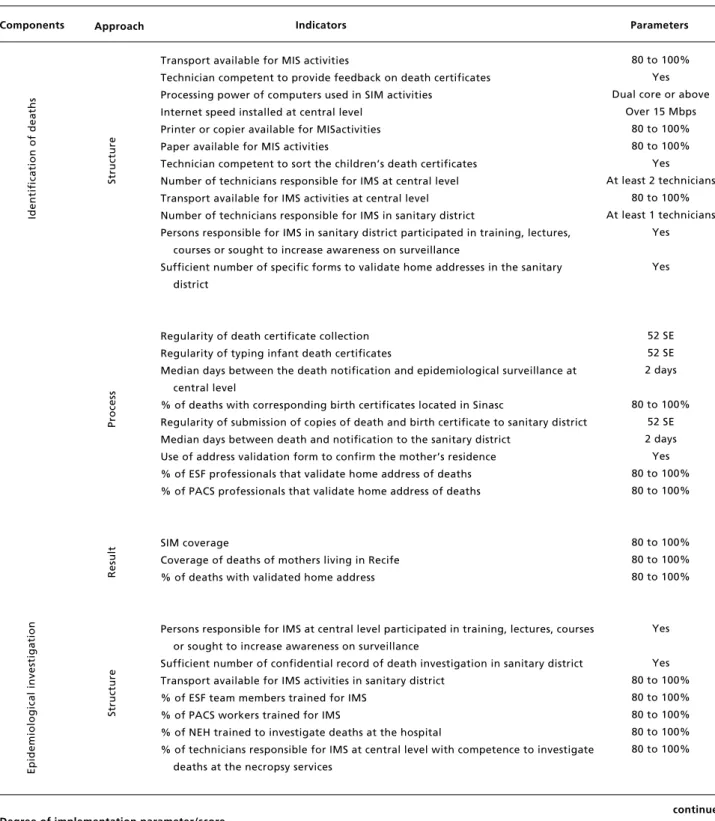
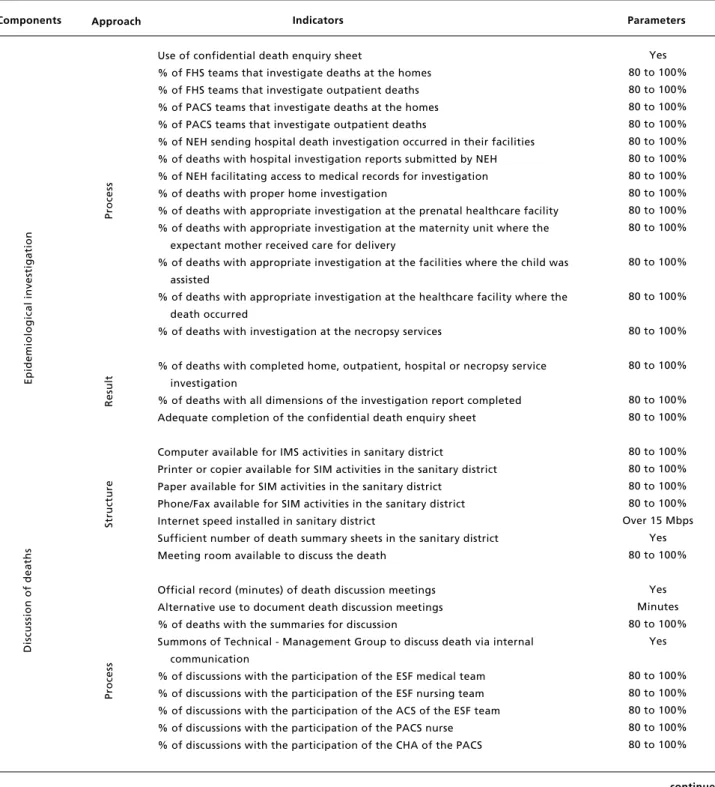
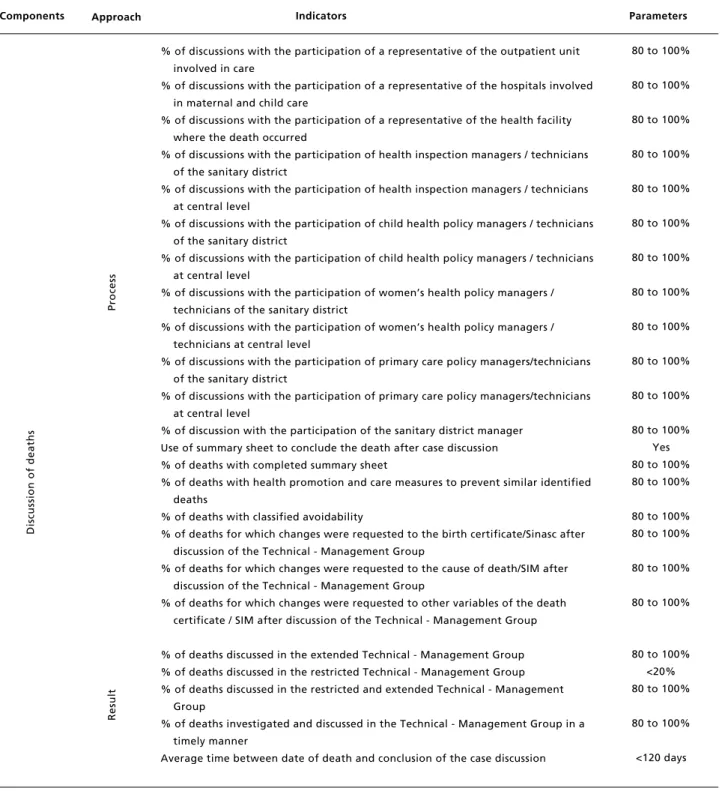
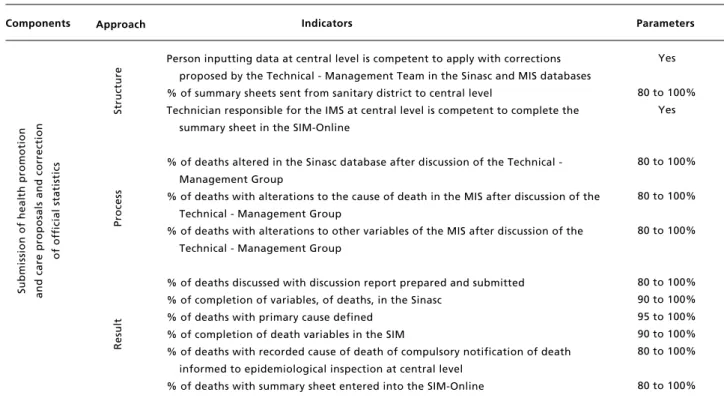
where the established and territorialised structure is provided, and where actions have been developed constantly for over ten years. The scores 1; 0.75; 0.5; 0.25, and 0 were established to judge the values found for each indicator (Table 1).
Data were collected from July to December 2015 by means of observation and questionnaires containing closed-ended and open-ended questions with those responsible for inspecting infant deaths and for the Mortality Information System (MIS) of the Municipal Department of Health and the Hospital Epidemiology Centres (HEC) of the State Department of Health.
Data of 2014 were collected from the MIS, including the online version; Information System on Live Births (Sinasc); municipal system of death certificate (DC) distribution and control; infant mortality surveillance panel; infant death and birth certificate (BC) submission protocol for sanitary
districts (SD); form of investigation and summary of infant deaths, death certificate submission sheets at the health units and necropsy services, compulsory notification of death (CND) by disease, and death entry sheets.
One hundred indicators were analysed, of which 83 were used to define the degree of implementation (structure and process) and 17 were used to define the results. The maximum estimated score was 100 points divided into the four components: 'identifica-tion of deaths' (10 points), epidemiological investi-gation' (30 point), 'discussion of deaths' (40 points), and ‘submission of health promotion and care proposals and correction of official statistics' (20 points).
and correction of official statistics' a lower score was also attributed because it is a major interface for the discussion on deaths between the workers and managers. The highest scores were assigned to ‘epidemiological investigation’ and ‘discussion of deaths' since they are central aspects of intervention. A weight of 30% was attributed to the approach ‘structure’ and a weight of 70% was attributed to ‘process’ because the assessment was performed in a large municipality with a minimally structured services network.
The classification of the degree of implementa-tion of infant mortality surveillance, arbitrated by the authors, was based on the time and duration of intervention, according to the indicators of structure and process, and categorised as: implemented (between 80.0 and 100.0%), partially implemented (60.0 to 79.9%), and not implemented (<60.0%).
Subsequently, the degree of implementation by components and as a whole was confronted with the theory of intervention, expressed in the logical model with empirical results based on deduction, and the intensity of relations was noted as consistent (degree of implementation and result indicators in the same category), partially consistent (degree of implementation and result indicators included in the category immediately above or below), and incon-sistent (involves the relationship between the highest and lowest degree of implementation categories and result indicators).18,23The degree of implementation analysis was confronted with each of the result indi-cators of respective components.
This study was approved by the research ethics committee of the Centro de Pesquisas Aggeu Magalhães da Fundação Oswaldo Cruz (CAAE: 07336313.6.0000.5190). The interviews were sche-duled and recorded after the participants signed an informed consent statement.
Results
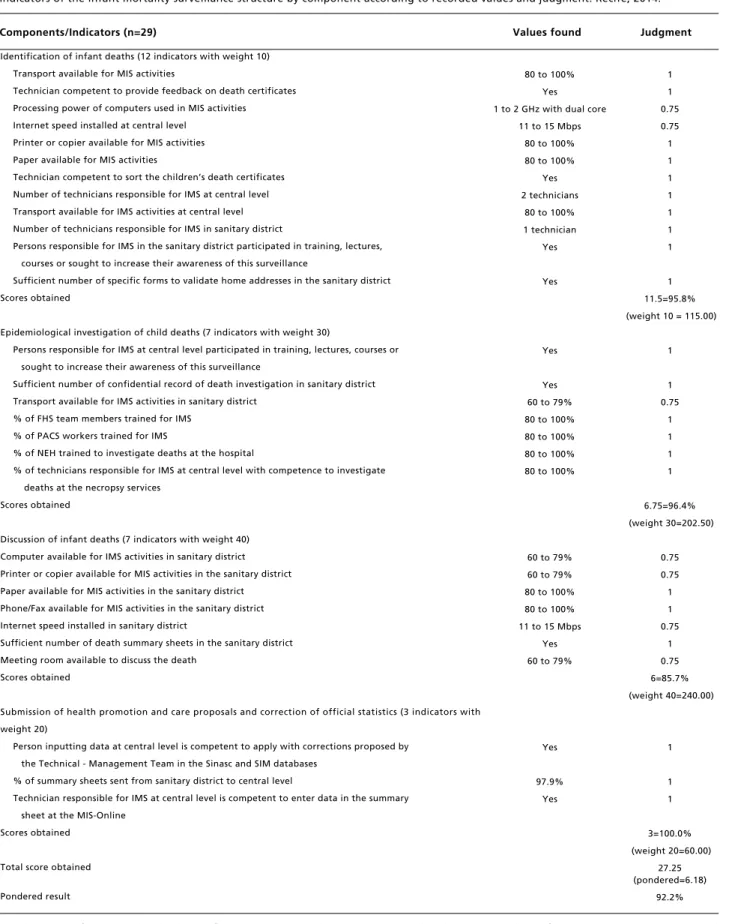
In the universe of structure indicators, all the infant mortality surveillance components were above 85%. In the component ‘submission of health promotion and care proposals and correction of official statis-tics’, all the indicators obtained a high score, while 'discussion of deaths' reached 85.7% of the expected score (Table 2).
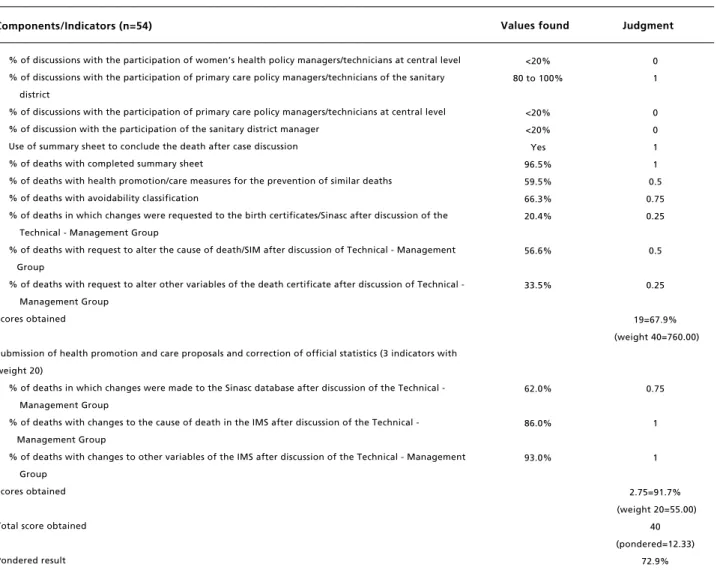
In relation to the process approach shown in Table 3, ‘submission of health promotion and care proposals and correction of official statistics’ was the best rated (91.7%) and 'discussion of deaths' obtained the lowest score (67.9%). Of these indica-tors, five were rated zero: percentage of discussions
with the participation of representatives of outpatient units and hospitals involved in care, managers/tech-nicians of maternal health and primary care at central level, and sanitary district manager. The structure approach obtained higher results than the-process in all the assessed components.
Infant mortality surveillance was classified as partially implemented (75.7%). Three components, however, were classified as implemented, namely 'identification of deaths', 'epidemiological investiga-tion’, and ‘submission of health promotion and care proposals and correction of official statistics’, with 85.7%, 88.1%, and 95.8%, respectively.
Of the 17 result indicators in relationship assess-ment of the degree of impleassess-mentation of infant mortality surveillance and its results with the logical model, only one indicator was considered inconsis-tent, namely 'percentage of infant deaths discussed with discussion reportprepared and submitted' (13.6%). This indicator is linked to the component ‘submission of health promotion and care proposals and correction of official statistics' (Figure 2).
Discussion
Infant mortality surveillance was considered partially implemented, although three components ('identification of deaths', 'epidemiological investi-gation’, and ‘submission of health promotion and care proposals and correction of official statistics’) were classified as implemented. The component ‘discussion of deaths’, which was attributed the highest weight, was decisive in the definition of the degree of implementation obtained in the interven-tion. Moreover, the empirical results obtained in mortality surveillance were compatible with its degree of implementation.
The structure approach was not considered a problem for operation and intervention activities, although other studies state the scarcity of resources as an obstacle to more productive action.11,24Some difficulties were detected in the indicators of 'identi-fication' and 'discussion of deaths’, all of which are related to failure to notify deaths in a timely manner and low participation of important actors in the discussion.
investiga-Rev. Bras. Saúde Matern. Infant., Recife, 17 (4): 801-815 out. / dez., 2017 809 Assessment of infant mortality surveillance: case study
Table 2
Indicators of the infant mortality surveillance structure by component according to recorded values and judgment. Recife, 2014.
DC=death certificate; BC=live birth certificate; SD=sanitary district; NC=central level; MIS= Mortality Information System; HEU=hospital epidemiology unit; FHS=family health strategy; PACS=Community Health Agent Programme; IMS=infant mortality surveillance; Sinasc=Live Births Information System.
Components/Indicators (n=29)
Identification of infant deaths (12 indicators with weight 10) Transport available for MIS activities
Technician competent to provide feedback on death certificates Processing power of computers used in MIS activities
Internet speed installed at central level Printer or copier available for MIS activities Paper available for MIS activities
Technician competent to sort the children’s death certificates Number of technicians responsible for IMS at central level Transport available for IMS activities at central level Number of technicians responsible for IMS in sanitary district
Persons responsible for IMS in the sanitary district participated in training, lectures, courses or sought to increase their awareness of this surveillance
Sufficient number of specific forms to validate home addresses in the sanitary district Scores obtained
Epidemiological investigation of child deaths (7 indicators with weight 30)
Persons responsible for IMS at central level participated in training, lectures, courses or sought to increase their awareness of this surveillance
Sufficient number of confidential record of death investigation in sanitary district Transport available for IMS activities in sanitary district
% of FHS team members trained for IMS % of PACS workers trained for IMS
% of NEH trained to investigate deaths at the hospital
% of technicians responsible for IMS at central level with competence to investigate deaths at the necropsy services
Scores obtained
Discussion of infant deaths (7 indicators with weight 40) Computer available for IMS activities in sanitary district Printer or copier available for MIS activities in the sanitary district Paper available for MIS activities in the sanitary district Phone/Fax available for MIS activities in the sanitary district Internet speed installed in sanitary district
Sufficient number of death summary sheets in the sanitary district Meeting room available to discuss the death
Scores obtained
Submission of health promotion and care proposals and correction of official statistics (3 indicators with weight 20)
Person inputting data at central level is competent to apply with corrections proposed by the Technical - Management Team in the Sinasc and SIM databases
% of summary sheets sent from sanitary district to central level
Technician responsible for IMS at central level is competent to enter data in the summary sheet at the MIS-Online
Scores obtained
Total score obtained
Pondered result
80 to 100% Yes 1 to 2 GHz with dual core
11 to 15 Mbps 80 to 100% 80 to 100%
Yes 2 technicians
80 to 100% 1 technician
Yes
Yes
Yes
Yes 60 to 79% 80 to 100% 80 to 100% 80 to 100% 80 to 100%
60 to 79% 60 to 79% 80 to 100% 80 to 100% 11 to 15 Mbps
Yes 60 to 79%
Yes
97.9% Yes
Values found Judgment
1 1 0.75 0.75 1 1 1 1 1 1 1
1 11.5=95.8% (weight 10 = 115.00)
1
1 0.75
1 1 1 1
6.75=96.4% (weight 30=202.50)
0.75 0.75 1 1 0.75
1 0.75 6=85.7% (weight 40=240.00)
1
1 1
3=100.0% (weight 20=60.00)
27.25 (pondered=6.18)
Table 3
Indicators of infant mortality surveillance by component according to values found and judgment Recife, 2014.
continue DC=death certificate; BC=live birth certificate; SD=sanitary district; NC=central level; MIS= Mortality Information System; HEU=hospital epidemiology unit; FHS=family health strategy; PACS=Community Health Agent Programme; IMS=infant mortality surveillance; Sinasc=Live Births Information System.
Components/Indicators (n=54)
Identification of infant deaths (9 indicators with weight 10) Regularity of death certificate collection
Regularity of entries of infant death certificates
Median days between the death notification and epidemiological surveillance at central level % of deaths with corresponding birth certificates located in Sinasc
Regularity of submission of copies of death and birth certificate to sanitary district Median days between death and notification to the sanitary district
Use of address validation form to confirm the mother’s residence % of FHS professionals that validate home address of deaths % of PACS professionals that validate home address of deaths Scores obtained
Epidemiological investigation of infant deaths (14 indicators with weight 30) Use of confidential death enquiry sheet
% of FHS teams that investigate deaths at the homes % of FHS teams that investigate outpatient deaths % of PACS teams that investigate deaths at the homes % of PACS teams that investigate outpatient deaths
% of HEU sending hospital death investigation occurred in their facilities % of deaths with hospital investigation reports submitted by HEU % of HEU facilitating access to medical records for investigation % of deaths with proper home investigation
% of deaths with appropriate investigation at the prenatal care unit
% of deaths with appropriate investigation at the maternity unit where the expectant mother delivered the infant
% of deaths with appropriate investigation at the healthcare services where the child received care % of deaths with appropriate investigation at the healthcare facility where the death occurred % of deaths with investigation at the necropsy services
Scores obtained
Discussion of infant deaths (28 indicators with weight 40) Official record (minutes) of death discussion meetings Alternative use to document death discussion meetings % of deaths with the summaries for discussion
Summons of Technical - Management Group to discuss death via internal communication % of discussions with the participation of the FHS medical team
% of discussions with the participation of the FHS nursing team % of discussions with the participation of the ACS of the FHS team % of discussions with the participation of the PACS nurse % of discussions with the participation of the ACS of the PACS
% of discussion with the participation of the outpatient representatives involved in care
% of discussion with the participation of the hospital representatives involved in maternal/child care % of discussions with the participation of a representative of the health facility where the death occurred % of discussions with the participation of health inspection managers/technicians of the sanitary district % of discussions with the participation of health inspection managers/technicians at central level % of discussions with the participation of child health policy managers/technicians of the sanitary district % of discussions with the participation of child health policy managers/technicians at central level % of discussions with the participation of women’s health policy managers/technicians of the sanitary district
98.1% 63.5% 15 days 94.3% 73.1% 37 days Yes 80 to 100% 80 to 100%
Yes 80 to 100% 80 to 100% 80 to 100% 80 to 100% 57.1% 55.1% 80 to 100%
71.7% 75.0% 84.2%
66.7% 96.7% 55.6%
Yes Minutes 80 to 100%
Yes 20 to 39% 80 to 100% 80 to 100% 80 to 100% 80 to 100%
<20% <20% 60 to 79% 80 to 100% 80 to 100% 80 to 100% 60 to 79% 80 to 100%
Values found Julgamento
1 0.75
0 1 0.75
0 1 1 1 6.5=72.2% (weight 10=65.00)
1 1 1 1 1 0.5 0.5 1 0.75 0.75 1
0.75 1 0.5 11.75=83.9% (weight 30=352.50)
1 1 1 1 0.25
1 1 1 1 0 0 0.75
1 1 1 0.75
Rev. Bras. Saúde Matern. Infant., Recife, 17 (4): 801-815 out. / dez., 2017 811 Assessment of infant mortality surveillance: case study
Table 3 concluded
Indicators of infant mortality surveillance by component according to values found and judgment Recife, 2014.
DC=death certificate; BC=live birth certificate; SD=sanitary district; NC=central level; MIS= Mortality Information System; HEU=hospital epidemiology unit; FHS=family health strategy; PACS=Community Health Agent Programme; IMS=infant mortality surveillance; Sinasc=Live Births Information System..
Components/Indicators (n=54)
% of discussions with the participation of women’s health policy managers/technicians at central level % of discussions with the participation of primary care policy managers/technicians of the sanitary
district
% of discussions with the participation of primary care policy managers/technicians at central level % of discussion with the participation of the sanitary district manager
Use of summary sheet to conclude the death after case discussion % of deaths with completed summary sheet
% of deaths with health promotion/care measures for the prevention of similar deaths % of deaths with avoidability classification
% of deaths in which changes were requested to the birth certificates/Sinasc after discussion of the Technical - Management Group
% of deaths with request to alter the cause of death/SIM after discussion of Technical - Management Group
% of deaths with request to alter other variables of the death certificate after discussion of Technical - Management Group
Scores obtained
Submission of health promotion and care proposals and correction of official statistics (3 indicators with weight 20)
% of deaths in which changes were made to the Sinasc database after discussion of the Technical - Management Group
% of deaths with changes to the cause of death in the IMS after discussion of the Technical - Management Group
% of deaths with changes to other variables of the IMS after discussion of the Technical - Management Group
Scores obtained
Total score obtained
Pondered result
<20% 80 to 100%
<20% <20% Yes 96.5% 59.5% 66.3% 20.4%
56.6%
33.5%
62.0%
86.0%
93.0%
Values found Judgment
0 1
0 0 1 1 0.5 0.75 0.25
0.5
0.25
19=67.9% (weight 40=760.00)
0.75
1
1
2.75=91.7% (weight 20=55.00)
40 (pondered=12.33)
Figure 2
Relationship ofthedegree of implementation of infant mortality surveillance components and their results with the logical model Recife, 2014.
Components Approach Results
Identification of deaths
Structure
Process
Degree of implementa-tion
95.8%
72.2%
85.7%
MIS coverage
Coverage of deaths of mothers living in Recife
% of deaths with validated home address
100.2%
99.3%
99.3%
Epidemiological investigation
Structure
Process
96.4%
83.9%
88.1%
% of deaths with completed home, outpatient, hospital or necropsy ser-vice investigation
Adequate completion of the confiden-tial death enquiry sheet
% of deaths with all dimensions of the investigation report completed
95.1%
77.7%
77.2%
Discussion of deaths
Structure
Process
85.7%
67.9%
71.4%
% of deaths discussed in the restricted and extended Technical - Management Group
% of deaths discussed in the restricted Technical - Management Group
% of deaths investigated and discussed in the Technical - Management Group in a timely manner
95.1%
62.1%
33.0%
Submission of health promotion and care
proposals and correction of official
statistics
Structure
Process
100.0%
91.,7%
95.8%
% of deaths with primary cause defined
% of completion of death variables in the SIM
% of deaths with recorded cause of death of compulsory notification of death informed to epidemiological inspection at central level
99.3%
99.0%
97.9% Implemented
Implemented
Partially implemented
% of deaths discussed in the extended Technical - Management Group
Average time between date of death and conclusion of the case discussion
27.5%
193 days
% of completion of variables, of deaths, in the Sinasc
% of deaths with summary sheet entered into the MIS-Online
% of deaths discussed with discussion report prepared and submitted Implemented
91.9%
84.6%
13.6%
Structure
Process
92.2%
72.9%
75.7% Summary of degree
of implementation
Partially implemented
NC=central level; MIS=Mortality Information System; Sinasc=Live Births Information System. Degree of
implementa-tion
Degree of implementa-tion
Degree of implementa-tion
Degree of implementa-tion
tion of infant deaths.25
The rapid flow of information and the timely start of investigations are important for the success of mortality surveillance.22In Brazil, the deadline to complete an investigation is 120 days from the date of the occurrence,9while in the United Kingdom the investigation must be concluded within one month of the death notification.26Delays in this process can hinder interventions to improve the quality of vital statistics information systems and prevent new deaths.
This study identified that almost all (95.1%) infant deaths, except those caused by congenital malformation, were investigated. This percentage is similar to the results found in the city of Londrina -Paraná (97% to 100% of deaths)15and different from the results of Arapiraca - Alagoas (54.3%).17The overall proportion of deaths investigated in Brazilian states is lower (in Bahia 21.3% and in São Paulo 57% of health management units investigated all infant deaths).11,14Moreover, the manner in which the forms are completed must be improved, espe-cially in terms of investigating the home, the prenatal care and child care units, and the necropsy services. It is critical to improving the quality of investigations in order to build a chain of events that supports death notifications and provides a better understanding of the socioeconomic, cultural, and care determinants.5,11,17
National and international discussions of deaths occur in committees by a group of experts from universities, health departments, councils, and non-governmental organizations.11,27,28 The studied municipalitydiffers when it that adds social services, inspection, and management workers into the discus-sion. Nonetheless, this was the component with the lowest degree of implementation.
The absence of relevant actors from the health system in discussions of deaths has a negative effect on one of the most important activities of this strategy. Discussions enable a change of attitude and social practices, improve the education of healthcare workers and managers, and increase the effective-ness of the recommendations. The participation in discussions and horizontal listening sessions of workers and managers with multiple roles and levels of involvement in the deaths can help establish ways to overcome barriers and provide care that better suits the needs of women and children. A study conducted in a capital city of northeastern Brazil on preventable infant deaths and barriers in primary care revealed conflicting understandings of the event depending on the position of the care networkor whether the person was the child’s mother.29
In spite of the strategy’s potential, international research on the social autopsy of mother and child deaths conducted in several countries found resis-tance among health workers to report or discuss these deaths due to fear of being held accountable or penalised.27
Analyses and studies of each death have also helped improve the healthcare information systems since, after the investigations, the team that discussed the case usually attributes new root causes to the infant's death, and completes and/or validates the variables of the live birth and death certifi-cates,9,12,13,16,17 as observed in this assessment. Furthermore, improving vital information systems promotes changes and adjustments to the child mortality profile and enables appropriate planning of actions for its challenging.
A low proportion of infant deaths involved the preparation and submission of reports with proposi-tions of the healthcare sector to the sectors respon-sible for taking the necessary precautions. These reports provide an overview of the quality of mother and child care in order to encourage healthcare authorities to act.27However, the discussion of death with the workers involved in care allows a change of attitude based on their own participation because of the educational, reflective, and purposeful nature of these meetings, which was also observed in perinatal audits in other regions of the world.28The expe-rience of Moldova shows that if all stages of this strategy are correctly executed, the quality of mother and child care will also improve and possibly reduce the occurrence of preventable infant deaths.28
The consistency between the result indicators and the degree of implementation of infant mortality surveillance suggests the model is suitable to unde-rstand the degree of implementation and situation of all activities in the studied case. One of the advan-tages of making the logical model of an intervention explicit is the possibility of extrapolation to other scenarios. In addition, the model improves the studied strategy by precisely outlining the objective, enhancing individual and collective actions, and identifying planned activities to achieve the expected results in an educational training perspec-tive, thus strengthening the acts and decisions of all stakeholders involved.19
The strengths of the studied strategy are related to the quality and complexity of the logic on which the research is based, and in the plausibility of inter-relationships between the activities and the results, which guarantees greater internal validity.19 However, in terms of external validity, a limit would be the extrapolation of results. The logical model can
be extrapolated, not the results.23
In conclusion, infant mortality surveillance does not fully adhere to the norms and guidelines esta-blished in regulatory documents. Some factors regarding this point were identified as being more fragile and should be considered in interventions to improve the strategy. In order to overcome the obsta-cles preventing appropriate mortality surveillance, scientific, organisational, and experience-based knowledge must be correctly combined and applied. Discussing a child’s death is a problem situation of circumstance that requires reflection, followed by
decoding, acknowledgment, and denaturalisation, especially in situations of restricted budget and rights.30
The logical model of infant mortality surveil-lance and its assessment were considered appropriate because they were capable of detecting the consis-tency of interrelationships between the proposed activities, and can, therefore,be reproduced in other scenarios. This type of assessment is critical to iden-tify the weaknesses and potentialities of the strategy and enable managers and technicians to act according to requirements.
References
1. Victora CG, Aquino EML, Leal MC, Monteiro CA, Barros FC, Szwarcwald CL. Maternal and child health in Brazil: progress and challenges. Lancet. 2011; 377 (9780): 1863-76.
2. AbouZahr C, Savigny D, Mikkelsen L, Setel PW, Lozano R, Nichols E, Notzon F, Lopez A. Civil registration and vital statistics: progress in the data revolution for counting and accountability. Counting births and deaths 1. Series. Lancet. 2015 [acesso em out 2015]. Disponível em: http://dx.doi.org/10.1016/S0140-6736(15)60173-8. 3. Grove J, Claeson M, Bryce J, Amouzou A, Boerma T,
Waiswa P, Victora C on behalf the Kirkland Group. Maternal, newborn, and child health and the Sustainable Development Goals—a call for sustained and improved measurement. Lancet. 2015; 386 (10003): 1511-4. 4. United Nations. 2015—time for global action for people
and planet. New York: United Nations. 2015 [acesso em set 2015]. Disponível em: http://www.un.org/sustainabledevel-opment.
5. Merali HS, Lipsitz S, Hevelone N, Gawande AA, Lashoher A, Agrawal P, Spector J. Audit-identified avoidable factors in maternal and perinatal deaths in low resource settings: a systematic review. BMC Pregnancy Childbirth. 2014; 14 (280): 1-12.
6. Bamber JH, Kinsella SM. MBRRACE-UK – the new home for the Confidential Enquiries into Maternal Deaths – reports for the first time. Anaesthesia. 2015; 70 (1): 5–9. 7. Shrestha S, Sharma A, Upadhyay S, Rijal P. Perinatal
mortality audit. Nepal Med Coll J. 2010; 12 (4): 257-9. 8. WHO (World Health Organization). Death reviews:
maternal, perinatal and child. WHO. 2013 [acesso em 24 jan 2016]. Disponível em: http://www.who.int/pmnch/ knowledge/publications/summaries/ks27/en/.
9. Brasil. Ministério da Saúde. Secretaria de Vigilância à Saúde. Portaria nº 72, de 11 de janeiro de 2010. Dispõe sobre a regulamentação da Vigilância de Óbitos Infantis e Fetais. Diário Oficial da União 2010, n. 7, 11 jan. 10. Oliveira CM, Bonfim CV, Guimarães MJB, Frias PG,
Medeiros ZM. Infant mortality: temporal trend and contri-bution of death surveillance. Acta Paul Enferm. 2016; 29 (3): 282-90.
11. Venâncio S, Paiva R. O processo de implantação dos Comitês de Investigação do Óbito Infantil no Estado de São Paulo. Rer Bras Saúde Matern Infant. 2010; 10 (3): 369-75. 12. Santana IP, Santos JMD, Costa JRD, Oliveira RRD, Orlandi MHF, Mathias TADF. Aspects of infant mortality, according to an investigation of death. Acta Paul Enferm. 2011; 24 (4): 556-62.
13. Jodas DA, Scochi MJ, Moura MB, Tiwata MZ. Atendimento à criança e às mães: investigação do óbito evitável em menores de cinco anos. Rev Gaúcha Enferm. 2011; 32 (4): 669-75.
14. Santana M, Aquino R, Medina MG. Effect of the Family Health Strategy on surveillance of infant mortality. Rev Saúde Pública. 2012; 46 (1): 59-67.
15. Santos HGD, Andrade SMD, Silva AMR, Carvalho WOD, Mesas AE, González AD. Agreement on underlying causes of infant death between original records and after investiga-tion: analysis of two biennia in the years 2000. Rev Bras Epidemiol. 2014; 17 (2): 313-22.
16. Frias PG, Lira PIC, Vidal SA, Vanderlei LCM. Vigilância de óbitos infantis como indicador da efetividade do sistema de saúde - estudo em um município do interior do Nordeste brasileiro. J Pediatr. 2002; 78 (6): 509-16.
17. Caetano SF, Vanderlei LCM, Frias PG. Avaliação da completitude dos instrumentos de investigação do óbito infantil no município de Arapiraca, Alagoas. Cad Saúde Coletiva. 2013; 21 (3): 309-17.
18. Champagne F, Brousselle A, Hartz Z, Contandriopoulos A-P, Denis J-L. A análise de implantação. In: Brousselle, A, Champagne F, Contandriopoulos A-P, Hartz Z. Avaliação: conceitos e métodos. Rio de Janeiro: Ed. Fiocruz; 2011. p. 217-38.
19. Chen HT. Pratical Program Evaluation: assessing and improving, planning, implementations, and effectviness. Thousand Oaks, CA: Sage Publications, 2005.
21. Recife. Secretaria Municipal de Saúde. Projeto de implan-tação da vigilância do óbito infantil no Recife. Recife, 2002.
22. Brasil. Ministério da Saúde. Secretaria de Vigilância à Saúde. Manual de vigilância do óbito infantil e fetal e do comitê de prevenção do óbito infantil e fetal. 2 ed. Brasília, DF; 2009.
23. Yin RK. Estudo de caso: planejamento e métodos. 3 ed. Porto Alegre: Bookman; 2005.
24. Pereira CCB, Vidal AS, Carvalho PI, Frias PG. Avaliação da implantação do Sistema de Informações sobre Nascidos Vivos (Sinasc) em Pernambuco. Rev Bras Saúde Matern Infant. 2013; 13 (1): 39-49.
25. Frias PG, Szwarcwald CL, Lira PIC. Avaliação dos sistemas de informações sobre nascidos vivos e óbitos no Brasil na década de 2000. Cad Saúde Pública. 2014; 30 (10): 2068-80.
26. GOV.UK. Department for Education. Child death reviews: forms for reporting child deaths. [acesso em 09 fev 2016].
Disponível em: from:http://www.nrhmhp.gov.in/sites/ default/files/files/Child%20death%20Review%20guide-lines.pdf.
27. Kalter HD, Salgado R, Babille M, Koffi AK, Black RE. Social autopsy for maternal and child deaths: a comprehen-sive literature review to examine the concept and the devel-opment of the method. Population Health Metrics. 2011; 9 (45): 1-13.
28. Stratulat P, Curteanu A, Caraus T, Petrov V, Gardosib J. The experience of the implementation of perinatal audit in Moldova. BJOG. 2014; 121 (Suppl 4): 167-71.
29. Vanderlei LCM, Navarrete MLV. Mortalidade infantil evitável e barreiras de acesso à atenção básica no Recife, Brasil. Rev Saúde Pública. 2013; 47 (2): 379-89. 30. Vanderlei LCM, Frias PG. Uncertainties in the Brazilian
scenario and its implications in mother and child health. Rev Bras Saúde Matern Infant. 2016; 16 (4): 375-6.
Rev. Bras. Saúde Matern. Infant., Recife, 17 (4): 801-815 out. / dez., 2017 815 Assessment of infant mortality surveillance: case study
______________
Received on May 9, de 2017