2011 Mar-Apr;19(2):437-44 www.eerp.usp.br/rlae
Corresponding Author: Ana Karina Bezerra Pinheiro
Universidade Federal do Ceará. Departamento de Enfermagem Rua Alexandre Baraúna, 1115
Bairro: Rodolfo Teóilo
CEP: 60430-160 Fortaleza, CE, Brasil E-mail: [email protected]
Integrative Review of the Nursing Interventions Used for the Early
Detection of Cervical Uterine Cancer
Camila Teixeira Moreira Vasconcelos
1Marta Maria Coelho Damasceno
2Francisca Elisângela Teixeira Lima
3Ana Karina Bezerra Pinheiro
4In a national program to combat cervical uterine cancer (CUC) four basic elements should
exist: primary prevention, early detection, diagnosis/treatment and palliative care. Of
these, early detection is the most effective modality. One of the purposes of
Evidence-Based Practice (EBP) is to encourage the use of research results with the assistance
provided, reinforcing the importance of research for clinical practice. This study aimed to
evaluate the evidence available in the literature regarding effective nursing interventions
for the early detection of CUC. The selection of articles was performed in the databases:
Scopus, PubMed, CINAHL, Lilacs and Cochrane. The sample of this review consisted of seven
articles, with evidence levels 1, 2 or 3. The behavioral, cognitive and social interventions,
showed positive effects in the early detection of CUC, especially the interactive cognitive
interventions. It is suggested, when appropriate, to use a combination of interventions in
order to obtain a more effective result.
Descriptors: Nursing; Women’s Health; Uterine Cervical Neoplasms; Vaginal Smears;
Evidence-Based Nursing.
1 RN, Doctoral student in Nursing, Universidade Federal do Ceará, Fortaleza, CE, Brazil. Scholarship holder of Coordenação de
Aperfeiçoamento de Pessoal de Nível Superior (CAPES). E-mail: [email protected].
2 RN, Professor, Departamento de Enfermagem, Universidade Federal do Ceará, Fortaleza, CE, Brazil. E-mail:
3 RN, Ph.D. in Nursing, Professor, Departamento de Enfermagem, Universidade Federal do Ceará, Fortaleza, CE, Brazil. E-mail:
Revisão integrativa das intervenções de enfermagem utilizadas para detecção precoce do câncer cérvico-uterino
Em um programa nacional de combate ao câncer cérvico-uterino (CCU) devem existir
quatro elementos básicos: prevenção primária, detecção precoce, diagnóstico/tratamento
e cuidados paliativos. Desses, a detecção precoce é a modalidade mais efetiva. Um
dos propósitos da Prática Baseada em Evidências é encorajar a utilização de resultados
de pesquisa junto à assistência prestada, reforçando a importância da pesquisa para
a prática clínica. Esse estudo objetivou avaliar as evidências disponíveis na literatura sobre as intervenções de enfermagem eicazes na detecção precoce do CCU. A seleção dos artigos foi realizada nas bases: Scopus, PubMed, CINAHL, LILACS e Cochrane. A
amostra desta revisão constitui-se de 7 artigos, com níveis de evidência 1, 2 ou 3.
Tanto as intervenções comportamentais como as cognitivas e sociais mostraram efeitos
positivos na detecção precoce do CCU, com destaque para as intervenções cognitivas
interativas. Sugere-se, quando adequado, utilizar combinação das intervenções para se obter resultado mais eicaz.
Descritores: Enfermagem; Saúde da Mulher; Neoplasias do Colo Uterino; Esfregaço
Vaginal; Enfermagem Baseada em Evidências.
Revisión integradora de las intervenciones de enfermería utilizadas para detección precoz del cáncer cervicouterino
En un programa nacional de combate al cáncer cervicouterino (CCU) deben existir cuatro
elementos básicos: prevención primaria, detección precoz, diagnóstico/tratamiento y
cuidados paliativos. De estos, la detección precoz es la modalidad más efectiva. Uno
de los propósitos de la Práctica Basada en Evidencias es incentivar la utilización de
resultados de investigación junto a la asistencia prestada, reforzando la importancia
de la investigación para la práctica clínica. Este estudio objetivó evaluar las evidencias disponibles en la literatura sobre las intervenciones de enfermería eicaces en la detección precoz del CCU. La selección de los artículos fue realizada en las bases: Scopus, Pubmed,
CINAHL, LILACS y Cochrane. La muestra de esta revisión se constituye de 7 artículos,
con niveles de evidencia 1, 2 o 3. Tanto las intervenciones comportamentales, como las
cognitivas y sociales mostraron efectos positivos en la detección precoz del CCU, con
destaque para las intervenciones cognitivas interactivas. Se sugiere, cuando adecuado, utilizar una combinación de las intervenciones para obtener un resultado más eicaz.
Descriptores: Enfermería; Salud de la Mujer; Neoplasias del Cuello Uterino; Frotis
Vaginal; Enfermería Basada en la Evidencias.
Introduction
Cervical uterine cancer (CUC) is a global disease,
despite presenting the greatest potential for prevention
and cure (nearly 100%) when diagnosed early. It is
the second most common cancer among the female
population, accounting for over 250,000 deaths in
2005, with 80% of these deaths occurred in developing
countries(1). Rates of CUC have decreased over the last
thirty years in most developed countries, probably as a
result of screening and treatment programs. Conversely,
these rates have increased or remained unchanged in
most developing countries. It is noteworthy that there
are also inequalities in the developed world, where
women from rural or poor areas are at greater risk of
facing the invasive type of CUC(1).
By presenting a slow evolution, with a long period
from the development of precursor lesions to the onset
of cancer, various actions can be performed in order to
national program to combat CUC there should be four
basic elements: primary prevention, early detection,
diagnosis/treatment and palliative care(1). Early detection
is the most effective modality in reducing this disease(3).
Early detection includes systematic screening programs
aimed at the appropriate age groups, with effective links
between all levels of care, as well as the education of health professionals and women, highlighting the beneits of the screening examination in the age groups that
typically manifests this cancer, its signs and symptoms.
Several studies have evaluated the role of the nurse
in the prevention and control of CUC as critical due to the
diverse areas of work of this professional with women
and due to the use of educational strategies(4-5). Nurses
are constantly challenged in the pursuit of knowledge in
order to promote the improvement of nursing care(6). One
of the purposes of Evidence-Based Practice (EBP) is to
encourage the use of research results with the assistance
provided in the different levels of healthcare, reinforcing
the importance of research for clinical practice(7). The
integrative literature review is one of the research
methods used in EBP, which allows the incorporation of
evidence into the clinical practice. This method aims to gather and synthesize research indings on a determined theme or question, in a systematic and orderly manner,
contributing to a deepening of knowledge on the subject
investigated(7).
To guide the integrative review, the following
question was formulated: which nursing interventions
are effective in the early detection of CUC? In order to
contribute to the improvement of nursing care in the ight against CUC, this study aimed to evaluate the evidence available in the literature regarding effective
interventions for the early detection of CUC.
Methodological procedure
For the elaboration of this integrative review,
the following steps were covered: establishment of
the hypothesis and aims of the integrative review;
establishment of criteria for inclusion and exclusion of articles (sample selection); deinition of the information to be extracted from the selected articles; analysis of
the results; discussion and presentation of the results; with the inal step constituted by the presentation of the review(7). For the selection of articles the following
databases were used: LILACS (Latin American and
Caribbean Health Sciences Literature), PubMed (Public/
Publisher Medline), CINAHL (Cumulative Index to Nursing
and Allied Health Literature), SCOPUS and COCHRANE. Initially, the criteria deined for inclusion of articles in this integrative review were: to be a complete research
article, available electronically, published in Portuguese,
English or Spanish; to portray interventions used in the
early detection of CUC with at least one nurse on the
list of the authors and to have an evidence level of 1, 2 or 3. Because of the speciic access characteristics of each of the ive selected databases, the strategies used to locate the articles were adapted for each, and
were guided by the question and the inclusion criteria
previously established to maintain consistency in the
search for the articles and to avoid possible biases. The
following controlled descriptors were used as keywords:
‘neoplasias do colo uterino and enfermagem’ and ‘uterine cervical neoplasms and nursing’. The search
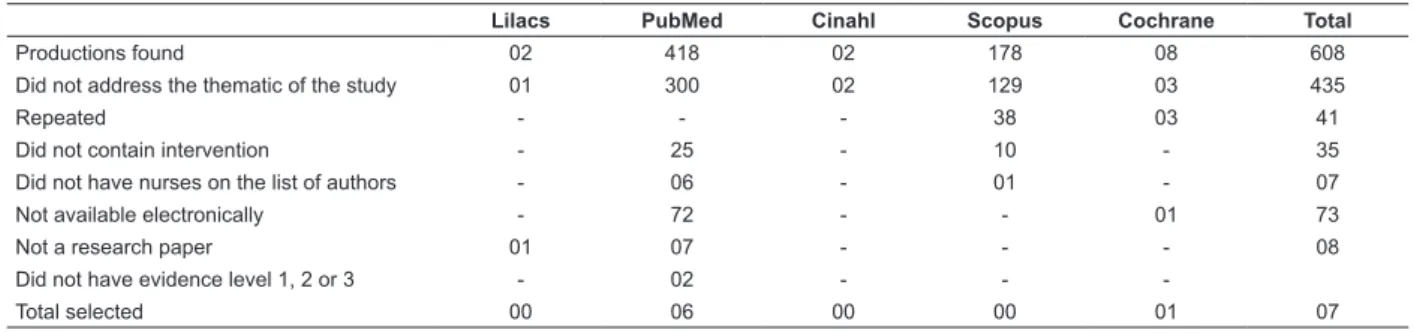
was conducted through online access, in October 2009, with the inal sample of this integrative review consisting of 07 articles (Table 1).
Table 1 - Selection of the research articles in the databases LILACS, PubMed, CINAHL, Scopus and Cochrane according
to the established inclusion criteria
Lilacs PubMed Cinahl Scopus Cochrane Total
Productions found 02 418 02 178 08 608
Did not address the thematic of the study 01 300 02 129 03 435
Repeated - - - 38 03 41
Did not contain intervention - 25 - 10 - 35
Did not have nurses on the list of authors - 06 - 01 - 07
Not available electronically - 72 - - 01 73
Not a research paper 01 07 - - - 08
Did not have evidence level 1, 2 or 3 - 02 - -
-Total selected 00 06 00 00 01 07
For data collection, an adapted instrument was
used(8), which included the following items: identiication
of the original article, methodological characteristics of
the study, evaluation of methodological rigor, of the
interventions and of the measured results. For the analysis
and subsequent synthesis of the articles that met the
inclusion criteria an adapted synoptic table was used(8),
specially constructed for this purpose, which included
the following aspects: name of the study, names of the
Rev. Latino-Am. Enfermagem 2011 Mar-Apr;19(2):437-44.
and conclusions. After analysis, the interventions were categorized, according to a classiication system previously developed, into: behavioral, cognitive or
social(9).
Behavioral interventions are those that propose
stimuli associated with the realization of early detection
examinations for CUC (e.g. reminders). Cognitive
interventions are those that provide new information,
educate women about the screening examinations and
clarify possible misconceptions. Social interventions use
peer counselors (members of the community trained to
offer information) or professionals in order to increase
the examination adherence(9).
The articles were classiied as evidence level 1 when the evidence came from a systematic review or
meta-analysis of all relevant randomized controlled
clinical trials of clinical guidelines based on systematic
reviews of randomized controlled clinical trials; 2 if the
evidence was derived from at least one well designed
randomized controlled clinical trial; and 3 when the
evidence was obtained from well designed clinical
trials without randomization(10). The presentation of the
results and discussion of the data obtained was carried
Table 2 - Characteristics of the studies
out in a descriptive way, enabling the reader to evaluate
the applicability of the elaborated integrative review, in
order to achieve the goal of this method.
Results
Of the selected articles, all were published in
journals of international origin. Regarding the databases, six articles were identiied in PubMed and one in Cochrane. Concerning the type of journal in which they
were published, only one belonged to a medical journal,
three were published in general nursing journals and three in nursing journals of speciic areas (gynecology and oncology). Regarding the methodological design, the articles were classiied as: systematic review (n=01), randomized controlled clinical trials (n=03),
clinical trials without randomization (n=03). Of the
seven selected articles, there were 24 different types of
interventions, 20 had the patients as their target; one,
the professionals; and three, changes in the existing
system. In general, a greater number of interventions
(n=13) used cognitive strategies, followed by behavioral
(n=06) and social (n=04) (Table 2).
Intervention N % References*
Studies 07 100.0
Evidence level of the Studies
Level 1 01 14.0 11
Level 2 03 43.0 12, 13, 14
Level 3 03 43.0 15, 16, 17
Interventions 24 100.0
Target of the Intervention
Patients 20 83.3 11†, 12, 13, 14, 15, 17
Professionals 01 4.2 16
System 03 13.5 11, 12
Type of Intervention
Behavioral 07 30.4 11, 16, 17
Cognitive 13 54.1 11, 13, 14, 17
Social 04 16.5 11, 12, 15
Contents of the intervention
Behavioral Intervention 07 100.0
Reminder letter 01 14.2 11
Telephone reminder 01 14.2 11
Diagrammatic reminder 01 14.2 16
Financial incentives‡ 03 43.2 11, 17
Follow-up protocol 01 14.2 11
Cognitive Intervention 13 100.0
Educational pamphlet or letter 06 46.0 11, 13 e 17 Counseling by telephone or in person 02 15.5 11
Discussion groups 02 15.5 14, 17
Educational medias (radio, TV, video, slides, newspaper) 03 23.0 11, 14, 17
Social Intervention 04 100.0
Care with nurse 02 50.0 12, 15
Computer use 01 25.0 12
Screening system 01 25.0 11
* Some studies contain more than one intervention.
† The systematic review consisted of eight studies and a total of 13 interventions.
Various strategies to effectively carry out early
detection of CUC, in each related category of intervention,
were evaluated.
Behavioral interventions
Behavioral intervention that used reminders (letters
or calls) as their strategy have proved effective in
relation to early detection of CUC, whether by increasing
examination adherence or by increasing the number
of follow-up appointments of women with abnormal
examination results. These interventions are based on
the assumption that people need only one stimulus
(reminder) to practice adequate behavior. For women,
this stimulus can be provided through telephone calls
or reminder letters to stimulate the performance of the
examination or the follow-up appointment(11). In the
case of the professionals, diagrammatic reminders are
generally used in the patients’ medical records or on the
admission form, so that they carry out the screening and
reinforce the importance of performing the examination
at that moment(12). One of the strategies studied was
the idealization of a new hospital admission form, with
a diagrammatic reminder, containing questions on the
screening for CUC, aiming to investigate its effects
on two results: the frequency with which the nurse in
charge of admissions records information related to
the screening and the report of the patients regarding
the performance of the examination 4 months after
discharge. There was only 01 (2.2%) medical record
in the control group (CG) which had a registration of
screening, while in the intervention group (IG) there were
29 (69%) registrations (p=0.001). Of the 42 women
in the IG, 22 were contacted by telephone 4 months
after hospital discharge, of these, 19 (86.4%) reported
not having conducted the examination in that period.
Sixteen women reported that the nurse had not talked
about the examination during the hospitalization(12). In
the same study(12), approximately half of the nurses said there was not suficient time to discuss screening during the hospitalization, although most agree that
the hospital is an important space for discussion of
preventive measures. This study demonstrated that the
intervention was effective in improving the CUC screening
records, however, it did not improve the concern of the
women for the performance of the exam. Interventions with the use of protocols for monitoring and inancial incentives, such as free examinations or money for transport, signiicantly improved the adherence to the examination, especially in economically disadvantaged
women(11,13).
Cognitive Interventions
The strategy of sending letters or educational
pamphlets, with simple language addressing aspects
related to the early detection examinations, had a
positive impact on women’s knowledge, although this
did not always mean an improvement in this practice of
the examination(11,13-14). In order to evaluate the effects
on the levels of knowledge and anxiety of women with
colposcopy scheduled because of an altered cytologic
examination, an educational pamphlet containing
information about the colposcopic examination was
mailed to them. No difference was found between the
CG (50.8%) and IG (47.9%) in relation to the level of
anxiety (p>0.05). Conversely, after the educational
intervention, it was shown that 72% of the women of
the IG had correct comprehension regarding colposcopy,
compared to 42% in the CG (p<0.05)(14).
In another study, which also used the strategy of
the educational pamphlet, the women had a statistically
superior evaluation of knowledge related to the
examination when compared to the others (p=0.002)(13).
The use of an educational brochure to motivate women
with cytological alterations to carry out the follow-up
examination obtained a slight increase in adherence(15).
However, when associated with the implementation
of a screening system, there was a considerable
increase(16). Telephone counseling, conducted to identify
and eliminate educational, psychological and practical
barriers in relation to the Papanicolau examination,
was shown to be an excellent strategy to improve
adherence to the examination, even when compared to
the telephone reminder(11). Educational sessions, with
group discussions, were shown to improve the women’s
knowledge about the examination, as well as positively inluencing them in relation to the intention of performing it(13,17). One of the interventions tested was a program of
cognitive-emotional intervention in the decision of Korean
women to take the examination, designed to provide
information about the examination and to work on the
emotional aspects, such as embarrassment, shyness
and anxiety that permeate the performance of this. The results veriied that knowledge scores were signiicantly higher in IG (p=0.000) and that there were differences in the perception of the women regarding the beneits of performing the examination (IG>CG: p=0.045). There
was no difference between the two groups regarding
the perception of the susceptibility of women to CUC or
Rev. Latino-Am. Enfermagem 2011 Mar-Apr;19(2):437-44.
to perform the examination in the near future(17). In
another study, women who participated in the educational
session also obtained higher percentages of knowledge
in relation to the examination (p=0.000)(13).
Social interventions
The social interventions outlined suggest the use of speciic professionals(18-19), such as the health promotion
nurse, or changes in the existing care system(11,18), in
order to improve the quality of care in relation to CUC
screening. In a study carried out in inner London, two
types of intervention were tested: computer use and
the presence of the health promotion nurse in the team
regarding their effects in the care process through the
computer records of preventive activities, among them
the Pap smear tests performed in the last three years
and the smoking history of women. All groups used
the computer to record the risk factors, however, the
IG had their risk factors checked and monitored by a
team composed of the health promotion nurse and the
general physician, while the CG was accompanied only
by the team composed of physicians(18). Also in this
study(18), there was a statistically signiicant differences in the smoking-related records, in the past ive years (IG: 73% and CG: 57%), and in relation to the Pap
smear test performed in the last three years in
non-hysterectomized women (IG: 76% and CG: 49%). The
24% increase in registrations of risk factors can be
attributed to the intervention used. These data suggest
that with organization and resources, over 90% of the
records and monitoring of risk factors can be realized in
the practice, even under the most adverse conditions of the rural cities, and that nurses, with deined responsibilities for preventive care in adults, are the key
characteristic for such procedures. The computer was a prerequisite for change, however, it was not suficient to achieve high levels of registration and monitoring, as
shown by the CG.
In order to increase the adherence of Chinese
women in Hong Kong, the experience and perception
of these women regarding the implementation of the
Pap smear test with a physician (CG) and with a nurse
(IG) were evaluated. Each group was comprised of 50
women randomly assigned and evaluated in relation to
the following aspects: technical quality of care, trust in
the professional, and quality of the samples collected.
Although there was no difference between the overall means of the groups in relation to the irst aspect, there was, however, a difference in one individual item
related to the information given about the procedure
(IG>CG: p=0.0130). With regard to conidence in the professional, there was a difference between the groups (IG>CG: p=0.024). There was no statistically signiicant difference in the overall mean of the item quality of
the sample collected between the groups (IG=CG),
however, when analyzed separately, in the item presence
of endocervical cells, the CG was higher than the IG
(p=0.0181)(19).
Discussion
As demonstrated in this review, many barriers in
relation to patients, professionals and existing systems
can be overcome with well designed interventions. The
selection of the interventions to be applied must take into consideration the speciic characteristics of each population or service. An example of this is the evidence that economically disadvantaged women beneit more from the behavioral interventions with inancial incentives, whereas women with higher incomes beneit more from the cognitive interventions(11).
Another relevant aspect to be considered in
the implementation of the interventions is the site
or environment. It is important to understand all the
spaces of service provision as potential health promotion
environments such as, for example, the hospital.
Hospitalization is a valuable opportunity to discuss CUC
screening, especially for indigent patients whose only
contact with the health system may be the period of
hospitalization. Hospitalization should be utilized as an
opportunity, a moment at which people are more available
to receive interventions, whether cognitive, social or behavioral. The presence of statistically signiicant relationships with the use of the admission form with a
diagrammatic reminder(12) supports the hypothesis that
the reminder intervention can improve the frequency of
the documentation of screening for CUC. This suggests
that the nurses were receptive to the idea of discussing
prevention with the patients in the hospital and possibly
just needed to be reminded.
The most direct implication of this study, performed
in the hospital, is the recommendation that nurses should
continue to use the reminder in their admission forms to
ask about preventive health measures. However, it seems that only asking about the examination is not suficient to promote its realization by the women, which suggests
the need to also offer information on the recommended
intervals, the purpose of the examination and other
information (cognitive intervention), especially as this
the conditions under which women are hospitalized, the
opportunity should be taken to carry out the examinations
in the hospital institution.
Behavioral interventions seem to have a more leeting effect when compared to the cognitive ones. One example of this was the comparison between the
telephone reminder and the telephone counseling. The irst intervention initially increased adherence, but was not as effective as the telephone counseling(11).
These results reiterate the need to use a combination of interventions to achieve better eficacy. Most of the interventions analyzed were cognitive, however, only
four tested the effects of interactive strategies, in which
the patient relates with the professional for the exchange
of information. It seems that when the information is provided by the professional, with space for speciic questions about the examination or even to talk about the
fears and worries that surround it, there is an increase in
rates of the practice of the examination when compared
to only offering information in a static way (letters,
pamphlets, videos etc.). This can be illustrated through
the study, in which it was only possible to improve
the level of knowledge of the women in relation to the
colposcopy examination using an educational pamphlet,
without, however, diminishing the anxiety level about
the examination of the women(14). Conversely, the
studies which used telephone counseling or discussion
groups to eliminate barriers (educational, psychological and practical) demonstrated a signiicant increase in adherence of the women to the examination(11).
To carry out more dialogued and participatory
educational health activities, it is essential that the
health professionals, including nurses, manage, in their
professional practice, to promote the reception and to
construct bonds with patients, in order to comprehend,
recognize and commit themselves to meet the health
needs of the patients(20). Women who have never
performed the Papanicolau examination can have dificulty adapting to the environment of traditional provision of health services. This becomes evident when
there is a cultural or language difference, which requires
strategies of an extensive scope(9). In these cases social
strategies are especially important, in which health
counselors (trained lay people from the community), community leaders or inluential people of the community can be used to carry out the intervention(21). Other social intervention strategies are the provision of speciic health professionals to provide care for the determined
population of women, incorporation of technologies
(computer) and changes in the system. In one of the
studies, the indings demonstrated a high level of satisfaction among women in both groups (examination
performed by the physician and by the nurse), which
could be attributed to the interpersonal skills and
experience of the professional. However, the level of
satisfaction among the women who carried out the
examination with the nurse was statistically superior(19).
Another study also referred to an increased level of
satisfaction of women who performed the examination
with the nurse, citing the interpersonal skills, amicability
and kindness of the nurse as the reasons(22-23).
Conclusions
This study demonstrated that the best choice
of intervention should take into consideration the
characteristics of the target population, such as race,
ethnicity, language, socioeconomic status, and the
environment in which they will be applied (hospital,
primary health unit, in the capital city, in the interior of
the State).
The behavioral, cognitive and social interventions
showed positive effects in the early detection of CUC,
however it is suggested that, where appropriate, a
combination of interventions should be used to achieve
a more effective result. The low number of studies
performed by nurses with evidence level equal to or
greater than three was highlighted. This does not mean
that nurses are not carrying out interventions, however, it relects the fragility of the methodological designs that describe the use of these to increase the early detection
of CUC. Another important fact is that among the studies
found, none related to Brazilian nursing. Although all the
studies were from the international literature, conducted
with women of different cultures, races and ethnicities,
as well as with users of a differentiated health system,
all the proposed interventions are easy to reproduce and
adapt to the context of Brazilian women.
It is hoped that this study encourages the nurses
to conduct research on intervention using theories
that support its use, as well as methodological designs
with higher evidence levels, thus contributing to a
consolidated and evidence-based nursing practice.
References
1. Organización Mundial de la Salud. Control integral
del cáncer cervicouterino: guía de práticas esenciales.
Geneva; 2007.
2. Saraiya M, Lee NC, Blackman D, Smith MJ, Morrow B,
Rev. Latino-Am. Enfermagem 2011 Mar-Apr;19(2):437-44.
of Pap smears and hysterectomies among women in
the United States. J Womens Health Gend Based Med.
2002;11(2):103-9.
3. U.S. Preventive Service Task Force. Screening for
cervical cancer: Recommendations and rationale. Am J
Nurs. 2003;103(11):101-2.
4. Rogers NM, Cantu AG. The nurse´s role in the prevention
of cervical cancer among underserved and minority
populations. J Commun Health. 2009;34:135-43.
5. Teitelman AM, Stringer M, Averbuch T, Witkoski A.
Human Papillomavirus, current vaccines, and cervical
cancer prevention. J Obstet Gynecol Neonat Nurs.
2009;38:69-80.
6. Lobiondo-Wood G, Harber J. Nursing research:
methods and critical appraisal for evidence-based
practice. 6ª ed. St. Louis (USA): Mosby/Elsevier; 2006.
7. Mendes KDS, Silveira RCCP, Galvão CM. Revisão
integrativa: método de pesquisa para a incorporação de
evidências na saúde e na enfermagem. Texto Contexto
Enferm. 2008;17(4):758-64.
8. Ursi ES. Prevenção de lesões de pele no período
perioperatório: revisão integrativa da literatura
[dissertação de mestrado]. Ribeirão Preto (SP): Escola
de Enfermagem de Ribeirão Preto da Universidade de
São Paulo;2005.130 p.
9. Yabroff KR, Mangan P, Mandelblatt J. Effectiveness of
interventions to increase Papanicolaou smear use. J Am
Board Fam Med. 2003;16(3):188-203.
10. Melnyk BM, Fineout-Overholt E. Evidence-based
practice in nursing & healthcare: a guide to best practice.
Philadelphia : Lippincott Williams & Wilkins; 2005.
11. Abercrombie PD. Improving adherence to abnormal
pap smear follow-up. J Obstet Gynecol Neonat Nurs.
2001;30(1):80-7.
12. Kelley CG, Daly BJ, Anthony MK, Zauszniewski JA,
Stange KC. Nurse practitioners and preventive screening
in the hospital. Clin Nurs Res. 2002;11(4):433-49.
13. Arevian M, Noureddine S, Kabakian-Khasholian
T. Rainsing awareness and providing free screening
improves cervical cancer screening among economically
disadvantaged Lebanese/Armenian women. J
Transcultural Nurs. 2006;17(4):357-64.
14. Tomaino-Brunner C, Freda MC, Damus K, Runowicz
CD. Can precolposcopy education increase knowledge
and decrease anxiety? J Obstet Gynecol Neonat Nurs.
1998;27(6):636-45.
15. Paskett ED, White E, Carter WB, Chu J. Improving
follow-up after an abnormal Pap smear: a randomized
controlled trial. Prevent Med. 1990;19:630-41.
16. Paskett ED, Phillips K, Miller M. Improving compliance
among women with abnormal Papanicolaou smears.
Obstet Gynecol. 1995;86:353-59.
17. Park S, Chang S, Chung C. Effects of a
cognition-emotion focused program to increase public participation
in Papanicolaou smear screening. Public Health Nurs.
2005; 22(4):289-98.
18. Robson J, Boomla K, Fitzpatrick S, Jewell AJ, Taylor
J, Self J, Colyer M. Using nurses for preventive activities
with computer assisted follow up: a randomized
controlled trial. BMJ. 1989;298:433-6.
19. Twinn S, Cheng F. Increasing uptake rates of cervical
câncer screening amongst Hong Kong Chinese women: the
role of the practitioner. J Adv Nurs. 2000;32(2):335-42.
20. Leonello VM, Oliveira MAC. Competências para ação
educativa da enfermeira. Rev. Latino-Am. Enfermagem.
2008;16(2):177-83.
21. Giarratano G, Bustamante-Floresta R, Carter C. A
multicultural and multilingual outreach program for
cervical and breast cancer screening. J Obstet Gynecol
Neonat Nurs. 2005;34(3):395-402.
22. Mitchell H. Pap smears collected by nurse
practitioners: a comparison with smears collected
by medical practitioners. Oncol Nurs Forum.
1993;20:807-10.
23. Furber SE, Donaldson C. The cost of cervical cancer
screening provided by a women´s health nurse. Austr J
Public Health. 1992;16:226-31.
Received: Feb. 3rd 2010