ANALYSIS OF PEOPLE WITH MULTIPLE SCLEROSIS IN MONTES CLAROS,
MINAS GERAIS
Análise dos portadores de esclerose múltipla em Montes Claros, Minas Gerais
Luís Gustavo Soares Rodrigues1
Arthur Caires Guimarães Brito2
Danilo Rodrigues Oliveira2
Mateus Mendes Márcico2
Pedro Hernesto Magalhães Canabrava2
Camila Teles Gonçalves1
Karina Andrade de Prince2
Abstract: Objective: To analyse the epidemiological situation and socio-demographic of the multiple
sclerosis in Montes Claros region. Methodology: Retrospective, cross-sectional investigation study,
descriptive and quantitative type, developed based on Hospital Information System of the Single Health
System, between 2008 and 2015. The variables gender, age, folk, hospitalizations number, treatment place,
public expenses were considered. Results: The EM prevalence floated between 1.1 e 2.5/100 thousand
habitants, therefore 1.8/100 thousand was the mean. The hospitalizations number is higher in women
(75,6%). The age with more disease incidence was the 20 to 39 years old (46,4 % of total number), and
brown complextion had the majority of cases (76%) . The most part of treatment happened in private
method (95,1%) and in urgency situation, producing a high cost (82.8%) of R$ 24.161,35. The deaths
number was 4,9%, being the majority by women aging between 50 to 59 and 70 to 79 years old. The death
rate reached higher value in 2010 (16,7), followed by 2013 (12,5). Conclusion: Montes Claros City – MG
had the growth in the multiple sclerosis number, hospitalizations, expenses and the private system demand.
These facts happen due to an increase in technology sources and the number of specialized doctors. There
is necessity of more multiple sclerosis study, aiming at the improvement of multi -professional formation,
sto that the diagnostics and treatments can be made earlier and more efficiently.
Keywords: Multiple Sclerosis; Hospitalizations; Death Rate.
________________
Corresponding author: Luís Gustavo Soares Rodrigues. E-mail: [email protected]
1 Faculdades Unidas do Norte de Minas. 2 Faculdades Integradas Pitágoras.
REVISTA UNIMONTES CIENTÍFICA
Montes Claros, I Congresso Nacional de Oncologia da Associação Presente - Agosto de 2017.
156
Resumo: Objetivo: Analisar o perfil epidemiológico e sócio-demográfico da esclerose múltipla (EM)
Montes Claros e região. Metodologia: Estudo de investigação retrospectivo, transversal, de caráter
descritivo e quantitativo, desenvolvido mediante análise da base de dados do Sistema de Informações
Hospitalares do Sistema Único de Saúde, nos anos de 2008 a 2015. Considerou-se as variáveis gênero, faixa
etária, raça, número de internações, estabelecimento de atendimento, gastos públicos e óbitos. Resultados:
A prevalência da EM variou entre 1,1 e 2,5/100 mil habitantes, sendo 1,8/100 mil a média encontrada. O
número de internações pela doença mostrou-se crescente e maior entre as mulheres (75,6%). A faixa etária
mais acometida foi entre os 20 e 39 anos (46,4% do total), ao passo que a raça parda deteve maior prevalência
(76%). A grande maioria dos atendimentos ocorreu em regime privado (95,1%) e em caráter de urgência,
apresentando custo mais elevado (82,8%) de R$ 24.161,35. O número de óbitos correspondeu a 4,9%, sendo
todos estes representados por mulheres, com idades entre 50 a 59 e 70 a 79 anos. A taxa de mortalidade
alcançou maior valor em 2010 (16,7), seguido por 2013 (12,5). Conclusão: A cidade de Montes Claros –
MG obteve aumento no número de casos de EM, no de internações, gastos e procura pelo regime privado.
Esses fatos decorrem da melhoria nos recursos tecnológicos e no número de médicos especializados. Há
necessidade de mais estudos referentes à EM, visando-se, especialmente, ao aprimoramento da formação
multiprofissional, para que diagnósticos e tratamentos sejam realizados de forma mais precoce.
REVISTA UNIMONTES CIENTÍFICA
INTRODUCTION
Multiple sclerosis (MS) is a neurologic
demyelinating disease of central nervous system, in
a chronic and progressive way. It is an autoimmune
pathology , in which leukocytes, mainly activated
T lymphocytes, cross the blood-brain barrier and
initiate an inflammatory response, destroying
oligodendrocytes and axons and/or the myelin
itself. In view of this, the neural impulse tends to
be impaired by changing movements, sensations
and various other body activities. The etiological
mechanisms of the disease are still unknown,
however, they seem to be associated with genetic,
immunological and infectious complications.
1-5Featuring unimodal distribution , EM
reaches approximately 2 million people in the
world, where there is higher prevalence in places
with temperate climate, as in northern Europe and
North America and South Australia (may reach
100/100 thousand inhabitants in these locations)
and lower in countries close to the equator line.
Whereas in Brazilian territory, the prevalence is
considered low. However, regions such as East and
South have diverging data regading this reality:
São Paulo and Santa Maria, for example, have
the values of 15 and 27.2 per 100,000 inhabitants,
respectively. Generally, the disease affects more
than 30 thousand individuals in the country and is
currently one of the main responsible for physical
disability in young people and adults.
2,6Primarily, the diagnosis of MS is
clinical, based on signs and symptoms that
suggest demyelinating disorders, among them
muscle weakness, spasticity, fatigue, changing
of vibrational/positional alteration, nystagmus,
ataxia and vesical, visual, intestinal and sexual
dysfunctions. In a second moment, it is essential
to carry out neurological examinations, such
as magnetic resonance imaging, computed
tomography or analysis of the cerebrospinal fluid
for investigation of topographical changes, after
all, in spite of the disease affecting mainly the
white substance, cortical and gray matter lesions
also may be present. It should be emphasized that
the confirmation of EM is not carried out only
on the detection of changes, but, when these are
characteristics of this pathology.
2,7.The
prognosisof multiple esclerosis depends
on the subtype of disease, individual characteristics
(such as sex, age and initial symptoms) and the
degree
of disabilityof the subject.
2The Cure has
not still been well clarified and, therefore, the
treatment of the disease is palliative, which uses
drugs to reduce the number of attacks/relapses and
assist in the treatment of symptoms Due to that , a
system of medication should be well organized for
any kind of treatment, especially in the case of EM,
with the implementation of rules which guide the
professionals immersed in this proces
2,8,9It should be emphasized that, although EN is
characterized as a severe and debilitating infection,
there is little availability of studies on it, making
it little known by the layman public and even by
some health professionals. Upon the exposed and
since that Montes Claros is considered a Center
for receiving patients from the north of Minas
Gerais State, it is essential to establish appropriate
measures for the early diagnosis and consequent
reduction of hospital morbidity of this disease. In
addition, this study is also important due to the fact
that it aims to expose the number of hospitalizations,
the socio-demographic and epidemiological profile
of carriers of the disease in this city.
REVISTA UNIMONTES CIENTÍFICA
Montes Claros, I Congresso Nacional de Oncologia da Associação Presente - Agosto de 2017.
158
METHODOLOGY
This is a retrospective study, research,
cross, descriptive and quantitative character.
The data were obtained from the database of the
Hospital Information System of the Unified Health
System - SIH/SUS, provided by the Department
of Informatics of SUS (DATASUS), the electronic
address (http://www.datasus.gov.br), regarding
hospitalizations due to multiple sclerosis in Montes
Claros - Minas Gerais, during the period from
January 2010 to December 2015. It was considered
the socio-demographic (gender, age and race) and
clinical variables (number of hospitalizations,
scheme, character of care, expenses, deaths and
establishment of care). During data collection, it
was sought to identify, in the study population, the
number of hospitalizations, the socio-demographic
and epidemiological profile of carriers of the
disease in this city. Descriptive analyzes were
performed of the surveyed data. It was used the
Excel software (Office 2016) and the Statistical
Pocckage for Social Sciences (SPSS) for Windows
version 15.0 and Origin 7.1, for management and
analysis of information. Because it is a database of
public domain, it was necessary to submit the study
to the Research Ethics Committee approval.
RESULTS
In the period from 2010 to 2015, depending
on the SIH/SUS databases, 41 patients were
hospitalized in Montes Claros - MG, due to the
occurrence of multiple sclerosis. It was also
observed that, in the same period, the number of
hospitalizations due to this pathology ranged from
4 to 10 cases - an average of 7 cases per year -,
while the prevalence ranged from 1.1 to 2.5
cases/100,000 inhabitants - mean 1,8/100 thousand
inhabitants (Figure 1).
Figure 1 - Number and prevalence of
hospitalizations due to multiple sclerosis in
Montes Claros MG, in the period from 2010 to
2015
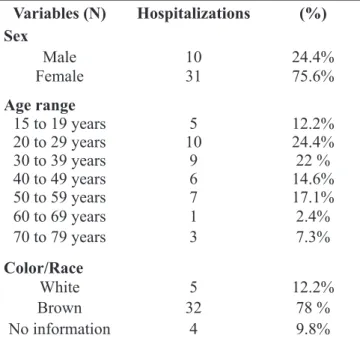
In accordance with the socio-demographic
data obtained, the number of hospitalizations for
EM stood out in female patients (75.6%), the age
range from 20 to 39 years (46.4%) and race (78%),
as it is evidenced in table 1.
Table 1 - socio-demographic data of the patients
hospitalized for Multiple Sclerosis in Montes
Claros (MG), in the period from 2010 to 2015.
Variables (N) Hospitalizations (%) Sex Male 10 24.4% Female 31 75.6% Age range 15 to 19 years 5 12.2% 20 to 29 years 10 24.4% 30 to 39 years 9 22 % 40 to 49 years 6 14.6% 50 to 59 years 7 17.1% 60 to 69 years 1 2.4% 70 to 79 years 3 7.3% Color/Race White 5 12.2% Brown 32 78 % No information 4 9.8%
Source: System of Hospital Information of SUS (SIH-SUS).
In relation to primary care provided, it is
observed that the private institutions (Hospitals
Aroldo Tourinho and Santa Casa) received 95.1%
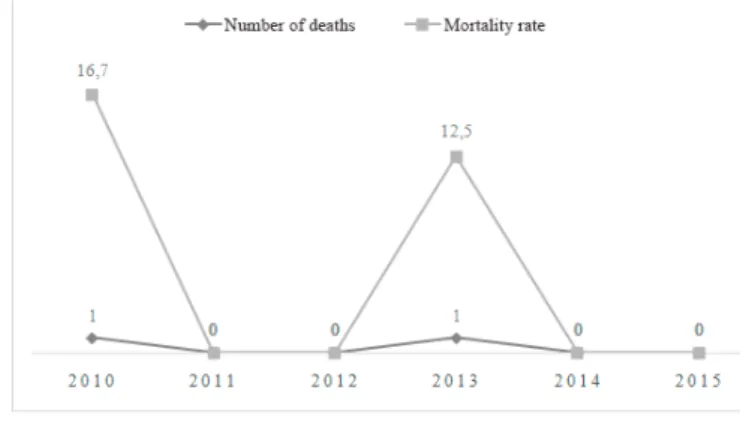
the city, only 2 (4.9%) died, and they were female
and the age ranges from 50 to 59 and 70 to 79 years.
The mortality rate, in turn, has reached the value of
16.7 in 2010, decreasing to null levels in the next
year and remained like this until the year 2012.
In that same year, the mentioned rate returned to
ascend, in a way that, in 2013 was in 12.5, second
largest value during the period analyzed (Figure 3).
Figure 3 - Number and of deaths and mortality
rate due to multiple sclerosis in Montes Claros
MG, in the period from 2010 to 2015
DISCUSSION
In the period from January 2010 to December
2015 41 cases of hospitalizations were observed in
the city of Montes Claros, MG. When analyzing
the state as a whole, it is also possible to check the
gradual increase in the number of hospitalizations
due to the disease, being registered 215, 352 and
409 cases in 2008, 2014 and 2015, respectively.
10In addition, the progression in the number
of hospitalizations due to the disease, between the
years of 2011 to 2013 and 2014 to 2015, shown in
this study, may be related to the increase of 30% in
the number of neurologists and 50% in the number
of magnetic resonance imaging. These events
represent advances of extreme significance for the
diagnosis of EM and monitoring of lesions arising
from it
11of the cases. Whereas the public regime (University
Hospital Clemente Faria) was responsible for the
acceptance of only 4.9%, as shown in Table 2. In
both regimes, the patients were treated in urgent
circumstances.
Table 2 - Distribution of Cases of Multiple
Sclerosis in accordance with the regime and
establishment of care in Montes Claros (MG),
2010 to 2015.
Estabishment Number of hospitalizations (%) Regime Public Private regime
HSC 15 36.6% - 15
HAT 24 58.5% - 24
HUCF 2 4.9% 2
-HSC: Santa Casa Hospital / HAT: Aroldo Tourinho Hospital / HUCF: University Hospital Clemente Faria
In the analysis of expenditures related to
EM, there was a cost of R$ 24,161.35 to health
establishments in the city. Although the private
sector held higher spending, totaling R$ 20,009.07,
the average value per hospitalization was R$513.05.
In contrast, the public sector showed the average
amount of R$2,076.14 per patient (Figure 2).
Figure 2 - Total amount spent with patients
suffering from multiple sclerosis in accordance
with the establishment of attendance in Montes
Claros - MG, in the period between 2008 to 2015.
The patients remained in health establishment
for varying periods, noting an average of six, eight
and thirty-nine days in hospitals Aroldo Tourinho
Hospital, Santa Casa Hospital and University
Hospital Clemente Faria, respectively.
Analysis of people with multiple sclerosis in Montes Claros, Minas Gerais
RODRIGUES, L. G. S.; BRITO, A. C. G.; OLIVEIRA, D. R.; MÁRCICO, M. M.; CANABRAVA, P. H. M.; GONÇALVES, C. T.; PRINCE, K. A. ISSN 2236-5257
160
REVISTA UNIMONTES CIENTÍFICA
Similar to the State situation, the number
of hospitalizations due to the disease has increased
sharply in the city studied. Despite this, its
prevalence is low (less than 5 cases per 100,000
inhabitants) in comparison with the state and
national rates, probably because the initial phase of
the disease is subtle.
12Thus, the prevalence of in in Montes Claros
is considered low, analogous to the Brazilian
average.
2However, some regions of the country
demonstrate divergent numbers of the general
national. In the municipality of Santa Maria, in the
southern part of the country, it was observed a high
prevalence (14 to 27 to 100 thousand inhabitants)
when compared to other regions.
13The cities of Santos (SP) and Belo Horizonte
(MG), obtained data that attest to the prevalence of
15.54 and 18.1 per 100,000, respectively, values
three times higher than that found in this work.
14,15These differences may be related to the existence
of the latitudinal factor and of miscegenation that
influenced the Brazilian population, especially, the
states of São Paulo and Minas Gerais.
5Moreover,
South and Southeast have the largest population in
Brazil, in addition to better socio-economical and
technological conditions, favoring the identification
of more cases of the disease.
Whereas the Northeast and Midwest
presented 10 (in 2004) and 4.41 to 19 cases per 100
thousand inhabitants (in 2008), respectively.
16, 17As to the color/race, in the present study,
there was a predominance of mixed race, with
78% of the cases, different from research in Santa
Maria (RS) and in Cuiabá (MS). The first noted
that 30% of individuals, in Brazil, are black;
13whereasae another showed that 80% of patients in
the outpatient clinic of neurology of CRIDAC were
white.
18The information presented here clarify
that the number of cases was much higher among
women, accounting for approximately 75.6% of
them. Bodies of research performed in the cities
of Cuiabá (MT) and Belo Horizonte (MG) also
observed that the majority of carriers is comprised
of women: (75%) and (78.8%), respectively.
18,19Again, this research is confirmed, with regard to the
most affected gender.
From this sketch, it was observed that the
demand for service regarding EM in Montes Claros
is held as a matter of urgency, being 95% in private
network. This situation can be understood by the fact
that: many patients need other health professionals
or even other medical specialties, but not always
the system allows this service happen jointly; the
diagnosis of EM requires an experienced clinician
and, many times, there is no financial incentive
for research about the disease, contributing to
the studies to be insufficient; moreover, there is
bureaucracy for the removal of the drugs.
2,20The sum of these circumstances is in
favor of the difficulty that these patients and their
relatives face during the process of identification
and diagnosis of the disease (many of them undergo
various tests before they can receive a proper
diagnosis), contributing to the demand for private
system and in urgency.
6On the other hand, it was evidenced, in this
work, that the average cost per hospitalization was
higher in the public system, compared to the private
sector. One explanation for this is the fact that the
patients stayed about 6 to 8 days under private
care, while 39 days was the time spent in public
establishment.
EM requires careful and very intense care,
demanding, many times, time and continuous
attention, in order to achieve a better arrangement
of family dynamics to contribute in its treatment.
Having said that, and given that the professionals
of the Family Health Strategy address the family
group as the center of primary care, the work of
these is of utmost importance, since the reality of
people assisted by it becomes more well-known,
leading them to be more responsive to the needs of
those users.
21Among the 41 cases of hospitalizations in
the city, only 2 (4.9%) died, and they were female
and the age ranges from 50 to 59 and 70 to 79 years.
Two thirds of deaths in people with EM are directly
related to the consequences of the disease, which
usually relate to opportunistic infections. The study
of Grzesiuk et al.
18, for example, noticed just one
death in the period observed due to infectious
complications.
18In its terminal phase, associated to
respiratory complications such as aspiration
pneumonia, atelectasis or respiratory insufficiency,
taking, on average, half of the patients to death.
22,23Although the mortality rate reported in this study
was higher in the year of 2010 in relation to the
year 2013, demonstrating that, despite the number
of hospitalizations have increased over the period
studied, the mortality rate has decreased or remained
unchanged in recent years
CONCLUSION
In the present study, it is concluded that,
in Montes Claros (MG), EM has predominated in
women, ranging in age from 20 to 39 years and
brown race. In this municipality, there was an
increase in the number of hospitalizations in recent
years, as well as the costs, especially in the private
network and in urgency care. The facts presented,
therefore, make us believe that most cases, when
diagnosed, are already at a late stage.
Due to EM being a chronic and degenerative
disease, time and experience are important allies in
the improvement of the clinical signs: as soon as
they the diagnosis and the treatment are performed,
the higher will be the chances of achieving healthier
life expectancy. In addition, family assistance and
of health professionals involved in the care of
patients also become very important in the quality
of life of the same.
It is evident, therefore, that patients, doctors,
nurses and other authorities in the area, should be
attentive to the fact that the treatment is a search for
the return of the functions. Therefore, they can and
should contribute to the prevention of diseases and
mortality reduction.
Thus, there is a need for further studies
related to EM in order to invest in modern
technology and, especially, to multiprofessional
team, so that this set is capable of screening early
the most susceptible patients, providing quality
care and better conduct before the patient carrier
of the disease. It is therefore concluded that
access to information is the best way to search for
improving the treatment and decrease the possible
consequences of the disease, fostering the guarantee
of promotion of health and the full quality of life.
REFERENCES
1. MARÍN, N. et al. Anti-myelin antibodies
play an important role in the susceptibility to
develop proteolipid protein-induced experimental
autoimmune encephalomyelitis, Clinical and
Experimental Immunology,
v.175, n. 2, p. 202-7,
2014.
2. BIENES, G.; OLIVEIRA, E. M. L.; BICHUETTI,
D. B. Esclerose Múltipla, Revista Brasileira de
Medicina, São Paulo,
v. 71, n. 12, p. 37-45, 2014.
3. CERQUEIRA, A. C. R.; NARDI, A. E. Depressão
e esclerose múltipla: Uma visão geral, Revista
Analysis of people with multiple sclerosis in Montes Claros, Minas Gerais
RODRIGUES, L. G. S.; BRITO, A. C. G.; OLIVEIRA, D. R.; MÁRCICO, M. M.; CANABRAVA, P. H. M.; GONÇALVES, C. T.; PRINCE, K. A. ISSN 2236-5257
162
REVISTA UNIMONTES CIENTÍFICA