Surgical techniques for facilitating laparoscopic
intracorporeal orthotopic neobladder: initial experience
_______________________________________________
Lianchao Jin
1,2, Mingshuai Wang
1, Feiya Yang
1, Yinong Niu
1, Nianzeng Xing
11 Department of Urology, Beijing Chao-yang Hospital, Capital Medical University, Beijing, China; 2 Department
of Urology, Peking University Shougang Hospital, Beijing, China
ABSTRACT
ARTICLE
INFO
______________________________________________________________ ______________________
Purpose: To describe our technique and outcomes for laparoscopic intracorporeal ileal neobladder (ICNB) reconstruction.
Materials and Methods: From April 2014 to November 2016, 21 patients underwent laparoscopic ICNB at our tertiary referral centre. ICNB with bilateral isoperistaltic af-ferent limbs and several technique improvements were introduced. Demographics, clinical, and pathological data were collected. Perioperative, 1-year oncologic, 1-year Quality of life and 1-year functional outcomes were reported.
Results: ICNB was successfully performed in all 21 patients without open conversion and transfusion. Mean operative time was 345.6±66.9 min, including 106±22 min for LRC and PLND and 204±46.4 min for ICNB, respectively. Mean established blood loss was 192±146 mL. The overall incidence of 90-d complication was 33.3%, while major complication occurred in 4.8%. One-year daytime and night-time continence rates were 85.7% and 57.1%, respectively. One patient died from myocardial infarction six months postoperatively, and two patients had lung metastasis five months and six months respectively.
Conclusions: We described our experience of 3D LRC with a novel intracorporeal or-thotopic ileal neobladder, and the technique improvements facilitate the procedure. However, further studies are required to evaluate long-term outcomes of the intracor-poreal neobladder with bilateral isoperistaltic afferent limbs.
Keywords:
Laparoscopy; Quality of Life; Cystectomy
Int Braz J Urol. 2018; 44: 1156-65
_____________________ Submitted for publication: September 15, 2017 _____________________ Accepted after revision: March 14, 2018
After Gill et al. firstly reported laparosco-pic radical cystectomy (LRC) and ICNB in 2002 (3), laparoscopic intracorporeal U shape orthotopic neobladder was proposed in many centers (8-10). They simplified the procedure of ICNB construc-tion, however, the function of the U shape neobla-dder is controversial as it is not in a global shape, which may result in relatively small neobladder capacity and higher neobladder pressure.
Hence, we describe a time efficient method of ICNB reconstruction and a series of technique improvements to overcome challenges during the procedure.
MATERIALS AND METHODS
We reviewed medical records of patients who underwent LRC with ICNB formation in our tertiary center from April 2014 to November 2016. The study was approved by the Institutional Re-view Board of Beijing Chao-yang Hospital, Capi-tal Medical University (Protocol number 2014-R-141), and all patients provided written informed consent. All surgeries were performed by one ex-perienced surgeon (N.X.), who has over 200 cases experience of LRC with orthotopic ileal neoblad-der. Indications for LRC were muscle-invasive bla-dder cancer (T2-3, N0-x, M0), high risk and recur-rent non-muscle-invasive cancer, T1G3, extensive non-muscle-invasive bladder cancer that could not be controlled by transurethral resection and intravesical therapy. Our exclusion criteria were
tumor in the urethra, urinary incontinence, his-tory of recurrent urethral strictures, abnormal ab-dominal straining, local radiotherapy and severe comorbidities and decompensated renal function.
Perioperative variables including patient’s characteristics, surgical outcomes, postoperative complications, oncologic outcomes and Quality--of-life data were analyzed. Postoperative com-plications were analyzed according to the Cla-vien-Dindo classification (11). After discharge, patients were followed up at 2 weeks, 3, 6, and 12 months, and then yearly. Neobladder function was assessed at 6 months postoperatively. Daytime or night-time continence referred to the requirement of <1 pad during daytime or night-time, respec-tively. Incontinence was defined as the need for more than 1 pad per day or night. Patients were asked to complete the European Organization for Research and Treatment of Cancer (EORTC) gene-ric (QLQ-C30) and bladder cancer specific instru-ments (QLQ-BLM30) questionnaires for Quality of Life assessment every year.
Surgical Techniques
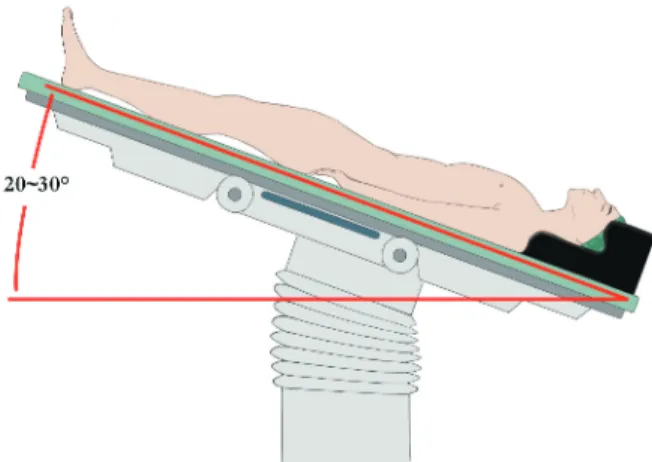
All procedures were performed using Olympus 3-D laparoscopic system. The patient was placed in a dorsal supine with a 30° Trende-lenburg position. Six laparoscopic ports were uti-lized as shown in Figure-1. The first 10 mm port for the camera was placed 1 cm cephalad to the umbilicus in the midline. Two 12 mm ports were symmetrically placed at the level of the umbilicus
on the left and right lateral to the rectus abdomi-nis. Two 5 mm ports were placed 2-3 cm superior and medial to the anterior superior iliac spines on each side. The sixth 12 mm port was placed 1 cm cephalad to the pubic symphysis in the midline after finishing the LRC and PLND for Endo-GIA.
After the peritoneum was incised and the sigmoid colon was mobilized, the ureters were mobilized down to the bladder without injuring the periureteral vessels. Then, the umbilical ar-teries were dissected and divided between Hem--o-lok clips. The peritoneum was incised along the vas deferens in the direction of the pouch of Douglas, and the seminal vesicles were comple-tely dissected. The posterior layer of the Denon-villiers fascia was then incised and the pre-rectal fatty tissue could be visualized. The dissection was continued in a blunt and sharp fashion as far as possible towards the apex of the prostate. The bilateral bladder pedicles were divided between Hem-o-lok clips. Then, the Retzius space was dissected and the incision was continued in the lateral direction up to the external iliac vessels and the endopelvic fascia. After cleaning fatty tissue on the prostate, the endopelvic fascia was incised on both sides. Then, both puboprostatic ligaments were fully dissected, and the dorsal vein complex was ligated with 2-0 V-Loc suture. In nerve-sparing procedures, the bilateral prosta-tic fascia was dissected and the prostaprosta-tic pedicles were clipped and cut with cold scissors step by step to detach neurovascular bundles from the prostatic capsule. In non-nerve-sparing procedu-res, LigaSure and ultrasonic scalpel were used to directly divide the prostatic pedicles towards the
spatula-STATISTICAL METHODS
Mean values with standard deviations were computed and reported for continuous data. Median, range were used to report categorical data. Continuous and categorical variables were compared with Student t test and the X2 test, res-pectively. All p values <0.05 were considered
sta-tistically significant. Statistical analysis was per-formed using STATA v12 (StataCorp LLC, College Station, Texas, USA).
RESULTS
LRC with ICNB was successfully accompli-shed in all 21 patients without open conversion.
Figure 2-A) Interrupted suturing of the posterior wall of the reservoir using 2-0 Vicryl suture. B) Pulling the interrupted knots to tension ileum to facilitate suturing (“pulling technique”). C) Closure of the distal half of the anterior wall of the reservoir. D) The proximal half of the back wall of the reservoir was anastomosed with the urethra back wall. E) The catheter and two single J stents were introduced through urethra. F) The ureters were spatulated for 2-3 cm and were end-to-end anastomosed with ipsilateral limb in a continuous manner, using 3-0 Vicryl sutures, respectively.
A
C
E
B
D
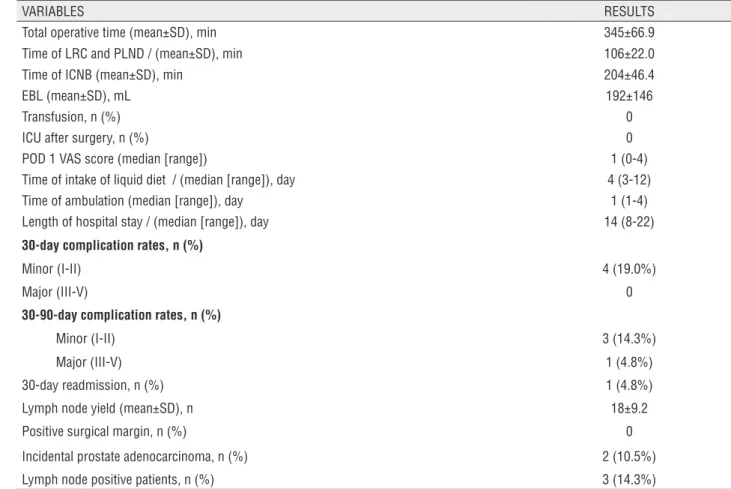
Tables 1 and 2 show the patient’s characteristics and surgical outcomes. The mean age was 60 years old with a mean BMI 24.5 kg/m2. Of 21 patients, four patients received neoadjuvant chemotherapy and fourteen patients had history of transurethral resection of bladder tumor. The median Charlson co-morbidity index score was 4, and ASA score was 2.
The mean operative time was 345.6±66.9 min, including 106±22 min for LRC and PLND and 204±46.4 min for neobladder reconstruction. Fi-gure-3 shows the learning curve of the procedure. The curve of LRC and PLND time was relatively
after cystography confirmed no urine leaked from the bladder. The median length of hospital stay was 14 days (range: 8-22).
Overall incidence of complications of any grade at 90-d was 33.3%, and major complications (Clavien grade ≥3) occurred in one patients (4.8%). One patient had prolonged ileus and urinary tract
infection at one week postoperatively, who was treated with antibiotics (Clavien grade 2). One pa-tient had ileus at 2 weeks postoperatively, whi-ch was resolved by supportive treatment (Clavien grade 1). One patient had urinary tract infection
Table 1 - Patient’s Characteristics.
VARIABLES RESULTS
Patients, n 21
Age (mean±SD), year 60±10.1
Male, n (%) 19 (90.5%)
BMI (mean ± SD), kg/m2 24.5±3.9
Neoadjuvant chemotherapy, n (%) 4 (19.0%)
Charlson comorbidity index
(median [range]) 4 (2-6)
ASA score, n
1-2 21
3-4 0
Smoking history, n (%) 9 (42.9%)
Abdominal surgery history, n (%) 5 (23.8%)
for one patient and small cell cancer for one pa-tient. The median lymph node yield was 18 (range: 2-38), and 3 patients had positive lymph nodes (1/18, 2/24, 18/38). All surgical margins were ne-gative. Incidental prostate cancer was detected in 10.5% (2/19) of the patients.
The median follow-up time was 15 (3-30) months. No patient suffered hydronephrosis ac-cess by ultrasound or abdominal CT. The conti-nence and neobladder function outcomes are sho-wn in Table-4. The complete daytime continence rate (pad-free) at 6 months and 12 months were
Table 2 - Surgical Outcomes.
VARIABLES RESULTS
Total operative time (mean±SD), min 345±66.9
Time of LRC and PLND / (mean±SD), min 106±22.0
Time of ICNB (mean±SD), min 204±46.4
EBL (mean±SD), mL 192±146
Transfusion, n (%) 0
ICU after surgery, n (%) 0
POD 1 VAS score (median [range]) 1 (0-4)
Time of intake of liquid diet / (median [range]), day 4 (3-12)
Time of ambulation (median [range]), day 1 (1-4)
Length of hospital stay / (median [range]), day 14 (8-22)
30-day complication rates, n (%)
Minor (I-II) 4 (19.0%)
Major (III-V) 0
30-90-day complication rates, n (%)
Minor (I-II) 3 (14.3%)
Major (III-V) 1 (4.8%)
30-day readmission, n (%) 1 (4.8%)
Lymph node yield (mean±SD), n 18±9.2
Positive surgical margin, n (%) 0
Incidental prostate adenocarcinoma, n (%) 2 (10.5%)
Lymph node positive patients, n (%) 3 (14.3%)
LRC=laparoscopic radical cystectomy; PLND=pelvic lymph node dissection; ICNB=intracorporeal neobladder; EBL=estimated blood loss; POD=postoperative; VAS=Visual analogue scale
Table 3 - Comparison of the first and last ten cases.
Case (1-10) Case (12-21) P
Total operative time (mean±SD), min 393±47.6 297±50.0 <0.001
LRC and PLND time (mean±SD), min 114±25.9 97.7±15.8 0.11
ICNB time (mean±SD), min 237±33.7 169±31.3 <0.001
EBL (mean±SD), mL 155±95.6 240±182.3 0.21
Figure 3-Learning Curve of the laparoscopic radical cystectomy with intracorporeal orthotopic neobladder.
Table 4 - Continence and Neobladder function Outcomes.
VARIABLES 6 MONTHS 12 MONTHS
Urinary Continence
Day time continence 0-1 pad/d 15/17 (88.2%) 12/14 (85.7%)
Night time continence 0-1 pad/d 6/14 (42.9%) 8/14 (57.1%)
Neobladder function
Neobladder Capacity (Median [range]), mL 214 (170-330) 375 (310-495)
Residual volume (Median [range]), mL 27 (0-135) 38 (20-160)
the QLQ-C30 and QLQ-BLM questionnaires. Mean questionnaire scores (QLQ-C30, QLQ-BLM30) are shown in the Figure-4. The lowest level of func-tioning in QLQ-C30 was “global quality of life” domain, and the highest level in QLQ-C30 was “social functioning” domain. The lowest level of QLQ-C30 symptoms scale was found in the “nau-sea and vomiting” and “diarrhea” domain and the highest level in the “constipation” domain. The QLQ-BLM30 questionnaire revealed the lowest le-vel of symptomatology in the “abdominal bloating and flatulence” domain and the highest level in the “sexual functioning” domain.
DISCUSSION
Laparoscopic and robotic techniques have been increasingly advocated for the potential ad-vantages, such as decreased blood loss, decreased analgesic requirements and quicker recovery (12, 13). Some studies demonstrated that complete ICNB reconstruction may lead to decreased bowel exposure, reduction of insensitive fluid losses, and shorter time to oral intake (14). Recently, more and more studies reported robot-assisted ICNB reconstruction with acceptable operative time, complication rates and oncologic outcomes (7, 15, 16). However, the experience of laparoscopic ICNB reported in the literature is limited because of the complex and time consuming procedure (3, 8, 10). Compared to laparoscopic technique, robotic
sys-tems simplified suturing procedure which lead to a decrease in ICNB reconstruction time because of 3-dimensional vision and robotic arms. Although 3-dimensional laparoscopic technique could cover the shortage of vision, many surgical improve-ments are still required for traditional laparosco-pic ICNB reconstruction.
In this study, we demonstrated a time effi-cient neobladder reconstruction and described many surgical improvements which could facili-tate the procedure of ICNB without compromising complications. The time efficient neobladder has bilateral isoperistaltic afferent limbs which was
re-ported by us before in the open approach (17). Ha-ving bilateral isoperistaltic afferent limbs, the left ureter could be anastomosed with left limb in situ avoiding being exceedingly mobilized. Additional mobilization of the left ureter for being brought to the right side could worsen the blood supply and thus lead to the development of ureteroileal stric-ture because of chronic ischemia (18). The surgical improvements are: (1) the division and continuity of the ileum was made using laparoscopic staplers; (2) “pulling technique” was applied during neo-bladder wall suture, which could facilitate suture and decrease ICNB time; (3) the ureters were end--to-end anastomosed with ipsilateral limb directly. In our experience, no patient developed ureteroi-leal stricture after the end-to-end anastomosis of ureter and ileal limb, and unidirectional peristalsis
Figure 4-A) EORTC QLQ-C30 Functional Scale: a high scale score represents a high/healthy level of functioning (0-100). For the global quality of life scale, a high scale score represents a low level of functioning. B) EORTC QLQ-C30 Symptoms scale and single items: a high scale score represents a high level of symptomatology/problems (0-100). C) EORTC QLQ-BLM30: a high scale score represents a high level of symptomatology/problems (0-100).
of the ureters and the afferent tubular ileal segment sufficiently protected the upper urinary tracts com-bined with low pressure neobladder. After applying the surgical improvements, the ICNB reconstruction time decreased from average 237 min for first ten cases to 169 min. for the last ten cases.
In many institutional centers worldwide, orthotopic neobladder has now replaced the ileal conduit as the standard form of reconstruction. Se-veral types of neobladder have been described, but all should have the following features: high capa-city, low pressure, absence of reflux, and complete voiding by abdominal straining and perineal rela-xation (19). In our study, the neobladder capacity was about 375 mL, which was smaller than mean volumes reported for open neobladder construction of 450-524 cm3 (20 ,21). However, no patient has hydronephrosis or ureterectasis one year after opera-tion. Two patient’s neobladder pressure was low (12 cm H2O and 17 cm H2O). We will ask more patients to receive urodynamic study to evaluate the function of the neobladder. The most common postoperative complication is urinary tract infection, which can be well controlled by antibiotics.
The EORTC QLQ-30 and the QLQ-BLM30 module are the most commonly used generic and disease-specific instruments. Comparing to a stu-dy by Ciro Imbimbo et al., mean values obtained from the physical functioning, role functioning, emotional functioning, social functioning and glo-bal quality of life scale were higher in the present study (22). Cognitive functioning value was lower in the present study because one patient suffered memory difficult at one year after operation. The symptom scales of fatigue, nausea and vomiting,
neobladder is based on our experience and practice, and more urodynamic and longtime follow-up data are required to evaluate its function.
CONCLUSIONS
We described our experience of 3D LRC with a novel intracorporeal orthotopic ileal neo-bladder, and many technique improvements faci-litate the procedure. However, further studies are required to evaluate long-term outcomes of the intracorporeal neobladder with bilateral isoperis-taltic afferent limbs.
ACKNOWLEDGMENTS
This work was supported by Beijing Mu-nicipal Administration of Hospital’s Ascent Plan. NO. DFL20150301
ABBREVIATIONS
RC=Radical cystectomy
PLND=Pelvic lymph node dissection
ICNB=Intracorporeal neobladder
LRC=Laparoscopic radical cystectomy
CONFLICT OF INTEREST
4. Goh AC, Gill IS, Lee DJ, de Castro Abreu AL, Fairey AS, Leslie S, et al. Robotic intracorporeal orthotopic ileal neobladder: replicating open surgical principles. Eur Urol. 2012;62:891-901.
5. Haber GP, Campbell SC, Colombo JR Jr, Fergany AF, Aron M, Kaouk J, et al. Perioperative outcomes with laparoscopic radical cystectomy: “pure laparoscopic” and “open-assisted laparoscopic” approaches. Urology. 2007;70:910-5.
6. Tyritzis SI, Hosseini A, Collins J, Nyberg T, Jonsson MN, Laurin O, et al. Oncologic, functional, and complications outcomes of robot-assisted radical cystectomy with totally intracorporeal neobladder diversion. Eur Urol. 2013;64:734-41.
7. Satkunasivam R, Santomauro M, Chopra S, Plotner E, Cai J, Miranda G, et al. Robotic Intracorporeal Orthotopic Neobladder: Urodynamic Outcomes, Urinary Function, and Health-related Quality of Life. Eur Urol. 2016;69:247-53. 8. Shao P, Li P, Ju X, Qin C, Li J, Lv Q, et al. Laparoscopic radical
cystectomy with intracorporeal orthotopic ileal neobladder: technique and clinical outcomes. Urology. 2015;85:368-73. 9. Palleschi G, Pastore AL, Ripoli A, Silvestri L, Petrozza V,
Carbone A. Videourodynamic evaluation of intracorporeally reconstructed orthotopic U-shaped ileal neobladders. Urology. 2015;85:883-9.
10. Pastore AL, Palleschi G, Silvestri L, Cavallaro G, Rizzello M, Silecchia G, et al. Pure intracorporeal laparoscopic radical cystectomy with orthotopic “U” shaped ileal neobladder. BMC Urol. 2014;14:89.
11. Dindo D, Demartines N, Clavien PA. Classification of surgical complications: a new proposal with evaluation in a cohort of 6336 patients and results of a survey. Ann Surg. 2004;240:205-13.
12. Marshall SJ, Hayn MH, Stegemann AP, Agarwal PK, Badani KK, Balbay MD, et al. Impact of surgeon and volume on extended lymphadenectomy at the time of robot-assisted radical cystectomy: results from the International Robotic Cystectomy Consortium (IRCC). BJU Int. 2013;111:1075-80. 13. Aboumarzouk OM, Drewa T, Olejniczak P, Chlosta PL.
Laparoscopic radical cystectomy: neobladder or ileal conduit, debate still goes on. Cent European J Urol. 2014;67:9-15. 14. Nazmy M, Yuh B, Kawachi M, Lau CS, Linehan J, Ruel NH,
et al. Early and late complications of robot-assisted radical cystectomy: a standardized analysis by urinary diversion type. J Urol. 2014;191:681-7.
15. Desai MM, Gill IS, de Castro Abreu AL, Hosseini A, Nyberg T, et al. Robotic intracorporeal orthotopic neobladder during radical cystectomy in 132 patients. J Urol. 2014;192:1734-40. 16. Simone G, Papalia R, Misuraca L, Tuderti G, Minisola F, Ferriero
M, et al. Robotic Intracorporeal Padua Ileal Bladder: Surgical Technique, Perioperative, Oncologic and Functional Outcomes. Eur Urol. 2016;S0302-2838:30721-7. [Epub ahead of print] 17. Xing NZ, Kang N, Song LM, Niu YN, Wang MS, Zhang JH.
Laparoscopic radical cystectomy with novel orthotopic neobladder with bilateral isoperistaltic afferent limbs: initial experience. Int Braz J Urol. 2017;43:57-66.
18. Schöndorf D, Meierhans-Ruf S, Kiss B, Giannarini G, Thalmann GN, Studer UE, et al. Ureteroileal strictures after urinary diversion with an ileal segment-is there a place for endourological treatment at all? J Urol. 2013;190:585-90. 19. Hautmann RE, Abol-Enein H, Hafez K, Haro I, Mansson W, Mills
RD, et al. Urinary diversion. Urology. 2007;69(1 Suppl):17-49. 20. Nam JK, Kim TN, Park SW, Lee SD, Chung MK. The Studer
orthotopic neobladder: long-term (more than 10 years) functional outcomes, urodynamic features, and complications. Yonsei Med J. 2013;54:690-5.
21. Burkhard FC, Kessler TM, Springer J, Studer UE. Early and late urodynamic assessment of ileal orthotopic bladder substitutes combined with an afferent tubular segment. J Urol. 2006;175:2155-60.
22. Imbimbo C, Mirone V, Siracusano S, Niero M, Cerruto MA, Lonardi C, et al. Quality of Life Assessment With Orthotopic Ileal Neobladder Reconstruction After Radical Cystectomy: Results From a Prospective Italian Multicenter Observational Study. Urology. 2015;86:974-9.
_______________________ Correspondence address: