
Signalling with Dividends? New Evidence from Europe
368
0
0
Texto
(2) “The important thing is never stop questioning” Albert Einstein. ii.
(3) TABLE OF CONTENTS. LIST OF TABLES ................................................................................................ viii LIST OF FIGURES.................................................................................................. x RESUMO ................................................................................................................ xi ABSTRACT ........................................................................................................... xii ACKNOWLEDGMENTS..................................................................................... xiii THE AUTHOR....................................................................................................... xv CHAPTER 1 INTRODUCTION .................................................................................................. 1 1.1. Introduction ....................................................................................................... 2 1.2. Motivation and Objectives of this Study ........................................................... 5 1.3. Study Organization ............................................................................................ 7 CHAPTER 2 LITERATURE REVIEW ...................................................................................... 9 2.1. Introduction ..................................................................................................... 10 2.2. Lintner’s Model ............................................................................................... 10 2.3. The Dividend Policy Irrelevance Hypothesis.................................................. 12 2.4. Main Factors Affecting Dividend Policy ........................................................ 15 2.4.1. Taxes...................................................................................................... 15 2.4.2. Agency Costs......................................................................................... 22 2.4.3. Uncertainty Associated with Future Remuneration Flows.................... 26 2.4.4. Information Asymmetry and the Dividend Signalling Hypothesis ....... 27 2.5. Dividend Signalling Models............................................................................ 31 2.5.1. Bhattacharya’s Model (1979) ................................................................ 32 2.5.2. Miller and Rock’s Model (1985) ........................................................... 33 2.5.3. John and Williams’s Model (1985) ....................................................... 34 2.5.4. Others .................................................................................................... 36 2.6. Empirical Tests on the Information Content of Dividends ............................. 38 2.6.1. The Effect of Dividend Announcements on Future Earnings ............... 39. iii.
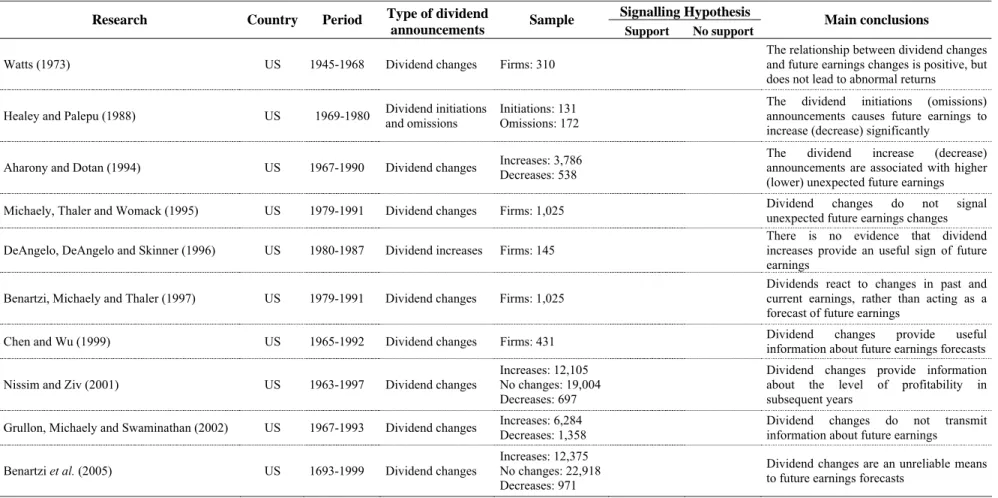
(4) 2.6.2. The Effect of Dividend Announcements on Share Prices ..................... 59 2.6.3. The Effect of Dividend Announcements on Market Expectation Revisions ................................................................................................... 85 2.6.4. The Effect of Dividend Announcements on a Firm’s Risk ................... 87 2.7. Evolution of Firms’ Propensity to Pay Dividends........................................... 89 2.8. Conclusions ..................................................................................................... 94 Tables ..................................................................................................................... 95 CHAPTER 3 THE EFFECT OF DIVIDEND ANNOUNCEMENTS ON SHARE PRICES AND ON FUTURE PERFORMANCE............................................. 101 3.1. Introduction ................................................................................................... 102 3.2. Hypotheses .................................................................................................... 103 3.2.1.. Hypothesis. 1. –. Relation. Between. Dividend. Change. Announcements and the Market Reaction............................................... 103 3.2.2. Hypothesis 2 – Relation between Dividend Changes and Firm’s Future Profitability .................................................................................. 104 3.2.2.1. Sub-Hypothesis 2A – Relation between Dividend Changes and Future Earnings Changes .................................................................. 104 3.2.2.2. Sub-Hypothesis 2B – Relation between Dividend Changes and Accounting Performance Measures .................................................. 105 3.2.2.3. Sub-Hypothesis 2C – Relation between Dividend Changes and Operating Performance Measures..................................................... 106 3.2.2.4. Sub-Hypothesis 2D – Relation between Dividend Changes and Market Expectations of Future Earnings .......................................... 107 3.3. Sample Selection and Methodology .............................................................. 109 3.3.1. Sample Selection ................................................................................. 109 3.3.2. Methodology........................................................................................ 113 3.3.2.1. Methodology to Test Hypothesis 1 – Relation between Dividend Change Announcements and the Market Reaction.................. 116 3.3.2.2. Methodology to Test Hypothesis 2 – Relation between Dividend Changes and Firm's Future Profitability ……………………..122. iv.
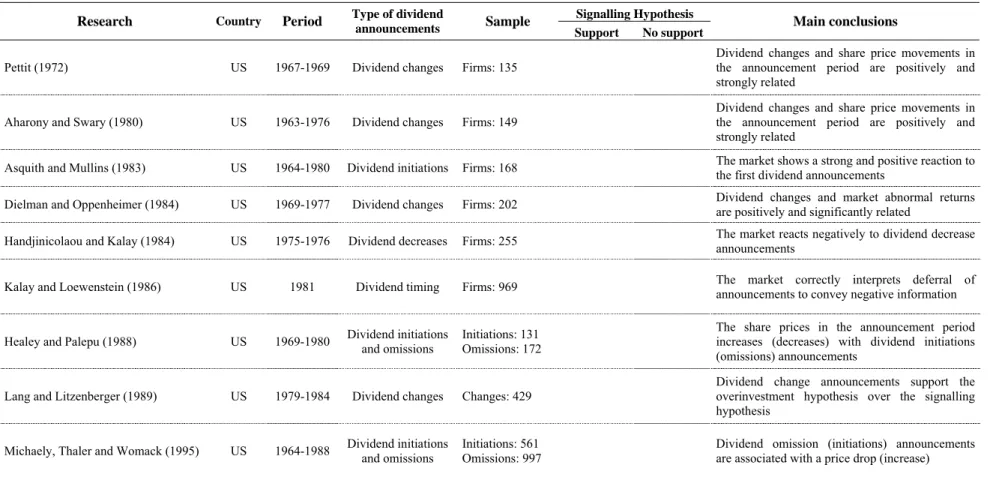
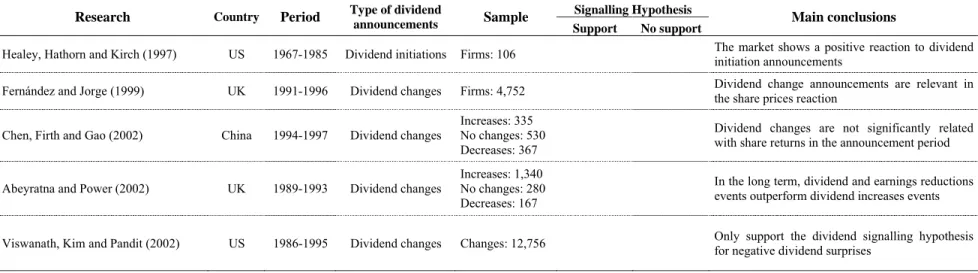
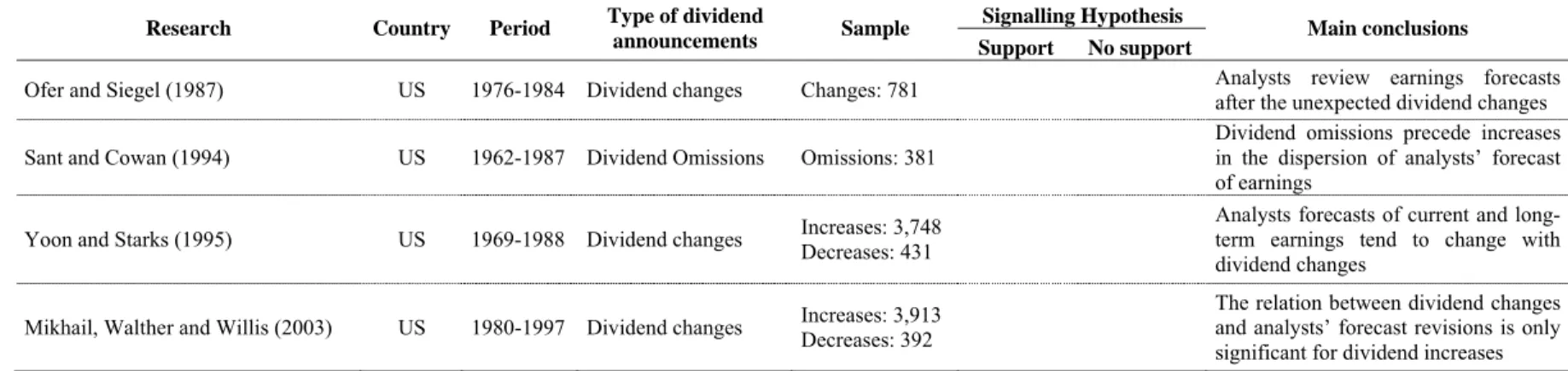
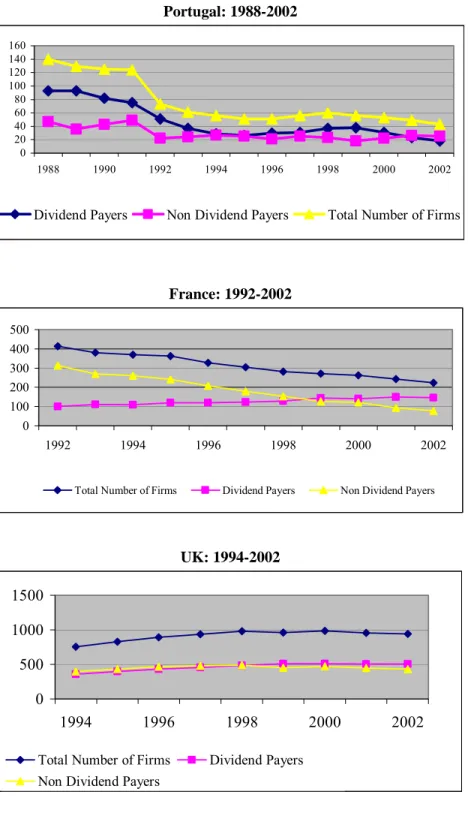
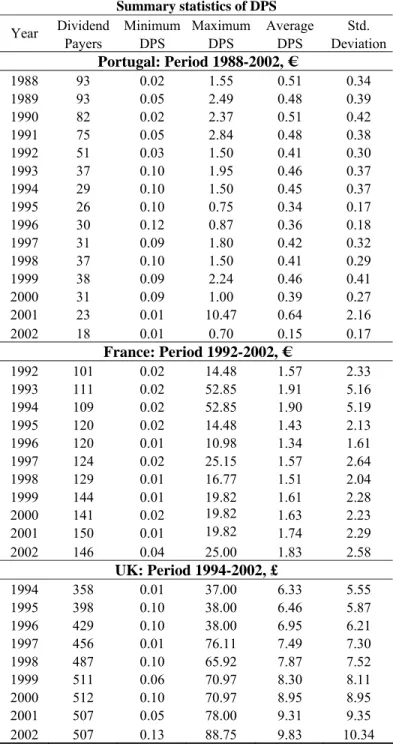
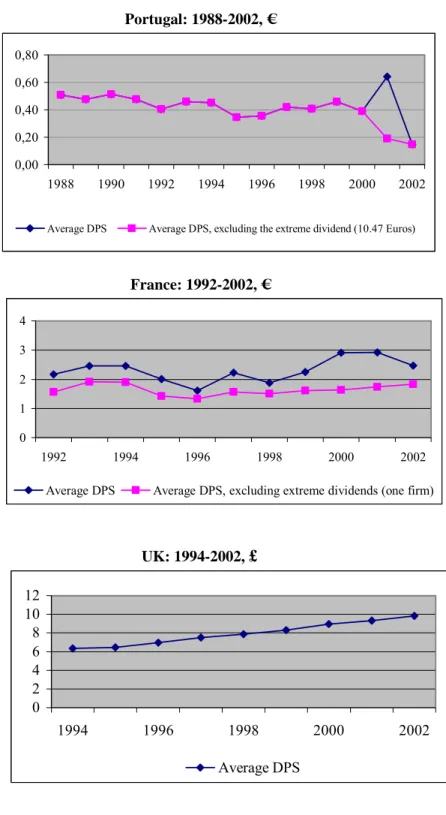
(5) 3.3.2.2.1. Methodology to test sub-hypothesis 2A – relation between dividend changes and future earnings changes.......................122 3.3.2.2.2. Methodology to test sub-hypothesis 2B – relation between dividend changes and accounting performance measures ......126 3.3.2.2.3. Methodology to test sub-hypothesis 2C – relation between dividend changes and operating performance measures ........127 3.3.2.2.4. Methodology to test sub-hypothesis 2D – relation between dividend changes and market expectations of future earnings .................................................................................................129 3.4. Empirical Results........................................................................................... 130 3.4.1. Time Trends in Cash Dividends .......................................................... 131 3.4.2. Description of the Sample ................................................................... 136 3.4.3. Test Results of the First Hypothesis - Relation Between Dividend Change Announcements and The Market Reaction ................................ 144 3.4.3.1. Abnormal Returns ...................................................................... 144 3.4.3.2. Market Reaction to Dividend Change Announcements During Up and Down Markets ................................................................ 151 3.4.3.3. Relation between Dividend Changes and Abnormal Returns .... 152 3.4.3.4. Robustness .................................................................................. 154 3.4.4. Test Results of the Second Hypothesis – Relation Between Dividend Change Announcements and The Market Reaction ................ 155 3.4.4.1. Test Results of Sub-hypothesis H2A - Relation between Dividend Changes and Future Earnings Changes ................................... 156 3.4.4.1.1. Regression results assuming linear mean reversion in earnings .................................................................................................156 3.4.4.1.2. Regression results controlling for the non-linear patterns in the behaviour of earnings (Fama and French Model, 2000).............159 3.4.4.2. Test Results of Sub-hypothesis H2B - Relation between Dividend Changes and Accounting Performance Measures ................... 161 3.4.4.3. Test Results of Sub-hypothesis H2C - Relation between Dividend Changes and Operating Performance Measures ...................... 165 3.4.4.4. Test Results of Sub-hypothesis H2D - Relation between Dividend Changes and Market Expectations of Future Earnings............ 175 3.5. Conclusions ................................................................................................... 177 v.
(6) Tables ................................................................................................................... 181 CHAPTER 4 THE EFFECT OF DIVIDEND ANNOUNCEMENTS ON FUTURE EARNINGS CONDITIONED TO THE RELATION BETWEEN DIVIDEND CHANGE ANNOUNCEMENTS AND THE MARKET REACTION......................................................................................................... 253 4.1. Introduction ................................................................................................... 254 4.2. Hypotheses .................................................................................................... 254 4.2.1. Hypothesis 3A – Relation between Dividend Changes and Future Earnings for the Events with a Positive Relation between Dividend Change Announcements and the Market Reaction.................................. 256 4.2.2. Hypothesis 3B – Relation between Dividend Changes and Future Earnings for the Events with a Negative Relation between Dividend Change Announcements and the Market Reaction.................................. 257 4.3. Methodology.................................................................................................. 260 4.3.1. Methodology to Test Hypothesis 3A – Relation between Dividend Changes and Future Earnings for the Events with a Positive Relation between Dividend Change Announcements and the Market Reaction ... 260 4.3.2. Methodology to Test Hypothesis 3B - Relation between Dividend Changes and Future Earnings for the Events with a Negative Relation between Dividend Change Announcements and the Market Reaction ................................................................................................... 262 4.4. Empirical Results........................................................................................... 263 4.4.1. Test Results of Hypothesis 3A – Relation between Dividend Changes and Future Earnings for the Events with a Positive Relation between Dividend Change Announcements and the Market Reaction ... 264 4.4.2. Test Results of Hypothesis 3B – Relation between Dividend Changes and Future Earnings for the Events with a Negative Relation between Dividend Change Announcements and the Market Reaction ................................................................................................... 268 4.5. Conclusions ................................................................................................... 271 Tables ................................................................................................................... 274. vi.
(7) CHAPTER 5 THE EFFECT OF FIRM-SPECIFIC FACTORS ON THE MARKET REACTION TO DIVIDEND ANNOUNCEMENTS ...................................... 289 5.1. Introduction ................................................................................................... 290 5.2. Hypothesis ..................................................................................................... 290 5.3. Methodology.................................................................................................. 291 5.3.1. Firm Size (FS) ..................................................................................... 293 5.3.2. Percentage Change in Dividends (PCD) ............................................. 294 5.3.3. Earnings Growth (EG)......................................................................... 294 5.3.4. Market to Book Ratio (MB) ................................................................ 294 5.3.5. Price/Earnings Ratio (PER) ................................................................. 295 5.3.6. Debt/Equity Ratio (DE) ....................................................................... 295 5.4. Empirical Results........................................................................................... 297 5.4.1. Relation between the Market Reaction to Dividend Change Announcements and the Firm-specific Characteristics ........................... 298 5.4.2. Relation between the Market Reaction to Dividend Increase and Dividend. Decrease. Announcements. and. Firm-specific. Characteristics ......................................................................................... 299 5.4.3. Robustness ........................................................................................... 302 5.4.4. Relation between the Probability of a Negative (Positive) Market Reaction to Dividend Increase (Decrease) Announcements and Firmspecific Characteristics ............................................................................ 303 5.4.5. Differences in Firm-specific Characteristics according the Distinct Market Reaction to Dividend Change Announcements .......................... 305 5.5. Conclusions.................................................................................................... 309 Tables ................................................................................................................... 313 CHAPTER 6 CONCLUSIONS................................................................................................. 324 6.1. Summary and Conclusions ............................................................................ 325 6.2. Suggestions for Future Research ................................................................... 328 APPENDICES..................................................................................................... 330 BIBLIOGRAPHY............................................................................................... 338 vii.
(8) LIST OF TABLES. Table 2.1 - Summary findings of the main studies on the effect of dividend announcements on future earnings ............................................................... 96 Table 2.2 - Summary findings of the main studies on the effect of dividend announcements on share prices .................................................................... 97 Table 2.3 - Summary findings of the main studies on the effect of dividend announcements on market expectations revisions........................................ 99 Table 2.4 - Summary findings of the main studies on the effect of dividend announcements on a firms’ risk.................................................................. 100 Table 3.1 - Trends in dividend payments ..................................................................... 182 Table 3.2 – Summary statistics of dividend per share ………………………………. 182 Table 3.3 – Dividend statistics by industry breakdown …………………………….. 184 Table 3.4 - Sample Selection........................................................................................ 189 Table 3.5 - Summary Statistics..................................................................................... 192 Table 3.6 - Lintner Model Estimations......................................................................... 194 Table 3.7 - Abnormal returns for the announcement period ........................................ 195 Table 3.8 - Abnormal returns for the announcement period in up and down markets. 199 Table 3.9 - Regression of market reaction on dividend changes.................................. 201 Table 3.10 - Regression of earnings changes on dividend changes and correlation matrix....................................................................................................... 203 Table 3.11 - Regression of earnings changes on dividend changes using Fama and French Approach ..................................................................................... 209 Table 3.12 - Regression of profitability measures changes on dividend changes........ 213 Table 3.13 - Change in post-announcement measures ................................................. 228 Table 3.14 - Change in post-announcement measures grouped by operating performance ............................................................................................. 232 Table 3.15 - Regression of cumulative abnormal returns on future performance measures .................................................................................................. 237 Table 3.16 - Regression of price minus book value on dividend changes ................... 251. viii.
(9) Table 4.1 - Sub Sample Selection................................................................................. 275 Table 4.2 - Regression of earnings changes on dividend changes for positive association between dividend change announcements and subsequent market reaction ...........................................................................................277 Table 4.3 - Regression of earnings changes on dividend changes for positive association between dividend change announcements and subsequent market reaction using Fama and French Approach .................................... 280 Table 4.4 - Regression of earnings changes on dividend changes for negative association between dividend change announcements and subsequent market reaction ........................................................................................... 283 Table 4.5 - Regression of earnings changes on dividend changes for negative association between dividend change announcements and subsequent market reaction using Fama and French Approach .................................... 286 Table 5.1 - Regression of BHAR on firm specific variables and correlation matrix ... 314 Table 5.2 - Regression of BHAR on firm specific variables with dummies ................ 317 Table 5.3 - Logistic regression of the negative (positive) reaction to dividend increase (decrease) announcements and firm specific variables .............................. 320 Table 5.4 - Selected specific variables for the sub-samples of events, according to the relationship between dividend change announcements and the BHAR ..... 323. ix.
(10) LIST OF FIGURES. Figure 3.1 - Dividend payers and non-payers .............................................................. 183 Figure 3.2 - Average dividend per share ...................................................................... 185. x.
(11) RESUMO. A política de dividendos é um dos tópicos mais debatidos na literatura financeira. Uma das suas vertentes baseia-se no conteúdo informativo dos dividendos, que impulsionou a investigação, tanto a nível teórico como prático. De acordo com a hipótese da sinalização dos dividendos, o anúncio da alteração de dividendos afecta a rendibilidade das acções pois transmite ao mercado as previsões dos gestores acerca das perspectivas futuras das empresas. Uma questão interessante, e ainda não explorada, é a evidência de uma reacção adversa do mercado às variações de dividendos. Esta dissertação analisa os pressupostos clássicos da hipótese da sinalização dos dividendos. Não encontramos evidência de uma relação positiva entre os anúncios de variação de dividendos e a reacção do mercado para o mercado francês, e apenas uma fraca evidência para as amostras de Portugal e do Reino Unido. Depois de controlarmos a não linearidade dos lucros, os resultados sugerem que as variações de dividendos não sinalizam variações nos lucros futuros. Contudo, encontramos alguma evidência, especialmente no Reino Unido, para o fenómeno designado de “window dressing” e para a hipótese de maturidade. Foi efectuada uma análise inovadora para investigar a relação entre a reacção do mercado às variações de dividendos e as alterações nos lucros futuros. Pretende-se compreender porque é que por vezes o mercado reage negativamente (positivamente) a aumentos (diminuições) de dividendos. Adicionalmente, tentamos identificar factores específicos das empresas que contribuam para a reacção adversa do mercado. A evidência sugere que empresas com uma reacção negativa aos anúncios de aumento de dividendos têm, em média, maior dimensão, bem como um crescimento dos lucros e um nível de endividamento mais baixos.. Palavras-chave: Dividendos, Hipótese de Sinalização, Reacção Adversa do Mercado, Factores Específicos das Empresas Classificação JEL: G35, G32. xi.
(12) ABSTRACT. The dividend policy is one of the most debated topics in the finance literature. One of the different lines of research on this issue is based on the information content of dividends, which has motivated a significant amount of theoretical and empirical research. According to the dividend signalling hypothesis, dividend change announcements trigger share returns because they convey information about management’s assessment of firms’ future prospects. An interesting issue, not yet explored, is the empirical evidence of an adverse market reaction to dividend changes. We analyse the classical assumptions of dividend signalling hypothesis. The evidence gives no support for a positive relation between dividend change announcements and the market reaction for French firms, and only a weak support for the Portuguese and the UK firms. After accounting for non-linearity in the mean reversion process, the global results do not give support to the assumption that dividend change announcements are positively related with future earnings changes. Nevertheless, we found some evidence, especially in the UK market, of the window dressing phenomenon and the maturity hypothesis. We introduce a new approach to investigate the relationship between the market reaction to dividend changes and future earnings changes with the purpose of understanding why the market sometimes reacts negatively (positively) to dividend increases (decreases). Moreover, we try to identify firm-specific factors that contribute in explaining the adverse market reaction to dividend change announcements. The evidence suggests that firms with a negative market reaction to dividend increase announcements have, on average, higher size, lower earnings growth rate and lower debt to equity ratios.. Key Words: Cash Dividends, Signalling Hypothesis, Adverse Market Reaction, Firmspecific Factors JEL Classification: G35, G32. xii.
(13) ACKNOWLEDGMENTS It is a pleasure to be able to express my acknowledgements to all those whom, in several ways, made this research possible. Firstly, I would like to express my deepest gratitude to my supervisor Clara Raposo, whose close examination of this dissertation through many drafts has helped to focus and strengthen it considerably. She has gone far beyond what might have been expected from a dissertation chair, including her enthusiasm, support and dedication, which constituted a motivation for this work. Special thanks are due to the ISCA - University of Aveiro, who granted me a leave of absence and partly funded my research, and to Ministério da Educação for financial support via the Prodep program. I am also grateful to several institutions that cooperated in the data collection process: Euronext Lisbon for allowing access to Dhatis database and documents, some Portuguese firms for copies of their financial statements, London Stock Exchange and Euronext Paris for their assistance. My special appreciation also goes to the collaboration of the host institution, ISCTE, for allowing access to the Datastream and Bloomberg databases. Foremost, I am grateful to Professors Patricia Ryan, Abeyratna Gunasekarage, Luís Rodrigues, Partington Graham and Raymond King for their encouragement in this research topic and for their helpful suggestions. I also thank Professors João Pedro Nunes and José Paulo Esperança for their input in the early stages of the dissertation plan, and José Dias Curto for his econometric opinions. I am also indebt to the anonymous referees and conference attendants for their relevant comments. I would specially like to thank my friends and ISCA-UA colleagues for their emotional support, but they are too numerous to name individually. In particular, I thank Ana Paula, Eliane, Graça, Carla and Patrícia for their spiritual support and Vasco for his computing assistant. Finally, I can never thank enough my family for the continuing support always received. To my brothers, father and, in particular, to my mother for baby-sitting for me so many times. Lastly, and most specially, thanks to my husband and children. I could not have accomplished this thesis without my children’s happiness and my husband’s love and encouragement. xiii.
(14) To my parents, to Abílo, Gonçalo and Rita. xiv.
(15) THE AUTHOR. Elisabete Fátima Simões Vieira obtained her Undergraduate degree in Business Administration from the Universidade Católica Portuguesa de Lisboa, Lisbon, Portugal, in July 1990. After a period of management functions in Portuguese firms, she subsequently joined the Management Department, in October 1991, of the Instituto Superior de Contabilidade e Administração - Universidade de Aveiro, where she taught several courses, particularly in the Finance domain. In 1996 she concluded the Masters degree in Management, specialisation in Finance, at the Universidade do Minho, Escola de Economia e Gestão. In September 2001 she started the classes of the Doctoral Research Programme, specialisation in Finance, at the Instituto Superior de Ciências do Trabalho e da Empresa, ISCTE. In June 2003 she presented her thesis project. After being approved, she started her doctoral research study. She was provided with a leave of absence, from Ministério da Educação, Prodep programme, during three years. During the preparation of this thesis she made two presentations related to it in peerrefereed international conferences.. xv.
(16) CHAPTER 1 INTRODUCTION. 1.
(17) 1.1. INTRODUCTION. In this thesis we investigate the impact of dividend change announcements in the firm value and future performance of three European countries: France, Portugal and the UK. Ahead of the analysis of market reaction to dividend change announcements and of firms’ future profitability, we wish to test the maturity hypothesis and the “windowdressing” phenomenon. In particular, we intend to carefully analyse the cases in which dividend changes and share prices move in opposite directions, trying to find possible explanations for these occurrences, which might be related with firms-specific factors. The dividend policy is one of the most important decisions that a financial manager has to take and is a financial decision clearly related with investors’ equity return, which can be divided into two components: capital gains and dividends. Given its importance in the corporate finance domain, it has been the subject of intensive theoretical modelling and empirical examination. However, and in spite of all the research done in this domain, it is still not possible to determine the optimal level of earnings to be distributed to shareholders as dividends. Research has resulted in an indication of the factors that contribute to a high or low dividend policy. This is far from being a peaceful matter in the corporate finance context and the dividend puzzle remains a controversial topic in the academic corporate finance literature. In fact, about 30 years ago, Black (1976, p. 5) wrote “The harder we look at the dividend picture, the more it seems like a puzzle, with pieces that just don't fit together.”, Feldstein and Green (1983, p. 17). argue that “the nearly universal policy of paying substantial dividends is the primary puzzle in the economics of corporate finance”. More recently, Brealey, Myers and Marcus (2001). enumerated a list of problems not yet solved in the finance domain, one of which being the dividend topic and Allen and Michaely (2003) pointed out that the empirical evidence on dividend signalling is far from conclusive, which evidences this is not a finished research topic, reinforcing the previous opinions. After over three decades since Black’s paper, the dividend puzzle persists. While authors as Gordon (1959) and Lintner (1962) sustain earnings distribution, there are others, mainly since the 1970’s, who defend non distribution, based on the negative correlation between dividends and firms market value. e.g. Lintzenberger and. Ramaswamy (1979) . There are others still in the compromise position, sustaining the. 2.
(18) dividends irrelevance, like Miller and Modigliani (1961), Friend and Puckett (1964), Black and Scholes (1974) and Miller and Scholes (1978). Miller and Modigliani (1961) sustain that, in a perfect capital market, and given a certain investment policy, dividends are irrelevant for firms’ shares value, that is, firms’ value is independent of the dividend policy. However, when empirical studies of the past decades are analysed, we find that a change in dividend policy has a significant impact on share prices, which suggests that dividends have some influence in firms valuation. Theoretical investigations and empirical studies have been conducted to find rational justifications for dividend payments, in order to understand their true role in the firm’s valuation. These justifications have as a basis the main market imperfections, like taxes, agency costs and information asymmetry. In what concerns the information asymmetry and the dividend policy, which is more related with our empirical research, we can refer the signalling theory and the free cash flows hypothesis. The signalling theory, associated to the dividend content information hypothesis, sustains that dividend policy acts as a vehicle for transmitting private information from firm’s managers to the market. The second theory postulates that dividends work as a vehicle to drain excess cash flows. Bhattacharya (1979), John and Williams (1985) and Miller and Rock (1985) developed the signalling theory classic models, showing that, under imperfect information, dividends will act as a signal of expected cash flows. These models’ underlying idea is that firms adjust dividends to signal their future evolution prospects, reducing the information asymmetry. Therefore, dividend increases signal an improvement in a firm’s future situation, which should reflect an increase in share prices, while dividend decreases suggest their worsening conditions, for which there will be, according to this theory, a decrease in share prices. There has been a significant number of empirical tests showing that dividend change announcements are positively associated with share returns in the days surrounding the dividend change announcement, such as Pettit (1972, 1976), Aharony and Swary (1980), Asquith and Mullins (1983), Benesh, Keown and Pinkerton (1984), Dhillon and Johnson (1994), and, more recently, Lee and Ryan (2000, 2002) and Gurgul, Madjosz and Mestel (2003), among others. Their conclusions point to the existence of dividend information content, or signalling effect. Nevertheless, several studies have not 3.
(19) supported evidence for a positive relation between dividend changes and the market reaction, as the studies of Lang and Litzenberger (1989), Benartzi, Michaely and Thaler (1997), and, more recently, Conroy, Eades and Harris (2000), Chen, Firth and Gao (2002) and Abeyratna and Power (2002). In addition, it is well documented that dividend change announcements are positively associated with future earnings. Brickley (1983), Aharony and Dotan (1994), Chen and Wu (1999), Nissim and Ziv (2001), Arnott and Asness (2001), and, very recently, Dhillon, Raman and Ramírez (2003), along with others, contribute to this evidence. However, empirical studies by Watts (1973), DeAngelo, DeAngelo and Skinner (1992, 1996), Benartzi, Michaely and Thaler (1997), Grullon, Michaely and Swaminathan (2002) and Benartzi et al. (2005) find little or no evidence that dividend changes predict abnormal increases in earnings. Furthermore, several studies found evidence of a significant percentage of cases where share prices reactions are opposite to the dividend changes direction, like the works of Asquith and Mullins (1983), Benesh, Keown and Pinkerton (1984), Born, Mozer and Officer (1988), Dhillon and Johnson (1994) and Healy, Hathorn and Kirch (1997)1, which seems to us an interesting research domain, not yet explored by empirical works. To the best of our knowledge, only the work of Healy, Hathorn and Kirch (1997) has approached this puzzling case, analysing the American market and just for the case of an adverse market reaction to the dividend initiation announcements. Summarising, several theories have been proposed in explaining why firms pay or do not pay dividends. While many earlier studies point out the tax-preference theory, the more recent ones emphasise agency cost and signalling of dividend announcements and payments. However, after so many years of research, the dividend puzzle is yet unsolved and the words of Black (1976) may well apply in today’s context. In this context, the purpose of this research is to investigate the impact of dividend change announcements on both the market reaction to dividend change announcements and on firms’ future profitability. In addition, we wish to test the maturity hypothesis and the “window-dressing” phenomenon. In particular, we intend to carefully analyse the cases in which dividend changes and share prices move in opposite directions,. 1. The percentage of these cases oscillates between 20% Benesh, Keown and Pinkerton (1984) and 42.5% Healy, Hathorn and Kirch (1997) .. 4.
(20) trying to find possible explanations for these occurrences, which might be related with firms-specific factors2. Overall, evidence in this study gives only a weak support for the dividend signalling hypothesis in the United Kingdom (UK) market, which is in agreement with our expectations, given the differences among the analysed countries. In the UK, where information asymmetry is supposedly higher than in the other two countries considered, managers tend to use dividends, in some extent, as a mechanism to mitigate that asymmetry. In France and in Portugal, countries characterised by a bank-based system, and where information asymmetry is less severe than in the UK, there is no pronounced need to use dividends to convey information to the market, being the signalling effect of dividends less important. This evidence is consistent with the axiom that there is a smaller signalling function in the bank-based system. Moreover, we find some support to the maturity hypothesis in all three samples, it being stronger in the UK market. Finally, the results indicate that firms’ specific factors have some influence on the market reaction to dividend change announcements in the two out of three samples considered. Next we will present the main motivations for conducting this study.. 1.2. MOTIVATION AND OBJECTIVES OF THIS STUDY. The relevance of dividend policy in corporate finance, the different results obtained on empirical conducted by now (namely in what concerns the relationship between dividend changes and future profitability) and the relative frequency with which we may observe an opposite relation between share prices reaction and dividend changes, are the main reasons for our research in this domain, with the purpose of trying to fit another piece on the dividend “puzzle”. Our study will try to correct some limitations of previous work in the dividend policy field and to provide additional relevant evidence to the “information content of 2. Taxes may also be an influencing factor for this phenomenon, given the fiscal disadvantage of dividends face to capital gains on most markets. According to this effect, the market reaction to dividend changes should be opposite to their change. Although this analysis is not part of this work, it will be a path for future researches.. 5.
(21) dividend” hypothesis, which may be interesting to academics. In addition, the study of the effects of dividend change announcements on both share prices and on future profitability might be interesting to investors, because it will help them to make decisions about their investments, i.e., buying and selling shares, and to market analysts, since their forecasts and recommendations will be more feasible if analysts understand whether the dividend policy affect firms and markets. The importance of this study, and its distinction faced to others conducted on this domain, is based on the following reasons: -. The study examines market behaviour in face of the dividend change announcements, so as to provide relevant additional evidence to the “information content of dividend” hypothesis. Miller and Modigliani (1961) asserted that the effect of the dividend policy on share prices is a matter of considerable importance to firms administration, who must set dividend policy, to investors to select their portfolios and to economists to analyse, understand and assess capital market performance;. -. It analyses a vast group of performance measures, both economics and financial, before and after dividend change announcements, as well as in a short and long term perspective, which allows verifying to what extent the future performance is in consonance with dividend changes, and it allows making some considerations about the window dressing effect and the maturity hypothesis. The vast tests done represents an innovation relative to previous research, which just assumes a set of profitability measures;. -. It gives special emphasis on the cases where the market reacts differently than would be expected under the signalling theory, that is, the enigmatic cases when the market reacts negatively to dividend increases and positively to dividend decreases. To the best of our knowledge, this is the first work to study this phenomenon in detail;. -. Examining the possible reasons that lead to an opposite relation between market reaction and dividend change announcements has not been previously done in the finance literature;. -. This research analyses three European markets with different characteristics: the Portuguese, the French and the UK markets. On one hand, the empirical work. 6.
(22) considers some markets that have not yet been explored, such as France and Portugal, which are clearly in need of research, since the great body of the empirical research has been carried out on the American market, and, in a smaller number, in other developed countries, such as Canada and the UK. Todate there is lack of evidence on how European firms behave in terms of their dividend policies and little is still known about dividend policy of firms operating outside the Anglo-American corporate governance system. Indeed, for the Portuguese market, as far as we know, our study is the first to empirically analyse the dividend signalling hypothesis. On the other hand, this analysis allows comparing results of several samples, detecting differences or similarities of behaviour in the analysed markets, testing the impact of differences in corporate governance systems across the sample countries and see whether these differences result in higher information asymmetries in market-based countries (UK) than in bank-based countries (France and Portugal). In this context, we will try to contribute to the resolution of the debate by providing further evidence on the roles of the dividend signalling hypothesis in explaining the information content of dividend change announcements.. 1.3. STUDY ORGANIZATION. The remainder of this dissertation takes the following structure. In Chapter 2, the study reviews both the theoretical and empirical research developed along the years in this domain, namely the effect of dividend change announcements on share prices and firms future profitability. Firstly, we begin by analysing the irrelevance of dividend policy hypothesis [Miller and Modigliani, 1961]. Secondly, we analyse the main factors affecting dividend policy, in particular the dividend signalling role of dividends. In addition, we make a summary of the main empirical tests that have been done regarding the information content of dividend change announcements. At the close of this chapter a summary of the evolution in the propensity to pay cash dividends can be found. The development of testable hypotheses, the description of the study methodology, as well as the empirical analysis are structured into three chapters, according to the approach we want to explore. We start by investigating, in Chapter 3, the relation 7.
(23) between current changes in dividends and both the market reaction in the announcement period and the future profitability. We introduce some detail in the existing methodology in order to improve the potential conclusions. This chapter covers the development of the testable hypotheses, the explanation about the procedure for selecting the sample, the description of the methodology and, finally, reports and discusses the empirical results. In Chapter 4 we examine the effect of dividend change announcements on future earnings, conditioned on the relation between these announcements and the market reaction. We focus the analysis on the cases of dividend increases (decreases) with a subsequent negative (positive) market reaction, starting by splitting the sample into distinct categories, according to the relation between dividend change announcements and the share price movements in the announcement period. This procedure arises because of the previous studies evidence of the adverse relation between dividend changes and market reaction. This rose some doubts about the dividend information content hypothesis. As in the previous chapter, we present the hypotheses, the methodology and the empirical results. In Chapter 5 we address firm-specific factors in order to analyse whether other information accessible to the market at the dividend announcement date can convey information to shareholders beyond that of dividend announcements itself, helping the market to understand a firm’s dividend change announcements. Finally, Chapter 6 summarises the main results obtained and discusses the conclusions of this research. To close the chapter, we suggest directions for future research.. 8.
(24) CHAPTER 2. LITERATURE REVIEW. 9.
(25) 2.1. INTRODUCTION. In this chapter we try to cover the main aspects related with dividend policy payout, including the classic theoretical models, the main factors affecting the dividend policy and the more relevant empirical works done in this domain. We summarise the recent studies referring to the evolution of the propensity to pay dividends. According to the empirical work we intent to develop in our thesis, the most important part of this chapter is composed by the sub sections 2.5 and 2.6, since they are closer related to the purpose of our dissertation. We finalise with the main conclusions associated with the factors affecting the dividend policy.. 2.2. LINTNER’S MODEL. The first empirical study accomplished in the dividend policy domain was performed by Lintner (1956). In its classic study, carried out in the United States (US), Lintner showed that managers tend to smooth dividends over time. He also argued that managers are extremely reluctant to decrease the level of dividends, because they are afraid of sending negative information to the market. They are also afraid of raising the levels of dividends, due to the fear of having to decrease them in the future. Dividend policy, which is more often followed by companies, is based on the maintenance of a stable level of dividends through the years, increasing the level only when there are perspectives that growth can be maintained in the future. Lintner selected 28 companies, analysing a period of seven years (1947 to 1953) and surveyed the views of firms’ managers3 about dividends and dividend policy. Lintner’s study allowed coming to a group of conclusions, from which we highlight the following ones:. 3. -. Company managers consider dividend policy definition a priority;. -. Earnings are the primary factor determining the degree of dividend changes;. The interviews were with corporate chief executives officers and chief financial officers.. 10.
(26) -. Managers seem to believe that shareholders prefer stable dividends and that the market puts a premium on such stability, recognising that shareholders prefer a steady increase of dividends;. -. Managers focus more on dividend changes than on absolute levels;. -. Most managers avoid making changes to dividends that have a significant probability of being reversed in the near future;. -. Firms seem to have a long-term target payout ratio and tend to make periodic partial adjustments to the target payout rather than changing their payout when a change in earnings occurs. They are equally reluctant to decrease dividends;. -. The mean payout ratio found, based on the survey of the twenty-eight managers was 50%. Despite the small size of the sample and the temporal displacement, this ratio is not very different from the one recently found by Grullon and Michaely (2002). These authors found a mean value of 48.55%, in the period between 1990 and 20004.. Lintner postulated that the most important elements of the dividend policy decision of companies could be explained by the following equations:. (. ). d i, t - d i, t -1 = a i + c i d * i ,t - d i, (t -1) + ε i, t. 2.1. and. d *i ,t = α i E i, t. 2.2. where, for firm i: d*i,t = desired dividend payment during year t; di,t = dividend payment during year t; di,t-1 = dividend paid during year t-1; = target payout ratio; i Ei,t = earnings during year t; ai = constant, related to dividend growth; ci = partial adjustment factor; = residual term. i,t Thus, it can be concluded that dividends depend, on the one hand, on the earnings of a company in the current exercise and on the other hand, on the dividends paid in the previous year. Moreover, the more conservative the company’s management, the slower 4 However, this value has tended to decrease in recent years, since in the period between 1995 and 2000, the mean ratio is 41%.. 11.
(27) is the growth, and the adjustment factor will be smaller, since management propose payout ratios that could vary positively in relation to previous years, but do not need to be reversed in the future. Although Lintner was the first author to present the modern theory of dividends, subsequent empirical studies confirm and enlarge Lintner’s work. Fama and Babiak (1968) investigated Lintner’s (1956) model, analysing the data of 392 industrial companies in the period from 1946 to 1964. They concluded that the model performs well. The authors documented managers’ reluctance to change dividends and found empirical support for the smoothing of dividends. Others obtained similar results, such as DeAngelo, DeAngelo and Skinner (1992, 1996) and Dewenter and Warther (1998). Three recent studies find evidence of the stability of dividend policy outside the US market. Beiner (2001) studied the Swiss market, Kumar (2003) the Indian market, and Omet (2004) the Jordanian market, all of them finding evidence of firms following stable cash dividend policies. However, in contrast with these results, Sahu (2002), analysing the Indian market, failed to find any empirical evidence supporting the stable dividend hypothesis, since it appeared to be no statistically significant linear relationship between dividend stability and share market returns.. 2.3. THE DIVIDEND POLICY IRRELEVANCE HYPOTHESIS. The effect of dividend policy on the value of a firm is one of the topics most thoroughly studied on corporate finance. It is, however, controversial, so that no consensus was reached about the influence of dividend changes on a firm’s value. The dividend policy irrelevance hypothesis states that dividend policy affects neither a company’s value nor its cost of capital. Thus, there is no particular dividend policy that allows an increase in shareholder wealth. The proponents of this theory are Miller and Modigliani (hereafter referred to as MM, 1961), two Nobel laureates. They were the first researchers to carry out a rigorous analysis of the effect of dividend payout policy. 12.
(28) in a firm’s value5, writing a paper that is considered a classic in dividend policy literature, proposing the irrelevance of dividends to a firm’s value. MM extended their analysis of the capital structure to the dividend policy. In this work, they demonstrated that, under some conditions that characterise a perfect market6, investors’ rational behaviour in the market and perfect certainty, the value of a firm is independent of its dividend policy, being this decision irrelevant to a company’s value maximisation. Thus, it may be concluded that investors are indifferent to the dividend policy adopted by a company. Assuming investors display rational behaviour, MM argue that investors are interested in their global return, and not whether they receive it in the form of dividends or capital gains. In addition, they sustain that the value of the firm is only determined by its capacity to obtain earnings through its assets (investment policy) and through its business risk, and not by the way the net earnings are divided between dividends and retained earnings. Thus, the dividend will be the difference between earnings and investments, being residual. Having proved the irrelevance of financing decisions based on the “homemade leverage” concept, they also emphasised the concept of “homemade dividends” in order to prove dividend policy irrelevance for a firm’s value. The underlying idea is that shareholders can replicate any desired stream of payments by purchasing and selling equity. Therefore, investors would not pay a premium for a certain dividend policy, as they can replicate this policy by investing cash payments or selling shares, so the important factor for the determination of a firm’s value is its investment decisions. MM concluded that given a firm’s investment policy, the dividend payout policy it chooses to follow will affect neither the current price of its shares nor the total return to its shareholders. The current value of a firm will be independent of the current dividend decisions, even when they consider the presence of uncertainty about future profits, 5. While Lintner (1956) used an empirical approach to dividend policy, this work has a theoretical approach. 6 MM’s work is based on the context of “perfect capital markets”, considering the following hypotheses: - No taxes, brokerages fees, or other transaction costs occur when securities are transitioned; - No agency costs occur; - No buyer or seller of securities is large enough for his transactions to have an appreciable impact on market prices; - All traders have the same expectations relating to firms’ investments, earnings and future dividends; - All traders have equal and costless access to the relevant information; - Investment policy is defined in advance and does not change with dividend policy; investment and financial decisions do not change.. 13.
(29) investment or dividends or the presence of debt financing, concluding that the dividend policy irrelevance remains valid. Moreover, MM demonstrated that, given no taxes and no transaction costs, the choice between dividend payments and share repurchases is irrelevant. If MM’s theory were correct, it would not lead to a better dividend policy for a firm, since it would not affect its value. In this context, shareholders are indifferent to a choice between dividends and capital gains. Rao (1987, p. 490) shares this opinion, writing: “In the simplified world of perfect markets it can be argued that dividends will have no influence on the impact on share prices.”. However, we do not find a consensus on this topic, and a difference of opinions persists, in spite of many academic and professional studies that have been made in this domain. After the publication of MM’s work, a considerable group of investigators tried to justify the existence of dividends. In fact, the theory does not explain why the market is so interested in dividend announcements, or why managers spend a lot of time trying to define dividend levels. The MM (1961) theory is defined in a context of perfect and complete capital markets. However, in the real world, some of these assumptions can be violated, and the dividend policy can, therefore, influence a firm’s value. Some of the elements that can be violated are as follows: 1- No Taxes. In the absence of taxes, investors are indifferent to whether the increment to their wealth takes the form of dividends or capital gains. However, if dividends and capital gains are taxed differently, it will become preferable to adopt the lower cost alternative. In the great majority of the cases, capital gains will be preferred to dividends, since cash dividends are taxed at a higher rate than capital gains; 2- Symmetric information. In a market with symmetric information, all the participants have exactly the same information set. In practice, this is rare because managers have inside information about the future profit prospects for their firms. Thus, dividends can convey some information to the market about the company value. In this context, dividend policy can affect firm value, becoming important for the market;. 14.
(30) 3- Complete contracts. With the establishment of complete contracts there would not be agency problems between managers and shareholders. If this assumption does not hold, dividend policy can lead managers to act in agreement with the shareholders’ interests. High payout ratios motivate managers to be more disciplined in the use of companies’ resources. Consequently, firms’ value increases; 4- No transaction costs. In the real world, any transaction involves costs, which will reduce a firm’s value. Thus, any change in dividend policy can modify the value of a firm; 5- Complete markets. If markets are not complete, there can be different groups of customers with distinct objectives about current and future consumption, so firms can increase their value, adjusting their dividend policy, accordingly to one or another group of customers. A vast number of empirical researches following MM (1961) are related to the fact that some of these assumptions do not hold in a real world. Most of the resulting explanations were related to market imperfections. Many of these factors influence, in a positive or negative way, the dividend policy. Given their importance, we will analyse, in the subsequent sections, the most relevant factors affecting dividend policy.. 2.4. MAIN FACTORS AFFECTING DIVIDEND POLICY. In this section we summarise the main factors affecting dividend policy, such as taxes, agency costs and the signalling content of dividends.. 2.4.1. TAXES. MM (1961) have shown that in a perfect world, investors may be indifferent to the amount of dividend, as it has no influence on the value of a firm. However, in the context of differential tax treatment of dividends and capital gains (usually dividends. 15.
(31) have heavier taxes than capital gains), they may matter. It suggests that, in the presence of taxes, investors would prefer smaller or no dividends. The relationship between tax rates and the preference for dividends on the part of the investors is a subject that has been thoroughly investigated. The difference between tax rates on dividends and on capital gains influences shareholder wealth, their preference for dividends and, consequently, managers’ decisions about dividend policy, since they want to maximise the firm’s market value. As in general capital gains tax is lower than dividend tax, rational investors tend to exhibit a certain aversion to dividends. Farrar and Selwyn (1967) and Brennan (1970) emphasise that, in distinct fiscal regimes where dividend tax is higher than capital gains tax, shareholders prefer different dividend policies, according to the tax they will pay. This phenomenon suggests that investors should demand a higher return (before taxes) for shares with high payout ratios, in order to be compensated for the disadvantageous tax treatment of dividends compared to capital gains. This implies the existence of a positive correlation between dividend yield and the risk-adjusted return. However, different authors have tested this hypothesis and arrived to different results. While Black and Scholes (1974) and Miller and Scholes (1982) did not find evidence of a tax effect, Litzenberger and Ramaswamy (1979, 1982), Rosenberg and Marathe (1979), Gordon and Bradford (1980), Morgan (1982) and Ang and Peterson (1985), among others, concluded that there is a positive relationship between return on equity (ROE) and the dividend yield. The literature in this domain has been divided into two different groups: studies that are based on the Capital Asset Pricing Model (CAPM), such as the work of Brennan (1970) and Litzenberger and Ramaswamy (1979, 1980), and studies that analyse the behaviour surrounding the ex-dividend day, such as the work of Elton and Gruber (1970) and Frank and Jagannathan (1998). Brennan (1970) was the first author to develop a version of CAPM, including dividends as an explanatory variable for return on assets. The results suggest evidence of a tax effect, so, according to the author, firms should not distribute dividends due to the fiscal disadvantage of these in relation to capital gains, with the aim of maximising a firm’s value. Other authors tested the same relationship type, including Poterba and Summers (1984), Keim (1985), Chen, Grundy and Stambaugh (1990) and Kalay and Michaely (2000).. 16.
(32) Black and Scholes (1974, p. 1) made one of the first studies in this domain, concluding “it is not possible to demonstrate that the expected returns on high yield common stocks differ from the expected returns on low yield common stocks either before or after taxes”. After the. shares risk adjustment through the CAPM model, the authors found evidence that share return before taxes is not related to dividend policy, defending the irrelevance of this policy, even in a taxed world. Black (1976) referred to the fact that firms pay high amounts of dividends, in spite of the existence of other earnings payment methods less onerously taxed (for example, share repurchases) as the “dividend puzzle”7. Litzenberger and Ramaswamy (1979, 1982) verified that the higher the dividend yield, the higher the return demanded by shareholders to compensate for the dividend tax disadvantage, which is consistent with Brennan (1970), in the sense that the positive coefficient of the dividend yield is evidence of a dividend tax effect. Kalay and Michaely (2000) carried out a similar study, but excluding from the sample the weeks that contained the dividend announcement day and the ex-dividend day, finding a positive and statistically significant dividend yield coefficient. Thus, they conclude that the underlying reason for the Litzenberger and Ramaswamy results would not be the information conveyed by dividend announcements. Poterba and Summers (1984) analysed a sample of British shares for the period between 1955 and 1981, in different fiscal regimes, before and after the introduction of capital gains taxes, in 1965. They found evidence that tax rates affect the equilibrium between dividends and share return. They documented, however, that in situations of more unfavourable taxes, dividends are also distributed, which did not help them to make progress to solve the “dividend puzzle”. In agreement with Allen and Izan (1992), the justification for this phenomenon can be obtained through agency costs arguments. More recently, Bell and Jenkinson (2002) examine the impact of a major change in dividend taxation introduced in the UK in July 1997, by considering the ex-dividend day behaviour of share prices. The whole sample contains 8,837 observations and covers the period of 30 months before and after the Finance Act 1997. The results. 7 According to DeAngelo and DeAngelo (2004), the “dividend puzzle” is actually two distinct enigmas: the “payout puzzle” and the “repurchase puzzle”. The essence of the “payout puzzle” is that a tax on distribution should cause firms to eliminate cash payouts and the second puzzle refers to the fact that, despite their tax advantages, repurchases have not displaced dividends as the preferred form of payout. For a detailed analysis of this two distinct enigmas, see the theoretical work of Braton (2004), which he called “the new dividend puzzle”.. 17.
(33) provide strong support for the hypothesis that taxation affects the valuation of firms. In addition, the authors found evidence of the clientele effect. Buckley et al. (1998) argue that managers should avoid dividends only if the alternative use is less onerous, in contrast to some authors who pointed out that dividend tax means that firms should not pay dividends at all. According Grinblatt and Titman (1998), taxes favour share repurchases rather than dividends. The associated gain depends on the following: (1) difference between capital gains tax and dividend tax; (2) the share acquisition price and (3) the timing of share sales. Amihud and Murgia (1997) analysed dividend policy in the German market, where dividends, in contrast to what happens in the American market, do not present a fiscal disadvantage compared to capital gains. Bhattacharya (1979), John and Williams (1985) and Bernheim and Wantz (1995) support the hypothesis that because dividend tax is higher than capital gains tax, dividends convey information on a firm’s future value. So, in Germany, dividends should not present information content, given the different fiscal regime. Amihud and Murgia investigated the effects of dividend changes on shareholder value for 200 firms listed on the Frankfurt Börse during the period 1988 to 1992. Their sample consists of 255 dividend increase announcements and 51 dividend decrease announcements. The authors found a statistically significant cumulative abnormal return for the announcement day of +0.96% for dividend increases and –1.73% for dividend decreases, which is in line with the studies of Pettit (1972) and Aharony and Swary (1980), who analysed the American market, which are not consistent with dividend signalling with taxes. The authors also found evidence that, in spite of earnings announcement being made before dividend announcements, the latter continue to hold information content. This evidence suggests the presence of other reasons, besides taxes, that make dividends convey information to the market. The authors emphasise that due to less informative accounting rules in Germany than in the US, dividends convey valuable information to the market. Fama and French (1998) find a positive relation between share value and dividends, contrary to the dividend tax hypothesis. They deduce that dividends convey information about profitability and that this information effect obscures its tax effect. Harris, Hubbard and Kemsley (2001) analysed the retained earnings returns in several countries with different fiscal regimes. They found higher discount rates in the US and. 18.
(34) in Japan, where dividends have higher taxes than in countries such as Australia, France, Germany and the UK, where there is a tax credit facet to dividends. Prevostt, Rao and Wagster (2002) and Zhen Li (2003) tested the tax effects on shareholder wealth. The former authors considered five important events concerning the eventual adoption of full dividend imputation in New Zeland, a small and infrequently traded market. Their results show that shareholders of low-debt firms experienced significant wealth gain while shareholders of high-debt firms experienced significant wealth losses, which is a strong support for the tax shield hypotheses that suggest that the loss of interest tax shields may offset any value gained from dividend imputation for high-debt firms. The latter author tested the taxes effects during the period from 1989 to 2000, considering a final sample of 9,748 American quarterly dividend change announcements. Zhen Li separates the negative tax effect of dividend from its positive information or agency cost effect and he found that the dividend tax penalty erodes the positive wealth effect of dividend and that the presence of a tax advantaged marginal investor mitigates the negative tax effect. Reddy (2003) analysed the influence of change in tax regime on the dividend policy of Indian firms and concluded that tax regime changes have not really influenced the dividend behaviour of firms and that the trade-off theory does not hold true in the Indian context. One year later, Omet (2004) examines the dividend policy behaviour of 44 firms listed on the Jordanian capital market, for the period from 1985 to 1999, analysing also the impact (if any) on the dividend behaviour of the Government imposition of a 10% tax rate on dividends in 19968. His main findings are: (1) firms are reluctant to decrease their cash dividends and prefer to gradually increase them; (2) firms have stable dividend policies; (3) lagged dividend per share is more important than current earnings per share in determining current dividend per share and (4) the imposition of tax on dividends had no impact on the dividend behaviour. In sum, Omet find evidence that support Lintner (1956) model, but find no support to the tax influence on dividends. Summarising, the fiscal effect is the strongest argument in favour of low dividend payments. However, after more than three decades of intensive research effort, no consensus has yet emerged. Furthermore, several studies suggest that dividend taxes are not important for a firm’s wealth, as is the case of Miller and Scholes (1982) and, more recently, Auerbach and Hasset (2000). This implies that investors will be indifferent to a 8. Till 1996, investors have been enjoying a zero tax rate both on capital gains and dividends.. 19.
(35) choice between dividends and capital gains. Thus, firm value may be not related to the dividend policy, even in a taxed world. This is a motivation to explore other factors that can influence a firm’s dividend policy. The dividend policy can be still associated with the clientele effect that, as we will see, is also associated to taxes. As some shareholders prefer high dividends, while others prefer them low, the clientele effect supports the idea that dividend policy answers to shareholder needs. This reduces the dividend policy impact on a firm’s market value. In fact, empirical tests completed by Pettit (1977) and Lewellen et al. (1978) show evidence that the dividends of shareholders’ portfolios are related to their tax rates. Shareholders with higher (lower) taxes tend to select shares with low (high) dividend payments, preferring (dividends) capital gains to dividends (capital gains) because they pay less tax. The exception is investors that need liquidity. With tax credit, firms with investments in the equity of others prefer dividends, because their tax rate is lower than that of capital gains. Masulis and Trueman (1988) have developed a model, which led them to conclude that investors with differing tax liabilities will not be uniform in their ideal firm dividend policy. As the tax liability on dividends increases (decreases), the dividend payment decreases (increases), while earnings reinvestment increases (decreases). This result supports the clientele theory. The clientele effect was originally suggested by MM (1961) who asserted that each firm tends to catch the attention of a specific “clientele” according to its particular payout ratio. Perhaps this effect is a possible reason for management reluctance in changing payout ratios in order to avoid transaction costs to shareholders. Several authors analyse the clientele effect through the relationship between the share price decrease in the ex-dividend date period and the dividend amount, concluding that share price decrease is smaller than the dividend amount, like Elton and Gruber (1970), Kalay (1982), Eades, Hess and Kim (1984) and Poterba and Summers (1984) for the American market, Lakanishok and Vermaelen (1983) for the Canadian market, Michaely and Murgia (1995) for the Italian market and Frank and Jagannathan (1998) for the Hong Kong market, where there are no tax rates either for dividends nor capital gains. However, Kalay (1982) argued that it is not possible to infer the existence of the clientele effect from the magnitude of the share price decrease, because results can be influenced by transaction costs and not by marginal tax rates, which can bias the results.. 20.
(36) Elton and Gruber (1970) carried out empirical work on the American market and asserted that MM were right when they proposed the clientele effect hypothesis. The authors show that shareholders with higher tax rates prefers capital gains to dividends in relation to those that have lower taxes, thus supporting the clientele effect. According Elton and Gruber, the share price after the dividend should drop less than the dividend value approximately (1-dividend tax rate) . Frank and Jagannathan (1998) examined the ex-dividend date share price behaviour in the Hong-Kong market, finding evidence that the medium share price decrease is lower than the dividend amount. Harris, Roenfeldt and Cooley (1983) examined a sample of large firms in the period between 1968 and 1976, in order to verify whether firms with high debt level have shareholders with low tax rates, and vice-versa. They found evidence that tax rates were negative and significantly correlated with debt level, giving support to the clientele effect hypothesis in firms with debt. Eades, Hess and Kim (1984) examined the ex-dividend date return of several types of shares. When they analysed common shares, they conclude that the ex-dividend date return is consistent with the hypothesis that dividend tax rate is superior to that of capital gains. This evidence supports the clientele effect and Elton and Gruber’s (1970) results. Examining the behaviour of non-taxed organizations, they found a significantly positive return for share dividends and share splits [confirmed by Grinblatt, Masulis and Titman (1984)] and a significantly negative return for non-taxed dividends, a result consistent with neither the clientele effect nor the taxes. The authors try to find possible reasons for the abnormal results9, but do not find justification for them. Pettit (1977) tested the clientele effect, examining portfolio composition for the period between 1964 and 1970. The evidence suggests the existence of clientele effect, but it does not show that the share prices are determined by the dividend policy set by firms. However, Lewellen et al. (1978) used Pettit’s data and arrived at different conclusions. Although the results show that the tax rate was negatively and significantly correlated with dividend yield, a marginal tax rate increase of 10% was associated with a decline of only +0.1% in asset returns. This result provides only weak evidence of the clientele effect. Koski and Sruggs (1998) also find weak evidence of the clientele effect. More recently, Zeng (2003) studied the Canadian market, founding evidence, although not 9 Such as the ex-dividend date error, the weekday effect, the dividend announcement effect and the normality assumption.. 21.
(37) strong, consistent with the tax clientele hypothesis, since firms paying dividends had significantly higher institutional ownership than firms not paying dividends10. Very recently, Graham and Kumar (2005) investigate the relation between retail investor and dividend preferences, analysing 77,995 households in the US for the period from 1991 to 1996. The authors test the proposition that, given clienteles, a dividend increase will be greeted more positively at a firm with a low tax clientele than it will at firm with a high tax clientele. There evidence is consistent with dividend clienteles and reinforces the findings from previous studies that have provided indirect or direct support for the existence of tax clienteles Elton and Gruber (1970), Kalay (1982), Eades, Hess and Kim (1984) and Lakanishok and Vermaelen (1986) . However, not all the studies found evidence that supports, at least in a strong way, the clientele effect hypothesis Lewellen et al. (1978), Koski and Sruggs (1998) and Zeng (2003) .. 2.4.2. AGENCY COSTS. The existence of potential conflicts of interest among parties involved in agency relations (bondholders, shareholders and managers) cause agency costs. A way of controlling these costs can be, according to some authors, the existence of dividends. An agency cost explanation of payout practice first appeared in the 1980s, being putt forward by several authors, such as Rozeff (1982), Easterbrook (1984) and Jensen (1986). In relation to dividend policy, the conflicts of interest between shareholders and managers, on one side, and shareholders and bondholders on the other, assume special significance. The first conflict of interest that can influence dividend policy is the conflict between managers and shareholders. When ownership and control are separated, conflicts of interest may be developed between managers (agents) and shareholders (principals). Two main works in the agency theory domain are the ones of Easterbrook (1984) and Jensen (1986). The former formulates the hypothesis of dividends being used to avoid excess cash flow under managers’ control. Easterbrook suggests that dividend payments may help reduce both agency costs and overinvestment problems because they force 10 Their empirical tests also support the signalling hypothesis, the agency theory and the liquidity hypothesis.. 22.
Imagem
+6


Documentos relacionados
(…) A arte, com o quer que a definamos, está presente em tudo o que fazemos para agradar os nossos sentidos.” Assim, a Arte permite que a expressão ocorra por uma via não- verbal, o
Validation of Venous Clinical Severity Score (VCSS) with other venous severity assessment tools from the American Venous Forum, National Venous Screening Program.. Journal of
Por fim, para avaliar se a cisteíno protease ativa no extrato de promastigotas em pH mais ácido poderia ser a otubaína, o extrato foi previamente incubado com o inibidor específico
The evaluation of shoot density, basal leaf removal, and cluster thinning effects on canopy microclimate characteristics and their influence on yield and
A competência cultural individual não é condição suficiente para a prestação de cuidados culturalmente competentes, “é um percurso que engloba a vontade e a
In terms of financial strength, I have tested four measures (ROE, Market-to-Book ratio, Debt Burden and Dividend Payout ratio) and the rational considered is that if PT’s
No final do século o nome de um negociante e capitalista como José Júlio da Rocha Abreu surgia não só na direcção da Caixa Económica de Angra, mas também no Asilo de
2.2 Modelos de Inteligência Emocional Como vimos no ponto anterior, e adotando a perspetiva de Mayer e Salovey 1990, a inteligência emocional é definida como a capacidade do
