DOI: 10.1590/1808-057x201704450
IFRS, synchronicity, and inancial crisis: the dynamics of
accounting information for the Brazilian capital market
Bruno Figlioli
Universidade de São Paulo, Faculdade de Economia, Administração e Contabilidade de Ribeirão Preto, Departamento de Contabilidade, Ribeirão Preto, SP, Brazil
Sirlei Lemes
Universidade Federal de Uberlândia, Faculdade de Ciências Contábeis, Uberlândia, MG, Brazil
Fabiano Guasti Lima
Universidade de São Paulo, Faculdade de Economia, Administração e Contabilidade de Ribeirão Preto, Departamento de Contabilidade, Ribeirão Preto, SP, Brazil
Received on 10.05.2016 – Desk acceptance on 11.07.2016 – 3rd version approved on 03.19.2017 – Ahead of print on 07.03.2017
ABSTRACT
his study aims is to investigate the synchronicity levels of shares traded on the spot market of the São Paulo Stock, Commodities, and Futures Exchange (BM&FBOVESPA) in relation to the accounting convergence process towards International Financial Reporting Standards (IFRS) in Brazil. he term synchronicity refers to the amount that company-speciic information and market information are relected in stock prices. he more share prices relect company-speciic information rather than market information, the greater the informational content of these prices will be in terms of representing the economic value of a particular company. For this investigation, information on companies and shares from 2005 to 2015 was collected, excluding the inancial sector. he data were analyzed using cross-sectional and panel regressions. he results indicate a reduction in the synchronicity levels of stocks in the period of full adoption of IFRS in Brazil from 2010 onwards. From 2008 to 2009, which includes the partial adoption of IFRS in Brazil, statistically signiicant results were not found for the synchronicity levels of shares. However, for times of inancial crisis, evidence was found of a reduction in the relevance of accounting information even with the adoption of international accounting standards. he results obtained for the Brazilian context do not support the idea that the adoption of IFRS necessarily causes an increase in the informational content of inancial statements and that relevant information is consequently relected in stock prices.
1. INTRODUCTION
In an eicient market, stock prices relect investor expectations with regards to future cash low creation. In the formation of these expectations, company-speciic information competes with market information, such as rumors and political events, among others (Roll, 1988).
Morck, Yeung, and Yu (2000) employed the term synchronicity to describe the amount that speciic and market information is incorporated into share prices. hese authors measured the synchronicity construct as the result of the coeicient of determination (R2) based on
the market model. he R2 can be interpreted as an inverse
measure of the informational content of share prices; that is, the lower the value of this measure, the greater the eiciency of share prices in relecting company-speciic information and consequently their intrinsic value. It follows on from this that lower synchronicity levels can be important factors for price and share returns forecasts.
The literature in Finance that addresses the informational content of share prices points to various factors being associated with synchronicity levels: ownership rights (Morck et al., 2000), corporate transparency (Jin & Myers, 2006), investment analyst coverage (Chan & Hameed, 2006), quality of inancial reports (Hutton, Marcus & Tehranian, 2009), and shareholder concentration (Boubaker, Mansali & Rjiba, 2014; Gul, Kim & Qiu, 2010), among others.
More recently, Kim and Shi (2012) and Wang and Yu (2015) indicated that the adoption of International Financial Reporting Standards (IFRS) by a particular country can lead to greater incorporation of company-speciic information in share prices (low synchronicity). However, the authors note than only for countries where adequate levels of legal enforcement and investor protection were identiied was an improvement in the informational content of share prices observed. It is therefore interesting to study the IFRS convergence process in less developed markets for at least three reasons.
he irst reason relates to comparing the quantitative and qualitative attributes of two diferent standards. Countries such as Brazil, Russia, India, and China (BRIC) have historically focused their accounting standards on providing information to their governments, whereas investors constitute the main users of the international standards (Ghio & Verona, 2015).
The second reason concerns the interaction of accounting information with the political, economic, and cultural aspects of each country. For example, Piotroski, Wong, and Zhang (2015) indicate that Chinese irms controlled by the government avoid reporting bad news
on their economic performance on dates close the Chinese Communist Party’s Annual Conference. For the authors, this characteristic of the Chinese market violates investors’ right of access to information.
he third reason relates to the measurement criteria adopted in IFRS for some items, such as financial instruments, which are measured at fair value. his marking-to-market in the measurement of assets and liabilities is subject to possible biases, especially in markets with little liquidity. In such markets value estimation techniques based on projected cash low are adopted, which can in turn create a considerable increase in manager discretion in this estimation process. Emerging markets supposedly it this scenario (Laux & Leuz, 2009; Mala & Chand, 2012).
In this context, in order to study the relationship between the construct of synchronicity of shares in emerging markets and IFRS adoption, the Brazilian scenario was defined as the focus of investigation. According to Ghio and Verona (2015), Brazil adopted IFRS without great changes, unlike countries such as China and India, which decided to adopt a kind of combination of local and international accounting standards. Moreover, the IFRS convergence process in Brazil was separated into two stages. he irst involved partial adoption for 2008 and 2009. In the second stage, from 2010 onwards, companies were obliged to publish their accounting reports entirely in the IFRS format.
they involve a period of transition and adaptation of the Brazilian market to the new accounting standards.
Another important result concerns the synchronicity levels during periods of inancial crisis in the Brazilian financial market. In these periods, increases in synchronicity levels were identiied, independently of partial or full adoption of IFRS. An example of this is that the synchronicity levels for 2014 and 2015 were not statistically diferent from those found for 2005, the latter period being prior to IFRS adoption.
In periods of financial crisis, the actions of less sophisticated investors (noise traders) can systematically distort asset prices in relation to their intrinsic value (De Long, Shleifer, Summers & Waldman, 1990). his factor could be a plausible explanation for the synchronicity levels veriied in this study for the periods of inancial crisis.
he results obtained have important implications for investors, regulators, and standardizers in the area of
accounting. For investors, they provide information on the share price formation process, especially in periods of greater inancial market turbulence; for regulators and standardizers in the area of accounting, they provide important contributions on the process of accounting convergence towards IFRS. For example, the period of partial adoption of IFRS in Brazil was shown to be critical in this accounting convergence process in terms of reducing the informational asymmetry between companies and investors.
his article is divided into ive sections. he irst relates to this introduction. he second section concerns the theoretical framework, which addresses IFRS accounting standardization, the synchronicity construct, and the development of the hypotheses. he third section presents the methodological aspects. he fourth presents and analyzes the results, and inally, section ive lays out the inal remarks.
2. THEORETICAL FRAMEWORK
2.1 Accounting Standardization – IFRS
The accounting reports that companies publish play an important role in the valuation process and in managing the diferent contracts established between the interested parties. For the evaluation process, accounting information can help current and potential investors to more precisely predict future economic beneits and their risks. For contract management, accounting information can be used as a means of control and in evaluating the performance of company resources, mitigating conlicts of interest between the diferent interested parties. he efectiveness of these functions of accounting information also involves examining the code used for its development; that is, its standardization. (Bruggemann, Hitz & Sellhorn, 2013).
Accounting standards establish the principles, rules, and guidelines for recognizing, measuring, and reporting accounting facts. hus, speciic accounting standards (United States Generally Accepted Accounting Principles – US GAAP –, IFRS, local standards) strike a particular balance between their qualitative and quantitative aspects (Glaum, Baete, Groethe & Oberdorster, 2013a). For example, the accounting standards of countries inluenced by common-law legal systems tend to be based on principles, unlike those of countries inluenced by the code-law model, in which accounting standards are based on rules (Ali & Hwang, 2000; Ball, Kothari & Robin, 2000).
he issue of accounting standardization has reshaped the research. Recently, more than 130 jurisdictions underwent the accounting convergence process from local standards to IFRS (Deloitte Global Services, 2016). However, studies have indicated contrasting results in relation to the economic consequences resulting from this convergence process.
Daske, Hail, Leuz, and Verdi (2013) examined the changes in market liquidity and cost of equity for companies in 30 countries that voluntarily and mandatorily adopted International Accounting Standards (IAS)/IFRS. he authors found evidence that only companies that integrated this accounting convergence process into their strategies to increase transparency (serious adopters) presented a signiicant increase in the liquidity of their shares listed on the stock exchange and a reduction in the cost of equity.
For Christensen, Lee, and Walker (2007), convergence towards international accounting standards does not beneit countries equally and creates winners and losers. Daske et al. (2013) and Daske, Hail, Leuz, and Verdi (2008) suggest that the institutional and political environment and ownership structure veriied in countries are important factors for explaining the supposed beneits derived from adopting IFRS.
In this sense, studies indicate a distinction between the economic consequences related to the IFRS adoption process for developed and non-developed markets. For emerging countries, for example, society’s perception regarding levels of government corruption, low legal enforcement, and ownership rights violations, are factors that mitigate the quality of accounting information (Houqe & Monem, 2016).
Studies such as those from Nnadi and Soobaroyen (2015) and Hamberg, Mavruk, and Sjogren (2013) indicate that the incentives for emerging countries to adopt IFRS lie in attracting more direct foreign investments and participation in international channels of exchange. hese incentives are warranted for the case of emerging countries as a signiicant portion of their wealth creation derives from exporting commodities: petroleum (Russia), soy and iron ore (Brazil), among others.
Another important point in the process of convergence towards IFRS, especially for emerging markets, relates to periods of inancial crisis.
Laux and Leuz (2009, p. 827) understand that “there are legitimate concerns related to measuring assets at market prices in periods of inancial crisis”. he authors perceive that accounting standards such as IFRS, which enable some items to be measured at market value, may not be adequate for markets with low liquidity. Under these conditions, accounting statements would lose comparability given that managers could use a high degree of discretion in estimating asset values. Emerging markets supposedly have less liquidity compared to developed markets. Also according to the authors, in periods of inancial crisis, marking assets to market creates incentives for managers to transfer bad results from previous periods to a single period (big bath accounting).
For the Brazilian case, Pelucio-Grecco, Geron, Grecco, and Lima (2014) investigated levels of discretionary accruals in companies listed on the BM&FBOVESPA and did not find evidence of earnings management ater the full adoption of IFRS. Silva, Wefort, Flores, and Silva (2014) identiied, for companies listed on the BM&FBOVESPA, indications of earnings management in periods of inancial crisis in Brazil. hus, periods of
greater inancial market instability can reduce the quality of accounting information published by companies.
As the idiosyncrasies identiied for emerging markets tend to reduce the relevance of accounting information for decision making, the process of accounting convergence towards IFRS may not reduce information asymmetry between companies and investors. hus, the informational content of Brazilian company reports was investigated by means of the synchronicity construct.
2.2 Synchronicity
Synchronicity refers to the amount that market and company-speciic information are relected in share prices (Morck et al., 2000). he more share prices relect market information (greater synchronicity), the worse the informational quality of these prices tends to be, having no relation with the ability of company investments to create future economic beneits based on their economic and inancial fundamentals. Roll (1988) proposed that market information would explain only a small portion of share prices and therefore company-speciic information would play a relevant role in the pricing process.
Morck et al. (2000) identiied greater synchronicity for emerging markets compared with developed markets and attributed this diference to the low levels of protection of ownership rights identiied in less developed markets.
For Jin and Myers (2006), environments with greater corporate transparency provide the necessary conditions so that a greater amount of relevant information can be accessed by investors, and with this, synchronicity levels reduced. It is thus reasonable to question whether IFRS adoption can inluence synchronicity levels for shares traded on the stock exchange.
Kim and Shi (2012), using data on 34 countries from between 1998 and 2004, found evidence of a reduction in synchronicity levels for companies that voluntarily adopted IFRS. According to the authors, this efect would be more signiicant for companies followed by a low number of market analysts, with high quality accruals, and a low institutional infrastructure. For Wang and Yu (2015), IFRS adoption by a particular country does not necessarily guarantee better informational quality in share prices. Wang and Yu (2015) indicated that a reduction in synchronicity levels was only veriied for countries with high legal enforcement.
the hypotheses raised by the authors, synchronicity levels would initially be reduced with IFRS adoption. Such norms would increase accounting information quality compared to local accounting standards. Subsequently, there would be an increase in synchronicity levels, given that the economic agents would more accurately predict company performance. he current accounting information would not result in “surprises” when estimating future cash lows for the share evaluation process.
hus, the literature on synchronicity has indicated to a greater or lesser extent that the economic consequences of IFRS adoption are dependent on factors related to institutional environment, legal enforcement, and ownership rights. Moreover, whether the theoretical model from Dasgupta et al. (2010) can be widened or even generalized for other markets such as emerging ones remains an open question.
2.3 Development of the Hypotheses
Of the emerging markets, Brazil has an environment that is conducive to investigating the possible economic consequences of the IFRS convergence process.
According to Ghio and Verona (2015), Brazil adopted IFRS without many alterations and basically involving a process of simple imitation. Moreover, this accounting convergence process was divided into two stages in the Brazilian context. he irst relates to the period from 2008 to 2009 with the partial adoption of IFRS norms. In the second stage, from 2010 onwards, companies were obliged to report their accounting statements entirely in the IFRS format.
Unlike Dasgupta et al. (2010), for this study the hypothesis was elaborated that there was an increase in the synchronicity levels of shares traded on the BM&FBOVESPA in the period covering the partial adoption of the IFRS accounting rules.
According to Glaum, Schmidt, Street, and Vogel (2013b), in periods of transition towards IFRS, companies may not present the same level of adaptation in relation to the accounting standards required. In this situation there may be an increase in information asymmetry between current and potential managers and investors. his thus gives rise to the irst hypothesis:
H1: the period of partial convergence towards IFRS in Brazil is characterized by an increase in the synchronicity level of the shares traded on the BM&FBOVESPA compared with the period in which local rules applied and the period of full adoption.
In relation to the period of full adoption, the hypothesis was elaborated of a reduction in the synchronicity level of the shares traded on the BM&FBOVESPA. In the period of full adoption, a higher level of company compliance with the new accounting standards was expected. An increase in the informational content of accounting reports was also expected in the period of full adoption. he Brazilian accounting standards in the pre-adoption period can be characterized as focused on fulilling the informational needs of government. In this case, the accounting reports were perceived by investors as being of little relevance to the decision making process (Lopes, 2006).
H2: the period of full convergence with IFRS in Brazil is characterized by a decrease in the synchronicity level of shares traded on the BM&FBOVESPA compared with the period in which local norms applied and the period of partial adoption.
In addition, a hypothesis was elaborated that relates periods of inancial crisis with the synchronicity construct. An increase in synchronicity levels in periods of inancial crisis was expected. his efect would be veriied both for local norms and for IFRS.
According to De Long et al. (1990), the actions of less sophisticated investors (noise traders) in the capital market can systematically distort the price of assets in relation to their fair value in periods of greater inancial market turbulence. hese agents would make share price arbitration processes diicult as their decision making processes supposedly do not involve information on the ability of companies to generate future economic beneits. he accounting information would thus lose relevance. his therefore gives rise to the third hypothesis:
H3: periods of inancial crisis are associated with higher synchronicity levels for shares traded on the BM&FBOVESPA, independent of the accounting standards adopted.
from the Brazilian Institute of Geography and Statistics (IBGE, 2016), in 2014 and 2015 the average variation in
Brazilian gross domestic product (GDP), considering quarterly data, was -2.99%.
3. METHODOLOGICAL ASPECTS
3.1 Data Collection and Sample
he data used in this study were gathered from the Economática® database. When necessary, they were taken
already adjusted for earnings of any nature and refer to information on companies and shares traded on the BM&FBOVESPA from 2005 to 2015.
When composing the sample, observations relating to the inancial sector were excluded. Some characteristics of this sector, such as liquidity and capital structure indicators, cannot be compared well with other sectors. Inactive shares were also excluded as well as the observations that did not present all of the information needed for a particular period in order to conduct the statistical and econometric tests. Moreover, observations
referring to periods in which a particular company presented negative net equity were also excluded, as the results of this study are based on the assumption of business continuity (going concern). With the ilters used for data exclusions, the inal sample was composed, on average, of shares with a higher degree of tradeability on the spot market of the BM&FBOVESPA. he sample was composed of 674 observations of the shares under analysis.
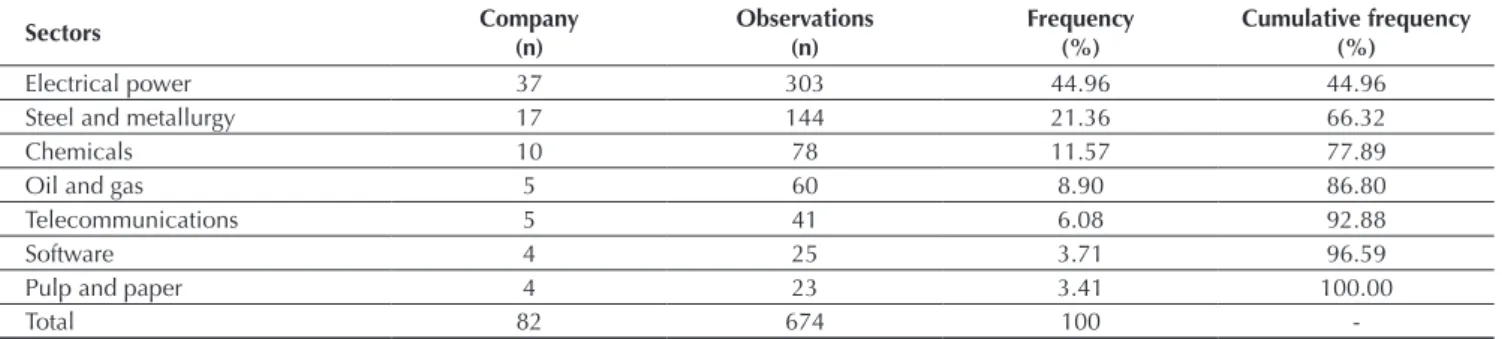
he sectors of economic activity of the companies in the sample are: electrical power, pulp and paper, oil and gas, chemicals, steel and metallurgy, sotware and telecommunications. Table 1 presents the simple and cumulative frequencies of the observations that compose the sample.
Table 1 Sample composition according to the sector of economic activity of the companies
Sectors Company
(n)
Observations (n)
Frequency (%)
Cumulative frequency (%)
Electrical power 37 303 44.96 44.96
Steel and metallurgy 17 144 21.36 66.32
Chemicals 10 78 11.57 77.89
Oil and gas 5 60 8.90 86.80
Telecommunications 5 41 6.08 92.88
Software 4 25 3.71 96.59
Pulp and paper 4 23 3.41 100.00
Total 82 674 100
3.2 Econometric Modeling
For the operationalization of the synchronicity construct, the market model was initially used. he market model generally associates share returns (dependent variable) with returns on the market portfolio
(independent variable). For this, the linear regression technique was used for each share that composes the sample. he linear regressions were in turn developed based on weekly data and refer to the annual period from 2005 to 2015. he econometric model was deined as follows:
in which: Rit: return on share i in period t; MKTt: return on the market portfolio in period t. he returns on the Bovespa index were used as representative of the returns on the market portfolio; ε: error term.
This study took the recommendations of Chan and Hameed (2006) into account for elaborating the synchronicity construct in terms of only using the variable representative of the market portfolio as being explicative of the share returns. According to Chan and Hameed (2006), emerging markets tend to present a high sectorial
concentration, which would make it diicult to distinguish any possible efect related to the market as a whole or speciic to each sector for the synchronicity levels of the shares.
Subsequently, the R2 of the linear regressions obtained
based on the market model were used to develop the synchronicity construct. According to Morck et al. (2000), the synchronicity levels of shares can be obtained via logistic transformation of the R2. his variable was deined
as follows:
in which: Syncit: synchronicity of share i for period t; ln: Napier’s logarithm; R2
it: coeicient of determination of
the market model in relation to share i and for period t. In the investigation of the relationship between the synchronicity levels of the shares traded on the
BM&FBOVESPA, given the IFRS convergence process, the linear regression technique was used, based on cross sectional data and panel data. he econometric model was deined as follows:
in which: Syncit: synchronicity of share i for period t;
IFRSpartial: dummyvariable that takes the value 1 for the observations related to 2008 and 2009, and 0 for the other observations; IFRSfull: dummy variable that takes the value 1 for the observations from 2010 onwards, and 0 for the other observations; Crisis: dummy variable that takes the value 1 for the observations related to 2008, 2009, 2014, and 2015, and 0 for the other observations; MV: market value of the companies, for this variable the logarithmic
scale was used; VOL: trading volume of shares, for this variable the logarithmic scale was used; Price_Book: ratio between stock price and net equity per share; ROA: return on assets; Ebit_Interest: ratio between earnings before interest and tax (Ebit) and inancial expenses; Shareholder_ Liquidity: stock exchange liquidity; Pref_Ord: dummy variable that takes the value 1 for preferred shares and 0 for ordinary shares; sector: company operating sector; εt: error term.
Rit = α + β
1MKTt + εt
Syncit = α + β1IFRSpartial + β2IFRSfull + β3Crisis + β4MV + β5VOL + β6Price_Book + β7ROA + β8Ebit_Interest + β9Shareholder_Liquidity+ β10Pref_Ord + β∑nsector + εt
1
2
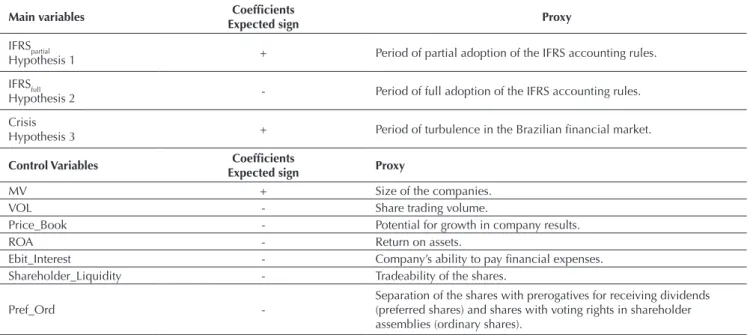
Table 2 presents the expected results for the linear regression from model 3.
in which: Syncit: synchronicity of share i for period t; D2006
to D2015: dummy variables that take the value 1 for the observations related to the respective years, and 0 for the other observations; MV: market values of the companies, for this variable the logarithmic scale was used; VOL: share trading volume, for this variable the logarithmic
scale was used; Price_Book: ratio between stock price and net equity per share; ROA: return on assets; Ebit_Interest: ratio between earnings before interest and tax (Ebit) and inancial expenses; Shareholder_Liquidity: stock market liquidity; Pref_Ord: dummyvariable that takes the value 1 for preferred shares and 0 for ordinary shares; sector:
Table 2 Expected results: model 3
Main variables Coeficients
Expected sign Proxy
IFRSpartial
Hypothesis 1 + Period of partial adoption of the IFRS accounting rules. IFRSfull
Hypothesis 2 - Period of full adoption of the IFRS accounting rules. Crisis
Hypothesis 3 + Period of turbulence in the Brazilian inancial market.
Control Variables Coeficients
Expected sign Proxy
MV + Size of the companies.
VOL - Share trading volume.
Price_Book - Potential for growth in company results.
ROA - Return on assets.
Ebit_Interest - Company’s ability to pay inancial expenses. Shareholder_Liquidity - Tradeability of the shares.
Pref_Ord
-Separation of the shares with prerogatives for receiving dividends (preferred shares) and shares with voting rights in shareholder assemblies (ordinary shares).
IFRS: International Financial Reporting Standards.
Source: Elaborated by the authors.
In Table 2 it can be observed that diferent coeicient signs were expected for the linear regression analysis for the period of partial and full adoption of the IFRS accounting rules (IFRSpartial and IFRSfull). For the Crisis variable, a positive sign was expected for its coeicient. hese results with regards to the coeicient signs as well as their statistical significance can support the indications raised via hypotheses 1, 2, and 3 in relation the synchronicity construct and the IFRS convergence process in Brazil.
With regards to the control variables, a positive sign was expected for the coeicient of the MV (market value) variable. According to Piotroski and Roulstone (2004), bigger companies tend to present higher synchronicity levels as they generally serve as a form of benchmark of company performance for smaller irms and can also
signal events of a macroeconomic nature with a certain degree of foresight.
For the other control variables a negative sign was expected for their coeicients as these variables are related, to a greater or lesser degree, with share transaction levels. For example, the liquidity indices for preferred shares are higher compared with ordinary shares in the Brazilian stock market. his characteristic of the Brazilian market can create incentives for more company-speciic information to be relected in preferred share prices, reducing synchronicity levels.
As a way of identifying the evolution of synchronicity levels over time, in the period between 2005 and 2010, a new econometric model was elaborated. he description follows (model 4).
Syncit = α + β1D2006 + β2D2007 + β3D2008 + β4D2009 + β5D2010 + β6D2011 + β7D2012 + β8D2013 + β9D2014 + β10D2015 + β11MV
+ β12VOL + β13Price_Book + β14ROA + β15Ebit_Interest + β16Shareholder_Liquidity+ β17Pref_Ord + β∑n1sector + εt
Table 3 Descriptive statistics
Panel A
Synchronicity variable Observations
(n) Mean
Standard
deviation Coeficient of variation
Difference of means z statistic
Total sample 674 -2.403 2.393 -0.996
-Pre-IFRS adoption (A) 127 -2.818 2.549 -0.905
-Partial adoption of IFRS (B) 121 -1.720 2.320 -1.349 (B-A)
3.550
Full adoption of IFRS (C) 426 -2.657 2.328 -0.876 (C-B)
-3.918 Full adoption of IFRS –
Excluding 2014 and 2015 272 -2.923 2.382 -0.815
-Non-crisis period (D) 441 -2.698 2.456 -0.910
-Crisis period (E) 233 -1.942 2.219 -1.143 (E-D)
4.054
Panel B Control variables
Total sample
Observations
(n) Mean Median Standard deviation Coeficient of variation
MV 674 14.795 15.210 1.961 0.133
VOL 674 11.283 10.964 3.800 0.337
Price_Book 674 2.215 1.407 6.805 3.072
ROA 674 15.945 4.839 315.052 19.759
Ebit_Interest 674 -0.792 -2.084 88.880 -112.222
Shareholder_Liquidity 674 0.340 0.005 0.882 2.594
Pref_Ord preferred shares (%) Ordinary shares (%)
41.50
58.50 - - -
-CV: coeficient of variation; Pre International Financial Reporting Standards (IFRS) adoption: covers 2005 to 2007; Partial adoption of IFRS: covers 2008 to 2009; Full adoption of IFRS: covers 2010 to 2015. Crisis period: covers 2008, 2009, 2014, and 2015; Non-crisis period: covers 2005, 2006, 2007, 2010, 2011, 2012, and 2013; MV: market value of the companies; VOL: share trading volume; Price_Book: ratio between stock price and net equity per share; ROA: return on assets; Ebit_Interest: ratio between earnings before interest and tax (Ebit) and inancial expenses; Shareholder_Liquidity: stock exchange liquidity; Pref_ Ord: dummy variable that takes the value 1 for preferred shares and 0 for ordinary shares.
Source: Elaborated by the authors.
company operating sector; εt: error term.
Econometric model 4 considers 2005 as the base year. herefore, the coeicients for the period from 2006 to 2015 will be analyzed as marginal alterations in relation to the base-year coeicient (coeicient of the intersection in model 4).
For model 4, the Crisis variable was removed in order to avoid multicollinearity problems. An increase in synchronicity levels is expected for the periods of crisis in the Brazilian inancial market. he periods of crisis for
this study correspond to 2008 and 2009 (international crisis) and 2014 and 2015 (domestic crisis).
In model 4 an increase in synchronicity levels was expected for 2008 and 2009 (period of partial adoption of the IFRS accounting rules) and a reduction in synchronicity levels was expected for 2010 to 2015 (period of full adoption of the IFRS accounting rules). For the other (control) variables the same pattern of coeicient signs as those presented in model 3 was expected.
4 PRESENTATION AND ANALYSIS OF THE RESULTS
4.1 Empirical Evidence
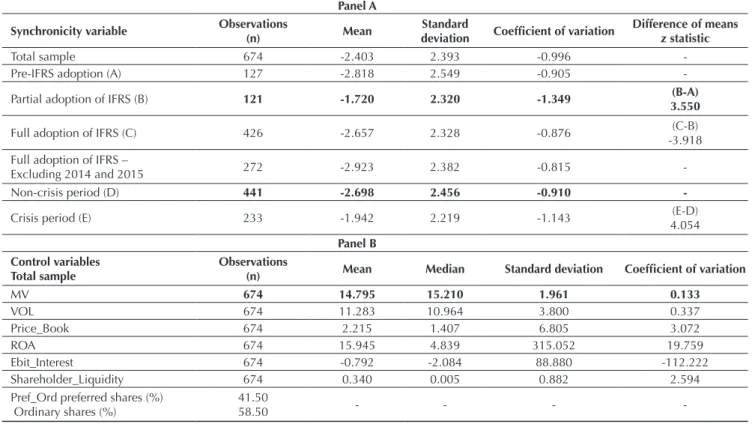
he descriptive statistics for the synchronicity variable are presented in Table 3 (panel A). hese statistics refer to the total sample in the period of partial and full adoption of IFRS and for the crisis and non-crisis periods.
Signiicant statistical diferences were identiied for the average synchronicity variable in relation to the periods investigated. here were indications of an increase in average synchronicity levels for the period of partial adoption of IFRS compared to the pre-adoption period (z statistic = 3.550). Moreover, there were indications of a decrease in the average synchronicity levels for the period of full adoption of IFRS in relation to the partial adoption period (z statistic = -3.918). For the Crisis variable, an increase in average synchronicity was identiied for the crisis periods compared to the non-crisis periods (z statistic = 4.054).
he results found via the diference of means tests support hypotheses 1, 2, and 3 raised in this study. However, these bivariate tests for the averages should be interpreted with much caution since among other facts
they did not use any control variable.
Table 3 (panel B) presents the descriptive statistics for the control variables. One potential problem for using these variables in the econometric models was the high coeicient of variation (CV) veriied in some variables (ROA and Ebit_Interest). For this, statistical procedures (Cook distance and measure of leverage) were used to identify the inluent (exacerbated) variables in the residuals of the auxiliary (non-tabulated) linear regressions. he observations identiied as outliers were removed from the sample. However, there were no signiicant changes in the quality of the data adjustment in relation to the linear regression model. We thus decided to maintain all of the data in the sample.
Subsequently, the Spearman correlation between the continuous variables was tested. According to Gujarati (2006), this test does not assume that data are derived from a normal distribution. he results are presented in Table 4.
Table 4 Spearman Correlation Coeficients
Sync MV VOL Price_Book ROA Ebit_interest Liquidity
Sync 1
MV 0.1176*** 1
VOL 0.1198*** 0.6603*** 1
Price_Book -0.0760* -0.0020 -0.0114 1
ROA 0.006 -0.0340 0.0325 0.0819** 1
Ebit_Interest -0.005 -0.0835** -0.0370 -0.0025 -0.0007 1
Liquidity 0.094** 0.4811*** 0.5597*** -0.0013 -0.0139 0.0262 1
***: 1% level of signiicance; **: 5% level of signiicance; *: 10% level of signiicance.
Ebit_Interest: ratio between earnings before interest and tax (Ebit) and inancial expenses; Liquidity: stock exchange liquidity; Price_Book: ratio between stock price and net equity per share; ROA: return on assets; Sync: synchronicity; MV: market value of the companies; VOL: share trading volume.
Source: Elaborated by the authors.
Table 4 identiied signiicant coeicients of correlation between the synchronicity variable (dependent variable) and the MV, VOL, Liquidity, and Price_Book variables (control variables). he MV, VOL, and Liquidity variables presented relatively high coefficients of correlation between each other, in the order of 0.50, which can
cause multicollinearity problems for the linear regression analyses. However, the variance inlation statistics did not indicate high levels of multicollinearity for the econometric models.
Table 5 Results of the regressions with cross sectional and panel data
Cross-sectional data Panel data
Variables Regression with robust
standard error Weighted least squares: MV
Random effects (robust standard error)
Random effects [error term AR (1)]
Constant -5.113*** (0.901) -2.902*** (0.348) -3.920*** (1.262) -4.481*** (1.087)
IFRSpartial -0.148
(0.364) -0.338 (0.366) -0.053 (0.417) 0.013 (0.372)
IFRSfull -0.775***
(0.242) -0.913*** (0.238) -0.757*** (0.252) -0.719*** (0.251) Crisis 0.739*** (0.236) 0.749*** (0.231) 0.673** (0.267) 0.629*** (0.240) MV 0.170*** (0.065) -0.079 (0.090) 0.123 (0.081) VOL 0.003 (0.032) 0.053** (0.027) 0.018 (0.040) 0.008 (0.040) Price_Book -0.030*** (0.009) -0.029*** (0.009) -0.027*** (0.008) -0.027** (0.013) ROA -0.000269 (0.000067) -0.0000675 (0.0000514) 0.0001114 (0.0000697) 0.0000546 (0.000285) Ebit_Interst 0.0001 (0.0008) 0.0001 (0.001) 0.0003959 (0.0006786) 0.0006356 (0.0009731) Shareholder liquidity -0.108
(0.105) -0.023 (0.100) -0.035 (0.133) -0.057 (0.173) Pref_Ord 0.141 (0.190) 0.010 (0.190) 0.144 (0.257) 0.142 (0.253)
Sector Yes Yes Yes Yes
F-Sig 0.000*** 0.000*** Wald χ
2
141.44***
Wald χ2
66.01*** R2 adjusted
(%) 13.89 13.93
R2 overall
13.49
R2 overall
13.70
n 674 674 674 674
RESET Test 0.273 0.8854 Breusch-Pagan Test
0.000*** NA
Link test Linear Linear Chow Test
0.000*** NA
Variance inlation factor 1.52 1.40 Sargan-Hansen Test
0.1519 NA
- - - Wooldridge Test
0.0031*** NA
***: 1% level of signiicance; **: 5% level of signiicance; *: 10% level of signiicance.
AR(1): 1st order autoregressive model; Crisis: period of economic-inancial crisis; Ebit_Interest: ratio between earnings before interest and tax (Ebit) and inancial expenses; Shareholder Liquidity: stock exchange liquidity; IFRSfull: period of full adoption of International Financial Reporting Standards (IFRS) accounting rules; IFRSpartial: period of partial adoption of IFRS accounting rules; NA: not applicable; Price_Book: ratio between stock price and net equity per share; Pref_Ord: dummy variable that takes the value 1 for preferred shares and 0 for ordinary shares; ROA: return on assets; VM: market value of the companies; VOL: share trading volume.
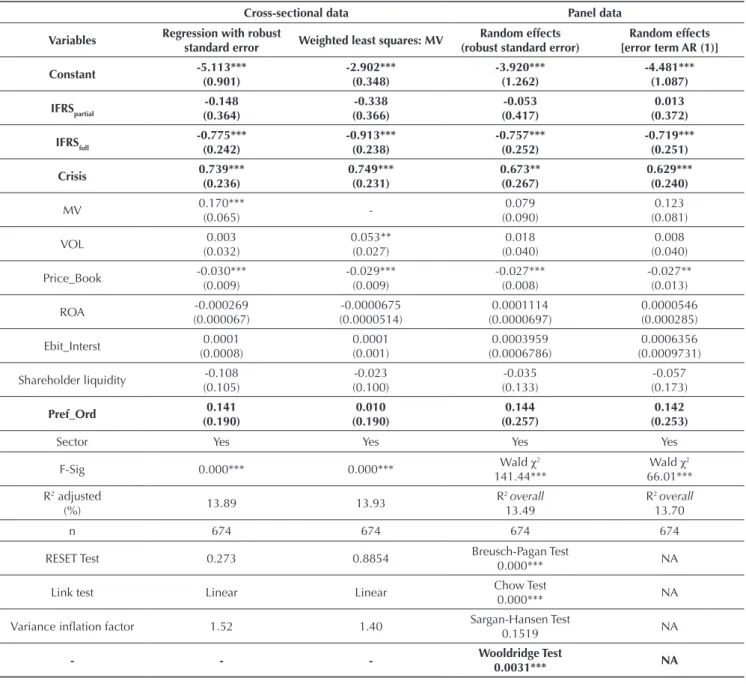
he linear regression models with cross-sectional data (model with standard errors robust against heteroskedasticty of the data and model with variables weighted by the market value of the companies) presented statistical significance for the F test, indicating the adequacy of the models. he RESET test did not show problems with the functional form of the models and the Link test identiied only linear patterns.
he results presented in Table 5 indicate that the sign of the coeicient for the IFRSpartial variable for the two linear regression models are negative. However they were not statistically signiicant. With regards to the coeicient of the IFRSfull variable, this presented a negative sign and 1% statistical signiicance, indicating a reduction in the synchronicity levels of the shares listed on the BM&FBOVESPA in the period of full adoption of IFRS. It was also identiied that the coeicient related to the periods of inancial crisis presented a positive sign and 1% statistical signiicance.
he panel data linear regressions were separated into two models. he irst used random efects with standard errors robust against heteroskedasticity of the data, based on the results found for the Breusch-Pagan,Chow, and Sargan-Hansen tests. To mitigate possible problems of autocorrection of the data indicated by the Wooldridge
test, the 1st order autoregressive model was used. his
second model also used random efects.
he results presented in Table 5 are very close to those found in the cross-sectional data analysis. he coeicient of the IFRSpartial variable was not statistically signiicant. he coeicients of the IFRSfull and Crisis variables presented negative and positive signs, respectively, and were also statistically signiicant. herefore, for this analysis, there were indications of a reduction in synchronicity levels only in the period of full adoption of IFRS, while in periods of inancial crisis there were indications of an increase in share synchronicity.
In relation to the control variables, only the Price_ Book variable was statistically signiicant in all of the econometric models (based on cross-sectional data and panel data). here were indications that synchronicity levels are lower for companies with growth potential in terms of creating current and future cash low. One reasonable explanation for this efect is that for the companies with this characteristic (high price/net equity ratio), investors would have incentives for using company-speciic information to access the quality of company investments.
Table 6 presents the results regarding the evolution of synchronicity levels for the period from 2005 to 2015.
Table 6 Results of the regressions based on the annual bases (2005 base)
Variables Regression with robust standard error
Weighted least squares: VM
Random effects (robust standard errors)
Random efects [error term AR(1)]
Constant -4.850*** (0.962) -2.495*** (0.454) -3.892*** (1.280) -4.340*** (1.010)
D2006 -0.130
(0.500) -0.163 (0.499) -0.115 (0.457) -0.145 (0.434)
D2007 -1.034**
(0.464) -1.017** (0.454) -0.978** (0.427) -0.959 (0.444)
D2008 0.118
(0.447) -0.069 (0.434) 0.148 (0.369) 0.125 (0.428)
D2009 0.221
(0.470) 0.022 (0.474) 0.282 (0.450) 0.283 (0.424)
D2010 -1.074**
(0.434) -1.210*** (0.423) -0.998** (0.392) -0.982** (0.416)
D2011 -1.699***
(0.470) -1.778*** (0.451) -1.620*** (0.457) -1.632*** (0.419)
D2012 -1.172**
(0.195) -1.358*** (0.480) -1.184** (0.468) -1.147*** (0.424)
D2013 -0.815*
(0.422) -1.011** (0.409) -0.815** (0.410) -0.812* (0.424)
D2014 -0.439
(0.440) -0.586 (0.422) -0.452 (0.379) -0.428 (0.422)
D2015 -0.465
VM 0.181***
(0.065)
-0.104*** (0.091)
0.141* (0.081)
VOL 0.003
(0.032)
0.055** (0.027)
0.017 (0.039)
0.009 (0.040)
Price_Book -0.029***
(0.009)
-0.028*** (0.009)
-0.026*** (0.008)
-0.026** (0.013)
ROA -0.0000284
(0.0000692)
-0.000071 (0.0000545)
0.0000953 (0.0000747)
0.0000498 (0.0002846)
Ebit_Interst 2.16e-06
(0.0009011)
7.06e-06 (0.001003)
0.0002613 (0.0007102)
0.0005208 (0.0009816) Shareholder liquidity -0.129
(0.108)
-0.037 (0.104)
-0.082 (0.132)
-0.0916 (0.174)
Pref_Ord 0.144
(0.190)
0.009 (0.190)
0.143 (0.257)
0.144 (0.253)
Sector Yes Yes Yes Yes
F-Sig 0.000*** 0.000*** Wald χ
2
167.57***
Wald χ2
78.38*** R2 ajusted
(%) 15.40 15.24
R2 overall
15.12
R2 overall
15.25
N 674 674 674 674
RESET test 0.6528 0.9235 -
-Link test Linear Linear -
-Variance inlation factor 1.74 1.68 -
-Breusch-Pagan Test - - 0.000***
-ChowTest - - 0.000***
-Sargan-HansenTest - - 0.0614
-WooldridgeTest - - 0.0044***
-***: 1% level of signiicance; **: 5% level of signiicance; *: 10% level of signiicance.
AR(1): 1st order autoregressive model; D2006: dummy variable that takes the value 1 for the observations related to 2006, and 0 for the other observations; D2007: dummy variable that takes the value 1 for the observations related to 2007, and 0 for the other observations; D2008: dummy variable that takes the value 1 for the observations related to 2008, and 0 for the other observations;
D2009: dummy variable that takes the value 1 for the observations related to 2009, and 0 for the other observations; D2010: dummy
variable that takes the value 1 for the observations related to 2010, and 0 for the other observations; D2011: dummy variable that takes the value 1 for the observations related to 2011, and 0 for the other observations; D2012: dummy variable that takes the value 1 for the observations related to 2012, and 0 for the other observations; D2013: dummy variable that takes the value 1 for the observations related to 2013, and 0 for the other observations; D2014: dummy variable that takes the value 1 for the
observations related to 2014, and 0 for the other observations; D2015: dummy variable that takes the value 1 for the observations
related to 2015, and 0 for the other observations; Ebit_Interest: ratio between earnings before interest and tax (Ebit) and inancial expenses; Shareholder_Liquidity: stock exchange liquidity; Price_Book: ratio between stock price and net equity per share; Pref_ Ord: dummy variable that takes the value 1 for preferred shares and 0 for ordinary shares; ROA: return on assets; VM: market value of the companies; VOL: share trading volume.
Source: Elaborated by the authors.
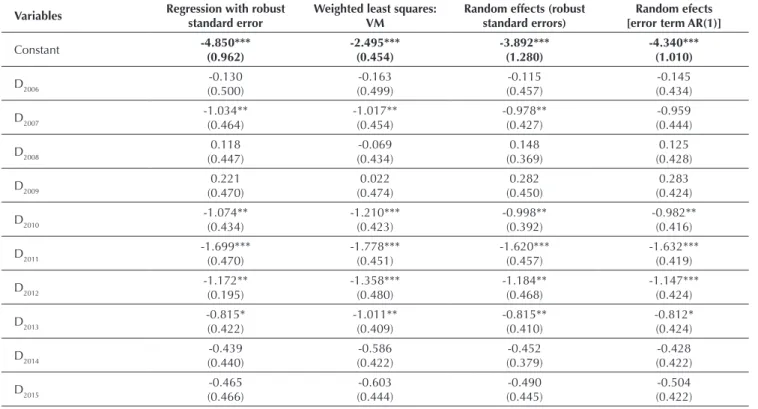
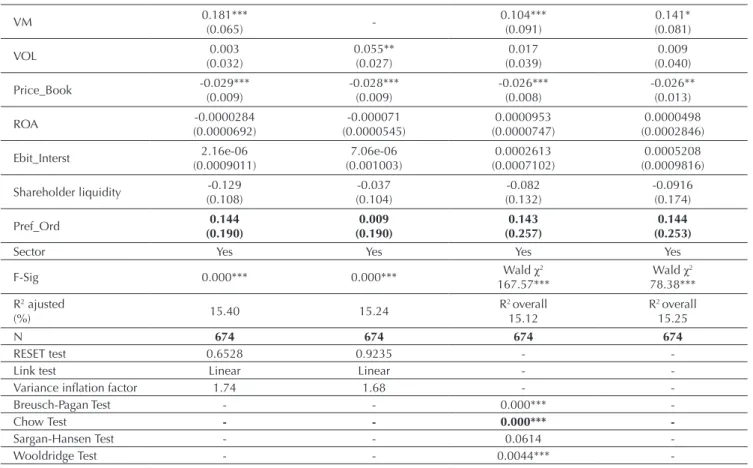
The results presented in Table 6 show that the coeicients of the variables D2008 and D2009, which are related to the period of partial adoption of IFRS, were not statistically signiicant. It was observed that the coeicients of the variables D2010 to D2013 presented negative signs and statistical signiicance. hese results indicate a reduction
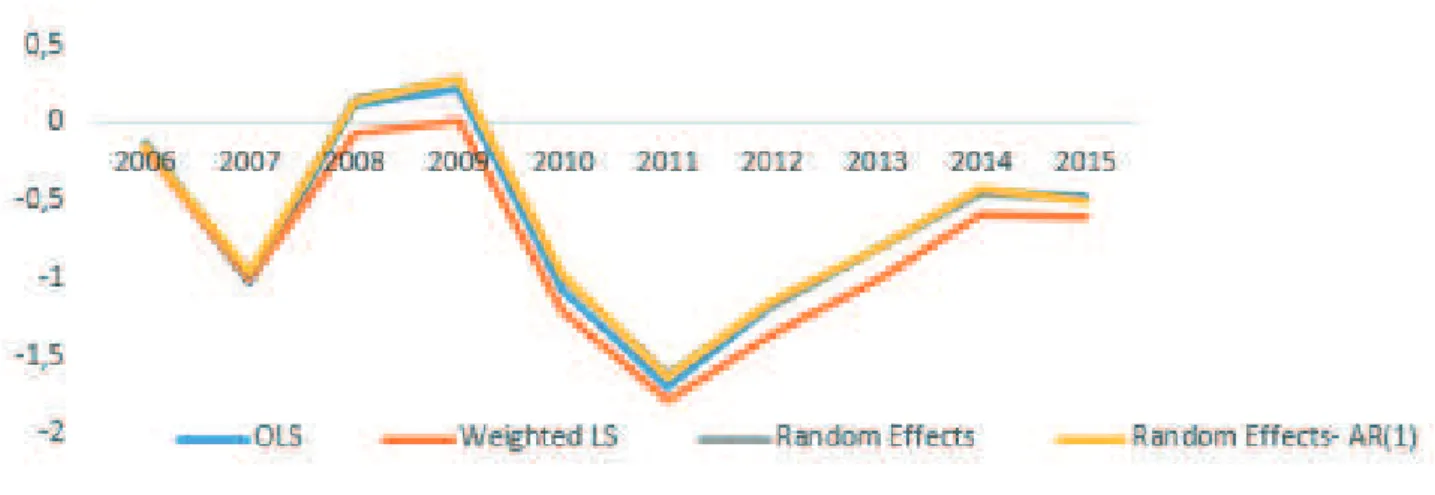
in the synchronicity levels of the shares traded on the BM&FBOVESPA for the years 2010 to 2013. However, the coeicients of the variables D2014 and D2015 did not present statistical signiicance. As an additional analysis, Figure 1 presents the evolution of the coeicients that are related to synchronicity levels.
In general, the results indicate that there were no changes in the synchronicity levels of the shares for the period of partial adoption of IFRS in Brazil. his suggests that there was no increase in the informational content brought by IFRS. here was thus no evidence to support hypothesis 1 of this study.
For the period of full adoption of the IFRS accounting rules there were indications of a reduction in the synchronicity levels of the shares. However, in periods of inancial crisis the results suggest a loss in relevance of the accounting information for the decision making process. For example, even under IFRS, 2014 and 2015 presented, statistically, the same synchronicity levels for shares traded on the BM&FBOVESPA compared to 2005 (pre-adoption period). hus, the results provided evidence that supports hypotheses 2 and 3 of this study.
4.2 Additional Tests
As a way of mitigating the possible biases in the econometric models developed in this study, especially from omitting relevant variables for explaining the synchronicity levels of the shares, additional tests were developed using a Probit model in panel data. This econometric model is less sensitive to non-normality and heteroskedasticity of data, which can give the results greater consistency.
he Probit model integrated new control variables that are related with characteristics involving companies reporting accounting information, levels of company resources invested in ixed assets compared with total assets, and ownership structure of the companies’ voting capital (model 5).
AR(1): 1st order autoregressive model; weighted LS: weighted least squares; OLS: ordinary least squares.
Figure 1 Coeficients of the synchronicity levels of the econometric models (2005 base)
Source: Elaborated by the authors.
Sync_Binit = β1IFRSpartial + β2IFRSfull + β3Crisis + β4MV + β5Fixed + β6Private_Public +
β7Cross_Listing + β8Penny + β9VAR_Accruals+ β∑nsector + εt 5
Table 7 Probit Model in panel data
Variables Expected sign for the coeficients Coeficients Standard Error
IFRSpartial + -0.589 0.368
IFRSfull - -0.843*** 0.256
Crisis + 0.883*** 0.240
MV + -0.008 0.080
Fixed - -1.236* 0.633
Private_Public - -0.006 0.537
Cross_Listing - -0.384*** 0.138
Penny + 0.5354 0.568
VAR_Accruals + 2.026 3.205
Sector Yes
-n 674
-Wald χ2 37.57***
-*** 1% level of signiicance; ** 5% level of signiicance; *10% level of signiicance.
Crisis: period of economic-inancial crisis; Cross_Listing: dummy variable that takes the value 1 for companies that trade shares on the US market via American Depositary Receipts (ADRs), and 0 for the other observations; IFRSfull: period of full adoption of the International Financial Reporting Standards (IFRS) accounting rules; IFRSpartial: period of partial adoption of the IFRS
accounting rules; Fixed: variable representative of the percentage share of ixed assets in relation to total assets; Penny: dummy variable that takes the value 1 for shares that on an yearly average were listed on the spot market of the BM&FBOVESPA for a value equal to or less than R$ 1.00, and 0 for the other observations; Private_Public: dummy variable that takes the value 1 for the companies that have their voting capital controlled by some private initiative, and 0 for the companies that have their voting capital controlled by the public sector; VAR_Accruals: variable representative of the standard deviation in accruals; MV: market value of the companies’ net equity.
Source: Elaborated by the authors.
in which: Sync_Binit: dummy variable representative of the synchronicity level of share i for period t, takes the value of 1 for the observations that present values higher than the median for the synchronicity levels of share i for the period from 2005 to 2015, and 0 for the other observations;
IFRSpartial: dummy variable that takes the value 1 for the observations related to 2008 and 2009, and 0 for the other observation; IFRSfull: dummy variable that takes the value 1 for the observations from 2010 onwards, and 0 for the other observations; Crisis: dummy variables that takes the value 1 for the observations related to 2008, 2009, 2014, and 2015, and 0 for the other observations; MV: market value of the companies’ net equity, for this variable the logarithmic scale was used; Fixed: variable representative of the percentage share of ixed assets in relation to total assets; Private_Public: dummy variable that takes the value 1 for companies with voting capital controlled by some private initiative, and 0 for companies with voting capital controlled by the public sector; Cross_Listing: dummy variable that takes the value 1 for companies that trade shares on the US market via American Depositary Receipts (ADRs), and 0 for the other observations; Penny: dummy variable that takes the value 1 for shares that on an yearly average were listed on the BM&FBOVESPA spot market for a value equal to or lower than R$1.00, and 0 for the other observations; VAR_Accruals: variable representative of the standard deviation in accruals, for the accruals calculation the companies’ balance sheet accounts
were used: variation in current assets (∆CA), variation in available cash (∆cash), variation in current liabilities (∆CL), variation in short term loans and inancing (∆LF), variation in tax payable (∆Tax) and depreciation expenses (DE). he expression for the accruals calculation was deined as: (∆CA-∆Cash) – (∆CL-∆LF-∆Tax) – DE. All of the variables were scaled by average annual total assets. To calculate the standard deviation in the accruals, three company annual accounting statement publications were considered (t-2, t-1, and t); Sector: economic activity sector of the companies; εt: error term.
he synchronicity levels of the shares in model 5 were controlled for company size, as recommended by Piotroski and Roulstone (2004). For this, the MV variable was used (market value of the net equity of the companies). he purpose of the Fixed variable was to control the results for the metric related to the investment structure of company resource in tangible and intangible assets (Brown & Kimbrough, 2011). Inclusion of the Cross_ Listing and Private_Public variables aimed to control the results for corporate governance mechanisms with regards to the companies’ reporting of accounting information (Li, Brockman & Zurbruegg, 2015). he
Penny variable considered the liquidity risk associated with investments in low value shares (Chiang & Zheng, 2015), and inally, the VAR_Accruals variable controlled the results for the possible efect of earnings management on the synchronicity levels of the shares (Kim & Shi, 2012).
he results presented in Table 7 support the idea that the synchronicity levels of the shares analyzed are statistically lower ater the adoption of IFRS in Brazil, compared with the period prior to this accounting standardization. he coeicient of the IFRSfull variable presented a negative sign and 1% statistical signiicance. he results were not signiicant for the IFRSpartial variable.
For the Crisis variable, its coeicient presented a positive sign and 1% statistical signiicance. he results obtained from the Probit model for the Crisis variable suggest a higher probability of increased synchronicity levels for the shares in periods of greater inancial market turbulence.
In relation to the control variables, it was veriied that only the Fixed and Cross_Listing variables presented statistical signiicance. For the Fixed variable, its coeicient was only marginally signiicant, to a level of 10%, indicating a negative association between the synchronicity levels of the shares and the share of tangible assets in relation to total assets of the companies analyzed. he Cross_Listing variable presented a statistically signiicant coeicient to a level of 1%, which may signal that the quantity and quality of accounting information required to trade ADRs in the US market may provide the conditions for share prices to more consistently relect relevant accounting information.
5. FINAL REMARKS
IFRS adoption has been one of the key accounting regulation milestones in Brazil. Brazilian accounting standardization was not historically focused on meeting investor demands for information and existed in a context that can be characterized by low legal and institutional enforcement. In these circumstances, the adoption of international accounting standards may not relect possible economic consequences such as lower synchronicity levels of shares traded on the stock exchange.
For the period of partial adoption of IFRS, no signiicant changes in the synchronicity levels of the shares were found. It can thus be inferred that this was a critical period in the accounting convergence process. Some factors may contribute to this: the diferent levels of company compliance in meeting the accounting standardization, questions of shareholder and market analyst experience in analyzing the accounting information derived from IFRS, and the chronogram by which the diferent standards were required of the companies, among others.
The results obtained by this study indicated a reduction in synchronicity levels for the shares listed on the BM&FBOVESPA only for the period of partial adoption of IFRS. his result therefore supports the hypothesis that IFRS is more relevant for the investor decision making process in comparison with previous accounting standards. The supposed increase in accounting information transparency derived from IFRS,
and consequent reduction in informational asymmetry between managers and current and potential shareholders, could be a plausible explanation for the synchronicity levels veriied in the Brazilian capital market.
However, for periods of inancial crisis, the results indicated that accounting information loses relevance, even information derived from IFRS. hus, the possible surprises derived from the accounting information would not be relected in the share prices; in these periods these prices would relect aspects of investor behavior.
Another important point in this paper was the consideration of information on shares listed on the Brazilian stock exchange only. This research design aimed to control the results for aspects of the regulatory environment in Brazil, since all of the companies in the sample operate within this environment. Including information on companies and shares in other countries in the sample, with possible diferences in regulatory environments, may on one hand increase the generalization of the results, but on the other hand it can lead to unsuitable inferences.
For future studies, we suggest an investigation of the characteristics of recognition, measurement, and reporting of accounting information under the IFRS rules and their relationships with the synchronicity levels of shares.
REFERENCES
Ali, A., & Hwang, L. (2000). Country-speciic factors related to inancial reporting and the value relevance of accounting data. Journal of Accounting Research, 38(1), 1-25.
Ball, R., Kothari, S. P., & Robin, A. (2000). he efect of
Barth, M. E., Landsman, W. R., & Lang, M. H. (2008).
International accounting standards and accounting quality. Journal of Accounting Research, 46(3), 467-498.
Boubaker, S., Mansali, H., & Rjiba, H. (2014). Large controlling shareholders and stock price synchronicity. Journal of Banking & Finance, 40, 80-96.
Brown, N. C., & Kimbrough, M. D. (2011). Intangible
investment and the importance of irm-speciic factors in the determination of earnings. Review of Accounting Studies, 16, 559-573.
Bruggemann, U., Hitz, J. M., & Sellhorn, T. (2013). Intended and unintended consequences of mandatory IFRS adoption: a review of extant evidence and suggestions for future research. European Accounting Review, 22, 1-37.
Chan, K., & Hameed, A. (2006). Stock price synchronicity and analyst coverage in emerging markets. Journal of Financial Economics, 80, 115-147.
Chiang, T. C., & Zheng, D. (2015). Liquidity and stock returns: evidence from international markets. Global Finance Journal, 27, 73-97.
Christensen, H. B., Hail, L., & Leuz, C. (2013). Mandatory IFRS reporting and changes in enforcement. Journal of Accounting and Economics, 56, 147-177.
Christensen, H. B., Lee, E., & Walker, M. (2007). Cross-sectional variation in the economic consequences of international accounting harmonization: the case of mandatory IFRS adoption in the UK. he International Journal of Accounting, 42, 341-379.
Dasgupta, S., Gan, J., & Gao, N. (2010). Transparency, price informativeness, and stock return synchronicity: theory and evidence. Journal of Financial and Quantitative Analysis, 45(5), 1189-1220.
Daske, H., Hail, L., Leuz, C., & Verdi, R. S. (2008). Mandatory IFRS reporting around the world: early evidence on the economic consequences. Journal of Accounting Research, 46(5), 1085-1142.
Daske, H., Hail, L., Leuz, C., & Verdi, R. S. (2013). Adopting a label: heterogeneity in the economic consequences around IAS/IFRS adoptions. Journal of Accounting Research, 51(3), 495-547.
De Long, J. B., Shleifer, A., Summers, L. H., & Waldman, R. J. (1990). Noise trader risk in inancial markets. Journal of Political Economy, 98(4), 703-738.
Deloitte Global Services (2016). Use of IFRS by jurisdiction. Retrieved from http://www.iasplus.com/en/jurisdictions
Ghio, A., & Verona, R. (2015). Accounting harmonization in the BRIC countries: a common path? Accounting Forum, 39, 121-139.
Glaum, M., Baetge, J., Grothe, A., & Oberdorster, T. (2013a). Introduction of international accounting Sstandards,
disclosure quality, and accuracy of analysts’ earnings forecasts. European Accounting Review, 22(1), 79-116.
Glaum, M., Schmidt, P., Street, D. L., & Vogel, S. (2013b). Compliance with IFRS 3 and IAS 36 required disclosures across 17 European countries: company and country-level determinants. Accounting and Business Research, 43(3), 163-204.
Gujarati, D. (2006). Econometria básica (Monteiro, M. J. C., Trad.) (Ed. rev.) (4a. ed.). Rio de Janeiro, RJ: Elsevier (2003).
Gul, F. A., Kim, J. B., & Qiu, A. A. (2010). Ownership
concentration, foreign shareholding, audit quality, and stock price synchronicity: evidence from China. Journal of Financial Economics, 95, 425-442.
Hamberg, M., Mavruk, T., & Sjogren, S. (2013). Investment allocation decisions, home bias, and the mandatory IFRS adoption. Journal of International Money and Finance, 36, 107-130.
Houqe, M. N., & Monem, R. M. (2016). IFRS adoption, extent of disclosure, and perceived corruption: a cross-country study. he International Journal of Accounting, 51(3), 363-378. Hutton, A. P., Marcus, A. J., & Tehranian, H. (2009). Opaque inancial reports, R2, and crash risk. Journalof Financial
Economics, 94, 67-86.
Instituto Brasileiro de Geograia e Estatística. (2016). Séries históricas e estatísticas.Retrieved from http://seriesestatisticas. ibge.gov.br/series.aspx?no=1&op=1&vcodigo=ST12&t=produ to-interno-bruto-br-variacao-volumebrtaxa
Jin, L., & Myers, S. C. (2006). R2 around the world: new theory and
new tests. Journal of Financial Economics, 79, 257-292. Kim, J. B., & Shi, H. (2012). IFRS reporting, irm-speciic
information lows, and institutional environments:
international evidence. Review of Accounting Studies, 17(3), 474-517.
Landsman, W. R., Maydew, E. L., & hornock, J. R. (2012). he information content of annual earnings announcements and mandatory adoption of IFRS. Journal of Accounting and Economics, 53, 34-54.
Laux, C., & Leuz, C. (2009). he crisis of fair-value accounting: making sense of the recent debate. Accounting, Organizations and Society, 34, 826-834.
Li, S., Brockman, P., & Zurbruegg, R. (2015). Cross-listing, irm-speciic information, and corporate governance: evidence from Chinese A-shares and H-shares. Journal of Corporate Finance, 32, 347-362.
Lopes, A. B. (2006). Financial accounting in Brazil: an empirical examination. Latin American Business Review, 6, 45-68. Mala, R., & Chand, P. (2012). Efect of the global inancial crisis on
accounting convergence. Accounting & Finance, 52, 21-46. Mensi, W., Hammoudeh, S., Reboredo, J. C., & Nguyen, D. K.
(2014). Do global factors impact BRICs stock markets? A quantile regression approach. Emerging Markets Review, 19, 1-17.
Morck, R., Yeung, B., & Yu, W. (2000). he information content of stock markets: why do emerging markets have synchronous stock price movements? Journal of Financial Economics, 58, 215-260.
Nnadi, M., & Soobaroyen, T. (2015). International inancial reporting standard and foreign direct investment: the case of Africa. Advances in Accounting, Incorporating Advances in International Accounting, 31, 228-238.
Piotroski, J. D., & Roulstone, D. (2004). he inluence of analysts, institutional investors, and insiders on the incorporation of market, industry, and irm-speciic information into stock prices. he Accounting Review, 79(4), 1119-1151.
Piotroski, J. D., Wong, T. J., & Zhang, T. (2015). Political incentives to suppress negative information: evidence from Chinese listed irms. Journal of Accounting Research, 53(2), 405-459.
Roll, R. (1988). R-squared. he Journal of Finance, 43, 541-566.
Silva, A. F., Wefort, E. F. J., Flores, E. S., & Silva, G. P. (2014).
Earnings management and economic crises in the Brazilian capital market. Revista de Administração de Empresas – RAE, 54(3), 268-283.
Tan, H., Wang, S., & Welker, M. (2011). Analyst following and forecast accuracy ater mandated IFRS adoptions. Journal of Accounting Research, 49(5), 1307-1357.
Wang, J. W., & Yu, W. W. (2015). he information content of stock prices, legal environments and accounting standards: international evidence. EuropeanAccountingReview, 24(3), 471-493.
Address for correspondence
Bruno Figlioli
Universidade de São Paulo, Faculdade de Economia, Administração e Contabilidade de Ribeirão Preto, Departamento de Contabilidade
Avenida Bandeirantes, 3900, Bloco B2, Sala 42 – CEP: 14040-900 Monte Alegre – Ribeirão Preto – SP – Brasil