i
Determinants of Continuance Intention in
Wearables
Bruno Alexandre Pinto Dimas Nascimento
The Case of Smartwatches
Dissertation presented as partial requirement for obtaining
the Master’s degree in Information Management
ii
NOVA Information Management School
Instituto Superior de Estatística e Gestão de Informação
Universidade Nova de Lisboa
DETERMINANTS OF CONTINUANCE INTENTION IN WEARABLES: THE
CASE OF SMARTWATCHES
by
Bruno Alexandre Pinto Dimas Nascimento
Dissertation presented as partial requirement for obtaining the Master’s degree in Information Management, with a specialization in Marketing Intelligence
Advisor: Prof. Doutor. Tiago André Gonçalves Félix de Oliveira
iii
DEDICATION
To the two pillars in my life, Mom and Dad, for providing me with the tools and conditions to learn, grow, and thrive. To my Mom – thank you for your never ending support, and for all the things you had to give up in order to see me succeed. I’ll make sure that this success is long lasting. To my Dad – I wish you were still here to see me reach the potential you always knew I was capable of. Thank you for giving me the strenght to overcome all the adversities, even from up there.
To my friends – without your encouragement and non-judgmentalism, the road would have seemed a lonely place.
To Nataša – my eternal cheerleader. You held me high at my lowest, celebrated my small achievements, made me believe that everything is possible. My heart will always be with you.
Words cannot express how much I love you all.
iv
ACKNOWLEDGEMENTS
To the ancestors who paved the path before me upon whose shoulders I stand.
To Prof. Dr. Tiago Oliveira for his extreme patience in the face of numerous obstacles, and for the generosity with his personal time, mentorship, and unwavering support. Thank you for pushing me forward.
To NOVA IMS for allowing me to conduct my research and providing any assistance requested. To everyone who walked alongside me during the last 10 years, who guided me, and showed me the doors that can be opened.
v
ABSTRACT
Smartwatch sales have been growing for the past few years, but their regular use is still sub-par. Understanding the primary determinants of smartwatch continuance intention is thus important for brands, researchers, and users alike. Therefore, a conceptual model was developed that combines the expectation-confirmation model (ECM) with habit, perceived usability, and perceived enjoyment, to explain the continuance intention of smartwatches. To test the conceptual model, we collected data from the U.S.A. (574 valid cases). Our results support the relationships of ECM, such as confirmation, perceived usefulness, and satisfaction, and also the role of habit and perceived usability. Habit was the most important factor to explain the continuance intention of smartwatches.
KEYWORDS
Smartwatches, Wearables, Continuance Intention, Expectation-Confirmation Model (ECM), Habit, Perceived Usability, Perceived Enjoyment
vi
SUBMISSION
SUBMISSION RESULTING FROM THIS DISSERTATION
PAPER
Nascimento, B. & Oliveira, T. DETERMINANTS OF CONTINUANCE INTENTION IN WEARABLES:
THE CASE OF SMARTWATCHES (submission to a Journal)
vii
INDEX
1. Introduction ... 1
2. Theoretical Background ... 2
2.1. The concepts of wearable technology and smartwatches ... 2
2.2. Continuance Theory ... 3
2.3. Expectation-Confirmation Theory and Expectation-Confirmation Model ... 3
3. Research Model ... 6
3.1. Confirmation ... 6
3.2. Perceived Usefulness ... 7
3.3. Satisfaction ... 7
3.4. Habit ... 7
3.5. Perceived Usability ... 8
3.6. Perceived Enjoyment ... 9
4. Methods... 10
4.1. Measurement Instruments ... 10
4.2. Data Collection ... 10
5. Results... 12
5.1. Measurement Model ... 12
5.2. Structural Model ... 13
6. Discussion ... 15
6.1. Theoretical Implications ... 15
6.2. Managerial Implications ... 15
6.3. Limitations and Future Research ... 16
7. Conclusions ... 18
8. Bibliography ... 19
viii
LIST OF FIGURES
Figure 1 - Expectation-Confirmation Theory process ... 3
Figure 2 - Expectation-Confirmation Model (Bhattacherjee, 2001b) ... 4
Figure 3 - Research model ... 6
Figure 4 - Model with results ... 14
ix
LIST OF TABLES
Table 1 - Summary of previous research related to the continuance intention to use
smartwatches ... 5
Table 2 - Demographic data of responses ... 11
Table 3 - Correlation matrix, composite reliability (CR), and square root of AVEs ... 12
Table 4 - Loadings and cross-loadings for the measurement model ... 13
x
LIST OF ABBREVIATIONS AND ACRONYMS
ECT Expectation-Confirmation TheoryEDT Expectation-Disconfirmation Theory ECM Expectation-Confirmation Model TAM Technology Acceptance Model DOI Diffusion of Innovations UI User Interface
IS Information System IT Information Technology SEM Structured Equation Modeling AVE Average Variance Extracted PLS Partial Least Squares
1
1. INTRODUCTION
The global market has witnessed sustained growth in the acceptance of wearable devices in the last few years. By Q4 2014, one in every five Americans were already owning some wearable device (PwC, 2014, p. 11). Wearable technology has a big potential and a growing acceptance as a novelty technology, but it is essential to study the intention of users to continue using it so that both companies and consumers can benefit. According to Juniper Research (Moar, 2016), an estimated 17.1 million smartwatches were shipped in 2015. Wearables, and in particular, smartwatches, do show potential benefits but are still far from reaching mainstream acceptance that is similar to that of smartphones (Danova, 2014). In fact, according to the PwC report (PwC, 2014), only one in ten Americans uses a wearable device every day.
In 2015, North America accounted for roughly 40% of the global wearables market (Cisco, 2016). With a global revenue of $750M in 2012 (Ak, 2014), the smartwatch market is expected to reach $32.9B in 2020, growing at a compound annual growth rate of 67.6% (Kohli, 2015). Despite this growth, consumers still show some reluctance towards smartwatches (Danova, 2014; PwC, 2014). Wearable technology and, in particular, smartwatch technology, are exciting new technologies to be researched because they allow for the continuous and reliable collection of data (Rawassizadeh, Price, & Petre, 2015), and the augmentation of human abilities and capabilities (Starner, 2001). This collected data has a significant potential in, for example, mobile health (mHealth) applications, not only for a healthier lifestyle but especially with the elderly care. At the same time, studies on this topic are relatively small in quantity, and mostly done by non-independent third-parties; hence the importance of an independent study to understand the continuance intention of IT.
The contribution of this research is fourfold. First most, extensive research has been conducted on the topic of technology acceptance, but the topic of technology continuance intention has a greater impact on the long-term viability of an information system (Bhattacherjee, 2001b). For this reason, this study thus aims to extend the knowledge on the latter topic. Secondly, empirical work regarding wearables and, in particular, smartwatches is very scarce. To the best of our knowledge, no published work was found on the topic of smartwatch continuance intention. A big contribution of this study is, in fact, the extension of knowledge on this topic. Third, this study takes an existing empirically validated post-acceptance theoretical model (the expectation-confirmation model (Bhattacherjee, 2001b)), extends it with perceived enjoyment (due to the hedonic component of wearable technology (Wakefield & Whitten, 2006)), perceived usability (due to the small screen of the device (Budiu, 2015, sec. Focus on the Essential)), and habit factors (due to the novelty of the technology (Polites & Karahanna, 2012)), and tests it with the topic of smartwatches for the first time. Fourth, as a new technology, smartwatches are still understudied. This study may, therefore, help brands with understanding the determinant factors that influence the continued use of the technology, and, ultimately, to develop products that deliver the most value to retain customers. The structure of the paper is as follows. In the next section, the concepts of wearables, smartwatches, continuance theory, and expectation-confirmation model are presented. Then, the research model is conceptualized. Posteriorly, the design, methodology, and results of this research are presented. Finally, the results of this study are discussed, including its implications for theory and practice, and further possible research directions are outlined.
2
2. THEORETICAL BACKGROUND
2.1.
T
HE CONCEPTS OF WEARABLE TECHNOLOGY AND SMARTWATCHESWearable technology is a form of ubiquitous computing, according to Mark Weiser (1991), as “it weaves itself into the fabric of everyday life until it is indistinguishable from it” (p. 94). It translates the concept of having computing everywhere and anywhere, and also extends the mobile concept as it can appear on any device, format, and location. Regarded as the father of wearable computing, Steve Mann (1998) defines it as a computer that is always on and always accessible. Some of the most common integrations of wearable technology include clothing (Kosir, 2015), glasses/goggles (such as the Google Glass and the Oculus Rift), bracelets (such as the Fitbit and Jawbone brands), and watches (such as the Apple Watch or the Samsung Galaxy Gear S).
Wearable technology is revolutionary in the sense that it is present at all times, and therefore, it allows an augmented interaction with the world around the user. According to Mann (1998), by definition, wearables have a constancy characteristic, meaning that they do not need to be turned on or opened up before use. In this way, according to Salah, MacIntosh, & Rajakulendran (2014), wearable devices have greater potential than smartphones “in any industry where hands-free data collection is highly valued” (p. 8) or “whenever information or communication is required, a hands-free interface is helpful, and consistent monitoring is beneficial” (p. 10). Besides having important application in, for example, the medical industry (Pentland, 2004; Salah et al., 2014; Sungmee Park & Jayaraman, 2003), wearables are also important in one’s work and personal lives as ways to manage information (Billinghurst & Starner, 1999) and connect in new ways (PwC, 2014).
According to the Smartwatch Group (“What is a smartwatch? Definition,” 2015), a smartwatch is defined by being worn on the wrist, able to indicate time and wirelessly connect to the internet. For Rawassizadeh et al. (2015), a smartwatch is not just a device that tells time, but a “general-purpose, networked computer with an array of sensors”. This study narrows those definitions and considers a smartwatch a device that is worn on the wrist, has a screen, is wirelessly connected to the internet on its own or through a smartphone, contains sensors (such as accelerometers, IR sensors, etc.), and can run either proprietary or third-party apps.
Smartwatches, according to Business Intelligence (Danova, 2014), will make up 59% of all wearable device shipments in 2015, and over 70% by 2019, making them the most relevant wearable devices. They liberate us from the hassle caused by smartphones themselves (Marks, 2013), as they can “provide relevant information within a very short interaction period” (Bieber, Kirste, & Urban, 2012, p. 1). Not only that, smartwatches might be easier to operate in certain work conditions due to them being mostly water resistant, having a battery life that spans a couple of days to years, and sensors that enable possible gesture interactions (Bieber et al., 2012).
As a platform, a smartwatch is only as good as the quality of the apps it has at its disposal (O’Reilly, 2015). Apple is slightly ahead of other major players in the market due to, not only, the number (Curry, 2015), but also the quality of apps (Mitroff, 2012). According to the PwC (2014) report on wearables, the Apple Watch is the sleek device that “will help mainstream the entire wearable category” (p. 11), and users will adopt this technology, but only if “it’s useful, interesting and/or fun” (p. 25).
3
2.2. C
ONTINUANCET
HEORYTechnology acceptance and use has been covered extensively by the information systems (IS) literature (Davis, 1989; Venkatesh, Morris, Davis, & Davis, 2003). The continuance intention of information technology (IT) is, however, the hot topic right now in the field of IS (Bhattacherjee, 2001b; Hoehle & Venkatesh, 2015; Venkatesh, Thong, Chan, Hu, & Brown, 2011). This topic has been researched with different technologies, including e-learning (K. M. Lin, 2011), internet banking (Eriksson & Nilsson, 2007), social networking (Cheung, Jin, Lee, Lee, & Chen, 2009), and personal IT devices (Chen & Koufair, 2014).
Bhattacherjee (2001b) argues that when considering IS success, the initial acceptance of IS plays a significant role, but ultimately, it is the continued used that will determine its long-term viability. Previous studies have also primordially considered the importance of continuance intention, like Rogers' (2003) five-stage diffusion of innovations (DOI) theory. The DOI theory incorporates the decision to continue or discontinue the use of technology in its final confirmation stage. However, Rogers’s (2003) study, like other previous studies, uses the same “pre-acceptance variables to explain both acceptance and continuance decisions” (Bhattacherjee, 2001b, p. 352), and thus, does not account for users who discontinue IS usage after previously accepting it.
2.3. E
XPECTATION-C
ONFIRMATIONT
HEORY ANDE
XPECTATION-C
ONFIRMATIONM
ODELThe expectation-confirmation theory (ECT) or expectation-disconfirmation theory (EDT) provides an explanation for consumers repurchase intention through satisfaction, typically used in the marketing field. This theory demonstrates that consumers reach a repurchase intention in the following way. Before purchase, consumers have expectations about specific products or services (Oliver, 1980), that is based on existing knowledge and prior experience (Zeithaml, Parasuraman, & Berry, 1990). This existing knowledge can be attained through interactions with different branches of the communication channels (Rogers, 2003), whether they are represented by mass-media or one-to-one marketing, but also from feedback from previous users and discussions amidst peer consumers (Premkumar & Bhattacherjee, 2008; Rogers, 2003). Thus, the extent of the expectations can vary for different customers for the same product (Tse & Wilton, 1988), depending on the factors mentioned above.
Consumers might form perceptions about the performance of a product or service. However, if the information about the product or service is misleading, expectations will not be realistic (Boulding, Lee, & Staelin, 1994; Oliver, 1980). Figure 1 represents the expectation-confirmation theory process which, ultimately, leads to a level of satisfaction.
Figure 1 - Expectation-Confirmation Theory process
Traditional ECT, however, is limited when explaining the formation process of IS expectation (Khalifa & Liu, 2004). Consumers might want to purchase a product even without having formed strong
4 expectations. Moreover, an IS that has an element of novelty may cause a different set of expectations that varies from user to user. Also, ECT deals with beliefs and attitudes toward a product’s attributes or performance (Olson & Dover, 1979), but does not capture its quality factors. In response to this, IS researchers have adapted the ECT to overcome its limitations.
The most popular adaptation is the one of Bhattacherjee (2001b): the expectation-confirmation model (ECM). The ECM (see, Figure 2) resolves around the assumptions of the IS continuance theory, where satisfied IT users are also more likely to use the technology continuously (Bhattacherjee, 2001b; Deng, Turner, Gehling, & Prince, 2010). It improved the ECT and previous models by focusing on post acceptance variables like perceived usefulness, a post-usage expectation, rather than on pre—usage expectations. The ECM postulates that “the effects of any pre-acceptance variables are already captured within the confirmation and satisfaction constructs” (Bhattacherjee, 2001b, p. 355).
Figure 2 - Expectation-Confirmation Model (Bhattacherjee, 2001b)
For reference, the perceived usefulness in Davis' (1989) technology acceptance model (TAM) refers to a pre-usage usefulness, but in Bhattacherjee's (2001b) ECM, it refers to a post-usage usefulness which reflects a long-term belief as a result of accumulated usefulness perceptions. The ECM builds on the ECT and adapts it to the context of IT continuance not only by replacing ECT’s expectation with post-usage perceived usefulness but also by replacing ECT’s repurchase intention with continued usage intention. Bhattacherjee's (2001b) model also removes the performance construct of ECT because it assumes that the influence of perceived performance is explained by confirmation, which is defined as “the congruence between expectation and actual performance” (Bhattacherjee, 2001b, p. 359).
The ECM has been well researched and validated in several technologies such as mobile banking (Susanto, Chang, Zo, & Park, 2012), microblogging (Barnes & Böhringer, 2011), and mobile internet (S. Hong, Thong, & Tam, 2006). When it comes to wearable technology and smartwatches, however, research on the continuance intention of the technology is seemingly non-existent. Nonetheless, smartphones share quite a few characteristics with wearables/smartwatches (mobility, always-on connection, type of applications, etc.), so parallels could be drawn between both. Yet, research on the continuance intention to use smartphones is also scarce. Notwithstanding, the major findings of each investigation on this topic and its predictive power in explaining the continuance intention to use the technology are presented in Table 1.
5
Main Theory Additional
Constructs Context Main Findings References
Expectation Confirmation Model (ECM) User Resistance Subjective Norm Smartphone Continuance Intention
ECM hypothesis were confirmed
User Resistance and Subjective Norm impacted the
Continuance Intention
Choi & Yoo (2015) IS Continuance Theory Perceived Playfulness Individual Mobility Temporal Dissociation Focused Immersion Smartphone Continuance Intention
Satisfaction positively impacted Continuance Intention
Perceived Playfulness positively impacted Continuance
Intention and Satisfaction Focused Immersion was not supported as a moderator between Satisfaction and Continuance Intention
Temporal Dissociation impacted the relationship between Satisfaction and Continuance Intention
Tan, Lee, & Hsu (2015) TAM Utilitarian Value Pleasure Hedonic Value Past Usage Smartphone Functions Continuance Intention
Perceived Usefulness was a strong predictor of Continuance Intention
Utilitarian value moderated the relationships between
antecedents and Continuance Intention
Xu, Lin, & Chan (2012) IS Continuance Theory Affective appraisal Cognitive appraisal Task complexity Flexibility of Multiple Personal IT Device Use Personal IT Device Continuance Intention
N/A (Research-in-Progress) Chen (2014)
IS Continuance Theory Push-Pull-Mooring Model (PPM) Switching Intention Smartphone Continuance /Switching Intention
Alternative Attractiveness (Pull effect), Attitude Towards Switching and Variety Seeking (Mooring effect) were the most significant influencers of Switching Intention Sung (2013) IS Continuance Theory Network Quality System Quality Contents Quality Customer Support Compatibility Smartphone Continuance Intention
All of the additional constructs only showed a significant relationship with Satisfaction and not with Continuance Intention
Role of Satisfaction as a mediator was verified
M. Kim, Chang, Park, & Lee (2015)
6
3. RESEARCH MODEL
This research encompasses a technology that accompanies the user throughout the day and is more immediate than the smartphone. As such, a level of enjoyment must be necessary for the continuance intention to exist. Information and user interface (UI) density in the small screen of the smartwatch might pose a potential problem when considering its continuance intention, and thus, the usability of the device must also be taken into consideration. Since this is a relatively new technology, using it may not be immediate, and overcoming certain less positive aspects of the device may require a degree of habit. Therefore, it is proposed to test Bhattacherjee's (2001b) ECM with the added constructs of perceived enjoyment, perceived usability, and habit. In this section, each of the determinants of the ECM, perceived enjoyment, perceived usability, and habit are defined, and the role of key moderators are specified. Figure 3 present the research model.
Figure 3 - Research model
3.1. C
ONFIRMATIONIf users’ pre-acceptance usefulness perceptions are not confirmed in the post-purchase period, a phenomena called cognitive dissonance may occur (Bhattacherjee, 2001b; Festinger, 1957). To minimize this dissonance, users might adjust their perceptions of usefulness to match reality. According to research, confirmation leads to an increased perception of usefulness, while disconfirmation, to a decreased one (Chiu, Hsu, Sun, Lin, & Sun, 2005; Roca, Chiu, & Martínez, 2006; Thong, Hong, & Tam, 2006). Although the level of performance is captured by confirmation, as posited by the ECM (Bhattacherjee, 2001b), it is likely that confirmation will also significantly influence the post-acceptance perceived usability and perceived enjoyment (as expected benefits), which in turn motivate users to continuously use (Bhattacherjee & Barfar, 2011). According to C. S.
7 Lin, Wu, & Tsai (2005), it is indeed expected that confirmation has an impact on perceived enjoyment. In this way, it is hypothesized:
H1. Confirmation (CONF) will have a positive impact on Perceived Usefulness (PU). H2. Confirmation (CONF) will have a positive impact on Perceived Usability (USAB). H3. Confirmation (CONF) will have a positive impact on Perceived Enjoyment (ENJ).
Both the research of Bhattacherjee (2001b) and Limayem et al. (2007) show that the level of users’ confirmation positively impacts their satisfaction with the technology. If the initial expectation is more analogous with, or lower than the user’s actual experience, it is expected that they have more satisfaction. In contrast, if the initial expectation is superior to the user’s actual experience, dissatisfaction will occur. As such, it is hypothesized:
H4. Confirmation (CONF) will have a positive impact on Satisfaction (SAT).
3.2. P
ERCEIVEDU
SEFULNESSAccording to Davis (1989), perceived usefulness represents users’ perceptions of the expected benefits of using an IS. It is connected with the aspect of performance of IS use (Bhattacherjee, 2001b; Venkatesh et al., 2011). Not only Bhattacherjee's (2001b) study establishes a positive relationship between perceived usefulness and satisfaction, and perceived usefulness and continuance intention, but subsequent studies (Limayem et al., 2007; C. S. Lin et al., 2005; Venkatesh et al., 2011) also reinforce that relationship. The more benefits users get from smartwatches, the more they are satisfied, and thus, more likely to continue using them. In this way, it is hypothesized: H5. Perceived Usefulness (PU) will have a positive impact on Satisfaction (SAT).
H6. Perceived Usefulness (PU) will have a positive impact on Continuance Intention (INT).
3.3. S
ATISFACTIONSatisfaction is regarded as a critical factor when considering customer loyalty in marketing literature. In marketing literature, satisfaction is considered key to building and retaining a loyal base of long-term consumers. Similarly, that relation is also expected in the context of IS “where satisfaction with an IS tends to reinforce a user’s intention to continue using the system” (Limayem et al., 2007, p. 708). Bhattacherjee’s body of work (Bhattacherjee & Barfar, 2011; Bhattacherjee, 2001b; C.-P. Lin & Bhattacherjee, 2008) indicates that satisfaction is indeed a fundamental determinant in post-acceptance behavior. Although there is a certain cost of switching, it is expected that satisfied smartwatch users will continue to use them. Therefore, it is posited:
H7. Satisfaction (SAT) will have a positive impact on Continuance Intention (INT).
3.4. H
ABITLimayem et al. (2007) define IS habit as “the extent to which people tend to perform behaviors (use IS) automatically because of learning” (p. 709). Although conscious intention (motivated both by emotional and cognition responses) is reiterated by top IS researchers, “they are well aware that some or much continuing IT use may be habitual” (De Guinea & Markus, 2009, p. 437). As one
8 repeatedly carries out an action, one tends to become better at doing that action (Ronis, Yates, & Kirscht, 1989). It is also expected that the more a user is accustomed to using a technology, the bigger the intention of continuing to use it. According to Gefen (2003) habit does have a positive impact in the continued use intention. Therefore, it is hypothesized:
H8. Habit (HAB) will have a positive impact on Continuance Intention (INT).
At the same time, the mechanisms that trigger satisfaction in response to the action might eventually become automatic (Verplanken & Aarts, 1999). Oliver (1980, 1981) defines satisfaction as a transient, experience-specific affect (expressed or observed emotional response). With the repeated use of technology, the overall relevance of evaluation decreases as a motivator of behavioral intention (S. S. Kim & Malhotra, 2005). It is therefore posited that the bigger the habitual usage of the technology, the smaller the impact of satisfaction, as a user evaluation, on continuance intention. To better explain what this theoretical reasoning means, consider the following example. A user is still in an initial usage stage. They may be satisfied with the overall experience of the smartwatch, and thus, intend to continue using it, or dissatisfied, and have little intentions of continuing using it. After using the smartwatch for longer, it is expected that it will become natural to them. This habit may make it so that, as the novelty wears off, and a certain quirkiness of the device is overcome, the initial satisfaction or dissatisfaction is moderated. Also, maybe due to the cost of switching, the user intends to continue using the smartwatch since it became automatic for him. It is, therefore, posited: H8a. Habit (HAB) will moderate the effect of Satisfaction (SAT) on Continuance Intention (INT), such that the effect will be weaker among people with high level of Habit (HAB).
Gefen, Karahanna, & Straub (2003) posited that knowledge about a technology is gained through its habitual use, and thus, with habit, users should learn how to operate it. This heightened understanding should translate into a greater perception of the usefulness of the technology. Karahanna, Straub, & Chervany (1999) also uncovered that compared to those with limited experience, users who have more experience with an IT might perceive more technology usefulness. At the same time, Gefen et al. (2003) also uncovered that familiarity translated into a greater perceived ease of use and less cognitive effort expenditure. Karahanna et al. (1999) research also supports this position, as users find an IT easier to use with experience. With frequent mobile phone usage, a mental model of how it works is established by the user (Yamashita, Barendregt, & Fjeld, 2007), and it is expected that the same happens with smartwatches. As it happens with most of the repetitive behaviors, the cognitive processing eventually disperses and leads to routinized behavior (Bargh, 1994; Logan, 1989; Ouellette & Wood, 1998). Furthermore, users are expected to adjust their objective usability and perceived enjoyment as their experience with the system grows to match their system interactions (Holden & Rada, 2011). Thus, it is posited:
H9. Habit (HAB) will have a positive impact on Perceived Usefulness (PU). H10. Habit (HAB) will have a positive impact on Perceived Usability (USAB).
3.5. P
ERCEIVEDU
SABILITYFlavián et al. (2006) define usability as the user’s “ability to know where he or she is at any time and what can be done”. Optimizing small screen usability is a “primary concern for information designers” (D. Churchill & Hedberg, 2008, p. 882). According to W. Hong, Thong, Wong, & Tam
9 (2002), the characteristics of a system are a fundamental aspect that impacts users’ continuance of a system. Tractinsky (1997) established that UI aspects that lead to an increased perceived usability could produce an increased acceptance of the technology. Davis (1989) and Parikh & Verma (2002) indeed defend that certain system features of user interfaces like menus and icons are precisely designed to augment usability. Branscomb & Thomas (1984) suggest that a good user interface might enable various ways for users to access a specific function, and such user interface would enhance the perceived usefulness of the technology. At the same time, Scott, Gudea, Golden, & Acton (2004) argue that not only the usability of a system is fully connected to the user acceptance of a UI through mediation, but at the same time comprises user satisfaction. In fact, Park & Hwan Lim (1999) proposed that the usability of user interfaces is one of the factors that impacts user satisfaction. Therefore, it is posited:
H11. Perceived Usability (USAB) will have a positive impact on Perceived Usefulness (PU). H12. Perceived Usability (USAB) will have a positive impact on Satisfaction (SAT).
3.6. P
ERCEIVEDE
NJOYMENTMotivation theorists distinguish between two types of motivation - extrinsic and intrinsic - with extrinsic motivation being related to the activity as an instrument to attain a valued outcome (Ryan & Deci, 2000). Perceived usefulness is an example of this extrinsic motivation, according to Davis, Bagozzi, & Warshaw (1992). Perceived enjoyment, on the other hand, is an example of intrinsic motivation, as it refers to the satisfaction of the activity itself, according to Davis et al. (1992). Meso, Musa, & Mbarika (2005) consider that ubiquitous technologies like smartphones can be used for business or social functions. Thong et al. (2006) postulate that perceived enjoyment could indeed affect user satisfaction since some technologies “are used for fun and enjoyment rather than for performance enhancement (e.g., iPod, Playstation, surfing the World Wide Web)” (p.803). Previous research highlighted the importance of perceived enjoyment as a determinant of IT usage, especially in TAM studies (Agarwal & Karahanna, 2000; Davis, 1989; Heijden, 2004; Venkatesh et al., 2003). Particularly, Davis et al. (1992) uncovered perceived enjoyment as the key motivator of PC usage intention. These validated and positive relationships between perceived enjoyment and IT usage are not expected to change in the case of wearable technology, and in particular, smartwatches. Users may want to use smartwatches to increase their productivity while also having an enjoyable experience when doing so. Therefore, it is proposed:
H13. Perceived Enjoyment (ENJ) will have a positive impact on Satisfaction (SAT).
H14. User’s Perceived Enjoyment (ENJ) will have a positive impact on their Continuance Intention (INT).
10
4. METHODS
4.1. M
EASUREMENTI
NSTRUMENTSAll measurement items were adapted, with slight modifications, from the literature. CONF and SAT were adapted from Bhattacherjee (2001b); PU from Venkatesh et al. (2011) and Thong et al. (2006); HAB from Limayem et al. (2007); USAB from Kirakowski et al. (1998), H. X. Lin et al. (1997), Roy et al. (2001), Flavián et al. (2006), and Zviran et al. (2006); ENJ from C.-P. Lin & Bhattacherjee (2008); INT from Bhattacherjee & Barfar (2011), Venkatesh & Goyal (2010) and Venkatesh et al. (2011). The items for all constructs are included in the Appendix 1.
The questionnaire was developed in English and hosted on a free platform. Most items were measured through a seven-point quantitative scale, ranging from “totally disagree” (1) to “totally agree” (7). The items for satisfaction (SAT) were the exception by being based on seven-point semantic differential scales, as per Bhattacherjee & Barfar (2011).
4.2. D
ATAC
OLLECTIONFirstly, a pilot survey with 80 answers was conducted to refine the questions and obtain further comments about the content and structure. The most significant change was in the items of perceived usefulness (PU), which initially were from Bhattacherjee & Barfar (2011). These generated misunderstandings and the simulation of the PLS estimation with a few answers, gave statistically poor results. The original items from the theory were “Using OBD improves my performance in managing personal finances”, “Using OBD increases my productivity in managing personal finances”, “Using OBD enhances my effectiveness in managing personal finances” and “Overall, OBD is useful in managing personal finances”. When adapted to the context of this study, the questions lost the object (“in managing personal finances”, in the original), and thus resulted in loose items such as “Using smartwatches improves my performance” or “Using smartwatches increases my productivity”. These items were replaced by similar, but more adequate, items from Venkatesh et al. (2011) and Thong et al. (2006). The main survey excluded data from the pilot survey.
To obtain the main survey the link to the questionnaire was shared with online discussion boards and social networks, among smartwatch users. Of the 1271 users who visited the survey, 922 replied, representing a 73% completion rate. Of the 922 responses, 574 were validated, corresponding to smartwatch users in the U.S.A.
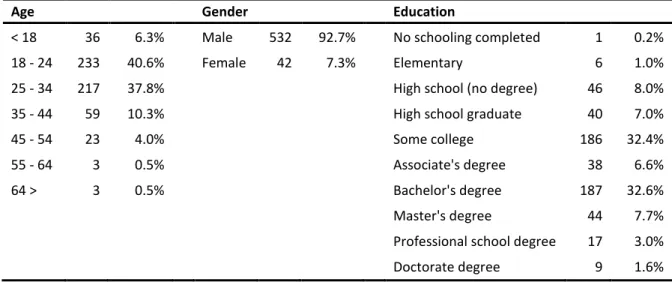
Concerning demographic data (Table 2), 93% of the respondents are male, and the average age is 27 years. Their education level corresponds to “Some college” for 32% of individuals, with 16% below that and 52% above.
11
Age Gender Education
< 18 36 6.3% Male 532 92.7% No schooling completed 1 0.2%
18 - 24 233 40.6% Female 42 7.3% Elementary 6 1.0%
25 - 34 217 37.8% High school (no degree) 46 8.0%
35 - 44 59 10.3% High school graduate 40 7.0%
45 - 54 23 4.0% Some college 186 32.4%
55 - 64 3 0.5% Associate's degree 38 6.6%
64 > 3 0.5% Bachelor's degree 187 32.6%
Master's degree 44 7.7%
Professional school degree 17 3.0%
Doctorate degree 9 1.6%
12
5. RESULTS
Structural equation modeling (SEM) is a statistical method for testing and estimating causal relations using a mix of statistical data and qualitative causal assumptions. Careful researchers acknowledge the possibilities of distinguishing between measurement and structural models and explicitly take measurement error into account (Henseler, Ringle, & Sinkovics, 2009). Two families of SEM methods can be highlighted: covariance based methods and variance based methods. Partial least squares (PLS) is a variance-based method, and the one used in this study considering that some of the items in the data are not distributed normally (p < 0.01 based on the Kolmogorov-Smirnov test), the research model has not yet been tested in the literature, and the research model is regarded as complex. Smart PLS v. 3.2.3 (Ringle, Wende, & Becker, 2014) was the software used to analyze the relationships defined by the theoretical model.
In the next two subsections, we first examine the measurement model to assess internal consistency, indicator reliability, convergent validity, and discriminant validity and then test the structural model.
5.1. M
EASUREMENTM
ODELConstruct reliability was tested using the composite reliability coefficient. PLS prioritizes indicator according to their individual reliability. As demonstrated in Table 3, all the constructs have a composite reliability above 0.7, which suggests that the constructs are reliable (Straub, 1989).
Constructs Mean SD CR CONF PU SAT HAB USAB ENJ INT
Confirmation 5.37 1.29 0.84 0.85 Perceived Usefulness 5.41 1.31 0.90 0.52 0.83 Satisfaction 5.77 1.08 0.94 0.68 0.65 0.90 Habit 5.66 1.38 0.87 0.46 0.62 0.61 0.83 Perceived Usability 5.38 1.28 0.89 0.58 0.52 0.65 0.51 0.77 Perceived Enjoyment 5.82 1.15 0.94 0.44 0.47 0.60 0.39 0.49 0.91 Continuance Intention 6.45 1.01 0.98 0.42 0.59 0.62 0.64 0.44 0.44 0.96
Table 3 - Correlation matrix, composite reliability (CR), and square root of AVEs
Indicator reliability was assessed based on the criteria that the loadings should be greater than 0.7 and that every loading less than 0.4 should be excluded (G. A. Churchill, 1979; Henseler et al., 2009). As shown in Table 4, the loadings (in bold) are greater than 0.7 with the exception of two items (USAB3 and USAB4), which are lower than 0.7 but greater than 0.4. Items USAB1 and USAB2 were eliminated due to a low loading. Overall, the instrument presented a good indicator reliability. To test convergent validity, average variance extracted (AVE) was used as the criterion. The AVE should be higher than 0.5 so that the latent variable explains more than half of the variance of its indicators (Fornell & Larcker, 1981; Hair, Sarstedt, Ringle, & Mena, 2012; Henseler et al., 2009). As shown in Table 3, all constructs have an AVE higher than 0.5, meeting this criterion.
Discriminant validity of the constructs was assessed using two measures: Fornell-Larcker criteria and cross-loadings. The first criterion postulates that the square root of AVE should be greater that the correlations between the construct (Fornell & Larcker, 1981). The second criterion requires that the loading of each indicator should be greater than all cross-loadings (Chin, 1998; Götz, Liehr-Gobbers, & Krafft, 2010; Grégoire & Fisher, 2006). As seen in Table 3, the square roots of AVEs (diagonal
13 elements) are higher than the correlation between each pair of constructs (off-diagonal elements). Table 4 shows that the patterns of loading are greater than cross-loading. Thus, both measures are satisfied.
Construct ITEM CONF PU SAT HAB USAB ENJ INT
Confirmation CONF1 0.87 0.48 0.61 0.39 0.52 0.40 0.39
CONF2 0.83 0.40 0.54 0.39 0.47 0.34 0.32
Perceived Usefulness PU1 0.51 0.86 0.66 0.59 0.49 0.46 0.62
PU2 0.41 0.84 0.50 0.49 0.41 0.35 0.45 PU3 0.39 0.83 0.45 0.49 0.39 0.36 0.42 PU4 0.39 0.78 0.47 0.45 0.41 0.36 0.43 Satisfaction SAT1 0.64 0.61 0.92 0.59 0.62 0.54 0.62 SAT2 0.63 0.59 0.93 0.59 0.59 0.54 0.58 SAT3 0.57 0.55 0.87 0.50 0.54 0.48 0.47 SAT4 0.59 0.56 0.88 0.50 0.58 0.57 0.54 Habit HAB1 0.39 0.53 0.54 0.89 0.41 0.34 0.62 HAB2 0.43 0.52 0.55 0.88 0.46 0.33 0.53 HAB3 0.31 0.49 0.41 0.72 0.40 0.30 0.43 Perceived Usability USAB3 0.36 0.33 0.42 0.32 0.66 0.31 0.28 USAB4 0.38 0.30 0.39 0.30 0.69 0.27 0.26 USAB5 0.47 0.42 0.52 0.43 0.81 0.43 0.34 USAB6 0.49 0.44 0.53 0.41 0.84 0.42 0.37 USAB7 0.48 0.40 0.51 0.40 0.81 0.38 0.34 USAB8 0.47 0.46 0.57 0.44 0.78 0.40 0.39
Perceived Enjoyment ENJ1 0.33 0.34 0.47 0.30 0.38 0.89 0.36
ENJ2 0.39 0.46 0.54 0.36 0.45 0.92 0.39 ENJ3 0.46 0.48 0.61 0.38 0.49 0.93 0.44 Continuance Intention INT1 0.42 0.57 0.60 0.60 0.42 0.42 0.95 INT2 0.42 0.58 0.59 0.60 0.43 0.43 0.97 INT3 0.39 0.56 0.59 0.63 0.42 0.42 0.97 INT4 0.40 0.57 0.58 0.62 0.40 0.40 0.95
Table 4 - Loadings and cross-loadings for the measurement model
The assessments of construct reliability, indicator reliability, convergent validity, and discriminant validity of the constructs were satisfactory, indicating that the constructs can be used to test the conceptual model.
5.2. S
TRUCTURALM
ODELThe structural model was estimated using R2 measures and path coefficients' level of significance. Figure 4 shows the model results. The R2 of dependent variables are 0.47, 0.41, 0.19, 0.66 and 0.59 for perceived usefulness, perceived usability, perceived enjoyment, satisfaction, and continuance intention, respectively. The significance of the path coefficients was assessed using a bootstrapping procedure (Hair, Ringle, & Sarstedt, 2011; Henseler et al., 2009) with 5000 iterations of resampling (Chin, 1998). Figure 4 also shows the path coefficients and t-value (in parenthesis) results.
14 Figure 4 - Model with results
The model explains 47.1% of the variation in perceived usefulness, and all variables are statistically significant, namely, confirmation ( = 0.23; p < 0.01), habit ( = 0.43; p < 0.01), and perceived usability ( = 0.17; p < 0.01). Respectively, hypothesis H1, H9 and H11 are confirmed.
The model explains 40.9% of the variation in perceived usability, with the effects of confirmation ( = 0.44; p < 0.01) and habit ( = 0.30; p < 0.01) being statistically significant. Respectively, hypothesis H2 and H10 are confirmed.
Perceived enjoyment is explained through confirmation ( = 0.44; p < 0.01), which is statistically significant and explains 19.0% of the variation in perceived enjoyment; therefore, hypothesis H3 is confirmed. As for satisfaction, 65.7% of its variation is explained through confirmation ( = 0.31; p < 0.01), perceived usefulness ( = 0.26; p < 0.01), perceived usability ( = 0.26; p < 0.01), and perceived enjoyment ( = 0.23; p < 0.01), which are all statistically significant; respectively, hypothesis H4, H5, H12 and H13 are confirmed.
Finally, 59.1% of the variation in continuance intention is explained through perceived usefulness ( = 0.19; p < 0.01), satisfaction ( = 0.19; p < 0.01), habit ( = -0.25; p < 0.001), and the moderation effect of habit in the relationship between satisfaction and continuance intention is statistically significant ( = -0.20; p < 0.001), which are statistically significant, but perceived enjoyment ( = 0.05; p > 0.10), is not; respectively, hypothesis H6, H7, H8, and H8a are confirmed, but H14 is not. In sum, out of the fifteen hypothesis, only one is not confirmed.
15
6. DISCUSSION
6.1. T
HEORETICALI
MPLICATIONSThis study’s results suggest that, theoretically, habit (HAB), perceived usability (USAB), and perceived enjoyment (ENJ) increase the predictive power of the ECM model in explaining continuance intention (INT). Perceived usefulness (PU), confirmation (CONF), and satisfaction (SAT) explain 44% of the variation in continuance intention (INT) in Bhattacherjee's (2001b) ECM; however, by coupling it with HAB, USAB and ENJ, variance explained increased in 15 p.p., thus providing a better explanatory power (Table 5). Not only is this a significant modification of the ECM for the context of smartwatches, but also an extension of its generalizability from a general IS use to the smartwatch technology. The survey instrument was tested for validity and reliability of the scales, and it can be easily used by future researchers in other countries.
In line with Bhattacherjee's (2001b) research, the effects of SAT and PU in INT were substantial, meaning that users value their satisfaction with the smartwatch, as well as its perceived usefulness when considering its continued use. Some studies examined the role of usability on satisfaction (Legris, Ingham, & Collerette, 2003; Liu, Liao, & Pratt, 2009; Zviran et al., 2006), but this study extended it to the continuance intention to use smartwatches. The effect that perceived usability has on satisfaction presents an important contribution that is often overlooked in the topic of IS continuance. Interestingly, perceived enjoyment did not have a significant direct nor total effect on continuance intention, but had a significant effect on satisfaction. This indicates that smartwatch users are more likely to value its utilitarian component than the hedonic one when considering its continued use (Batra & Ahtola, 1991). Lastly, prior studies in IS have also focused on habit as a moderation between continuance intention and actual continued usage (Bhattacherjee & Barfar, 2011; Limayem, Cheung, & Chan, 2003; Limayem et al., 2007). However, this study also demonstrates the significant effect of habit on IS continuance intention on the specific context of smartwatches.
6.2. M
ANAGERIALI
MPLICATIONSThe findings of this study revealed that satisfaction is an important factor affecting a user’s intention to continue using a smartwatch, especially for those users with a low level of habit. Therefore, in order to retain them, managers need to focus on the users’ satisfaction (Bhattacherjee, 2001a). The focus should therefore be, as previously noted, on confirmation, perceived usefulness, perceived usability, and perceived enjoyment. Selling a smartwatch that delivers on its promise, or, on the other hand, under-promises and over-delivers, will result in a higher confirmation level, and likewise, satisfaction (Limayem et al., 2007; Oliver, 1980). Product managers should improve their market
Bhattacherjee's (2001b) ECM Research model
Construct R2 R2 Adj. Construct R2 R2 Adj.
Continuance Intention 0.45 0.44 Continuance Intention 0.59 0.59
Perceived Usefulness 0.27 0.27 Perceived Usefulness 0.47 0.47
Satisfaction 0.57 0.57 Satisfaction 0.66 0.65
Perceived Usability 0.41 0.41
Perceived Enjoyment 0.19 0.19
16 researches and employ a culture of design thinking in order to ensure that the smartwatch has characteristics and functions that fits users’ needs, and implement such characteristics and functions in a usable way. Likewise, a smartwatch that displays information clearly, does not have a cluttered user interface, is easy to understand, and is generally usable, will bring a bigger satisfaction to the user (Park & Hwan Lim, 1999). Improving the perceived enjoyment factor of the smartwatch will also lead to a higher satisfaction. This does not necessarily imply the addition of games to the smartwatch, but rather making the experience as a whole enjoyable.
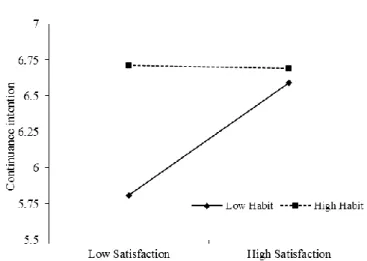
However, habit was the most significant factor affecting a user’s intention to continue using a smartwatch, and at the same time, an effect moderator of satisfaction on the continuance intention. Managers and marketers should focus on strengthening the habitual use of a smartwatch, by, proactively reinforcing the relationship with its users and giving them exclusive benefits, or promoting experimentation with new or more advanced features (Limayem et al., 2007). Based on Figure 5 we can conclude that satisfaction has higher impact on continuance intention for user that have a low habit level.
Figure 5 - Continuance intention - Moderation between Habit and Satisfaction
6.3. L
IMITATIONS ANDF
UTURER
ESEARCHWhile this study adds to the current body of knowledge, it also recognizes its limitations. The first, concerns the sampling. The respondents of this study were mostly male, and thus, what they value might partially differ from the population average. For example, PwC’s (2014) report revealed that on social media conversations about wearable technology, gaming is the most referred subject by men, but women are more likely to talk about fitness. At the same time, according to research (Buenaflor & Kim, 2013; Epps, Doty, Knott, & Vokshi, 2013; Salah et al., 2014), wearable technology users are equally distributed between men and women with an average age of 36. The distribution of the survey among online discussion board and social network users are likely one of the reasons for both the relatively small percentage of female respondents and the lower age average when compared to other market research. The second limitation concerns the lack of inclusion of a model/operative system (OS) variable. Considering that smartwatches vary in their characteristics according to the model and OS, it can also be said that they vary in their levels of usability and perceived usefulness. These differences might have slightly impacted the variance of our sample. Lastly, this study only
17 considered one stage of post adoption, and past research has shown that usefulness and attitude perceptions fluctuate over time (Bhattacherjee & Premkumar, 2004; Venkatesh et al., 2011).
It is recommended that future research tests both segments of men and women, in order to uncover significant differences (if any), just like past studies in different areas (Moores & Chang, 2006; Morris & Venkatesh, 2000). Future research can also take this study as a starting point, and build on it by testing this model on different smartwatch models or OSs in order to understand their differences and similarities. Furthermore, future research should take the assumptions of this study and apply them to a two-stage IS continuance model, such as the one developed by Venkatesh et al. (2011). Lastly, it would also be of interest to apply this model to the same topic in other regions, especially in Asia/Pacific, which is predicted to become the highest revenue generating geography by 2020 in the smartwatch market (Kohli, 2015).
18
7. CONCLUSIONS
Plenty of research on the IS area has focused on IT acceptance, but IT continuance was found to have a bigger impact on an IS’s long-term viability. The topic of smartwatches, to the best of our knowledge, had not been studied in an IS context yet. To address this gap, this study contributed to the continuance theory, developing a conceptual framework that combines the ECM with habit, perceived usability, and perceived enjoyment factors were combined. Satisfaction and perceived usefulness were found to have a significant effect on continuance intention – and thus, confirming the ECM’s results – also habit and the moderation effect of habit on satisfaction to explain continuance intention had the biggest impact. Thus, by including habit, perceived usability, and perceived enjoyment in the proposed framework, a stronger predictive power was added to the existing ECM.
19
8. BIBLIOGRAPHY
Agarwal, R., & Karahanna, E. (2000). Time flies when you’re having fun: Cognitive absorption and beliefs about information technology usage. MIS Quarterly, 24(4), 665–694.
http://doi.org/10.2307/3250951
Ak, S. (2014). Global wearable technology market research report 2018. Retrieved from http://www.prweb.com/releases/2014/01/prweb11478994.htm
Bargh, J. A. (1994). The four horsemen of automaticity: Awareness, intention, efficiency, and control in social cognition. In R. S. Wyer & T. K. Srull (Eds.), Handbook of Social Cognition (2nd ed., pp. 1–40). Lawrence Erlbaum Associates.
Barnes, S. J., & Böhringer, M. (2011). Modeling use continuance behavior in microblogging services: The case of twitter. Journal of Computer Information Systems, 51(4), 1–10.
http://doi.org/10.1080/08874417.2011.11645496
Batra, R., & Ahtola, O. T. (1991). Measuring the hedonic and utilitarian sources of consumer attitudes. Marketing Letters, 2(2), 159–170. http://doi.org/10.1007/BF00436035
Bhattacherjee, A. (2001a). An empirical analysis of the antecedents of electronic commerce service continuance. Decision Support Systems, 32(2), 201–214. http://doi.org/10.1016/s0167-9236(01)00111-7
Bhattacherjee, A. (2001b). Understanding information systems continuance: An expectation-confirmation model. MIS Quarterly, 25(3), 351–370. http://doi.org/10.2307/3250921
Bhattacherjee, A., & Barfar, A. (2011). Information technology continuance research: current state and future directions. Asia Pacific Journal of Information, 21(2), 1–18.
Bhattacherjee, A., & Premkumar, G. (2004). Understanding changes in belief and attitude toward information technology usage: A theoretical model and longitudinal test. MIS Quarterly, 28(2), 229–254. http://doi.org/10.1111/j.1365-2575.2007.00265.x
Bieber, G., Kirste, T., & Urban, B. (2012). Ambient interaction by smart watches. In Proceedings of the
5th International Conference on PErvasive Technologies Related to Assistive Environments - PETRA ’12 (p. 1). New York, New York, USA: ACM Press.
http://doi.org/10.1145/2413097.2413147
Billinghurst, M., & Starner, T. (1999). Wearable devices: new ways to manage information. Computer,
32(1), 57–64. http://doi.org/10.1109/2.738305
Boulding, W., Lee, E., & Staelin, R. (1994). Mastering the mix: Do advertising, promotion, and sales force activities lead to differentiation? Journal of Marketing Research, 31(2), 159.
http://doi.org/10.2307/3152191
Branscomb, L. M., & Thomas, J. C. (1984). Ease of use: A system design challenge. IBM Systems
Journal, 23(3), 224–235. http://doi.org/10.1147/sj.233.0224
Budiu, R. (2015, May). The Apple Watch: User-Experience Appraisal. Retrieved from https://www.nngroup.com/articles/smartwatch/
Buenaflor, C., & Kim, H. C. (2013). Six human factors to acceptability of wearable computers.
20 Chen, C.-W., & Koufair, M. (2014). BYOD flexibility : The effects of flexibility of multiple it device use
on users’ attitudes and continuance intention. In The 20th Americas Conference on Information
Systems (AMCIS). Savannah, Georgia, USA.
Cheung, C. M. K., Jin, X. L., Lee, M. K. O., Lee, M. K. O., & Chen, H. P. (2009). How to keep members using the information in a computer-supported social network. Computers in Human Behavior,
25(5), 1172–1181. http://doi.org/10.1016/j.chb.2009.04.008
Chin, W. W. (1998). The partial least squares approach to structural equation modeling. In G. A. Marcoulides (Ed.), Modern Methods for Business Research (pp. 295–336).
Chiu, C. M., Hsu, M. H., Sun, S. Y., Lin, T. C., & Sun, P. C. (2005). Usability, quality, value and e-learning continuance decisions. Computers and Education, 45(4), 399–416.
http://doi.org/10.1016/j.compedu.2004.06.001
Choi, S., & Yoo, J. (2015). Roles of user resistance and social influence in continued use of
smartphone. In 2015 17th International Conference on Advanced Communication Technology
(ICACT) (pp. 287–291). IEEE. http://doi.org/10.1109/ICACT.2015.7224805
Churchill, D., & Hedberg, J. (2008). Learning object design considerations for small-screen handheld devices. Computers & Education, 50(3), 881–893.
http://doi.org/10.1016/j.compedu.2006.09.004
Churchill, G. A. (1979). A paradigm for developing better measures of marketing constructs. Journal
of Marketing Research, 16(1), 64–73. http://doi.org/10.2307/3150876
Cisco. (2016). Cisco visual networking index: Global mobile data traffic forecast update, 2015–2020.
Cisco Systems.
Curry, D. (2015). Apple Watch hits 10,000 apps: How do Android Wear, Pebble, and Samsung
compare? Retrieved December 12, 2015, from http://www.digitaltrends.com/wearables/apple-watch-apps-comparison/
Danova, T. (2014). The wearable computing market report: Growth trends, consumer attitudes, and
why smartwatches will dominate. BI Intelligence.
Davis, F. D. (1989). Perceived usefulness, perceived ease of use, and user acceptance of information technology. MIS Quarterly, 13(3), 319–340. http://doi.org/10.2307/249008
Davis, F. D., Bagozzi, R. P., & Warshaw, P. R. (1992). Extrinsic and intrinsic motivation to use computers in the workplace. Journal of Applied Social Psychology, 22(14), 1111–1132. http://doi.org/10.1111/j.1559-1816.1992.tb00945.x
De Guinea, A. O., & Markus, M. L. (2009). Why break the habit of a lifetime? Rethinking the roles of intention, habit, and emotion in continuing information technology use. MIS Quarterly, 33(3), 433–444. http://doi.org/10.2307/20650303
Deng, L., Turner, D. E., Gehling, R., & Prince, B. (2010). User experience, satisfaction, and continual usage intention of IT. European Journal of Information Systems, 19(1), 60–75.
http://doi.org/10.1057/ejis.2009.50
Epps, S. R., Doty, C. A., Knott, J., & Vokshi, A. (2013). Fitness wearables - Many products, few
customers.
21 case of Internet banking. Technovation, 27(4), 159–167.
http://doi.org/10.1016/j.technovation.2006.11.001
Festinger, L. (1957). A theory of cognitive dissonance (1st ed.). Stanford University Press.
Flavián, C., Guinalíu, M., & Gurrea, R. (2006). The role played by perceived usability, satisfaction and consumer trust on website loyalty. Information and Management, 43(1), 1–14.
http://doi.org/10.1016/j.im.2005.01.002
Fornell, C., & Larcker, D. F. (1981). Evaluating structural equation models with unobservable variables and measurement error. Journal of Marketing Research, 18(1), 39–50.
http://doi.org/10.2307/3151312
Gefen, D. (2003). TAM or just plain habit. Journal of Organizational and End User Computing, 15(3), 1–13. http://doi.org/10.4018/joeuc.2003070101
Gefen, D., Karahanna, E., & Straub, D. W. (2003). Trust and TAM in online shopping: An integrated model. MIS Quarterly, 27(1), 51–90.
Götz, O., Liehr-Gobbers, K., & Krafft, M. (2010). Evaluation of Structural Equation Models Using the Partial Least Squares (PLS) Approach. In Handbook of Partial Least Squares (pp. 691–711). Berlin, Heidelberg: Springer Berlin Heidelberg. http://doi.org/10.1007/978-3-540-32827-8_30 Grégoire, Y., & Fisher, R. J. (2006). The effects of relationship quality on customer retaliation.
Marketing Letters, 17(1), 31–46. http://doi.org/10.1007/s11002-006-3796-4
Hair, J. F., Ringle, C. M., & Sarstedt, M. (2011). PLS-SEM: Indeed a silver bullet. Journal of Marketing
Theory and Practice, 19(2), 139–152. http://doi.org/10.2753/MTP1069-6679190202
Hair, J. F., Sarstedt, M., Ringle, C. M., & Mena, J. A. (2012). An assessment of the use of partial least squares structural equation modeling in marketing research. Journal of the Academy of
Marketing Science, 40(3), 414–433. http://doi.org/10.1007/s11747-011-0261-6
Heijden, H. van der. (2004). User acceptance of hedonic information. MIS Quarterly, 28(4), 695–704. Henseler, J., Ringle, C. M., & Sinkovics, R. R. (2009). The use of partial least squares path modeling in
international marketing. In R. R. Sinkovics & P. N. Ghauri (Eds.), Advances in International
Marketing (Vol. 20, pp. 277 – 319). Emerald Group Publishing Limited.
http://doi.org/10.1108/S1474-7979(2009)0000020014
Hoehle, H., & Venkatesh, V. (2015). Mobile Application Usability: Conceptualization and Instrument Development. MIS Quarterly, 39(2), 435–472.
Holden, H., & Rada, R. (2011). Understanding the influence of perceived usability and technology self-efficacy on teachers’ technology acceptance. Journal of Research on Technology in
Education, 43(4), 343–367. http://doi.org/10.1080/15391523.2011.10782576
Hong, S., Thong, J. Y. L., & Tam, K. Y. (2006). Understanding continued information technology usage behavior: A comparison of three models in the context of mobile internet. Decision Support
Systems, 42(3), 1819–1834. http://doi.org/10.1016/j.dss.2006.03.009
Hong, W., Thong, J. Y. L., Wong, W.-M., & Tam, K. Y. (2002). Determinants of user acceptance of digital libraries: An empirical examination of individual differences and system characteristics.
Journal of Management Information Systems, 18(3), 97–124.
22 A cross-sectional comparison of pre-adoption and post-adoption beliefs. MIS Quarterly, 23(2), 183–213. http://doi.org/10.2307/249751
Khalifa, M., & Liu, V. (2004). The State of Research on Information System Satisfaction. Journal of
Information Technology Theory and Application JITTA, 5(4), 37–49.
Kim, M., Chang, Y., Park, M.-C., & Lee, J. (2015). The effects of service interactivity on the satisfaction and the loyalty of smartphone users. Telematics and Informatics, 32(4), 949–960.
http://doi.org/10.1016/j.tele.2015.05.003
Kim, S. S., & Malhotra, N. K. (2005). Predicting system usage from intention and past use: Scale issues in the predictors. Decision Sciences, 36(1), 187–196.
http://doi.org/10.1111/j.1540-5915.2005.00070.x
Kirakowski, J., Claridge, N., & Whitehand, R. (1998). Human centered measures of success in website design. In Proceedings of the Fourth Conference on Human Factors and the Web.
Kohli, B. (2015). World smartwatch market - Opportunities and forecasts, 2013 - 2020. Kosir, S. (2015). A look at smart clothing for 2015. Retrieved August 4, 2015, from
https://www.wearable-technologies.com/2015/03/a-look-at-smartclothing-for-2015/ Legris, P., Ingham, J., & Collerette, P. (2003). Why do people use information technology? A critical
review of the technology acceptance model. Information and Management, 40(3), 191–204. http://doi.org/10.1016/S0378-7206(01)00143-4
Limayem, M., Cheung, C., & Chan, G. (2003). Explaining information systems adoption and post-adoption: Toward an integrative model. In Proceedings of the International Conference on
Information Systems, ICIS 2003. Seattle, Washington, USA.
Limayem, M., Hirt, S. G., & Cheung, C. M. K. (2007). How habit limits the predictive power of intention: The case of information systems continuance. MIS Quarterly, 31(4), 705–737. Lin, C. S., Wu, S., & Tsai, R. J. (2005). Integrating perceived playfulness into expectation-confirmation
model for web portal context. Information and Management, 42(5), 683–693. http://doi.org/10.1016/j.im.2004.04.003
Lin, C.-P., & Bhattacherjee, A. (2008). Elucidating individual intention to use interactive information technologies: The role of network externalities. International Journal of Electronic Commerce,
13(1), 85–108. http://doi.org/10.2753/JEC1086-4415130103
Lin, H. X., Choong, Y.-Y., & Salvendy, G. (1997). A proposed index of usability: A method for comparing the relative usability of different software systems. Behaviour & Information
Technology, 16(4-5), 267–277. http://doi.org/10.1080/014492997119833
Lin, K. M. (2011). e-Learning continuance intention: Moderating effects of user e-learning experience.
Computers and Education, 56(2), 515–526. http://doi.org/10.1016/j.compedu.2010.09.017
Liu, S. H., Liao, H. L., & Pratt, J. A. (2009). Impact of media richness and flow on e-learning technology acceptance. Computers and Education, 52(3), 599–607.
http://doi.org/10.1016/j.compedu.2008.11.002
Logan, G. D. (1989). Automaticity and cognitive control. In J. S. Uleman & J. A. Bargh (Eds.),
Unintended Thought (pp. 52–74). Guilford Press.
23 2015, from http://wearcomp.org/wearcompdef.html
Marks, P. (2013). Samsung launch kickstarts the smartwatch boom. Retrieved October 3, 2015, from https://www.newscientist.com/article/dn24154-samsung-launch-kickstarts-the-smartwatch-boom/
Meso, P., Musa, P., & Mbarika, V. (2005). Towards a model of consumer use of mobile information and communication technology in LDCs: the case of sub-Saharan Africa. Information Systems
Journal, 15(2), 119–146. http://doi.org/10.1111/j.1365-2575.2005.00190.x
Mitroff, S. (2012). Android is bigger, but here’s why Apple is still the undisputed app cash king. Retrieved October 4, 2015, from http://www.wired.com/2012/12/ios-vs-android/ Moar, J. (2016). Smartwatches - Clocking the trend. Juniper Research.
Moores, T., & Chang, J. (2006). Ethical decision making in software piracy: Initial development and test of a four-component model. MIS Quarterly, 30(1), 167–180.
Morris, M. G., & Venkatesh, V. (2000). Age Differences in Technology Adoption Decisions: Implications For a Changing Work Force. Personnel Psychology, 53(2), 375–403. http://doi.org/10.1111/j.1744-6570.2000.tb00206.x
O’Reilly, Q. (2015). This is what we know (and need to know) about the Apple Watch. Retrieved September 13, 2015, from http://businessetc.thejournal.ie/apple-watch-preview-1980956-Mar2015/
Oliver, R. L. (1980). A Cognitive Model of the Antecedents and Consequences of Satisfaction Decisions. Journal of Marketing Research, 17(4), 460–469. http://doi.org/10.2307/3150499 Oliver, R. L. (1981). Measurement and evaluation of satisfaction processes in retail settings. Journal
of Retailing, 57(3), 25–48.
Olson, J. C., & Dover, P. A. (1979). Disconfirmation of consumer expectations through product trial.
Journal of Applied Psychology, 64(2), 179–189. http://doi.org/10.1037/0021-9010.64.2.179
Ouellette, J. A., & Wood, W. (1998). Habit and intention in everyday life: The multiple processes by which past behavior predicts future behavior. Psychological Bulletin, 124(1), 54–74.
http://doi.org/10.1037/0033-2909.124.1.54
Parikh, M. A., & Verma, S. (2002). Utilizing internet technologies to support learning: an empirical analysis. International Journal of Information Management, 22(1), 27–46.
http://doi.org/10.1016/S0268-4012(01)00038-X
Park, K. S., & Hwan Lim, C. (1999). A structured methodology for comparative evaluation of user interface designs using usability criteria and measures. International Journal of Industrial
Ergonomics, 23(5), 379–389. http://doi.org/10.1016/S0169-8141(97)00059-0
Pentland, A. (2004). Healthwear: medical technology becomes wearable. Computer, 37(5), 42–49. http://doi.org/10.1109/MC.2004.1297238
Polites, G. L., & Karahanna, E. (2012). Shackled to the status quo: The inhibiting effects of incumbent system habit, switching costs, and inertia on new system acceptance. MIS Quarterly, 36(1), 21– 42.
Premkumar, G., & Bhattacherjee, A. (2008). Explaining information technology usage: A test of competing models. Omega, 36(1), 64–75. http://doi.org/10.1016/j.omega.2005.12.002