Use of active metabolites of vitamin D orally for
the treatment of psoriasis
Mayara Lourencetti 1
Marilda Morgado de Abreu2
1.Academic Course of Medicine, University of West Paulista (UNOESTE), Presidente Prudente/São Paulo, Brasil. 2.Full Professor of the Discipline of Dermatology, University of West Paulista (UNOESTE), Presidente Prudente/São Paulo, Brasil and Chief of Dermatology Service of the Regional Hospital of Presidente Prudente, Presidente Prudente/São Paulo, Brasil.
http://dx.doi.org/10.1590/1806-9282.64.07.643
SUMMARY
Objective: The objective of this study was to analyse the existing bibliographic production on clinical trials related to the use of vitamin D for oral treatment of psoriasis. Method: A literature review of clinical trials related to the use of vitamin D for oral treatment of pso-riasis, published in the LILACS, Scielo, Medline, PubMed and Cochrane Library from 1986 to 2013. The search included the following terms: “Psoriasis and oral Vitamin D”; “psoríase e vitamina D oral”.Results: After analysing the titles and summaries, 10 articles met the eligibility criteria. Discussion: According to the literature, most tests were made in moderate psoriasis with doses ranging from 0.25 to 2µg, demonstrating improvement with this treatment modality. Some studies suggest the use of high doses, but the biggest concern is hypercalciuria as a side effect.Conclusion: The use of active metabolites of vitamin D orally for the treatment of psoriasis showed efficacy and safety.
KEYWORDS: Administration, oral. Review literature as topic. Psoriasis. Vitamin D.
DATE OF SUBMISSION: 29-Nov-2017 DATE OF ACCEPTANCE: 06-Dec-2017
CORRESPONDING AUTHOR: Marilda Morgado de Abreu Rua José Bongiovani, 700
Cidade Universitária – Presidente Prudente, SP, Brasil 19050-920 – Tel:18 3229-1500l
E-mail: [email protected]
INTRODUCTION
Psoriasis is a chronic inflammatory skin disease that affects about 2% of the world’s population and 3 million people in Brazil. It is characterized by er-ythematous and scaly papules or plaques, usually located in the elbows, knees, feet, hands, sacral re-gion, and scalp or even throughout the body, with pe-riods of exacerbations, remissions and recurrences. According to the location or characteristics of the le-sions, it can be classified as plaque, guttate, inverted, pustular (generalized and localized), palmoplantar, scalp, nail, erythrodermic and arthropathic psoriasis (Figures 1, 2 and 3). Although psoriasis does not af-fect survival, it has a negative impact on the patient’s physical and psychosocial well-being, as the appear-ance of the lesions is a cause for stigma1.
The pathophysiology of psoriasis defines it as an immune-mediated systemic disease involving help-er T lymphocytes type 1 (Th1). Cytokines of the Th1 pathway - interferon gamma, interleukins 2 and 12 and TNF-alpha - predominate in the psoriatic plaques, as well as interleukin-17, which induces the expres-sion of chemoattractant in the leexpres-sion. Therefore, an unknown stimulus activates the dendritic cells that present antigens of the skin, which will lead to the activation of the helper T cells, and, finally, the re-lease of a cascade of inflammatory cytokines. This cascade results in the recruitment and activation of other cells, such as neutrophils and endothelial cells, chemokines and growth factors that will induce ke-ratinocyte proliferation. A chronic condition,
fore, guarantees and leads to the formation of skin lesions in psoriasis2.
In addition, psoriasis is nowadays associated with vitamin D deficiency. A study by Gisondi et al.3,
which analysed the vitamin D status in patients with chronic plaque of psoriasis, demonstrated that vita-min D deficiency is common in these patients, re-gardless of age, gender, body mass index, Psoriasis
Area Severity Index (Pasi), parathyroid levels (PTH) and blood collection time.
Vitamin D - or cholecalciferol - is a steroid hor-mone that has endogenous formation in cutaneous tissues after exposure to ultraviolet B radiation. Cholecalciferol circulates in protein-bound blood and, when it reaches the liver, undergoes hydrox-ylation, forming 25-hydroxyvitamin D or 25(OH)D3, which in spite of being biologically inert, represents the circulating form in greater amounts of vitamin D. Blood levels of 25(OH)D3 correspond in proportion to the amount of vitamin D that is ingested or produced on the skin. The final stage of production of the hor-mone is its hydroxylation in the kidney, where the biologically active form of vitamin D, calcitriol or 1,25(OH)D3 will be synthesized. The main function of vitamin D in the body is to participate in calcium ho-meostasis, stimulating the active transport of this ion in enterocytes4. In addition, many cell types involved
in immune responses not only express vitamin D re-ceptors, but also have all the enzymatic machinery for the local synthesis of 1,25 (OH)2 D3; these sites of synthesis in cells related to immunity are of great portance for the regulation and control of various im-mune responses5. Thus, the existence of extra-renal
hydroxylation of vitamin D, with autocrine or para-crine action, has the function of inhibiting cell prolif-eration, promoting cell differentiation and regulating immunological mechanisms4, such as the control of
the inappropriate activation of interleukin-17, which participates in the pathogenesis of multiple inflam-matory and autoimmune diseases6.
Topical vitamin D derivatives have immunomod-ulatory effects on monocytes, macrophages, T lym-phocytes and dendritic cells. Thus, topical vitamin D products have been widely used in monotherapy or in combination with steroids3. The latter alternative
is considered first-line therapy for the majority of pa-tients with mild to moderate psoriasis, demonstrat-ing efficacy and safety in treatment of patients with plaque psoriasis7.
However, evidence that psoriasis is a systemic disease, involving many comorbidities, suggests the importance of analysing the treatment of this disease with oral vitamin D, given the few studies investigat-ing this modality in patients with psoriasis2. Doses
of oral vitamin D can be expressed in microgram or International Unit (IU), with 1 microgram corre-sponding to 40 IU8. In addition, when the literature is
observed, the forms of vitamin D used for oral
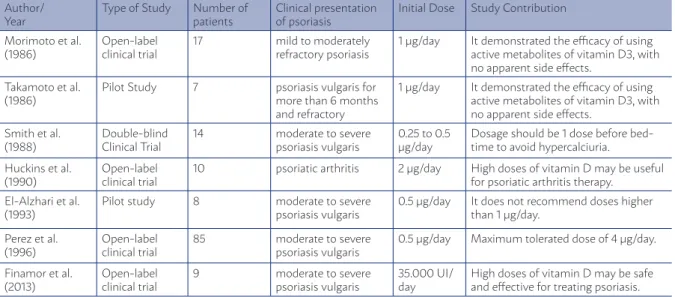
patients with psoriasis vulgaris, resistant to topical corticosteroid therapy, and administered 1 μg/day of 1α(OH)D3 for six months. The authors demonstrat-ed that the biologically active metabolites of vitamin D3 are effective in therapy of the disease and do not cause apparent side effects.
Smith et al.13 studied 14 patients with psoriasis
from moderate to extensive lesions. They admin-istered 1,25-(OH)2D3, at the initial dose of 0.25 μg, once or twice daily. Patients should limit daily cal-cium intake to less than 800 mg. If they had normo-calciuria at the follow-up, the dose was increased to a maximum of 2 μg/day; if hypercalciuria occurred, therapy was discontinued. Hypercalciuria was ob-served when fractionated doses of vitamin D ex-ceeded 0.75 μg/day. To avoid this effect, the dosage was changed to only one dose of 0.25 to 0.5 μg be-fore bedtime: the authors believe that the influence of 1,25-(OH)2D3 on the absorption of calcium by the intestine is lower at night; therefore, higher doses administered before bedtime possibly cause a lower risk of hypercalciuria. In this study, 13 of the 14 pa-tients improved with two months of treatment and continued to improve up to 6-8 months after the ini-tial improvement was observed.
El-Azhary et al.14, in a pilot study, treated eight
patients with psoriasis vulgaris, presenting more than 25% of body involvement at an initial dose of 1,25-(OH)2D3 of 0.5 μg before bedtime. This dose was beneficial for one patient, who had psoriatic plaques completely resolved within two months and no side effects. Patients receiving dosages greater than 1 μg/day showed an increase in calcium excre-tion in the urine for 24 hours. Considering this, they do not recommend the use of doses above 1 μg/day. The research also shows that serum vitamin D levels do not correlate with disease activity.
Perez et al.15 conducted a clinical trial to test the
safety and efficacy of oral calcitriol to treat psoriasis in 85 patients with at least 15% of the body affected by the disease. The initial dose was 0.5 μg/day of vitamin D before bedtime and was subsequently in-creased by 0.5 μg/day every two weeks, with labora-tory control of serum calcium and urine for 24 hours; while these tests remained within normal range, the dose of vitamin D would be increased. The treatment lasted between 6 and 36 months; the maximum toler-ated dose was 4 μg/day and the average dose ranged from 2.1 +/- 0.8 μg/night for treatments lasting 24 months and 2.4 +/- 0.6 μg/night for treatments of 36 ment may be: 1,25(OH)D3, which is the biologically
active form of this hormone or 1α(OH)D3, which is a precursor 1.25(OH)D39-16.
OBJECTIVE
This study aims at analysing the literature on the clinical trials related to the use of vitamin D for oral treatment of psoriasis. It will be analysed especially the type of psoriasis in which the treatments were applied, results, side effects and doses used in this therapeutic alternative.
METHODS
This is a bibliographic review research using the online databases Lilacs, SciELO, Medline, PubMed and Cochrane Library, consulted from the portal of free and restricted databases of the virtual library of the Universidade do Oeste Paulista.
Thus, a search was initially made on the produc-tion of knowledge regarding the oral use of vitamin D for the treatment of psoriasis.
In the search, the titles and abstracts of the arti-cles were considered for the broader choice of proba-ble papers of interest, being selected the articles that provided complete texts. The descriptors used were “Psoriasis and oral Vitamin D”; “psoríase e vitamina D oral”.
At the end of the research, ten articles were se-lected for the study, covering the period between 1986 and 2013.
RESULTS
The research strategy was to analyse the titles and abstracts of the articles. According to the topic of interest, ten articles, published in the period be-tween 1986 and 2013, were used to carry out the lit-erature review.
DISCUSSION
The therapeutic use of vitamin D in psoriasis dates back to the 1930s when the compound was used as an oral agent to treat osteoporosis in a patient with psoriasis where subsequently the improvement of psoriatic skin lesions was observed9,10.
In 1986, Morimoto et al.11, in an open-label clinical
months. The results were 88% of patients improved their clinical condition, 26.5% had complete improve-ment, 36.2% had moderate improvement and 25.3%, slight improvement.
Huckins et al.16 performed an open-label trial
us-ing 1,25-(OH)2D3 for the treatment of psoriatic ar-thritis in ten patients at an oral dose of 2 μg/day for six months. More than 50% achieved substantial im-provement and 25% improved moderately. The con-clusion of the study was that high doses of vitamin D could be used as a therapeutic agent of psoriatic arthritis.
Werner de Castro et al. (2012)17 mention the
reso-lution of a psoriasis case, induced by the use of adali-mumab, in a woman with rheumatoid arthritis, after using high doses of vitamin D to treat the deficient rates of this vitamin.
A pilot study by Finamor et al. (2013),6 evaluated
the effect of prolonged oral administration of high daily doses of vitamin D in the clinical course of 16 patients with vitiligo and 9 patients with psoriasis, using 35,000 IU per day for six months. This study suggested that high daily doses of vitamin D might be particularly critical for controlling the activity of autoimmune disorders. Cumulative data from the past 30 years, reviewed by the authors, establish a regulatory effect of vitamin D on the innate and adaptive immune response, with circulating levels of 25 (OH)D3 - the main circulating form of vitamin D - inversely related to autoimmune disease activity. They state that doses of up to 40,000 IU per day of
vitamin D3 are probably safe for healthy individuals and that in patients with autoimmune disorders, polymorphisms that affect vitamin D metabolism enzymes may increase their tolerability. They also point out that hypervitaminosis D are associated with the positive regulation of intestinal vitamin D receptors and increased dietary calcium absorption; a calcium-deficient diet protects against vitamin D toxicity not only by reducing calcium available for intestinal absorption but also by facilitating vitamin D inactivation at sites related to calcium metabolism. In the pilot study, all patients had clinical improve-ment of the cutaneous condition without side effects: serum calcium concentrations (total and ionized) were measured and did not differ significantly from baseline values after six months of high treatment doses with vitamin D3. The urinary excretion of cal-cium increased considerably, but remained within the normal range. The dose chosen by the authors of 35,000 IU was selected arbitrarily, as well as other interventions that have already been applied to treat autoimmune disorders using high doses of vitamin D3, however it is suggested that PTH may be the best biological indicator for the individual establishment of the optimal dose of vitamin D3 for the treatment of autoimmune disorders. The magnitude of reduction in PTH serum concentration from baseline to the lev-el reached after the treatment period may provide a reasonable estimate of how much the initial daily dose of vitamin D3 should be increased to reduce se-rum PTH levels below reference range.
TABLE 1: STUDIES EVALUATING THE EFFICACY OF USING THE ACTIVE METABOLITES OF ORAL VITAMIN D FOR THE TREATMENT OF PSORIASIS.
Author/ Year
Type of Study Number of patients
Clinical presentation of psoriasis
Initial Dose Study Contribution
Morimoto et al. (1986)
Open-label clinical trial
17 mild to moderately
refractory psoriasis
1 µg/day It demonstrated the efficacy of using active metabolites of vitamin D3, with no apparent side effects.
Takamoto et al. (1986)
Pilot Study 7 psoriasis vulgaris for more than 6 months and refractory
1 µg/day It demonstrated the efficacy of using active metabolites of vitamin D3, with no apparent side effects.
Smith et al. (1988)
Double-blind Clinical Trial
14 moderate to severe
psoriasis vulgaris
0.25 to 0.5 µg/day
Dosage should be 1 dose before bed-time to avoid hypercalciuria.
Huckins et al. (1990)
Open-label clinical trial
10 psoriatic arthritis 2 µg/day High doses of vitamin D may be useful for psoriatic arthritis therapy.
El-Alzhari et al. (1993)
Pilot study 8 moderate to severe
psoriasis vulgaris
0.5 µg/day It does not recommend doses higher than 1 μg/day.
Perez et al. (1996)
Open-label clinical trial
85 moderate to severe
psoriasis vulgaris
0.5 µg/day Maximum tolerated dose of 4 μg/day.
Finamor et al. (2013)
Open-label clinical trial
9 moderate to severe
psoriasis vulgaris
35.000 UI/ day
According to Gisondi et al. (2011)3, the
toxic-ity of vitamin D supplementation is very rare to occur and consists mainly of acute hypercalce-mia, which usually results from doses exceeding 10,000 IU per day.
On the other hand, Trémezaygues and Reichrath (2011)5 affirm that only supraphysiological doses lead
to a clinical improvement of psoriasis, therefore, the use of vitamin D analogues in dermatology was con-sidered, decades ago, limited due to the occurrence of serious effects related to calcium metabolism.
Furthermore, Smith et al. (1988)13, in the
liter-ature review they did to compare the results ob-tained in their clinical trial, report that in the 1930s and 1940s there were studies in which extremely high doses of vitamin D (around 100,000 IU) were administered to treat a variety of skin disorders such as scleroderma, eczema, acne and psoriasis. Although some responses were favourable, the dos-es required were very toxic, and since vitamin D is biologically inert, successive hydroxylation is re-quired in the liver and later in the kidneys, in order to form 1,25-(OH)2D3 and thus have biological activ-ity. They conclude that increased intake of vitamin D has few beneficial effects.
PRACTICAL ASPECTS OF THIS REVIEW
According to the literature, oral vitamin D test-ing was primarily performed on moderate to severe vulgar psoriasis. Most studies have shown that the active metabolites of vitamin D3 - 1,25-(OH)2D3 or 1α(OH)D3 (synthetic analogue of 1,25-(OH)2D3) -
pro-vide favourable results in the evolution of psoriasis and cause few side effects, and may be a therapeu-tic alternative for the treatment of this disease. The most worrying adverse effect that can occur is acute hypercalciuria, which can be avoided by restricting daily calcium intake (less than 800 mg per day), by administering vitamin D at night - before bedtime - and by properly monitoring, throughout the treat-ment, urinary calcium levels; if the patient has hy-percalciuria, the use of vitamin D should be stopped. The doses that can be used vary from 0.25 μg to 2 μg per day, but recently, a higher dose (35,000 IU) has shown therapeutic safety and efficacy, and PTH is the best biological indicator for the establishment of the vitamin D3 dose.
CONCLUSION
The review of the literature revealed that there are still few studies that have tested the use of oral vitamin D active metabolites for the treatment of pso-riasis, in addition to the fact that the sample studied in all of them is small and the follow-up time is very limited. However, existing data suggest that such a therapeutic alternative is safe and effective. There-fore, more studies are needed, in the long term and in larger cases, to try to establish an adequate proto-col of treatment and thus to reach a consensus as to the doses and time that should be employed, since this alternative is low cost and apparently safe, even at high doses, unlike most systemic drugs current-ly used in psoriasis, the adverse effects of which are significant and many of them are costly.
RESUMO
OBJETIVO: O objetivo deste estudo foi analisar a produção bibliográfica existente sobre os ensaios clínicos relacionados ao uso da vita-mina D para tratamento por via oral da psoríase. MÉTODOS: Revisão de literatura de ensaios clínicos relacionados ao uso de vitamina D para tratamento por via oral da psoríase publicados no Lilacs, SciELO, MedLine, PubMed e Biblioteca Cochrane no período de 1986 a 2013. A pesquisa incluiu os seguintes termos: “Psoriasis and oral Vitamin D”; “psoríase e vitamina D oral”. RESULTADOS: Depois de analisar os títulos e resumos, dez artigos preencheram os critérios de elegibilidade. DISCUSSÃO: Segundo a literatura, a maioria dos en-saios foi realizada na psoríase moderada, com dose que varia de 0,25 a 2 µg, demonstrando melhora com esta modalidade terapêutica. Alguns estudos sugerem o uso de doses elevadas, porém a maior preocupação é a hipercalciúria como efeito colateral. CONCLUSÃO: O uso de metabólitos ativos de vitamina D por via oral para o tratamento da psoríase demonstrou eficácia e segurança com relação aos efeitos colaterais.
REFERENCES
1. Rodrigues AP, Teixeira RM. Desvendando a psoríase. Rev Bras Anal Clin. 2009;41(4):303-9.
2. Fu LW, Vender R. Systemic role for vitamin D in the treatment of pso-riasis and metabolic syndrome. Dermatol Res Pract. 2011;2011:276079.
3. Gisondi P, Rossini M, Di Cesare A, Idolazzi L, Farina S, Beltrami G, et al. Vitamin D status in patients with chronic plaque psoriasis. Br J Derma-tol. 2012;166(3):505-10.
4. Marques CDL, Dantas AT, Fragoso TS, Duarte ALBP. A importância dos níveis de vitamina D nas doenças autoimunes. Rev Bras Reumatol. 2010;50(1):67-80.
5. Trémezaygues L, Reichrath J. Vitamin D analogs in the treatment of psoriasis: Where are we standing and where will we be going? Derma-toendocrinol. 2011;3(3):180-6.
6. Finamor DC, Sinigaglia-Coimbra R, Neves LC, Gutierrez M, Silva JJ, Torres LD, et al. A pilot study assessing the effect of prolonged ad-ministration of high daily doses of vitamin D on the clinical course of vitiligo and psoriasis. Dermatoendocrinol. 2013;5(1):222-34.
7. Patel M, Day A, Warren RB, Menter A. Emerging therapies for the treatment of psoriasis. Dermatol Ther (Heidelb). 2012;2(1):16.
8. Althoff MEWS, Ramos DMB, Silva DMW, Santos Neto PE. A im-portância da vitamina D na prevenção de fraturas em adultos acima de 45 anos. RBNE. 2009; 3(13): 50-62.
9. Nagpal S, Lu J, Boehm MF. Vitamin D analogs: mechanism of action and therapeutic applications. Curr Med Chem. 2001;8(13):1661-79.
10. Kim GK. The rationale behind topical vitamin d analogs in the treat-ment of psoriasis: where does topical calcitriol fit in? J Clin Aesthet Dermatol. 2010;3(8):46-53.
11. Morimoto S, Yoshikawa K, Kozuka T, Kitano Y, Imanaka S, Fukuo K, et al. Treatment of psoriasis vulgaris by oral administration of 1 alpha-hydroxyvi-tamin D3: open-design study. Calcif Tissue Int. 1986;39(3):209-12.
12. Takamoto S, Onishi T, Morimoto S, Imanaka S, Yukawa S, Kozuka T, et al. Effect of 1 alpha-hydroxycholecalciferol on psoriasis vulgaris: a pilot study. Calcif Tissue Int. 1986;39(6):360-4.
13. Smith EL, Pincus SH, Donovan L, Holick MF. A novel approach for the evaluation and treatment of psoriasis. Oral or topical use of 1,25-dihy-droxyvitamin D3 can be a safe and effective therapy for psoriasis. J Am Acad Dermatol. 1988;19(3):516-28.
14. el-Azhary RA, Peters MS, Pittelkow MR, Kao PC, Muller SA. Efficacy of vitamin D3 derivatives in the treatment of psoriasis vulgaris: a prelim-inary report. Mayo Clin Proc. 1993;68(9):835-41.
15. Perez A, Raab R, Chen TC, Turner A, Holick MF. Safety and efficacy of oral calcitriol (1,25-dihydroxyvitamin D3) for the treatment of psoria-sis. Br J Dermatol. 1996;134(6):1070-8.
16. Huckins D, Felson DT, Holick M. Treatment of psoriatic arthritis with oral 1,25-dihydroxyvitamin D3: a pilot study. Arthritis Rheum. 1990;33(11):1723-7.