Critical Behavior in Reaction-Diffusion Systems
Exhibiting Absorbing Phase Transitions
G´eza ´
Odor
Research Institute for Technical Physics and Materials Science,
H-1525 Budapest, P.O.Box 49, Hungary
Received on 31 March, 2003
Phase transitions of reaction-diffusion systems with a site occupation restriction, particle creation requiring n > 2parents, and in which explicit diffusion of single particles (A) is possible, are reviewed. Arguments based on mean-field approximation and simulations are given which support novel kind of nonequilibrium crit-icality. These are in contradiction with the implications of a suggested phenomenological, multiplicative noise Langevin equation approach and with some recent numerical analyses. Simulation results for one- and two-dimensional binary spreading model,2A→4A,4A→2A, reveal a new type of mean-field criticality
charac-terized by the critical exponentsα= 1/3andβ= 1/2, as suggested in a recent preprint [cond-mat/0210615].
I
Introduction
The classification of universality classes of second order phase transitions is still one of the most important uncom-pleted tasks of statistical physics. Recently phase transi-tions of genuine nonequilibrium systems have been inves-tigated intensively in reaction-diffusion (RD) type models exhibiting absorbing states [1-3]. There has been a hope that in such homogeneous systems symmetries and spatial dimensions are the most significant factors like in equilib-rium ones, but gradually it turned out that there may be other relevant factors as well. The best known example is the parity conserving class (PC), which differs from the robust universality class of directed percolation (DP). The DP hy-pothesis stated by Janssen and Grassberger [4, 5], according to which in one component systems exhibiting continuous phase transitions to a single absorbing state (without extra symmetry and inhomogeneity or disorder) short ranged in-teractions can generate DP class transitions only. However parity conservation itself proved to be an insufficient condi-tion in many cases [6-9] and rather an underlyingA→3A,
2A→ ∅(BARW2) process [10] of particles and theZ2 sym-metry of absorbing states is necessary for this class [11]. On the other hand parity conservation in N-component branch-ing and annihilatbranch-ing random walk (N-BARW) systems [10], or by triplet production models [12] was found to be respon-sible for novel classes again. In one dimensional, multi-component reaction-diffusion systemssite restrictionturned out to be a relevant, new factor [13, 14]. Global conserva-tion laws by directed percolaconserva-tion and lattice gas models were shown to be irrelevant [15-18], while systems with multiple absorbing states [19] or with multi-components also exhibit DP class scaling behavior [20].
Another important puzzle has been investigated inten-sively during the past three years that emerges at phase transitions of binary production reaction-diffusion systems [8,9,20-29] (PCPD). In these systems particle production by pairs competes with pair annihilation and single particle dif-fusion. If production wins steady states with finite parti-cle density appear in (site restricted), while in unrestricted (bosonic) models the density diverges. By lowering the pro-duction/annihilation rate a doublet of absorbing states with-out symmetries emerges. One of such states is completely empty, the other possesses a single wandering particle. In case of site restricted systems the transition to absorbing state is continuous. It is important to note that these models do not break the DP hypothesis, because they exhibit multi-ple absorbing states which are not frozen, isolated particles may diffuse in them. Howeverno corresponding symmetry or conservation law has been found yet. A non-DP phase transition in a binary production system was already men-tioned in the early work of Grassberger [30]. A correspond-ing bosonic field theoretical model the annihilation fission (AF) process was introduced and studied by Howard and T¨auber [21]. These authors claim a non-DP transition in AF, because the action does not contain a linear mass term and the theory is not renormalizible perturbatively, unlike the Reggeon field theory of DP. In field theories of models ex-hibiting DP class transitions the canonicalA→ ∅,A→2A
reactions are generated by the renormalization transforma-tion unlike here. Further facts opposing DP criticality are the set of different mean-field exponents and the different upper critical dimension of binary production PCPD like models (dc = 2vs.dc= 4)[21, 9].
about two years that this model should possess novel, non-DP transition. The first density matrix study by Carlon et al. [22] did not support a DP transition, but reported expo-nents near to those of the PC class. Since the PCPD does not conserve the particle number modulo 2, neither exhibitsZ2
symmetric absorbing states, PC criticality was unfavored. Simulation studies by Hinrichsen [23] and ´Odor [24] and coherent anomaly calculations by ´Odor [24, 26] resulted in novel kind of critical behavior, although there was an un-certainty in the precise values of critical exponents. Expo-nent estimates showed diffusion (D) dependence that was supported by pair mean-field results [24], possessing two distinct classes as a function of D. Recently Park et al. reported a well defined set of critical exponents in differ-ent versions of binary production PCPD-like processes [31]. However these simulations were done at a fixed, high diffu-sion/annihilation rate and agree with ´Odor’s corresponding results [32]. Kockelkoren and Chat´e on the other hand claim another set of critical exponents [33] that agrees with ´Odor’s low diffusion/annihilation data.
The PCPD model can be mapped onto a two-component model [25] in which pairs are identified as a particle species following DP process and single particles as another, cou-pled species following annihilating random walk. Simula-tions of such a two-component system atD = 0.5showed a continuous phase transition with exponents agreeing with those of the PCPD for high diffusions. This model is simi-lar to another one [34], which exhibits global particle num-ber conservation as well. Field theory [34] and simulations [35, 36] for the latter model reported two different univer-sality classes as the function ofD. It would be interesting to see if this conservation law is relevant or not like in case of the DP [18].
Interestingly, higher level cluster mean-field approxima-tions result in a single class behavior by varying D and it turned out that by assuming logarithmic corrections the single class scenario can be supported by simulations too [32]. The origin of such logarithmic corrections may be a marginal perturbation between pairs and single particles in a coupled system description. A field theoretical explana-tion would be necessary.
Two more recent studies [37, 38] reported non-universality in the dynamical behavior of the PCPD. While in the former one Dickman and Menezes explored different sectors (a reactive and a diffusive one) in the time evolu-tion and gave non-DP exponent estimates, in the latter one Hinrichsen set afloat a speculative conjecture that the ulti-mate long time behavior might be characterized by DP scal-ing behavior. In a subsequent preprint [39] Hinrichsen pro-vided a discussion about the possibility of the DP transition based on a series of assumptions. His starting point is a Langevin equation that is mapped onto a wetting process by Cole-Hopf transformation. By analyzing this process within a certain potential he gave arguments for a DP transition. While this Langevin equation with real noise is valid for the bosonic version of PCPD at and above the critical point, its usage in case of site occupancy restricted models is
hypo-thetical, as the noise can be complex at the transition point and may even change sign at the transformation. Further-more the diffusive field of solitary particles is neglected.
In a very recent preprint [40] Barkema and Carlon con-tinue this line and show that some simulation and density matrix renormalization results may also be interpreted as a signal of a phase transition belonging to the DP class. By as-suming correction to scaling exponents that are equal to DP exponents and relevant up to quadratic or 3-rd order in the asymptotic limit they fitted their numerical results in case of two independent exponents. The extrapolated results are close to DP values forD = 0.5. However for smallerD-s and by surface critical exponents this technique gave expo-nent estimates which are out of the error margin of DP.
Another novel class that may appear in triplet production systems was proposed in [33, 41] (TCPD). This reaction-diffusion model differs from the PCPD in that for new par-ticle generation at least three parpar-ticles have to meet. For such generalizations Park et al. proposed a phenomeno-logical Langevin equation that exhibits real, multiplicative noise [41]. By simple power counting they found that the triplet model exhibits distinct mean-field exponents and up-per critical dimension 4/3 ≤ dc ≤ 8/3. The simula-tions in 1d [41] indeed showed non-trivial critical expo-nents, which do not seem to correspond to any known uni-versality classes. Kockelkoren and Chat´e reported similar results in stochastic cellular automata (SCA) versions of general nA → (n+k)A, mA → (m−l)A type mod-els [33], where multiple particle creation on a given site is suppressed by an exponentially decreasing creation proba-bility (pN/2) of the particle number. They claim that their
simulation results in 1d are in agreement with the fully oc-cupation number restriction counterparts and set up a gen-eral table of universality classes, where as a function ofn
andmonly 4 non-mean-field classes exist, namely the DP class, the PC class, the PCPD and TCPD classes. However more extensive simulations of 1 and 2 dimensional site stricted lattice models [12] do not support some of these re-sults in case of different triplet and quadruplet models. In the3A→4A3A→ ∅triplet model 1d numerical data can be interpreted as mean-field behavior with logarithmic cor-rections and in two dimensions clear mean-field exponents appear, hence the upper critical dimension isdc = 1, which contradicts the Langevin equation prediction. Surprisingly other non-trivial critical behavior were also detected in the
3A → 5A 3A → A parity conserving triplet model and in some quadruplet models [12]. The cause of differences between the results of these studies is subject of further in-vestigations. Again proper field theoretical treatment would be important.
start-ing from the master equation in a proper way. Furthermore for higher-order processes the emerging nonlinearities in the master equation action do not allow a rewriting in terms of Langevin-type stochastic equations of motion, hence for high-order processes like those of the TCPD a Langevin rep-resentation may not exist.
This situation resembles to some extent the decade-long debate over the critical phase transition of driven diffusive systems [43-45]. The latest papers on this topic suggest that the phenomenological Langevin equation originally set up for such systems does not correspond exactly to the lattice models investigated. Simulations for different lattice mod-els show that instead of an external current, anisotropy is the real cause of the critical behavior observed in simulations [46, 47].
II
Mean-field classes
In this section I show that mean-field classes of site re-stricted lattice models with general microscopic processes of the form
nA→σ (n+k)A, mA→λ (m−l)A, (1) withn >1,m >1,k >0,l >0andm−l≥0are different from those of the DP and PC processes backing numerical results which claim novel type of criticality belowdc. The mean-field equation that can be set up for the lattice version of these processes (with creation probabilityσand annihila-tion or coagulaannihila-tion probabilityλ= 1−σ) is
∂ρ
∂t =akσρ
n(1−ρ)k−al(1−σ)ρm,
(2)
whereρdenotes the site occupancy probability anda is a dimension dependent coordination number. Each empty site has a probability (1-ρ) in mean-field approximation, hence the need forkempty sites at a creation brings in a(1−ρ)k
probability factor. By expanding(1−ρ)k and keeping the
lowest order contribution one can see that for site restricted lattice systems aρn+1-th order term appears with negative
coefficient that regulates eq.(2) in the active phase. In the inactive phase one expects a dynamical behavior dominated by themA → ∅process, for which the particle density de-cay law is knownρ(t) ∝ t1/(m−1)[10]. The steady state solutions were determined in [12] analytically and one can distinguish three different situations at the phase transition: (a)n=m, (b)n > mand (c)n < m.
A. The
n
=
m
symmetric case
As discussed in [12] the leading order singularities of steady state solution can be obtained. By approaching the the critical pointσc=l/k+lin the active phase the steady state density vanishes continuously as
ρ∝ |σ−σc|βM F
, (3)
with the order parameter exponent exponentβM F = 1. At
the critical point the density decays with a power-law
ρ∝t−αM F , (4)
withαM F = βM F/νM F
|| = 1/n, henceν||M F = n,
pro-viding a series of mean-field universality classes forn >1
(besides DP an PC whereνM F
|| = 1) and backing the
re-sults, which claim novel non-trivial transitions below the critical dimension. Unfortunately determining the the value ofdc is a non-trivial task without a proper Langevin equa-tion. These scaling exponents can be obtained from bosonic, coarse grained formulation too [41], where aρn+1-th order
term, with negative coefficient has to be added by hand to suppress multiple site occupancy. It is known however that hard-core particle blocking may be a relevant perturbation in
d= 1dimension [14], so for cases where the upper critical dimension isdc ≥1the site restricted,N >1cluster mean-field approximation that takes into account diffusion would be a more adequate description of the model (see [48]).
B. The
n > m
case
In this case the mean-field solution provides first order transition (see [12]), hence it does not imply anything with respect to possible classes for models below the critical di-mension (d < dc). Note however, that by higher order cluster mean-field approximations, where diffusion plays a role the transition may turn continuous (see for example [49-51]). The simulations by Kockelkoren and Chat´e report DP class transition for such models in one dimension [33].
C. The
n < m
case
In this case the critical point is at zero branching rate
σc = 0, where the density decays withαM F = 1/(m−1)
as in case of then = 1branching andm = lannihilating models studied by Cardy and T¨auber [10] (BkARW classes). However the steady state solution for particle production withn > 1parents gives differentβ exponents than those of BkARW classes, namelyβM F = 1/(m−n), defining a
new series of mean-field classes [12], for a simplicity I shall call them PkARW classes. It is important to note that one has not found a symmetry or conservation law correspond-ing to these classes. These mean-field classes imply novel kinds of critical behavior ford < dc. For n = 2,m = 3
the mean-field exponents areβ = 1andα= 1/2agreeing with the mean-field exponents of the PCPD class. Indeed forn = 2,m= 3[33] reports PCPD class dynamical crit-icality. This supports the expectation that non-mean-field classes follow the distinctions observed in the correspond-ing mean-field classes. To go further in sections III and IV I investigate the phase transition of the simplest unexplored PkARW classes, in then= 2,m= 4model.
D. The role of
k
and
l
expected forn = m. For a stochastic cellular automaton version of these reactions [33] reported a non-trivial critical transition. In general one may expect such effects for large
kandl values, for which N-cluster mean-field approxima-tion – that takes into account diffusion – would give a better description.
III
Simulations of the
2
A
→
4
A
,
4
A
→
2
A
model in two
dimen-sions
In Sec. II, I introduced PkARW mean-field classes for
n < m. Here I explore the phase transition in the sim-plest model from this class, in the2A → 4A,4A → 2A
model with diffusion rateD = 0.5. Two dimensional sim-ulations were performed onL = 1000linear sized lattices with periodic boundary conditions. One Monte Carlo step (MCS) — corresponding todt= 1/P(whereP is the num-ber of particles) — is built up from the following processes. A particle and a numberx ∈(0,1)are selected randomly; if x < D = 0.5 a site exchange is attempted with one of the randomly selected empty nearest neighbors (nn); if
x ≥D = 0.5two particles are created with probabilityσ
at randomly selected empty nn sites provided the number of nn particles is≥2; or ifx≥0.5two particles are removed with probability1−σ. The simulations were started from fully occupied lattices and the particle density (ρ(t)) decay was followed up to4×105MCS.
0.00000 0.00002 0.00004 0.00006 0.00008 0.00010
1/t
0.35 0.348 0.346 0.344 0.342 0.34 0.338 0.336 0.334 0.332
αeff
Figure 1. αef f(1/t)in the two dimensional 2A → 4A,
4A→2Amodel atσc= 0. The dashed line shows a linear fitting fort >105MCS resulting inα= 0.334(1).
First the critical point was located by measuring the dy-namic behavior ofρ(t). It turned out that the transition is at zero branching rate (σc = 0). The density decay was analyzed by the local slopes defined as
αef f(t) = −ln [ρ(t)/ρ(t/m)]
ln(m) (5)
where I used m = 4. As Fig.1 shows, the local slope curve fort >105MCS extrapolates to the mean-field value α= 0.334(1). This value agrees with the mean-field value
αM F = 1/3.
Density decays for several σ-s in the active phase (0.0002 ≤ σ ≤ 0.05) were followed on logarithmic time scales and averaging was done over∼100independent runs in a time window which exceeds the level-off time by a decade. The steady state density in the active phase near the critical phase transition point is expected to scale as
ρ(∞, σ)∝ |σ−σc|β. (6) Using the local slopes method one can get a precise es-timate forβas well as for the corrections to scaling
βef f(σi) = lnρ(∞, σi)−lnρ(∞, σi−1) ln(σi)−ln(σi−1)
. (7)
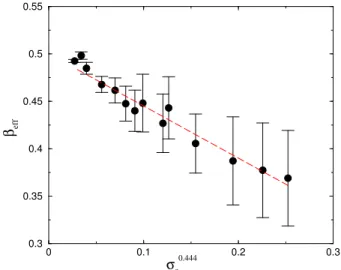
As one can see in Fig.2 the effective exponent clearly tends to the expected mean-field valueβ = 0.5asσ→0. Assum-ing a correction to scalAssum-ing of the form
βef f =β−at−δ (8)
nonlinear fitting results inδ= 0.44(1)correction to scaling exponent.
0 0.1 0.2 0.3
σc 0.444
0.3 0.35 0.4 0.45 0.5 0.55
βeff
Figure 2. βef f as a function ofσ−δ in the two dimensional
2A → 4A, 4A → 2A model (bullets). The dashed line shows a fitting of the form (8).
Besides these corrections to scaling assumptions I also tried to apply different, lowest order logarithmic corrections to the data, but these fits gave exponents slightly away from mean-field values and the corresponding coefficients proved to be very small, therefore I concluded thatdc <2. In the next section I perform the same analysis ind= 1.
IV
Simulations of the
2
A
→
4
A
,
4
A
→
2
A
model in one dimension
The initial states were again fully occupied lattices, and the density of particles is followed up to4×106MCS. An
ele-mentary MCS consists of the following processes: (a) A∅ ↔ ∅Awith probability D,
(b) AAAA→ ∅AA∅with probability(1−σ)(1−D), (c) AA∅∅ →AAAAor∅∅AA→AAAAwith probability
σ(1−D),
The critical point was again located atσc = 0. As one can see in Fig. 3 there is a crossover of the local slopes for
t > 5×10⁵ MCS and a linear extrapolation for this
re-gion results inα= 0.329(5), agreeing with the mean-field value.
0.000 0.010 0.020 0.030 0.040
t−1/3
0.4 0.35 0.3 0.25 0.2
αeff
Figure 3. αef f(t−1/3)in the one dimensional 2A → 4A,
4A→2Amodel atσc = 0. The dashed line shows a linear fitting fort >5×10⁵MCS resulting inα= 0.32(2).
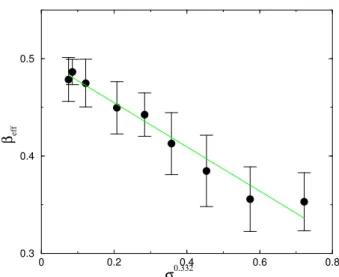
The steady state data were analyzed in the active region for 0.0003 ≤ σ ≤ 0.5 as in two dimensions, by the local slopes method (eq. 7) and assuming a correction to scaling of the form (8). This resulted in a correction to scaling ex-ponent ofδ′ = 0.332. The local slope plotted as a function
of σ−δ, shown on Fig. 4, extrapolates toβ = 0.49(1)in
agreement with the mean-field exponent.
V
Conclusions
In this paper I reviewed and discussed the state of the art of phase transitions of reaction-diffusion systems exhibiting explicit diffusion and production by n > 1 parents. Ar-guments are given against the DP criticality recently sug-gested in some papers. These are supported by a series of mean-field classes that can be classified by the existence of an=msymmetry in the system and by thenandmvalues. The need for a proper field theoretical treatment is empha-sized. The upper critical dimension in these models is not known. I showed simulation results indicating that for the binary production model,2A →4A,4A→ 2A, the upper critical dimension isdc<1.
0 0.2 0.4 0.6 0.8
σ0.332
0.3 0.4 0.5
βeff
Figure 4. βef f as a function ofσ−δ in the one dimensional
2A → 4A, 4A → 2A model (bullets). The dashed line shows a fitting of the form (8).
Note that while the density decay results in one dimen-sion are in agreement with those of Kockelkoren and Chat´e [33], the off-critical order parameter exponent isβM F = 1/(m −n) which shows that more classes exist at zero branching rate besides the BkARW universality classes. It is still an open question if there is any variant of the PkARW models that exhibits non-mean-field criticality in physical dimensions (d≥1).
Acknowledgements:
Support from Hungarian research funds OTKA (Grant No. T-25286) is acknowledged. The author thanks the trial access to the NIIF Cluster-GRID Hungary.
References
[1] For references see : J. Marro and R. Dickman, Nonequilib-rium phase transitions in lattice models, (Cambridge Univer-sity Press, Cambridge, 1999).
[2] For a review see : H. Hinrichsen, Adv. Phys.49, 815 (2000).
[3] For a recent review see : G. ´Odor, cond-mat/0205644.
[4] H. K. Janssen, Z. Phys. B42, 151 (1981).
[5] P. Grassberger, Z. Phys. B47, 365 (1982).
[6] H.Park and H.Park, Physica A221, 97 (1995).
[7] N. Menyh´ard and G. ´Odor, J. Phys. A29, 7739 (1996).
[8] K. Park, H. Hinrichsen, and In-mook Kim, Phys. Rev. E63, 065103(R) (2001).
[9] G. ´Odor, M. A. Santos, M. C. Marques, Phys. Rev. E65, 056113 (2002).
[10] J. L. Cardy and U. C. T¨auber, Phys. Rev. Lett.77, 4780 (1996); J. L. Cardy and U. C. T¨auber, J. Stat. Phys. 90, 1 (1998).
[11] N. Menyh´ard, G. ´Odor, Braz. J. of Physics,30, 113 (2000).
[12] G. ´Odor, Phys. Rev. E67, 056114 (2003).
[14] G. ´Odor and N. Menyh´ard, Physica D168305 (2002). [15] T. Tom´e and M. J. de Oliveira, Phys. Rev. Lett.86, 5643
(2001).
[16] M.M.S. Sabag and M. J. de Oliveira, Phys. Rev. E66, 036115 (2002).
[17] H. Hilhorst and F. Van Vijland, Phys. Rev.E 65, 035103 (2002).
[18] M. J. de Oliveira, Phys. Rev. E67, 027104 (2003).
[19] I. Jensen and R. Dickman, Phys. Rev. E48, 1710 (1993); I. Jensen, Phys. Rev. Lett.70, 1465 (1993).
[20] G. ´Odor, Phys. Rev. E65, 026121 (2002).
[21] M. J. Howard and U. C. T¨auber, J. Phys. A30, 7721 (1997). [22] E. Carlon, M. Henkel and U. Schollw ¨ock, Phys. Rev. E63,
036101-1 (2001).
[23] H. Hinrichsen, Phys. Rev. E63, 036102-1 (2001).
[24] G. ´Odor, Phys. Rev. E62, R3027 (2000). [25] H. Hinrichsen, Physica A291, 275-286 (2001).
[26] G. ´Odor, Phys. Rev. E63, 067104 (2001). [27] J. D. Noh and H. Park, cond-mat/0109516.
[28] M. Henkel and U. Schollw¨ock, J. Phys. A34, 3333 (2001). [29] M. Henkel and H. Hinrichsen, J. Phys. A34, 1561 (2001).
[30] P. Grassberger, Z. Phys. B47, 365 (1982).
[31] K. Park and I. Kim, Phys. Rev E66, 027106 (2002). [32] G. ´Odor, Phys. Rev E67, 016111 (2003).
[33] J. Kockelkoren and H. Chat´e, Phys. Rev. Lett.90, 125701 (2003).
[34] F. van Wijland, K. Oerding and H. J. Hilhorst, Physica A251, 179 (1998).
[35] J. E. de Freitas, L. S. Lucena, L. R. da Silva and H. J. Hil-horst, Phys. Rev. E61, 6330 (2000).
[36] U. L. Fulco, D. N. Messias and M. L. Lyra, Phys. Rev. E63, 066118 (2001).
[37] R. Dickman and M. A. F. de Menenzes, Phys. Rev. E 66, 045101 (2002).
[38] H. Hinrichsen, Physica A320, 249 (2003).
[39] H. Hinrichsen, cond-mat/0302381.
[40] G. T. Barkema and E. Carlon, cond-mat/0302151.
[41] K. Park, H. Hinrichsen and I. Kim, Phys. Rev. E66, 025101 (2002).
[42] Grinstein G., Mu˜noz M.A., and Tu Y., Phys. Rev. Lett.76, 4376 (1996); Tu Y., Grinstein G., and Mu ˜noz M.A. Phys. Rev. Lett.78, 274 (1997).
[43] J. L. Vall´es and J. Marro, J. Stat. Phys.49, 89 (1989).
[44] K.-t. Leung, Phys. Rev. Lett.66, 453 (1991).
[45] R.K.P. Zia, L.B.Shaw and B. Schmittman, Physica A279, 60 (2000).
[46] A. Achahbar, Pedro L. Garrido, J. Marro, Miguel A. Munoz, Phys. Rev. Lett.87, 195702 (2001).
[47] E. V. Albano and G. Saracco, Phys. Rev. Lett. 88, 145701 (2002).
[48] G. ´Odor, Phys. Rev. E65, 026121 (2002).
[49] G. ´Odor, N. Boccara, G. Szab´o, Phys. Rev. E48, 3168 (1993).
[50] G. ´Odor and A. Szolnoki, Phys. Rev. E53, 2231 (1996).