Brazilian Journal of Physics, vol. 36, no. 2A, June, 2006 291
The Oxidation Mechanism of CdTe (110) Surface
F. D. Kiss and A. C. Ferraz
Instituto de F´ısica da Universidade de S˜ao Paulo, Caixa Postal 66318, CEP 05315-970, S ˜ao Paulo, SP, Brazil
Received on 4 April, 2005
Using a first-principles pseudopotential technique within a generalized gradient approximation of the density functional theory, we have investigated the mechanism of adsorption of molecular oxygen on the CdTe(110) surface. The determination of the more favorables structures and their formation through the activation barrier analysis indicates that the formation can occur in the regimes of low and high temperatures. According to our calculations it was verified that in the regime of low temperatures the oxygen molecule binds exclusively to Cd at the topmost site through Cd-O-O or Cd-O2bonds. The electronic band structure presents a characteristic state like a double acceptor defect. In the high temperature regime the molecule adsorbs between Cd of the surface and Te of the subsurface, breaking Cd-Te bond and causing an upward dislocation of Cd from the subsurface. In this regime of high temperatures the complex presents Cd-O, Cd-O2, Te-O and O-O bonds and the electronic band structure is almost free of gap of states.
Keywords: Oxidation mechanism; First-principles pseudopotential technique; CdTe(110)
I. INTRODUCTION
It is well known that surface cleaning, oxidation and any other chemical or physical process brought about on the sur-face, determine the character and density of surface states. Thus, such a process influences the electronic properties of the surface and of the structure grown on it. Optoelectronic de-vices based on II-VI semiconductors attracted recently a con-siderable interest to the investigations of the surface eletronic structure of these materials as well controlled preparation of insulating oxides, essential for the development of device technology. CdTe, as a prototype of zinc-blend II-VI crys-tals, is one of the most intensively studied material, its sur-face properties were also thoroughly investigated and a quite complete scheme of electronic structure was determined for clean surfaces of the crystal. However, the processes occur-ing on various surfaces of CdTe duroccur-ing oxidation, passivation, chemical and plasma etching are still investigated by means of many experimental techniques. For most device applica-tions, the surface of CdTe must be properly passivated. If we consider solid state radiation detectors, for example, among the factors that affect the performance at room temperature of such devices, surface leakage current is one of the most detrimental. This limiting factor can be significantly reduced by chemical oxidation of CdTe surface, enhancing their per-formance [1]. Although the calculated ternary phase diagram indicates that CdTeO3and not TeO2is an equilibrium oxide
on CdTe, some early experimental studies showed that oxides formed on the CdTe surface exposed to air at room tempera-ture were essentially TeO2with litle or undectable formation
of CdO [2, 3]. Other works [4, 5] indicate a small amount or even a major formation of CdTeO3and suggest that TeO2is
a metastable phase on CdTe surfaces exposed to air at room temperature [5]. However, in a recent experimental work by Fritscheet al[6] it is observed in their X-ray photoelectron spectroscopy (XPS) spectra that after exposed to air, the CdTe surface is severely oxidized with the formation of TeO2and
CdO. On the other hand, because of the known peculiarities of the phase diagram, CdTe bulk crystals grown by different
techniques have excess Te than the stoichiometric composi-tion which aggregates as Te precipitates. Here we report se-lective mechanisms for the O2 molecules adsorption on the
CdTe(110) surface based on first-principles total-energy cal-culations with a temperature-dependent scheme.
II. THEORETICAL CONSIDERATIONS
The calculations were performed in the framework of the density-functional theory within pseudopotential scheme. The electron-electron exchange correlation was considered by us-ing the generalized-gradient approximation (GGA) [7]. The pseudopotentials for Cd, Te, O and H were derived by using the scheme of Troullier and Martins [8]. For the Cd specie, the 4d electrons were treated as core state but its influence on valence electrons was taken into account by applying the non linear core correction (NLCC) [9]. The surface was mod-elled in a super-cell geometry, with an atomic slab of six Cd-Te layers and a vacuum region equivalent to six atomic lay-ers. The theoretical lattice constant of 6.47 ˚A obtained for the bulk CdTe is used in surface calculations. On the top side of the slab we placed the oxygen molecules in different con-figurations, and the back surface was passivated by H atoms arranged in a dihydride structure. We used four Monkhorst-Pack specialkpoints for the Brillouin-some summation. The single particle orbitals were expressed in a plane-wave basis set up to the kinetic-energy cutoff of 35 Ry. The electronic and ionic degrees of freedom were relaxed by adopting the scheme described by Bockstedteet al[10]. The atoms were assumed to be in their fully relaxed positions when the forces acting on the ions were smaller than 0.005 eV/ ˚A. The ad-sorption energies for the oxygen molecules was calculated as Econ fads =−[Econ f−Ere f], whereEcon f is the total energy for
the considered configuration,Ere f is the total energy for the
move-292 F. D. Kiss and A. C. Ferraz
ment along the pathway is a response to forces in a local region around it. The constraint is set only for the oxygen molecule during the adsorption process. Considering the phe-nomenological approach in the form of the Arrhenius equa-tion [11, 12] we have estimated the adsorpequa-tion barriers.
III. RESULTS
For bulk CdTe our first-principles calculations give 6.47 ˚A for the equilibrium lattice constant (ao), 0.40 Mbar for the
bulk modulus (BM), and 1.32 eV for the energy band gap. Our structural parameters are in good agreement with the ex-perimental values ofao= 6.48 ˚A, andBM= 0.59 Mbar [13].
They are also in agreement with the substimation profile ob-served for the energy band gap typical of supercell-DFT cal-culations, as the experimental value of Egis 1.48 eV. The clean
CdTe(110) surface show a well-established relaxation pattern: at the surface layer the anion moves away from the bulk in fa-vor of an s2p3bonding with three neighbouring cations, result-ing in a pyramidal geometry. The cation on the surface moves into the bulk in favour of an sp2bonding with three neighbour-ing cations, resultneighbour-ing in a planar geometry. The tilt angle for our calculated CdTe(110) surface is found to be 30.0◦, while the vertical buckling of the top layer is 0.11 ˚A, in good agree-ment with the experiagree-mental values of 30.5◦ and 0.12 ˚A ob-tained via LEED analysis. The electronic band structure for the free CdTe(110) surface compare well with the available angle-resolved photoemission results. We have also investi-gated the structural parameter for the O2 gas molecule. We
calculated the O-O bond length of 1.20 ˚A and an enthalpy of formation of 218 kcal/mol, also in good agreement with the experimental values of 1.21 ˚A and 205 kcal/mol, respec-tively [13]. In a previous work we verified that O2molecules
could be formed over the surface with atomic adsorption [14]. We have considered many possibilities for the adsorption of O2molecules on the CdTe(110) surface but only a few
struc-tures could be found has the more favorables considering the calculated adsorption energies. These structures with the ad-sorbed molecule present bonds between Cd and the molecule and, in some cases, also bonding to Te. In order to analyse the possibility of O2molecule to bond only to Te, we verified that
the molecule on that site was desorbed from the surface or its relaxed structure was energeticaly unfavorable. Our calcula-tions indicate that the oxygen molecule adsorbs preferentially over Cd surface-sites forming Cd-O2and Cd-O-O bonds and
between Cd from the first layer and Te of the second layer forming an oxygen complex composed of Cd-O, Cd-O2, Te-O
and O-O bonds. Both types of structures preserve the Cd-Te surface-bond but in the second case, the bond between Cd from the surface and Te of the second layer is broken , in order to fix the molecule, with a dislocation upward of Cd from the second layer.
For the structures that adsorbs oxygen molecules over the surface, Cd-O bond length is around 1.90 ˚A, 14% smaller than the sum of their covalent radii (1.21 ˚A) and O-O bond length is of 1.23 ˚A, 2% bigger than in free molecule. At the surface, the Cd-Te bond length is of 2.79 ˚A, only 0.3% smaller than
this crystal distance and 3% bigger than that of free surface. The Cd-Te tilt angle at surface is now reduced to less than 6◦. From these parameters we can verify that the adsorption of O2molecule at these structures restore the surface to
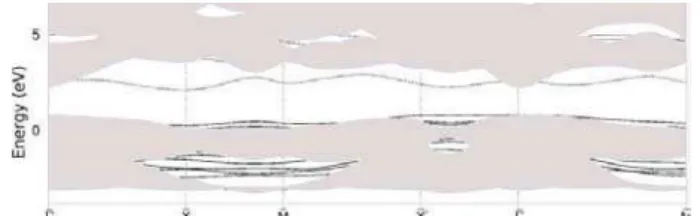
crys-tal configuration. The adsorption energies calculated for these structures are between 7.1 and 8.4 kcal/mol with a difference of 1.3 kcal/mol. As the difference is of the some order of the precision in this kind of theoretical calculations, we find three possible structures with the same characteristic above described. Fig.1 shows the surface electronic band structure for these configurations. The expected passivation effect of the oxygen adsorbed system does not occur but there is a dou-ble acceptor like state localized around 10 meV above the top of the valence band.
FIG. 1. The electronic band structure for the adsorption of O2 mole-cules on CdTe(110) at low temperatures regime. The projected bulk spectrum corresponds to the hatched region. The calculated localized surface electronic states are shown by dashed lines.
For the second kind of adsorption it was found only one structure that favour the O2 adsorption between the surface
and the second layer. On that configuration both oxygen atoms bond to the surface Cd with a bond length of 1.90 ˚A and one of the oxygen atoms bond to the subsurface Te with a bond length of 2.03 ˚A. The distance between the molecule atoms is 1.32 ˚A, 10% bigger than the free molecule distance. Te atom from the subsurface moves 0.60 ˚A downward and Cd of this layer moves 1.23 ˚A, in order to bond one oxygen. Cd-Te bond between the surface and subsurface is broken but the surface atoms now have almost the same positions as the free surface (tilt angle of 31.1◦) but with a upward Cd-Te displace-ment of 0.60 ˚A. The calculated electronic band structure for this structure, shown in Fig.2, reveal a band gap almost free of surface states and a good passivation around the top of the valence band. The adorption energy for that structure is found as 25.3 kcal/mol indicating that it is around 17 kcal/mol more favorable than the first kind of structures with the O2
adsorp-tion at the surface. Comparing our results for both kind of structures we can infer that the complexes CdTeO3and TeO2
verified on the experimental results are only related to the Te excess at the surface.
Brazilian Journal of Physics, vol. 36, no. 2A, June, 2006 293
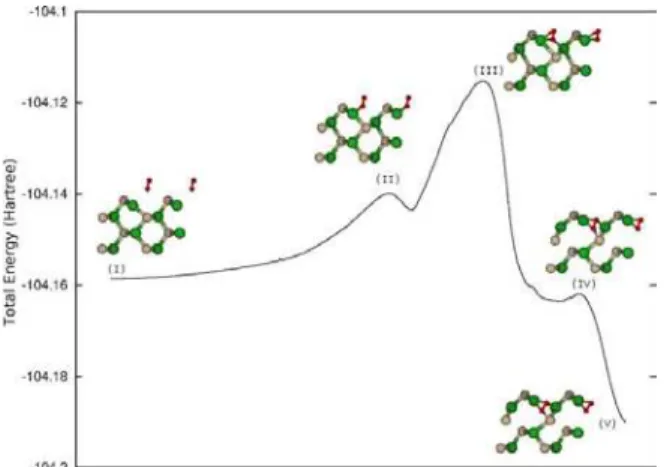
FIG. 3. Calculated energy barrier diagram for the O2adsorption on the CdTe(110) surface at low temperatures regime. The structures formed during the adsorption process are shown.
FIG. 4. Calculated energy barrier diagram for the O2adsorption on the CdTe(110) surface at high temperatures regime. The structures formed during the adsorption process are shown.
Using a constraint dynamics scheme with pathways from the gas-phase molecule to the adsorbed structure and consid-ering the phenomenological approach in the form of the Ar-rhenius equation, we have stimated , for complete adsorption and with no zero-point energy correction, the activation barri-ers. It is worthy emphasizing that is well known that the use of
pseudopotentials in non-local density functional theory calcu-lations is responsible for an underestimation of the calculated activation energies.
The energetics related to the process of O2adsorption at the
surface is schematically represented in Fig.3. The activation barries are between 2.4 and 7.8 kcal/mol corresponding to a thermal activation energy between 40 and 130 K, suggesting a low temperatures regime for this kind of adsorption. Fig.4 represents the process to the molecule adsorption between the surface and subsurface layers. The activation barrier for this mechanism is of 25.5 kcal/mol with a thermal activation en-ergy of 430 K, suggesting a high temperatures regime.
IV. SUMMARY
First-principles pseudopotential calculations for the forma-tion of O2 complexes on CdTe(110) surfaces are presented.
Our findings coudl identify two possible kind of structures associated to a two temperature regimes. At low tempera-tures the adsorption occur at the surface layer with Cd-O-O and Cd-O2 bonds, the surface becomes flat and the
associ-ated eletronic band structure present a state like double ac-ceptor defect. At more high temperatures there is a formation of a complex, between the surface and subsurface, with Cd-O, Cd-O2, Te-O and O-O bonds. The related electronic band
structure associated to this complex is almost free of surface states.
Acknowledgments
The authors acknowledge financial support from the Brazil-ian agencies CNPq, CAPES and FAPESP.
[1] H. Chen, K. Chattopadhyay, K. -T. Chen, A. Burger, M. A. George, J. C. Gregory, P. K. Nag, J. J. Weimer, and R. B. James, J. Vac. Sci. Technol.17, 97 (1999).
[2] B. J. Kowalski, E. Guziewicz, B. A. Orlowski, and A. Cricenti, Appl. Surf. Sci.142, 33 (1999).
[3] B. J. Kowalski, B. A. Orlowski, and J. Ghijsen, Surf. Sci. 412-413, 544 (1998).
[4] K. -T. Chen, D. T. Shi, H. Chen, B. Granderson, M. A. George, W. E. Collins, A. Burger, and R. B. James, J. Vac. Sci. Technol. A15, 850 (1997).
[5] F. Wang, A. Schwartzman, A. L. Fahrenbruch, R. Sinclair, R. H. Bube, and C. M. Stahle, J. Appl. Phys.62, 1469 (1987). [6] J. Fritsche, S. Gunst, E. Golusda, M. C. Lejard, A. Thissen, T.
Mayer, A. Klein, R. Wendt, R. Gegenwart, D. Bonnet, and W. Jaegermann, Thin Solid Films387, 161 (2001).
[7] J. P. Perdew, J. A. Chevary, S. H. Vosko, K. A. Jackson, M.
R. Pederson, D. J. Sing, and C. Fiolhais, Phys.Rev. B46, 6671 (1992).
[8] N. Troullier and J. L. Martins, Phys. Rev. B43, 1993 (1991). [9] S. G. Louie, S. Froyen, and M. Cohen, Phys. Rev. B26, 1738
(1982).
[10] M. Bockstedte, A. Kley, J. Neugebauer, and M. Scheffler, Comp. Phys. Commun.107, 187 (1997).
[11] M. J. Pilling and P. W. Seakins,Reaction Kinetics(Oxford Sci-ence Publications, Oxford, 1995).
[12] R. Miotto, G. P. Srivastava, and A. C. Ferraz, Phys. Rev. B63, 125321 (2001).
[13] D. R. Lide, Handbook of Chemistry and Physics (Chemical Rubber Company, Roca Raton, 1995).