*e-mail: [email protected]
Faculdade de Medicina de Ribeirão Preto, Universidade de São Paulo, Av. Bandeirantes 3900, 14049-900 Ribeirão Preto-SP, Brazil
Os únicos fármacos aprovados para o tratamento da doença de Chagas, nifurtimox e benznidazol, apresentam efeitos colaterais e eficácia limitada na fase crônica da doença, destacando a necessidade de novos fármacos. Entre os diferentes alvos moleculares de fármacos identificados no parasita, uma trans-sialidase de Trypanosoma cruzi (TcTS) tem sido considerada essencial para o reconhecimento e invasão nas células do hospedeiro. Desta forma, o trabalho descreve a síntese eficiente e a avaliação biológica (inibição de TcTS e atividade antitripanossoma) de alguns triazol-arilsulfonamidas contendo galactose pela reação de 1,3-dipolar de cicloadição azida-alcino Cu(I) (CuAAC) em micro-ondas, usando como precursores os derivados de azido benzenossulfonamidas e alcino derivado de galactose. A maioria dos compostos testados contra TcTS mostrou inibição moderada a fraca (40%-15%), com exceção de um dos compostos (81%). Quanto ao ensaio de atividade antitripanossoma, alguns compostos [(IC50 70,9 µM) e (IC50 44,0 µM)]
apresentaram atividades mais significativas, embora não tenham sido tão ativos como benznidazol (IC50 1,4 µM). Adicionalmente, a avaliação da citotoxicidade mostrou que todos os compostos não
foram citotóxicos. Neste trabalho preliminar, alguns compostos foram considerados protótipos para posterior otimização.
The only drugs approved for the treatment of Chagas disease, nifurtimox and benznidazole, present toxic side effects and limited efficacy in the chronic stage of the disease, which highlight the need for new drugs. Amongst the different molecular drug targets discovered in the parasite,
Trypanosoma cruzi trans-sialidase (TcTS) has been considered crucial in the recognition and invasion of host cells. Hence, we report the efficient synthesis and biological evaluation (TcTS inhibition and antitrypanosomal activities) of some galactose-containing triazol-arylsulfonamides via microwave-assisted Cu(I) 1,3-dipolar azide-alkyne cycloaddition (CuAAC) based on azide benzenesulfonamides and a galactose-derived alkyne as precursors. Most of the compounds tested against TcTS showed moderate to weak inhibition (40%-15%), except one of the compounds (81%). Regarding the antitrypanosomal assay, some compounds [(IC50 70.9 µM) and (IC50 44.0 µM)]
exhibited the most significant activities, although not as active as benznidazole (IC50 1.4 µM).
Nevertheless, the cytotoxicity assessment showed that all compounds were not cytotoxic. In this preliminary work, we considered some compounds as lead scaffolds for further optimization.
Keywords: Chagas disease, Trypanosoma cruzi, trans-sialidase, benzenesulfonamides, click chemistry
Introduction
The last decade witnessed enormous advances in our understanding of Trypanosoma cruzi (T. cruzi) genome,
Junqueira et al. 1873 Vol. 25, No. 10, 2014
surface superfamily of molecules, such as trans-sialidase, proteases and surface gp63 proteins associated with mucin (MASP’s).1 From the exploration of outstanding
possibilities offered by genomic and proteomic resources, a series of molecular targets were identified to seek for high-affinity ligands, which may open up a new generation of selectivity drug candidates.2-7 In this regard, trans
-sialidase enzyme, found in flagellar trypomastigotes vesicles-containing glycoproteins, plays an essential role in parasite cellular invasion, growth, differentiation and survival processes.8-11 Furthermore, T. cruzi trans-sialidase
(TcTS) affects parasite entry in cardiac cells, leading to the development of host cell inflammatory response and infection process, besides being extremely important in modulating the immune response against infection in the chronic phase of Chagas disease.12
The molecular mechanism of TcTS relies on the transference of sialic acids from host cells to terminal
β-galactose molecules present on parasite surface
glycoproteins, introducing them into parasite surface mucins.13-17 Only after the sialylation process, T. cruzi
can invade and infect macrophages host cells. In general, it is established that parasite and host cell interactions are mediated by several molecules comprising calcium, glycoprotein Gp83, PKC, cruzipain, mucins and Gp85/
trans-sialidase primarily by the action of Gp82 component
which triggers Ca2+ mobilization from cell stores, and
contribute for the invasion step.12,18,19 Thus, besides the
relative relevance of TcTS for the parasite entry, sialylated mucins greatly contribute for parasite to escape from host immunological defense mechanisms hence acquisition of sialic acids leads mucins to interact with the inhibitory sialic acid-binding protein Siglec-E (sialic acid binding Ig like lectin-E), which disables immune cells activation.20,21
Furthermore, trans-sialidase also plays a role after parasite invasion and subsequent fusion of parasitophorus vacuole with lysosomes, since it promotes pore membrane formation by desialylation of lysosome membrane glycoproteins, from which the parasite escapes to the cytoplasm and differentiates into replicative amastigote forms.22-24 Therefore, the role played by trans-sialidase in
the pathogenesis of Chagas disease makes it a valuable
and selective target to be explored in the search for new therapeutics. In fact, potential TcTS inhibitors acting by complementary interaction at both donor (β-galactose) and acceptor (sialic acid) sub-sites are of great concern.25-27
Currently, the treatment of the Chagas disease is based on two drugs, nifurtimox (1) and benznidazole (2), which are effective during the acute phase of the disease albeit several drawbacks related to side effects and resistance development are described.6,28,29 Despite the significant
reduction of parasite load and changes in the immune response during the course of benznidazole-combined therapy, for instance with allopurinol,30 clomipramine,31
amiodarone,32 and posaconazole,5 this promising discovery
strategy based on the exploitation of new clinical activity observed for an old drug hitherto did not reach the market.33
According to the World Health Organization (WHO), Program for Tropical Disease Research (TDR) and BIO Ventures for Global Health, the major issues concerning the research and drug development in neglected disease, in which Chagas disease is a case in point, encompass implementation of new public policies and alternative strategies to translate basic research into new drug candidate.34
In this scenario, the major aim in designing antitrypanosomal drugs is to find a drug which will be effective in the chronic stage of the disease and remain active despite resistant variants, since an estimated 10,000 deaths still occur annually and 7 to 8 million people are infected worldwide.35 Among the numerous potent
antitrypanosomal agents, sulfonamide derivatives have shown high in vitro activities against T. cruzi and trans -sialidase (Figure 1).
Thus, based on molecular hybridization strategy,36 a
series of N-quinolin-8-yl-arylsulfonamides,37
arylsulfonyl-2-methyl-1,2,3,4-tetrahydroquinolines38 and N
-(biphenyl-4-yl-sulfonyl)-nicotinamides39 were described as potential
antitrypanosomal agents, as respectively illustrated by compounds 3 (IC50 31.75 µM, Selectivity Index-SI 2.1),
4 (IC50 11.44 µM, SI 21.7) and 5 (lytic concentration-LC50
50.61 µM, SI not available). Regarding trans-sialidase, chalcone-derived sulfonamides, such as 6, proved to be very active, with IC50 ranging from 0.6 to 7.3 µM, which
benzenesulfonamides might provide TcTS inhibitors and antitrypanosomal lead derivatives. Examples of syntheses of glycosylmimetics based on TcTS substrates, assembled by a triazole linker, have been previously described by our group.43,44 In this sense, we have decided to assemble
these two important motifs (galactose and sulfonamide) for TcTS inhibition and antitrypanosomal activities via 1,2,3-triazole ring. Additionally, variations on heterocycle-linked sulphonamide core by the bioisosteric replacement of isoxazole, pyrimidine and pyridine rings or an acyl group may represent a convenient strategy to construct chemical diversity and regulate acidity.
Synthesis
The synthesis of target products 8-14 (Scheme 1) started from 2’-propynyl-2,3,4,6-tetra-O-acetyl-β -D-galactopyranoside (15), which was obtained in 90% from the TMSOTf-catalysed glycosylation reaction using propargyl alcohol and 2,3,4,6-tetra-O-acetyl-β -D-galactopyranosyl trichloroacetimidate.45
Taking advantage of the commercial available arylsulfonamides 16-22, named sulfanilamide (16), sulfacetamide (17), sulfamethoxazole (18), sulfamerazine
Junqueira et al. 1875 Vol. 25, No. 10, 2014
(19), sulfamethazine (20), sulfadimethoxine (21) and sulfapyridine (22), we explored their use as starting material to introduce azide group46 in the place of their corresponding
free 4-aminoaryl group via diazo intermediates.47 Thus,
treatment of precursors 16-22 with tert-butyl nitrite in tert-butyl alcohol for addition of nitroso group to the amino functionalities, followed by dehydration of protonated diazohydroxyl intermediates, afforded the diazo derivatives (23-29), which were used without work up and further purification. Thus, the azide benzenesulfonamide 30 were prepared by a modified procedureusing microwave-assisted reaction48 to improve the condensation between azide group
and diazo functionality of 23, generating aryl-pentazenes and -pentazol intermediates, with resultant release of nitrogen to give azide 30 in 86% yield, significantly higher than those reported under conventional heating (61%).49
While these conditions were very convenient to prepare the intermediate 4-azidobenzenesulfonamide (30), the reduced solubility of precursors 24-29 in tert-butyl alcohol limited their further application in the synthesis of the remaining azido intermediates 31-36. To circumvent this issue, several experiments were carried out varying the solvents (DMF, acetonitrile, acetone, dioxane and THF), but only recovery of starting materials or products formation in very low yields (approximately 10%) was observed.50 Given the
high proportion of tert-butyl nitrite (6 to 12 equivalents), which might impair precursor solubilization during the microwave-assisted reaction, its reduction (4 equivalents) proved to be convenient to obtain the azide intermediates
31-36 in high yields (71 to 85%) using acetonitrile, dioxane or THF (depending on the starting material), with exception of the pyridinyl-benzenesulfonamide 36 (51% yield).47,50 The characterization of azide intermediates
30-36 by 1H NMR showed the downfield shifted (0.5 ppm
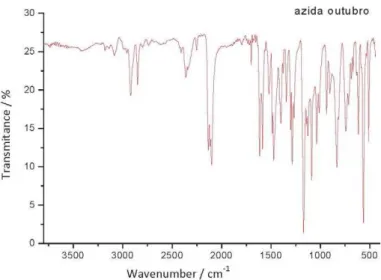
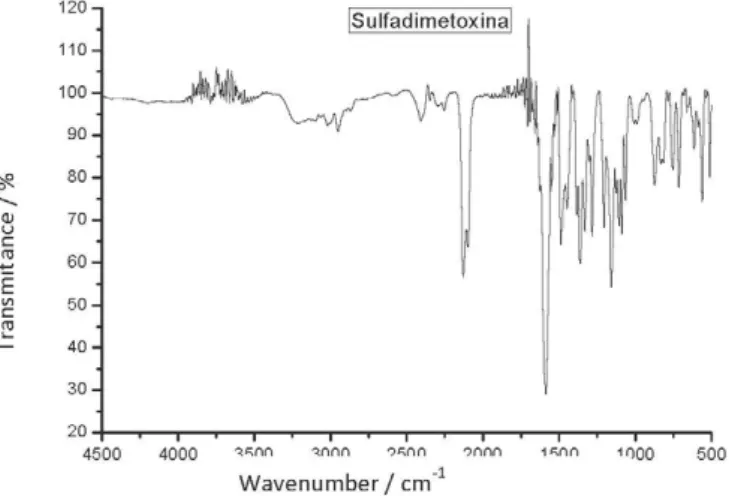
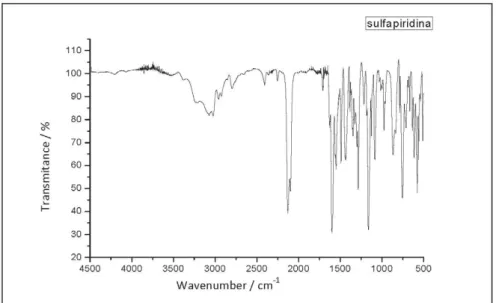
on average) of the aromatic hydrogens once compared to the corresponding amine precursors (16-22), besides the intense azide band (2097 cm–1) at IR spectrum.
With the azide benzenesulfonamides intermediates
30-36 in hands, the coupling of their azide functions with the O-propynyl galactoside 15 was carried out using the highly efficient CuAAC coupling in a sealed tube under microwave-assisted conditions, which shortened the required reaction time for up 1 h, instead of 16 h under conventional heating.51 In general, the reactions were
conducted in DMF at 70-80 °C (150 W) for 10-60 min in the presence of copper sulfate and sodium ascorbate for in situ generation of Cu(I) catalyst. Under these conditions, a small chemical diversity of protected galactosyl-triazolo-benzenesulfonamides 37-43 were obtained with complete regioselectivity since the 1,4-disubstituted triazoles were the unique isomer observed by 1H NMR, with a single
triazole hydrogen approximately at 8.0 ppm. Despite the previously reported synthesis of non-substituted derivative 37 in higher yield,52 our novel series containing
N-acetamide and -heterocycles groups was conveniently prepared in 50-63% yield.
Finally, removal of the sugar acetate protecting groups with catalytic NaOMe in MeOH, followed by treatment with DOWEX® 50WX8 resin, afforded the target products
8-14 in nearly quantitative yield.
Biological evaluations
Inhibition of T. cruzi trans-sialidase (TcTS)
The in vitro inhibitory properties of compounds 8-14
against a recombinant T. cruzi trans-sialidase were assessed by a sensitive and practical continuous fluorimetric method that measures the residual hydrolase activity of TcTS on the donor substrate 2’-(4-methylumbelliferyl)-α-D-N -acetyl-neuraminic acid (MuNANA) by cleaving the glycosidic bond that releases the fluorophore, methylumbelliferone (MU).53 Thus, an initial screening was performed using
1.0 mM concentration of products 8-14 in the presence of MuNANA (0.1 mM). For comparison purposes, the activities of 2-deoxy-2,3-dehydro-N-acetyl-neuraminic acid (DANA) and pyridoxal phosphate were concomitantly measured in the same concentrations of the target compounds due to their respective weak and moderate activities on TcTS.54
According to Figure 2, compounds 8-14 showed a variable influence on TcTS enzyme inhibition, being compound 14 the most active of the series with an inhibition percentage of 81%, higher than pyridoxal phosphate (73%). On the other hand, the inhibition profile of compounds 9-13
was just moderate (40%), and compound 8 was weak (15%). Based on the greatest efficacy of 14 against TcTS, bearing a pyridine heterocycle at the benzenesulfonamide core, we pursued the enzymatic activity at lower concentrations (1.0, 0.75, 0.5 and 0.25 mM), however, the inhibition dropped significantly, giving an IC50 of 0.61 mM. In fact,
the inhibition of this enzyme presents a great challenge, since there are few examples of strong TcTS inhibitors that act at nM range.27
Despite the lack of evidences that correlate TcTS and in vitro trypomastigote survival, we also investigated the potential antitrypanosomal properties of compounds 8-14
as TcTS-independent experiments.
Antitrypanosomal and cytotoxicity evaluations
red-β-D-galactoside (CPRG) as substrate for modified
β-galactosidaseTulahuen strain of T. cruzi.2,55 From these
experiments, the IC50 for all derivatives were calculated
considering the concentrations of compounds able to promote 50% parasite lysis, so-called antitrypanosomal activity, using benznidazole (Bz) as reference. From the IC50 data (Table 1 and Figure 3), it was evident that
benzenesulfonamide substituents affect the activity in a reasonable extension, although they were not as active as benznidazole (IC50 1.4 µM).
Accordingly, compounds 13 (IC50 44.0 µM) and 10
(IC50 70.9 µM), having the 2,4-dimethoxypyrimidine and
5-methylisoxazole groups, respectively, exhibited the most significant antitrypanosomal activity, while derivatives 11
(6-methylpyrimidine), 12 (4,6-dimethylpyrimidine) and 14
(pyridine), besides the non-substituted benzenesulfonamide
8, showed the lowest potencies of the series with IC50
ranging from 155.3 to 204.9 µM. Comparing to the previous
set of compounds, intermediate activities were attained for compound 9 (acetamide) with IC50 119.5 µM.
It is noteworthy that pyridine derivative 14 that positively inhibit TcTS, failed to inhibit parasite growth as anticipated, suggesting that the antitrypanosomal activities observed for products 10 and 13 may occur by a different mechanism of action. On the other hand, the moderate TcTS activity showed by 14 could be insufficient to cause parasite death.
In addition, compounds 8-14 were examined for their ability to affect mammalian cells, such as cultured mouse spleen cells (Figure 4).56 As a general observation,
all galactosyl-triazolo-benzenesulfonamides were not cytotoxic to cells in concentrations similar to those used in the evaluation of the antitrypanosomal activities (500 to 3.9 µM). Given the lack of cytotoxicity, the corresponding LD50 values and, consequently, the selectivity index could
not be calculated at the tested conditions.
benzenesulfonamides (8-14) using a continuous fluorimetric method. The results are based on three independent experiments, performed in triplicate.
Figure 3. Percentage of antitrypanosomal activities of compounds 8-14 and reference compound benznidazole (Bz) against Tulahuen-modified strain of
Junqueira et al. 1877 Vol. 25, No. 10, 2014
Conclusions
In summary, our studies demonstrated that commercial available benzenesulfonamides can be converted to the corresponding azide derivatives using different solvents under microwave-assisted reaction. The coupling of the azide benzenesulfonamides, comprising the free sulfonamide function or substituted by acetamide or different heterocycles, with galactose-derived alkyne was successfully achieved via CuAAC reaction for the formation of a small set of regioselective 1,4-disubstituted galactosyl-triazolo-benzenesulfonamides in moderate to good yields.
Bioassays with products 8-14 revealed TcTS inhibition only for the galactosyl-triazolo-benzenesulfonamide 14, containing a sulfonamide-linked pyridine ring. Despite the weak activity in terms of IC50, its inhibition was
superior to pyridoxal phosphate used as reference. On the other hand, the evaluation of products 8-14 against
T. cruzi trypomastigote showed products 10 and 13,
bearing respectively the 2,4-dimethoxypyrimidine and 5-methylisoxazole groups, as the most actives of the series, while the remaining products were two to four fold less active than 13. Bearing in mind the role played by TcTS in parasite cell surface glycosylation and the difficulties to associate TcTS inhibition with parasite viability in vitro assays, we found, indeed, a lack of correlation between the results obtained in enzyme and T. cruzi trypomastigote in vitro assays, suggesting that antitrypanosomal activities found for products 10 and 13 is not related to TcTS
inhibition and may involve alternative mechanisms. Thus, based on the low cytotoxicity displayed by the series, compounds 10 and 13 can be considered as lead scaffolds for further optimization.
Experimental
General
All chemicals were purchased as reagent grade and used without further purification. Solvents were
dried according to standard methods.57 MuNANA
(2’-(4-methylumbelliferyl)-α-D-N-acetyl-neuraminic acid sodium salt), used as a donor substrate for silylation reactions, was acquired from Toronto Research Chemicals Inc.. The trans-sialidase used in this study was a His-tagged 70 kDa recombinant material truncated to remove C-terminal repeats but retaining the catalytic N-terminal domain of the enzyme.58 Reactions were monitored by thin
layer chromatography (TLC) on 0.25 nm precoated silica gel plates (Whatman, AL SIL G/UV, aluminium backing) with the indicated eluents. Compounds were visualized under UV light (254 nm) and/or dipping in ethanol-sulfuric acid (95:5, v/v), followed by heating the plate for a few minutes. Column chromatography was performed on Silica Gel 60 (Fluorochem, 35-70 mesh) or on a high performance flash chromatography (Biotage Horizon) system using 12 or 25 mm flash cartridges with the indicated eluents. The microwave-assisted reactions were performed in sealed
tubes on a CEM Discover® Microwave System. HPLC
Synthesis of azide benzenesulfonamides 30-36
General procedure
Sodium azide (78 mg, 1.20 mmol, 3 equiv.) was introduced in a microwave flask equipped with a stirring bar and solubilized with water (150 µL). To this solution, the remaining reagents were added in the following order: solvent reaction (1 mL), 4-aminobenzenesulfonamide (16-22) (0.4 mmol, 1 equiv.) and tert-butyl nitrite (t-BuONO). The mixture was stirred and heated under microwave radiation at 150 W. The reaction was followed by TLC and after completion, the reaction mixture was partitioned between hexane and EtOAc. The aqueous phase was extracted with EtOAc (3 times), and the organic phase was dried over Na2SO4, filtered and concentrated.
The product was obtained after flash chromatography on a Biotage Horizon, using 12 mm flash cartridge, flow 8 mL min–1; hexane/EtOAc; gradient 0-40% and
40%-40% (v/v).
4-azidobenzenesulfonamide (30)
F o l l o w i n g t h e g e n e r a l p r o c e d u r e , u s i n g 4-aminobenzenesulfonamide (16) (68.8 mg), tert-butyl alcohol as solvent, t-BuONO (285 µL, 2.4 mmol, 6 equiv.), reaction time 35 min at 60 °C. Yield: 86% (0.344 mmol). IR (KBr) νmax/cm–1 3247, 3338, 2100 (azide peak); 1H NMR
(300 MHz, CD3OD) d 7.89 (d, 2H, Jortho 8.9 Hz, Ar-H
and CHCSO2NHR), 7.21 (d, 2H, Jortho 8.9 Hz, Ar-H and
CHCN3).
N-[(4-azidophenyl)sulfonyl]acetamide (31)
Following the general procedure, using N
-[(4-aminophenyl)sulfonyl]acetamide(17) (85.6 mg) acetonitrile as solvent, t-BuONO (190 µL, 1.60 mmol, 4 equiv.), reaction time 35 min at 40 °C. Yield: 83% (0.332 mmol). IR (KBr)
νmax/cm–1 2100 (azide peak); 1H NMR (300 MHz, CD3OD)
d 8.01 (d, 2H, Jortho 8.8 Hz, Ar-H and CHCSO2NHR), 7.24
(d, 2H, Jortho 8.8Hz, Ar-H and CHCN3), 1.97 (s, 3H, CH3).
(105.6 mg), dioxane as solvent, t-BuONO (190 µL,
1.60 mmol, 4 equiv.), reaction time 20 min at 55 °C. Yield: 74% (0.296 mmol). IR (KBr) νmax/cm
–1 3500,
3250, 3000, 2750, 2110 (azide peak); 1H NMR (300 MHz,
CD3OD) d 8.21 (d, 1H, J 5.2 Hz, H-pyrimidine), 8.06 (d,
2H, Jortho 8.8 Hz, Ar-H and CHCSO2NHR), 7.19 (d, 2H,
Jortho 8.8 Hz, Ar-H and CHCN3), 6.82 (d, 1H, J 5.2 Hz,
H-pyrimidine), 2.34 (s, 3H, CH3).
4-azido-N-(4,6-dimethylpyrimidin-2-yl)benzenesulfonamide (34)
Following the general procedure, using 4-amino-N -(4,6-dimethylpyrimidin-2-yl)benzenesulfonamide (20)
(111.3 mg), dioxane as solvent, t-BuONO (190 µL,
1.60 mmol, 4 equiv.), reaction time 20 min at 55 °C. Yield: 71% (0.284 mmol). IR (KBr) νmax/cm–1 2110 (azide peak);
1H NMR (400 MHz, CD
3OD) d 8.04 (d, 2H, Jortho8.6 Hz,
Ar-H and CHCSO2NHR), 7.16 (d, 2H, Jortho8.6 Hz, Ar-H
and CHCN3), 6.67 (s, 1H, H-pyrimidine), 2.26 (s, 6H, 2×
CH3).
4 - a z i d o -N- ( 2 , 6 - d i m e t h o x y p y r i m i d i n - 4 - y l ) benzenesulfonamide (35)
Following the general procedure, using 4-amino-N -(2,6-dimethoxypyrimidin-4-yl)benzenesulfonamide (21) (124 mg) THF as solvent, t-BuONO (190 µL, 1.60 mmol, 4 equiv.), reaction time 40 min at 30 °C. Yield: 85% (0.340 mmol). IR (KBr) νmax/cm–1 1570, 2110 (azide peak);
1H NMR (400 MHz, CD
3OD) d 7.92 (d, 2H, Jortho8.8 Hz,
Ar-H and CHCSO2NHR), 7.16 (d, 2H, Jortho 8.8 Hz, Ar-H
and CHCN3), 5.95 (s, 1H, H-pyrimidine), 3.79 (s, 3H,
OCH3), 3.78 (s, 3H, OCH3).
4-azido-N-pyridin-2-yl-benzenesulfonamide (36)
Junqueira et al. 1879 Vol. 25, No. 10, 2014
IR (KBr) νmax/cm–1 1570, 1200, 2110 (azide peak); 1H NMR
(400 MHz, CD3OD) d 7.92 (s, 1H, H-pyridine), 7.89 (d,
2H, Jortho8.8 Hz, Ar-H and CHCSO2NHR), 7.66 (ddd, 1H,
J 9.0, 7.2, 1.9 Hz, H-pyridine), 7.18 (dd, 1H, J 9.0, 1.0 Hz, H-pyridine), 7.13 (d, 2H, Jortho9.0 Hz, Ar-H and CHCN3),
6.84 (ddd, 1H, J 7.2, 5.9, 1.0 Hz, H-pyridine).
2-propynyl 2,3,4,6-tretra-O-acetyl-β-D-galactopyranoside (15)
2,3,4,6-tetra-O -acetyl-α-D-galactopyranosyl
trichloroacetimidate (2.15 g, 4.37 mmol) was diluted with anhydrous dichlorometane (DCM) (40 mL), under argon atmosphere, and treated with propargyl alcohol (2.55 mL, 43 mmol). The mixture was cooled to –40 °C and stirred for 30 min, then treated dropwise with trimethylsilyl trifluoromethanesulfonate (0.16 mL, 0.94 mmol) solution in DCM (1 mL). The mixture was kept stirring for a period of 1 h and the reaction was followed by TLC (hexane/EtOAc 1:1). After completion, the reaction was neutralized with triethylamine (0.1 mL), warmed to room temperature and filtered off. The mixture was concentrated under reduced pressure and purified by gradient flash chromatography (hexane/EtOAc; gradient 0-50%). The product 15 was obtained in 90% yield. 1H NMR (300 MHz, CDCl
3) d 5.40
(dd, 1H, J3,4 3.4 Hz, J4,5 0.78 Hz, H-4), 5.22 (dd, 1H, J1,27.8 Hz, J2,3 10.5 Hz, H-2), 5.06 (dd, 1H, J2,3 10.5 Hz, J3,43.4 Hz, H-3), 4.74 (d, 1H, J1,2 8.0 Hz, H-1), 4.38 (d, 2H, J 2.4 Hz, OCH2CCH), 4.19 (dd, 1H, J5,6 6.6 Hz, J6’,6 11.2 Hz, H-6), 4.13 (dd, 1H, J5,66.6 Hz, J6’,611.2 Hz, H-6’), 3.94 (dt, 1H, J4,5 1.1 Hz, J5,66.6 Hz, H-5), 2.46 (t, 1H, J 2.4 Hz, CCH), 2.15-1.99 (s, 12H, 4× CH3CO).
S y n t h e s i s o f p r o t e c t e d g a l a c t o s y l t r i a z o l o -benzenesulfonamides (37-43) and final products (8-14)
General procedure
4-azidobenzenesulfonamides (30-36) (0.2 mmol, 1 equiv.) were diluted in DMF (0.3 mL) in a microwave sealed flask, equipped with a stirring bar, and treated with the propynyl sugar 15 (85.0 mg, 0.22 mmol, 1.1 equiv.), sodium ascorbate (3.96 mg, 0.02 mmol, 0.1 equiv.) and copper sulfate solution 0.1 mol.L–1 (60 µL). The mixture
was stirred and heated under microwave radiation at 150 W varying time and temperature. The reaction was monitored by TLC [hexane/EtOAc 1:9 (v:v)], which showed the formation of only one product. The mixture was concentrated and coevaporated with toluene under reduced pressure to eliminate the solvent (DMF). Then, the product was extracted using EtOAc (3 portions of 5 mL) and washed with water (1 portion of 3 mL) to eliminate the remaining salts. After filtration, the organic
phase was dried over Na2SO4, filtered and concentrated.
The product was obtained after flash chromatography on a Biotage Horizon [12 mm flash cartridge, flow 8 mL min–1; hexane/EtOAc; gradient 0-50%, 50-100% and
100-100% (v/v)]. The O-protected galactosyl-triazolo-benzesulfonamides 37-43 (0.1 mmol) were dissolved in methanol (2 mL) and treated dropwise with NaOMe (1 mol L–1) at 0 °C until pH 9. The mixture was stirred until
the completion of the reaction, followed by TLC (hexane/ EtOAc 1:3). Then, the mixture was neutralized with DOWEX resin (50WX8 H+), filtered and concentrated
under reduced pressure. The products 8-14 were obtained in quantitative yield.
4-{4-[(2’,3’,4’,6’-tetra-O-acetyl-β-D- galactopyranosyl)-oxymethyl]-1-H-1,2,3 triazol-1-yl}benzenesulfonamide (37) and 4-{4-[(β-D-galactopyranosyl)-oxymethyl]-1-H-1,2,3
triazol-1-yl}benzenesulfonamide (8)
Protected product (37): Following the general
procedure using 4-azidobenzenesulfonamide (30)
(39.6 mg), reaction time 40 min at 70 °C. Yield:
60% (0.12 mmol). 1H NMR (300 MHz, CDCl
3) d 8.12
(d, 2H, Jortho8.7 Hz, Ar-H and CHCSO2NHR), 8.09 (s,
1H, CH-triazole), 7.94 (d, 2H, Jortho 8.7 Hz, Ar-H and CHC-triazole), 5.44 (dd, 1H, J4,5 1.0 Hz, J4,3 3.3 Hz, H-4), 5.28 (dd, 1H, J2,17.8 Hz, J2,310.5Hz, H-2), 5.10 (d, 1H, Jgem 12.5 Hz, OCH2-triazole), 5.07 (dd, 1H,
J3,4 3.4 Hz, J3,210.3 Hz, H-3), 4.92 (d, 1H, Jgem12.5 Hz, OCH2-triazole), 4.72 (d, 1H, J 7.8 Hz, H-1), 4.23 (dd, 1H,
J5,6 6.8 Hz, J6,6’ 11.2 Hz, H-6), 4.16 (dd, 1H, J5,6’ 6.6 Hz, J6’,6 11.2 Hz, H-6’), 4.00 (ddd, 1H, J5,4 1.0 Hz, J5,6 6.8 Hz, J6,6’ 6.6 Hz, H-5), 2.20-1.98 (s, 12H, 4× CH3CO);
13C NMR (75 MHz, CDCl
3) d 170.5-169.7 (CH3CO),
145.7 (C-triazole), 142.2 (Ar,C-SONH2), 139.6 (Ar, p-CSONH2), 127.9 (Ar,m-CSONH2), 120.8 (CH-triazole),
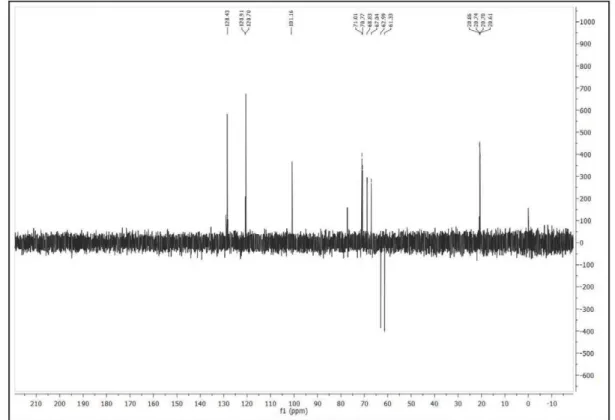
120.1 (Ar, o-NH2), 100.1 (C-1), 70.4 (C-5), 70.1 (C-2), 68.2 (C-3), 66.4 (C-4), 62.3 (C-6), 60.8 (OCH2), 20.2-19.9
(CH3CO).
Deprotected product (8): 1H NMR (300 MHz, DMSO)
d 8.89 (s, 1H, H-triazole), 8.05 (d, 2H, J 8.6 Hz, Ar-H), 7.93 (d, 2H, J 8.6 Hz, Ar-H), 7.45 (s, 2H, NH2), 4.85 (d,
1H, Jgem 12.3 Hz, CH2-triazole), 4.65 (d, 1H, Jgem12.3 Hz,
CH2-triazole), 4.20 (d, 1H, J1,27.0 Hz, H-1), 3.55-3.05 (m,
6H, H-2, H-3, H-4, H-5, H-6, H-6’); 13C NMR (75 MHz,
DMSO) d 145.6 (C-triazole), 143.5 (Ar, CSO2), 139.4
(Ar,p-CSO2), 127.4 (Ar, m-CSO2), 122.9 (CH-triazole),
119.9 (Ar,o-CSO2), 102.8 (C-1), 75.1 (C-5), 70.6 (C-3),
67.8 (C-2), 61.3 (C-6), 60.4 (OCH2); HRMS (ESI-MS)
m/z, calcd. for C20H24N6O8S [M + Na]
+: 439.1001, found:
5.06 (dd, 1H, J3,4 3.4 Hz, J2,3 10.3 Hz, H-3), 4.91 (d, 1H, Jgem12.5 Hz, OCH2-triazole), 4.71 (d, 1H, J1,2 8.1 Hz, H-1),
4.20 (dd, 1H, J5,6 6.6 Hz, J6,6’ 11.0 Hz, H-6), 4.14 (dd, 1H, J5,6’ 6.6 Hz, J6’,611.0 Hz, H-6’), 3.98 (ddd, 1H, J4,5 0.6 Hz, J5,66.6 Hz, J5,6’6.6 Hz, H-5), 2.10 (s, 3H, CH3-sulfonamide),
2.05-1.99 (s, 9H, 3x CH3CO); 13C NMR (75 MHz, CDCl3)
d 170.7-169.9 (CH3CO), 168.0 (CO-sulfonamide), 145.7
(C-triazole), 140.6 (Ar,C-SO2), 138.5 (Ar,p-CSO2), 130.6
(Ar,m-CSO2), 120.4 (CH-triazole), 120.3 (Ar, o-CSO2),
100.8 (C-1), 71.0 (C-5), 70.8 (C-3), 68.8 (C-2), 67.4 (C-4), 63.3 (C-6), 61.8 (OCH2), 24.95 (CH3-sulfonamide),
20.9-20.7 (CH3CO).
Deprotected product (9): 1H NMR (400 MHz, DMSO)
d 8.98 (s, 1H, H-triazole), 8.17 (d, 2H, Jortho 8.7 Hz, Ar-H and CHCSO2NHR), 8.11 (d, 2H, Jortho8.7 Hz, Ar-H and
CHC-triazole), 4.92 (d, 1H, Jgem12.5 Hz, CH2-triazole), 4.75
(d, 1H, 12.5 Hz, CH2-triazole), 4.27 (d, 1H, J1,2 7.3 Hz, H-1),
3.64 (m, 1H, H-4), 3.56 (m, 2H, H-6 and H-6’), 3.42-3.28 (m, 3H, H-2, H-3, H-5), 1.94 (s, 3H, CH3);
13C NMR
(100 MHz, DMSO) d 169.3 (CO), 145.6 (C-triazole), 139.8 (Ar, CSO2), 138.9 (Ar,p-CSO2), 129.6 (Ar, m-CSO2), 123.0
(CH-triazole), 120.3 (Ar, o-CSO2), 102.9 (C-1), 75.4 (C-5),
73.4 (C-3), 70.5 (C-2), 68.2 (C-4), 61.3 (OCH2-triazole),
60.6 (C-6), 23.4 (CH3); HRMS (ESI-MS) m/z, calcd. for
C17H22N4O9S [M – H]
–: 457.11075, found: 457.1028.
4-{4-[(2’,3’,4’,6’-tetra-O-acetyl-β-D-
galactopyranosyl)-oxymethyl]-1-H-1,2,3triazol-1-yl}-N-(5-methylisoxazol-3-yl) benzenesulfonamide (39) and 4-{4-[(β-D-
galactopyranosyl)-oxymethyl]-1-H-1,2,3-triazol-1-yl}-N-(5-methylisoxazol-3-yl) benzenesulfonamide (10)
Protected product (39): Following the general
procedure, using 4-azido-N-(5-methylisoxazol-3-yl) benzenesulfonamide (32) (55.8 mg), reaction time 60 min at 80 °C. Yield: 50% (0.1 mmol). 1H NMR (400 MHz, CDCl
3)
d 8.05 (d, 2H, Jortho 8.9 Hz, Ar-H and CHCSO2NHR), 7.81
(s, 1H, H-triazole), 7.89 (d, 2H, Jortho8.9 Hz, Ar-H and
(C-4), 62.9 (OCH2), 61.3 (C-6), 20.8-20.5 (CH3CO), 12.71
(CH3-isoxazole).
Deprotected product (10):1H NMR (500 MHz, CD 3OD)
d 8.67 (s, 1H, H-triazole), 8.07 (d, 2H, Jortho9.0 Hz Ar-H and CHCSO2NHR), 8.04 (d, 2H, Jortho9.0 Hz Ar-H and
CHC-triazole), 6.14 (s, 1H, H-isoxazole), 5.01 (d, 1H, Jgem12.9 Hz, CH2-triazole), 4.88-4.86 (m, 1H, CH2-triazole),
4.36 (d, 1H, J1,2 7.8 Hz, H-1), 3.80 (dd, 1H, J3,43.4 Hz, J4,50.7 Hz, H-4), 3.77 (dd, 1H, J5,6 6.5 Hz, J6,6’ 11.2 Hz, H-6), 3.70 (dd, 1H, J5,6’ 6.5 Hz, J6’,6’ 11.2 Hz, H-6’), 3.56-3.52 (m, 2H, H-2 and H-5), 3.45 (dd, 1H, J2,3 9.6 Hz, J3,43.4 Hz, H-3), 2.29 (s, 3H, CH3);13C NMR (125 MHz, CD3OD)
d 172.3 (C-O-isoxazole), 159.1 (C=N-isoxazole), 147.1 (C-triazole), 140.6 (Ar, CSO2), 140.1 (Ar, p-CSO2), 130.3
(Ar, m-CSO2), 123.8 (CH-triazole), 121.8 (Ar, o-CSO2),
104.5 (C-1), 96.5 (CH-isoxasole), 76.9 (C-5), 74.9 (C-3), 72.5 (C-2), 70.4 (C-4), 63.1 (OCH2-triazole), 62.7 (C-6),
12.3 (CH3-isoxazole); HRMS (ESI-MS) m/z, calcd. for
C19H23N5O9S [M – H]
–: 520.1014, found: 520.1113.
4-{4-[(2’,3’,4’,6’-tetra-O-acetyl-β-D-
galactopyranosyl)-oxymethyl]-1-H-1,2,3triazol-1-yl}-N-(4-methylpyrimidin-2-yl) benzenesulfonamide (40) and 4-{4-[(β-D-
galactopyranosyl)-oxymethyl]-1-H-1,2,3-triazol-1-yl}-N-(4-methylpyrimidin-2-yl) benzenesulfonamide (11)
Protected product (40): Following the general
procedure using 4-azido-N-(4-methylpyrimidin-2-yl) benzenesulfonamide (33) (58 mg), reaction time 40 min at 70 °C. Yield: 60% (0.12 mmol). 1H NMR (400 MHz,
CDCl3) d 8.54 (d, 1H, J 5.3 Hz, H-pyrimidine), 8.32 (d,
2H, Jortho 8.7 Hz, Ar-H and CHCSO2NHR), 8.06 (s, 1H,
H-triazole), 7.89 (d, 2H, J 8.7 Hz, Ar-H and CHC-triazole), 6.84 (d, 1H, J 5.3 Hz, H-pyrimidine), 5.41 (dd, 1H, J3,4 3.3 Hz, J4,5 0.7 Hz, H-4), 5.25 (dd, 1H, J1,2 7.9 Hz, J2,3 10.4 Hz, H-2), 5.06 (d, 1H, Jgem 12.8 Hz, CH2-triazole),
Junqueira et al. 1881 Vol. 25, No. 10, 2014
4.20 (dd, 1H, J5,6 6.7 Hz, J6,6’ 11.1 Hz, H-6), 4.14 (dd, 1H, J5,6’ 6.7 Hz, J6’,6 11.1 Hz, H-6’), 3.97 (dt, 1H, J4,5 0.7 Hz, J5,66.7 Hz, H-5), 2.44, (s, 3H, CH3-pyrimidine), 2.15-1.98
(s, 12H, 4× CH3CO);
13C NMR (100 MHz, CDCl
3) d
170.5-170.0 (CH3CO), 168.3 (C-2’), 156.3 (C-6’), 156.1
(C-4’), 145.7 (C-triazole), 140.0 (Ar, CSO2), 139.9 (Ar,
p-CSO2), 130.8 (Ar, m-CSO2), 120.8 (CH-triazole), 119.8
(Ar, o-CSO2), 115.1 (C-5’), 100.8 (C-1), 70.9 (C-5), 70.8
(C-3), 68.8 (C-2), 67.0 (C-4), 62.9 (C-6), 62.3 (OCH2),
23.6 (CH3-pyrimidine), 20.2-19.9 (CH3CO).
Deprotected product (11): 1H NMR (300 MHz,
D2O) d 8.51 (s, 1H, H-triazole), 8.18 (d, 1H, J 5.9 Hz,
H-pyrimidine), 8.16 (d, 2H, Jortho 8.7 Hz, Ar-H and
CHCSO2NHR), 7.86 (d, 2H, J 8.7 Hz, Ar-H and
CHC-triazole), 6.83 (d, 1H, J 5.6 Hz, H-pyrimidine), 5.11 (d, 1H, Jgem12.8 Hz, CH2-triazole), 4.99 (d, 1H,
Jgem12.8 Hz, CH2-triazole), 4.57 (d, 1H, J1,2 7.7 Hz, H-1),
3.96 (d, 1H, J3,43.3 Hz, H-4), 3.75-3.65 (m, 3H, H-5, H-6, H-6’), 3.57 (dd, 1H, J2,3 10.0 Hz, J3,4 3.3 Hz, H-3), 3.58 (dd, 1H, J1,27.8 Hz, J2,3 10.0 Hz, H-2), 2.34 (s, 3H, CH3-pyrimidine); 13C NMR (75 MHz, CD3OD) d 166.0
(C-2’), 156.3 (C-6’), 156.0 (C-4’), 144.6 (C-triazole), 141.2 (Ar, CSO2), 138.8 (Ar, p-CSO2), 128.8 (Ar, m-CSO2), 123.8
(CH-triazole), 121.0 (Ar, o-CSO2), 111.7 (C-5’), 102.1
(C-1), 75.3 (C-5), 72.2 (C-3), 70.7 (C-2), 68.6 (C-4), 61.8 (C-6), 60.9 (OCH2-triazole); HRMS (ESI-MS) m/z, calcd.
for C20H24N6O8S [M + Na]+: 531.1273, found: 531.1270.
4-{4-[(2’,3’,4’,6’-tetra-O-acetyl-β-D- galactopyranosyl)-oxymethyl]-1-H-1,2,3triazol-1-yl}-N -(4,6-dimethylpyrimidin-2 - y l ) b e n z e n e s u l fo n a m i d e (4 1) a n d 4 - { 4 - [ (β-D
-galactopyranosyl)-oxymethyl]-1-H-1,2,3-triazol-1-yl}-N -(4,6-dimethylpyrimidin-2-yl)benzenesulfonamide (12)
Protected product (41): Following the general
procedure using 4-azido-N-(4,6-dimethylpyrimidin-2-yl) benzenesulfonamide (34) (60.8 mg), reaction time 10 min at 70 °C. Yield: 63% (0.13 mmol). 1H NMR (400 MHz, CDCl
3)
d 8.34 (d, 2H, Jortho 8.8 Hz, Ar-H and CHCSO2NHR), 8.07
(s, 1H, H-triazole), 7.90 (d, 2H, Jortho 8.8 Hz, Ar-H and CHC-triazole), 6.67 (s, 1H, H-pyrimidine), 5.42 (dd, 1H, J3,4 3.5 Hz, J4,5 0.7 Hz, H-4), 5.26 (dd, 1H, J1,2 8.1 Hz, J2,3 10.4 Hz, H-2), 5.07 (d, 1H, Jgem 12.6, CH2-triazole), 5.05
(dd, 1H, J3,43.5 Hz, J2,3 10.4 Hz, H-3), 4.90 (d, 1H, Jgem 12.6, CH2-triazole), 4.69 (d, 1H, J1,28.1 Hz, H-1), 4.22 (dd, 1H,
J5,6 6.6 Hz, J6,6’ 11.1 Hz, H-6), 4.15 (dd, 1H, J5,6’ 6.6 Hz, J6’,611.1 Hz, H-6’), 3.98 (ddd, 1H, J4,5 0.7 Hz, J5,6 6.6 Hz, J5.6’ 6.6 Hz, H-5), 2.38 (s, 6H, 2x CH3-pyrimidine),
2.16-1.99 (s, 12H, 4× CH3CO); 13C NMR (100 MHz,
CDCl3) d 170.5-169.6 (CH3CO), 168.4 (C-2’), 155.9 (C-4’
and C-6’), 145.7 (C-triazole), 139.9 (Ar, CSO2), 139.9 (Ar,
p-CSO2), 130.9 (Ar, m-CSO2), 120.8 (CH-triazole), 119.7
(Ar, o-CSO2), 115.0 (C-5’), 100.7 (C-1), 70.9 (C-5), 70.8
(C-3), 68.8 (C-2), 67.0 (C-4), 62.9 (C-6), 61.3 (OCH2),
23.5 (CH3-pyrimidine), 20.8-20.6 (CH3CO)
Deprotected product (12): 1H NMR (300 MHz, D 2O)
d 8.55 (s, 1H, H-triazole), 8.20 (d, 2H, Jortho 5.6 Hz, H-pyrimidine), 8.09 (d, 2H, Jortho 8.7 Hz, Ar-H and CHCSO2NHR), 7.88 (d, 2H, Jortho 8.7 Hz, Ar-H and
CHC-triazole), 6.85 (d, 1H, Jortho 5.6 Hz, H-pyrimidine), 5.05 (d, 1H, Jgem 12.8 Hz, CH2-triazole), 4.89 (d, 1H,
Jgem 12.8 Hz, CH2-triazole), 4.46 (d, 1H, J1,2 7.6 Hz, H-1),
3.85 (dd, 1H, J3,4 3.2 Hz, J4,5 0.9 Hz, H-4), 3.75-3.65 (m, 3H, H-5, H-6, H-6’), 3.57 (dd, 1H, J3,43.2 Hz, J2,3 9.9 Hz H-3), 3.48 (dd, 1H, J2,3 9.9 Hz, J1,27.8 Hz, H-2), 2.35 (s, 3H, CH3);
13C NMR (75 MHz, D
2O) d 166.7 (C-2’), 156.7 (C-6’),
155.6 (C-4’), 144.6 (C-triazole), 141.2 (Ar, CSO2), 139.9
(Ar, p-CSO2), 128.8 (Ar, m-CSO2), 123.8 (CH-triazole),
119.7 (Ar, o-CSO2), 111.7 (C-5’), 102.1 (C-1), 74.6 (C-5),
72.7 (C-3), 70.7 (C-2), 67.9 (C-4), 61.1 (C-6), 60.3 (OCH2),
21.7 (CH3); HRMS (ESI-MS) m/z, calcd. for C21H26N6O8S
[M + Na]+: 545.1331, found: 545.1431.
4-{4-[(2’,3’,4’,6’-tetra-O-acetyl-β-D- galactopyranosyl)-o x y m e t h y l ] - 1 -H -1 , 2 , 3 - t r i a z o l- 1 -y l } -N ( 2 , 6 -dimethoxypyrimidin-4-yl)benzenesulfonamide (42) and 4-{4-[(β-D-galactopyranosyl)-oxymethyl]-1-H-1,2,3-triazol
-1-yl}-N-(2,6-dimethoxypyrimidin-4-yl)benzenesulfonamide (13)
Protected product (42): Following the general
procedure using 4-azido-N -(2,6-dimethoxypyrimidin-4-yl)benzenesulfonamide (35) (67.2 mg), reaction time
60 min at 80 °C. Yield: 61% (0.12 mmol). 1H NMR
(400 MHz, CDCl3) d 8.15 (d, 2H, Jortho 8.85 Hz, Ar-H
and CHCSO2NHR), 8.07 (s, 1H, H-triazole), 7.92 (d,
2H, Jortho 8.85 Hz, Ar-H CHC-triazole), 6.25 (s, 1H, H-pyrimidine), 5.41 (dd, 1H, J3,4 3.4 Hz, J4,5 1.0 Hz, H-4), 5.25 (dd, 1H, J1,2 7.8 Hz, J2,3 10.3 Hz, H-2), 5.07 (d, 1H, Jgem 12.8, CH2-triazole), 5.05 (dd, 1H, J3,4 3.4 Hz,
J2,3 10.3 Hz, H-3), 4.90 (d, 1H, Jgem 12.8 Hz, CH2-triazole),
4.69 (d, 1H, J1,2 7.8 Hz), 4.21 (dd, 1H, J5,6 6.5 Hz, J6,6’ 11.2 Hz, H-6), 4.13 (dd, 1H, J5,6’ 6.5 Hz, J6’,611.2 Hz, H-6’), 3.98 (ddd, 1H, J4,5 1.0 Hz, J5,6 6.5 Hz, J5.6’ 6.5 Hz, H-5), 3.92 (s, 3H, OCH3), 3.90 (s, 3H, OCH3),
2.16-1.99 (s, 12H, 4× CH3CO); 13C NMR (100 MHz, CDCl3)
d 172.8 (C-6’), 170.7-169.7 (CH3CO), 164.4 (C-2’), 158.4
(C-4’), 145,8 (C-triazole), 140.2 (Ar, CSO2), 139.7 (Ar,
p-CSO2), 129.4 (Ar, m-CSO2), 120.7 (CH-triazole), 120.6
(Ar, o-CSO2), 100.7 (C-1), 85.9 (C-5’), 70.9 (C-5), 70.7
(C-3), 68.8 (C-2), 67.0 (C-4), 62.9 (C-6), 61.3 (OCH2),
(Ar, o-CSO2), 102.8 (C-1), 84.8 (C-5’), 75.3 (C-2), 73.3
(C-3), 70.5 (C-5), 68.2 (C-4), 61.2 (C-6), 60.8 (OCH2),
54.6 (OCH3), 53.9 (OCH3); HRMS (ESI-MS) m/z, calcd.
for C21H26N6O10S [M + Na]+: 577.1328, found: 557.1338.
4-{4-[(2’,3’,4’,6’-tetra-O-acetyl-β-D- galactopyranosyl)-oxymethyl]-1-H-1,2,3 triazol-1-yl}benzenesulfa-or tho -pyridine (43) and 4-{4-[(β-D-
galactopyranosyl)-oxymethyl]-1-H-1,2,3triazol-1-yl}benzenesulfa-ortho-pyridine (14)
Protected product (43):Following the general procedure using 4-azido-N-pyridin-2-yl-benzenesulfonamide (36) (55 mg), reaction time 30 min at 80 °C. Yield: 50%
(0.1 mmol). 1H NMR (400 MHz, CDCl
3) d 8.32 (dd, 1H,
J 6.0 Hz, J 1.3 Hz, H-pyridine), 8.10 (d, 2H, Jortho 8.8 Hz, Ar-H and CHCSO2NHR), 8.04 (s, 1H, H-triazole), 7.80
(d, 2H, Jortho 8.8 Hz, Ar-H and CHC-triazole), 7.69 (ddd, 1H, J 9.0 Hz, J 6.2 Hz, J 1.9 Hz, H-pyridine), 7.44 (d, 1H, J 9.0 Hz, H-pyridine), 6.84 (dt, 1H, J 6.2 Hz, J 1.0 Hz, H-pyridine), 5.40 (dd, 1H, J3,4 3.5 Hz, J4,50.9 Hz, H-4), 5.23 (dd, 1H, J1,2 7.9 Hz, J2,3 10.3 Hz, H-2), 5.05 (d, 1H, Jgem 12.8 Hz, CH-triazole), 5.03 (dd, 1H, J2,310.3 Hz, J3,4 3.5 Hz, H-3), 4.87 (d, 1H, Jgem12.8 Hz, CH-triazole), 4.69 (d, 1H, J1,27.9 Hz, H-1), 4.19 (dd, 1H, J5,66.5 Hz, J6,6’11.3 Hz, H-6), 4.14 (dd, 1H, J5,6’ 6.5 Hz, J6’,6 11,3 Hz, H-6’), 3.97 (dt, 1H, J4,50.9 Hz, J5,6 6.5 Hz, H-5), 2.14-1.97 (s, 12H, 4× CH3CO);
13C NMR (100 MHz, CDCl
3)
d 170.5-169.6 (CH3CO), 155.6 (C-2’), 145.6 (C-triazole),
143.3 (C-6’), 142.3 (Ar, CSO2), 139.0 (C-3’), 139.2 (Ar,
p-CSO2), 128.7 (Ar, m-CSO2), 120.8 (CH-triazole), 120.5
(Ar, o-CSO2), 115.8 (C-4’), 113.9 (C-5’), 100.7 (C-1), 70.9
(C-5), 70.7 (C-3), 68.8 (C-2), 67.0 (C-4), 62.9 (C-6), 62.3 (OCH2), 20.8-20.6 (CH3CO).
Deprotected product (14):1H NMR (300 MHz, CD 3OD)
d 8.68 (s, 1H, H-triazole), 8.04 (d, 2H, Jortho 9.0 Hz, Ar-H and CHCSO2NHR), 7.92 (d, 2H, Jortho9.0 Hz, Ar-H and
CHC-triazole), 7.86 (dd, 1H, Jmeta 5.0 Hz, Jortho 7.2 Hz, H-pyridine), 7.66 (ddd, 1H, Jmeta 1.87 Hz, Jortho7.2 Hz,
Biological assays
Trans-sialidase inhibition assay
Trans-sialidase used in this study was a His-tagged
70 kDa recombinant material truncated to remove C-terminal repeats but retaining the catalytic N-terminal domain of the enzyme.58 Inhibition was assessed using the
continuous fluorimetric assay described by Douglas and co-workers.53 Briefly, the assay was performed in triplicate
in 96-well plates containing phosphate buffer solution at pH 7.4 (25 µL), recombinant enzyme solution (25 µL) and inhibitor solution (25 µL of a 4.0 mM solution). This mixture was incubated for 10 min at 26 °C followed by addition of MuNANA (Km = 0.68 mM;53 25 µL of a 0.4 mM
solution giving an assay concentration of 0.1 mM). The fluorescence of the released product (Mu) was measured after 10 min, with excitation and emission wavelengths of 360 and 460 nm, respectively, and the data were analyzed with GraphPad Prism software version 4.0 (San Diego, CA, USA). Inhibition percentages were calculated by the equation: % I = 100 × [1 – (Vi/V0)], where Vi is the velocity
in the presence of inhibitor and V0 is the velocity in absence
of inhibitor.
In vitro antitrypanosomal assay
To evaluate the antitrypanosomal activity in both trypomastigote form of T. cruzi, LLC-MK2 cell strain (ATCC) were resuspended in RPMI medium without phenol red at 2 × 10³ cells well–1 and were cultured in
96-well plates for 24 h.2,55 The cells were infected with
1 × 10⁴ trypomastigotes forms of T. cruzi Tulahuen
strain stably expressing the β-galactosidase gene from
Escherichia coli (Tulahuen-lacZ), and after 24 h, the
Junqueira et al. 1883 Vol. 25, No. 10, 2014
100 µM chlorophenol red-β-D-galactoside (CPRG-Sigma) were added. Plates were incubated at 37 °C for 4 h and absorbance was read at 570 nm.59 Results of parasite
viability were measured based on the catalysis of CPRG by β-galactosidase and performed in triplicates.
In vitro cytotoxicity assay
The cytotoxicity of compounds 8-14 was evaluated on spleen cells isolated from C57BL/6 mice, spleens were macerated in RPMI 1640 medium (Gibco-BRL Life Technologies, Grand Island, NY) and incubated for 5 min with red blood cell lysis buffer (one part of 0.17 M Tris-HCl and nine parts of 0.16 M ammonium chloride). The isolated cells were centrifuged at 1500 rpm for 10 min and resuspended in RPMI medium containing 5% fetal bovine serum (Life Technologies Inc., Bethesda, MD) and antibiotics (Sigma Chemical Co., St. Louis). The spleen cells were seeded flat-bottom 96-well plates at 6.5 × 10⁶ mL–1 cells well–1 with different concentrations
of the synthesized compounds at 37 °C for 24 h.56 Tween
20 at 0.5% was used as cell death positive control and benznidazole (Roche) was used as a reference drug. After 24 h the cells were incubated with 10 µg mL–1 propidium
iodide (Sigma) and acquired using a FACSCantoII (Becton-Dickinson Immunocytometry System Inc., San Jose, CA, USA). Data analysis was performed using FlowJo software (Ashland, Oregon, USA). The experiments were also performed in triplicates.
Supplementary Information
Supplementary data are available free of charge at http://jbcs.sbq.org.br as PDF file.
Acknowledgments
This work was supported by grants from Fundação de Amparo à Pesquisa do Estado de São Paulo (FAPESP) (grant 2008/00373-3) and Conselho Nacional de Desenvolvimento Científico e Tecnológico (CNPq) (grant 555488/2010-1). We are also grateful to Vinícius Palaretti and José Carlos Tomaz for NMR and HRMS analyses, respectively.
References
1. El-Sayed, N. M.; Science2005, 309, 409.
2. Dias, L. C.; Dessoy, M. A.; Silva, J. J. N.; Thiemann, O. H.; Oliva, G.; Andricopulo, A. D.; Quim. Nova 2009, 32, 2444. 3. Rivera, G.; Bocanegra-Garcia, V.; Ordaz-Pichardo, C.;
Nogueda-Torres, B.; Monge, A.; Curr. Med. Chem.2009, 16, 3286.
4. Bernardes, L. S. C.; Zani, C. L.; Carvalho, I.; Curr. Med. Chem.
2013, 20, 2673.
5. Urbina, J. A.; Mem. Inst. Oswaldo Cruz 2009, 104, 311. 6. Coura, J. R.; Mem. Inst. Oswaldo Cruz2009,104, 549. 7. Andriani, G.; Amata, E.; Beatty, J.; Clements, Z.; Coffey, B.;
Courtemanche, G.; Devine, W.; Erath, J.; Juda, C.; Wawrzak, Z.; Wood, J.; Lepesheva, G.; Rodriguez, A.; Pollastri, M.; J. Med. Chem. 2013,56, 2556.
8. Previato, J. O.; Jones, C.; Xavier, M. T.; Wait, R.; Parodi, A. J.; Previato, L. M.; J. Biol. Chem.1995, 270, 7241.
9. Corey, W. T.; Lima, M. F.; Villalta, F.; Biochem. Bioph. Res. Co.2002, 290, 29.
10. Pereira-Chioccola, V. L.; Acosta-Serrano, A.; De Almeida, I. C.; Ferguson, M. A. J.; Souto-Padron, T.; Rodrigues, M. M.; Travassos, L. R.; Schenkman, S.; J. Cell Sci.2000, 113, 1299. 11. Agrellos, O. A.; Jones, C.; Todeschini, A. R.; Previato, J. O.;
Mol. Biochem. Parasitol.2003, 126, 93.
12. Torrecilhas, A. C.; Schumacher, R. I.; Alves, M. J. M.; Colli, W.;
Microbes Infect. 2012, 14, 1465.
13. Schenkman, S.; Eichinger, D.; Pereira, M. E. A.; Nussenzweig, V.;
Annu. Rev. Microbiol.1994, 48, 499.
14. Buschiato, A.; Amaya, M. F.; Cremona, M. L.; Frasch, A. C.; Alzari, P. M.; Mol. Cell2002, 10, 757.
15. Amaya, M. F.; Buschiazzo, A.; Nguyen, T.; Alzari, P. M.; J. Mol. Biol.2003, 325, 773.
16. Neres, J.; Bryce, R. A.; Douglas, K. T.; Drug Discov. Today
2008,13, 110.
17. Mitchell, L.; Neres, J.; Ramraj, A.; Raju, R. K.; Hilier, I. H.; Vincent, M. A.; Bryce, R.; Biochemistry2013, 52, 3740. 18. Alves, M. J. M.; Colli, W.; Open Parasitol. J.2010, 4, 77. 19. Tonelli, R. R.; Torrecilhas, A. C.; Jacysyn, J. F.; Juliano, M. A.;
Colli, W.; Alves, M. J. M.; Parasitology 2011, 138, 481. 20. Buscaglia, C. A.; Campo, V. A.; Frasch, A. C. C.; Noia, J. M.;
Nature Rev. Microb. 2006, 4, 229.
21. de Lederkremer, R. M.; Agusti, R.; Chem. Biochem.2009, 62, 311.
22. Andrews, N. W.; J. Cell Biol. 2002, 158, 389.
23. Andrade, L. O.; Andrews, N. W.; J. Exp. Med. 2004, 200, 1135. 24. Rubin-de-Celis, S. S.; Uemura, H.; Yoshida, N.; Schenkman, S.;
Cell Microbiol. 2006, 8, 1888.
25. Vandekerckhove, F.; Schenkman, S.; Pontes de Carvalho, L.; Tomlinson, S.; Kiso, M.; Yoshida, M.; Hasegawa, A.; Nussenzweig, V.; Glicobiology1992,2, 541.
26. Busse, H.; Hakoda, M.; Stanley, M.; Streicher, H.; J. Carbohydr. Chem.2007, 26, 159.
27. Neres, J.; Brewer, M. L.; Ratier, L.; Botti, H.; Buschiazzo, A.; Edwards, P. N.; Mortenson, P. N.; Charlton, M. H.; Alzari, P. M.; Frasch, A. C.; Bryce, R. A.; Douglas, K. T.; Bioorg. Med. Chem. Lett.2009, 19, 589.
28. Castro, J. A.; Meccan, M. M.; Bartel, L. C.; Hum. Exp. Toxicol.
34. Nwaka, S.; Ramirez, B.; Brun, R.; Maes, L.; Douglas, F.; Ridley, R. P.; PLOS Negl. Trop. Dis.2009,3, 1.
35. Clayton, J.; Nature2010, 465, S4-S5; World Health Organization (WHO); Chagas Disease (American trypanosomiasis), Fact sheet No. 340, 2013. Available at http://www.who.int/ mediacentre/factsheets/fs340/en/ accessed in April, 2014. 36. Viegas-Junior, C.; Danuello, A.; da Silva Bolzani, V.; Barreiro,
E. J.; Fraga, C. A.; Curr. Med. Chem. 2007, 14, 1829. 37. da Silva, L. E.; Joussef, A. C.; Pacheco, L. K.; da Silva, D. G.;
Steindel, M.; Rebelo, R. A.;Bioorg. Med. Chem.2007, 15, 7553. 38. Pagliero, R. J.; Lusvarghi, S.; Pierini, A. B.; Brun, R.; Mazzieri,
M. R.; Bioorg. Med. Chem. 2010, 18, 142.
39. Bocanegra-Garcia, V.; Villalobos-Rocha, J.; Nogueda-Torres, B.; L e m u s - H e r n a n d e z , M . ; C a m a r g o - O r d o ñ e z , A . ; Rosas-Garcia, N.; Rivera, G.; Med. Chem.2012, 8, 1039. 40. Kim, J. H.; Ryu, H. W.; Shim, J. H.; Park, K. H.; Withers, S.
G.; ChemBioChem 2009,10, 2475.
41. Campo, V. L.; Carvalho, I.; da Silva, C. H. T. P.; Schenkman, S.; Hill, L.; Nepogodiev, S. A.; Field, R. A.; Chem. Sci. 2010, 1, 507.
42. Carvalho, I.; Andrade, P.; Campo, V. L.; Guedes, P. M. M.; Sesti-Costa, R.; Silva, J. S.; Schenkman, S.; Dedola, S.; Hill, L.; Rejzek, M.; Nepogodiev, S. A.; Field, R. A.; Bioorg. Med. Chem.
2010, 18, 2412.
43. Campo, V. L.; Sesti-Costa, R.; Carneiro, Z. A.; Silva, J. S.; Schenkman, S.; Carvalho, I.; Bioorg. Med. Chem.2012, 20, 145.
44. Martins-Teixeira, M. B.; Campo, V. L.; Biondo, M.; Sesti-Costa, R.; Carneiro, Z. A.; Silva, J. S.; Carvalho, I.; Bioorg. Med. Chem.2013, 21, 1978.
Christensen, C.; Meldal, M. J.; J. Org. Chem. 2002, 67, 3057; Bodine, K. D.; Gin, D. Y.; Gin, M. S.; J. Am. Chem. Soc. 2004,
126, 1638; Aragão-Leonetti, V.; Campo, V. L.; Gomes, A. S.; Field, R. A.; Carvalho, I.; Tetrahedron2010, 66, 9475. 52. Wilkinson, B. L.; Bornaghi, L. F.; Houston, T. A.; Innocenti, A.;
Vullo, D.; Supuran, C. T.; Poulsen, S. A.; J. Med. Chem. 2007,
50, 1651.
53. Neres, J.; Buschiazzo, A.; Alzari, P. M.; Walsh, L.; Douglas, K. T.; Anal. Biochem.2006,357, 302.
54. Neres, J.; Bonnet, P.; Edwards, P. N.; Kotian, P. L.; Buschiazzo, A.; Alzari, P. M.; Bryce, R. A.; Douglas, K. T.;
Bioog. Med. Chem.2007, 15, 2106.
55. Guedes, P. M. M.; Oliveira, F. S.; Gutierrez, F. R.; da Silva, G. K.; Rodrigues, G. J.; Bendhack, L. M.; Franco, D. W.; do Valle Matta, M. A.; Zambonim, D. S.; da Silva, R. S.; Silva, J. S.; Br. J. Pharmacol.2010, 160, 270.
56. Silva, J. J. N.; Pavanelli, W. R.; Gutierrez, F. R. S.; Lima, F. C. A.; Silva, A. B. F.; Silva, J. S.; Franco, D. W.; J. Med. Chem.2008, 51, 4104.
57. Perrin, D. D.; Armarego, W. L. F.; Perrin, D. R.; Purification of Laboratory Chemicals, 2nd ed., Pergamon: New York, 1980. 58. Schenkman, S.; Chaves, L. B.; de Carvalho, L. C. P.; Eichinger,
D. J.; Biol. Chem. 1994, 269, 7970.
59. Buckner, F. S.; Verlinde, C.; LaFlamme, A. C.; VanVoorhis, W. C.; Antimicrob. Agents Chemother. 1996, 40, 2592.
Submitted on: April 7, 2014 Published online: July 1, 2014
Supplementary Information
S
I
J. Braz. Chem. Soc., Vol. 25, No. 10, S1-S43, 2014. Printed in Brazil - ©2014 Sociedade Brasileira de Química 0103 - 5053 $6.00+0.00
*e-mail: [email protected]
Synthesis and in vitro Evaluation of Novel Galactosyl-triazolo-benzenesulfonamides
Against Trypanosoma cruzi
Getúlio G. Junqueira,a Marcelo R. Carvalho,a Peterson de Andrade,a Carla D. Lopes,b
Zumira A. Carneiro,b Renata Sesti-Costa,b João S. Silvab and Ivone Carvalho*,a
aFaculdade de Ciências Farmacêuticas de Ribeirão Preto, Universidade de São Paulo,
Av. Café s/n, 14040-930 Ribeirão Preto-SP, Brazil
bFaculdade de Medicina de Ribeirão Preto, Universidade de São Paulo,
Av. Bandeirantes 3900, 14049-900 Ribeirão Preto-SP, Brazil
4-azidobenzenesulfonamide (30)1-3
Figure S1.1H NMR (300 MHz, CD
Figure S2. FT-IR (KBr) of compound 30.
N-[(4-azidophenyl)sulfonyl]acetamide (31)1-3
Figure S3.1H NMR (300 MHz, CD
Junqueira et al. S3 Vol. 25, No. 10, 2014
Figure S4. FT-IR (KBr) of compound 31.
4-azido-N-(5-methylisoxazol-3-yl)benzenesulfonamide (32)1-3
Figure S5.1H NMR (300 MHz, CD
Figure S6. FT-IR (KBr) of compound 32.
4-azido-N-(4-methylpyrimidin-2-yl)benzenesulfonamide (33)1-3
Figure S7.1H NMR (300 MHz, CD
Junqueira et al. S5 Vol. 25, No. 10, 2014
Figure S8. FT-IR (KBr) of compound 33.
4-azido-N-(4,6-dimethylpyrimidin-2-yl)benzenesulfonamide (34)1-3
Figure S9.1H NMR (300 MHz, CD
Figure S10. IR (KBr) of compound 34.
4-azido-N-(2,6-dimethoxypyrimidin-4-yl)benzenesulfonamide (35)1-3
Figure S11.1H NMR (300 MHz, CD
Junqueira et al. S7 Vol. 25, No. 10, 2014
Figure S12. FT-IR (KBr) of compound 35.
4-azido-N-pyridin-2-yl-benzenesulfonamide (36)1-3
Figure S13. 1H NMR (300 MHz, CD
Figure S14. FT-IR (KBr) spectrum of compound 36.
2-propynyl 2,3,4,6-tretra-O-acetyl-β-D-galactopyranoside (15)4
Figure S15.1H NMR (300 MHz, CDCl
Junqueira et al. S9 Vol. 25, No. 10, 2014
4-{4-[(2´,3´,4´,6´-tetra-O-acetyl-β-D-galactopyranosyl)-oxymethyl]-1-H-1,2,3triazol-1-yl}benzenesulfonamide (37)5,6
Figure S16. 1H NMR (300 MHz, CDCl
3) spectrum of compound 37.
Figure S17.13C NMR(75 MHz, CDCl
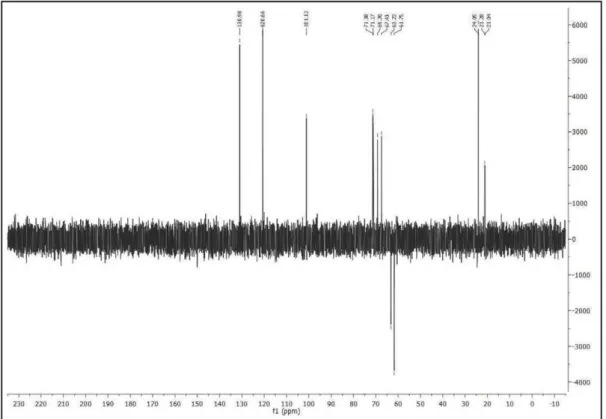
Figure S18.13C NMR DEPT (75 MHz, CDCl
3) spectrum of compound 37.
4-{4-[(β-D-galactopyranosyl)-oxymethyl]-1-H-1,2,3triazol-1-yl}benzenesulfonamide (8)6
Junqueira et al. S11 Vol. 25, No. 10, 2014
Figure S20.13C NMR (75 MHz, DMSO) spectrum of compound 8.
Figure S22. Bi-dimensional (COSY) spectrum of compound 8.
Junqueira et al. S13 Vol. 25, No. 10, 2014
Figure S24. Mass spectrum (ESI-MS) of compound 8.
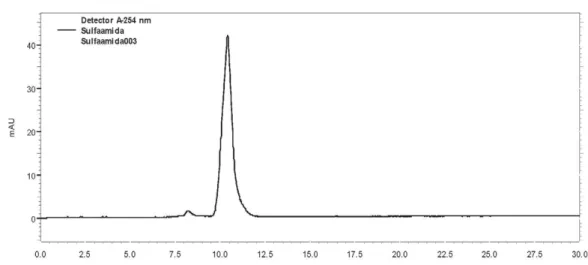
Figure S25. HPLC chromatogram of compound 8.Flow 0.9 mL min–1; mobile phase 40% MeOH, 60% H
Figure S26. 1H NMR (300 MHz, CDCl
3) spectrum of compound 38.
Figure S27. 13C NMR (75 MHz, CDCl
Junqueira et al. S15 Vol. 25, No. 10, 2014
Figure S28.13C NMR DEPT (75 MHz, CDCl
3) spectrum of compound 38.
4-{4-[(β-D-galactopyranosyl)-oxymethyl]-1-H-1,2,3-triazol-1-yl}-N-[(phenyl) sulfonyl] acetamide (9)
Figure S30. 13C NMR (75 MHz, DMSO) spectrum of compound 9.
Junqueira et al. S17 Vol. 25, No. 10, 2014
Figure S32. Bi-dimensional (COSY) spectrum of compound 9.
Figure S34. Mass spectrum (ESI-MS) of compound 9.
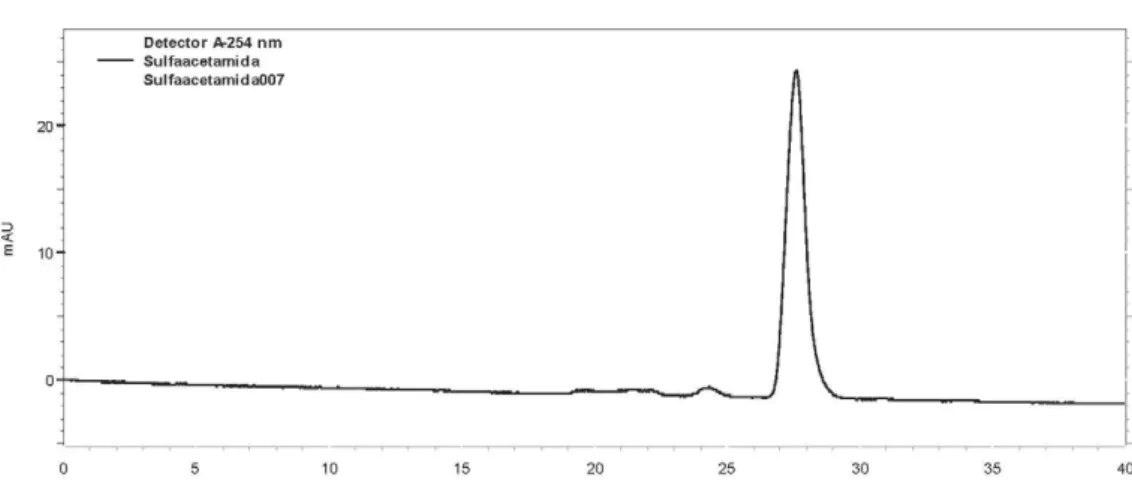
Figure S35. HPLC chromatogram of compound 9. Flow 0.9 mL min–1; mobile phase 40% MeOH, 60% H
Junqueira et al. S19 Vol. 25, No. 10, 2014
4-{4-[(2’,3’,4’,6’-Tetra-O-acetyl-β-D-galactopyranosyl)-oxymethyl]-1-H-1,2,3 triazol-1-yl}-N-(5-methylisoxazol-3-yl)
benzenesulfonamide (39)5
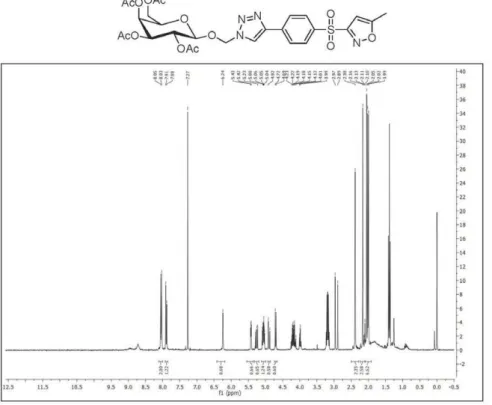
Figure S36.1H NMR (300 MHz, CDCl
3) spectrum of compound 39.
Figure S37.13C NMR (75 MHz, CDCl
Figure S38. 13C NMR (75 MHz, CDCl
3) spectrum of compound 39.
4-{4-[(β-D-galactopyranosyl)-oxymethyl]-1-H-1,2,3-triazol-1-yl}-N-(5-methyl isoxazol-3-yl)benzenesulfonamide (10)
Figure S39. 1H NMR (300 MHz, CD
Junqueira et al. S21 Vol. 25, No. 10, 2014
Figure S40. 13C NMR (75 MHz, CD
3OD) spectrum of compound 10.
Figure S41.13C NMR DEPT (75 MHz, CD
Figure S42. Bi-dimensional (COSY) spectrum of compound 10.
Junqueira et al. S23 Vol. 25, No. 10, 2014
Figure S44. Mass spectrum (ESI-MS) of compound 10.
Figure S45. HPLC chromatogram of compound 10.Flow 0.9 mL min-1; mobile phase 40% MeOH, 60% H
Figure S46.1H NMR (300 MHz, CDCl
3) spectrum of compound 40.
Figure S47. 13C NMR (75 MHz, CDCl
Junqueira et al. S25 Vol. 25, No. 10, 2014
Figure S48.13C NMR DEPT (75 MHz, CDCl
3) spectrum of compound 40.
4-{4-[(β-D-galactopyranosyl)-oxymethyl]-1-H-1,2,3-triazol-1-yl}-N-(4-methyl pyrimidin-2-yl)benzenesulfonamide (11)
Figure S49.1H NMR (300 MHz, D
Figure S50.13C NMR (75 MHz, D
2O) spectrum of compound 11.
Figure S51. 13C NMR DEPT (75 MHz, D
Junqueira et al. S27 Vol. 25, No. 10, 2014
Figure S52. Bi-dimensional (COSY) spectrum of compound 11.
Figure S54. Mass spectrum (ESI-MS) of compound 11.
Figure S55. HPLC chromatogram of compound 11.Flow 0.9 mL min-1; mobile phase 40% MeOH, 60% H
Junqueira et al. S29 Vol. 25, No. 10, 2014
4-{4-[(2’,3’,4’,6’-tetra-O-acetyl-β-D-galactopyranosyl)-oxymethyl]-1-H-1,2,3 triazol-1-yl}-N-(4,6-dimethylpyrimidin-2-yl)
benzenesulfonamide (41)5
Figure S56.1H NMR (400 MHz, CDCl
3) spectrum of compound 41.
Figure S57.13C NMR (100 MHz, CDCl
Figure S58.13C NMR DEPT (100 MHz, CDCl
3) spectrum of compound 41.
4-{4-[(β-D-galactopyranosyl)-oxymethyl]-1-H-1,2,3-triazol-1-yl}-N-(4,6-dimethyl pyrimidin-2-yl) benzenesulfonamide (12)
Figure S59.1H NMR (300 MHz, CD
Junqueira et al. S31 Vol. 25, No. 10, 2014
Figure S60.13C NMR (75 MHz, CD
3OD) spectrum of compound 12.
Figure S61.13C NMR DEPT (75 MHz, CD
Figure S62. Bi-dimensional (COSY) spectrum of compound 12.
Junqueira et al. S33 Vol. 25, No. 10, 2014
Figure S64. Mass spectrum (ESI-MS) of compound 12.
Figure S65. HPLC chromatogram of compound 12.Flow 0.9 mL min-1; mobile phase 40% MeOH, 60% H
Figure S66.1H NMR (400 MHz, CDCl
3) spectrum of compound 42.
Figure S67.13C NMR (100 MHz, CDCl
Junqueira et al. S35 Vol. 25, No. 10, 2014
Figure S68.13C NMR DEPT (100 MHz, CDCl
3) spectrum of compound 42.
4-{4-[(β-D-galactopyranosyl)-oxymethyl]-1-H-1,2,3-triazol-1-yl}-N-(2,6-dimethoxy pyrimidin-4-yl)benzenesulfonamide (13)
Figure S69.1H NMR (300 MHz, CD
Figure S70. 13C NMR (75 MHz, CD
3OD) spectrum of compound 13.
Figure S71. 13C NMR DEPT(75 MHz, CD
Junqueira et al. S37 Vol. 25, No. 10, 2014
Figure S72. Bi-dimensional spectrum (HMQC) of compound 13.
4-{4-[(2’,3’,4’,6’-Tetra-O-acetyl-β-D-galactopyranosyl)-oxymethyl]-1-H-1,2,3triazol-1-yl}benzenesulfa-ortho-pyridine (43)5
Figure S75.1H NMR (400 MHz, CDCl
Junqueira et al. S39 Vol. 25, No. 10, 2014
Figure S76. 13C NMR (100 MHz, CDCl
3) spectrum of compound 43.
Figure S77. 13C NMR (100 MHz, CDCl
Figure S78. 1H NMR (300 MHz, CD
3OD) spectrum of compound 14.
Figure S79. 13C NMR (75 MHz, CD
Junqueira et al. S41 Vol. 25, No. 10, 2014
Figure S80.13C NMR DEPT (75 MHz, CD
3OD) spectrum of compound 14.
Figure S82. Bi-dimensional spectrum (HMQC) of compound 14.
Junqueira et al. S43 Vol. 25, No. 10, 2014
Figure S84. HPLC chromatogram of compound 14.Flow 0.9 mL min-1; mobile phase 40% MeOH, 60% H
2O, TFA 0.1%; temp. 24.5 °C.
References
1. Bräse, S.; Gil, C.; Knepper, K.; Zimmermann, V.; Angew. Chem., Int. Ed.2005,44, 5188. 2. Barral, K.; Moorhouse, A. D.; Moses, J. E.; Org. Lett.2007, 9, 1809.
3. Kappe, C. O.; Angew. Chem., Int. Ed.2004, 43, 6250.
4. Muthana, S.; Yu, H.; Huang, S.; Chen, X.; J. Am. Chem. Soc. 2007, 129, 11918.
5. Huisgen, R.; Angew. Chem. Int., Ed. Engl. 1963, 2, 633; Rostovtsev, V. V.; Green, L. G.; Fokin, V. V.; Sharpless, K. B.; Angew. Chem., Int.