CPD
11, 637–670, 2015Trace metal evidence for a poorly ventilated glacial
Southern Ocean
M. Wagner and I. L. Hendy
Title Page
Abstract Introduction
Conclusions References
Tables Figures
◭ ◮
◭ ◮
Back Close
Full Screen / Esc
Printer-friendly Version
Interactive Discussion
Discussion
P
a
per
|
Discussion
P
a
per
|
Discussion
P
a
per
|
Discussion
P
a
per
Clim. Past Discuss., 11, 637–670, 2015 www.clim-past-discuss.net/11/637/2015/ doi:10.5194/cpd-11-637-2015
© Author(s) 2015. CC Attribution 3.0 License.
This discussion paper is/has been under review for the journal Climate of the Past (CP). Please refer to the corresponding final paper in CP if available.
Trace metal evidence for a poorly
ventilated glacial Southern Ocean
M. Wagner1,*and I. L. Hendy1
1
Department of Earth and Environmental Sciences, University of Michigan, 1100 N University Ave, Ann Arbor, MI 48109, USA
*
now at: Department of Earth and Atmospheric Sciences, Central Michigan University, Brooks Hall 314, Mount Pleasant, MI 48859, USA
Received: 4 December 2014 – Accepted: 10 February 2015 – Published: 11 March 2015
Correspondence to: M. Wagner ([email protected])
CPD
11, 637–670, 2015Trace metal evidence for a poorly ventilated glacial
Southern Ocean
M. Wagner and I. L. Hendy
Title Page
Abstract Introduction
Conclusions References
Tables Figures
◭ ◮
◭ ◮
Back Close
Full Screen / Esc
Printer-friendly Version
Interactive Discussion
Discussion
P
a
per
|
Discussion
P
a
per
|
Discussion
P
a
per
|
Discussion
P
a
per
|
Abstract
Glacial benthic δ13C and ∆14C measurements from the Atlantic Ocean have been interpreted to indicate the existence of a poorly ventilated Southern Ocean with greater CO2 and nutrient contents compared to present. Enhanced storage of CO2 in the deep ocean predicts that oxygen concentrations should have declined at the same 5
time, although no unequivocal evidence for glacial Southern Ocean suboxia has yet been found. Here we take a novel approach by using concentrations of redox-sensitive trace metals to show that Southern Ocean sediments from two cores in the Atlantic sector were suboxic during deglaciation and the last glacial period, implying reduced ventilation and/or elevated export production that significantly altered deep water 10
chemistry. In the Cape Basin, high concentrations of the authigenically deposited trace metal Re coincide with oldest∆14C values at 3.8 km water depth in the Subantarctic Zone, indicating that poorest Southern Ocean ventilation occurred during the Last Glacial Maximum (∼23–19 ka). Furthermore, trace metal results suggest that the vertical structure of the glacial Southern Ocean differed from modern deep water mass 15
arrangement such that Lower Circumpolar Deep Water had lower O2 concentrations, and therefore was the likely reservoir of glacial CO2.
1 Introduction
Ice core records demonstrate that atmospheric CO2 concentrations (pCO2) were 80–100 ppm lower than preindustrial levels during glacial intervals of the last ∼ 20
400 000 years (Petit et al., 1999). Of the ∼40–50 ppm pCO2 decrease currently
unaccounted for, the most plausible storage location for this “missing” glacial CO2 is the deep ocean because it is the largest easily exchangeable reservoir of carbon on the planet (Sigman and Boyle, 2000). Paleoclimate studies have targeted the Southern Ocean as a primary regulator for glacial–interglacial atmospheric CO2 25
CPD
11, 637–670, 2015Trace metal evidence for a poorly ventilated glacial
Southern Ocean
M. Wagner and I. L. Hendy
Title Page
Abstract Introduction
Conclusions References
Tables Figures
◭ ◮
◭ ◮
Back Close
Full Screen / Esc
Printer-friendly Version
Interactive Discussion
Discussion
P
a
per
|
Discussion
P
a
per
|
Discussion
P
a
per
|
Discussion
P
a
per
exchange with the deep ocean and by downward CO2transfer via the biological pump (Marinov et al., 2006). Proposed physical mechanisms for drawing down atmospheric CO2 during glacial intervals include increased Southern Ocean vertical stratification
(Francois et al., 1997) and (subsequently) decreased deep ocean ventilation rate (Toggweiler, 1999). Because O2 is only added at the sea surface, if glacial Southern
5
Ocean ventilation was reduced, continuous organic matter respiration as deep waters “aged” would have caused CO2 and nutrients to accumulate as O2 was consumed. Hence bottom water O2concentrations provide an indirect assessment of whether the
biological pump and/or changes to ocean vertical water column structure enhanced deep Southern Ocean CO2storage during glacial intervals.
10
A recent compilation (Jaccard and Galbraith, 2012) of sedimentary oxygenation proxies documents increased deep ocean ventilation between the Last Glacial Maximum (LGM) and the early Holocene. Other studies have sought to characterize global glacial–interglacial circulation and deep ocean ventilation changes using benthic
13
C/12C ratios (δ13C) (e.g., Curry and Oppo, 2005; Herguera et al., 2010; Hodell et al., 15
2003; Ninnemann and Charles, 2002) or ∆14C (e.g., Keigwin, 2004; Robinson et al., 2005; Skinner et al., 2014) derived from sedimentary CaCO3. The longer a water mass is isolated from the surface and the more nutrients it accumulates, the lower theδ13C of its pCO2 (Broecker and Peng, 1982). Similarly, surface waters dissolve CO2 with an atmospheric14C signature, but once a water mass leaves the sea surface, its14C 20
content diminishes – increasing the offset from the atmosphere – as the radiocarbon decays (Broecker and Peng, 1982).
In the Atlantic Ocean, glacialδ13C and ∆14C data imply different Southern Ocean chemistry potentially resulting from changes to deep ocean vertical stratification and mixing. South Atlantic benthic δ13C values that are more than 1 ‰ lower than 25
CPD
11, 637–670, 2015Trace metal evidence for a poorly ventilated glacial
Southern Ocean
M. Wagner and I. L. Hendy
Title Page
Abstract Introduction
Conclusions References
Tables Figures
◭ ◮
◭ ◮
Back Close
Full Screen / Esc
Printer-friendly Version
Interactive Discussion
Discussion
P
a
per
|
Discussion
P
a
per
|
Discussion
P
a
per
|
Discussion
P
a
per
|
cannot uniquely identify whether bottom water masses were oxygen-poor and/or export productivity was high. Paired benthic-planktonic14C ventilation measurements from the northwest Atlantic Ocean (Keigwin, 2004; Keigwin and Schlegel, 2002; Robinson et al., 2005) are also consistent with an “old” Southern-sourced water mass below ∼2.5– 3 km water depth. However,∆14C is also affected by water mass mixing, and robust 5
interpretation of this proxy requires accurate determination of surface ocean reservoir age. As an added complication, both δ13C and ∆14C measurements require good carbonate preservation, but CaCO3is poorly preserved in the CO2-rich waters south
of the Antarctic Polar Front (Howard and Prell, 1994). Because every proxy is subject to a unique set of biases, agreement among several proxies increases confidence 10
in our interpretations. Thus, it is prudent to seek additional evidence for decreased bottom water O2/increased CO2 concentrations in the glacial Southern Ocean from
other proxies.
Redox-sensitive trace metals are reliable proxies for sedimentary pore water redox conditions (especially in the high latitude Southern Ocean where sediments contain 15
primarily biogenic silica and little to no CaCO3; Diekmann, 2007) and provide
an alternative approach to reconstructing deep water ventilation. Additionally, by examining a suite of trace metals it is possible to disentangle the relationship between low-oxygen bottom waters and intensive oxidation of organic matter in sediments that can produce reducing sedimentary pore waters. In this study we measured the 20
redox-sensitive trace metals Ag, Cd, Re, and Mo to reconstruct deep Southern Ocean oxygenation history over the last ∼30 kyr for two piston cores from the deep South Atlantic Ocean: RC13-254 (48.57◦S, 5.127◦E, 3636 m water depth), from the Cape
Basin; and TN057-13-4PC (53.1728◦S, 5.1275◦E, 2848 m water depth), from the open
ocean Antarctic Zone (Fig. 1). Additionally, we present new organic carbon (Corg)
25
CPD
11, 637–670, 2015Trace metal evidence for a poorly ventilated glacial
Southern Ocean
M. Wagner and I. L. Hendy
Title Page
Abstract Introduction
Conclusions References
Tables Figures
◭ ◮
◭ ◮
Back Close
Full Screen / Esc
Printer-friendly Version
Interactive Discussion
Discussion
P
a
per
|
Discussion
P
a
per
|
Discussion
P
a
per
|
Discussion
P
a
per
2 Background
2.1 Trace metal geochemistry
Because trace metals are supplied to sediments via a number of different delivery mechanisms, a suite of trace metals is required to differentiate the processes that produce reducing conditions in pore waters. Here we follow the definition of 5
Berner (1981), and classify sediments whose pore waters contain no measurable
dissolved oxygen or dissolved sulfide as suboxic, and those whose pore waters contain measurable dissolved sulfide as anoxic. Onset of suboxic conditions occurs between the reduction potentials of Mn and NO−
3 reduction (Froelich et al., 1979).
Silver and Cd are thought to be delivered by sinking biogenic particles (Hendy and 10
Pedersen, 2005; Wagner et al., 2013) and preserved as their respective sulfides where trace quantities of dissolved sulfide are present (Crusius and Thomson, 2003; Rosenthal et al., 1995b). Hence, enhanced preservation of these metals indicates suboxic conditions caused by a high flux of organic matter (Hendy and Pedersen, 2005). Cadmium also displays a strong tendency toward authigenic precipitation in 15
sediments where reducing conditions occur close to the sediment–water interface (Calvert and Pedersen, 1993; Pedersen et al., 1989; Rosenthal et al., 1995b). In contrast, authigenic Ag2S precipitation appears to be negligible except in severely anoxic sediments where sulfate reduction is occurring (McKay and Pedersen, 2008). Elevated Re concentrations also indicate pore water suboxia. Rhenium exists in 20
seawater as the conservative perrhenate anion (ReO−
4) (Koide et al., 1986). It diffuses
into sediments along concentration gradients and precipitates directly from seawater under reducing conditions, possibly as ReO2 (Crusius et al., 1996), although the
probability for this reaction to proceed spontaneously in typical seawater has recently been questioned (Helz and Dolor, 2012; and references therein). Due to its low crustal 25
CPD
11, 637–670, 2015Trace metal evidence for a poorly ventilated glacial
Southern Ocean
M. Wagner and I. L. Hendy
Title Page
Abstract Introduction
Conclusions References
Tables Figures
◭ ◮
◭ ◮
Back Close
Full Screen / Esc
Printer-friendly Version
Interactive Discussion
Discussion
P
a
per
|
Discussion
P
a
per
|
Discussion
P
a
per
|
Discussion
P
a
per
|
and/or Cd indicate that low bottom water O2 concentrations were likely present, and this deficit was primarily responsible for suboxia in underlying sediments.
Molybdenum enrichment occurs under anoxic conditions and requires measurable sulfide levels to precipitate. In seawater Mo is present as the conservative molybdate anion (MoO2−
4 ). Under oxic conditions, Mo associates with Mn-oxyhydroxides (Calvert
5
and Pedersen, 1993; Zheng et al., 2000) which produces low-level enrichments unrelated to reductive processes. When redox conditions become favorable to Mn-oxyhydroxide reduction, adsorbed Mo can be released to pore waters (Crusius et al., 1996), decreasing preserved solid-phase Mo. Significant enrichments of Mo (up to tens of ppm in non-euxinic settings (Scott and Lyons, 2012)) above lithogenic background 10
are controlled by pore water H2S concentrations. At sulfide concentrations below ∼11 µM, progressive substitution of O for S atoms occurs in molybdate, leading to the formation of multiple thiomolybdate species (MoOxS
2−
4−x) that co-precipitate as a labile
Mo-Fe-S phase (Erickson and Helz, 2000; Helz et al., 1996). The substitution reaction is kinetically slow, but above the threshold value of 11 µM, a “geochemical switch” 15
(Helz et al., 1996) is flipped and complete conversion to MoS2−
4 (tetrathiomolybdate)
occurs. Downcore measurements of Mo and H2S in Santa Barbara Basin sediments provide empirical support for this theoretical “geochemical switch” (Zheng et al., 2000). Tetrathiomolybdate is highly particle-reactive and adsorbs to pyrite, after which it is retained in sediments as a Mo-Fe-S cubane compound (Bostick et al., 2003). Above 20
sulfide concentrations of∼100 µM, direct precipitation of a discrete Mo-sulfide phase is hypothesized to occur (Zheng et al., 2000). Similar to Re, elevated Mo concentrations not coupled with increased Ag and/or Cd concentrations imply that low bottom water O2concentrations caused anoxic conditions in pore waters.
Because Ag and Cd delivery to sediments is associated with biogenic particles, 25
CPD
11, 637–670, 2015Trace metal evidence for a poorly ventilated glacial
Southern Ocean
M. Wagner and I. L. Hendy
Title Page
Abstract Introduction
Conclusions References
Tables Figures
◭ ◮
◭ ◮
Back Close
Full Screen / Esc
Printer-friendly Version
Interactive Discussion
Discussion
P
a
per
|
Discussion
P
a
per
|
Discussion
P
a
per
|
Discussion
P
a
per
et al., 1996; Morford et al., 2009), minimizing any offset with the sediment age. A quantitative relationship has yet to be shown between sedimentary trace metal accumulation and export production or bottom water ventilation due to the combined effects of biogenic particle remineralization, sedimentation rate, dilution by other phases, and post-depositional re-oxidation of trace metals. For this reason, trace 5
metals can provide a qualitative determination of the relative importance of export production vs. bottom water ventilation by comparing Ag and Cd (metals associated with biodetritus) enrichments with Re and Mo (authigenic metals) enrichments. For this study, when Ag and/or Cd concentrations increase with increasing Re and/or Mo concentrations, we interpret this pattern as high export production that depletes 10
sedimentary oxidants. When Ag and/or Cd concentrations decrease with increasing Re and/or Mo concentrations, we interpret this pattern as a relative decrease in export production and concomitant decrease in bottom water oxygenation. However it is important to note that export production and bottom water oxygenation may operate synergistically to produce contemporaneous trace metal enrichments.
15
2.2 Oceanographic setting
Core TN057-13-4PC was recovered from a small sedimentary basin northeast of Bouvet Island, at the same location as ODP Site 1094 (Kanfoush et al., 2002), so the two cores can be directly compared. Presently, TN057-13-4PC is located slightly to the south of the Southern ACC Front (Orsi et al., 1995) and ∼2◦ north of the 20
average winter sea ice edge (Kanfoush et al., 2002). Primary productivity in this region is high (Moore and Abbott, 2000) and dominated by the heavily-silicified diatom
Fragilariopsis kerguelensis(Abelmann et al., 2006). Sediments are composed primarily
of diatomaceous ooze and diatom mud (Shipboard Scientific Party, 1999b). Site RC13-254 is located southwest of Meteor Rise in the Cape Basin, on the northern edge of the 25
CPD
11, 637–670, 2015Trace metal evidence for a poorly ventilated glacial
Southern Ocean
M. Wagner and I. L. Hendy
Title Page
Abstract Introduction
Conclusions References
Tables Figures
◭ ◮
◭ ◮
Back Close
Full Screen / Esc
Printer-friendly Version
Interactive Discussion
Discussion
P
a
per
|
Discussion
P
a
per
|
Discussion
P
a
per
|
Discussion
P
a
per
|
sediments in the upper portion of the core are composed primarily of CaCO3 and transition to diatomaceous ooze during deglaciation (Charles et al., 1991).
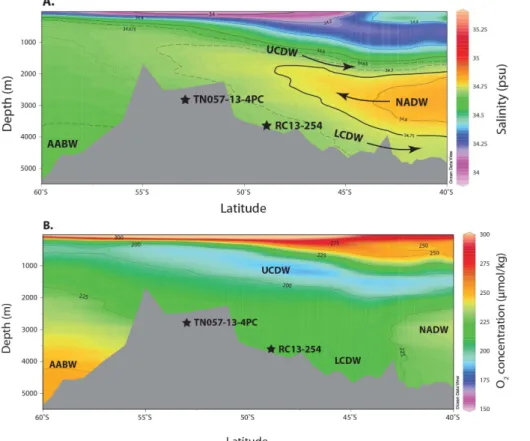
Today both cores are overlain by Lower Circumpolar Deep Water (LCDW) (Fig. 2), a cold, saline, recirculating water mass of the Antarctic Circumpolar Current (ACC). Modern LCDW is a mixture of North Atlantic Deep Water (NADW), Antarctic Shelf 5
Waters, and recirculated Pacific and Indian Deep Waters (PDW and IDW) that is exported to the three major ocean basins through Deep Western Boundary Currents (Talley, 2008). LCDW is ventilated from the north by penetration of NADW into the ACC, and from the south by upward mixing of Antarctic Bottom Water (Orsi et al., 1999). (Note, however, that bottom waters overlying TN057-13-4PC receive less influence 10
from NADW than sites further to the north (Shipboard Scientific Party, 1999a), such as RC13-254/ODP 1091.) Once LCDW enters the Indian and Pacific basins, it upwells diapycnally to form the major volume of PDW and IDW. These subsequently re-enter the Atlantic basin through Drake Passage, mix with ACC waters, and upwell isopycnally to form modern Upper Circumpolar Deep Water (UCDW) (Talley, 2008), a nutrient-15
rich and slightly lower-oxygen water mass. Thus in the modern ACC, waters are well ventilated but the vertical water column structure can be characterized as having a lower-oxygen water mass overlying a higher-oxygen water mass (Fig. 2b).
3 Methods and materials
3.1 Trace metal and organic carbon analysis
20
Cores were sampled at millennial- to submillennial-scale resolution from the core tops to ∼30 ka. Concentrations of Ag, Cd, Re, and Mo were measured at the University of Michigan Keck Environmental Geochemistry Laboratory (KEGL) by isotope dilution inductively coupled plasma-mass spectrometry (ID ICP-MS) using a Finnigan Element mass spectrometer. Prior to analysis, samples were spiked and subjected to total 25
CPD
11, 637–670, 2015Trace metal evidence for a poorly ventilated glacial
Southern Ocean
M. Wagner and I. L. Hendy
Title Page
Abstract Introduction
Conclusions References
Tables Figures
◭ ◮
◭ ◮
Back Close
Full Screen / Esc
Printer-friendly Version
Interactive Discussion
Discussion
P
a
per
|
Discussion
P
a
per
|
Discussion
P
a
per
|
Discussion
P
a
per
HF, HCl, and HNO3 (Crusius et al., 1996). An aliquot was removed from digested samples for Cd and Ag analysis and passed through a column of Dowex 1X-8 resin to remove interfering isotopes. Working spike concentrations and ratios of109Ag/107Ag,
111
Cd/113Cd,185Re/187Re, and95Mo/97Mo were calibrated using natural element ICP standards (Ricca Chemical Company). Errors are reported as one-sigma standard 5
deviations for each run based on repeated analysis of the sediment standard MESS-3. Weight percent organic carbon (Corg) was determined by paired analysis of acidified and unacidified bulk sediment samples using a Costech ECS4010 elemental analyzer. Relative SD is 3 % based on duplicate analysis of∼10 % of samples.
3.2 Age models
10
Published age models were used for both cores. The initial age model for core RC13-254 (Charles et al., 1991) was based on oxygen isotope chronostratigraphy. More recently, calibrated14C dates have been incorporated that indicate that the core top is ∼7 kyr younger than originally estimated, and the age model for the upper∼190 cm of RC13-254 has been modified accordingly (R. F. Anderson, personal communication, 15
2011; Anderson et al., 1998; Kumar et al., 1995). The age of the core top (0–1 cm) was set to 3500 years before present. A constant sedimentation rate was assumed between age-depth points provided by R. F. Anderson (personal communication). The age model for core TN057-13-4PC is based on a series of 14C dates (Shemesh et al., 2002) that were recalibrated using the program CALIB 6.0 and the Marine09 20
CPD
11, 637–670, 2015Trace metal evidence for a poorly ventilated glacial
Southern Ocean
M. Wagner and I. L. Hendy
Title Page
Abstract Introduction
Conclusions References
Tables Figures
◭ ◮
◭ ◮
Back Close
Full Screen / Esc
Printer-friendly Version
Interactive Discussion
Discussion
P
a
per
|
Discussion
P
a
per
|
Discussion
P
a
per
|
Discussion
P
a
per
|
4 Results and discussion
4.1 Oxidative burndown
Oxidative burndown occurs when previously deposited sediments become re-exposed to oxygen, remobilizing reduced trace metal phases. It is more likely to occur in slowly accumulating sediments and during times of rapid environmental change, such as 5
during a glacial–interglacial transition (Tribovillard et al., 2006). Once remobilized, trace metals can either diffuse downward into the sediment column if concentration gradients decrease in that direction, or diffuse upward out of sediments into the water column. In the former case, evidence of oxidative burndown usually presents as a sharp peak below a redox front. The effect has been observed downcore for Re in organic 10
carbon-rich turbidites (Crusius and Thomson, 2003) and for Cd and U in Subantarctic sediments (Rosenthal et al., 1995a) directly below the glacial–interglacial transition.
Burndown is likely to have affected the upper ∼200 cm of TN057-13-4PC and the upper∼60–70 cm of 254. Evidence for oxidative burndown is clearest for RC13-254. An abrupt transition from very low to glacial-level trace metal concentrations 15
occurs between∼60 and 70 cm core depth (∼13–13.5 ka), coinciding with decreases in pore water NO−
3 and increases in pore water Mn concentrations at a nearby core
(King et al., 2000). No evidence for oxidative burndown is apparent further downcore as at no other point do all redox-sensitive trace metals decrease abruptly and coherently to crustal concentrations. Muted trace metal enrichments in TN057-13-4PC from the 20
core top to ∼200 cm (∼5.5 ka) suggest the onset of oxidative burndown during the late Holocene. However, NO−
3 and Mn pore water profiles (King et al., 2000) indicate
that the present oxic-suboxic transition occurs ∼20–30 cm core depth (∼0.7–1 ka), implying that a slowdown in trace metal delivery rather than re-oxidation may exert primary control over trace metal enrichments in the upper portion of the core.
25
CPD
11, 637–670, 2015Trace metal evidence for a poorly ventilated glacial
Southern Ocean
M. Wagner and I. L. Hendy
Title Page
Abstract Introduction
Conclusions References
Tables Figures
◭ ◮
◭ ◮
Back Close
Full Screen / Esc
Printer-friendly Version
Interactive Discussion
Discussion
P
a
per
|
Discussion
P
a
per
|
Discussion
P
a
per
|
Discussion
P
a
per
880 cm core depth (∼21.6–26.9 ka) indicate possible burndown. If true, co-occurring Re peaks appear to have migrated further downcore. However, U fluxes increase slightly from ∼832 to 884 cm (∼22.1–26.5 ka) (Anderson et al., 2009), suggesting that burndown was minimal or affected U in a similar – though less severe – manner to Ag and Cd. Changes in Corg flux can control the onset of burndown (Crusius and
5
Thomson, 2000) and may help to diagnose when burndown began. Sedimentary Corg
concentrations in TN057-13-4PC decline from a maximum of about 0.5 % to about 0.3 % from 30 ka to the end of MIS 3 (∼22 ka), coincident with the large Ag, Cd, and Re peaks. Subsequently, agreement among Ag, Cd, Re, and Corg peaks between
∼760 and 820 cm (∼16.2–21.6 ka) suggests a true increase in export productivity. 10
Sedimentary Corgconcentrations in the Antarctic Zone thereforeincreasegoing into the LGM and a decrease in the intensity of organic matter respiration cannot be responsible for re-oxygenation of sediments. Rather, burndown appears to have occurred sometime during late MIS 3. Therefore, with the evidence at hand, we will assume that oxidative burndown has had a minimal effect on trace metal concentrations near the glacial– 15
interglacial transition.
4.2 Glacial–interglacial changes in Southern Ocean redox conditions
Trace metal concentrations in Holocene-age sediments reported here for the Atlantic sector Southern Ocean are low, similar to those measured for Pacific sector core top sediments both within and outside the opal belt (Wagner et al., 2013). These 20
data suggest that marine chemistry unfavorable to trace metal accumulation exists throughout the modern Southern Ocean. In contrast, trace metal concentrations at both sites are significantly higher downcore (Figs. 3a–d, 4a–d). Although both RC13-254 and TN057-13-4PC are situated in the open ocean, trace metal concentrations in deglacial- and glacial-age sediments are similar to concentrations found at modern 25
CPD
11, 637–670, 2015Trace metal evidence for a poorly ventilated glacial
Southern Ocean
M. Wagner and I. L. Hendy
Title Page
Abstract Introduction
Conclusions References
Tables Figures
◭ ◮
◭ ◮
Back Close
Full Screen / Esc
Printer-friendly Version
Interactive Discussion
Discussion
P
a
per
|
Discussion
P
a
per
|
Discussion
P
a
per
|
Discussion
P
a
per
|
such as the eastern Pacific Ocean where dissolved oxygen concentrations are much lower than the∼200–225 µM typical of modern LCDW (Fig. 2b).
At RC13-254 (Cape Basin, modern APFZ), the obvious difference in trace metal enrichments between late MIS 2 and the late Holocene (Fig. 3a–d) indicates a significant change in deep Southern Ocean chemistry∼3.6 km water depth. Prior to 5
∼13.5 ka, the record presents a strong case for pore water suboxia near the sediment– water interface. During MIS 3, mostly elevated Ag (79–273 ppb) and Cd (0.22– 1.26 ppm) concentrations coupled with a trend of relatively stable Re concentrations (average 16.3 ppb) that do not correspond to changes in Ag and Cd concentrations suggest that low bottom water O2concentrations acted synergistically with variations in 10
primary productivity to produce suboxic pore waters. Transitioning into the Last Glacial Maximum (∼19.1–21.1 ka; ∼181–206 cm), decreasing Ag and Cd and increasing Re concentrations (maximum 38.5 ppb) suggest that low bottom water O2concentrations
became more important in controlling sedimentary redox conditions. Subsequent deglacial increases in Ag and Cd concentrations that correspond to Re concentrations 15
from∼13.5–19.1 ka (∼70–181 cm) imply that suboxic pore waters resulted primarily from high organic matter flux to sediments. After ∼13.5 ka (above ∼70 cm), Ag, Cd, and Re concentrations greatly decrease to near or below crustal concentrations, probably due to oxidative burndown (see Sect. 4.1). The Mo record is dissimilar to the other trace metals and suggests little, if any, authigenic enrichment (Fig. 3d). 20
A possible exception occurs∼25.4 ka (∼309 cm) when a corresponding increase in Cd concentrations is observed.
Glacial- and deglacial-age Ag, Cd, and Re enrichments (Fig. 3a–c) do not likely result from lithogenic input. Estimates of terrigenous content do not exceed 35 % (Latimer and Filippelli, 2001, Fig. 3g) and Ag, Cd, and Re concentrations are nearly always greater 25
CPD
11, 637–670, 2015Trace metal evidence for a poorly ventilated glacial
Southern Ocean
M. Wagner and I. L. Hendy
Title Page
Abstract Introduction
Conclusions References
Tables Figures
◭ ◮
◭ ◮
Back Close
Full Screen / Esc
Printer-friendly Version
Interactive Discussion
Discussion
P
a
per
|
Discussion
P
a
per
|
Discussion
P
a
per
|
Discussion
P
a
per
The pattern of trace metal enrichments at TN057-13-4PC (modern Antarctic Zone) is dissimilar to that at RC13-254. The overall record (Fig. 4a–d) suggests that bottom waters at the site have been well ventilated for approximately the last 25 kyr, with organic matter respiration mostly responsible for periods of sedimentary suboxia. Silver, Cd, and Re show large enrichments prior to∼16 ka (below∼760 cm) (Fig. 4a– 5
c). Rhenium concentrations as high as 65 ppb (Fig. 4c) between ∼25.2 and 30.6 ka (∼860–921 cm) suggest that low bottom water O2 concentrations caused suboxic
pore waters during this time. Rhenium concentrations then decrease as Ag and Cd concentrations increase to maxima of 589 ppb and 1.13 ppm, respectively, between∼ 23.4 and 25.2 ka (∼840–860 cm). These trends suggest increasing export production 10
and bottom water O2concentrations. From ∼16.2–23.4 ka (∼760–840 cm) Re peaks show reasonable agreement with Ag and Cd, indicating a change to suboxia driven by high export production. From∼11–16.2 ka (∼560–760 cm), relatively low Ag, Cd, and Re concentrations suggest improved bottom water ventilation at the site. Long-term increases in Ag, Cd, Re, and Corg concentrations between ∼5.5 and 11 ka (∼200– 15
560 cm) suggest that trace metal enrichments responded to pore water suboxia driven by high export production, but coeval opal fluxes decline. Well-oxygenated sediments similar to modern conditions appeared∼5.5 ka (∼200 cm), coincident with the onset of the Neoglacial (Hodell et al., 2001) and increased sea ice presence at the site (Stuut et al., 2004, Fig. 4h). Burndown and/or a slowdown in trace metal delivery appears to be 20
responsible for low trace metal concentrations after∼5.5 ka (see Sect. 4.1). Similar to site RC13-254, Mo concentrations are low throughout the core (Fig. 4d), thus indicating no authigenic enrichment.
Estimates of terrigenous content from Ti-normalization (Fig. 4g) suggest that increased lithogenic input probably contributed to high total Ag, Cd, and Re 25
concentrations during early MIS 2 and MIS 3. However, similar to site RC13-254, estimates of terrigenous content are no more than 55 % and therefore cannot be the only factor contributing to high trace metal concentrations. Sedimentary Corg
CPD
11, 637–670, 2015Trace metal evidence for a poorly ventilated glacial
Southern Ocean
M. Wagner and I. L. Hendy
Title Page
Abstract Introduction
Conclusions References
Tables Figures
◭ ◮
◭ ◮
Back Close
Full Screen / Esc
Printer-friendly Version
Interactive Discussion
Discussion
P
a
per
|
Discussion
P
a
per
|
Discussion
P
a
per
|
Discussion
P
a
per
|
in TN057-13-4PC. However, as noted in Sect. 4.1, it is impossible to unequivocally state that oxidative burndown near the glacial–interglacial transition has not affected the record. Additionally, increasing terrigenous input might dilute biogenic phases.
In summary, Ag, Cd, and Re enrichments in sediments from the modern APFZ (RC13-254) and the Antarctic Zone (TN057-13-4PC) reveal millennial-scale changes 5
in both productivity and bottom water ventilation. These changes indicate a significant shift in Southern Ocean water chemistry from the last glacial period and deglaciation to the late Holocene, when sedimentary trace metal accumulation is nearly absent. Additionally, the two cores are separated by only∼5◦ of latitude, and so the different trace metal records demonstrate glacial/deglacial spatial heterogeneity in the Southern 10
Ocean.
4.3 Bottom water ventilation changes
Constraining the timing, location, and intensity of bottom water ventilation changes can help to unravel the mechanism of glacial–interglacial atmospheric CO2variations. Rhenium is a valuable tool for assessing bottom water ventilation changes because 15
it precipitates directly from seawater under suboxic conditions and is not cycled with biogenic particles (Colodner et al., 1993; Crusius et al., 1996). The radiocarbon (14C) content of deep ocean waters is an alternate, more common measure of water mass ventilation that has been applied to the last glacial period and deglaciation (e.g., Broecker and Barker, 2007; Marchitto et al., 2007; Robinson et al., 2005). By comparing 20
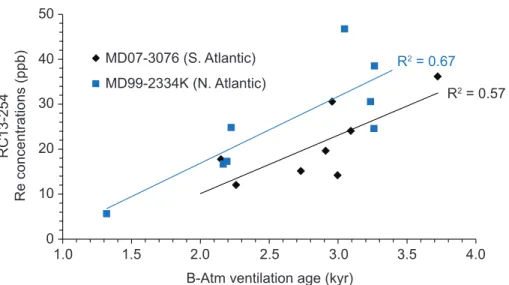
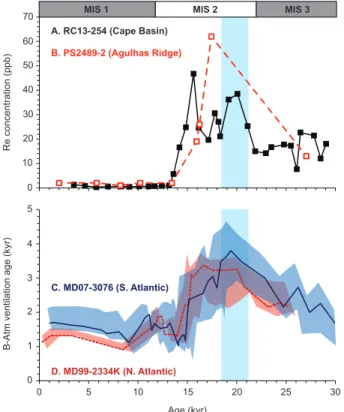
these two measures of bottom water ventilation, a consistent picture emerges in the Atlantic. Rhenium concentrations from RC13-254, ∆14C apparent ventilation ages from Subantarctic core MD07-3076 (44.074◦S, 14.208◦W, 3770 m) (Skinner et al.,
2010), and∆14C apparent ventilation ages from northeast Atlantic core MD99-2334K (37.80◦N, 10.17◦W, 3146 m) (Skinner et al., 2014) were binned into 500 year intervals
25
CPD
11, 637–670, 2015Trace metal evidence for a poorly ventilated glacial
Southern Ocean
M. Wagner and I. L. Hendy
Title Page
Abstract Introduction
Conclusions References
Tables Figures
◭ ◮
◭ ◮
Back Close
Full Screen / Esc
Printer-friendly Version
Interactive Discussion
Discussion
P
a
per
|
Discussion
P
a
per
|
Discussion
P
a
per
|
Discussion
P
a
per
measured benthic-atmospheric∆14C offsets of nearly 4 kyr (Fig. 6), thus supporting the conclusion of Skinner et al. (2010) that the carbon sequestration capacity of the Southern Ocean was enhanced at this time due to slower ventilation rates at the depth of modern LCDW. Overall, oxygen depletion appears to have intensified in the deep Atlantic as global climate moved into the full glacial conditions of the LGM, became less 5
intense during deglaciation, and then Southern Ocean oxygen concentrations reset to more modern conditions sometime after∼13.5 ka.
A lower-resolution Re record from PS2489-2 (42.873◦S, 8.973◦E, 3700 m)
(Martínez-Garcia et al., 2009, Fig. 6b) corroborates the pattern from RC13-254 of lower Re concentrations/lower ventilation ages during MIS 3 and higher Re 10
concentrations/higher ventilation ages during MIS 2. Rhenium data (this study) also support the prediction (Sarnthein et al., 2013) that oxygen-depleted conditions similar to the modern Eastern Pacific oxygen minimum zone (see Sect. 4.2) occurred in the Atlantic sector of the Southern Ocean at the LGM. Furthermore, recent deep-sea coral
∆∆14C measurements from Drake Passage (Burke and Robinson, 2012) tentatively 15
support better ventilation at depths corresponding to modern UCDW compared to LCDW during the LGM.
∆14C (MD07-3076) and trace metal (RC13-254) results therefore suggest that ocean circulation changes may have inhibited glacial LCDW from mixing with better ventilated waters and/or that vertical stratification increased, similar to conclusions drawn from 20
δ18O andδ13C tracer data (Lund et al., 2011). Other observations further support these conclusions: (1) Glacial North Atlantic Intermediate Water (GNAIW) penetrated only to ∼30◦S (Curry and Oppo, 2005), reducing ventilation from the north. Lund et al. (2011) also suggest that shoaling of modern North Atlantic Deep Water to GNAIW reduced mixing by bottom topography. (2) Indian Oceanδ15N measurements (Francois et al., 25
CPD
11, 637–670, 2015Trace metal evidence for a poorly ventilated glacial
Southern Ocean
M. Wagner and I. L. Hendy
Title Page
Abstract Introduction
Conclusions References
Tables Figures
◭ ◮
◭ ◮
Back Close
Full Screen / Esc
Printer-friendly Version
Interactive Discussion
Discussion
P
a
per
|
Discussion
P
a
per
|
Discussion
P
a
per
|
Discussion
P
a
per
|
cooling of the open ocean water column as a driver for increased brine formation (Keeling and Stephens, 2001).
The sum of the data therefore points to glacial LCDW as the storage reservoir of glacial CO2. Because modern LCDW forms the bulk of Indian and Pacific Deep Waters (Talley, 2008), a low 14C signature during the last glacial period is also expected for 5
deep Pacific and Indian Ocean sites downstream of glacial South Atlantic LCDW. In agreement with this prediction, apparent ventilation ages ∼3600 years older than modern values (and∼2500 years older than those reported by Skinner et al., 2010) were measured at Chatham Rise (Sikes et al., 2000; Vandergoes et al., 2013), where the Deep Western Boundary Current flows into the Southwest Pacific (Carter and 10
McCave, 1997). Additionally, increased LGM benthic-planktonic age differences have been observed in the deep North Pacific (Galbraith et al., 2007). Targeting glacial LCDW and its downstream deep water products (glacial IDW and PDW, as well as deep Atlantic waters; Orsi et al., 1999) allows for a radiocarbon-depleted Southern Ocean source to be diffused into a large volume of deep ocean water, thereby circumventing 15
the need for a smaller, extremely depleted14C reservoir (Broecker and Barker, 2007). Based on glacial age benthic-planktonic age differences from the western Pacific that are similar to modern values, it has been argued that an isolated,14C-depleted abyssal reservoir could only have existed below 2.8 km water depth (Broecker et al., 2008). This extremely “old” reservoir would then have dissipated by mixing into the global ocean 20
at the deglaciation (Broecker and Barker, 2007). However, Burke and Robinson (2012) point out that the age of such a reservoir would need to be less extreme if a portion of the trapped CO2 is allowed to vent directly to the atmosphere, perhaps through increased Southern Ocean upwelling (Anderson et al., 2009). Using the volume and average depth of each major ocean basin, a simple calculation estimates that the 25
CPD
11, 637–670, 2015Trace metal evidence for a poorly ventilated glacial
Southern Ocean
M. Wagner and I. L. Hendy
Title Page
Abstract Introduction
Conclusions References
Tables Figures
◭ ◮
◭ ◮
Back Close
Full Screen / Esc
Printer-friendly Version
Interactive Discussion
Discussion
P
a
per
|
Discussion
P
a
per
|
Discussion
P
a
per
|
Discussion
P
a
per
distributed, “old” oceanic carbon reservoir is so far lacking. However, benthic-planktonic age differences often assume constant surface reservoir ages. If this assumption is not valid, and surface water reservoir ages are high, the “true” age of deep waters may not be apparent. Furthermore, CaCO3 is not well preserved in the deep Pacific, and suitable samples from depths below 2.8 km are difficult to obtain (Broecker et al., 2007). 5
Presently, LCDW bathes site TN057-13-4PC (Antarctic Zone); however, the lack of strong Re enrichments (Fig. 4c; Table S1) suggests that a different, well-ventilated water mass (perhaps a glacial equivalent of UCDW) existed at 2.8 km. The contrast with ventilation records from RC13-254 (Cape Basin) showing older, more O2-depleted
glacial LCDW suggests that the modern water mass arrangement in which a lower-O2 10
component of CDW overlies a higher-O2 component may have been reversed during the last glacial period. The ventilation source at TN057-13-4PC is unclear, however, and the paucity of cores from all sectors of the Antarctic Zone leaves the glacial vertical water column structure an open question.
4.4 Comparison to other trace metal records
15
Most other trace metal records available from the Southern Ocean utilize Cd or authigenic U as suboxic indicators, although interpreting bulk sediment U is not straightforward because its accumulation is influenced by a combination of bulk sedimentation rate/sediment focusing, organic carbon rain rate, and bottom water O2
concentration (Frank et al., 2000). Higher Cd and U accumulation rates/concentrations 20
in Subantarctic sediments during the last glacial period have been primarily interpreted to record suboxic conditions caused by a northward shift of the ACC high productivity zone (Anderson et al., 1998; Bareille et al., 1998; Chase et al., 2001; Frank et al., 2000; Kumar et al., 1995; Rosenthal et al., 1995a). Elevated glacial Ag, Cd, and Corg concentrations (Fig. 3a, b, e) concur with previous work by demonstrating strong export 25
CPD
11, 637–670, 2015Trace metal evidence for a poorly ventilated glacial
Southern Ocean
M. Wagner and I. L. Hendy
Title Page
Abstract Introduction
Conclusions References
Tables Figures
◭ ◮
◭ ◮
Back Close
Full Screen / Esc
Printer-friendly Version
Interactive Discussion
Discussion
P
a
per
|
Discussion
P
a
per
|
Discussion
P
a
per
|
Discussion
P
a
per
|
fluxes at the LGM before increasing during deglaciation (Anderson et al., 1998; Frank et al., 2000), when the high productivity zone shifted southward again. Other studies from the Indian sector demonstrate modest increases in bulk sediment Cd and U accumulation rates during the LGM similar to deglacial accumulation rates (Rosenthal et al., 1995a). Organic carbon accumulation rates also show a modest increase during 5
the LGM, but afterward increase rapidly during the early deglaciation, suggesting that preservation issues could have influenced proxy accumulation. South Atlantic trace metal concentrations (this study) follow the results of Anderson et al. (1998) most closely by decreasing toward the LGM and increasing through the deglacial and Holocene (Fig. 4a–d).
10
A simple explanation of trace metal enrichment patterns is complicated by Cd and U accumulation trends that imply decreased CDW oxygen concentrations (Bareille et al., 1998; Francois et al., 1997; Rosenthal et al., 1995a) in addition to glacial– interglacial shifts of the high productivity zone. Increasing Re concentrations coupled with decreasing Ag and Cd concentrations during the LGM (Fig. 3a–c) support this 15
conclusion, and suggest that export production and bottom water O2 concentrations
both influenced trace metal accumulation north of the modern APF. However, available data do not provide a clear indication of oxygenation levels in the glacial Antarctic Zone, and how they may have changed over time. Further studies employing a suite of redox proxies are needed from all three sectors of the Southern Ocean to sufficiently 20
characterize glacial deep water ventilation.
5 Conclusions
This study is the first to present a suite of trace metal (Ag, Cd, Re, and Mo) concentrations in Atlantic sector Southern Ocean sediments over the last ∼30 kyr, recording substantial changes in regional ventilation and export production history. 25
CPD
11, 637–670, 2015Trace metal evidence for a poorly ventilated glacial
Southern Ocean
M. Wagner and I. L. Hendy
Title Page
Abstract Introduction
Conclusions References
Tables Figures
◭ ◮
◭ ◮
Back Close
Full Screen / Esc
Printer-friendly Version
Interactive Discussion
Discussion
P
a
per
|
Discussion
P
a
per
|
Discussion
P
a
per
|
Discussion
P
a
per
Southern Ocean water chemistry. Cape Basin sediments (RC13-254) were suboxic from at least ∼30 to ∼13.5 ka due to a combination of high export production and reduced bottom water ventilation. After ∼13.5 ka, trace metal concentrations fall to crustal levels as oxidative burndown erases the authigenic record. The presence of burndown underscores the glacial–interglacial redox shift in Southern Ocean water 5
mass chemistry. Furthermore, during the LGM (19–23 ka) elevated Re concentrations unconnected to export production coincide with oldest∆14C apparent ventilation ages (Skinner et al., 2010, 2014).
Trace metal enrichments in the Antarctic Zone (TN057-13-4PC) are mostly weaker than those from the Cape Basin and indicate suboxic sediments due to enhanced 10
export production from ∼16.2 to 25.2 ka, and during the early Holocene from ∼5.5 to 11 ka. Increased Re concentrations indicate that sedimentary suboxia due to poor bottom water ventilation may have existed from∼25.2 to 30.6 ka, although burndown during MIS 3 and/or at the glacial–interglacial transition cannot be entirely ruled out.
Poorer ventilation of the glacial Southern Ocean requires changes in global deep 15
ocean circulation. We hypothesize that changes in water mass mixing and stratification altered deep water chemistry such that the model of a modified modern Southern Ocean vertical water column structure may not be appropriate. Furthermore, our work suggests that glacial CO2 was stored within glacial LCDW and its downstream
products, Indian and Pacific Deep Waters and the deep Atlantic. 20
The Supplement related to this article is available online at doi:10.5194/cpd-11-637-2015-supplement.
Acknowledgements. This study was supported by a grant to M. Wagner from the Geological Society of America (GSA) and by the University of Michigan (to I. L. Hendy). Samples were provided by the Lamont-Doherty Earth Observatory Core Repository. M. Wagner thanks Bob
25
Anderson (LDEO) and Sam Jaccard (ETH Zürich) for sharing data; Ted Huston and Kate
CPD
11, 637–670, 2015Trace metal evidence for a poorly ventilated glacial
Southern Ocean
M. Wagner and I. L. Hendy
Title Page
Abstract Introduction
Conclusions References
Tables Figures
◭ ◮
◭ ◮
Back Close
Full Screen / Esc
Printer-friendly Version
Interactive Discussion
Discussion
P
a
per
|
Discussion
P
a
per
|
Discussion
P
a
per
|
Discussion
P
a
per
|
Napier for help with TOC analyses. The manuscript was greatly improved by comments from several anonymous reviewers.
References
Abelmann, A., Gersonde, R., Cortese, G., Kuhn, G., and Smetacek, V.: Extensive phytoplankton blooms in the Atlantic sector of the glacial Southern Ocean, Paleoceanography, 21, PA1013,
5
doi:10.1029/2005PA001199, 2006.
Anderson, R. F., Kumar, N., Mortlock, R. A., Froelich, P. N., Kubik, P., Dittrich-Hannen, B., and Suter, M.: Late-Quaternary changes in productivity of the Southern Ocean, J. Marine Syst., 17, 497–514, 1998.
Anderson, R. F., Ali, S., Bradtmiller, L. I., Nielsen, S. H. H., Fleisher, M. Q., Anderson, B. E.,
10
and Burckle, L. H.: Wind-driven upwelling in the Southern Ocean and the deglacial rise in
atmospheric CO2, Science, 323, 1443–1448, 2009.
Bareille, G., Labracherie, M., Bertrand, P., Labeyrie, L., Lavaux, G., and Dignan, M.: Glacial– interglacial changes in the accumulation rates of major biogenic components in Southern Indian Ocean sediments, J. Marine Syst., 17, 527–539, 1998.
15
Berner, R. A.: A new geochemical classification of sedimentary environments, J. Sediment. Petrol., 51, 359–365, 1981.
Bostick, B. C., Fendorf, S., and Helz, G. R.: Differential adsorption of molybdate and
tetrathiomolybdate on pyrite (FeS2), Environ. Sci. Technol., 37, 285–291, 2003.
Broecker, W. S. and Barker, S.: A 190 ‰ drop in atmosphere’s ∆14C during the “Mystery
20
Interval” (17.5 to 14.5 kyr), Earth Planet. Sc. Lett., 256, 90–99, 2007.
Broecker, W. S. and Peng, T.-H.: Tracers in the Sea, Lamont-Doherty Geological Observatory, Palisades, NY, 1982.
Broecker, W. S., Clark, E., Barker, S., Hajdas, I., Bonani, G., and Moreno, E.: Radiocarbon age of late glacial deep water from the equatorial Pacific, Paleoceanography, 22, PA2206,
25
doi:10.1029/2006PA001359, 2007.
Broecker, W. S., Clark, E., and Barker, S.: Near constancy of the Pacific Ocean surface to
mid-depth radiocarbon-age difference over the last 20 kyr, Earth Planet. Sc. Lett., 274, 322–326,
CPD
11, 637–670, 2015Trace metal evidence for a poorly ventilated glacial
Southern Ocean
M. Wagner and I. L. Hendy
Title Page
Abstract Introduction
Conclusions References
Tables Figures
◭ ◮
◭ ◮
Back Close
Full Screen / Esc
Printer-friendly Version
Interactive Discussion
Discussion
P
a
per
|
Discussion
P
a
per
|
Discussion
P
a
per
|
Discussion
P
a
per
Burke, A. and Robinson, L. F.: The Southern Ocean’s role in carbon exchange during the last deglaciation, Science, 335, 557–561, 2012.
Calvert, S. E. and Pedersen, T. F.: Geochemistry of recent oxic and anoxic marine sediments: implications for the geological record, Mar. Geol., 113, 67–88, 1993.
Carter, L. and McCave, I. N.: The sedimentary regime beneath the Deep Western Boundary
5
Current inflow to the southwest Pacific Ocean, J. Sediment. Res., 67, 1005–1017, 1997. Charles, C. D., Froelich, P. N., Zibello, M. A., Mortlock, R. A., and Morley, J. J.: Biogenic opal
in Southern Ocean sediments over the last 450 000 years: implications for surface water chemistry and circulation, Paleoceanography, 6, 697–728, 1991.
Chase, Z., Anderson, R. F., and Fleisher, M. Q.: Evidence from authigenic uranium for increased
10
productivity of the glacial Subantarctic Ocean, Paleoceanography, 16, 468–478, 2001. Colodner, D., Sachs, J., Ravizza, G., Turekian, K., Edmond, J., and Boyle, E.: The geochemical
cycle of rhenium: a reconnaissance, Earth Planet. Sc. Lett., 117, 205–221, 1993.
Crusius, J. and Thomson, J.: Comparative behavior of authigenic Re, U, and Mo during reoxidation and subsequent long-term burial in marine sediments, Geochim. Cosmochim.
15
Ac., 64, 2233–2242, 2000.
Crusius, J. and Thomson, J.: Mobility of authigenic rhenium, silver, and selenium during postdepositional oxidation in marine sediments, Geochim. Cosmochim. Ac., 67, 265–273, 2003.
Crusius, J., Calvert, S., Pedersen, T., and Sage, D.: Rhenium and molybdenum enrichments in
20
sediments as indicators of oxic, suboxic, and sulfidic conditions of deposition, Earth Planet. Sc. Lett., 145, 65–78, 1996.
Curry, W. B. and Oppo, D. W.: Glacial water mass geometry and the distribution ofδ13C ofΣCO2
in the western Atlantic Ocean, Paleoceanography, 20, PA1017, doi:10.1029/2004PA001021, 2005.
25
Diekmann, B.: Sedimentary patterns in the late Quaternary Southern Ocean, Deep-Sea Res. Pt. II, 54, 2350–2366, 2007.
Erickson, B. E. and Helz, G. R.: Molybdenum (VI) speciation in sulfidic waters: stability and lability of thiomolybdates, Geochim. Cosmochim. Ac., 64, 1149–1158, 2000.
Francois, R., Altabet, M. A., Yu, E. F., Sigman, D. M., Bacon, M. P., Frank, M., Bohrmann, G.,
30
Bareille, G., and Labeyrie, L. D.: Contribution of Southern Ocean surface-water stratification
to low atmospheric CO2concentrations during the last glacial period, Nature, 389, 929–935,
CPD
11, 637–670, 2015Trace metal evidence for a poorly ventilated glacial
Southern Ocean
M. Wagner and I. L. Hendy
Title Page
Abstract Introduction
Conclusions References
Tables Figures
◭ ◮
◭ ◮
Back Close
Full Screen / Esc
Printer-friendly Version
Interactive Discussion
Discussion
P
a
per
|
Discussion
P
a
per
|
Discussion
P
a
per
|
Discussion
P
a
per
|
Frank, M., Gersonde, R., v. d. Loeff, M. R., Bohrmann, G., Nürnberg, C. C., Kubik, P. W.,
Suter, M., and Mangini, A.: Similar glacial and interglacial export bioproductivity in the Atlantic sector of the Southern Ocean: multiproxy evidence and implications for glacial atmospheric
CO2, Paleoceanography, 15, 642–658, 2000.
Froelich, P. N., Klinkhammer, G. P., Bender, M. L., Luedtke, N. A., Heath, G. R., Cullen, D.,
5
Dauphin, P., Hammond, D., Hartman, B., and Maynard, V.: Early oxidation of organic matter in pelagic sediments of the eastern equatorial Atlantic: suboxic diagenesis, Geochim. Cosmochim. Ac., 43, 1075–1090, 1979.
Galbraith, E. D., Jaccard, S. L., Pedersen, T. F., Sigman, D. M., Haug, G. H., Cook, M., Southon, J. R., and Francois, R.: Carbon dioxide release from the North Pacific abyss during
10
the last deglaciation, Nature, 449, 890–894, 2007.
Helz, G. R. and Dolor, M. K.: What regulates rhenium deposition in euxinic basins?, Chem. Geol., 304–305, 131–141, 2012.
Helz, G. R., Miller, C. V., Charnock, J. M., Mosselmans, J. F. W., Pattrick, R. A. D., Garner, C. D., and Vaughan, D. J.: Mechanism of molybdenum removal from the sea and its concentration
15
in black shales: EXAFS evidence, Geochim. Cosmochim. Ac., 60, 3631–3642, 1996. Hendy, I. L. and Pedersen, T. F.: Is pore water oxygen content decoupled from productivity on
the California Margin? Trace element results from Ocean Drilling Program Hole 1017E, San Lucia slope, California, Paleoceanography, 20, PA4026, doi:10.1029/2004PA001123, 2005. Herguera, J. C., Herbert, T., Kashgarian, M., and Charles, C.: Intermediate and deep water
20
mass distribution in the Pacific during the Last Glacial Maximum inferred from oxygen and carbon stable isotopes, Quaternary Sci. Rev., 29, 1228–1245, 2010.
Hodell, D. A., Kanfoush, S. L., Shemesh, A., Crosta, X., Charles, C. D., and Guilderson, T. P.: Abrupt cooling of Antarctic surface waters and sea ice expansion in the South Atlantic sector of the Southern Ocean at 5000 cal yr B.P., Quaternary Res., 56, 191–198, 2001.
25
Hodell, D. A., Venz, K. A., Charles, C. D., and Ninneman, U. S.: Pleistocene vertical carbon isotope and carbonate gradients in the South Atlantic sector of the Southern Ocean, Geochem. Geophy. Geosy., 4, 1004, doi:10.1029/2002GC000367, 2003.
Honjo, S., François, R., Manganini, S., Dymond, J., and Collier, R.: Particle fluxes to the interior
of the Southern Ocean in the Western Pacific sector along 170◦W, Deep-Sea Res. Pt. II, 47,
30
CPD
11, 637–670, 2015Trace metal evidence for a poorly ventilated glacial
Southern Ocean
M. Wagner and I. L. Hendy
Title Page
Abstract Introduction
Conclusions References
Tables Figures
◭ ◮
◭ ◮
Back Close
Full Screen / Esc
Printer-friendly Version
Interactive Discussion
Discussion
P
a
per
|
Discussion
P
a
per
|
Discussion
P
a
per
|
Discussion
P
a
per
Howard, W. R. and Prell, W. L.: Late Quaternary CaCO3 production and preservation
in the Southern Ocean: implications for oceanic and atmospheric carbon cycling, Paleoceanography, 9, 453–482, 1994.
Jaccard, S. L. and Galbraith, E. D.: Large climate-driven changes of oceanic oxygen concentrations during the last deglaciation, Nat. Geosci., 5, 151–156, 2012.
5
Kanfoush, S. L., Hodell, D. A., Charles, C. D., Janecek, T. R., and Rack, F. R.: Comparison of ice-rafted debris and physical properties in ODP Site 1094 (South Atlantic) with the Vostok ice core over the last four climatic cycles, Palaeogeogr. Palaeocl., 182, 329–349, 2002. Keeling, R. F. and Stephens, B. B.: Antarctic sea ice and the control of Pleistocene climate
instability, Paleoceanography, 16, 112–131, 2001.
10
Keigwin, L. D.: Radiocarbon and stable isotope constraints on Last Glacial Maximum and Younger Dryas ventilation in the western North Atlantic, Paleoceanography, 19, PA4012, doi:10.1029/2004PA001029, 2004.
Keigwin, L. D. and Schlegel, M. A.: Ocean ventilation and sedimentation since the glacial maximum at 3 km in the western North Atlantic, Geochem. Geophy. Geosy., 6, 1–14,
15
doi:10.1029/2001GC000283, 2002.
King, S. L., Froelich, P. N., and Jahnke, R. A.: Early diagenesis of germanium in sediments of the Antarctic South Atlantic: in search of the missing Ge sink, Geochim. Cosmochim. Ac., 64, 1375–1390, 2000.
Koide, M., Hodge, V. F., Yang, J. S., Stallard, M., Goldberg, E. G., Calhoun, J., and Bertine, K. K.:
20
Some comparative marine chemistries of rhenium, gold, silver, and molybdenum, Appl. Geochem., 1, 705–714, 1986.
Kroopnick, P. M.: The distribution of 13C of ΣCO2 in the world oceans, Deep-Sea Res., 32,
57–84, 1985.
Kumar, N.: Trace metals and natural radionuclides as tracers of ocean productivity, PhD thesis,
25
Columbia University, New York, 336 pp., 1994.
Kumar, N., Anderson, R. F., Mortlock, R. A., Froelich, P. N., Kubik, P., Dittrichhannen, B., and Suter, M.: Increased biological productivity and export production in the glacial Southern Ocean, Nature, 378, 675–680, 1995.
Latimer, J. C. and Filippelli, G. M.: Terrigenous input and paleoproductivity in the Southern
30
CPD
11, 637–670, 2015Trace metal evidence for a poorly ventilated glacial
Southern Ocean
M. Wagner and I. L. Hendy
Title Page
Abstract Introduction
Conclusions References
Tables Figures
◭ ◮
◭ ◮
Back Close
Full Screen / Esc
Printer-friendly Version
Interactive Discussion
Discussion
P
a
per
|
Discussion
P
a
per
|
Discussion
P
a
per
|
Discussion
P
a
per
|
Lund, D. C., Adkins, J. F., and Ferrari, R.: Abyssal Atlantic circulation during the Last Glacial Maximum: constraining the ratio between transport and vertical mixing, Paleoceanography, 26, PA1213, doi:10.1029/2010PA001938, 2011.
Marchitto, T. M., Lehman, S. J., Ortiz, J. D., Flückiger, J., and van Geen, A.: Marine radiocarbon
evidence for the mechanism of deglacial atmospheric CO2 rise, Science, 316, 1456–1459,
5
2007.
Marinov, I., Gnanadesikan, A., Toggweiler, J. R., and Sarmiento, J. L.: The Southern Ocean biogeochemical divide, Nature, 441, 964–967, 2006.
Martínez-Garcia, A., Rosell-Melé, A., Geibert, W., Gersonde, R., Masqué, P., Gaspari, V., and Barbante, C.: Links between iron supply, marine productivity, sea surface temperature,
10
and CO2over the last 1.1 Ma, Paleoceanography, 24, PA1207, doi:10.1029/2008PA001657,
2009.
McKay, J. L. and Pedersen, T. F.: The accumulation of silver in marine sediments: a link to biogenic Ba and marine productivity, Global Biogeochem. Cy., 22, GB4010, doi:10.1029/2007GB003136, 2008.
15
McLennan, S. M.: Relationships between the trace element composition of sedi-mentary rocks and upper continental crust, Geochem. Geophy. Geosy., 2, 1021, doi:10.1029/2000GC000109, 2001.
Moore, J. K. and Abbott, M. R.: Phytoplankton chlorophyll distributions and primary production in the Southern Ocean, J. Geophys. Res., 105, 28709–28722, 2000.
20
Morford, J. L. and Emerson, S.: The geochemistry of redox sensitive trace metals in sediments, Geochim. Cosmochim. Ac., 63, 1735–1750, 1999.
Morford, J. L., Martin, W. R., François, R., and Carney, C. M.: A model for uranium, rhenium, and molybdenum diagenesis in marine sediments based on results from coastal locations, Geochim. Cosmochim. Ac., 73, 2938–2960, 2009.
25
Ninnemann, U. S. and Charles, C. D.: Changes in the mode of Southern Ocean circulation over the last glacial cycle revealed by foraminiferal stable isotopic variability, Earth Planet. Sc. Lett., 201, 383–396, 2002.
Orsi, A. H., Johnson, G. C., and Bullister, J. L.: Circulation, mixing, and production of Antarctic bottom water, Prog. Oceanogr., 43, 55–109, 1999.
30
CPD
11, 637–670, 2015Trace metal evidence for a poorly ventilated glacial
Southern Ocean
M. Wagner and I. L. Hendy
Title Page
Abstract Introduction
Conclusions References
Tables Figures
◭ ◮
◭ ◮
Back Close
Full Screen / Esc
Printer-friendly Version
Interactive Discussion
Discussion
P
a
per
|
Discussion
P
a
per
|
Discussion
P
a
per
|
Discussion
P
a
per
Pedersen, T. F., Waters, R. D., and Macdonald, R. W.: On the natural enrichment of cadmium and molybdenum in the sediments of Ucluelet Inlet, British Columbia, Sci. Total Environ., 79, 125–139, 1989.
Petit, J. R., Jouzel, J., Raynaud, D., Barkov, N. I., Barnola, J.-M., Basile, I., Bender, M., Chappellaz, J., Davis, M., Delaygue, G., Delmotte, M., Kotlyakov, V. M., Legrand, M.,
5
Lipenkov, V. Y., Lorius, C., Pépin, L., Ritz, C., Saltzman, E., and Stievenard, M.: Climate and atmospheric history of the past 420 000 years from the Vostok ice core, Antarctica, Nature, 399, 429–436, 1999.
Robinson, L. F., Adkins, J. F., Keigwin, L. D., Southon, J., Fernandez, D. P., Wang, S.-L., and Scheirer, D. S.: Radiocarbon variability in the western North Atlantic during the last
10
deglaciation, Science, 310, 1469–1473, 2005.
Rosenthal, Y., Boyle, E. A., Labeyrie, L., and Oppo, D.: Glacial enrichments of authigenic Cd and U in Subantarctic sediments: a climatic control on the elements’ oceanic budget?, Paleoceanography, 10, 395–413, 1995a.
Rosenthal, Y., Lam, P., Boyle, E. A., and Thomson, J.: Authigenic cadmium enrichments in
15
suboxic sediments: precipitation and postdepositional mobility, Earth Planet. Sc. Lett., 132, 99–111, 1995b.
Sarnthein, M., Schneider, B., and Grootes, P. M.: Peak glacial 14C ventilation ages
suggest major draw-down of carbon into the abyssal ocean, Clim. Past, 9, 2595–2614, doi:10.5194/cp-9-2595-2013, 2013.
20
Scott, C. and Lyons, T. W.: Contrasting molybdenum cycling and isotopic properties in euxinic vs. non-euxinic sediments and sedimentary rocks: refining the paleoproxies, Chem. Geol., 324–325, 19–27, 2012.
Shemesh, A., Hodell, D., Crosta, X., Kanfoush, S., Charles, C., and Guilderson, T.: Sequence of events during the last deglaciation in Southern Ocean sediments and Antarctic ice cores,
25
Paleoceanography, 17, 1056, doi:10.1029/2000PA000599, 2002.
Shipboard Scientific Party: Leg 177 summary: Southern Ocean paleoceanography, in: Proc. ODP, Init. Rpts., edited by: Gersonde, R., Hodell, D. A., and Blum, P., Ocean Drilling Program, College Station, TX, 67 pp., 1999a.
Shipboard Scientific Party: Site 1094, in: Proc. ODP, Init. Repts., edited by: Gersonde, R.,
30
Hodell, D. A., and Blum, P., Ocean Drilling Program, College Station, TX, 73 pp., 1999b. Sigman, D. M. and Boyle, E. A.: Glacial/interglacial variations in atmospheric carbon dioxide,
CPD
11, 637–670, 2015Trace metal evidence for a poorly ventilated glacial
Southern Ocean
M. Wagner and I. L. Hendy
Title Page
Abstract Introduction
Conclusions References
Tables Figures
◭ ◮
◭ ◮
Back Close
Full Screen / Esc
Printer-friendly Version
Interactive Discussion
Discussion
P
a
per
|
Discussion
P
a
per
|
Discussion
P
a
per
|
Discussion
P
a
per
|
Sikes, E. L., Samson, C. R., Guilderson, T. P., and Howard, W. R.: Old radiocarbon ages in the southwest Pacific Ocean during the last glacial period and deglaciation, Nature, 405, 555–559, 2000.
Skinner, L. C., Fallon, S., Waelbroeck, C., Michel, E., and Barker, S.: Ventilation of the deep
Southern Ocean and deglacial CO2rise, Science, 328, 1147–1151, 2010.
5
Skinner, L. C., Waelbroeck, C., Scrivner, A. E., and Fallon, S. J.: Radiocarbon evidence for alternating northern and southern sources of ventilation of the deep Atlantic carbon pool during the last deglaciation, P. Natl. Acad. Sci. USA, 111, 5480–5484, 2014.
Stuut, J.-B. W., Crosta, X., van der Borg, K., and Schneider, R.: Relationship between Antarctic sea ice and southwest African climate during the late Quaternary, Geology, 32, 909–912,
10
2004.
Talley, L. D.: Freshwater transport estimates and the global overturning circulation: shallow, deep, and throughflow components, Prog. Oceanogr., 78, 257–303, 2008.
Toggweiler, J. R.: Variation of atmospheric CO2 by ventilation of the ocean’s deepest water,
Paleoceanography, 14, 571–588, 1999.
15
Tribovillard, N., Algeo, T. J., Lyons, T., and Riboulleau, A.: Trace metals as paleoredox and paleoproductivity proxies: an update, Chem. Geol., 232, 12–32, 2006.
Vandergoes, M. J., Hogg, A. G., Lowe, D. J., Newnham, R. M., Denton, G. H., Southon, J., Barrell, D. J. A., Wilson, C. J. N., McGlone, M. S., Allan, A. S. R., Almond, P. C.,
Petchey, F., Dabell, K., Dieffenbacher-Krall, A. C., and Blaauw, M.: A revised age for the
20
Kawakawa/Oruanui tephra, a key marker for the Last Glacial Maximum in New Zealand, Quaternary Sci. Rev., 74, 195–201, doi:10.1016/j.quascirev.2012.11.006, 2013.
Wagner, M., Hendy, I. L., McKay, J. L., and Pedersen, T. F.: Influence of biological productivity on silver and redox-sensitive trace metal accumulation in Southern Ocean surface sediments, Pacific sector, Earth Planet. Sc. Lett., 380, 31–40, 2013.
25
CPD
11, 637–670, 2015Trace metal evidence for a poorly ventilated glacial
Southern Ocean
M. Wagner and I. L. Hendy
Title Page
Abstract Introduction
Conclusions References
Tables Figures
◭ ◮
◭ ◮
Back Close
Full Screen / Esc
Printer-friendly Version
Interactive Discussion
Discussion
P
a
per
|
Discussion
P
a
per
|
Discussion
P
a
per
|
Discussion
P
a
per
Figure 1.Locations of cores used for this study relative to fronts of the Antarctic Circumpolar
CPD
11, 637–670, 2015Trace metal evidence for a poorly ventilated glacial
Southern Ocean
M. Wagner and I. L. Hendy
Title Page
Abstract Introduction
Conclusions References
Tables Figures
◭ ◮
◭ ◮
Back Close
Full Screen / Esc
Printer-friendly Version
Interactive Discussion
Discussion
P
a
per
|
Discussion
P
a
per
|
Discussion
P
a
per
|
Discussion
P
a
per
|
Figure 2.Locations of cores used for this study relative to water masses of the Southern Ocean.
(a)Salinity along WOCE Line A12.(b)Oxygen concentration along WOCE Line A12. NADW,
CPD
11, 637–670, 2015Trace metal evidence for a poorly ventilated glacial
Southern Ocean
M. Wagner and I. L. Hendy
Title Page Abstract Introduction Conclusions References Tables Figures ◭ ◮ ◭ ◮ Back Close
Full Screen / Esc
Printer-friendly Version Interactive Discussion Discussion P a per | Discussion P a per | Discussion P a per | Discussion P a per A. Ag B. Cd C. Re D. Mo
G. Terrigenous content E. Corg
Increased Productivity Increased Productivity/ Reduced Ventilation
F. Opal flux
Ag concentration (ppb)
0 100 200 300 400
Cd concentration (ppm)
0.0 0.4 0.8 1.2 1.6 2.0
Re concentration (ppb)
0 10 20 30 40 50
Mo concentration (ppm)
0.0 1.0 2.0 3.0 4.0
% terrigneous (T
i-normalized) 0 10 20 30 40 4.0 3.0 2.0 1.0 0.0
Opal flux (g cm
-2 kyr -1) 0.2 1.2 0.4 0.6 1.0 0.8 Sedimentary C org (weight %)
5 10 15 20 25
Approximate age (kyr)
Depth in core (cm)
0 50 100 150 200 250 300 350
MIS 3 MIS 2