Determination of low tetanus or
diphtheria antitoxin titers in sera
by a toxin neutralization assay
and a
modified toxin-binding inhibition test
1Divisão de Desenvolvimento Tecnológico e Produção,
2Seção de Controle Biológico, Instituto Butantan, São Paulo, SP, Brasil M.H. Sonobe1*,
A.G. Trezena1*, F.B. Guilhen1, V.L. Takano1,F. Fratelli1, D. Sakauchi2,J.F. Morais2, S.M.A. Prado1 and H.G. Higashi1
Abstract
A method for the screening of tetanus and diphtheria antibodies in serum using anatoxin (inactivated toxin) instead of toxin was devel-oped as an alternative to the in vivo toxin neutralization assay based on the toxin-binding inhibition test (TOBI test). In this study, the serum titers (values between 1.0 and 19.5 IU) measured by a modified TOBI test (Modi-TOBI test) and toxin neutralization assays were correlated (P < 0.0001). Titers of tetanus or diphtheria antibodies were evaluated in serum samples from guinea pigs immunized with tetanus toxoid, diphtheria-tetanus or triple vaccine. For the Modi-TOBI test, after blocking the microtiter plates, standard tetanus or diphtheria antitoxin and different concentrations of guinea pig sera were incubated with the respective anatoxin. Twelve hours later, these samples were transferred to a plate previously coated with tetanus or diphtheria antitoxin to bind the remaining anatoxin. The anatoxin was then detected using a peroxidase-labeled tetanus or diphtheria antitoxin. Serum titers were calculated using a linear regression plot of the results for the corresponding standard antitoxin. For the toxin neutral-ization assay, L+/10/50 doses of either toxin combined with different concentrations of serum samples were inoculated into mice for anti-tetanus detection, or in guinea pigs for anti-diphtheria detection. Both assays were suitable for determining wide ranges of antitoxin levels. The linear regression plots showed high correlation coefficients for tetanus (r2 = 0.95, P < 0.0001) and for diphtheria (r2 = 0.93, P < 0.0001)
between the in vitro and the in vivo assays. The standardized method is appropriate for evaluating titers of neutralizing antibodies, thus permitting the in vitro control of serum antitoxin levels.
Correspondence M.H. Sonobe
Laboratório de Bacteriologia Instituto Butantan Avenida Vital Brasil, 1500 05503-900 São Paulo, SP Brasil
Fax: +55-11-3726-7222 E-mail: [email protected]
Presented at the XIX Annual Meeting of the Federação de Sociedades de Biologia Experimental,
Águas de Lindóia, SP, Brazil, August 25-29, 2004.
*These authors contributed equally to this study.
Research supported by the Butantan Foundation.
Received December 1, 2005 Accepted August 3, 2006
Key words
•Tetanus •Diphtheria
Introduction
In vivo and in vitro tests for measuring tetanus and diphtheria antitoxin levels in serum from different species have been stan-dardized and executed for many years. Among the in vivo protocols is the classical toxin neutralization (TN) assay in mice or guinea pigs as described by the World Health Organization (1). For diphtheria antitoxin, there is also the neutralization test in microcell culture using VERO (green monkey renal epithelium) cells (2,3). Several in vitro sero-logic methods have been described, such as passive hemagglutination (1,4-6), enzyme-linked immunosorbent assay (ELISA) (1,7-9) and the toxin-binding inhibition (TOBI) test (10,11).
The toxin neutralization assay has been identified as a precise and sensitive test able to detect antitoxin levels as low as 0.001 IU/ mL (1,12). On the other hand, this test in-volves high costs, is time-consuming, and requires specialized personnel (trained to work with toxins), as well as large numbers of animals and significant amounts of se-rum. The same situation applies to the VERO cell assay, since cell culture tests also are expensive and require specialized personnel as well as special laboratory equipment. Consequently, in vitro serologic methods have been developed as alternative ap-proaches to reduce costs and to improve animal welfare.
One of the major goals of controlling the quality of the production of vaccines against tetanus toxoid (TT), diphtheria and tetanus (DT, for infants under 6 years), diphtheria and tetanus (dT, for adults), diphtheria, teta-nus and pertussis (DTP, for infants under 6 years) and DTP plus Haemophilus influen-zae type b (DTP-Hib, for infants under 6 years) is to determine the immunogenicity of the tetanus and diphtheria components. This control is usually performed by TN tests in mice or guinea pigs, as cited above. We have described a modification of the
TOBI test for high levels of tetanus antitoxin in serum from horses immunized to obtain antitoxin for therapeutic use (11).
In the present study, we describe another modification of the TOBI test (Modi-TOBI) for detecting low levels of tetanus and diph-theria antibodies in serum as an alternative protocol to TN tests for the control of DT, dT, DTP, and DTP-Hib vaccines. This Modi-TOBI test utilizes inactivated tetanus or diph-theria toxins (anatoxins) instead of the tox-ins employed in the original method (10), resulting in significant safety improvement for the laboratory staff.
Material and Methods
Animals
Guinea pigs (250-300 g) and Swiss NIH mice (18-22 g) of both sexes were main-tained under standard conditions at the Bu-tantan Institute.
Antibodies, anatoxins and vaccines
Standard anti-tetanus and anti-diphtheria antibodies were purchased from the National Institute for Biological Standards and Con-trol (NIBSC), Hertfordshire, UK.
Tetanus and diphtheria anatoxins and purified horse polyclonal anti-diphtheria and anti-tetanus IgG were produced at the Bu-tantan Institute (São Paulo, SP, Brazil) as recommended by WHO (13,14). Peroxidase-labeled antibodies were prepared from puri-fied horse polyclonal antibodies (Butantan Institute) according to the protocol described by O’Sullivan and Marks (15) and Nakane and Kawaoi (16).
samples were taken from the routine produc-tion process at the Butantan Institute. All chemicals and reagents used were of analyt-ical grade or equivalent.
Immunization protocol
Guinea pigs (6 per group) were inocu-lated subcutaneously with half a human im-munizing dose of TT, DTP, or dT. The ani-mals were bled 4 weeks later to determine anti-diphtheria antibody titers, and 6 weeks later for anti-tetanus antibody titers. The sera were inactivated and stored at -20ºC. Seventeen samples of sera from guinea pigs inoculated with different lots of vaccine were analyzed.
Modi-TOBI test for the determination of anti-tetanus antibody titers
Flat bottom (Corning Costar, NY, USA) microplates (plate 1, P1) were blocked for 90 min at 37ºC with 200 µL/well PBS con-taining 0.5% bovine serum albumin (PBS-BSA; Sigma, St. Louis, MO, USA). After washing with PBS containing 0.05% Tween 80 (PBS-T), a 2-fold dilution range of guin-ea pig serum samples was prepared in dupli-cate in 100-µL quantities. On each plate, 2.5 to 0.019 IU/mL standard tetanus antitoxin (NIBSC) was titrated to quantitate the un-known serum samples. Subsequently, 100 µL tetanus anatoxin (0.1 Lf/mL diluted in PBS 1% peptone) instead of toxin, as de-scribed previously (10), was added to all wells, with the exception of the blank col-umn, according to our previously described modifications (11). These microplates were incubated for 60 min at 37ºC and overnight at 4ºC. A parallel series of plates (Maxisorp® Nunc, Roskilde, Denmark) (plate 2, P2) were coated with 12 µg/mL purified polyclonal horse antitetanus serum (diluted in 0.05 M carbonate-bicarbonate buffer, pH 9.6) and incubated overnight at 4ºC. The next day, these plates were blocked for 90 min at 37ºC
with 200 µL per well of PBS-BSA. After washing with PBS-T, 100 µL serum-ana-toxin mixtures of P1 were transferred to the corresponding wells of P2 and incubated for 90 min at 37ºC. After a second washing step, 100 µL peroxidase-labeled horse anti-teta-nus IgG was added to the wells (10 µg/mL diluted in PBS) and incubated at 37ºC for 90 min. After the incubation step and washing with PBS-T, 100 µL o-phenylenediamine tablets (Sigma) substrate was added in 25 mL 0.15 M citrate-phosphate buffer, pH 5.0, and 5 µL H2O2 30% and incubated in the dark for 15 min. The reaction was stopped by the addition of 100 µL 4 N H2SO4.
The determination of diphtheria anti-bodies by the Modi-TOBI test was performed as described for the anti-tetanus assay, but using 10 to 0.078 IU/mL standard diphtheria antitoxin (NIBSC) and 1.0 Lf/mL diphtheria anatoxin on plate P1. Plate P2 was coated with 10 µg/mL purified horse anti-diphthe-ria serum and assayed with 10 µg/mL peroxidase-labeled horse anti-diphtheria IgG.
Absorbance was measured at 492 nm using a Multiscan EX automatic plate reader (Labsystems Inc., Helsinki, Finland). To obtain maximum absorbance, only anatoxin and PBS were added to a row of wells. The absorbances of the serum sample dilutions with values near 50% of maximum absorb-ance were plotted on the curve obtained from standard serum antitoxins in order to calculate the titers, using a statistical calcu-lation based on linear regression analysis.
Toxin neutralization (TN assay)
mice. The L+/10/50 test dose was defined as the amount of tetanus toxin that, combined with 0.1 IU standard tetanus antitoxin (NIBSC), caused death of 18-20 g mice 96 h after injection. Andiphtheria antibody ti-ters were determined by mixing different dilutions of guinea pig serum samples with L+/10/50 doses of diphtheria toxin, incubat-ing for 45 min at 37ºC, and subcutaneously injecting them into 250-300 g guinea pigs. The L+/10/50 test dose was defined as the amount of diphtheria toxin that, combined with 0.1 IU standard diphtheria antitoxin (NIBSC), caused the death of 250-300 g guinea pigs 96 h after injection. The mice and guinea pigs were observed for 96 h and all deaths were recorded. Parallel control tests with L+/10/50 doses of toxins mixed with three dilutions of the standard antitox-ins (NIBSC) were also performed.
Statistical analysis
Pearson’s correlation was calculated for
the results obtained by the TN assay and by the Modi-TOBI test, with the level of signif-icance set at 5%.
Results
The TOBI test reaction is based on the capacity of the coated antitoxin in the sec-ond step (P2) to bind any anatoxin that did not interact with the antibodies of the sera tested in the first step (P1). The anatoxin in P2 is assayed by peroxidase-labeled IgG. In the TN test, the toxin not inactivated by the serum tested provokes death when inocu-lated into mice.
In the present study, serum anti-tetanus and anti-diphtheria antibodies were meas-ured using both the Modi-TOBI test and TN assays. The results obtained by the two meth-ods were analyzed and compared. Figure 1 presents the results for the tetanus compo-nent of different lots of tetanus TT, dT, and DTP. The results of the Modi-TOBI test ranged from 2.6 to 19.2 IU/mL for the tetanus component, while the results of the TNassay ranged from 2.6 to 19.5 IU/mL. The lowest concentration of antitetanus antibodies de-tected by the two methods was 2.6 IU/mL.
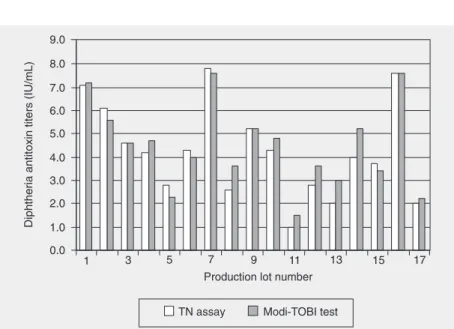
The titers of the diphtheria component of the different lots of dT and DTP are shown in Figure 2. The results of the Modi-TOBI test ranged from 1.5 to 7.6 IU/mL, while the results of the TN assay ranged from 1.0 to 7.8 IU/mL.
As shown in Figure 3, positive and sig-nificant correlations were observed between the results obtained by the TN assay and the Modi-TOBI for anti-tetanus antibody titers (A) and for anti-diphtheria antibody titers (B). A very good correlation (r = 0.98, P < 0.0001) was observed between the tetanus TN assay and the Modi-TOBI test. The cor-relation coefficient had an r2 of 0.95. A high correlation was also observed (r = 0.96, P < 0.0001) for the diphtheria TN assay and the Modi-TOBI test. The correlation coefficient (r2) was 0.93, P < 0.0001.
Figure 2. Comparison of the levels of diphtheria anti-toxin determined by the anti-toxin neutralization (TN) and modified toxin-binding inhibition (Modi-TOBI) tests. Lots of diphtheria and tetanus (dT) vaccine and diphtheria, tetanus and pertussis (DTP) vaccine were inoculated into guinea pigs that were bled after 4 weeks. The levels of anti-diphtheria toxin antibodies (IU/mL) were measured in serum by the in vitro Modi-TOBI test (filled columns) and by the in vivo TN assay (open columns).
Discussion
We describe here a second modification of the TOBI test protocol (10,11), denomi-nated Modi-TOBI test, in order to detect low levels of tetanus and diphtheria antibodies in serum. By the earlier modified assay (11), it was only possible to detect titers higher than 1,000 IU/mL in the serum of immunized horses. In the present study, tetanus and diphtheria antibodies reached a maximum level of approximately 20 IU/mL in the se-rum of guinea pigs immunized to test the potency of vaccines with tetanus and diph-theria fractions produced at the Butantan Institute.
If the in vitro techniques cited in the Introduction were applied as alternative pro-tocols, the passive hemagglutination test could be performed in much less time (1). However, two principal disadvantages are: first, passive hemagglutination is preferen-tially sensitive to IgM antibodies (unable to neutralize tetanus toxin) (17), and second, a poor correlation (r = 0.34) was observed between passive hemagglutination and the reference VERO cell tests for the diphtheria antitoxin (18). There are many different ELISA protocols. The toxoid-ELISA and TN tests demonstrate a relatively good cor-relation (r = 0.74) for tetanus antitoxin (10), and a better correlation with VERO cell tests (TN VERO) for the diphtheria antitoxin (r = 0.81) (18). However, the ELISA methods have a very poor correlation at concentra-tions below 0.2 IU/mL (1,8,9). A compara-tive evaluation of ELISA and TN tests was performed to quantify antibodies against teta-nus toxin in the sera of guinea pigs and mice immunized with TT. ELISA determination on sera collected after less than 6 weeks of immunization and tested against a hyperim-mune serum did not correlate with TN lev-els. The antibody levels determined by ELISA were 35-40 times higher than those determined in TN tests (19) in samples taken 2 weeks after the mice had been injected.
A very good correlation between the TOBI and VERO cell tests was described for diphtheria antitoxin (r = 0.93) (1,18). The correlation between the TN and TOBI tests applied to samples of human sera was also very high (r = 0.95) (10) for tetanus anti-toxin. Another advantage of the TOBI test is that it is based on pharmacodynamic interac-tions of TT. The toxin (or anatoxin) reacts in solution with the corresponding antitoxin in reactions related to the binding of the tetanus toxin to neuronal membrane components at the beginning of its mechanism of action. No toxicity was detected when this binding was prevented by tetanus antitoxin (17,20). In the present analysis, the choice of the TOBI test as an alternative protocol for TN tests in the quality control of vaccine production was based on the fact that this test can detect neutralizing antibodies against tetanus and diphtheria toxins. This characteristic is es-sential for the control of vaccine potency.
A very good correlation was obtained here between the TOBI and TN tests both for tetanus antitoxin (r = 0.98, r2 = 0.95) and diphtheria antitoxin (r = 0.96, r2 = 0.93) in terms of determining titers of these antitox-ins in guinea pigs. Our results agree with the data obtained by Hendriksen et al. (10) for tetanus antitoxin (r = 0.95) and by Walory et al. (18) for diphtheria antitoxin, although the latter investigators studied the correlation between the TOBI and VERO cell tests.
results indicate that the Modi-TOBI test also can serve as an alternative assay for diphtheria toxoid. Additionally, the Modi-TOBI test could be used for the determination of the titers of tetanus and diphtheria antitoxins in intermedi-ate steps of the production process in order to reduce the number of animals utilized.
The reduction of animal use in humane vaccine quality control is a goal for both production institutions and regulatory agen-cies like the WHO. Initiated with the publi-cation of “The Principles of Humane Ex-perimental Technique” in 1959 (24), the concept of 3R was developed, i.e., replace-ment, reduction and refinement of animal tests. The establishment and validation of alternative in vitro methods for in vivo tests in the quality control of vaccines, such as the Modi-TOBI test for potency determination, may greatly contribute to this goal. Various other alternative in vitro methods have been
developed to reduce animal use (for a re-view, see Ref. 21). In vivo TN tests utilize live animals, and the VERO cell tests require a cell line, both of which imply the use of biological material. Such tests generate data that often require subjective interpretation (for example, diagnosing the symptoms of tetanus). The Modi-TOBI test has the advan-tage (as does ELISA) of automatically ana-lyzing results with an ELISA reader that can then be expressed numerically. This tech-nique could refine the quality control of the vaccines and make it possible to compare and share data between vaccine producers worldwide.
Acknowledgments
We are grateful to the Anaerobic and Aerobic Vaccines Sections, Butantan Insti-tute, for technical support.
References
1. World Health Organization. Expanded programme on immunization basis for immunization. Module 2: Diphtheria. Module 3: Tetanus. WHO Documents. WHO/PEI/GEN/93.12-93.13; 1993.
2. Miyamura K, Nishio S, Ito A, Murata R, Kono R. Micro cell culture method for determination of diphtheria toxin and antitoxin titres using VERO cells. I. Studies on factors affecting the toxin and antitoxin titration. J Biol Stand 1974; 2: 189-201.
3. Miyamura K, Tajiri E, Ito A, Murata R, Kono R. Micro cell culture method for determination of diphtheria toxin and antitoxin titres using VERO cells. II. Comparison with the rabbit skin method and practical application for seroepidemiological studies. J Biol Stand
1974; 2: 203-209.
4. Fulthorpe AJ. Multiple diphtheria antigen-antibody systems investi-gated by passive haemagglutination techniques and other methods.
Immunology 1962; 5: 30-45.
5. Kishimoto S, Tomino S, Mitsuya H, Fujiwara H, Tsuda H. Age-related decline in the in vitro and in vivo syntheses of anti-tetanus toxoid antibody in humans. J Immunol 1980; 125: 2347-2352. 6. Peel MM. Measurement of tetanus antitoxin. I. Indirect
haemaggluti-nation. J Biol Stand 1980; 8: 177-189.
7. Gentili G, Pini C, Collotti C. The determination of the potency of human tetanus immunoglobulins by an enzyme-linked immunosor-bent assay. J Biol Stand 1984; 12: 167-173.
8. Kristiansen M, Aggerbeck H, Heron I. Improved ELISA for determi-nation of anti-diphtheria and/or anti-tetanus antitoxin antibodies in sera. APMIS 1997; 105: 843-853.
9. Simonsen O, Bentzon MW, Heron I. ELISA for the routine
determi-nation of antitoxic immunity to tetanus. J Biol Stand 1986; 14: 231-239.
10. Hendriksen CF, Van Der Gun JW, Nagel J, Kreeftenberg JG. The toxin binding inhibition test as a reliable in vitro alternative to the toxin neutralization test in mice for estimation of tetanus antitoxin in human sera. J Biol Standartization 1988; 16: 287-297.
11. Nishikawa AK, Prado SMA, Vancetto MDC, Stephano MA, Higashi HG. Estimation of anti-tetanus toxin antibody in equine sera by enzyme immunoassay. Arq Biol Tecnol 1995; 38: 465-475. 12. Gupta RK, Maheshwari SC, Singh H. The titration of tetanus
anti-toxin IV. Studies on the sensitivity and reproducibility of the anti-toxin neutralization test. J Biol Stand 1985; 13: 143-149.
13. World Health Organization. Manual for the production and control of vaccines: diphtheria toxoid. Geneva: WHO (BLG/UNDP/77.1 Rev. 1); 1977.
14. World Health Organization. Manual for the production and control of vaccines: tetanus toxoid. Geneva: WHO (BLG/UNDP/77.2 Rev. 1); 1977.
15. O’Sullivan MJ, Marks V. Methods for the preparation of enzyme-antibody conjugates for use in enzyme immunoassay. Methods Enzymol 1981; 73: 147-166.
16. Nakane PK, Kawaoi A. Peroxidase-labeled antibody. A new method of conjugation. J Histochem Cytochem 1974; 22: 1084-1091. 17. Ourth DD, MacDonald AB. Neutralization of tetanus toxin by human
and rabbit immunoglobulin classes and subunits. Immunology 1977; 33: 807-815.
sero-logical methods for the detection of diphtheria anti-toxin antibody. J Immunol Methods 2000; 245: 55-65.
19. Gupta RK, Siber GR. Comparative analysis of tetanus antitoxin titers of sera from immunized mice and guinea pigs determined by toxin neutralization test and enzyme-linked immunosorbent assay.
Biologicals 1994; 22: 215-219.
20. Habermann E, Dreyer F. Clostridial neurotoxins: handling and ac-tion at the cellular and molecular level. Curr Top Microbiol Immunol
1986; 129: 93-179.
21. Metz B, Hendriksen CF, Jiskoot W, Kersten GF. Reduction of animal use in human vaccine quality control: opportunities and problems.
Vaccine 2002; 20: 2411-2430.
22. Winsnes R, Hendriksen C, Sesardic D, Akkermans A, Daas A. Serological assays as alternatives to the Ph Eur challenge test for batch release of tetanus vaccines for human use. Dev Biol Stand
1999; 101: 277-288.
23. Kreeftenberg JG, van der Gun J, Marsman FR, Sekhuis VM, Bhandari SK, Maheshwari SC. An investigation of a mouse model to estimate the potency of the diphtheria component in vaccines. J Biol Stand 1985; 13: 229-234.