Machado Rb, Lee Hd, Ayrizono MLs, Leal Rf, Coy CsR, fagundes JJ, Wu fC. Prototype of a computer system for managing data and video colonoscopy exams. J Coloproctol, 2012;32(1): 50-60.
AbstrACt: Objective: develop a prototype using computer resources to optimize the management process of clinical information and video colonoscopy exams. Materials and Methods: Through meetings with medical and computer experts, the following requirements were deined: man -agement of information about medical professionals, patients and exams; video and image captured by video colonoscopes during the exam, and the availability of these videos and images on the Web for further analysis. The technologies used were Java, flex, Jboss, Red5, Jboss sEAM, MysQL and flamingo. results and Discussion: The prototype contributed to the area of colonocospy by providing resources to maintain the patients’
his-tory, tests and images from video colonoscopies. The web-based application allows greater lexibility to physicians and specialists. The resources for
remote analysis of data and tests can help doctors and patients in the examination and diagnosis. Conclusion: The implemented prototype has contrib-uted to improve colonoscopy-related processes. future activities include the prototype deployment in the service of Coloproctology and the utilization
of this model to allow real-time monitoring of these exams and knowledge extraction from such structured database using artiicial intelligence. Keywords: colonoscopy; telemedicine; exam management; remote patient monitoring; communication with hospital equipment.
resuMO: Objetivo: desenvolver um protótipo por meio de recursos computacionais para a otimização de processos de gerenciamento de informações clínicas e de exames de videocolonoscopia. Materiais e Métodos: Por meio de reuniões com especialistas médicos e
com-putacionais, deiniram-se os seguintes requisitos: gestão de informações sobre proissionais médicos, pacientes e exames complementares;
aquisição dos vídeos e captura de imagens a partir do videocolonoscópio durante a realização desse exame, e a disponibilidade por meio da
Web para análise posterior dessas imagens. As tecnologias aplicadas foram: Java, flex, JbOss, Red5, JbOss sEAM, MysQL e flamin-go. resultados e Discussão: O protótipo contribuiu para a área de colonocospia disponibilizando recursos para manutenção de histórico de pacientes, exames e imagens. O acesso à aplicação, por meio de browser, permite maior lexibilidade aos médicos e especialistas. Os
recursos para análise remota de dados e exames podem auxiliar médicos e pacientes na realização de exames e diagnósticos. Conclusão: O protótipo implementado contribuiu para melhoria de processos relacionados a exames de videocolonoscopia. Trabalhos futuros incluem implantação do protótipo no serviço de coloproctologia, bem como a extensão do modelo para o acompanhamento dos exames em tempo
real e extração de conhecimento dessa base de dados estruturada por meio de inteligência artiicial.
Palavras-chave: colonoscopia; telemedicina; gerenciamento de exames; acompanhamento remoto de pacientes; comunicação com equipamentos hospitalares.
Prototype of a computer system for managing data and video
colonoscopy exams
Renato bobsin Machado1, Huei diana Lee2, Maria de Lourdes setsuko Ayrizono3, Raquel franco Leal3, Cláudio
saddy Rodrigues Coy4, João José fagundes4, feng Chung Wu5
1Attending Doctor’s Degree program, Department of Surgery (D.M.A.D.) of the Service of Coloproctology at the Universidade
Estadual de Campinas (UNICAMP) – Campinas (SP), Brazil; Professor and Researcher of the Laboratory of Bioinformatics (LABI) at the Universidade Estadual do Oeste do Paraná (UNIOESTE) – Foz do Iguaçu (PR), Brazil. 2Doctor and Professor of
Computer Science at UNIOESTE; Professor, Postgraduate Program of Dynamic and Energy Systems Engineering (PGESDE); General Coordinator of LABI at UNIOESTE – Foz do Iguaçu (PR), Brazil; Visiting Professor, Postgraduate Program of Surgery Sciences at the Faculdade de Ciências Médicas da UNICAMP – Campinas (SP), Brazil. 3Doctor and Professor of the Department
of Surgery (D.M.A.D.), Service of Coloproctology at UNICAMP – Campinas (SP), Brazil. 4Doctor and Professor, Department of Surgery (D.M.A.D.), Service of Coloproctology at UNICAMP – Campinas (SP), Brazil. 5Doctor and Professor and Researcher, Service of Coloproctology at the Faculdade de Ciências Médicas da UNICAMP – Campinas (SP), Brazil; Doctor and Professor
at UNIOESTE and Coordinator of the Medical Area of LABI at UNIOESTE – Foz do Iguaçu (PR), Brazil.
Study carried out at the Laboratory of Bioinformatics (LABI) at the Universidade Estadual do Oeste do Paraná (UNIOESTE), Foz do Iguaçu (PR) and the Ser-vice of Coloproctology (SC) of the Faculdade de Ciências Médicas (FCM) at the Universidade Estadual de Campinas (UNICAMP) – Campinas (SP), Brazil. Funding source: Universidade Estadual do Oeste do Paraná (UNIOESTE) and Universidade Estadual de Campinas (UNICAMP).
Conlict of interest: nothing to declare.
INtrODuCtION
The fast development of the technological area and, in particular, information technology resources, has allowed broad applicability in several areas of knowledge1-5. some developments of the computer area that have contributed to this scenario include: in-crease in storage capacity, expansion of processing ca-pacity, improvements in computer application safety, development of new data communication techniques, popularization of Internet and web-based systems4,5.
based on these developments, the utilization of computer techniques to help medical sciences has pro-vided great contributions, involving the use of varied resources, including: computer graphics, image pro-cessing, database, distributed systems, data
commu-nication, artiicial intelligence6-14. This scenario boosts the utilization of computer methods in different med-ical areas, from corporate solutions to hospitals and clinics to remote patient monitoring.
One important contribution linked with this mul-tidisciplinary characteristics is the remote exchange of medical information, which enables distance diagno-sis and treatment11.Examples of possible uses could be patient consultation and monitoring, information sharing, discussion of exams and medical inquiries, all made remotely9,11,14. These services need effective data communication mechanisms to ensure exchanged information privacy and reliability15.
due to the variety of computer applications in health areas, the computer systems have been
classi-ied as13Hospital Information Systems (HIs),
Radiol-ogy Information Systems (RIs) and Picture Archiving and Communication Systems (PACs).
The integration PACs, RIs and HIs has been promoted with the creation of standards, such as current Digital Imaging Communications in Medi-cine (dICOM)16 and Health Level Seven (HL7)13,17. These multidisciplinary applications, which in-volve the medical and computer areas, have en-couraged the development of various products and studies, in both corporate and academic environ-ments11. In this context, the Laboratory of bioin-formatics (LAbI) of the Universidade Estadual do Oeste do Paraná (UNIOEsTE), in a partnership with the service of Coloproctology of the facul-dade de Ciências Médicas da Universifacul-dade
Estad-ual de Campinas (UNICAMP), has developed sev-eral multidisciplinary studies1,6,8-10,14,18-20.
The model proposed in this study is from the Tele-medicine line of investigation conducted by both LAbI and UNICAMP. The proposed solution involves the concepts of HIs13, including data management related to the patients, health professionals, exams and reports.
The prototype includes other functionalities
classiied as PACS13, in which a communication pro-tocol is established between a computer system and the video colonoscopy equipment. based on this in-teraction, this model provides management of pa-tients’ exams, including image and video capture during the examinations. Another important char-acteristic of this prototype is that it enables authen-ticated professionals to have a web-based access to patients’ exams and data. Then, the development of this study was encouraged for ensuring continuity to previously developed models, this way contributing to exam supervision and offering technological re-sources that help perform distance diagnoses.
MAterIALs AND MetHODs
The proposed experimental model involves concepts and functionalities of HIs13 and PACs13. The development of this study followed
method-ological characteristics deined by Software En -gineering21, using the Uniied Modeling Language (UML)22 modeling.
One of the prerequisites for the development of this study was the study on the problem domain, through literature and meetings with experts, involv-ing the protocol to perform video colonoscopy23,24. In addition, the study on items that constitute23,25 the vid-eo colonoscope, such as: communication mechanisms available, differences between components according to the product manufacturer, model, video resolution, image quality, video input and output technology, was extremely important.
Regarding the problem domain, the literature
re-lated to protocols, standardizations and classiications
of systems used in the medical area – e.g., HIs13, RIs13, PACs13, dICOM16 and HL717 – was also referred to.
meetings with experts from the medical and computer areas, the requirements for outlining this model were
identiied. The main characteristics deined were: • The system accessibility should be made only by
registered professionals, with permission to use the system;
• Maintainability of information about health pro
-fessionals, patients and exams, using eficient
safety and privacy criteria;
• Availability for web-based utilization of the
solution;
• Permission to store and manage patient-related
information through clinical history records and clinical exams performed;
• Permission to enter and maintain data about health
professionals and researchers, who have access to the system to perform and/or analyze the exams;
• Capability to manage data and image captured
during colonoscopy;
• Implementation of resources that enable the sys -tem communication with the video colonoscope, offering mechanisms for image capture and stor-age during colonoscopy;
• User-friendly interface to perform and monitor
colonoscopy;
• Implementation of functionalities that enable the
visibility and analysis of performed exams after they are concluded. for this requirement implemen-tation, the remote utilization of the system should be considered via browser and internet connection.
After the deinition of all requirements to be offered
by the prototype and considering the particularities of the problem domain, the technological options were ana-lyzed and, with these procedures, the solution model was
deined, according to the sequence of architectural, logic/
process and data models, presented as follows.
a) Architectural model
figure 1 shows the architecture of the proposed model, considering the physical arrangement of its components, functionalities offered and technologies used in the solution. The computer model includes the utilization of Hospital Equipment (HE); in this case,
equipment speciically designed for colonoscopy (vid -eo colonoscope).
Colonoscope
• CA • S- ideo
Execution Client
Clients
Clients
Internet
Application Server • Jboss Server • Jboss Seam • MySql
• Apache Tomcat • ed5
• Flamingo
Colonoscopy is an endoscopic exam that shows the internal part of the whole colon. It uses a flexible tube whose length is 70 to 160 cm. At the end of this tube, there is a camera, which sends im-ages to a display23. These images can also be cap-tured and stored in memory cards connected to the video colonoscopy equipment processor23. during the exam, images and videos are captured by dis-tinct colonoscopy devices (different manufacturers and models) in Intensity and Chroma (Y/C), Video Graphics Array (VGA), super Video formats, in National Television System(s) Committee (NTsC) color system. These exams can be monitored di-rectly through the display and the selected images can be printed23.
This way, video colonoscopes usually have the following components24,25: colonoscope (iberscope), light source, aspiration and biopsy channels,
enlarge-ment lenses, air insuflation or irrigation channels,
NTsC display with Y/C input and VGA with color and brightness adjustments, trolley or cart for equip-ment support, video printer compatible with NTsC color system, alphanumeric keys and printer.
As illustrated in figure 1, the interaction between the video colonoscope and the computer system was
deined in this model, named Execution Client. This
computer is equipped with a video capture board and is physically located in the exam room. RCA or super Video connected were selected to establish the com-munication, interconnecting the video colonoscope output to the capture board input.
The Execution Client has the access to software
functionalities classiied as HIS13, such as registration of patients, health professionals and researchers and exams. besides these functionalities, characteristics
classiied as PACS13 are provided, which will be used during the exams, such as capture, monitoring and storage of images from the video colonoscope.
For the proper execution of the deined function -alities, the Execution Client should have the access to the services offered by the Application server. These services include data management, network commu-nication, functionalities for data entry, management and history analysis of patient and exam data. The technological resources employed to provide these
characteristics were deined according to the Logic
and Process Model section.
This way, the Application server enables the ser-vices required for an adequate operation of the Execu-tion Client and other Clients. It should be noted that the functionalities not directly related to the exam ex-ecution were available to Clients in both local network and internet, by using web technologies (figure 1).
b) Logic and process model
The outlined computer architecture uses the Model-view-controller (MVC)26 standard and Java programming language27, JbOss Application server 4.228, Red5 1.0 streaming server29, Jboss seam de-velopment framework30 and MysQL 5.1.42 database Management system31. The visual presentation of vid-eos and images and the communication with capture devices used flex 4.032 programming language. The interaction and communication between the classes developed in Java and flex were established through the access to remote objects, using functions available in flamingo framework33.
After the deinition of all technological resources to
be included in the computer project, the main processes implemented using the prototype were presented.
The main process is related to image communi-cation during the video colonoscopy. for this process, VP-440025 fuginon video colonoscope was used, con-nected to a Core 2 duo 2.2 GHz computer, with Pixel-View PlayTV Xtreme video capture board, through the super Video format video interface. for the streaming management, a connection with REd5 1.029 streaming server was used. The images collected during the ex-ams were stored in the Application server and the video capture was made by the video colonoscope, but the ex-periments were not performed during real exams.
for the image capture, H.264 codec was used, with 500 x 500 pixel resolution and 30 fps (frames per second). The images captured during the exams were stored in JPEG34 format; the visual display of imag-es and the communication with capture devicimag-es were made using flex32 language.
c) Data model
To support data storage, a data model was elaborat-ed, named Relation Entity Model, and implemented by a Mysql database management system31,35, composed of the following entities and relations: Professional, for the storage of data related to physicians and professionals that will have access to the system, with encrypted
pass-word ield, and using MD515 algorithm; Patient, to keep the history of patients that will be registered at the hospi-tal or clinic; Equipment, to identify the exam equipment; and Exam, which constitutes in one entity that relates the other tables and stores the data regarding the exams performed, including patient, physician and equipment used, type of exam, medical care and institution where
the exam was performed. This table also stores speciic
information about the exam, such as exam date and links to see the images captured during the exam.
resuLts
The development of this study enabled the do-main study in the medical and computer areas. The in-teraction with professionals from these areas allowed to list procedures that can contribute to better process-es for exams that complement video colonoscopy.
Based on these information, the identiication of
resources, the evaluation of technological alternatives,
the computer project deinition and the prototype im -plementation were performed.
The computer model was deined and imple -mented integrating technologies based on free
soft-ware, in such way to fulill the requirements of layout (user-friendly interface), eficient user safety and pri -vacy and robust data storage and management. based on this context, the physical, logic and component ar-chitecture was implemented, according to the model illustrated in figure 1.
Regarding the prototype implementation results, they can be categorized into: layout and interface, data management, application safety and availability of mechanisms for local and remote exam supervision and with resources for subsequent analysis.
The system interfaces were standardized, with a management screen and others for data insert, edit,
display and other speciic actions. These screens were
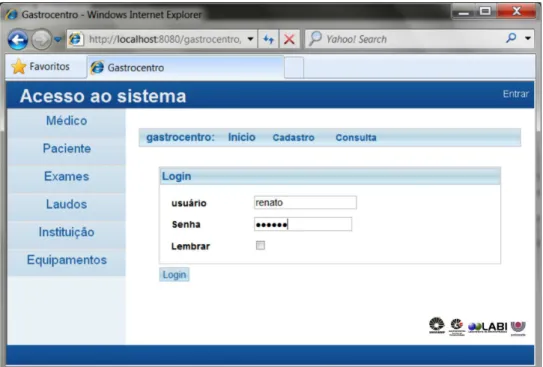
created for the professional entities, patient, institu-tion, equipment, reports and exams. for instance, figure 2 illustrates the layout generated for the initial screen of the system, figure 3 illustrates the interface for exam management, figure 4 shows the screen for
Figure 4. Screen for new exam entry.
entering a new exam and figure 5 illustrates the layout to perform and supervise a video colonoscopy exam.
The igures mentioned above show the main char -acteristics available on the other screens of the proto-type, involving the arrangement of graphic elements, menu bar, navigation mode, indexing and search re-sources, component to present the results, resources to view and supervise the videos and images from the video colonoscopy, among other characteristics.
Regarding data management, the Relation Entity model was created to ensure integrity and reliability to the storage of data from entities and relations. besides
the speciic requirements of this prototype, the base
was estimated to allow easy integration with other computer systems for the medical area and the appli-cation of knowledge extraction methods.
besides data layout and model, the data and user safety requirement was implemented by using Md515 algorithm, generating a 128-bit hash.
for the prototype development, the integration of Jboss seam30 framework with flex32 language
al-lowed greater lexibility for the interface and image
handling, keeping the MVC26 model robustness for
database management, utilization of eficient encryp -tion methods and prototype development in a web-based environment.
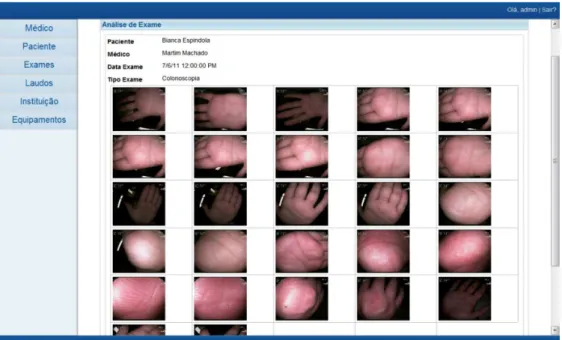
The characteristics implemented in the prototype were validated by experts from the medical and com-puter areas, with special regards to the functionalities that allow real-time exam supervision and the possi-bility of future analyses, as illustrated in figure 5.
DIsCussION
The prototype development for patient and colonoscopy data management uses the characteristics of HIs13 and PACs13.
The web-based access to the application allows
greater lexibility to physicians and experts, as the system
can be accessed from any hardware or operating system platform, via web browsers, with the internet connection as the only prerequisite15. This way, no applications have to be installed to access the prototype and its functional-ities, and the architecture provides easier maintainability and transparent incorporation of new functionalities to end users; in this case, health professionals.
These deinitions allowed to classify this proto -type as an application linked with Telemedicine re-search. In this context, an important contribution of this study is that it enables physicians and experts to refer to patients’ data and exams and discuss cases and interact in patients’ diagnosis and treatment, also in
real time. This aspect can also help reduce the impact of geographical distances, considering that, in several situations, the experts cannot be present in all places where they practice, and the lack of experts in smaller cities, far from urban centers.
The resources used to provide system authentica-tion was Md515 encryption method, which generates a 128-bit hash. This method is today’s one of the most
eficient algorithms, with lexibility to determine the
key size according to the safety level required15. One of the advantages of using this method in the proto-type is that both Jboss seam30 technology and Mysql35 database have compatible functions with this method. Then, it was possible to ensure compatibility and the
desirable level of encryption eficiency, reduce the de -velopment time and enable the encrypted password storage in the database. The system login interface is illustrated in figure 2.
After the system authentication, the prototype functionalities are ready to be used. The interface was developed using Jboss seam30, a web-based platform, which integrates with the data management resources.
Mechanisms were developed in the prototype that integrate the interface with the database to enable data entry, edit, display and removal, keeping functional and referential data integrity. These characteristics were provided for data related to physicians, patients, exams, institutions and devices. The management of such data is performed using the menus on the left side of the interface (figure 3), which open other screens
with speciic functions.
One of the prototype advantages is that it com-bines free software tools, reducing development costs, but keeping an intuitive, user-friendly and easy-to-navigate layout.
The interface provides a search ield in the up -per part of the screen and the entries stored in the system are displayed in the lower part. These entries are the result of a search parameter, the default is “display all” (figure 3).
for each entry, links are provided on the right part of the screen for entry view or edit. When opening
the edit option, data are viewed with all related ields,
which can be altered by the system user. The lower part of the edit screen has the following buttons: Up-date (save alterations), Remove (remove the current entry) or Cancel (exit the edit mode, keeping the entry
unaltered). The lower part of the search results has the Insert button. When clicking this button, an interface is provided to add new entries (figure 4). These func-tional characteristics are typical of HIs13.
The prototype has functionalities that were de-veloped to allow the communication with the video colonoscopy, image capture and display during the exam and subsequent storage. After the conclusion of complementary exam procedure, data and im-ages were available to health professionals via web
resources. These functionalities are classiied as
PACs13. To better understand these functional re-quirements, the protocol proposed for exam manage-ment will be discussed.
figure 3 shows the exam management inter-face. The insertion of an exam entry usually occurs at the moment the patient comes to the exam room. When clicking the Insert button, the user has the ac-cess to an interface to enter exam-related informa-tion (figure 4).
The exam registration in the system requires the following: patient’s name, physician in charge of the procedure, equipment to be used, exam date, the pa-tient’s medical care, reason for the exam, papa-tient’s ref-erence, institution and specialty for which the exam will be performed. To support the integration of this prototype with the PACs model previously developed in this research line19, optional ields were added of se -ries description, study description and study remarks. After saving the new exam, other functions are provided, which will allow to go to the exam screen (figure 5) or return to the exam management screen (figure 3). for entries of data on exams registered in the system, but that have not been performed yet, ac-tions are provided for exam execution, real-time exam supervision and exam entry edit. for concluded ex-ams, options are provided for analysis, to have access to all exam data and images, and edit, to alter con-cluded exam data.
When executing the “perform exam” action, the prototype opens a screen (figure 5) to locally and re-motely watch the exam video, allowing to capture ages the physician considers important. After he im-ages are captured, at the physician’s discretion, the procedure can be concluded.
exam management interface (figure 3), on the “Exam In-quiry” screen, as illustrated in figure 5. The images from the palmar region of hand, illustrated in figure 5, were used in the validation of exam execution and monitoring functionalities and the analysis characteristic. These im-ages were captured using a video colonoscope from the service of Coloproctology of UNICAMP.
After the prototype functionalities were outlined,
it was conirmed that all requirements deined with the
experts had been implemented and that they provide important contributions to video colonoscopy execu-tion; some positive characteristics that could help phy-sicians and experts are:
• Storage of patient and exam data history; • The possibility of image capture and integra
-tion into the system during the colonoscopy ex-ecution. The video colonoscopy devices usually store captured images in magnetic media, which should be taken to a computer for visualization;
• The use-to-use, web-based graphic interface; • The web-based exam and image display, allow
-ing the exams to be remotely analyzed by experts, which contributes to diagnoses of improved ef-fectiveness;
• The system can be used in distant cities without
experts in the area, minimizing the patients’ ef-forts of traveling to urban centers and, especially, reducing diagnosis times.
Besides the speciic characteristics of the solu -tion presented in this study, this model can be inte-grated with other studies previously developed in this research line19.
Regarding the technology employed, it provides the advantage of using all components developed Ja-va27 and open coding services. These characteristics allow the system operation in any hardware or oper-ating system platform that supports Java virtual ma-chine, as well as reduced development cost, keeping
the data management eficiency and the easy naviga -tion in the applica-tion screens. The developed proto-type was validated in Windows and Linux operating systems, using Mozzila Firefox, Internet Explorer and Chrome browsers.
CONCLusION
This study presented a prototype of a computer solution that combines HIs and PACs characteristics.
The development of this prototype contributed to improved processes related to video colonoscopy exam execution, allowing to create a history of pa-tients and exams in a structured database and the re-mote analysis of patient and exams.
One of the differentiations of this study is in the provision of resources for video colonoscopy exam su-pervision in real time. future activities include the pro-totype deployment in the service of Coloproctology at UNICAMP, the integration of the database from this
prototype with other models deined in partnerships with
LAbI at UNIOEsTE with the service of Coloproctolo-gy at the faculdade de Ciências Médicas da UNICAMP, and utilization of this model to allow real-time monitor-ing of these exams and knowledge extraction from such
structured database using artiicial intelligence.
reFereNCes
1. Costa LHd, ferrero CA, Lee Hd, Coy CsR, fagundes JJ, Wu fC. Mapeamento de laudos médicos de endoscopia digestiva alta apoiados por ontologias. In: X Workshop de Informática Médica. belo Horizonte: sociedade brasileira de Computação; 2010.
2. fedel Gs, Medeiros CMb. busca multimodal para apoio à pesquisa em biodiversidade. In: IX Workshop de Teses e dissertações em banco de dados. são Paulo: Universidade de são Paulo; 2010.
3. Liu H, Motoda H. Computational methods of feature selection. boca Raton: Chapman & Hall/CRC; 2008. 4. Wright RT, brown RA. Technology: design and applications.
2a ed. UsA: Goodheart-Willcox Co; 2008.
5. shortliffe EH, Cimino JJ. biomedical informatics: computer
applications in health care and biomedicine. 3a ed. New York: springer science+business Media; 2006.
6. Nabo RGb, Machado Rb, Lee Hd, Zalewski W, ferrero CA, Coy CsR, et al. desenvolvimento de um protótipo de um sistema PACs para aquisição de exames médicos e transmissão de vídeos de colonocospia em tempo real pela internet. In: XVIII sIICUsP – simpósio Internacional de
iniciação Cientíica da USP. São Paulo: Universidade de São
Paulo; 2010.
7. spolaôr N, Lorena C, Lee Hd. Use of multiobjective genetic algorithms in feature selection. In: brazilian symposium
on Artiicial Neural Network. São Bernardo do Campo:
sociedade brasileira de Computação; 2010.
reports into structured databases. In: ALIO-INfORMs Joint International Meeting. buenos Aires: Association of Latin-Iberoamerican Operational Research societies; 2010. 9. Neitzel N. desenvolvimento de uma solução para o
armazenamento e a disponibilização de dados e exames
médicos aplicando a padronização DICOM [Monograia de
Graduação]. foz do Iguaçu: Universidade Estadual do Oeste do Paraná, campus foz do Iguaçu; 2009.
10. silva RAL, Machado Rb, Maciel JN, Lee Hd, Wu fC, fagundes JJ, et al. Avaliação de soluções multimídia para a utilização no desenvolvimento de aplicações em telemedicina. In: Anais do IV Congresso da Academia Trinacional de Ciências. foz do Iguaçu: Universidade Estadual do Oeste do Paraná; 2009. 11. Urtiga Ks, Louzada LA. Telemedicina: uma visão geral
da arte. In: Proceedings do IX Congresso brasileiro de Informática em saúde. Ribeirão Preto: sociedade brasileira de Informática em saúde; 2004.
12. Caritá EC. sistema de gerenciamento de imagens para ambiente hospitalar com suporte à recuperação de imagens baseada em conteúdo [Tese de doutorado]. Ribeirão Preto: Universidade de são Paulo; 2006.
13. Yu L, Jihong W. PACs and digital medicine: essential principles and modern practice. boca Raton: Taylor and fracis Group; 2011. IsbN: 13:978-1-4200-8366-8.
14. Maciel JN. Protótipo de conferência multimídia e transmissão de dados de experimentos médicos em tempo real pela Web [Monograia de Graduação]. Foz do Iguaçu: Universidade
Estadual do Oeste do Paraná, campus foz do Iguaçu; 2005. 15. Coulouris G, dollimore J, Kindberg T. sistemas distribuídos:
conceitos e projetos. 4a ed. Porto Alegre: Editora bookman; 2007. 16. Pianykh Os. digital Imaging and Communications in
Medicine (dICOM): A practical introduction and survival guide. boston: Editora springer; 2008. IsbN 354074570X. 17. HL7. Join HL7 International. 2011. [cited 2011 Jun 29].
Available from: http://www.hl7.org/
18. Wu fC. Estudo dos efeitos de diferentes concentrações de oxigênio e da hiperoxigenação hiperbárica sobre anastomoses cólicas comprometidas ou não pela isquemia. Trabalho experimental em ratos [Tese de doutorado]. Campinas: faculdade de Ciências Médicas da Universidade Estadual de Campinas; 2003.
19. Lee Hd, Machado Rb, ferrero CA, Coy CsR, fagundes JJ, Wu fC. Modelo computacional para o gerenciamento de dados e exames de pacientes para o acompanhamento remoto por meio de conferência multimídia. Rev bras Coloproct 2010;30(4):399-408.
20. Lee Hd, Costa LHd, ferrero CA, Coy CsR, fagundes JJ, Machado Rb, et al. Protótipo de um sistema de gerenciamento de protocolos de câncer colorretal. Rev bras Coloproct 2011;31(1):1-9.
21. Pressman Rs. Engenharia de software. 6a ed. são Paulo: McGraw-Hill; 2006.
22. booch G, Rumbaugh J, Jacobson I. UML Guia do usuário. Rio de Janeiro: Campus; 2000.
23. Quilici fA, Grecco C. Colonoscopia. são Paulo: Lemos Editorial; 2000. IsbN 85-7450-048-8.
24. Rocha JJR. Coloproctologia: príncipios e prática. são Paulo: Atheneu; 2005.
25. Operation Manual. EVE Processor: VP-4400. fukinon Corporation. v. 1.1. Japan.
26. deacon J. Model-View-Controller (MVC) architecture. John deacon Computer system development, Consulting & Training 2005:1-6. [cited 2011 Jun 29]. Available from:
http://www.jdl.co.uk/brieings/index.html#mvc
27. deitel HM. Java: como programar. 6a ed. são Paulo: Editora Pearson Prentice Hall; 2005.
28. Jamae J, Johnson P. JBoss in action: coniguring the JBoss
application server. Greenwich: Manning Publications; 2009. IsbN: 1933988029.
29. REd5. The open source media server. [cited 2011 Jun 29]. Available from: http://www.red5.org/
30. Allen d. sEAM in action. Greenwich: Editora Manning Publications; 2008.
31. Korth Ab, silberschatz Hf. sistema de banco de dados. 2a ed. são Paulo: Editora Makron books; 1995.
32. Tiwari s, Elrom E, schulze C. flex 4 avançado. são Paulo: Novatec; 2011.
33. flamingo. Exadel Community. [cited 2011 Jun 29]. Available from: http://exadel.com/web/portal/opensource?redirected=/
lamingo
34. JPEG. JPEG Homepage. [cited 2011 Jun 29]. Available from: http://www.jpeg.org/jpeg/index.html/
35. Mysql. sistema gerenciador de banco de dados MysQL. [cited 2011 Jun 29]. Available from: http://www.mysql.com/
Correspondence to: Renato bobsin Machado
Laboratório de bioinformática (LAbI), Universidade Estadual do Oeste do Paraná (UNIOEsTE), Parque Tecnológico Itaipu (PTI) Avenida Tancredo Neves, 6731, Caixa Postal 39