Case Report
79
Basso MP, Christiano AB, Oliveira AlCd, Cunrath Gs, Netinho JG. Appendicular endometriosis as a cause of chronic abdominal pain alone in the right iliac fossa: case report and literature review. J Coloproct, 2012;32(1): 80-3.
AbstRACt: Endometriosis is a disease characterized by the presence of ectopic endometrial glands and stroma. Although its etiology is
unde-ined, it is suggested to be a result of coelomic metaplasia, retrograde menstruation, to provide a genetic component, or to be one that occurs due to
blood or lymphatic spread. The involvement of the gastrointestinal tract is common. However, appendicular endometriosis is a rare condition. It is usually asymptomatic. Recurrent pain in the right iliac fossa is an unusual clinical manifestation. There are no non-invasive complementary tests
to conirm the diagnosis. Laparoscopy is the main option for research, due to its diagnostic and therapeutic features. A histopathological examina -tion is necessary for the diagnosis. Although surgical and drug therapies have special indica-tions, the combina-tion therapy showed lower symptom recurrence. This study reports a case of appendicular endometriosis that was diagnosed and treated in the service of Coloproctology of the Base Hospital at Faculdade de Medicinaofsão Jose do Rio Preto. There is also a literature review about this situation.
Keywords: endometriosis; gastrointestinal tract; appendix; abdominal pain.
Resumo: Endometriose é uma doença caracterizada pela presença de estroma e glândulas endometriais ectópicas. Apesar de sua
etiolo-gia não deinida, sugere-se que seja decorrente de metaplasia celômica, menstruação retrógada, apresente componente genético, ou ocorra
devido à disseminação linfática ou sanguínea. O acometimento do trato gastrointestinal é comum; no entanto, a endometriose apendicular
é condição rara e se apresenta com maior frequência de forma assintomática. Dor recorrente em fossa ilíaca direita é uma manifestação clínica incomum. Não há exames complementares não invasivos que conirmem o diagnóstico. A laparoscopia é a principal opção durante a investigação, por sua característica diagnóstica e terapêutica. O diagnóstico pode ser feito apenas após um exame histopatológico. Embora as terapias medicamentosa e cirúrgica apresentem indicações particulares, a terapêutica combinada mostra menor recorrência dos sintomas. O objetivo do trabalho é relatar um caso de endometriose apendicular diagnosticado e tratado na Disciplina de Coloproctologia do Hospital
de Base da Faculdade de Medicina de são José do Rio Preto, além de revisar a literatura acerca dessa situação.
Palavras-chave: endometriose; trato gastrointestinal; apêndice cecal, dor abdominal.
Appendicular endometriosis as a cause of chronic abdominal pain
alone in the right iliac fossa: case report and literature review
Marcelo Pandoli Basso1, Adriana Borgonovi Christiano1, André luís Cozetto de Oliveira2,
Geni satomi Cunrath3, João Gomes Netinho4
1Resident of Coloproctology at the Base Hospital of Faculdade de São José do Rio Preto (FAMERP) – São José do Rio
Preto (SP), Brazil. 2Student at the ifth year of Medicine at FAMERP – São José do Rio Preto (SP), Brazil. 3Medical
Assistant at the discipline of Coloproctology at the Base Hospital of FAMERP – São José do Rio Preto (SP), Brazil. 4Head
of the discipline of Coloproctology at the Base Hospital of FAMERP – São José do Rio Preto (SP), Brazil.
Study carried out at the discipline of Coloproctology, Department of Surgery at the Base Hospital of Faculdade de Medicina de São José do Rio Preto. Financing source: none.
Conlict of interest: nothing to declare.
Submitted on: 08/30/2010
Approved on: 10/14/2010
INtRoDuCtIoN
Endometriosis is characterized by the pre-sence of stroma and endometrial glands outside the uterine cavity. It can be called internal en-dometriosis or adenomyosis, when the endome-trial tissue is inside the uterine muscle, or exter
-nal endometriosis, if there is extrauterine ectopic implant1. The latter divides into
intraperitone-al (blatter, douglas’ Pouch, ovaries, sigmoide, appendix) and extraperitoneal (umbilicus, surgi -cal scars, vagina, vulva, lungs)2.
Appendicular endometriosis as a cause of chronic abdominal pain alone in the right iliac fossa: case report and literature review
Marcelo Pandoli Basso e et al.
80
Rev bras Coloproct January/march, 2012
Vol. 32 Nº 1
reproductive age3,4. One third of the infertility cases
among females are associated with endometriosis5. The etiology of the disease is not deined. Among the most accepted theories, coelomic metaplasia is mentioned6, as well as retrograde menstruation,
pro-posed by sampson7, and the genetic theory, besides
blood and lymphatic spread.
Ectopic endometrial implants are usually present in the pelvic region, especially the pelvic peritoneum, ovaries, fallopian tubes, and rectovaginal septum3.
The involvement of the gastrointestinal tract is com-mon, ranging from 3 to 37% of the cases1,3,8. Bowel
endometriosis affects the rectum and the rectosigmoid junction in 70 to 85% of the cases1,3,9. The small
intes-tine involvement is around 7% more likely restricted to the terminal ileum. The less affected sites are the cecum (3.6%) and the appendix (3%)3,10.
CAse RePoRt
SMASR, 44 years old, mother of ive, presented with abdominal pain in the right iliac fossa, which lasted for two years. The pain was continuous, mild and worse-ned in the last four months. There was no gynecological or gastrointestinal complaint, nor any relation with the menstrual cycle. At irst, a total abdominal ultrasound was performed (18th day of the menstrual cycle), which
revealed a hypoechoic oval image, with echogenic center and regular forms, measuring 2.0x1.4 cm, located betwe -en the cecum and the right attachm-ent.
Due to the lack of deinition in this case, a magne -tic resonance imaging test was requested and revealed an oval and heterogeneous image, with intense central signal, intense signals in the right iliac fossa, with inti-mate contact with the cecum and small intestine loops, measuring around 2.4x2.1x2.2 cm. After the infusion of the contrast, there was intense pervading (Figure 1).
Tumor markers/antigens associated with can-cer 125 (CA 125) and carcinoembryogenic antigens (CEA) were normal, as well as the thoracic x-ray. Co -lonoscopy revealed invaginated appendix (Figure 2).
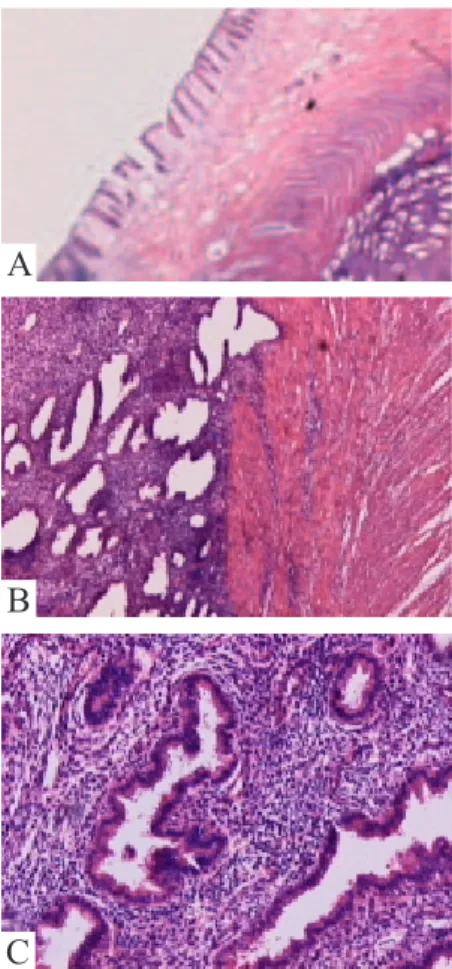
Because it was impossible to exclude the hypo -thesis of neoplasm, a right colectomy was performed, associated with ipsilateral salpingo-oophorectomy. The mass had approximately 4 cm in diameter. The biopsy of the surgical specimen conirmed the diagno -sis of endometrio-sis (Figure 3).
Figure 1. (A) and (B) Mass in the right iliac fossa at magnetic nuclear resonance.
A
B
Figure 2. (A) and (B) Invaginated appendix at colonoscopy.
B
A
A
B
C
Appendicular endometriosis as a cause of chronic abdominal pain alone in the right iliac fossa: case report and literature review
Marcelo Pandoli Basso e et al.
81
Rev bras Coloproct January/march, 2012
Vol. 32 Nº 1
The patient recovered well after surgery. Follow-up had no signs of recurrence or complications.
DIsCussIoN
Endometriosis affecting the ileocecal appendix is rare. The clinical picture is complex, and may be categorized into groups according to the symptoms: asymptomatic patients, those with acute appendici-tis, patients presenting invagination of the appendix, those with appendicular perforation and also the ones with atypical symptoms (abdominal pain, nausea and melena)1,11. Also, the chronic obstruction of intestinal
lumen may lead to the formation of mucocele or in-lammatory periappendicular mass, which is hard to distinguish from neoplasm12.
The laboratory evaluation for CA 125 dosage presents low sensitivity and speciicity due to high se -rum concentrations in other affections, thus, it is not a possible diagnosis12.
No radiological examination can diagnose ileo -cecal appendicular endometriosis13. At ultrasound, it is possible to see cystic, solid or complex images due to the hormonal response of the ectopic tissue in the appendix, while computed tomography shows distended appendix with no inlammation. However, they help to rule out pathologies that manifest the same way14.
laparoscopy is the diagnostic test of choice in ca-ses of endometriosis because it enables the direct vi-sualization of the affected site, revealing macroscopic characteristics, determining the extension of the lesions and providing material for the histopathological inves-tigation. Besides, it is also a therapeutic method11.
The diagnosis is conirmed by a histopatholo -gical evaluation. Lesions are usually supericial and small, located on the third distal and, sometimes, with weak adherence, similar to what happens in the tubes affected by endometriosis11. The mucosa of the organ
is rarely affected. The endometrial tissue in the mus-cle and the seromuscular layer is present in 2/3 of the cases, and the affection of the serum layer is present in 1/3 of these cases1.
The differential diagnosis of appendicular endome-triosis should include diverticular disease, colorectal car-cinoma, inlammatory bowel disease, carcinoid tumors, benign intramural neoplasm, occult intra-abdominal me-tastases, mesenteric neoplasm and pelvic abscess13.
since the ectopic endometrial tissue responds to ovarian hormones, estrogen and progesterone, patients with few implants clinically respond to hormonal the-rapy. In cases of advanced lesions, such as the ones with nodular proliferation, hormonal therapy leads to partial regression within several months of treatment. However, none of the drug therapies completely eradi-cates endometrial implants, that is, after the disconti-nuation of medicines, symptoms may return. Also, the resulting collateral effects may inhibit the adhesion to the treatment13. since the CA 125 dosage is correlated
with the severity of the disease, it has proved to be useful to assess the response to clinical treatment12.
Patients with obstructive bowel symptoms who are refractory to clinical treatment, or those cases in which it is not possible to exclude the neoplastic etio -logy, present surgical indication. Cases of appendicular endometriosis should be treated as appendicectomy12.
Also, surgical resection prevents the recurrence of symptoms and the late development of local endome-trial carcinoma, which is a possible but not common complication13. However, surgical treatment does not
remove the microscopic disease. so, CA 125 dosage after resection in women who presented high levels prior to the procedure is important for the follow-up, in case of recurrence of the symptoms12.
The recommendation for olingosymptomatic pa-tients who are younger than 40 years old and manifest the wish to get pregnant is conservative surgical the-rapy, which consists of partial oophorectomy, besides the resection of the appendix2. surgical removal of the appendix is conirmed by the correlation reference be -tween appendicular endometriosis and infertility11. The
radical surgical treatment is recommended for patients aged 40 years or more, or for those who are younger but do not respond to clinical therapy or conservative surgery, presenting with severe symptoms. It consists of bilateral oophorectomy and hysterectomy, with im-provement of the symptoms in 90% of the cases2.
Appendicular endometriosis as a cause of chronic abdominal pain alone in the right iliac fossa: case report and literature review
Marcelo Pandoli Basso e et al.
82
Rev bras Coloproct January/march, 2012
Vol. 32 Nº 1
ReFeRÊNCIAs
1. Uncu H, Taner d. Appendiceal endometriosis: two case reports. Arch Gynecol Obstet 2008;278: 273-5.
2. Guerra GMlsR, Monteiro EP, souza HFs, Fonseca MFM, Horta sHC, Formiga GJs. Endometriose de reto – relato de caso. Rev bras Coloproct 2004;24(4):354-7.
3. Orbuch IK, Reich H, Orbuch M, Orbuch l. laparoscopic treatment of recurrent small bowel obstruction secondary to ileal endometriosis. J Minim Invasive Gynecol 2007;14(1): 113-5. 4. Bailey HR. Colorectal endometriosis. Perspect Colon Rectal
surg 1992;5:251-9.
5. drake Ts, Grunert GM. The unsuspected pelvic factor in the infertility evaluation. Fertil steril 1980;34:27-31.
6. Ridley JH. The histogenesis of endometriosis. A review of facts and fancies. Obstet Gynecol surv 1968;20:1-35. 7. sampson JA. Perforating hemorrhagic (chocolate) cysts of the
ovary, their importance and especially their relation to pelvic adenomas of endometrial type. Arch surg 1921;3:245-323.
8. Prystowsky JB, Stryker SJ, Ujiki GT, Poticha SM.
Gastrointestinal endometriosis. Arch surg 1988;123:855-8. 9. Faccioli N, Manfredi R, Mainardi P, Chiara Ed, spoto E, Minelli
l, et al. Barium enema evaluation of colonic involvement in endometriosis. AJR Am J Roentgenol 2008;190(4):1050-4.
10. Macafee CH, Greer Hl. Intestinal endometriosis. A report of 29 cases and a survey of the literature. J Obstret Gynecol 1960;67:539-55.
11. sagae UE. Endometriose do trato gastrointestinal: correlações clínicas e laparoscópicas; papel da corrida dos órgãos peritoneais na endometriose (COPE) [dissertação]. são Paulo (sP): Faculdade de Medicina da Universidade de são Paulo (UsP); 2005.
12. snyder MJ, stryker sJ. Endometriosis. In: Wolff BG,
Fleshman JW, Beck DE, Pemberton JH, Wexner, SD, editors. The ASCRS Textbook of colon and rectum surgery. New
York: springer; 2007. p. 308-19.
13. Gordon PH. Miscellaneous entities. In: Gordon PH, Nivatvongs s, editors. Principles and practice of surgery for the colon, rectum, and anus. 3rd ed. New York: Informa Healthcare; 2007. p. 1271-4.
14. Park sB, Kim JK, Cho Ks. sonography of endometriosis in
infrequent sites. J Clin Ultrasound, 2008;36(2):91-7.
Correspondence to:
dr. João Gomes Netinho
Rua san Francisco, 481 – Condomínio débora Cristina CEP: 15093-030 – são José do Rio Preto (sP), Brazil
E-mail: [email protected] CoNCLusIoN
Endometriosis affecting the ileocecal appendix is a rare condition, being mostly asymptomatic. due to the need for histopathological conirmation, because of the variety of clinical presentations and the absence of