Sagae UE, Lima DMR, Alves KR, Kurachi G, Tanaka TM, Bonatto MW, Tsuchiya RS, Carvalho CA. Effectiveness of biofeedback therapy in patients with chronic constipation. J Coloproctol, 2012;32(1): 66-72.
ABSTRACT: Purpose: The purpose of this study was to evaluate the effect of physical therapy in women diagnosed with chronic constipa-tion using funcconstipa-tional training of the pelvic loor (biofeedback). Patients and Methods: From March 2009 to March 2010, 67 women with chronic constipation were prospectively evaluated. The patients were evaluated and the constipation score proposed by Agachan et al. was applied. Then, they were sent to biofeedback. These patients were divided into 2 groups: with anismus (group I: mean age of 46.90 years old) and without anismus (group II: mean age of 44.89 years old) and diagnosed by anorectal electromanometry. The treatment was performed with different exercises for each group, associated with some hygieno-dietetic directions. At the end of treatment, the constipation score was reapplied. Results: Pre-biofeedback constipation score in group I was 15.04 (standard deviation – SD=2.48) and post-biofeedback constipation score was 3.39 (SD=1.62) (p<0.0001). Pre-biofeedback constipation score in group II was 14.82 (SD=2.401) and post-biofeedback constipa-tion score was 2.90 (SD=1.64) (p<0.0001). Besides, a signiicant difference (p<0.005) was observed between the groups regarding the number of biofeedback sessions. Conclusion: Thus, the authors conclude that biofeedback is effective in the treatment of constipation.
Keywords: biofeedback; constipation; pelvic loor.
RESUMO: Objetivo: Este trabalho objetivou avaliar o efeito do tratamento isioterapêutico, em mulheres diagnosticadas com constipação crô -nica, utilizando treinamento funcional do assoalho pélvico (biofeedback). Casuística e Método: No período de março de 2009 a março de 2010,
foram avaliadas, prospectivamente, 67 mulheres com constipação intestinal. As pacientes foram avaliadas e o escore de constipação, proposto por Agachan et al., foi aplicado; então, foram encaminhadas ao biofeedback. Essas pacientes foram divididas em 2 grupos: com anismus (56 pacientes do grupo I: média de idade 46,90 anos) e sem anismus (11 pacientes do grupo II: média de idade 44,89 anos), diagnosticadas pela eletromanome-tria anorretal. Para o tratamento, foram estipulados exercícios diferentes para cada grupo, associados com orientações higienodietéticas. Ao im do tratamento, foi reaplicado o escore de constipação. Resultados: O escore de constipação do grupo I, na avaliação pré-biofeedback, foi 15,04 (des-vio padrão – DP=2,48) e, no pós-tratamento, foi 3,39 (DP=1,62) (p<0,0001). O escore de constipação do grupo II, na avaliação pré-biofeedback, foi 14,82 (DP=2,401) e, no pós-tratamento, foi 2,90 (DP=1,64) (p<0,0001). Além disso, em relação ao número de sessões de biofeedback entre os grupos, houve diferença signiicativa (p<0,005). Conclusão: Concluiu-se que o biofeedback é eicaz no tratamento da constipação intestinal. Palavras-chave: feedback de eletromiograia; constipação intestinal; diafragma da pelve.
Effectiveness of biofeedback therapy in patients
with chronic constipation
Univaldo Etsuo Sagae1, Doryane M. dos Reis Lima2, Kelli Rizardi Alves3, Gustavo Kurachi4, Tomaz M. Tanaka5, Mauro W. Bonatto6, Ricardo S. Tsuchiya7, Carlos Alberto de Carvalho8
1Master in Digestive Tract Surgery, Universidade de São Paulo – São Paulo (SP), Brazil; Professor of Gastroenterology
and Digestive Tract Surgery, Universidade Estadual do Oeste do Paraná (UNIOESTE) – Cascavel (PR), Brazil. 2Master in Surgery, Universidade Federal do Ceará (UFC) – Fortaleza (CE), Brazil; Professor of General Anatomy, Faculdade Assis Gurgacz (FAG) – Cascavel (PR), Brazil. 3Specialist in Urogynecological Physical Therapy, Colégio Brasileiro de Estudos Sistêmicos (CBES) – Curitiba (PR), Brazil. 4Specialist in General Surgery, Hospital Governador Celso Ramos – Florianópolis (SC), Brazil; Specialist in Coloproctology, Hospital das Clínicas da Universidade Federal de Goiás (UFG) – Goiânia (GO), Brazil. 5Doctor in Surgery, Escola Paulista de Medicina da Universidade Federal de São Paulo (UNIFESP)
– São Paulo (SP), Brazil; Professor of Introduction to Medical Practice, Surgical Technique and Anesthesiology, UNIOESTE – Cascavel (PR), Brazil. 6Master in Surgical Practice, Universidade Federal do Paraná (UFPR) – Curitiba (PR), Brazil; Coordinator of the Discipline of Gastroenterology and Digestive Tract Surgery, UNIOESTE – Cascavel (PR),
Brazil. 7Professor of Introduction to Medical Practice, Surgical Technique and Anesthesiology, UNIOESTE – Cascavel (PR), Brazil. 8Master in Surgery, Escola Paulista de Medicina da UNIFESP – São Paulo (SP), Brazil.
Study carried out at the Gastroclínica Cascavel – Cascavel (PR), Brazil. Financing source: none.
Conlict of interest: nothing to declare.
INTRODUCTION
In the last 20 years, great concepts have been established regarding the functional disorders of pelvi-perineal musculature in constipation. Consti-pation is neither a disease nor a sign, but a symp-tom, and as such, it is associated with disorders of intestinal motility or pelvic floor, or both1,2.
Epi-demiological studies have consistently shown el-evated prevalence of constipated patients, reach-ing up to 20–30% of the adult population in the Western hemisphere3,4.
Constipation is deined as a delay in fecal elimi
-nation or abnormal fecal retention into the bowel. The
clinical presentation does not have a single deinition,
widely accepted and helpful from the clinical perspec-tive, but, according to the Rome III Criteria, it is charac-terized by persistent frequency of evacuations less than
three times a week, dificult evacuation at least 25% of
the times, sensation of incomplete evacuation and intes-tinal obstruction in more than 25% of the evacuations, hard and dry stool and digital stimulation to help stool removal in more than 25% of the evacuations5.
When evaluating constipation, first, second-ary systemic and intestinal causes that can alter and/or block the intestinal flow should be exclud-ed. The exclusion of secondary causes defines the group of patients with functional intestinal con-stipation, colonic constipation (colonic inertia and intestinal dysmotility) and rectal constipation (obstructed evacuation) or the association of these types. This group presents multifactorial etiology, involving anatomical, functional, psychological and sociocultural aspects.
Agachan et al.6 proposed a constipation
question-naire, in which they consider the following information as priority for constipation diagnosis: pain during evacuation, abdominal pain, attempt to evacuate within minimum time in the toilet, unsuccessful attempt to evacuate within 24 hours, duration of years of constipation, assistance, intesti-nal frequency and sensation of incomplete evacuation.
For many years, constipation was treated with no worry about knowing the physiological behavior of the anal canal. During defecation, the pelvic dia-phragm musculature and the anal sphincters need to relax to enable the perineum to move downwards and the anal canal to open. In the presence of any
anatomi-cal or functional dysfunction, this relaxation will not
be insuficient or absent7,8.
The pelvic loor rehabilitation through biofeed
-back is a technique that uses perianal electrodes asso-ciated with a graphic representation that promptly and continuously shows some of its internal, normal and ab-normal physiological events, in the form of visual and/ or hearing signs. This is a device that measures, evalu-ates and treats neuromuscular dysfunctions. And it
ef-iciently evaluates the pelvic loor muscles by moni
-toring the pelvic loor force and stiffness. It mainly
favors the relaxation training, consequently
improv-ing mobility, lexibility and muscle coordination7,9-11.
OBJECTIVE
This study has the purpose to evaluate the effect of physical therapy in women diagnosed with chron-ic constipation using functional training of the pelvchron-ic
loor (biofeedback).
PATIENTS AND METHODS
From March 2009 to March 2010, a prospective study was conducted with 71 women with intestinal constipation from the Outpatient Clinic of Coloproc-tology at Gastroclínica, in Cascavel (PR).
The patients were evaluated by colonoscopy, an-orectal electromanometry and the constipation score proposed by Agachan et al.6 was applied; after that,
they were sent to biofeedback. These patients were di-vided into 2 groups: with anismus (group I) and with-out anismus (group II) and diagnosed by anorectal electromanometry.
The mean age in group I was 46.90 years old (rang-ing from 28 to 67 years old) and in group II was 44.89 years old (14 to 73 years old). All of them signed the Free Consent Term and accepted to participate in this study approved by the Medical Ethics Committee of the Uni-versidade Estadual do Oeste do Paraná (UNIOESTE).
The anamnesis, physical evaluation and biofeed-back treatment were performed at Gastroclínica by a single physical therapist.
First, the physical exam was performed with the patient in left lateral decubitus, without rectal
prepa-ration, to evaluate the anal-cutaneous relex and per
a functional assessment of the pelvic loor (FAPF).
According to Ortiz12, the assessment is scored 0 to
5, being: 0, no objective perineal function, neither at palpation; 1, absent objective perianal function,
rec-ognized at palpation only; 2, deicient objective pe -rianal function, recognized at palpation; 3, objective perineal function, without opposing resistance to
pal-pation; 4, objective perineal function and opposing resistance not maintained at palpation; 5, objective perineal function and opposing resistance maintained at palpation for more than 5 s. After that, the patient was placed in dorsal decubitus position and the
analy-sis of clitoral sensitivity and relex was performed.
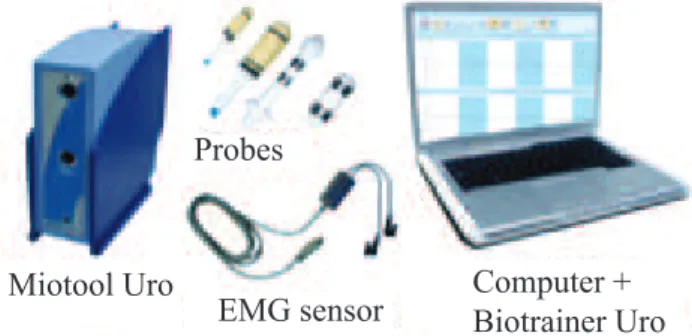
After these evaluations, the treatment was con-ducted with biofeedback using an electromyographic
device – Miotool 400 (Miotec Equipamentos Biomê
-canicos® (Porto Alegre, RS, Brazil) (Figure 1). This
device has a 4-channel system with up to 8-fold gain each, 14-bit resolution and sampling frequency of 2000 Hz per channel. Only one channel is used, with 2 differential surface sensors SDS500, connected with disposable electrodes (1.9 cm diameter). The surface electrodes were placed anteriorly and posteriorly to the anus (Figure 2), and one reference electrode (earthing electrode) was placed in a bony surface, in this case, in the anterior superior iliac spine.
Both groups were submitted to a protocol of exercise created by the authors that consisted in the following:
Figure 1. Electromiographical device – Miotool 400.
Biofeedback device produced by MIOTEC Miotool Uro
EMG sensor Probes
Computer + Biotrainer Uro
Source: Vetter, Frank H. Atlas de Anatomia Humana. 2ed. Porto Alegre: Artmed; 2000
Figure 2. Locations of surface electrodes placed in the perineal region.
Mons Pubis
(monte) Anterior commissure
of labia majora Posterior commissure
of labia majora Clitoral hood
(prepúcio) Clitoral glans
Urethral orifice (óstio da uretra)
Labia minora
Labia majora
Bartholin’s glands Vestibule
Anus
Skene’s glands
Position of electrodes
Caruncula hymenalis Frenulum
of clitoris
Perineum
Frenulum of labia minora
Vestibular fossa
• group I: exercises of sustained contraction for 40 s,
followed by relaxation for 8 s and evacuation effort. The number of repetitions during the session varied according to the patient’s muscular resistance;
• group II: exercises of sustained contraction for
40 s, followed by relaxation for 8 s and evacu-ation effort, followed by 10 repetitions of sus-tained contraction for 2 s and relaxation for 5 s. This sequence was performed twice.
Both groups were instructed to not contract acces-sory muscles, such as abdominal, gluteal and adductor muscles13 and encouraged to perform the exercises daily.
In the beginning of the treatment, the patients received recommendations to be observed at home, during all the treatment, such as increase the intake
of ibers – such as fruits, vegetables and cereals14,15;
keep the daily water intake above 1 L14,15; never
ig-nore evacuation relexes, never hesitate to evacuate if
feeling so16; perform physical activities17; respect the
correct evacuation position, i.e., legs wide apart, el-bows on the knees, making abdominal force to help the evacuation8,13.
The number of sessions ranged from 4 to 29 (mean of 13.25). At the end of the treatment, the con-stipation score proposed by Agachan et al.6 was
ap-plied again.
RESULTS
Group I had 56 patients. From these, 22 had had vaginal births and 20 some type of orificial surgery, with mean time of constipation of 20.18 years (0.6–56). Forty-five patients presented soil-ing associated with constipation before biofeed-back, and only one in after biofeedback. The con-stipation score proposed by Agachan et al.6 was
15.04 (standard deviation 2.48) at the pre-bio-feedback evaluation and 3.39 (standard deviation 1.62) at the post-biofeedback evaluation – Chart 1 (p<0.0001). The number of biofeedback sessions in this group was 13.85 weeks.
Group II had 11 patients. From these, 8 had had
vaginal births and 5 some type of oriicial surgery,
with mean time of constipation of 18.22 years (0.5–37). Nine patients presented soiling associated with con-stipation before biofeedback, and none of them
pre-16 14
12
10
8 6
4
2 0
Chart 2. Constipation score proposed by Agachan et al.6 in group 2.
sented this symptom after biofeedback. The consti-pation score proposed by Agachan et al.6 was 14.82
(standard deviation 2.401) at the pre-biofeedback evaluation and 2.90 (standard deviation 1.64) at the post-biofeedback evaluation – Chart 2 (p<0.0001). The number of biofeedback sessions in this group was 10.27 weeks.
No signiicant difference was observed between the
analyzed groups in relation to pre-biofeedback and post-biofeedback score (p=0.44) (Charts 3 and 4); however,
a signiicant difference (p<0.005) was observed in the
number of biofeedback sessions between the groups. The colonoscopy exams of all participants did not
show alterations that justiied constipation. Regarding the sensitivity, relex and functional assessment of the pelvic loor performed at the evaluation, all patients
presented preserved items.
16 14 12 10
8 6 4
2 0
DISCUSSION
Data on the subject have shown that constipation considerably interferes in many aspects of the quality of life, affecting the individual’s routine, mood, and professional and leisure activities18-20.
According to the literature, biofeedback for the
pelvic loor is an important resource used to treat
evacuation dysfunctions, with positive results regard-ing restored force and relaxation21,22.
The pelvic loor rehabilitation includes exercises
to normalize the muscle tone, and it is used to strengthen the hypotonic areas and relax the hypertonic areas21,22.
The success of a treatment depends on the patient’s mo-tivation and capability to understand the instructions provided by the therapist. In addition, the structural in-tegrity of the sphincter muscle should be preserved.
8
6
4
2
0
p>0.05
Chart 4. Comparison of post-biofeedback constipation scores between groups I and II.
In the past, there was no consensus on the dei
-nition of pelvic loor dysfunction and obstructed defec
-tion, and then some criteria started to be developed,
deining that, in assisted evacuation, patients should
not have inadequate contraction or failure to relax the
pelvic loor muscles, inadequate propulsive force and
incomplete evacuation force. Although presumably acquired, these dysfunctions are usually caused by be-havioral disorders11,23,24.
The treatment with biofeedback is based on
pelvic loor training, using manometry or electrical
stimulation25,26, associated with sound or visual
stimu-lation. The purpose is to obtain a more adequate muscle response with active exercises of contraction and relax-ation and enable the patient’s proper perception of the mechanisms involved in evacuation. Then, it will in-volve changes to improve and coordinate the various stages of evacuation through directions provided by the therapist and the active participation of the patient.
Gilliland et al.27, in a study that included 194
con-stipated patients submitted to biofeedback, did not ob-serve any difference in the results from the utilization of electromyography or electromanometry and sug-gest at least 5 sessions of biofeedback in the treatment of anismus. The various series of studies in the litera-ture report success rate in 25–70% of the cases28,29.
Ac-cording to the general result obtained by the authors in this study, the physical therapy using biofeedback in patients with constipation was satisfactory. A re-duction was observed in the constipation score from 15.04 (pre-biofeedback) to 3.39 (post-biofeedback) in group I and from 14.82 (pre-biofeedback) to 2.90 (post-biofeedback) in group II. The comparison of pre-biofeedback and post-pre-biofeedback scores between the
groups did not show a statistically signiicant differ
-ence. However, regarding the number of biofeedback
sessions between the groups, a signiicant difference
was observed, indicating that the patients in group I required more sessions for rehabilitation.
It should be noted that constipation rarely occurs
alone and is frequently associated with other pelvic loor
problems, such as urinary disorders (bladder alterations), sexual dysfunctions and chronic pain30. The authors
ob-served reduced pain in these patients (reduced constipa-tion score) and improvement in associated soiling.
One of the aspects that should be taken into ac-count is that a realistic evaluation of the patient’s
20
15
10
5
0
p>0.05
REFERENCES
1. Oliveira CCL. Fisiologia anorretal. Rio de Janeiro: Editora Rubio; 2010.
2. Longstreth GF, Thompson WG, Chey WD, Houghton LA, Mearin F, Spiller RC. Functional bowel disorders. Gastroenterology 2006;130(5):1480-91.
3. Sonnenberg A, Koch TR. Epidemiology of constipation in the United States. Dis Colon Rectun 1989;32(1):1-8. 4. Pare P, Ferrzazzi S, Thompson WC, Irvine EJ, Rance L. An
epidemiological survey of constipation in Canada: deinitions, rates, demographics and predictors of health care seeking. Am J Gastroenterol 2001;96(11):3130-7.
5. Francisconi MFC. Capítulos selecionados dos critérios de Roma III: os distúrbios gastrointestinais funcionais. São Paulo: Editora Segmento Farma; 2009.
6. Agachan F, Chen T, Pfeifer J, Reissman P, Wexner SD. A constipation scoring system to simplify evaluation and management of constipated patients. Dis Colon Rectum 1996;39(6):681-5.
7. Enck P. Biofeedback trainig in disordered defecation. A critical review. Dig Dis Sci 1993;38(11):1953-60.
8. Guyton AC, Hall JE. Tratado de isiologia médica. 10a ed. Rio de Janeiro: Guanabara; 2002.
9. Basmajian JV. Biofeedback principles and practice for clinicians. 3rd ed. Baltimore: Williams & Wilkins; 1989. p. 281-5.
10. Berghmans B. Actas urológicas espanolas; 2006.
11. Grosse D, Sengler J. Reeducação perineal. São Paulo: Editora Manole; 2002.
12. Contreras Ortiz O, Coya Nuñez F, Ibañez G. Evaluación funcional del piso pelviano femenino (classiicación funcional). Bol Soc Latinoam Uroginecol Cir Vaginal 1994;1(1):5-9.
13. Prado FC, Ramos J, Ribeiro do Valle J (editors). Atualização terapêutica. 21a ed. São Paulo: Artes Médicas; 2003. 14. Lopes CA, Victoria RC. Ingestão de ibra alimentar e tempo
de trânsito colônico em pacientes com constipação funcional. Arq Gastroenterol 2008;45(1):58-63.
15. Lissner MS. The pathophysiology, diagnosis, and treatment of constipation. J Dtsch Arztebl 2009;106(25):424-31. 16. Mota DM, Barros AJ. Toilet training: methods, parental
expectations and associated dysfunctions. J Pediatr (Rio J). 2008;84(1):9-17.
17. Prasad SA, Cerny FJ. Factors that inluence adherence to exercise and their effectiveness: application to cystic ibrosis. Pediatr Pulmonol 2002;34(1):66-72.
18. Damon H, Dumas P, Mion F. Impact of anal incontinence and chronic constipation on quality of life. Gastroenterol Clin Biol 2004;28(1):16-20.
19. Iacono G, Bonventre S, Scalici C, Maresi E, Prima L, Soresi M, et al. Intorelance and chronic constipation: manometry and histology study. J Gastroenterol 2006;18(2):143-50. 20. Voskuij WP, Zaag-Loonen HJ, Ketel IJ, Grootenhuis MA,
Derkx BH, Benninga MA. Health related quality of life in disorders of defecation: the defecation disorder list. Arch Dis Child 2004;89(12):1124-7.
21. Kegel AH. The nonsurgical treatment of genital relaxation. West Med Surg 1948;31:213-6.
22. Kegel AH. Progressive resistance exercise to the functional restoration of the perineal muscles. Am J Obst Gynec 1948;56:238-48.
23. Etienne MA, Waitman MC. Fisioterapia como recurso terapêutico. São Paulo: LMP; 2006.
24. Amaro JL, Gameiro MO. Tratamento não cirúrgico: cinesioterapia. Belo Horizonte: Editora Atheneu; 2001. 25. Chang HS, Myung SJ, Yang SK, Yoon IJ, Kwon OR, Jung HY,
et al. Functional constipation with impaired rectal sensation improved by eletrical stimulation therapy: report of a case. Dis Colon Rectum 2004;47(6):933-6.
26. Chiaroni G, Chistolini F, Menegotti M, Salandini L, Vantini I, Morelli A, et al. One year follow-up studty on the effects of eletrogalvanic stimulation in chronic idiopathic constipation with pelvic loor dyssinergia. Dis Colon Rectum 2004;47(3):346-53.
27. Gilliland R, Heymen S, Altomare DF, Park UC, Vickers D, Wexner SD. Outcome and predictors of success of biofeedback for constipation. Br J Surg 1997;84(8):1123-6.
physical and mental capabilities is required for a suc-cessful therapy like this one31
Many authors suggest that the biofeedback treatment for constipation has limited therapeutic ef-fect32 and, because of that, the authors suggest a
re-assessment six months after the end of the treatment mentioned above.
CONCLUSION
The results obtained in this study conirm that
biofeedback was effective in the treatment of
consti-pation and associated pelvic loor disorders, such as
28. Kairaluoma M, Raivio P, Kupila J, Aarnio M, Kellokumpu I. The role of biofeedback therapy in functional proctologic disorders. Scand J Surg 2004;93(3):184-90.
29. Heymen S, Scarlett Y, Jones K, Ringel Y, Drossman D, Whitehead WE. Randomized, controlled trial shows biofeedback to be superior to alternative treatments for patients with pelvic loor dyssynergia-type constipation. Dis Colon Rectum 2007;50(4):428-41. 30. Chattor D, Emmanuel A. Constipation and evacuation disorders.
Best Pract Res Clin Gastroenterol 2009;23(4):517-30.
31. Bouras EP, Tangalos EG. Chronic constipation in the elderly. Gastroenterol Clin North Am 2009;38(3):463-80.
32. Faried M, El Nakeeb A, Youseef M, Omar W, EL Monem HA. Comparative study between surgical and non-surgical treatment of anismus in patients with symptoms of obstructed defecation: a prospective randomized study. J Gastrointest Surg 2010;14(8):1235-43.
Correspondence to: Univaldo Eysuo Sagae