ISSN 0100-879X
BIOMEDICAL SCIENCES
www.bjournal.com.br
www.bjournal.com.br
Volume 45 (8) 681-791 August 2012
Braz J Med Biol Res, August 2012, Volume 45(8) 763-770
doi:
10.1590/S0100-879X2012007500104
Increased coherence among striatal regions in the theta range
during attentive wakefulness
G. Lepski, A. Arévalo, A.C. do Valle, G. Ballester and A. Gharabaghi
Institutional Sponsors
The Brazilian Journal of Medical and Biological Research is partially financed by
Faculdade de Medicina de Ribeirão Preto Campus
Ribeirão Preto
Explore High - Performance MS Orbitrap Technology In Proteomics & Metabolomics
Increased coherence among striatal regions in
the theta range during attentive wakefulness
G. Lepski
1, A. Arévalo
2, A.C. do Valle
3, G. Ballester
1and A. Gharabaghi
41Divisão de Neurocirurgia, Departamento de Neurologia, Universidade de São Paulo, São Paulo, SP, Brasil 2Departamento de Neurocirurgia, Hospital Santa Cruz, Pontifícia Universidade Católica do Paraná,
Curitiba, PR, Brasil 3Departamento de Patologia, Faculdade de Medicina, Universidade de São Paulo, São Paulo, SP, Brasil 4Department of Neurosurgery, Eberhard Karls Universität, Tübingen, Germany
Abstract
The striatum, the largest component of the basal ganglia, is usually subdivided into associative, motor and limbic components. However, the electrophysiological interactions between these three subsystems during behavior remain largely unknown. We hypothesized that the striatum might be particularly active during exploratory behavior, which is presumably associated with
increased attention. We investigated the modulation of local field potentials (LFPs) in the striatum during attentive wakefulness
in freely moving rats. To this end, we implanted microelectrodes into different parts of the striatum of Wistar rats, as well as into the motor, associative and limbic cortices. We then used electromyograms to identify motor activity and analyzed the
instanta-neous frequency, power spectra and partial directed coherence during exploratory behavior. We observed fine modulation in
the theta frequency range of striatal LFPs in 92.5 ± 2.5% of all epochs of exploratory behavior. Concomitantly, the theta power
spectrum increased in all striatal channels (P < 0.001), and coherence analysis revealed strong connectivity (coefficients >0.7)
between the primary motor cortex and the rostral part of the caudatoputamen nucleus, as well as among all striatal channels (P < 0.001). Conclusively, we observed a pattern of strong theta band activation in the entire striatum during attentive
wakeful-ness, as well as a strong coherence between the motor cortex and the entire striatum. We suggest that this activation reflects
the integration of motor, cognitive and limbic systems during attentive wakefulness.
Key words: Attention; Behavior; Striatum; Theta rhythm; Partial directed coherence
Introduction
Lesions in the basal ganglia are known to promote severe motor disturbances. Unilateral depletion of striatal dopamine in rats, for example, causes ipsilateral rotation
(1), clumsy and inefficient use of the contralateral paw
(2-4), and also failure to respond adequately to stimuli to the contralateral side, a phenomenon called “striatal neglect” (5). Moreover, the striatum, the largest component of the basal ganglia, is known to be involved in mental activities other than movement control. Corroborating these functional observations, anatomical studies (6-8) divided the striatum of rodents into 3 main parts, based on their connectiv-ity pattern: 1) a limbic region (9,10) in the ventromedial striatum (in the context of “expanded amygdala” and the ventral striatopallidal system), which is connected to the orbitofrontal and cingulate cortical areas and is responsible for motivational and reward processing; 2) a motor region
(11,12), which is centered around the putamen, and is closely connected to the sensorimotor cortex, and 3) an associative region (13) in the dorsolateral striatum, which is connected to the prefrontal cortical area and is involved in cognitive processing. Moreover, histological studies
using multiple fluorescence have demonstrated additional
subdivisions based on the neurotransmitters expressed
(14). Nevertheless, the functional significance of these
anatomical divisions still remains to be determined. Oscillations are a key mechanism of dynamic coupling
between brain areas, and local field potentials (LFP) are
modulated by task- and state-dependent changes (15). Theta oscillations (5 to 11 Hz), particularly, are commonly observed during the activation of numerous brain struc-tures. The theta rhythm is related to learning, attention and memory tasks (16), facilitates synaptic plasticity (17),
Correspondence: G. Lepski, Divisão de Neurocirurgia, Departamento de Neurologia, Universidade de São Paulo, Av. Dr. Enéas de Carvalho Aguiar, 255, 05403-000 São Paulo, SP, Brasil. Fax: +55-11-2661-7152. E-mail: [email protected]
764 G. Lepski et al.
influences reaction time (18), and correlates with increased
attention (19).
The theta rhythm is a prominent feature of hippocampal
spike and local field potential activity in rats, and has been
recorded while animals engage in active behaviors (20-22). Other studies have observed theta activity in other cortical and subcortical regions, including the striatum (21). Never-theless, some investigators have reported the occurrence of hippocampus-coherent theta in limbic portions of the striatum (23,24), and defend the notion that striatal theta is not locally generated, but recorded due to volume conduction from the hippocampus (i.e., electrotonic spread of current).
Here we asked whether the striatal theta rhythm is modulated during spontaneous behavior in rats. To do this, we recorded LFP in associative, limbic and motor areas of the caudatoputamen complex of rats while the animals a) rested or b) actively explored their environment; during ex-ploration, it is reasonable to assume that
a higher degree of attention is required. We found that striatal LFP activity modu-lates in the theta band during exploratory behavior, and oscillates in strong coher-ence (highly synchronous) with the theta rhythm in the primary motor cortex. This striatal activity was not coherent with hippocampal theta, and thus cannot be explained by volume conduction from the hippocampus, indicating that it might be locally generated. We suggest that such
rhythmic activity most likely influences
attention processing in neocortical areas, and that the striatum therefore plays a central role in the integration of associa-tive, limbic and motor systems during attentive wakefulness.
Material and Methods
Methods
Seven adult Wistar rats of both sexes, weighing 270 to 310 g (corresponding to 2-3 months of age depending on the sex), were anesthetized with an intraperitoneal injection of diazepam, 0.5 mg/100 g, and ketamine, 10 mg/100 g (Merck, Ger-many) in accordance with the national and institutional guidelines for animal experimentation, after approval by the Research Ethics Committee of Univer-sidade de São Paulo, as well as with the National Institute of Health Guide for the Care and Use of Laboratory Animals (NIH Publications No. 80-23 from 1996). The surgical procedure was described elsewhere (25). Bipolar nickel-chrome
electrodes (wire thickness 120 µm) were previously set up with active contacts 300 µm apart. The animals were then secured to a Cunningham stereotactic frame (Stoelting Co., USA). According to previously determined stereotactic coordinates from the Paxinos’ atlas (26) for the deep tar-gets and Zilles’ atlas (27) for cortical ones, bipolar surface electrodes were placed over cortical areas 10 (prefrontal, AP = 4.0; L = 2.0), 6 (sensorimotor, AP = -2.7; L = 3.2), 17 (visual, AP = -7.3; L = 4.0). Deep bipolar electrodes were inserted into Ammon’s horn 3 of the hippocampal formation
(CA3, AP = -2.3; L = 1.5; H = 3.5), and additionally into five
different portions of the caudatoputamen complex as fol-lows: rostral (CPur, AP = 1.7; L = 2.5; H = 5.0), dorsolateral (CPudl, AP = -0.8; L = 4.0; H = 3.8), ventral (CPuv, AP = -0.8; L = 4.0; H = 5.8), medial (CPum, AP = -0.8; L = 2.5; H = 4.5), and caudal (CPuc, AP = -1.8; L = 4.5; H = 5.0), as illustrated in Figure 1. In addition, bipolar electrodes
Figure 1. Implantation technique. A, Target coordinates in the striatum according to the Paxinos atlas: CPur denotes the rostral part, CPudl the dorsolateral part, CPuv
the ventral, CPum the medial part, and finally CPuc the caudal part of the caudate
putamen. B, Coordinates of the cortical electrodes according to Krieg’s atlas (on the right); the functional atlas of Zilles is represented on the left side for orientation. The cortical areas A10 (prefrontal), A6 (sensorimotor), A17 (visual), and hippocampal
Am-mon’s horn CA3 were bilaterally implanted to allow definition of the sleep-wake cycle
were inserted into the neck muscles, eyes and vibrissae to monitor the movement pattern. Electrodes were then
fixed to the skull with methyl methacrylate and coupled to
an electrical interface for later recording. Recordings were performed by transferring the animals at night to a record-ing chamber, and connectrecord-ing them to a computer interface wired-linked to a Nihon-Kohden electroencephalograph
(Neurofax EEG-5532, Japan). Signals were filtered with a band-pass filter fom 1 to 475 Hz and recorded on a personal
computer via an analog-digital converter (CED, Cambridge Electronic Design Ltd., UK) at a 1-KHz sampling rate for off-line analysis. The potentials were analyzed both visually (for characterization of behavioral patterns) and instrumentally as described below. The mathematical analyses used here were developed by Prof. K. Sameshima in our laboratory (Universidade de São Paulo) for the Matlab® environment (Mathworks Inc., USA). Animals were observed during their sleep-wake cycles and all episodes of wakefulness lasting longer than 10 min were visually selected based on motor activity, as well as predominance of desynchronization in the prefrontal cortex. These episodes included periods of rest wakefulness, during which animals were quiet or walking slowly in their cages. Next, we selected within
these longer episodes of wakefulness, the first 6 periods
of attentive wakefulness per animal (a total of 42 epochs),
lasting 20 s each, characterized by nonspecific motor activ -ity, frontal desynchronization and theta rhythmic activity in the hippocampus. Consecutive epochs were taken to avoid selection bias. These episodes were compared to 42 small
intervals of alertness intensification lasting 2 s at the begin -ning of exploratory behaviors, during which concomitant activation of the neck extensors, eye muscles and vibrissae was visually detected in the electromyograms. Only periods of clear signal artifact generated by head scratching or hit-ting the socket against the cage walls were suppressed. The modulation of the instantaneous frequency during exploratory behavior was then analyzed (see Supporting information). Moreover, the frequency spectrum was
de-termined based on the finite Fourier transform. The power
spectrum of these oscillations was determined according to the square of the Fourier transform (power spectrum, expressed as uV2/Hz), based on Parseval’s theorem for energy signals.
To predict the connection among structures, the partial directed coherence method was employed (28) for the theta band, here assumed to be 5-11 Hz. See Supporting information.
Electrode tracks and microlesions marking the final positions were identified in sections of formalin-fixed tissue
cut at 40 µm and stained for the Nissl substance.
Statistical analysis
Mean data were compared by the Mann-Whitney U-test using the SPSS software (IBM, USA). Graphs were con-structed with the Igor 5.04 tool (Wavemetrics, USA).
Results
We recorded a total of 7 animals for 62 h and selected
the first 6 segments for each animal during which wakeful -ness lasted longer than 10 min. As mentioned above, we
compared 42 epochs of wakefulness with unspecific motor
activity, frontal desynchronization and theta rhythmic activity in the hippocampus, to 42 other 2-s intervals at the begin-ning of exploratory behavior, characterized by concomitant activation of the three electromyographic channels recorded. Oscillations in striatal LFP occur in the awake, behaving rat and are modulated by behavioral activity. Robust theta-band activity was evident in LFP recorded in the entire central processing unit during periods of spontaneous movement. During exploratory behavior, the power in the oscillatory signal was greatest for the theta band. Striatal theta activity was less prominent during grooming and during wakeful rest.
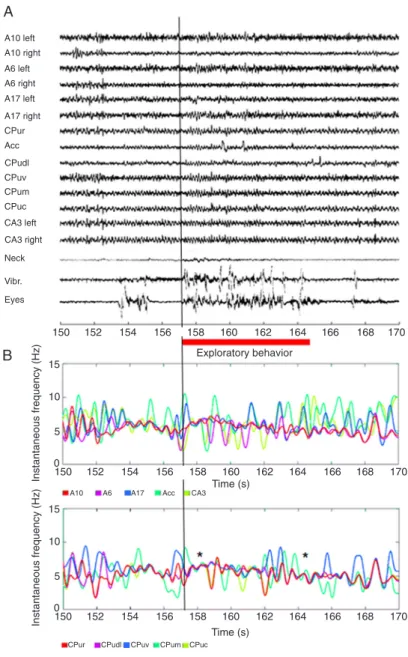
Overall, during exploration we observed a desynchro-nization in area 10 and in the rostral caudatoputamen, as well as theta activity at most of the striatal electrodes and in areas 6, 17, and CA3 (see Figures 2A and 3). Analysis of the instantaneous frequency revealed that striatal LFP signals oscillated in a narrow theta band. Figure 2B il-lustrates the variation in the instantaneous frequency for all recorded channels during the epoch shown in 2A. We recorded exploratory behavior between times 157 and 164 s and detected activity in the neck, vibrissae and eyes (highlighted with a red bar). Interestingly, striatal signals
undergo fine modulation with brief periods of frequency
convergence in the theta range, and this modulation was most prominent at the beginning and at the end of the exploratory behavior (marked with asterisks). This kind of modulation was not seen in A17 or CA3, and rarely seen in A6 and A10. Nevertheless, modulation was present in 92.5 ± 2.5% of all segments analyzed in the striatal
chan-nels; more specifically, 97.2 ± 2.3% in the CPur, 96.4 ±
2.1% in the CPudl, 95.3 ± 2.6% in the CPuv, 82.7 ± 2.2%
in the CPum, and finally 91 ± 2.6% in the CPuc. Next we
analyzed the power spectra in order to measure the relative contribution of each frequency to the recorded signals (see Figure 3). Overall, a clear predominance of theta activity
was confirmed in all striatal areas. Comparing episodes
of wakefulness to episodes of exploratory behavior, we observed an increase in theta spectra from 35 ± 3 to 40 ± 5 µV2/Hz in the CPudl (P < 0.001), from 25 ± 2 to 59 ± 4 µV2/Hz in the CPuv (P < 0.001), from 41 ± 5 to 61 ± 5 µV2/ Hz in the CPum (P < 0.001), and from 100 ± 7 to 170 ± 9 µV2/Hz in the CPuc (P < 0.001).
766 G. Lepski et al.
graphs of averaged coherence coefficients
for all 40 segments studied, in wakefulness (A) and at the beginning of exploratory be-haviors (B). Functionally distinct zones of the striatum exhibit coherent LFP oscillations during exploration. Additionally, the theta-band activity was highly synchronous within and across all recorded striatal regions, with coherence values of at least 0.7. A consistent increase in the partial directed coherence among all striatal channels and between CPur and A6 during attention periods was
evident, a finding not repeated in any of the
other pairs recorded. The coherence be-tween CPur and A6, for example, increased from 0.9059 ± 0.0564 during wakefulness to 0.9626 ± 0.0224 (P < 0.001) during explor-atory behavior. Similarly, the CPudl-CPuv pair showed increased coherence from 0.7799 ± 0.1318 to 0.8903 ± 0.0657 (P < 0.001); CPudl-CPum from 0.8041 ± 0.1173 to 0.8890 ± 0.0665 (P < 0.001); CPudl-CPuc from 0.7659 ± 0.1402 to 0.8228 ± 0.1061 (P < 0.05); CPuv-CPum from 0.7569 ± 0.1402 to 0.8746 ± 0.0751 (P < 0.001); CPuv-CPuc from 0.6607 ± 0.2032 to 0.7443 ± 0.1532 (P
< 0.5), and finally CPum-CPuc from 0.9511
to 0.9494 (P = 0.79). Figure 4C and D show in tridimensional graphs the magnitude of the increase in coherence between the recorded pairs observed during increased attention. Taken together, these data support the notion that different anatomical regions of the rodent striatum interplay with high coherence in the theta band during increased attention related to environment exploration.
Discussion
In the present study, LFP recordings of distinct striatal structures in freely moving rats, concomitantly with prefrontal and motor
cortical areas, revealed fine modulation of
theta oscillations during exploratory behavior in all striatal channels, but not in the prefrontal or visual cortex. Moreover, the theta power spectrum increased throughout the 5 striatal channels recorded during exploration, in parallel with changes in behavioral patterns. Finally, partial directed coherence analyses revealed a closer connectivity between A6 and the rostral portion of the striatum, concomitant with increased activity among all other striatal channels. These results indicate that ana-tomically distinct parts of the rodent striatum
Figure 3. Increase in theta power spectra in all striatal areas during periods of increased
atten-tion. Attentive wakefulness was defined as pre -dominance of desynchronization in the prefrontal cortex, theta rhythmic activity in the hippocampus,
and general motor activity. Intensification of alert
-ness during exploratory behavior was defined
based on the initiation of concomitant muscle activity in the neck extensor muscles, eyes and vibrissae. We selected for analysis 2-s intervals at the beginning of exploratory behaviors and 20-s intervals of attentive wakefulness without exploratory movements. The power spectra of all recorded channels during periods of attentive wakefulness are represented on the left, and dur-ing exploratory behavior on the right.Robust theta
band activity was evident in local field potentials
768 G. Lepski et al.
actively participate in the organization of attention related to exploratory behavior, and oscillate with high coherence with the sensorimotor cortex in the theta band.
The timing of neuronal activity in the striatum is critical
for motor and cognitive control. Our findings demonstrate
that oscillatory activity is a prominent feature of locally
generated field potential activity in the rat’s striatum and
show that, across a range of frequency bands, the power of the theta rhythm varies with spontaneous behavior. Our
findings suggest that modulation of theta activity during
exploratory behavior may represent an important influence
on corticostriatal loop function during attentive behavior. Theta rhythmicity in the striatum was most conspicuous during spontaneous running and environment exploration, and was weak during grooming and wakeful rest, when hippocampal theta is high. These characteristics held when the LFP recordings were in the medial, ventral, dorsolat-eral, head, and caudal portions of the striatum. The theta band oscillations recorded in these different regions were largely coherent. Although theta activity was concomitantly
Figure 4. Increased coherence between the primary motor cortex and the head of the caudate nucleus, and among all caudate putamen (CPu) channels. A and B, Contour graphs showing the coherence coefficients (partial
directed coherence in the theta band) among recorded areas during the whole segment lasting 20 s (A, left) and during the 2-s segment at the beginning of the exploratory behavior (B, right). Coefficient values are color-coded
according to the legend on the right, where blue represents low coherence and red high coherence, without
infer-ence on information flow (see text). Note an increase in the coherinfer-ence among all striatal channels and between A6
measured in the hippocampus during exploration, this was not coherent with striatal LFP. It has been suggested that volume conduction can account for the rhythmic activity recorded in the striatum, due to electrotonic spread of the voltage signal from remote oscillators (29). Nevertheless, it has been shown that the striatal theta is not consistently correlated with the hippocampal theta during T-maze tasks (30). This demonstrates that the hippocampus is not re-sponsible for the striatal rhythms. The low coherence in our experiments between the striatum and the hippocampus during environment exploration supports this notion.
Theta rhythmicity is thus a general characteristic of LFP activity in the striatum of rats actively exploring and moving in their environment. These results suggest that theta-band rhythmicity in the striatum does not depend exclusively
on region-specific functions of particular striatal circuits.
Rather, the LFP rhythms appear to be a shared feature of
the temporal structuring of field activity in the striatum
(31-33). The observed striatal LFP oscillations, as well as their
marked coherence across all recording sites, may reflect the influence exerted by other sites such as neocortex,
thalamus, and pallidum, or the activity of local striatal circuits operating in conjunction with these (31,34,35).
An important role attributed to the corticostriatal sys-tem is that of learning and memory. DeCoteau et al. (30) demonstrated that the coherence between striatal and hip-pocampal theta peaked during the decision period of tasks requiring navigational and cue-based associative learning, implying a key role of the striatum in cognitive processing. These investigators had previously demonstrated that there was no consistent relationship between the power of the theta band in the striatum and the primary characteristics of motor behavior, such as velocity or acceleration (32). This suggests that striatal theta activity may be linked to other behavioral state characteristics engaged during exploration of the environment. We propose here that the striatum may represent a relay station for distribution of attention to
vari-ous neocortical areas. Our findings provide evidence that
oscillatory activity in the striatum is systematically modulated by the behavioral context and especially according to the degree of attention; moreover, this activity seems to be coordinated across functionally different striatal regions.
In the present study, we conducted LFP recordings to demonstrate the predominance of synchronization in theta frequencies during attentive behavior in rodent striatum. The power spectra in theta increased during exploratory
behavior, indicating a higher degree of activation during this time period. It is reasonable to assume that during environment exploration a higher degree of attention is being required. This modulation was observed in all striatal channels, highlighting the importance of the entire striatum during attention. Moreover, directed coherence analyses indicated strong connections during increased attention be-tween area 6 and the rostral portion of the caudatoputamen complex, as well as among all striatal channels recorded.
Our data conflict with results of previous studies that have
demonstrated a tricompartmental striatal organization of associative, motor and limbic components, based on the connectivity patterns of these structures even in rats (6,8). The functional analysis of LFP during motor behavior in this study indicates concomitant activation of the whole striatum, as well as strong synchronization between the rostral striatum and the primary motor cortex during peri-ods of increased attention. In an attempt to interpret these
apparently divergent findings, we hypothesize that the
three mental functions processed in the striatum - namely cognitive and associative aspects (integrated in the dor-solateral caudate nucleus), emotional status and reward (limbic ventral striatopallidal system) and motor planning (central putamen) - must all be concomitantly integrated during spontaneous behavior.
The data reported here serve to advance the current knowledge on basal ganglia function. We suggest that modulation of oscillatory activity in the striatum may be a key feature of neural processing related to the organiza-tion of attenorganiza-tion and the integraorganiza-tion of motor, cognitive, and limbic systems during voluntary behavior. Further ex-periments are needed to describe the electrophysiological alterations under pharmacological or surgical manipulation of this complex system.
Supporting information
Click here to view.
Acknowledgments
The authors would like to thank Prof. Koichi Sameshima for assistance with computational analysis, and
posthu-mously, Prof. Cesar Timo-Iaria for the scientific formation of the G. Lepski. We also thank FAPESP for financial
support.
References
1. Ungerstedt U, Arbuthnott GW. Quantitative recording of rotational behavior in rats after 6-hydroxy-dopamine lesions of the nigrostriatal dopamine system. Brain Res 1970; 24: 485-493.
2. Evenden JL, Robbins TW. Effects of unilateral
6-hydroxydo-pamine lesions of the caudate-putamen on skilled forepaw use in the rat. Behav Brain Res 1984; 14: 61-68.
3. Marshall JF, Richardson JS, Teitelbaum P. Nigrostriatal bundle damage and the lateral hypothalamic syndrome. J
770 G. Lepski et al.
4. Whishaw IQ, O’Connor WT, Dunnett SB. The contributions of motor cortex, nigrostriatal dopamine and caudate-putamen to skilled forelimb use in the rat. Brain 1986; 109 (Part 5): 805-843.
5. Ljungberg T, Ungerstedt U. Sensory inattention produced by 6-hydroxydopamine-induced degeneration of ascending dopamine neurons in the brain. Exp Neurol 1976; 53: 585-600.
6. Nauta WJ, Domesick VB. Afferent and efferent relationships of the basal ganglia. Ciba Found Symp 1984; 107: 3-29. 7. Nauta WJ. Limbic innervation of the striatum. Adv Neurol
1982; 35: 41-47.
8. Alexander GE, Crutcher MD, DeLong MR. Basal ganglia-thalamocortical circuits: parallel substrates for motor, oculo-motor, “prefrontal” and “limbic” functions. Prog Brain Res
1990; 85: 119-146.
9. Alheid GF, Heimer L. Theories of basal forebrain organiza-tion and the “emoorganiza-tional motor system”. Prog Brain Res 1996; 107: 461-484.
10. Heimer L, Alheid GF. Piecing together the puzzle of basal forebrain anatomy. Adv Exp Med Biol 1991; 295: 1-42. 11. DeLong MR, Alexander GE, Georgopoulos AP, Crutcher MD,
Mitchell SJ, Richardson RT. Role of basal ganglia in limb movements. Hum Neurobiol 1984; 2: 235-244.
12. Kunzle H. Projections from the primary somatosensory cor-tex to basal ganglia and thalamus in the monkey. Exp Brain Res 1977; 30: 481-492.
13. Goldman PS, Nauta WJ. An intricately patterned prefronto-caudate projection in the rhesus monkey. J Comp Neurol
1977; 72: 369-386.
14. Riedel A, Hartig W, Seeger G, Gartner U, Brauer K, Arendt T. Principles of rat subcortical forebrain organization: a study
using histological techniques and multiple fluorescence
labeling. J Chem Neuroanat 2002; 23: 75-104.
15. Benchenane K, Peyrache A, Khamassi M, Tierney PL, Gio-anni Y, Battaglia FP, et al. Coherent theta oscillations and reorganization of spike timing in the hippocampal-prefrontal network upon learning. Neuron 2010; 66: 921-936. 16. Kahana MJ, Seelig D, Madsen JR. Theta returns. Curr Opin
Neurobiol 2001; 11: 739-744.
17. Buzsaki G, Draguhn A. Neuronal oscillations in cortical net-works. Science 2004; 304: 1926-1929.
18. Linkenkaer-Hansen K, Nikulin VV, Palva S, Ilmoniemi RJ, Palva JM. Prestimulus oscillations enhance psychophysi-cal performance in humans. J Neurosci 2004; 24: 10186-10190.
19. Womelsdorf T, Fries P, Mitra PP, Desimone R. Gamma-band synchronization in visual cortex predicts speed of change detection. Nature 2006; 439: 733-736.
20. Buzsaki G, Chrobak JJ. Synaptic plasticity and self-organization in the hippocampus. Nat Neurosci 2005; 8: 1418-1420.
21. Hasselmo ME. What is the function of hippocampal theta rhythm? - Linking behavioral data to phasic properties of
field potential and unit recording data. Hippocampus 2005; 15: 936-949.
22. Vertes RP, Hoover WB, Viana Di Prisco G. Theta rhythm of
the hippocampus: subcortical control and functional signifi -cance. Behav Cogn Neurosci Rev 2004; 3: 173-200. 23. Berke JD, Okatan M, Skurski J, Eichenbaum HB. Oscillatory
entrainment of striatal neurons in freely moving rats. Neuron
2004; 43: 883-896.
24. van der Meer MA, Redish AD. Theta phase precession in rat ventral striatum links place and reward information. J
Neurosci 2011; 31: 2843-2854.
25. Andersen ML, Valle AC, Timo-Iaria C, Tufik S. Implantação
de elétrodos para o estudo eletrofisiológico do ciclo
vigília-sono do rato. São Paulo: Ed. UNIFESP; 2001.
26. Paxinos G, Watson C. The rat brain in stereotaxic coordi
-nates. 4th edn. New York: Elsevier; 2004.
27. Zilles KJ. The cortex of the rat: a stereotaxic atlas. Berlin, New York: Springer-Verlag; 1985.
28. Sameshima K, Baccala LA. Using partial directed coherence to describe neuronal ensemble interactions. J Neurosci
Methods 1999; 94: 93-103.
29. Sirota A, Montgomery S, Fujisawa S, Isomura Y, Zugaro M, Buzsaki G. Entrainment of neocortical neurons and gamma oscillations by the hippocampal theta rhythm. Neuron 2008; 60: 683-697.
30. DeCoteau WE, Thorn C, Gibson DJ, Courtemanche R, Mitra P, Kubota Y, et al. Learning-related coordination of striatal and hippocampal theta rhythms during acquisition of a procedural maze task. Proc Natl Acad Sci U S A 2007; 104: 5644-5649.
31. Courtemanche R, Fujii N, Graybiel AM. Synchronous, focally
modulated beta-band oscillations characterize local field
potential activity in the striatum of awake behaving monkeys.
J Neurosci 2003; 23: 11741-11752.
32. DeCoteau WE, Thorn C, Gibson DJ, Courtemanche R,
Mitra P, Kubota Y, et al. Oscillations of local field potentials
in the rat dorsal striatum during spontaneous and instructed behaviors. J Neurophysiol 2007; 97: 3800-3805.
33. Magill PJ, Pogosyan A, Sharott A, Csicsvari J, Bolam JP, Brown P. Changes in functional connectivity within the rat striatopallidal axis during global brain activation in vivo. J
Neurosci 2006; 26: 6318-6329.
34. Aldridge JW, Gilman S. The temporal structure of spike trains in the primate basal ganglia: afferent regulation of bursting demonstrated with precentral cerebral cortical abla-tion. Brain Res 1991; 543: 123-138.
35. Lebedev MA, Nelson RJ. Rhythmically firing neostriatal