TRADITIONAL AND CHALLENGER BANKS IN UK:
COMPARISON IN TERMS OF CUSTOMER VALUE
Sara Santos
Dissertation written under the supervision of João Freire de Andrade
Dissertation submitted in partial fulfilment of requirements for the
MSc in Finance, at Universidade Católica Portuguesa,
ABSTRACT
Title of the Thesis:
Traditional and Challenger banks in UK: Comparison in terms of customer value Author: Sara Maria Sustelo Santos
Keywords: FinTech, Banks, Customer Value, Customer Experience
Banking is about delivering value to the customer. There are two main type of banks: Traditional banks with centuries of history, a large customer base, a trusted, familiar and recognized brand, which have been challenged by newcomers – the Challenger banks as they started to rethink customer journey within banking business models. The purpose of this research is to conclude on which type of bank provides more value to their customers, which factors contribute for that and study the effect of those results on consumer behavior outcomes, in UK. The hypotheses are formulated after an extensive review of both academic literature and white papers about FinTech, banking industry and customer value measurement methods. Using primary data methods obtained with 201 valid respondents from UK, contacted online, performing scale development, CFA and SEM, resulted in the development of a customer value measurement method with 34-items and eight factors. In general, the results showed that Challenger banks provide higher customer value than Traditional banks, presenting higher average scores in seven factor while Traditional banks stand-out in one factor. Moreover, customer value and its factors predict consumer behavior outcomes Word-of-mouth and Loyalty, being the factors Price offer fairness and Outcome focus highly relevant because of its close link to the outcomes. The research contributes to existent academic literature on FinTech, banking industry with a validated customer value measurement method, having also practical implications for managers of financial institutions, giving them a useful tool for the development of specific strategies of marketing.
ABSTRACT (Portuguese version)
Título:
Traditional and Challenger banks in UK: Comparison in terms of customer value Autor: Sara Maria Sustelo Santos
Palavras-chave: FinTech, Bancos, Valor para o cliente, Valor
O setor bancário está relacionado com a entrega de valor ao cliente. Existem dois tipos principais de bancos: os Tradicionais, com história, elevado número de clientes, marca de confiança, familiar e reconhecida, que têm sido desafios pelos bancos conhecidos por “Challengers”, que repensaram a experiência do cliente e o “business model” do setor bancário. O objetivo desta pesquisa é concluir que tipo de banco fornece mais valor ao cliente, quais os fatores que contribuem para tal e estudar o efeito desses no comportamento do cliente, no Reino Unido. As hipóteses são formuladas após uma extensa revisão da literatura académica, relatórios sobre “FinTech”, o setor bancário e medidas de valor. Dados primários foram obtidos por contacto online alcançando 201 indivíduos, clientes de bancos do Reino Unido. Utilizando CFA e SEM, resultou num método final com 34 itens e oito fatores que o valor. No geral, os resultados demonstram que os bancos “Challenger” fornecem mais valor ao cliente do que os Tradicionais, apresentando uma pontuação mais elevada em sete fatores enquanto os Tradicionais apresentam maior num fator. Para além disso, o valor para o cliente e os seus fatores explicam os comportamentos do cliente “Word-of-mouth” e “Loyalty”, sendo que os fatores “Offer fairness” e “Outcome focus” são relevantes pelo seu poder explicativo dos comportamentos. A pesquisa contribui para literatura existente sobre “FinTech” e o setor bancário, com um método válido para medir valor, tendo implicações práticas para gestores de instituições financeiras, com uma ferramenta útil para delinear estratégias de marketing.
TABLE OF CONTENTS
1. INTRODUCTION ... 1
2. LITERATURE REVIEW ... 3
2.1. FinTech in Banking Industry ... 3
2.2. Traditional banks versus Challenger banks ... 5
2.3. Customer Value ... 9 2.4. Consumer Behavior ... 12 2.5. Research Hypotheses ... 13 3. METHODOLOGY ... 15 3.1. Methodology synthesis ... 15 3.2. Survey sampling ... 15 3.3. Data collection ... 17
3.4. Descriptive statistics of Data ... 18
3.5. Scale development and validation ... 19
3.6. Measurement models ... 23
4. RESULTS ... 28
4.1. Results from the first study ... 28
4.1.1. Scale validation ... 28
4.1.2. Descriptive statistics of items ... 30
4.1.3. Estimated factor scores (model 1) ... 32
4.1.4. Overall customer value score (model 2) ... 33
4.2. Results from the second study ... 33
4.2.1. Models validation ... 33
4.2.2. Descriptive statistics of items ... 34
4.2.3. Estimated factor scores: WOM and LOY (models 3.1 and 3.2) ... 35
4.2.4. Effects on consumer behavior outcomes (model 4 and model 5) ... 36
TABLE OF FIGURES
Figure 1 - Explaining customer behavior (adapted from Klaus, 2015) ... 12
Figure 2 – Second study SEM conceptualization . ... 14
Figure 3 - Selected Articles of Previous Studies for this dissertations ... 15
Figure 4 - Completion Rates and Missing Data explanation ... 16
Figure 5 - Number of respondents for each study divided in three different possibilities ... 16
Figure 6- Descriptive Statistics: Demographic Data of respondents ... 18
Figure 7 – Scale development ... 19
Figure 8 - Internal Consistency of measurements with dataset of Pilot-testing ... 20
Figure 9 – Internal Consistency of measurements with final dataset ... 22
Figure 10 – Word-of-Mouth (WoM) and Loyalty Behavior (LOY) factors ... 25
Figure 11 – Structural Model 4 ... 27
Figure 12 - Structural Model 5 ... 27
Figure 13 – Results of CFA for the 1st order 8-factor model (with p-value = 0.00 < 0.05) .... 29
Figure 14 – Means and standard deviations of items ... 32
Figure 15 – Descriptive statistics 1st order 8-factor model ... 32
Figure 16- Customer value overall score ... 33
Figure 17 – CFA results of WOM and LOY measurement models 3.1 and 3.2 ... 34
Figure 18 – Means and standard deviations for items part of WOM and LOY ... 35
Figure 19 – Descriptive statistics of models 3.1. and 3.2 ... 35
Figure 20 – Results from SEM of model 4 ... 36
APPENDIX
Appendix 1 – Table with areas of activity of FinTech start-ups ………...……….40
Appendix 2 – Service experience construct and measure model (EXQ)………...……41
Appendix 3 – Neobanks and Challenger banks in UK per category………..…42
Appendix 4 – Distribution of Traditional and Challenger banks in the sample………….……43
Appendix 5 – Questionnaire structure………...……44
1. INTRODUCTION
FinTech or Financial Technology is one of the most promising industries in 2016 (Chishti and Barberis, 2016). The financial industry has been going through a lot of change, FinTech Startups are entering the market offering not new, but revolutionized services that are traditionally offered by established financial institutions, such as banks and insurance companies (Dapp, 2014). However, this industry is one of the last large industries that has not been completely disrupted by the digital revolution. Most banks in the financial sector have a conservative attitude towards solutions and think that the heavy regulation will protect them and limit the enter and growth of FinTech Startups not understanding that tech companies are agile enough to make use of the existing regulation (Gelis, 2016). FinTech Startups try to solve gaps in the customer journey. Successfully, many of them already reached a critical mass of users proving the viability of their business models. Revolut, a digital banking alternative, broke even in December of 2017 for the first time and claims to have reached 2 million users (CNBC, June 2018) with its $1.7 billion post-money valuation in Series D funding (TechCrunch, April 2018). FinTech Startups usually focus on a very specific niche segment of the industry while banks try to compete on all levels possessing every aspect of the financial services range (Rachel Nienaber, The FinTech Book, pp. 21, 2016). Almost every financial service that a bank offers is also offered, or soon will be, by a FinTech company (Appendix 1). In the past, banks were the only option for the costumer’ financial needs and this last for a long time. Today, there’s an alternative to banks services. While other industries were being disrupted, it took more time for that to happen in Finance sector. According to TransferWise1 Report (“Future of Finance”, 2016), in ten years the financial services sector will be transformed and the main driver for that to happen is behavior and expectations of customers. In the same report, TransferWise presents five conditions that allow the FinTech Startups to enter the sector: loss of trust in banking sector after the global financial crisis of 2008, following that the expectations of customers are higher, the rise of millennials and of the mobile internet and finally, changes in regulation that focus more on the rights of the customer (PSD2, GDPR)2.Fasnacht (2009) argues that changes in customer demographics and their requirements affected Financial Services conservative industry bringing more innovation and new business opportunities.
1UK-based money transfer service launched in January 2011.
2 PSD2: Payment Services Directive (European Commission Press Release, October 2015). GDPR: General Data
In the past, customers valued convenience and visibility so that banks who had larger branch networks would standout, competing on product, price and scale regarding the number of branches they had. Today, the main competitive factor is customer experience, that combines what is sold and how that is delivered, being both critical components of the customer journey (EY, 2017). Most of bank customers now prefer to access their financial information through mobile banking and, as a response to that, Banks have been closing branches since the financial crisis of 2008. For example, in UK more than 1,000 banks branches have closed between 2015 and 2016 (Dunkley, 2016).Furthermore, according to research from CACI3, consumer visits to retail bank branches will decline 36% between 2017 and 2022, while mobile transactions will rise 121% in the same period. Closing branches reduces operation costs for being the average cost saving around £200.000 annually according to Deloitte (2014). Additionally, according to Accenture (North America Consumer Digital Banking Survey, 2015), 81% of customers would not change banks if their local branch closed. EY Global Consumer Banking Survey (2017) confirms that banks are under pressure to master the customer experience due to two reasons: increasing commoditization, i.e., customers don’t see differences between Traditional banks offering and business models, and new competition from FinTech Startups and other new market entrants that give more importance to customer value. Furthermore, it is estimated that 80% of sold devices by 2020 will be smartphones and that mobile data consumption will increase seven-fold by 2021 (Cisco Mobile Visual Networking Index Forecast, 2016). In this new setting, banks should focus on offering products that are simple, visual and user-friendly having the customer relationship as a focus (Erman, 2017).
Until now there is no research that aims to assess the customer value that Challenger banks provide and compare it with Traditional banks, in order to understand their main differences when relating to customers. This research focuses on two studies. First, the comparison, in terms of customer value and its factors, between Traditional banks and Challenger banks, with a scale development and an assessment of customer value, to conclude about which group offer more value to their customers and which drivers are behind that. The second study, is about the effect of customer value from both type of banks, on consumer behavior outcomes such as Word-of-Mouth (WOM) and Behavioral Loyalty Intentions (LOY).
2. LITERATURE REVIEW
2.1.FinTech in Banking Industry
The inception of the credit card in the 1950s and ATMS in the 1970s changed the way people access and pay for goods. The internet revolution in the early 1990s had a profound impact in the financial markets worldwide, having emerged many e-finance business models such as online banking, online brokerage services, mobile banking and payments. The FinTech revolution has been building a new appearance of the financial world after the global financial crisis in 2008, according to The Economist (2015), and the most beneficiary from its fast growth are the consumers (Rometty, 2016).
FinTech is still at its beginning, however, has been gaining popularity not only in financial markets but also in research. The few scientific researches about FinTech are about the effects that the FinTech Startups have on established players in the financial markets or about the business areas that these types of companies develop, and how they interact with each other (Stuckenborg et al., 2017).
There is a broad agreement between scientific and practical experts that FinTech is a combination of the words “financial” and “technology”. It can be simply described as “the use of technology to deliver financial solutions” (Arner et al., 2015, p.3). For the research purpose of this dissertation, it will be considered the definition given by Sia et al. (2016, p. 105) who describes FinTech as “a new generation of financial technology Startups that are revolutionizing the financial industry”. In total, it’s distinguished twelve different areas of FinTech activities, presented in Appendix 2, with its area of activity, description and an example of a FinTech Startup. For every financial service virtually, there’s a FinTech Startup (Chen, 2016). In this research, the FinTech Startups considered include Neobanks and Challenger banks, excluding all the other type of FinTech activities.
According to BBVA, there are two main groups of FinTech banks: Neobanks and Challenger banks. Neobanks are an internet/mobile bank that offer more customized services focus on a niche of the market, having as main value proposition the user interface/experience, however, it needs to have a partner bank, i.e., they rely on a real bank’s infrastructure so that they work as an interface. Challenger banks offer very similar services as a Traditional bank with lower costs since they build their own infrastructure from scratch, i.e., they do not rely on another bank, having themselves a banking license or are in the process of getting one and, they don’t
have legacy costs so that is easier to get market share. This type of banks aim to become all-in banks, but without branch-based distribution channels being mobile banks (BBVA, 2016). Challengers banks and Neobanks have as main differences the banking license and the full control on the core banking system, having Challenger banks more ability to innovate according to customer’s needs since they don’t rely completely on third party providers (Djelassi, 2017). The main challenges for Neobanks are (1) the cost of customer acquisition and (2) the dependence on a partner bank while for Challenger banks is the first one (Trieu, 2015). Another possible classification is GAFA banks, which are banks that would exist if a Tech giant such as Google or Facebook, created a bank (Barberis, 2016).
Neobanks and Challenger banks can have a Consumer (B2C), a Business-to-Business (B2B) type of business or both. In the B2C type of business, the bank offers its products and services directly to the consumers (E.g. Mondo, N26)4. In the B2B type of business, the bank sells its services to other business such as Small or Medium Enterprise Business (SMEs) or sole traders (E.g. Tide, Counting up)5. Other digital banks such as Starling Bank and Revolut6 are focused on both type of businesses. Research by Burnmark (2016) shows that 43% of Challenger banks in the world offer only basic products such as current accounts and saving accounts. The other 57% offer Traditional products such as mortgages, SME lending, children’s savings and insurance. For Challenger banks the significant source of revenue are not large organizations but individual customers and SMEs (Lee et al., 2018). The last type of bank presented is the one that exists for longer and that it’s often associated with the concept “bank”. In this dissertation, this type of bank will be called Traditional banks. Banks are “institutions whose current operations consist in granting loans and receiving deposits from the public” (Freixas and Rochet, 1997). These represents banks’ core activity that distinguishes them from the other financial institutions. Roengpitya et al. (2014) classified three banks business models through a statistical clustering algorithm using data from balance sheet: retail-funded, wholesale-funded and trading banks. The first business model that was label commercial “retail-funded”, it’s characterized by having a high share of loans in their balance sheet and a high reliance on stable funding sources such as deposits. Fasnacht (2009) classifies
4 Mondo is a mobile first bank. N26 is challenger bank.
5 Tide is a neobank that offers a current account for SMEs. Counting up is an accounting bank.
retail banking as a service for end users, distinct from commercial banking that is focused on companies.
In this dissertation, Traditional banks definition is in accordance with the previous definitions of Retail Banking and “retail-funded”, added the fact that will only be considered established financial institutions with more than five years of existence that have physical branches and offer at least the following services to their customers: credit, deposit and money management. For the purpose only Neobanks, Challenger banks and Traditional banks are considered. The focus of the dissertation is the comparison, in terms of customer value, between Traditional banks and a new type of banks that joins Neobanks and Challenger banks and will be aggregated and called Challenger banks. Furthermore, the focus is on consumer banking, i.e., B2C type of business and for that reason, banks that only do B2B will not be considered. Moreover, consumer banking is the most likely to be disrupted by FinTech according to 73% of the financial sector executives (PWC, 2016).
2.2.Traditional banks versus Challenger banks
FinTech Startups are disrupting the existing products and services, with a focus on user experience, extracting value from data, decreasing operation costs and increasing efficiency with their business models, through advance technology (Chappuis Halder, 2015). As newcomers, Challenger banks can rethink the banking business model and the technology behind it. However, barriers to entry remain high and it takes time to build a recognized, familiar and trusted brand such as Traditional banks have (Djelassi, 2017). Chuen and Teo (2015) identified the LASIC principles that new disruptive businesses should aim to have success, being this not sufficient, but necessary conditions: low margin, asset light, scalable, innovative and compliance easy business models. Traditional banks and Challenger banks have different capabilities which lead to different strategies in the financial sector. Consequently, understanding their core points of differentiation is useful for this research.
Osterwalder, Pigneur et al. (2010) propose for companies to build business models based on the customer perspective. Being an innovative and customer-centric company is vital for survival and growth (Capgemini Worldwide, “World FinTech Report”, 2018). Around 53% of the Traditional banks say they are customer-centric while for FinTech Startups that accounts for 80% (PWC, 2016). FinTech Startups seem to follow this customer-centric approach, since they are able to understand their customers better than the Traditional banks and thus address their needs in a more effective way (Mackenzie, 2015). DBS Bank’s Sonia Wedrychowic, Head
of Consumer Bank Technology Singapore, advocates for Traditional banks to assume an outside-in perspective, keeping the customer journey in mind in a way that the customers design the customer experience instead of looking at the journey from the bank’s perspective. In most cases, Challenger banks provide a more efficient way to sell the same old products and services, possibly because of the technologies used, but in a different and unbundled way. These unbundled activities have limited scope. However, this ability of unbundle services has been very disruptive for Traditional banks (Walchek, 2015) and one of the major drivers of growth in the FinTech sector (Lee et al., 2018). Offering personalized niche services and providing services that are more personalized and more segmented to the customer’ needs, has been one of the key differentiations of Challenger banks. Although Traditional banks are in disadvantage regarding the unbundling of services, since they provide one-stop comprehensive financial services and products to customers, being their value chain based on many bundled activities, this provides them powerful economies of scope (Navaretti et al., 2017). According to KPMG (“Banking the Customer Experience Dividend”, 2016) most of Traditional banks’ relationships with their customers have become standardized having a lack of emotional differentiation that reinforces unexploited financial opportunity. Regarding channels as a distribution element it’s important to compare Traditional and digital banking models. Consistency in customer experience is the focus for digital banking model since channels are non-existent, contrarily of the Traditional model that has an inconsistent customer experience across channels (Padmaavathy and Adalarasu, 2015). Traditional banks have used their branches to acquire customers. On an average, customers go to a branch once or twice a year and with their mobile devices they interact 20 to 30 times per month, according to Luvleen Sidhu, President of BankMobile (2018). Traditional banks have been through a lot of change in the past years, specially related with the online banking systems, however they’re doing it at a slow pace. Before, most of the transactions required the presence of the customer in the branch (Landers, 2016) which took lots of time and effort, compared with online banking. Staff levels have been reduced, the most unprofitable branches have been closed and new branch concepts start to being tested. PWC (“Retail Banking 2020: Evolution or Revolution”, 2014) expect these trends to speed up. Furthermore, Traditional banks are providing better user experience, being their services faster and more user-friendly than they were some years ago. Although most of the largest banks have initiated their online services and closing of branches, Challenger banks already surpass the digital banking model itself. Challenger banks stand-out due to extreme minimalism in design and functionality, simplification, easiness in use and on the eyes reflecting core User Experience (UX) principles (Chen, 2016) which is reflected in the design
of the app from the customer’s perspective. Besides working only in online and mobile context, Challenger banks have less complex IT systems, simpler product set, more streamlined and automated operating models and fewer legacy compliance issues (KPMG, “Challenger banking report” 2016) compared with Traditional banks that have increasing costs due to more austere banking regulatory environment. While Traditional financial institutions are working on their business models trying to optimize them, they are surround by immense regulation burdens. Nevertheless, Traditional banks have as advantage, knowledge about existing regulation and the ability to forecast the evolution of the industry (Philippon, 2016) while most Challenger banks do not have the expertise to understand and comply with the new regulations. However, they are not subject to high compliance regimes which encourages them to be more innovative and entails lower capital requirements. Douglas (2016) wrote that the success of FinTech Startups depends on combining their cutting-edge technology capabilities and flexibility in changing regulations.
One of the key advantages of Traditional banks is their huge customer base (Philippon, 2016) and the time-honored relationships built with their customers, which represents a unique opportunity to use big data techniques to provide a personalized. Personalization is needed to drive growth and shareholder value and accounts for 23% of the overall customer experience (KPMG, 2016). It seems that Challenger banks are doing a good job in terms of customer acquisition because of the great user interface they are offering and the focus on customer experience, however, Traditional banks have been much more experienced and good at it because “of the stickiness of the direct deposit checking account relationship”, according to Luvleen Sidhu (2018). Traditional banks have made it hard for customer to switch from one bank to the other: banks try to attract customer as early as possible and they use long term products such as mortgages or loans to lock customers as long as possible (Djelassi, 2017). Challenger banks will have to maintain their customer acquisition cost (CAC) as low as possible and “manage their profitability/growth dilemma until their business model becomes the new standard of doing banking” according to Djelassi (2017). Traditional banks have established technologies that are in the best case partly integrated after successive mergers that have left banks like this (Kumar, 2016). Besides that, they have established processes, being the structure and pace of transactions standardized and although they’re not fast as customers would like it to be, they are predictable and familiar, since the bank behavior is rarely surprising, according
to Galarza (2017), founder and CEO at Entryless7. Challenger banks take the advantage of their flexibility and agility due to freedom from legacy burdens to offer a new service or product that matches with consumers’ new habits (Vauplane, 2015). FinTech Startups have a lean and agile movement in the financial sector, starting with their culture and innovative business models that are based on advanced technology such as Blockchain and cloud infrastructure that helps enhance customer experience and reduce costs (Chishti and Barberis, 2016) or authentication technologies that avoid the customer going to a branch (Burnmark, 2017). Traditional banks are feeling the need to adapt to a new world. Investments in innovation programs and R&D of new processes and technologies are happening. However, R&D is fundamentally different from innovation and few banks provide more than sporadic disclosures regarding innovation and mostly of the disclosures are qualitative (Larsen, 2017).
Challenger banks had the “first mover” advantage, however, they still lack scale in most of the cases because Traditional banks are viewed positively by customers regarding trust. In Burnmark research (“Challenger Bank battlefield”, 2017) it was found that 23.6% of customers of FinTech Startups providers have trust in them compared with the 26.6% for Traditional financial institutions. Furthermore, Traditional financial institutions have an advantage over FinTech Startups regarding fraud protection, quality of service and transparency, according to the same report. Also, Traditional banks have a strong market position in terms of security, trust and antimoney-laundering aspects (Lukanova and Vasiljeva, 2016). In Accenture’s 2015 North America Digital Banking Survey, Traditional banks were trusted by 86% of customers to manage securely personal data compared with other institutions, which means that banks can and should use this as an advantage when it comes to customer data. Nevertheless, transparency is not completely supported by other studies as being one advantage of Traditional banks over Challenger banks. A market investigation about retail banking in UK by CMA8 in 2015 revealed that although banks advertise personal current accounts as free, those generate revenues of £8 billion per year, which customers pay in foreign transaction charges, overdraft charges and foregone interest. Challenger banks claim to have a different approach regarding fees, being transparency the main driver of their business. Moreover, Challenger banks have been able to achieve cost optimization by using cost-effective methods. In a world of wide-spread internet access, most services are free and users have low willingness to pay for those. This will translate
7 Entryless is a bill automation and payment platform 8 Competition & Markets Authority
into a period in which the initial margin will be low or inexistent but over time it increases, with different sources of revenue being captured (Chuen and Teo, 2015).
2.3. Customer Value
“Banking is about attracting customers and making them feel good about their relationship with the bank so that they become customers for life”, said Jay Sidhu, chairman and CEO of Customers Bank.
In the banking industry the relationships between the institutions and the customer are focused on the long-term in order to benefit from customers’ loyalty and participation (Berry, 1983). Furthermore, keeping a customer in a continued relationship with the bank can be up to ten times cheaper than attracting a new customer (Heskett et al., 1990). Value creation and delivering to the customer is very important in the banking industry and the agents in this space (banks) should be providers of value. Many changes have been happening in the last years in these industry, being the customers’ behavior and expectations one of the main ones (Gardener et al., 1999).
The literature on financial services specifies that one of the main fundamental points that banks should be focused on, is customer perceived value (Marple and Zimmerman, 1999). First, it’s important to know what is customer value, how customers form their valuations and how should be measured. According to Payne et al. (1999) many banks use the term “customer value” to refer to the value that the customer creates for them and not the value that they can deliver to their customers. However, there is a consensus regarding seeing value as a customer perception and cannot be determined by the provider of the service, being a subjective evaluation, i.e., for different customers, the dimensions of perceived value might be differentially weighted (Woodruff, 1997). Furthermore, value perceived by customers is not static, is a dynamic process that changes over time (Hansen et al., 2013; Parasuraman and Grewal, 2000).
There is one conceptualization of customer perceived value, according to Sanchez-Fernandez et al. (2006) that defines customer value as a multidimensional construct that has more than one dimension being this approach the most appropriate for customer value in banking industry since there are different elements that can potentially measure it: quantitative (price, cost reduction, speed, time saved) or qualitative elements (newness, customization, design, customer experience, user experience, brand/status, convenience).
Sheth et ak. (1991) identified five types of customer needs: functional value, social value, emotional value, epistemic value and conditional value. Sweeney & Soutar (2001) included factors to the functional value dimension (price or value-for-money, adaptability and quality of the product) and claimed that neither conditional value nor epistemic value should be considered for the customer value construct. Izquierdo et al. (2006) classified the dimensions of customer value in three categories: functional value, affective value which includes both social and emotional value and saving value. Furthermore Roig et al. (2006), adapting the GLOVAL9 scale, found that customer value in the banking industry has six dimensions: functional value divided in four dimensions regarding the installations of the bank, the personnel, the service quality and the price, plus other two dimensions, social value and emotional value, represented by a total of 22-items.
In general, the authors who treat customer value as multidimensional construct agree that two main dimensions can be differentiated: a functional and an affective dimension. The first one assumes that individuals make rational and economic valuations (Roig et al., 2006) while the second one contemplates that “there are non-reasoned reactions that are formed in the customer’s subconscious” according to Sanchez et al. (2006).
To measure customer value there are several methods available. The most known and simple way to measure would be using the Net Promoter Score (NPS) created by Fred Reichheld (2006) based on the perspective that customers of a company can be divided into three categories (promoters, passives and detractors) and the difference between the percentage of the two extreme groups represent the NPS. Traditional banks have open the market enter of Challengers through persistently presenting low customer satisfaction, having the largest UK banks an average NPS of -24 (Bernoff, 2011). Although NPS has great benefits with its simplicity and ease of data collection, it does not generate the scientific data to identify which factors influence most customer value, i.e., there’s a lack of ability to identify and correct the drivers behind those methods (Klaus, 2015). Another method more focused on measure the service quality is SERQUAL or its commercial equivalent “Rater”, which measure the gap between customers’ expectations and customers’ perceptions of the service (Parasuraman et al. 1988). However, SERQUAL’s dimensions are too limited to capture the customer experience completely (Sureshchangar et al., 2002). A need to measure customer experience (CX) before and after the service encounter(s), considering both direct and indirect contacts and the social
context or peer influences (Berry et al., 2002; Payne et al. 2008), resulted in the creation of EXQ - a measure of customer experience quality developed by Klaus and Maklan (2011). EXQ represents a 19-items with four dimensions’ scale and besides explaining customer experience, also predicts consumer behavior better than other methods such as customer satisfaction or NPS (Klaus and Maklan, 2013). The service experience construct and measure (EXQ) is in Appendix 2.
Customer experience is linked to intentions and a customer’s state-of-mind (e.g. customer satisfaction, loyalty or likelihood of a customer giving a recommendation) or actual behavior (e.g. actively recommending the company’s services or products, purchase an item and repurchase it or word-of-mouth behavior). The banking experience of the client is the sum of all interactions that the customer perceives along the entire customer journey when interacting with its bank (Gautam, 2017). In the Digital Banking Report’s Customer Experience in Banking survey (2017) 90% of banks said that CX is a priority, and approximately three-quarters expect to increase their investment in CX this year. However, only 37% of organizations have a formal CX plan and the CX’s objectives at most financial institutions rely on internal benefits such as more sales and cost cutting “to improve the share of wallet” (29%) and “to gain efficiency” (25%), and not in customer benefits.
EXQ measures customer’s experience quality through four dimensions: Peace of mind (PEA), Moments-of-truth (MOM), Outcome focus (OUT) and Product experience (PE), which captures mostly the functional value having also emotional elements. Matzler (2006) argues that companies should consider price satisfaction’ dimensions when monitoring customer satisfaction and showed that five dimensionsinfluence it being two of them Price Transparency and Price fairness. Therefore, two other constructs to measure customer value regarding the functional value dimension were considered for this dissertation: Price Transparency (Störmer, 2004) and Price offer Fairness (Herrmann, 2007). Störmer (2004) analyzed the effect of a cost-based price presentation in customers’ satisfaction regarding factors such as price transparency, WTP10, loyalty and purchase intentions, in a motor insurance context. The results showed that an additional cost presentation significantly rises customers’ satisfaction, having a positive consequence on their purchase decisions and their willingness to recommend the offer purchased. The construct Satisfaction with perceived price transparency used in the study was adapted for the present dissertation and will be referred as Price Transparency. Herrman (2007)
studied how price fairness influences customer satisfaction and has demonstrated empirically that this construct has a direct effect on satisfaction judgements and an indirect effect through price procedure fairness, in the context of automobile purchases. The construct of Price Fairness will be considered as a construct for this study.
Besides the functional value as a dimension for customer value, affective value will also be considered as an important dimension of customer value. The affective dimension is divided into two sub-dimensions: emotional and social (Izquierdo et al., 2006). The emotional dimension is related with feelings or internal emotions generated by the experience, while the social dimension is related with the social impact of using a product or service (Sánchez et al., 2006). Emotions play an important and critical role in customer behavior (Klaus, 2015) being crucial to include an emotional value dimension. Furthermore, an individual experience with a company can be also dependent on the “social experience of a group or wider social context” (Gentile et al., 2007). Social benefits that the customer receives from establish a relationship with the bank are of great importance for customers (Peterson, 1995). Emotional and Social value dimensions of customer value are adapted from Roig et al. (2006) and Ivanauskiene et al. (2012).
2.4. Consumer Behavior
Besides the study of customer value, it’s important that the customer value is able to explain consumer behavior outcomes being Behavioral Loyalty Intentions (Zeithmal et al., 1996; Parasuraman et al., 2005) and Word-of-Mouth (WoM) Behavior (Brown et al., 2005) identified as the most important outcomes of service quality in the literature (Anderson et al. 1994; Verhoef et al., 2003, Dagger et al., 2007). This dissertation uses several methods to measure customer value’ dimensions and to explain consumers’ behavior, such as Customer value will measure the cause (customer value with all of its dimensions) in relation to the effects or outcomes such as WoM Behavior and Behavioral Loyalty Intentions (Figure 1).
Satisfied customers are the bank’s best sales force, and if they generate trust for the bank, they will give referrals to other people. Moreover, new customers who come to the bank through Figure 1 - Explaining customer behavior (adapted from Klaus, 2015)
referral are usually more loyal than those that come for other reasons (Goodwin and Gremler, 1996). McDougall and Levesque (2000) proves the effect of the value expected by the customers on their loyalty intentions, i.e., customers become loyal to the bank because they expect to receive value in exchange.
2.5. Research Hypotheses
According to the two studies of this dissertation, the research hypotheses are divided. The first study about comparing the customer value and its dimensions between the two types of banks, has the following research hypothesis:
2.5.1. Which is the type of bank that provides more value to its customers?
In this part of the first study, a scale of customer value with its factors is build, tested and validated, in order to have a measurement model that allows the comparison of the overall score of customer value between the two types of banks: Challenger banks and Traditional banks. Using questionnaire as the method of primary data collection and Confirmatory Factor Analysis to estimate the factor scores from the answers of the customers from both type of banks and combine those factors to estimate the overall customer score and conduct further analysis (second study). After reviewing the literature, it’s hypothesized:
H1: Overall customer value is scored higher for Challenger banks than for Traditional banks.
2.5.2. Which dimensions are scored higher and lower for each type of bank?
In this part of the first study, using the results from the questionnaire, the factor scores are compared for both type of banks in order to understand where each type of bank has higher and lower values. This is done using the factor scores estimated with CFA. After reviewing the literature, it’s hypothesized:
H2: The factors Peace of mind, Moments-of-truth, Outcome focus, Price offer fairness, Price transparency, Social Value are scored higher for Challenger banks than Traditional banks. H3: The factors Product experience and Emotional Value are scores higher for Traditional banks than Challenger banks.
The second study about the effect of customer value on consumer behavior outcomes from literature (WOM and LOY), has the following research hypothesis:
2.5.3. Which dimensions of customer value have greater effect on WOM and LOY for each type of bank?
In the second study, using the estimated factor scores of customer value factors and doing further estimation of WOM and LOT factor scores, the Structural Equation Modelling (SEM) is applied to get the effects that each factor of customer value has on those consumer behavior outcomes from literature. This will enable the comparison between both effects in order to conclude which factor of customer value predicts better consumer behavior outcomes. Figure 2 illustrates the second study.
Figure 2 – Second study SEM conceptualization with a) representing the isolated effects that each factor has on WOM and b), the isolated effects that each factor has on LOY.
After reviewing the literature, it’s hypothesized:
H4: Customer value has a positive effect on WOM and LOY, being a good predictor of consumer behavior outcomes.
H5: The factors of customer value have positive effects on WOM and LOY, being also, in part, predictors of consumer behavior outcomes.
Factors of customer value
a) EXQ (includes four factors) b) Price offer fairness
c) Price transparency d) Social value e) Emotional value
Word-of-Mouth
Behavior Loyalty Intentions a)
3. METHODOLOGY
3.1. Methodology synthesis
In order to answer the research questions, the method of primary data collection selected was a questionnaire. From a review of academic articles and practice literature, a 46-item questionnaire was generated, with a total of ten factors. Figure 3 summarizes the references used for each dimension.
Dimensions References
Peace of mind, Moments-of-truth, Outcome focus and Product experience
Klaus and Maklan (2011)
Price offer fairness Herrmann (2007)
Price transparency Stormer (2004)
Social value and Emotional value Roig et al. (2006) and Ivanauskiene et al. (2012)
Word-of-mouth Brown et al. (2005)
Behavior Loyalty Intentions Zeithmal et al. (1996) and Parasuraman et al. (2005) Figure 3 - Selected Articles of Previous Studies for this dissertations
For the first study, a customer value scale is built after the pilot-test and validation phases, with 34-items and eight factors: Peace of mind, Moments-of-truth, Outcome focus and Product experience, Price offer fairness, Price transparency, Social Value and Emotional Value. CFA is used to estimate the factor scores and estimate the overall customer value score. The second study about the effect of customer value and its factors on consumer behavior outcomes was performed using SEM as the main method.
3.2. Survey sampling
The questionnaire was carried out in May and June of 2018 and a total of 365 individuals responded to the online survey, validly surveying 201 customers of banks located in UK. With a completion rate of 100% there are 163 valid surveys. For this research’ purposes, not only the surveys with a completion rate of 100% were considered, but also the ones with lower completion rates that can contribute for the analysis. Figure 4 presents what is the missing data in each group of surveys according to the completion rate.
Completion Rate # Surveys Description of missing data
100% 163 No missing Data.
68% - 46% 21
Replied to section 1, section 2 and section 3 of the survey, however, section 3 is not complete. It’s missing the data about Challenger banks for Q4 and Q5, having only completed the part about Traditional banks and being client of both type of banks. Moreover, section 4 with demographic data is also missing. This part of sample can be used for first and second studies.
37% – 36% 17
Replied to section 1, section 2 and regarding section 3 they only replied until Q4. Q5 that captures the Consumer Behavior part is missing. Moreover, section 4 with demographic data is also missing. This part of sample can only be used for the first study.
< 36% or errors 164
164 surveys were deleted because of one of the following reasons: non-bank clients are excluded (7 respondents were in this situation), completion rate is below 36%, the respondent is neither living in UK or from UK (has to be in one of this situations), surveys with mistakes in the answers (e.g. because of not understanding the question, an individual responded to the part of Traditional bank thinking about the experience that had with both type of banks simultaneously, which should be considered separated).
Figure 4 -Completion Rates and Missing Data explanation
For the first study, the deletion of missing data resulted in 201 valid responses which includes three possibilities, as it’s described in Figure 5. This means that 28% of the whole sample represent individuals that are clients of both type of banks. For the second study, there are 177 valid responses.
Studies Total sample Traditional bank only Challenger bank only Both
First study respondents 201 144 8 49
Second study respondents 177 120 8 49
Figure 5 - Number of respondents for each study divided in three different possibilities: being client both of Traditional banks and Challenger banks, only of Traditional banks or only of Challenger banks-
Besides having missing data in certain parts of the questionnaire, the sample also has missing values in some of the respondents’ answers. In order to estimate factor scores, data imputation must be done and, in order to do so, there cannot exist missing values in the data. The
questionnaire had the option Do not know/Not Applicable, which results in missing values. For this reason, missing values had to be estimated through Expectation Maximization method in SPSS, which has as assumption that the missing values are completely random which was assessed with Little’s Missing Completely at Random (MCAR) test (Roderick J. A. Little, 1988).
There are some reasons behind the choice of selecting UK banks. UK has a FinTech adoption index of 42% which includes FinTech users as a percentage of the digitally active population (EY, 2017), being the highest rate among developed markets and the third country after China (69%) and India (52%). The term “Challenger bank” was originated in UK, existing sixty-four Challenger banks there according to Mapa Research (January, 2018) and the vast majority of them are based in UK due to several factors such as friendly regulatory environment and the strong entrepreneurial FinTech ecosystem. The Financial Conduct Authority and the Prudential Regulation Authority have approved multiple FinTech Startups for banking licenses, i.e., that wanted to become fully licensed banks.
3.3. Data collection
For data collection, several sampling methods were employed. The survey was published in Reedit11 in several groups which allowed the discussion about the thesis topic with people living in UK. Besides that, Facebook groups of people such as student’s clubs from UK Universities, immigrant and emigrant groups of people that still had a bank account in UK, FinTech groups, academic research groups, and other Facebook groups. Furthermore, Twitter was also used to contact directly followers of Challenger banks to increase the number of customers that are users of these banks. These followers were contacted one by one which also allowed discussions and exchange of knowledge and experiences with banks in UK. However, not only followers were contacted, but also, people that reached these Challenger banks complaining or praising about them or simply asking questions regarding the app, which allows the sample to have also customers that experienced customer support from them.
3.4. Descriptive statistics of Data
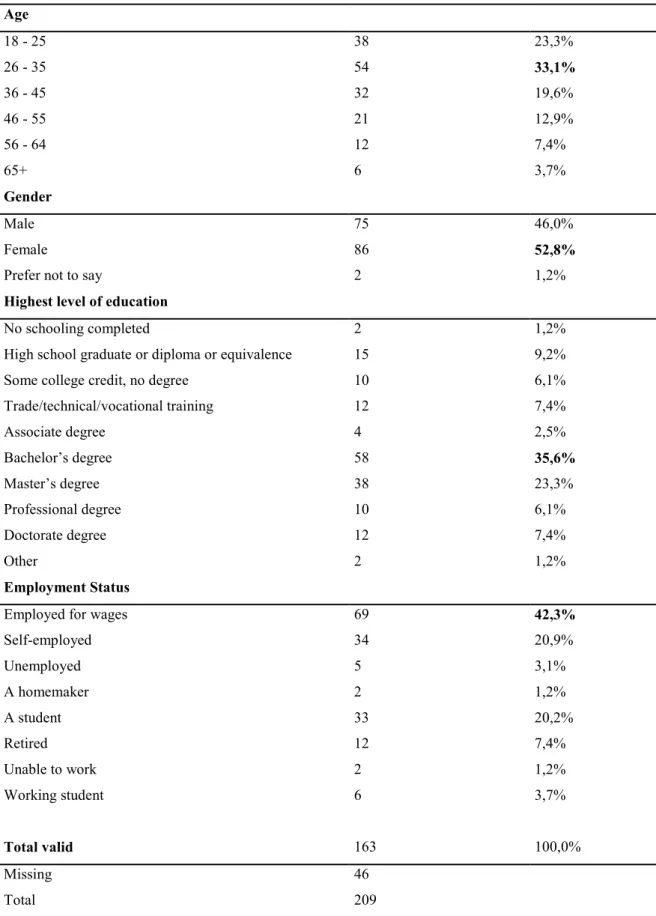
The sample appears to be representative of banking customers in UK (Figure 6).
Demographic Data Frequency Valid Percentage
Age 18 - 25 38 23,3% 26 - 35 54 33,1% 36 - 45 32 19,6% 46 - 55 21 12,9% 56 - 64 12 7,4% 65+ 6 3,7% Gender Male 75 46,0% Female 86 52,8%
Prefer not to say 2 1,2%
Highest level of education
No schooling completed 2 1,2%
High school graduate or diploma or equivalence 15 9,2%
Some college credit, no degree 10 6,1%
Trade/technical/vocational training 12 7,4% Associate degree 4 2,5% Bachelor’s degree 58 35,6% Master’s degree 38 23,3% Professional degree 10 6,1% Doctorate degree 12 7,4% Other 2 1,2% Employment Status
Employed for wages 69 42,3%
Self-employed 34 20,9% Unemployed 5 3,1% A homemaker 2 1,2% A student 33 20,2% Retired 12 7,4% Unable to work 2 1,2% Working student 6 3,7% Total valid 163 100,0% Missing 46 Total 209
Other data such as the Traditional and Challenger banks used by the respondents and for how long the respondents were clients of those banks is reported in Appendix 4.
3.5. Scale development and validation
The Stage 1 included searching for already validated methodologies that measure customer value and its dimensions or factors and the Stage 2 involved the beginning of the validation process. The following stages are described in Figure 7 and afterwards in more detail.
Stage 3: Pilot-testing and final version of survey
The stage 3 included a pre-test that was carried out with a group consisting of twenty bank customers, and the results permitted to consider the questionnaire definitive. According to Cronbach’s Alpha’ criterion, the reliability assessment of each dimension ranged from 0.70 to 0.88 excluding the dimensions of EXQ which presented a CA of 0.46, on average, which will be ignored since EXQ scale has been reliable and validated in multiple contexts, including in retail banking industry (Figure 8).
Stage 4:
Reliability and validity assessment of measurements
Several factors were taken into consideration: - Insights from literature review were used - Methods that were already applied and validated with retail banking customers are more reliable
- The more applicable are the survey questions to the banking industry the better
- Opinions of contacted experts in FinTech area, for example, the CEO and Research Director of a Startup in UK that does research about FinTech, were taken into account regarding survey questions
- Reviews of survey with experts in customer value and customer experience measurement
- Survey was initially tested and validated in terms of reliability with Cronbach’s Alpha
- Factors with a Cronbach’s Alpha higher than 0.70 are consider to have an “acceptable” internal consistency in most social science research and those were kept - Constructors with less than 0.70 were excluded from the survey
- Final version of survey
Stage 1: Select the most
appropriate methods that make sense in Banking
industry to build an initial survey
Stage 2: Face validity
which included talking with experts in areas
of interest for this analysis
Stage 3: Pilot test in
terms of reliability regarding each factorof customer value and final
version of survey
- Reliability test with the final dataset - Confirmatory Factor Analysis (CFA)
- Computation of Factor Loadings and test for convergent validity
- Test for tau-equivalence: chi-square difference between two models with different and equal weighting
Scale, dimensions or factors Cronbach’s Alpha Peace of mind, Moments-of-truth, Outcome focus and Product experience 0.46
Price offer fairness 0.78
Price transparency 0.88
Social value 0.70
Emotional value 0.87
Word-of-mouth 0.83
Behavior Loyalty Intentions 0.88
Figure 8 - Internal Consistency of measurements with dataset of Pilot-testing
All the scales measuring the factors/dimensions have been validated in previous studies and were adapted to ensure applicability in the context of banking. After stage 3 with the pilot-test, in order to measure customer value, 34 items and 8 dimensions remained, namely:
(1) Peace of mind (PEA). This factor describes the customer’s assessment of all the interactions with the bank before, during and after dealing with it, being about building a relationship with the bank. It includes emotional aspects of the service regarding the benefits experienced based on the perceived expertise of the bank and direction given during the process, which should be easy and increases confidence.
(2) Moments-of-truth (MOM). This factor is based on literature about service recovery and flexibility. Describes the influence of the bank behavior on a current or future decision in case of a mishap, incorporating aspects such as interpersonal skills and perception of risk in case a situation happens.
(3) Outcome focus (OUT). This factor is about having a bank that reduces the transaction cost faced by the customers (seeking out and qualifying new providers) and that provides goal-oriented experiences to their customers, which are seen as a strong basis for the customer to build a habit of using that bank despite the awareness of other offerings and the competitiveness of the bank.
(4) Product experience (PRO). This factor represents choice dynamics (McAlister and Srivastava, 1991), i.e., the customers’ perception of having choices and the ability to do comparison of offerings within the same bank.
(5) Price offer fairness (POF). This factor was developed by Herrmann (2007) in the context of automobile purchases. It represents a perception of the customer on the equality of treatment across customers, the degree that customers perceive that a
cost-based pricing strategy is performed by the bank and the customers’ perceptions of the relationship between their needs and the price.
(6) Price transparency (PTR). This factor was developed by Störmer (2014) in motor insurance context and was designated as the satisfaction with perceived price transparency. It was adapted to banking context and it’s composed by four items. (7) Social value (SOV). This factor was developed by Roig et al. (2006) and Ivanauskiene
et al (2012). It is related with the social impact of the service purchase made by the customer and includes the social benefits resulting from establishing a relationship with the bank. Five items were selected to represent social value.
(8) Emotional Value (EMV). This dimension was developed by Roig et al. (2006) and Ivanauskiene et al (2012). Emotional Value consists of the feelings such as positive atmosphere, relaxation, trust, confidence and happiness, generated by the experience with the bank.
Furthermore, it was included in the questionnaire two dimensions of Consumer Behavior with a total of 12 items, namely:
(1) Word-of-mouth Behavior (WOM). The scale used for this factor is the one developed by Brown et al. (2005) that considers WoM as an informal communication between two people: a communicator that is perceived as noncommercial and a receiver, about a target object (e.g. bank’s brand, product or service) transferred via some communication medium.
(2) Behavior Loyalty Intentions (LOY). The scale used for this factor is the one developed by Zeithaml et al. (1996) and Parasuraman et al. (2005) and intends to represent the factor loyalty that the customers have with their bank. All the items of Behavior Loyalty Intentions were considered.
The questionnaire structure is represented in Appendix 5 and its questions in Appendix 6. The questionnaire is in English. The third section of the questionnaire is intended to define how the respondents qualify the selected customer value dimensions, based on a 7-point Likert type response scale being the most negative description presented in the left side and the most positive in the right side (“1 – Strongly Disagree” to “7 – Strongly Agree”), having the Do not know/Not Applicable option in the extreme right side. The seven-level Likert scale is used questionnaire-wide and ensures constancy in data collection and evaluation. The last and fourth section enabled to explore demographic characteristics of the respondents.
Stage 4: Reliability and validity assessment of measurements
The first step to do scale refinement is the computation of coefficient α, i.e., Cronbach Alpha (Churchill, 1979). The reliability test with α was performed a second time with the final dataset for all factors of customer value, and the values ranged from 0.81 to 0.95, excluding Price offer fairness with a lower value of 0,57, as expressed in Figure 9. The reliability of the instrument contributes to its validity. According to Nunnally’s criterion, values above 0.80 indicates high reliability and the minimum satisfactory value is 0.70 it’s considered “acceptable”. In this case the items above 0.80 part of the questionnaire will most likely be measuring what is proposed to measure.
Scales, dimensions or factors Cronbach’s Alpha
Peace of mind, Moments-of-truth, Outcome focus and Product experience
0.81
Price offer fairness 0.57
Price transparency 0.89
Social value 0.81
Emotional value 0.90
Customer Value Scale 0.92
Word-of-mouth 0.95
Behavior Loyalty Intentions 0.91
Figure 9 – Internal Consistency of measurements with final dataset
In order to have a Cronbach’s Alpha indicator per factor, this indicator is a weighted average by the number of respondents, of both type of bank’ samples. After the reliability test, CFA was performed using the AMOS 22.0 program, an added SPSS module for SEM and CFA. Although it’s common in scale development, Exploratory Factor Analysis (EFA) was not considered for this research because EFA’s purpose is to discover the latent factors without substantive constrains on the Data and assuming that all items load on all factors. On the contrary, CFA is theory-driven, i.e., tests if the Data fits a hypothesized measurement model being applied when there is some information available about the underlying latent variable structure (i.e., customer value’s structure) which is the case of this research, having the factors of customer value based
on literature. The same happens for the consumer behavior outcomes, WOM and LOY are both constructs that already exist in literature.
The output of CFA gives a global model fit test, the significance of item loadings and the factor loadings themselves, among other indicators. Also, it’s possible to test appropriateness of model constraints or model additions via tests for change in model fit. After estimating the CFA, the next step is to assess how well the model matches the observed data.
The maximum likelihood estimation method (MLE) was used to perform CFA. Fabrigar, Wegener, MacCallum and Strahan (1999) argued that MLE is the best choice when data is relatively normally distributed because it allows to calculate a wide range of measures of the goodness of fit of the model and the significance testing of the factor loadings which represent the independent contribution of each item to the factor, i.e., it’s the correlation between the observed score and the latent score. In order to use this method, the normality assumption had to be examined for each variable in the proposed model (Hair et al., 2010). The values of the all variables (items) for univariate skewness and kurtosis were acceptably within the criteria for normality, which is -3 to 3 for skewness and -10 to 10 for kurtosis (Kline,2006).
3.6. Measurement models
Model 1 - First-order 8-factor model with 34-items
For the factor construction, i.e., to assign scores for individual responses to each question (item), it must be decided between the assignment of equal or different weights to each item. In scale construction this appears to be an open question. Babbie (2007) suggests that there should be given equal weights to items “unless there are compelling reasons for differential weighting” because if not, “equal weighting should be the norm”. Babbie (2007) states that it has to be done a validation of the scale through item analysis to examine the extent to which the composite factors are related to the individual and respective items included in that factors, i.e., providing a test of the independent contribution of each item to the factor, in order to select the best items for the scale, which is done through CFA.
In order to compare both methods and conclude about which to follow, a new measurement model was created by adding a constrain to the previous model: factor loadings are fixed to 1, i.e., assumes equal weight of each item in their respective factor. The differences in both models fit are compared through a tau-difference test, also known as a χ2 difference test, a test used to
compare and evaluate an adequate model and other alternative measurement models. The difference of the χ2 values and the difference of the degrees of freedom are taken and, the χ2 difference is significant, which means that the “larger” model with different weighting of factor loadings fits the data better than the model in which the factor loadings are fixed to one. With this results it was decided that the best option is to estimate the respective parameters with CFA and to prefer the model with different weighting (Schermelleh-Engel, K., Moosbrugger, H., & Müller, H., 2003).
Model 2 - Second-order model for Customer Value scale with 8 factors
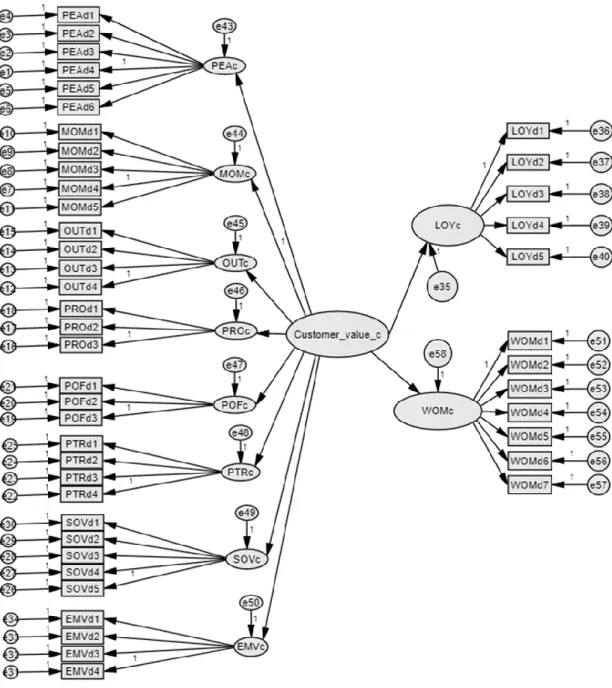
The factor scores were estimated based on the factor loadings with the data imputation tool in AMOS 22.0. With this factor scores for each factor, a second-order model has to be created in order to assess the overall customer value scale, being customer value a latent variable and the factors composite variables of their items that are observed variables. It is clear that the factors load into a latent variable (Figure 9). The factor loadings from the sample of Traditional banks is more reliable due to the bigger size of the sample.
Figure 9: 2nd Order CFA for second-order model of customer value scale with 8 factors, for both samples of Traditional bank (Customer_value_t) and Challenger banks (Customer_value_c). Numbers represent factor loadings.
In order to make both customer value scores comparable across two samples with different sizes, allowing clear interpretation, the scores of the customer value scale were computed assuming equal weighting of the factors. Research has suggested that this solution can be more reliable in some cases compared with more complex approaches. Having samples with different sizes and factor loadings that are different for each, summing scores is more effective (Grice,
2001). Furthermore, with the reliability analysis using Cronbach’s Alpha, knowing that this indicator assumes equal weight for each factor, the result was 0.92 regarding factors of customer value, which is an excellent indicator of reliability for this method with equal weighting. Comrey & Lee (1992) suggests that a simple way to estimate factor scores involves summing the scores corresponding to all items loading on a factor using simple (0,1) weighting, i.e., if an item loads on a factor a weight of one should be given to it and zero weight if it does not load. By summing the individual factor scores per response, the customer value per individual is obtained. Then, to assess the overall customer value, an average of the individuals’ customer value is computed, considering the size of the samples.
Factor scores estimated by AMOS are a function of the items scores and their respective weights and Customer value scale for each individual is a sum of the respective factor scores.
Models 3.1 and 3.2 - Factor Analysis for WoM and LOY
Estimating the extent to which each factor of customer value explains consumer behavior and the customer value itself as a predictor of consumer behavior for each type of bank, is part of the second study and uses SEM as main the method. Factor analysis was also performed to estimate the factor scores of WOM and LOY (Figure 10). The same was done for the sample of Challenger banks.
Model 4 and 5 – Effect on Consumer Behavior Outcomes: WoM & LOY
In order to assess the effect of overall customer value construct on consumer behavior outcomes, the structural model expressed in Figure 11 aims to measure that effect using the SEM methodology. Moreover, it’s also important to study the individual effect of each customer value’ factor and its significance on consumer behavior outcomes in order to validate that customer value’ factors are reflected into marketing outcomes that are relevant for banks. These two models were applied for each factor which means there is a total of sixteen measurement models (Figure 12).
Figure 11 – Structural Model 4 with Customer Value construct and its effect on LOY and WOM
4. RESULTS
4.1. Results from the first study 4.1.1. Scale validation
With the results obtained from validation it’s possible to conclude that the 34-items customer value scale has a multidimensional character, formed by eight factors: PEA, MOM, OUT, PRO, PEA, PTR, SOV and EMV. The scale reflects internal consistency, remains consistent across two different samples and surpasses the reliability and validity tests performed. After validating the customer value scale with a first-order model of the factors and a second-order model in which customer value is a construct of those factors, it’s possible to analyze the results that this scale provides with both samples of customers from two types of banks.
In order to advance with the first study, the measurement first and second-order models have to be validated with CFA with the data from the sample of Traditional bank users (N=201). In SEM, to assess convergent validity, the maximum likelihood loading of each item has to be significant to its underlying construct (Arnold and Reynolds, 2003). In this research, all factor loadings for items measuring the same factor were statistically significant, which reflects that all items successfully measure their corresponding factor (Anderson and Gerbing, 1988). Moreover, the factor loadings obtained are higher than 0.4 being the lowest value 0.44 and higher 0.93 (Figure 13). The factor loadings were computed also for the sample of Challenger banks users which confirmed, once more, the convergent validity and relevance of the items for those corresponding factors.
The fit of the measurement models examined was assessed with several indices, which is recommended by Hoyle and Panter (1995). The results revealed a good model fit. Chi-squared is significant with p-value = 0, the χ2 /df less than 3 is considered a good fit (Kline, 2006) and the accepted level for the RMSEA indicator is less than 0.10, which indicates a good model fit (Hair et al., 1998, p. 772). NFI and CFI have a recommended threshold of > 0.90 that was adopted as indicative of good model fit for these indices. With this results it’s possible to conclude that the measurement models of first and second-order have a good fit.
Items Factor Loadings
1 2 3 4 5 6 7 8 T C T C T C T C T C T C T C T C PEA1 0.82 0.81 PEA2 0.80 0.69 PEA3 0.73 0.86 PEA4 0.44 0.79 PEA5 0.73 0.78 PEA6 0.68 0.86 MOM1 0.73 0.90 MOM2 0.67 0.79 MOM3 0.65 0.77 MOM4 0.75 0.91 MOM5 0.78 0.91 OUT1 0.74 0.79 OUT2 0.83 0.83 OUT3 0.74 0.79 OUT4 0.69 0.88 PRO1 0.63 0.69 PRO2 0.46 0.73 PRO3 0.94 0.83 POF1 0.94 0.98 POF2 0.46 0.54 POF3 0.38 0.68 PTR1 0.84 0.92 PTR2 0.87 0.86 PTR3 0.84 0.67 PTR4 0.69 0.88 SOV1 0.81 0.84 SOV2 0.70 1.00 SOV3 0.79 0.73 SOV4 0.59 0.59 SOV5 0.56 0.66 EMV1 0.81 0.93 EMV2 0.85 0.90 EMV3 0.80 0.88 EMV4 0.81 0.85
Figure 13 – Results of CFA for the 1st order 8-factor model (with p-value = 0.00 < 0.05), being T referred to