Rev Bras
Cineantropom
Hum
DOI: http://dx.doi.org/10.5007/1980-0037.2016v18n4p471
original article
Stages of Behavior Change for physical activity
and associated factors among
technical-administrative servers of a federal university
Estágios de Mudança de Comportamento para a
atividade física e fatores associados em servidores
técnico-administrativos de uma universidade federal
Juliane Berria1
Davi Monteiro Teixeira1
Giseli Minatto1
Edio Luiz Petroski1
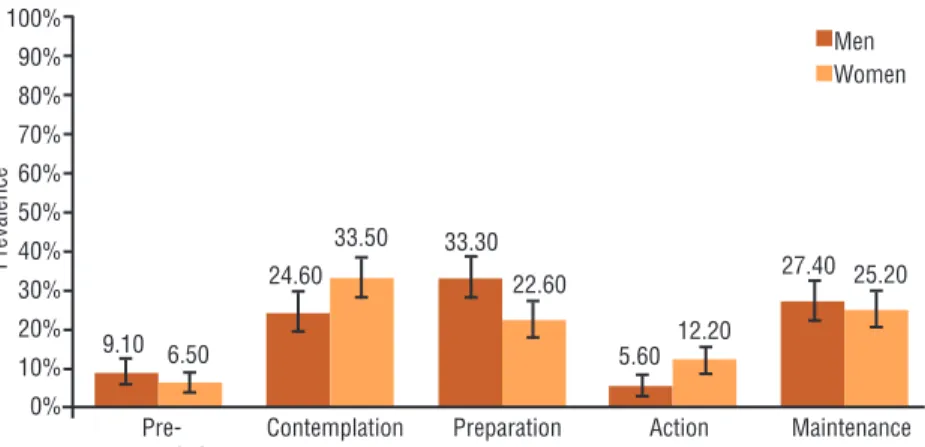
Abstract – he beneits that the regular practice of physical activity (PA) provides to health and its importance in preventing and ighting chronic diseases. he aim of this study was to identify the Stages of Behavior Change (SBC) for PA among technical-administrative servers and its association with sociodemographic and health risk fac-tors. his cross-sectional study investigated 622 technical-administrative servers (337 women) from a Brazilian federal university. SBC for PA, sociodemographic information (gender, age, marital status and educational level) and health risk factors (inadequate eating habits, excessive alcohol consumption, smoking, commuting and PA at work) were collected through questionnaires. Multinomial regression with adjustment for the hierarchical level was applied and signiicance level of 5% was adopted. he distribution of technical-administrative servers in SBC for PA identiied prevalence of 9.1% and 6.5% in the pre-contemplation stage, 24.6% and 33.5% in contemplation, 33.3% and 22 6% in preparation, 5.6% and 12.2% in action and 27.4% and 25.2% in maintenance stages between men and women, respectively. Lower odds ratio of being in the prepara-tion stage was identiied among women (OR=0.62; CI95%=0.41; 0.93) while those with inadequate eating habits were more odds to be in the “pre-contemplation + contemplation” (OR=2.77; CI95%=1.85; 4.15) and preparation stages (OR=1.75; CI95%=1.12; 2.70). Over 60% of technical-administrative servers are insuiciently active (pre-contemplation, contemplation and preparation stages) and factors associated with SBC were female sex and inadequate eating habits.
Key words: Educational status, Motor activity, Occupational health.
Resumo – Os benefícios que a atividade física (AF) regular proporciona à saúde e a sua importân-cia para prevenir e combater doenças crônicas não transmissíveis. Objetivou-se identiicar os Es-tágios de Mudança de Comportamento (EMC) para a AF em servidores técnico-administrativos e sua associação com fatores sociodemográicos e de risco a saúde. Este estudo transversal investigou 622 servidores (337 mulheres) técnico-administrativos de uma universidade federal brasileira. Foram coletados os EMC para a AF, informações sociodemográicas (sexo, idade, estado civil e escolaridade) e fatores de risco à saúde (hábitos alimentares inadequados, consumo excessivo de álcool, tabagismo, forma de deslocamento e AF no trabalho) por meio de questionários. Aplicou-se a regressão multinomial com ajuste por nível hierárquico e adotou-se nível de signiicância de 5%. A distribuição dos servidores nos EMC para a AF identiicou prevalência de 9,1% e 6,5% no estágio de pré-contemplação, 24,6% e 33,5% de contemplação, 33,3% e 22,6% de preparação, 5,6% e 12,2% de ação e 27,4% e 25,2% de manutenção entre homens e mulheres, respectivamente. Menor chance de estar no estágio de preparação foi identiicada entre as mulheres (RC: 0,62; IC95%: 0,41; 0,93) enquanto aqueles com hábitos alimentares inadequados apresentaram maior chance de estar nos estágios de pré-contemplação + contemplação (RC: 2,77; IC95%: 1,85; 4,15) e preparação (RC: 1,75; IC95%: 1,12; 2,70). Mais de 60% dos servidores da instituição são insuicientemente ativos (estágios de pré-contemplação, contemplação e preparação) e os fatores
1 Federal University of Santa Catari-na. Center for Research in Kinanthro-pometry and Human Performance. Florianópolis, Santa Catarina, Brasil.
INTRODUCTION
he beneits that the regular practice of physical activity (PA) provides to health and its importance in preventing and ighting chronic diseases such as obesity, heart disease, hypertension, type 2 diabetes, musculoskeletal diseases and even some forms of cancer have been widely reported in literature1-3.
Despite the ofer of information provided by science on the subject, low levels of regular PA have been found in diferent population groups. Regarding workers, this factor may predispose occupational disorders such as repetitive strain injury (RSI) and work-related musculoskeletal disorders (WRMD)4. Moreover, it is known that work demands can inluence the
practice of PA during leisure time5,6.
he transtheoretical model proposed by Prochaska and Marcus7 has
been useful for investigating the behavior of individuals related to PA, as it indicates the exact behavior stage the subject is found8. his is crucial as
it informs the current stage of the subject evaluated, which allows direct-ing actions of speciic interventions for each stage. For example, physically active individuals include those who began practicing PA recently and are more likely to drop it out, and also those who have already incorporated the practice of PA into their lifestyle. Among those insuiciently active, there are those who have no intention of starting a PA program and also those who wish to practice it in the near future9.
Literature indicates that women are more likely to be in the early stages for PA when compared to males. Furthermore, a systematic review showed that young people, white skin, single, higher schooling, non-smokers, normal weight and with with higher level of PA and physical itness are more likely to be in more advanced stages for PA9.
In Brazil, few studies using the SBC to research PA in public servers or others workers have been identiied10. It is known that work characteristics
can inluence the practice of PA and that the determination SBC for PA can help in the development of more efective interventions to promote PA for this population while enabling adapt strategies for each stage of readiness. hus, the objective of this study was to investigate which stages of behavior change (SBC) for PA technical-administrative servers of a Brazilian federal university are and which sociodemographic and health risk factors are associated with SBC for PA. We hypothesized that which sociodemographic and health risk factors are associated which SBC for PA can be diferent between stages.
METHODOLOGICAL PROCEDURES
Population and sample
approved by the Ethics Committee of Research with Human Beings of the Federal University of Santa Catarina (UFSC), protocol No. 27939/13.
he study population consisted of 2,993 technical-administrative servers (171 auxiliary level, 1,823 intermediate level, and 999 upper level) of UFSC. Sample calculation adopted conidence level of 95% (CI 95%), unknown prevalence for the outcome of 50%, sampling error of 3.5 per-centage points plus 20% for potential losses and refusals. he estimated sample was 746 technical-administrative servers.
he sample selection was stratiied proportionally by level (auxiliary, intermediate and upper). Overall, 43 auxiliary-level, 456 intermediate-level, and 25 upper-level technical-administrative servers were randomly and systematically selected to compose the sample, totaling 749 workers. Sam-ple replacement was performed in the case of absence, leave, resignation, retirement, those assigned to other institutions, those who had resigned and those that could not be located due to lack of information about the current workplace, totaling 54 replacements. All technical-administrative servers were eligible to participate. hose who refused to answer questions regarding SBC for PA were excluded from the analyses.
Instruments
SBC for PA were veriied through questionnaire proposed by Marcus11,
which classiies individuals from ive stages: 1) Pre-contemplation (indi-vidual does not intend to change behavior in the near future); 2) Con-templation (there is intention to change behavior, but not immediately); 3) Preparation (individual is not engaged in PA on a regular basis, but intends to do it within the next 30 days); 4) Action (individual is regularly active for less than six months), and 5) Maintenance (individual is active on a regular basis for at least six months).
Sociodemographic variables were gender (male and female), age (20-29; 30-39; 40-49; 50-59 and 60-69 years), marital status (single, married, separated / widowed) and schooling (≥ 12 years; 9-11 years and ≤ 8 years). he following health risk factors: inadequate eating habits, smoking, and excessive alcohol consumption were determined from self-administered questionnaire “Fantastic Life Style” of the Canadian Association of Physiology12,translated and validated into Portuguese (Cronbach α 0.69;
R=0.92)13.
Eating habits were assessed using the question: “I eat a balanced diet,” (Cronbach α 0.69; 0.72) which considers the consumption of ive to 12 daily servings of grains and cereals, ive to 10 daily servings of fruits and vegetables, two to three daily servings of meat and similar and two to four daily servings of dairy products. Response alternatives were almost always and always classiied as “adequate eating habits” and sometimes, rarely, and almost never as “inadequate eating habits”.
was considered “excessive alcohol consumption” and 11 to 12 doses, 10 doses and eight to zero to seven doses per week as “not excessive alcohol consumption”.
he question “I smoke cigarettes” (Cronbach α 0.69; R=0.86) was used to assess tobacco use. Technical-administrative servers that marked the following alternatives: more than 10 per day and from one to 10 per day, were categorized as “smokers” and those who answered none in the last six months, last year or last ive years as “nonsmokers”.
Sedentary behavior was identiied through questionnaire proposed and validated by Barros14 and modiied by Fonseca15. Sedentary behavior
in displacement was identiied using the question: “On most days of the week, how do you get to work?” Going to work on foot and bicycle was considered “active commuting” and bus, car or motorbike as “little active commuting”. he question “Your activities at work can be described as:” I spend most time sitting (a) and I walk short distances (“sitting”); most of the day I perform moderate physical activities such as fast walks or manual tasks (“moderate activities”); I often perform intense physical activities (“intense activities”), was used to characterize sedentary behavior at work.
Statistical analysis
Sample characterization was performed by means of central tendency and dispersion measurements. Although SBC for PA (outcome) is not a disease, prevalence was referred to as the proportion of workers who are at each stage of the outcome. Diferences between proportions of SBC for PA in relation to the study variables were analyzed using the chi-square test. Multinomial logistic regression was used to assess the association of workers in “preparation” and “pre-contemplation + contemplation” stages and the study variables, and odds ratios (OR) and conidence intervals of 95% (CI 95%) were estimated in crude and adjusted analyses. Hierarchi-cal model 16 was adopted in three levels, considering the hypothetical
temporal relationship of variables, being, 1st level: demographic variables
(gender, age); 2nd level: socioeconomic variable (schooling and marital
status) and 3rd level: behavioral variables (eating habits, excessive alcohol
consumption, smoking, commuting and work activities). Variables were controlled at each level of the hierarchical model and by those of previous levels that showed p ≤ 0.20. he conidence level for all analyses was 95%. Data analysis was conducted by the Statistical Package for Social Sciences (SPSS) software version 15.0.
RESULTS
excluded from this study. hus, the sample was composed of 622 techni-cal-administrative servers, 285 men and 337 women. Table 1 shows that losses and refusals were higher among males, but no diference between occupational level was observed.
Table 1. Relative frequency of the selected sample collected, losses and refusals according to sex
and occupational level. Florianópolis, SC, Brazil, 2012.
Variables
Total (n= 749)
Sample (n=622)
Losses and refusals
(n= 127) Chi-square p-value
% % %
Sex 7.401 0.01
Men 48.1 79.2 20.8
Women 51.9 86.6 13.6
Occupational level 1.204 0.55
Auxiliary 6.0 88.9 11.1
Intermediate 60.9 82.5 17.5
Superior 33.1 83.1 16.9
he distribution of workers according to SBC for PA indicates that most women intend to become active in the next six months (CI 95%: 28.47; 38.6) and men are physically active, but not on a regular basis (CI 95%: 27.93; 38.84) (Figure 1). Diferences in the proportions of men and women were identiied in the stages of preparation (men CI 95%: 27.93; 38.84 and women CI 95%: 18.07; 27.04) and action (men CI 95%: 2.93; 8.30 and women CI 95%: 8.66; 15.67).
Figure 1. Distribution of servers in stages of behavior change for physical activity. Florianopolis,
SC, Brazil, 2012.
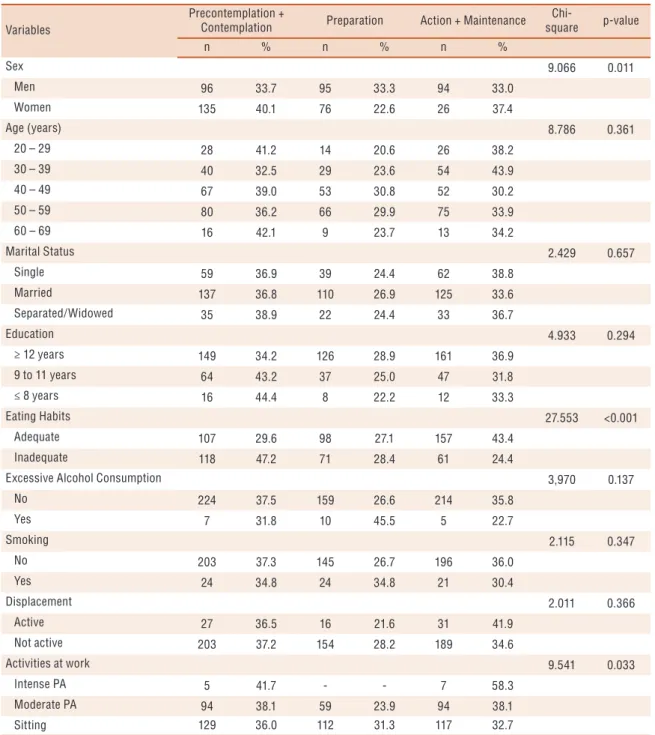
he prevalence of workers in “pre-contemplation + contemplation” stages was 33.7% among men and 40.1% among women, in “preparation” stage, this prevalence was 33.3% among men and 22.6 % among women and in “action + maintenance” stages, prevalence was 33.0% among men and 37.4% among women (Table 2).
stage, highest proportion was found in workers with inadequate eating habits (28.4%) and those who remain sat at work (31.3%), while in “action + maintenance” stages, most workers have adequate eating habits (43.4%) and perform intense PA at work (58.3%) (Table 2).
Table 2. General distribution of the sample in stages of behavior change for physical activity according to the sociodemographic
indicators and health risk factors in technical-administrative servers of UFSC. Florianopolis, SC, Brazil, 2012.
Variables
Precontemplation +
Contemplation Preparation Action + Maintenance
Chi-square p-value
n % n % n %
Sex 9.066 0.011
Men 96 33.7 95 33.3 94 33.0
Women 135 40.1 76 22.6 26 37.4
Age (years) 8.786 0.361
20 – 29 28 41.2 14 20.6 26 38.2
30 – 39 40 32.5 29 23.6 54 43.9
40 – 49 67 39.0 53 30.8 52 30.2
50 – 59 80 36.2 66 29.9 75 33.9
60 – 69 16 42.1 9 23.7 13 34.2
Marital Status 2.429 0.657
Single 59 36.9 39 24.4 62 38.8
Married 137 36.8 110 26.9 125 33.6
Separated/Widowed 35 38.9 22 24.4 33 36.7
Education 4.933 0.294
≥ 12 years 149 34.2 126 28.9 161 36.9
9 to 11 years 64 43.2 37 25.0 47 31.8
≤ 8 years 16 44.4 8 22.2 12 33.3
Eating Habits 27.553 <0.001
Adequate 107 29.6 98 27.1 157 43.4
Inadequate 118 47.2 71 28.4 61 24.4
Excessive Alcohol Consumption 3,970 0.137
No 224 37.5 159 26.6 214 35.8
Yes 7 31.8 10 45.5 5 22.7
Smoking 2.115 0.347
No 203 37.3 145 26.7 196 36.0
Yes 24 34.8 24 34.8 21 30.4
Displacement 2.011 0.366
Active 27 36.5 16 21.6 31 41.9
Not active 203 37.2 154 28.2 189 34.6
Activities at work 9.541 0.033
Intense PA 5 41.7 - - 7 58.3
Moderate PA 94 38.1 59 23.9 94 38.1
Sitting 129 36.0 112 31.3 117 32.7
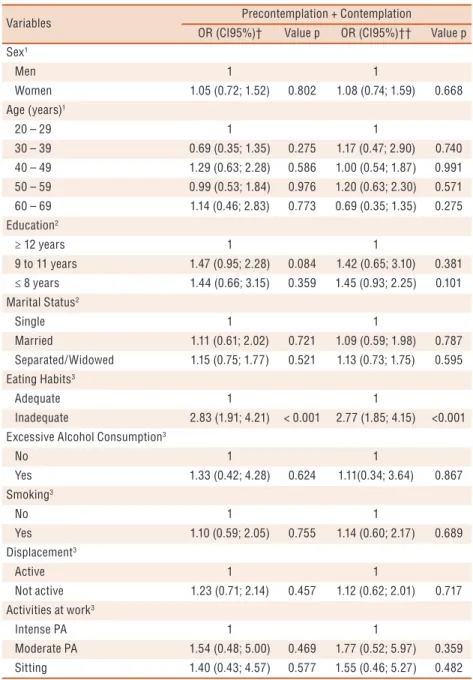
Table 3. Odds ratios and confidence intervals for the crude and adjusted analyzes between the stages of behavior change “pre-contemplation + contemplation” and sociodemographic indicators and health risk factors in technical-administrative servers of UFSC. Florianopolis, SC, Brazil, 2012.
Variables Precontemplation + Contemplation
OR (CI95%)† Value p OR (CI95%)†† Value p Sex1
Men 1 1
Women 1.05 (0.72; 1.52) 0.802 1.08 (0.74; 1.59) 0.668 Age (years)1
20 – 29 1 1
30 – 39 0.69 (0.35; 1.35) 0.275 1.17 (0.47; 2.90) 0.740 40 – 49 1.29 (0.63; 2.28) 0.586 1.00 (0.54; 1.87) 0.991 50 – 59 0.99 (0.53; 1.84) 0.976 1.20 (0.63; 2.30) 0.571 60 – 69 1.14 (0.46; 2.83) 0.773 0.69 (0.35; 1.35) 0.275 Education2
≥ 12 years 1 1
9 to 11 years 1.47 (0.95; 2.28) 0.084 1.42 (0.65; 3.10) 0.381 ≤ 8 years 1.44 (0.66; 3.15) 0.359 1.45 (0.93; 2.25) 0.101 Marital Status2
Single 1 1
Married 1.11 (0.61; 2.02) 0.721 1.09 (0.59; 1.98) 0.787 Separated/Widowed 1.15 (0.75; 1.77) 0.521 1.13 (0.73; 1.75) 0.595 Eating Habits3
Adequate 1 1
Inadequate 2.83 (1.91; 4.21) < 0.001 2.77 (1.85; 4.15) <0.001 Excessive Alcohol Consumption3
No 1 1
Yes 1.33 (0.42; 4.28) 0.624 1.11(0.34; 3.64) 0.867 Smoking3
No 1 1
Yes 1.10 (0.59; 2.05) 0.755 1.14 (0.60; 2.17) 0.689 Displacement3
Active 1 1
Not active 1.23 (0.71; 2.14) 0.457 1.12 (0.62; 2.01) 0.717 Activities at work3
Intense PA 1 1
Moderate PA 1.54 (0.48; 5.00) 0.469 1.77 (0.52; 5.97) 0.359 Sitting 1.40 (0.43; 4.57) 0.577 1.55 (0.46; 5.27) 0.482
OR: odds ratio; CI95%: confidence interval of 95%. † crude analysis; †† adjusted analysis; Adjusted analysis by hierarchical level: 1Level distal; 2 Level intermediate; 3Level Proximal; *OR and CI 95% not estimated by the absence of individuals in the reference category.
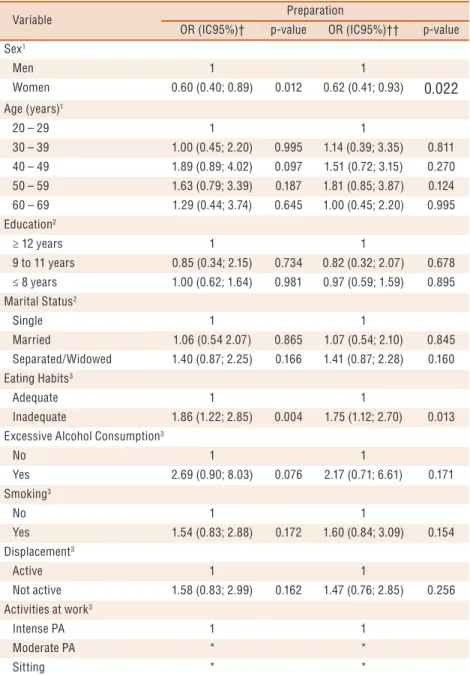
Table 4.Odds ratios and confidence intervals for the crude and adjusted analyzes between the stages of behavior change “preparation” and sociodemographic indicators and health risk factors in technical-administrative servers of the UFSC. Florianópolis, SC, Brazil, 2012.
Variable Preparation
OR (IC95%)† p-value OR (IC95%)†† p-value Sex1
Men 1 1
Women 0.60 (0.40; 0.89) 0.012 0.62 (0.41; 0.93) 0.022
Age (years)1
20 – 29 1 1
30 – 39 1.00 (0.45; 2.20) 0.995 1.14 (0.39; 3.35) 0.811 40 – 49 1.89 (0.89; 4.02) 0.097 1.51 (0.72; 3.15) 0.270 50 – 59 1.63 (0.79; 3.39) 0.187 1.81 (0.85; 3.87) 0.124 60 – 69 1.29 (0.44; 3.74) 0.645 1.00 (0.45; 2.20) 0.995 Education2
≥ 12 years 1 1
9 to 11 years 0.85 (0.34; 2.15) 0.734 0.82 (0.32; 2.07) 0.678 ≤ 8 years 1.00 (0.62; 1.64) 0.981 0.97 (0.59; 1.59) 0.895 Marital Status2
Single 1 1
Married 1.06 (0.54 2.07) 0.865 1.07 (0.54; 2.10) 0.845 Separated/Widowed 1.40 (0.87; 2.25) 0.166 1.41 (0.87; 2.28) 0.160 Eating Habits3
Adequate 1 1
Inadequate 1.86 (1.22; 2.85) 0.004 1.75 (1.12; 2.70) 0.013 Excessive Alcohol Consumption3
No 1 1
Yes 2.69 (0.90; 8.03) 0.076 2.17 (0.71; 6.61) 0.171 Smoking3
No 1 1
Yes 1.54 (0.83; 2.88) 0.172 1.60 (0.84; 3.09) 0.154 Displacement3
Active 1 1
Not active 1.58 (0.83; 2.99) 0.162 1.47 (0.76; 2.85) 0.256 Activities at work3
Intense PA 1 1
Moderate PA * *
Sitting * *
OR: odds ratio; CI95%: confidence interval of 95%. † crude analysis; †† adjusted analysis; Adjusted analysis by hierarchical level: 1Level distal; 2 Level intermediate; 3Level Proximal; *OR and CI 95% not estimated by the absence of individuals in the reference category.
DISCUSSION
he prevalence of servers active on a regular basis (“action + mainte-nance”) in the present study was similar to results found among university professors of Florianópolis, Brazil (38.9%)10 and also among adults surveyed
in southern Brazil (25.8% of women and 33.6% of men)17. his indicates
the tendency of little PA on a regular basis, also seen in other countries18,19.
his behavior becomes worrisome since it is a risk factor for chronic dis-eases such as heart disease, hypertension, obesity, type-2 diabetes, and musculoskeletal diseases1-3. In the case of workers, this behavior may also
predispose to occupational disorders such as RSI and WRMD4.
Women in this study were fewer odds to be in the “preparation” stage, which is controversial in literature9,17,20,21.A survey conducted in southern
Brazil revealed that women were fewer odds to be in the “maintenance” phase for PA17.In Canada, another research found that women were more
likely to be in the “preparation” stage for PA20.his tendency of women to
present early stages for PA when compared to males was evidenced by sys-tematic review9 and university students21.In general, women tend to become
more involved in household tasks and domestic services, even those in the labor market, and men are more engaged in PA in leisure and planned / systematic activities22.he results of this study may not be similar to
stud-ies mentioned above because it included a population of workers, which features and labor functions are peculiar of the sample investigated here.
Technical-administrative servers with inadequate eating habits were more odds to be in the “pre-contemplation + contemplation” and “prepara-tion” stages. he direct association between physical activity and diet has been shown in other studies23,24 as in the telephone inquiry conducted
among adults from Florianópolis, SC Brazil, whose physical inactivity is associated with inadequate eating habits among women25.Among young
adults in the state of Sergipe, Brazil, no relationship between eating habits and SBC for PA26 was observed. he adoption of healthy behavior can
increase self-eicacy to other healthy behaviors, thus adopting a more active lifestyle can facilitate the adoption of healthy diet and vice versa23.
he results of this study showed no signiicant association between SBC for PA and variables age, schooling, marital status, excessive alcohol consumption, smoking, commuting and work activities. Silva and Pereira26
also found no correlation between SBC for PA, age, and marital status. A systematic review has found that individuals with a higher probability of being in the most advanced stages for PA (action and maintenance) are: young men, white, unmarried, higher schooling, nonsmokers and normal weight9.Other variables, such as excessive alcohol consumption, smoking,
commuting and work activities need to be further investigated in literature. It is noteworthy that a variable associated with certain behavior is not always the same as that associated with the change of this behavior17.In
addition, little is known about variables that explain changes in human behavior and further studies should be carried out to elucidate them9.
addition, the question used to investigate the eating habits is generic and does not allow distinguishing food groups, food frequency, and portions consumed. he use of questionnaire and recall-type self-reported measures may allow some recall bias, or have their veracity questioned. However, it is emphasized that this study was conducted with a representative sample of technical-administrative servers and identiied factors related to SBC for PA, which does not yet have a consensus. Moreover, the most appropriate analysis model (multinomial regression) was used to analyze the SBC9. Few
studies that investigated the SBC for PA in adults have been identiied and the inconsistencies regarding the associations found in these studies indicates the need for further research to clarify these issues and be able to make more speciic interventions for each population.
CONCLUSION
More than half of technical-administrative servers do not perform PA on a regular basis considering the SBC for PA (pre-contemplation, contempla-tion, and preparation). Women and servers with inadequate eating habits were more exposed to early SBC for PA.
he development of programs to promote PA aimed at these work-ers can use these results to outline more efective strategies, especially to groups more exposed to early stages (“pre-contemplation”, “contemplation” and “preparation”). he theory of SBC for PA7 suggests that diferent
approaches should be adopted for each stage, so actions aimed at work-ers that are in the “pre-contemplation” stage could involve interventions focusing on education for PA through meetings, lectures and guidance on health beneits in order to educate individuals about the importance of behavior change.
For workers in the “contemplation” stage, which includes individuals who have realized the importance of PA but did not begin the practice, actions should contemplate the creation of structured and easy-to-access locations for the practice of PA, with infrastructure and safety. hese ac-tions could be inserted into the work environment, so that they would have the opportunity to practice PA at breaks, for example.
For workers that are in the “preparation” stage, actions aimed at ad-vance stage could include strategies to engage them in PA on a regular basis and the opportunity to experience diferent practices. Accordingly, the university could provide varied PA to employees and schedules to fa-cilitate their participation. Additionally, nutrition professionals could be involved in these programs, since inadequate eating habits were associated with early SBC for PA.
Acknowledgments
REFERENCES
1. Roberts CK, Barnard RJ. Efects of exercise and diet on chronic disease. J Appl Physiol (1985) 2005;98(1):3-30.
2. Claas SA, Arnett DK. he Role of Healthy Lifestyle in the Primordial Prevention of Cardiovascular Disease. Curr Cardiol Rep 2016;18(6):56.
3. Sales-Peres SH, Guedes MF, Sa LM, Negrato CA, Lauris JR. Lifestyle of patients with diabetes mellitus type 1: a systematic review. Cien Saude Colet 2016;21(4):1197-1206.
4. Silva SGd, Silva MCd, Nahas MV, Viana SL. Fatores associados à inatividade física no lazer e principais barreiras na percepção de trabalhadores da indústria do Sul do Brasil. Cad Saúde Pública 2011;27(2):249-59.
5. Fransson EI, Heikkilä K, Nyberg ST, Zins M, Westerlund H, Westerholm P, et al. Job Strain as a Risk Factor for Leisure-Time Physical Inactivity: An Individual-Participant Meta-Analysis of Up to 170,000 Men and Women: he IPD-Work Consortium. Am J Epidemiol 2012;176(12):1078-89.
6. Kirk MA, Rhodes RE. Occupation correlates of adults’ participation in leisure-time physical activity: a systematic review. Am J Prev Med 2011;40(4):476-85.
7. Prochaska JO, Marcus BH. he transtheoretical model: applications to exercise. In: Dishman RK, editor. Advances in exercise adherence. Champaign: Human Kinetics; 1994.
8. Prochaska JO, Velicer WF. he transtheoretical model of health behavior change. Am J Health Promot 1997;12(1):38-48.
9. Dumith SC, Domingues MR, Gigante DP. Estágios de mudança de compor-tamento para a prática de atividade física: uma revisão da literatura. Rev Bras Cineantropom Desempenho Hum 2008;10(3):301-7.
10. Petroski EL, Oliveira MM. Atividade física de lazer e estágios de mudança de com-portamento em professores universitários. Rev Port Cien Desp 2008;8(2):209-218.
11. Marcus BH, Banspach SW, Lefebvre RC, Rossi JS, Carleton RA, Abrams DB. Using the stages of change model to increase the adoption of physical activity among community participants. Am J Health Promot 1992;6(6):424-9.
12. Wilson DMC, Ciliska D. Lifestyle Assessment. Can Fam Physician 1984;30:1527-32.
13. Rodriguez Añez CR, Reis RS, Petroski EL. Versão brasileira do questionário “estilo de vida fantástico”: tradução e validação para adultos jovens. Arq Bras Cardiol 2008;91(2):102-9.
14. Barros MVG. Atividades físicas no lazer e outros comportamentos relacionados à saúde dos trabalhadores da indústria no estado de Santa Catarina, Brasil: Univer-sidade Federal de Santa Catarina; 1999.
15. Fonseca S. Inatividade física no lazer e outros fatores de risco à saúde em industriári-os catarinenses, 1999-2004. 2005: Universidade Federal de Santa Catarina; 2005.
16. Victora CG, Huttly SR, Fuchs SC, Olinto MT. he role of conceptual frame-works in epidemiological analysis: a hierarchical approach. Int J Epidemiol 1997;26(1):224-7.
17. Dumith SC, Gigante DP, Domingues MR. Stages of change for physical activity in adults from Southern Brazil: a population-based survey. Int J Behav Nutr Phys Act 2007;4:25.
18. Hallal PC, Andersen LB, Bull FC, Guthold R, Haskell W, Ekelund U. Global physical activity levels: surveillance progress, pitfalls, and prospects. Lancet 2012;380(9838):247-57.
19. Tucker JM, Welk GJ, Beyler NK. Physical activity in U.S.: adults compliance with the Physical Activity Guidelines for Americans. Am J Prev Med 2011;40(4):454-61.
CORRESPONDING AUTHOR Juliane Berria
Universidade Federal de Santa Catarina. Centro de Desportos. Núcleo de Pesquisa em Cineantropometria e Desempenho Humano. Campus Universitário Trindade – Caixa postal 476 – CEP 88040‐900. Florianópolis, Santa Catarina, Brasil.
Phone number/fax: +55 48 37218562
E‐mail: [email protected]
21. Quintino PL, Silva DAS, Petroski EL. Estágios de mudança de comportamento para atividade física em universitários e fatores sociodemográicos associados. Rev Bras Educ Fís Esporte 2014;28(2):305-14.
22. Potvin L, Gauvin L, Nguyen NM. Prevalence of stages of change for physical activity in rural, suburban and inner-city communities. J Community Health 1997;22(1):1-13.
23. Loprinzi PD. Association between accelerometer-determined physical activity and lavonoid-rich fruit and vegetable consumption among a national sample of U.S. adults. Prev Med Rep. 2016;3:58-61.
24. Loprinzi PD, Smit E, Mahoney S. Physical activity and dietary behavior in US adults and their combined inluence on health. Mayo Clin Proc 2014;89(2):190-8.
25. Martins TG, Assis MAA, Nahas MV, Gauche H, Moura EC. Inatividade física no lazer de adultos e fatores associados. Rev Saúde Pública 2009;43(5):814-24.