1
Faculdades Integradas do Vale do Ribeira, Curso de Nutrição, Departamento de Nutrição. R. Oscar Yoshiaki Magário, 185, Jd. das Palmeiras, 11900-000, Registro, SP, Brasil. Correspondência para/Correspondence to: GA TAMASIA. E-mail: <[email protected]>.
2
Instituto de Saúde, Centro de Tecnologias em Saúde. São Paulo, SP, Brasil. 3
Instituto de Saúde, Centro de Pesquisa e Desenvolvimento. São Paulo, SP, Brasil.
Article based on the master’s thesis of GA TAMASIA, intitled: “Perfil da amamentação e alimentação complementar no município de Registro-SP”. Universidade de São Paulo; 2013.
Situation of breastfeeding and complementary
feeding in a medium-sized municipality
in the
Ribeira
Valley,
São Paulo
Situação da amamentação e alimentação complementar
em um município de médio porte
do Vale do Ribeira, São Paulo
Gislene dos Anjos TAMASIA1
Sonia Isoyama VENÂNCIO2
Silvia Regina Dias Medici SALDIVA3
A B S T R A C T
Objective
To analyze the situation of breastfeeding and complementary feeding in the city of Registro, São Paulo.
Methods
This cross-sectional study collected sociodemographic and feeding information of infants aged less than one year who participated in the 2011 multiple vaccine campaign. Breastfeeding and complementary feeding were analyzed by indicators proposed by the World Health Organization. The association between outcomes (exclusive breastfeeding and introduction to complementary feeding) and the explanatory variables (maternal and child characteristics) was investigated by the Poisson model with a robust error variance.
Results
Conclusion
The study identified inappropriate infant feeding practices. Such studies can contribute to the proposal of policies, which is particularly important in an unfavorable social development context characterized by the study city.
Keywords: Breast feeding. Indicators. Supplementary feeding.
R E S U M O
Objetivo
Analisar a situação da amamentação e alimentação complementar no município de Registro, São Paulo.
Métodos
Estudo transversal no qual foram coletadas informações sobre alimentação e dados sociodemográficos de crianças menores de um ano que participaram da campanha de multivacinação de 2011. Foram consideradas elegíveis todas as crianças menores de um ano que participaram da campanha de vacinação, a fim de garantir a representatividade das informações para o município. Realizou-se a análise dos indicadores de aleitamento materno e alimentação complementar, propostos pela Organização Mundial de Saúde. A associação entre os desfechos (aleitamento materno exclusivo e introdução da alimentação complementar) e as variáveis explanatórias (características maternas e infantis), realizou-se por meio do modelo de regressão de Poisson com variância robusta.
Resultados
Foram analisados dados de 713 crianças. A prevalência do aleitamento materno exclusivo de 0 a 6 meses foi de 50,0%. As crianças que estavam mamando exclusivamente no primeiro dia em casa (RP=2,40; IC95%=1,42-4,06) e não usavam chupeta (RP=1,95; IC95%=1,15-3,30) foram as que apresentaram maior chance de aleitamento materno exclusivo. Ao analisar os indicadores de alimentação complementar, observou-se que a proporção de crianças de 6 a 8,9 meses que consumiram fruta mais papa salgada foi de 62,1%. Nenhuma das variáveis explanatórias mostrou associação significativa com esse desfecho.
Conclusão
O estudo identificou práticas de alimentação infantil inadequadas. A realização de estudos desse tipo pode contribuir para a formulação de propostas de intervenção, o que se torna particularmente relevante em um contexto de desenvolvimento social pouco favorável, como o que caracteriza o município estudado.
Palavras-chave:Aleitamento materno. Indicadores. Suplementação alimentar.
I N T R O D U C T I O N
Breastfeeding has unquestionable advantages for the child and the mother. It is an important strategy for promoting the mother-child bond, and protecting and nourishing the child. It is a sensitive, inexpensive, and effective intervention to reduce infant morbidity and mortality, and promotes the holistic health of the
mother-child dyad1. The World Health
Organization (WHO) and the Brazilian Ministry of Health (BMH) recommend exclusive breastfeeding until age six months, and after this age, infants should receive complementary foods in addition to breast milk until age two years or later2. For
breastfeeding promotion to be successful, engagement of the public authorities is essential. In this sense, the Sistema Único de Saúde (SUS, Unefied Healh Care System) has recorded initiatives at different levels to reduce infant mortality and encourage breastfeeding. However, Brazil is still far from reaching the target recommended by the WHO3.
appropriate diet for the children should be an essential component of the global strategy to assure the food security of a population. The final success of promoting complementary feeding depends on appropriate governmental policies and the support and participation of the entire society. Nonetheless, health professionals have an essential role in this promotion and can influence appropriate practices when complementary foods are introduced5.
The World Health Organization recommends that complementary foods be introduced at age six months in small amounts, increasing gradually as the child grows. From this age onward, the child already has physiological and neurological maturity to consume other foods. Nevertheless, it is important for the child to continue breastfeeding until age two years or more, given that breast milk is nutritious and protects the child from diseases6.
Analysis of infant feeding practices is particularly important in not very favorable social development contexts because of its ability to reduce infant morbidity and mortality. Registro is a medium-sized municipality in the state of São
Paulo whose Human Development Index (HDI)
ranked 199 among the 645 state municipalities in 2010. The municipality is characterized by low income, longevity, and education indices7. Hence, the objective of this study is to analyze the situation of breastfeeding and complementary feeding in Registro (SP), in 2011.
M E T H O D S
This analytical, cross-sectional, population-based study was conducted during the multiple vaccine campaign of 2011 and included children aged less than one year. The study used the methodology proposed by the Projeto
Ama-mentação e Municípios (AMAMUNIC, Project
Breastfeeding and Municipalities), whose objective is to collect information about the breastfeeding and complementary feeding profiles of municipalities in the state of São Paulo8.
According to this methodology, all children aged less than one year who participated in the multiple vaccine campaign are eligible for the study, and municipalities with up to 1,500 children the year before the study should conduct the survey on all children8. Thus, the present study considered eligible all children aged less than one year who participated in the vaccination campaign to ensure the representativeness of the municipal information.
The exclusive breastfeeding categories and indicators used by the present study are based on a publication by the WHO that provides fifteen indicators for assessing the adequacy of the feeding practices of children aged 0 to 23 months, of which seven are optional9. The proposed exclusive breastfeeding indicators also took into account the recommendations of the Food Guide for Children aged less than two years10. Some adaptations were necessary because the study included children aged less than one year (the indicators proposed by the WHO include children aged up to 24 months). Furthermore, since the questionnaire was administered during the vaccination campaign, it had to be administered quickly not to interfere with the vaccination, so the intake of foods 24 hours before the interview was not investigated as thoroughly as required by the WHO, imposing some limitations on the construction of the indicators.
The outcomes of the present study were defined as follows: exclusive breastfeeding when the child is given breast milk, oral rehydration fluids, and/or vitamin, mineral, and medication drops or syrups from ages 0 to 6 months; and correct introduction of complementary feeding when the child is given fruits and a savory mash from ages 6 to 9 months.
follow-up at a health care facility (SUS or private). The mother-related explanatory variables were: age (<20; 20-35; and >35 years), number of parturitions (primiparous/multiparous), employment status (works away from home/does not work away from home), and education level (<8 years; 8-11; >11 years).
The study indicators were descriptively analyzed by calculating the proportions. The median exclusive breastfeeding and breastfeeding were given by logit analysis, which uses statistical modeling to estimate the probability of the study event as a function of the child’s age11. To assess the association between the explanatory variables and the outcomes, crude and adjusted analyses were done using Poisson regression with robust error variance given that this is a cross-sectional study and the outcomes are not rare12. The variables with p<0.20 in the simple regression were included in the multiple model. The data were analyzed by the software Stata 10.1.
The study protocol was approved on May 6, 2008, by the Research Ethics Committee of the Institute of Health under Protocol number 001/2008.
R E S U L T S
The population of children aged less than one year in the municipality of Registro (SP) in 2011 was 871, and 836 were vaccinated, resulting in a vaccination coverage of 96.0%. We collected data from 723 children, of which ten (1.4%) were excluded from the analysis because their birth date was missing. The total study sample was 713 children, representing coverage of 86.5% children of the age bracket of interest. In relation to the sample, 89.4% of the children lived in urban areas, 94.5% lived in Registro (SP), and 87.7% were accompanied by their mothers.
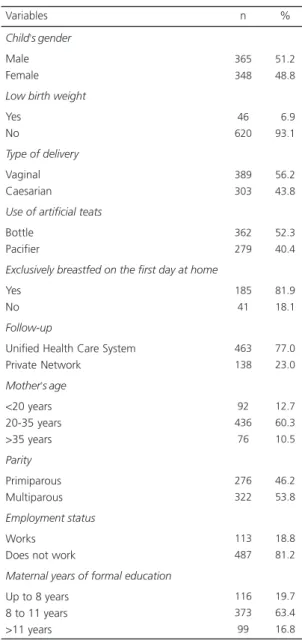
Table 1 shows the distribution of the sample according to the children’s and mothers’
characteristics. Gender distribution was similar.
Most children were delivered vaginally (normally or through the use of a forceps), but the caesarian rate was high at 43.7%. The proportion of exclusively breastfed children on the first day at home after hospital discharge was high, although more than half of the mothers reported using a bottle and 40.0% had used a pacifier the day before the interview. Most mothers were aged between 20 and 35 years, did not work away from home, and had 8 to 11 years of formal education.
Table 1. Distribution of the maternal and child characteristics in the study sample. Registro (SP), 2011.
Child’s gender
Male Female
Low birth weight
Yes No
Type of delivery
Vaginal Caesarian
Use of artificial teats
Bottle Pacifier
Exclusively breastfed on the first day at home
Yes No
Follow-up
Unified Health Care System Private Network
Mother’s age
<20 years 20-35 years >35 years
Parity
Primiparous Multiparous
Employment status
Works Does not work
Maternal years of formal education
Up to 8 years 8 to 11 years >11 years Variables
365 348
46 620
389 303
362 279
185 41
463 138
92 436 76
276 322
113 487
116 373 99
51.2 48.8
06.9 93.1
56.2 43.8
52.3 40.4
81.9 18.1
77.0 23.0
12.7 60.3 10.5
46.2 53.8
18.8 81.2
19.7 63.4 16.8
Figure 1 shows the exclusive breastfeeding and breastfeeding probabilities according to the children’s ages. The exclusive breastfeeding rates
plummeted during the first days of life. After ninety days, the probability dropped to less than 50%, and at 180 days, the probability of being exclusively breastfed was around 13%. The probability of breastfeeding remained higher than 70% up to 180 days of life, dropping to 47% of the children at around age one year. The median durations of exclusive breastfeeding and breastfeeding were 79.7 days (95% Confidence Interval-95%CI=67.66-90.36) and 350.23 days (95%CI=312.96-406.39), respectively.
Figure 1. Probability of children aged less than one year being Exclusively Breastfed (EBF) and Breastfed (BF). Registro
(SP), 2011.
Table 2. Distribution of the children according to exclusive breastfeeding and complementary feeding indicators. Registro (SP), 2011.
Breastfed in the first hour of life
Yes No
Exclusively breastfed <6 months
Yes No
Breastfed from 9-12 months
Yes No
Children aged 6 to 8.9 months given fruits and savory meals
Yes No
Children aged 6 to 6.9 months given 1 savory meal
Yes No
Children aged 7 to 11.9 months given 2 savory meals
Yes No
Children aged 8 to 11.9 months given foods prepared for the family
Yes No
Children aged 6 to 11.9 months given high-iron foods
Yes No
Children aged 6 to 11.9 months given at least 1 unhealthy food
Yes No Variables
546 127
205 206
76 51
90 55
13 24
123 62
59 90
222 15
204 66
81.1 18.9
49.9 50.1
59.8 40.2
62.1 37.9
35.1 64.9
66.5 33.6
39.6 60.4
93.7 6.3
75.6 24.4
Table 2 shows the breastfeeding and complementary feeding indicators of the study population. Most children were breastfed in the first hour of life after delivery, half the children aged less than six months were being exclusively breastfed, and 60% continued to breastfeed at
the end of the first year of life (between 9 and 12 months).
The complementary feeding indicators showed that 62.0% of the children aged 6 to 8.9 months consumed fruits and at least one savory meal, as recommended by the BMH, and only
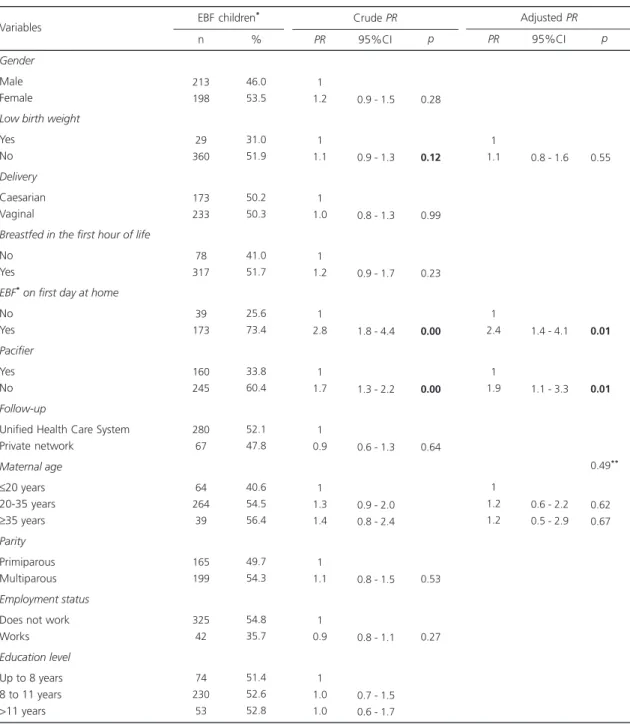
Table 3. Proportion of Exclusively Breastfed Children (EBF) aged less than six months and respective Prevalence Ratios (PR) and crude and adjusted 95% Confidence Intervals (95%CI) by maternal and child characteristics. Registro (SP), 2011.
Gender
Male Female
Low birth weight
Yes No
Delivery
Caesarian Vaginal
Breastfed in the first hour of life
No Yes
EBF* on first day at home
No Yes Pacifier Yes No Follow-up
Unified Health Care System Private network
Maternal age
≤20 years 20-35 years
≥35 years
Parity
Primiparous Multiparous
Employment status
Does not work Works
Education level
Up to 8 years 8 to 11 years >11 years Variables 213 198 29 360 173 233 78 317 39 173 160 245 280 67 64 264 39 165 199 325 42 74 230 53 46.0 53.5 31.0 51.9 50.2 50.3 41.0 51.7 25.6 73.4 33.8 60.4 52.1 47.8 40.6 54.5 56.4 49.7 54.3 54.8 35.7 51.4 52.6 52.8
EBF children*
n % 1 1.2 1 1.1 1 1.0 1 1.2 1 2.8 1 1.7 1 0.9 1 1.3 1.4 1 1.1 1 0.9 1 1.0 1.0
0.9 - 1.5
0.9 - 1.3
0.8 - 1.3
0.9 - 1.7
1.8 - 4.4
1.3 - 2.2
0.6 - 1.3
0.9 - 2.0 0.8 - 2.4
0.8 - 1.5
0.8 - 1.1
0.7 - 1.5 0.6 - 1.7
Crude PR PR 95%CI 0.28 0.12 0.99 0.23 0.00 0.00 0.64 0.53 0.27 p 1 1.1 1 2.4 1 1.9 1 1.2 1.2
0.8 - 1.6
1.4 - 4.1
1.1 - 3.3
0.6 - 2.2 0.5 - 2.9
Adjusted PR PR 95%CI 0.55** 0.01** 0.01** 0.49** 0.62** 0.67** p
35.0% received at least one savory meal between ages 6 and 6.9 months. Thirty-nine percent of the children aged 8 to 11.9 months were given foods prepared for the family. The high consumption of high-iron foods was surprising. On the other hand, more than three-fourths of the children were given at least one unhealthy meal in the 24 hours that preceded the interview, namely cookies/biscuits or chips (63.7%), foods with added sugar (40.4%), drink mixes (22.4%), coffee (8.2%), and soda (7.1%).
Table 3 shows the proportions of exclusively breastfed children aged less than six months, the respective Prevalence Ratios (PR), and crude and adjusted 95%CI by maternal and child characteristics. In the crude analysis, female infants, infants delivered vaginally, infants who were breastfed in the first hour of life, multiparous mothers, mothers with more education, mothers who were followed at SUS, and mothers who did not work away from home had PR higher than 1, but p>20 kept them out of the multiple model.
Table 4. Proportion of children aged 6 to 8.9 months given Complementary Foods (fruits + savory meal) and the respective crude and adjusted Prevalence Ratios and 95% Confidence Intervals (95%CI) by maternal and child characteristics. Registro (SP), 2011. Gender Male Female Low weight Yes No Bottle No Yes Pacifier Yes No Follow-up Private
Unified Health Care System
Maternal age
≤20 years 20-35 years
≥35 years
Parity
Primiparous Multiparous
Work situation
Does not work Works
Education level
Up to 8 years 8-11 years >11 years Variables 63.4 60.8 55.6 64.1 51.2 66.9 70.1 56.6 83.8 56.0 53.3 64.4 85.7 70.2 61.4 85.0 55.2 44.4 63.6 88.9 n % CF* 71 74 9 128 39 103 67 76 37 91 15 87 14 57 57 40 76 18 66 27
0.6 - 1.4
0.5 - 2.8
0.8 - 2.1
0.8 - 1.9
0.4 - 1.0
0.6 - 2.5 0.7 - 3.9
0.55 - 1.38
0.4 - 1.0
0.7 - 3.0 0.9 - 4.4
PR 95%CI 1.0 0.9 1.0 1.1 1.0 1.3 1.0 1.2 1.0 0.7 1.0 1.2 1.6 1.0 0.9 1.0 0.6 1.0 1.4 1.9 0.84 0.76 0.29 0.31 0.08 0.62 0.29 0.564 0.06 0.35 0.09 p
Crude PR
0.4 - 1.5
0.4 - 1.2
0.6 - 2.9 0.5 - 3.7
PR 95%CI 1.0 0.8 1.0 0.7 1.0 1.4 1.4 0.42** 0.89** 0.24** 0.07** 0.40** 0.47** p
Adjusted PR
Note: *Complementary foods; **Linear trend p; In bold: p<0.20.
The variables low birth weight, exclusive breastfeeding on the first day at home, use of pacifier, and maternal age had p<0.20, so they were included in the multiple regression model. In the final model, the prevalence ratios for exclusive breastfeeding were significantly higher among children who were breastfed on the first day at home (PR=2.40; 95%CI=1.42-4.06) and those who did not use pacifiers (PR=1.95; 95%CI=1.15-3.30).
Table 4 shows the proportions of children aged 6 to 8.9 months given complementary foods (fruit and savory meal) and their crude and adjusted PR and 95%CI according to maternal and child characteristics. In the exploratory analyses, children more likely to receive proper complementary foods were males, children born with appropriate birth weight, children given bottles, and children not given pacifiers. Additionally, primiparous and older mothers were more likely to offer complementary foods, but these variables were not included in the final model because their p>0.20. The variables included in the multiple model were: follow-up at a health care facility and maternal employment status and education level, but in the final model none of the variables remained statistically associated with the outcome.
D I S C U S S I O N
The prevalence of exclusive breastfeeding in Registro (SP) was higher than that of Brazilian capitals and Distrito Federal (41%), of the Southeast region (39.4%), and of the municipality of São Paulo (39.1%)13. It was also higher than those of 227 municipalities that conducted the II Survey on Breastfeeding Prevalence in 200814, but it is still far from the WHO recommendations2. Meanwhile, the prevalence of breastfeeding at the end of the first year of life was similar to that found by the II Survey on Breastfeeding Prevalence (II PPAM/2008)13.
An eye-catching fact is the sharp decrease in the probability of exclusive breastfeeding as
the child grows older, a trend also found in the municipality of Itapira, where only 9.6% of the children aged 121 to 180 days were being exclusively breastfed15, and Campina Grande (PB), where the prevalence of exclusive breastfeeding dropped from 20.9% in the third month to 8.3% in the sixth month16.
Exclusive breastfeeding on the first day at home after hospital discharge indicated a higher likelihood that the child would be exclusively breastfed in the first six months of life, a finding also reported by other studies15,17. Another factor associated with exclusive breastfeeding was not using a pacifier, corroborating many domestic studies17-21. These findings reinforce the importance of the information provided by maternity hospitals and the Baby-Friendly Hospital Initiative, which contemplates the Ten Steps to Successful Breastfeeding and the non-use of artificial teats and/or other fluids or foods besides breast milk22. Venancio et al.23 and Vieira et al.24 found that being born at a Baby-Friendly Hospital and receiving information at maternity hospitals increase the probability of exclusive breastfeeding in the first months of life.
The prevalence of breastfeeding in the first hour of life in Registro (SP) was also higher than those found by the II Survey on Breastfeeding Prevalence in Brazilian capitals and the Distrito Federal (67.7%)13, by the Pesquisa Nacional de
Demografia e Saúde 2006 (PNDS, National Survey
about Demographics and Health) (43.0%)25,and by other regional studies26,27. This finding is very important because there is evidence that this practice can reduce neonatal mortality28,29 and encourage exclusive breastfeeding30.
on the other hand more than 70% of the children were given unhealthy foods.
Domestic studies on complementary feeding are scarce and use different indicators at different age groups, which impairs comparing the results. However, all studies found significant inadequacies: the II PPAM/200813 found that more than one-fourth of the children aged 6 to 9 months were not given savory foods; likewise, the PNDS/200625 found that 64.4% of the children aged 6 to 8 months had been given savory foods; some domestic studies also reported the early introduction of complementary foods, that is, before the child is six months old31-33.
Domestic studies on the intake of high-iron foods disagree. A study conducted in the urban area of the municipality of Acrelândia in the state of Acre with 164 children found that the proportion of children aged 9 to 11 months with low iron intake was 94%, while a study conducted in the fourteen poorest municipalities of the state of Paraíba with children aged 0 to 23.9 months found that 70% of the children were consuming high-iron foods34.
A prospective study in the cities of São Paulo (SP), Curitiba (PR), and Recife (PE) found early the introduction of unhealthy foods, such as packaged sweets, sandwich cookies, instant noodles, TV dinners, soda, and drink mixes35. Population-based foreign studies that assessed the food intake of American and European (German, Polish, Italian, Spanish, and Belgium) breastfeeding infants also reported the use of inappropriate foods for this age group, such as high-fat and high-sugar foods36-38.
The absence of an association between the explanatory variables and the complementary food indicator could partly be explained by the small number of children in this age group, which consists of a study limitation. Another limitation consists on the fact that the survey was conducted on a single day during the vaccination campaign, imposing restrictions on data collection.
Notwithstanding, some positive metho-dological aspects deserve to be pointed out, as
the methods are a widely recommended and used strategy in Brazil because of their ease of use, and low cost, and the broad coverage of vaccination campaigns39. Hence, the results are representative of the population of infants aged less than one year from the municipality of
Registro (SP) and can contribute to the planning
of interventions that aim to increase breastfeeding practice and the use of healthy complementary foods.
The non-adherence of the municipality of
Registro (SP) to the various strategies proposed
by the National Food and Nutrition Policy and National Child Health Policy is a factor that should be considered when analyzing the results. Thus, among the possible interventions, we can suggest the implementation of the Baby-Friendly Hospital Initiative because of its impact on breastfeeding indicators, and the Brazil Breastfeed and Feed Strategy, resulting in the integration of the Brazil Breastfeed Network and the National Strategy for Promoting Healthy Complementary Foods (ENPACS), whose objective is to promote breastfeeding and healthy complementary foods at the primary care level40.
We also hope that the results of this study help to generate hypotheses for future studies on the theme and contribute to increase the knowledge on the profile of complementary feeding practices in our medium, given that few studies have approached the correct introduction of complementary foods in the first year of life.
C O L L A B O R A T O R S
GA TAMASIA and SI VENANCIO helped to design the study, collect data, analyze, and discuss the results of the dissertation on which this article is based. SRDM SALDIVA helped to analyze the data and write the article.
improvement of maternal and child nutrition: What can be done and at what cost? Lancet. 2013; 382(9890):452-77.
2. Brasil. Ministério da Saúde. Secretaria de Atenção à Saúde. Dez passos para uma alimentação saudá-vel: guia alimentar para crianças menores de dois anos: um guia para o profissional da saúde na aten-ção básica. 2ª ed. Brasília: Ministério da Saúde; 2013.
3. Venancio SI, Saldiva SRDM, Monteiro CA. Tendência secular da amamentação no Brasil. Rev Saúde Pública. 2013; 47(6):1205-8.
4. Bortolini GA, Gubert MB, Santos LMP. Consumo alimentar entre crianças brasileiras com idade de 6 a 50 meses. Cad Saúde Pública. 2010; 28(9):1759-71.
5. Dias MCAP, Freire LMS, Franceschini SCC. Reco-mendações para alimentação complementar de crianças menores de dois anos. Rev Nutr. 2010; 23(3):475-86. http://dx.doi.org/10.1590/S1415-52 732010000300015
6. World Health Organization. Global strategy for infant and young child feeding. Geneva: WHO; 2003.
7. Atlas do Desenvolvimento Humano no Brasil. Re-gistro, SP: indicadores de desenvolvimento huma-no. 2013 [acesso 2014 nov 22]. Disponível em http:/ /www.atlasbrasil.org.br/2013/pt/perfil_m/registro_ sp#idh
8. Venancio SI, Saldiva SRDM, Castro ALS, Gouveia AGC, Santana AC, Pinto JCC, et al. Projeto ama-mentação e municípios: a trajetória de implantação de uma estratégia para a avaliação e monito-ramento das práticas de alimentação infantil no Estado de São Paulo, no período de 1998-2008. Bepa. 2010; 7(83):4-15.
9. World Health Organization. Indicators for assessing infant and young child feeding practices: Conclusions of a consensus held 6-8 November 2007. Washington (DC): WHO; 2008.
10. Ministério da Saúde. Organização Pan-Americana de Saúde. Guia alimentar para crianças menores de 2 anos. 2ª ed. Brasília: Ministério da Saúde; 2010. Série A. Normas e Manuais Técnicos. 11. Venancio SI, Escuder MML, Saldiva SRDM, Giugliani
ERJ. Breastfeeding pratice in Brazilian capital cities and Federal District: Current status e advances. J Pediat. 2010; 86(4):317-24.
12. Barros AJD, Hirakata VN. Alternatives for logistic regression in cross-sectional studies: An empirical comparison of models that directly estimate the prevalence ratio. BMC Med Res Methodol. 2003; 3:21.
13. Brasil. Ministério da Saúde. Secretaria de Atenção à Saúde. II Pesquisa de prevalência de aleitamento
materno nas capitais brasileiras e Distrito Federal. Brasília: Ministério da Saúde; 2009.
14. Brasil. Ministério da Saúde. Secretaria de Atenção à Saúde. Pesquisa de prevalência de aleitamento materno em municípios brasileiros. Brasília: Minis-tério da Saúde; 2010.
15. Audi CAF, Correa MAS, Latorre MRDO. Alimentos complementares e fatores associados ao aleita-mento materno e ao aleitaaleita-mento materno exclusivo em lactentes até 12 meses de vida em Itapira, São Paulo, 1999. Rev Bras Saúde Matern Infant. 2003; 3(1):85-93.
16. Barros VO, Cardoso MAA, Carvalho DF, Gomes MMR, Ferraz NV, Medeiros CCM. Aleitamento ma-terno e fatores associados ao desmame precoce em crianças atendidas no programa de saúde da família. Nutrire. 2009; 34(2):101-14.
17. Souza SNDH, Migoto MT, Rossetto EG, Mello DF. Prevalência de aleitamento materno e fatores as-sociados no município de Londrina - PR. Acta Paul Enferm. 2012; 25(1):29-35.
18. Soares ME, Giugliani ER, Braun ML, Salgado AC, Oliveira AP, Aguiar PR. Uso de chupeta e sua relação com o desmame precoce em população de crianças nascidas em Hospital Amigo da Criança. J Pediatr. 2003; 79(4):309-16.
19. Feldens CA, Vitolo MR, Rauber F, Cruz LN, Hilgert JB. Risk factors for discontinuing breastfeeding in southern Brazil: A survival analysis. Matern Child Health. 2011; 16(6):1257-65.
20. Sanches MT, Buccini GD, Gimeno SG, Rosa TE, Bonamigo AW. Fatores associados à interrupção do aleitamento materno exclusivo de lactentes nas-cidos com baixo peso assistidos na atenção básica. Cad Saúde Pública. 2011; 27(5):953-65.
21. França GVA, Brunken GS, Silva SM, Escuder MM, Venancio SI. Determinantes da amamentação no primeiro ano de vida em Cuiabá, Mato Grosso. Rev Saúde Pública. 2007; 41(5):711-8.
22. Venancio SI. Dificuldades para o estabelecimento da amamentação: o papel das práticas assistenciais das maternidades. J Pediatr. 2003; 79(1):1-2. 23. Venancio SI, Saldiva SRDM, Escuder MML, Giugliani
ERJ. The baby-friendly hospital initiative shows positive effects on breastfeeding indicators in Brazil. J Epidemiol Comm Health. 2012; 66(10):914-8. 24. Vieira TO, Vieira GO, Oliveira NF, Mendes CMC,
Giugliani ERJ, Silva LR. Duration of exclusive breastfeeding in a Brazilian population: New determinants in a cohort study. BMC Pregnancy and Childbirth. 2014; 14:175.
26. Boccolini CS, Carvalho ML, Oliveira MIC, Leal MC, Carvalho MS. Factors that affect time between birth and first breastfeeding. Cad Saúde Pública. 2008; 24(11):2681-94.
27. D’Orsi E, Chor D, Giffin K, Ângulo-Tuesta A, Barbosa GP, Gama AS, et al. Qualidade da atenção ao parto em maternidades do Rio de Janeiro. Rev Saúde Pública. 2005; 39(4):645-54.
28. Edmond KM, Zandoh C, Quigley MA, Amenga-Etego S, Owusu-Agyei S, Kirkwood BR. Delayed breastfeeding initiation increases risk of neonatal mortality. Pediatrics. 2006; 117(3):380-6. 29. Boccolini CS, Carvalho ML, Oliveira MI,
Pérez-Escamilla R. Breastfeeding during the first hour of life and neonatal mortality. J Pediatr. 2013; 89(2):131-6.
30. Neves ACM, Moura EC, Santos W, Carvalho KMB. Factors associated with exclusive breastfeeding in the Legal Amazon and Northeast regions, Brazil, 2010. Rev Nutr. 2014; 27(1):81-95. http://dx. doi.org/10.1590/1415-52732014000100008 31. Santos CS, Lima LS, Javorski M. Fatores que
inter-ferem na transição alimentar de crianças entre cinco e oito meses: investigação em serviço de pueri-cultura do Recife, Brasil. Rev Bras Saúde Mater Infant. 2007; 7(4):373-80.
32. Saldiva SRDM, Venancio SI, Gouveia AGC, Castro ALS, Escuder MML, Giugliani ERJ. Influência re-gional no consumo precoce de alimentos diferentes do leite materno em menores de seis meses residentes nas capitais brasileiras e Distrito Federal. Cad Saúde Pública. 2011; 27(11):2253-62. 33. Bortolini GA, Vitolo MR, Gubert MB, Santos LM.
Early cow’s milk consumption among Brazilian children: Results of a national survey. J Pediatr. 2013; 89(6):608-13.
34. Garcia MT, Granado FS, Cardoso MA. Complementary feeding and nutritional status of 6-24-month-old children in Acrelândia, Acre State, Western Brazilian Amazon. Cad Saúde Pública. 2011; 27(2):305-16. 35. Palmeira PA, Santos SMC, Vianna RPT. Prática ali-mentar entre crianças menores de dois anos de idade residentes em municípios do semiárido do Estado da Paraíba, Brasil. Rev Nutr. 2011; 24(4):553-63. http://dx.doi.org/10.1590/S1415-52 732011000400004
36. Caetano MC, Ortiz TTO, Silva SGL, Souza FIS, Sarni ROS. Complementary feeding: Inappropriate practices in infants. J Pediatr. 2010; 86(3):196-201. 37. Agostoni C, Braegger C, Decsi T, Kolacek S, Koletzko B, Michaelsen KF, et al. Breastfeeding: A commentary by the ESPGHAN committee on nutrition. J Pediatr Gastroenterol Nutr. 2009; 49(1):112-25.
38. Kleiman RE, editor. Pediatric nutrition handbook. 6th ed. Elk Grove Village (IL): American Academy of
Pediatrics; 2009.
39. Santos LM, Paes-Sousa R, Silva Junior JB, Victora CG. National immunization day: A strategy to monitor health and nutrition indicators. Bull World Health Organ. 2008; 86(6):474-9.
40. Brasil. Ministério da Saúde. Portaria nº 1.920/2013. Institui a estratégia nacional para promoção do aleitamento materno e alimentação complementar saudável no Sistema Único de Saúde (SUS) -Estratégia Amamenta e Alimenta Brasil. Brasília: Ministério da Saúde; 2013.