301
Radiol Bras. 2011 Set/Out;44(5):301–307
Radiographic processing effluents management status
in healthcare centers
*
Situação do gerenciamento de efluentes de processamento radiográfico em serviços de saúde
Jamyle Calencio Grigoletto1, Claudia Benedita dos Santos2, Leny Borghesan Albertini3, Angela Maria Magosso Takayanagui2
Objective: The present study was aimed at identifying the status of radiographic processing effluents management in radiodiagnosis centers in regard to handling, packaging, storage, treatment and disposal. Materials and Methods: A descriptive-exploratory study was developed in the period from February to May 2009, with interviews based on a script including semistructured questions conducted in 12 radiodiagnosis centers of Ribeirão Preto, SP, Brazil, randomly selected by means of the Statistical Package for Social Sciences, version 10.0. Results: According to the respondents, untreated image-processing effluents discharge directly into the public sewage system occurs as follows: developer liquid by 16.66% of the healthcare centers; fixer by 8.33%; and film washing water by 75% of the centers. Conclusion: The present study results demonstrate the need for a closer surveillance, control and monitoring by the competent agencies, encouraging the pre-treatment of such effluents in order to minimize their impact on public health and the environment.
Keywords: Management; Effluents; Radiographic.
Objetivo: O objetivo deste estudo foi identificar a situação do gerenciamento de efluentes radiográficos em serviços de diagnóstico por imagem, em relação ao manuseio, acondicionamento, armazenamento, tratamento e descarte desses efluentes. Materiais e Métodos: Tratou-se de estudo descritivo e exploratório, realizado por meio de entrevistas baseadas em roteiro com perguntas semiestruturadas, realizadas no período de fevereiro a maio de 2009. A investi-gação foi realizada em 12 serviços de saúde humana e animal de radiodiagnóstico de Ribeirão Preto, SP, Brasil, esco-lhidos aleatoriamente por sorteio por meio do programa Statistical Package for the Social Sciences, versão 10.0. Re-sultados: De acordo com os entrevistados, 16,66% dos serviços descartavam revelador usado na rede pública de esgoto, sem tratamento prévio, 8,33% descartavam o fixador e 75% descartavam a água de lavagem de filmes dire-tamente no esgoto, sem tratamento prévio. Conclusão: Os resultados deste estudo evidenciam necessidade de maior fiscalização, controle e monitoramento, pela vigilância ambiental e sanitária, para com os efluentes radiográficos, estimulando tratamento antes do descarte, minimizando o impacto à saúde pública e ao ambiente.
Unitermos: Gerenciamento; Efluentes; Radiográfico.
Abstract
Resumo
* Study developed at the Environmental Health Laboratory, Department of Maternal-Infant and Public Health, Nursing School of Ribeirão Preto-SP, Brazil. University of São Paulo. Nursing Collaborating Center of WHO for the Development of Nursing Research. Financial support: Fundação de Amparo à Pesquisa do Estado de São Paulo (Fapesp).
1. PhD, General Advice-Coordination of Health Surveillance, Department of Environmental Health Surveillance and Workers Health – Ministry of Health of Brazil.
2. PhD, Associate Professors, Department of Maternal-Infant and Public Health, Nursing School of Ribeirão Preto-SP, Brazil. University of São Paulo. Nursing Collaborating Center of WHO for the Development of Nursing Research.
3. PhD, Coordinator Chemist at the Chemical Waste Labora-tory of the São Carlos, University of São Paulo, São Carlos-SP, Brazil.
Grigoletto JC, Santos CB, Albertini LB, Takayanagui AMM. Radiographic processing effluents management status in healthcare cen-ters. Radiol Bras. 2011 Set/Out;44(5):301–307.
inappropriate disposal of radiographic ef-fluents(2,3).
According to the Resolution No. 358/05 of Conselho Nacional do Meio Ambiente (Conama) (the Brazilian Environment Council), effluents from radiographic im-age processing are considered as being “group B effluents” for comprising sub-stances that can pose risks to public health or to the environment, depending upon their flammability, corrosiveness, reactiv-ity and toxicreactiv-ity. According to Article 21 of the mentioned Resolution, group B wastes, with hazardous characteristics, as it is the case with radiographic effluents, when not submitted to processes for reuse, recovery or recycling, must undergo specific treat-ment and final disposal. Article 22 provides oper, fixer, and wash water) posing an
en-vironmental threat, as such effluents con-tain organic and inorganic compounds that are toxic to the environment in cases where they are inappropriately disposed of(1).
Investments have been made in training of professionals, in process and equipment improvements in the health sector as a whole and specifically in the field of im-aging diagnosis, however little has been done to prevent the occurrence of occupa-tional injuries and disorders and to mini-mize the environmental impact caused by
Mailing Address: Jamyle Calencio Grigoletto. QMSW 5, Lote 9, ap. 243, Bairro Sudoeste. Brasília, DF, Brazil, 70680-500. E-mail: [email protected]
Received August 30, 2010. Accepted after revision August 18, 2011.
INTRODUCTION
(devel-that group B wastes in liquid state may be disposed of to streams or public sewer sys-tems provided they comply with, respec-tively, the guidelines established by the environmental authorities, and competent water and sanitation management agen-cies(4).
However, according to reports in the lit-erature, what actually happens at many health centers is the effluents disposal into streams or into public sewer systems with levels of inorganic compounds such as sil-ver above allowed limits. Additionally, such effluents are discarded with a high chemical oxygen demand (COD) and hydrogenic potential (pH), and color, total dissolved solids concentration, chlorides, sulfates and turbidity over allowed limits(5).
The final disposal and treatment of such effluents at most of imaging diagnosis cen-ters, including teaching and research insti-tutions, are not appropriately performed. In most of times, chemical wastes such as developer and fixer solutions are directly discarded without any previous treatment, into the public sewer system(6).
This is a worrisome fact when one con-siders that only 20.2% of Brazilian cities have public sewer collection and treatment systems(7). Additionally, many hazardous
chemicals that are present in liquid health services wastes (HSR) are not broken down in wastewater treatment plants in the coun-try, so the disposal of hazardous liquid ef-fluents into the public sewer system, with-out any previous treatment, is a totally un-acceptable practice.
An appropriate solution for the disposal of radiographic effluents would be the sub-stitution of conventional radiography appa-ratuses by digital radiography appaappa-ratuses which do not require chemical solutions for radiographic processing, therefore not gen-erating effluents and avoiding workers to come in contact with chemicals, thus mini-mizing impacts on occupational health, on the environment and on the public health as a whole.
According to Teschke et al.(8), the
tech-nological development of digital imaging methods is an available option to eliminate the utilization of developer and fixer solu-tions in imaging diagnosis centers.
Authors such as Braunschweig et al.(9)
have stated that after three or four years
from the installation of digital systems, such a technology becomes more profitable than the conventional system because of savings on the purchase of radiographic films.
According to Gonzaga Junior and Carvalho(10), the technological conversion
from conventional into digital radiography is economically feasible. The authors report that after approximately 53 months, a re-duction in the cost of the new technology is achieved by the elimination of radio-graphic film utilization, paying back the initial investment. Additionally, the authors highlight that the digital technology allows the permanent data storage in digital me-dia, reducing required physical storage space and avoiding the disposal of physi-cal radiographic documentation. However, they consider that process safety must be sustained by keeping the capacity of pro-ducing images by the conventional method to meet emergency situations caused by technical problems that might occur with the digital environment(10).
Other option to solve the problem posed by the disposal of radiographic effluents with environmental optimization is the treatment of such effluents. Although such effluents are highly pollutant, if properly treated they can be turned into useful sub-stances which can generate income and savings for the health centers(2).
The treatment of radiographic effluents can be performed in loco, at the very health
center where they are generated, or outside, by specialized companies.
Such a treatment of radiographic efflu-ents prior to their disposal into the public sewer system would provide for the neu-tralization, recovery and/or destruction of toxic substances contained in such efflu-ents besides adjusting to established pH and COD parameters for such effluents.
According to Lunar et al.(11), different
radiographic effluent treatment alternatives have been proposed, as follows: chemical precipitation and sedimentation, chemical oxidation, carbon adsorption, biological oxidation, and reverse osmosis. Some methods combinations have also been uti-lized, such as chemical-biological, chemi-cal-electrochemical oxidation, and oxida-tion-separation processes. Besides such processes, recycling of radiographic
efflu-ents has also been performed by means of several procedures, such as Cl2-biological treatment, filtration-chelation treatment and adsorption-reverse osmosis.
According to Igarashi-Mafra et al.(12),
photo-Fenton oxidation is utilized for de-struction of organic compounds in water, including those effluents from radiographic processing. The application of the photo-Fenton reaction does not require costly equipment or special abilities and there-fore, it might be used in loco at small
cen-ters whose facilities and reduced waste volumes would not justify the utilization of other processes such as incineration(13).
The photo-Fenton technology is a novel alternative that may be adopted by health centers, since it is easily performed. It also meets environmental requirements, utiliz-ing only ultraviolet radiation and compo-nents from the environment such as iron and hydrogen peroxide, being considered a “green” technology(14).
In addition to organic compounds, ra-diographic processing effluents are also constituted by inorganic compounds. Among those, the main and also the most hazardous compound is silver, which also must be treated or recovered from the ef-fluents before disposal into the sewer sys-tem.
The recovery of silver from radio-graphic effluents is already feasible and is actually performed by many laboratories. The main techniques for silver recovery include electrolytic recovery, which is more efficient for silver-rich solutions such as fixers, for electrolysis-based solutions, metal displacement solutions (carburizing and metallic exchange), as well as for some that utilize chemical precipitation(15).
As it may be observed in the above men-tioned literature data, methods for treat-ment and recovery of radiographic process-ing effluents have already been developed and are continuously utilized and im-proved. Such methods are simple and can be utilized in health centers provided there is availability of the necessary infrastruc-ture as well as of technically skilled person-nel to perform such an activity.
to properly licensed effluent treatment in-stitutions.
The present study was aimed at evalu-ating the situation of radiographic effluents management in imaging diagnosis centers of Ribeirão Preto, SP, Brazil, with respect to handling, packaging, storage, treatment and disposal of such effluents.
MATERIALS AND METHODS
The present descriptive and exploratory study was developed in the period from February until May 2009 by means of in-terviews based on a semi-structured ques-tionnaire about handling, packaging, stor-age, treatment and disposal of radiographic processing effluents (developer and fixer solutions and radiographic film wash wa-ter), as per Appendix A.
The investigation was undertaken in 12 radiodiagnosis centers in Ribeirão Preto, including services in universities and hos-pitals, besides public and private medical, dental and veterinary radiodiagnosis cen-ters that agreed in participating in the study. The services were selected based on the registry of health centers equipped with radiographic apparatuses of the Ribeirão Preto City Department of Health, which is updated on a monthly basis.
At the time of such an investigation, 1,138 health centers equipped with radio-graphic apparatuses were registered in the city, comprising small, medium and large health centers, universities, associations and other public and private institutions.
A previous selection was made amongst the 1,138 registered services, with the pur-pose of selecting only those which pro-vided exclusively imaging diagnosis ser-vices (49), excluding the remaining 1,089 services which were mostly small sized services providing other types of health services such as dental offices.
The final sample comprised 12 radio-diagnosis centers which were randomly selected among the 49 previously selected services, by the Statistical Package for the Social Sciences, version 10.0, representing 24.5% of the pre-selected services.
After the final selection of the services, professionals were appointed to be inter-viewed, including owners or workers re-sponsible for the radiology services.
Appendix A
Questionnaire for professionals responsible for health centers on the handling, packaging, storage, treat-ment and disposal of radiographic processing effluents (developer/fixer solutions and film wash water). I. IDENTIFICATION ... Interview date: ___/___/2009 1 – General data on the center:
Name:... Sector:... Address:... Fone number:... 2 – General data on the responder:
Name:... Gender:... Age:... Function:... Fone number:... 3 – How many X-ray apparatuses are there in this center?
A – In use:... B – Not in use:...
B.1 – Reason:
Broken:... Maintenance:... Other:... 4 – What type of X-ray apparatuses does the service operate?
A – Digital X-ray:... B – Conventional X-ray:... II. MANAGEMENT OF DEVELOPER/FIXER SOLUTIONS AND RADIOGRAPHIC FILM WASH WATER 5 – What is the monthly average amount of developer solution used in this center?...
... 6 – What is the monthly average amount of fixer solution used in this center?... ... 7 – What is the amount of water used in radiographic processing in this center?... ... 8 – How often are developer/fixer solutions and radiographic film wash water changed?... ... 9 – After utilization, what is done with the developer and fixer solutions and wash water?
Developer:... Fixer:... Wash water:... 10 – In case the answer to question 9 is “treatment”, what is the responsible company and place where
the effluents are sent to?
Developer:... Fixer:... Wash water:... 11 – In case there is storage of effluents, where is the storage area?
Developer:... Fixer:... Wash water:... 12 – How long are such used solutions and wash water stored?
Developer:... Fixer:... Wash water:... 13 – What is the type of container used for the storage of the solutions?
The data obtained in the interviews were categorized and entered into Excel worksheets for two times with an interval of five days between the first and second data entries in order to minimize transcrip-tion errors. Later, validatranscrip-tion of the data-bank, errors correction, and calculation of the percentages of obtained answers were performed. The project for the present in-vestigation was approved by the Commit-tee for Ethics in Research of the Scholl of Nursing of Ribeirão Preto – University of São Paulo.
RESULTS
The results of the present investigation are presented according to the proposed ob-jective of diagnosing the status of radio-graphic processing effluents management in the selected radiodiagnosis centers in the city of Ribeirão Preto, Brazil.
The interviews were carried out in 12 services, as follows: two dental radiology services (16.66%), one veterinary ogy service (8.33%), four medical radiol-ogy services (33.33%), one university vet-erinary hospital radiology service (8.33%), one university hospital radiology service (8.33%), one maternity hospital radiology service (8.33%), one specialized hospital radiology service (8.33%) and one philan-thropic hospital radiology service (8.33%). Most of the interviewed professionals were women (66.66%), with ages between 22 and 65 years.
Questions related to the knowledge on laws and radiographic effluent manage-ment standards were not asked. The ques-tions were answered immediately after the interviewer asked then, without referring to written documents.
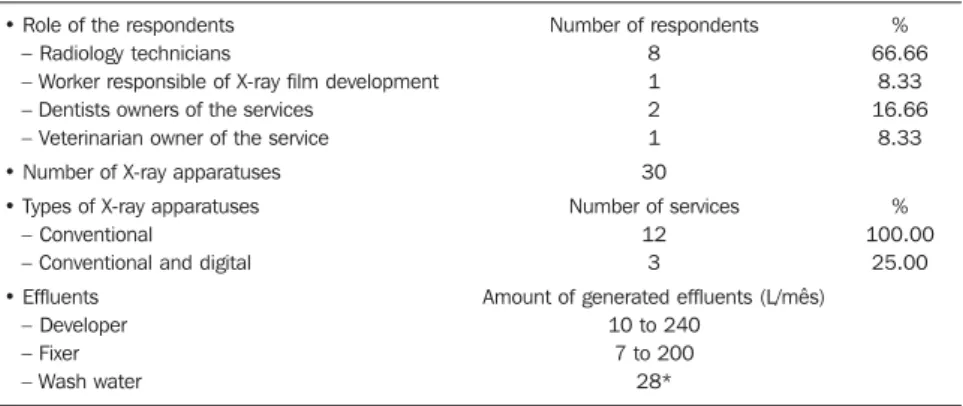
The results from the interviews are pre-sented on Tables 1, 2, and 3.
DISCUSSION
As regards types of radiographic appa-ratuses found at the investigated radiodiag-nosis services, it was observed that some of them (3 services) already utilized digi-tal equipment, reflecting a global trend, constituting an effective solution for the problem of radiographic processing efflu-ents. In Brazil, some specialized and
excel-Table 2 Frequency of change of effluents, form of packaging and temporary storage of effluents.
• Frequency of effluents change – Developer and fixer solutions
Monthly Every 15 days Weekly
Every three or four days Did not know – Wash water
Continuous change Weekly
Did not know
• Form of effluent packaging – Developer
Not packed* Containers or buckets Plastic drum Tank Did not reply – Fixer
Not packed†
Containers or buckets Plastic drum Did not reply
• Form of temporary storage of effluents – Developer
Did not store‡
Dark chamber room Basement
Laundry, open area, over plastic plates Closed and roofed room
Masonry external shelter Did not reply
– Fixer Did not store§
Dark chamber room Covered external area
Laundry, open area, over plastic plates Closed and roofed room
Outside mansonry shelter Did not reply
Number of services 2 6 2 1 1 10
1 1
4 5 1 1 1 2 7 2 1
4 3 1 1 1 1 1 2 5 1 1 1 1 1
% 16.66 50.00 16.66 8.33 8.33 83.33 8.33 8.33
33.33 41.66 8.33 8.33 8.33 16.66 58.33 16.66 8.33
33.33 25.00 8.33 8.33 8.33 8.33 8.33 16.66 41.66 8.33 8.33 8.33 8.33 8.33 *In one center (8.33%) the effluent was disposed of after being filtered, in another (8.33%) the developer was disposed of into a septic tank and in two others (16.66%) the developer was disposed of from the automatic processing system into the public sewer system.
† In one service (8.33%) the fixer solution was disposed of into a septic tank and in another (8.33%) the effluent
was disposed of directly from the automatic processing system into the public sewer system.
‡ Two services (16.66%) disposed of the developer solution directly from the automated processor to the public
sewage system, one service (8.33%) disposed of the effluent after filtering it and another (8.33%) disposed of the effluent at the septic tank.
§ In one service (8.33%) the fixer solution was directly disposed of from the automated processing system into
the public sewer system and in another (8.33%) the effluent was disposed of into a septic tank.
Table 1 Role of the respondents in the centers, number of X-ray apparatuses and monthly amount of effluents generated by each investigated center.
• Role of the respondents – Radiology technicians
– Worker responsible of X-ray film development – Dentists owners of the services
– Veterinarian owner of the service • Number of X-ray apparatuses • Types of X-ray apparatuses
– Conventional – Conventional and digital • Effluents
– Developer – Fixer – Wash water
* The amount of wash water was reported by only one professional (28 L/month). One declared that he did not have such information, and the remaining 10 (83.33%) informed that their centers were equipped with auto-mated film processing apparatuses which utilize a continuous water flow.
Number of respondents 8 1 2 1 30 Number of services
12 3
Amount of generated effluents (L/mês) 10 to 240
7 to 200 28*
% 66.66
8.33 16.66
8.33
% 100.00
lence centers already utilize digital systems, but such systems involve additional costs for small sized centers because of the high initial acquisition cost. Authors such as Braunschweig et al.(9) and Gonzaga Junior
and Carvalho(10) have reported that after a
period between 36 and 53 months from the installation of the digital system, it be-comes economically viable since it is not necessary to buy radiographic films and developer solutions.
As regards the amount of developer and fixer solutions and radiographic film wash water utilized by each one of the investi-gated services, according to the respon-dents, the amount of developer solution ranged between 10 and 240 l/month and that of fixer solution, between 7 and 200 l/ month, which demonstrates a high con-sumption and, consequently, the generation of a great effluent amount, corroborating the findings reported by Carlson(16), who
have found, in a case study, that the radi-ology service of a hospital generated 15
containers filled with 20 l of developer and fixer solutions effluents every week, or approximately 15,000 l/year of liquid chemical waste, containing 16 kg of silver in its composition besides other chemical substances.
The amount of developer and fixer so-lutions utilized in radiological centers var-ies according to the size of the health ser-vice and to the number of acquired images. Generally, large health care centers such as hospitals receive a large flow of patients and consequently utilize a great amount of developer and fixer solutions, consequently generating a greater volume of radio-graphic processing effluents.
On the other hand, small health centers such as orthopedic, dental and veterinary clinics perform a lower number of exami-nations, using a smaller amount of devel-oper and fixer solutions, consequently gen-erating lower amounts of radiographic pro-cessing effluents. However, as at such small services the generated effluent
amount is usually small, many times it is disposed of directly into sinks, thus reach-ing the sewer system without any previous treatment.
As regards packaging of effluents, ac-cording to the respondents the effluents were stored in containers, buckets, plastic drums or even in septic tanks, with the containers or plastic drums being the same containers in which the solutions came in when they were purchased.
Packaging radiographic processing ef-fluents is the act of placing such segregated effluents in bags or containers that do not leak and that are puncture and rupture re-sistant. According to Resolution RDC No. 306/2004 of Agência Nacional de Vigilân-cia Sanitária (Anvisa) (National Agency for Health Surveillance), the liquid wastes must be packed in containers made from materials compatible with the liquid to be contained, and must be strong, rigid, wa-tertight and fitted with a screwed on and sealing lid(17). Furthermore, according to Table 3 Storage time, treatment and disposal of effluents and companies responsible for collection and treatment of effluents.
• Effluents storage time in the service 15 to 20 days
1 week 1 month 1 year 3 months Did not know
• Treatment and disposal of effluents – Developer
Storage for later collection by private company
Disposal into the public sewer system, after being filtered in the service Disposal into the public sewer system, without any previous treatment
Disposal into septic tank and later shipment and treatment in the municipal waste water treatment plant Did not answer
– Fixer
Storage for later collection by private company
Disposal into the public sewer system, after being filtered in the service Disposal into the public sewer system, without any previous treatment
Disposal into a septic tank and later shipment to a municipal waste water treatment plant Did not answer
– Wash water
Disposal into the public sewer system, without any previous treatment Disposal into the public sewer system, after being filtered in the service
Disposal into a septic tank and later shipment to the municipal waste water treatment plant Did not answer
• Types of companies responsible for the collection and treatment of developer and fixer solution effluents – Company licensed by Cetesb, with internet website and phone number for contact
– Without internet website, with phone number for contact registered under the company’s name – With no data on the company
Note: Only six centers (50%) had their radiographic processing effluents collected and treated by five private companies, with two services hiring a same company. According to the respondents, one of the companies responsible for the collection and treatment of effluents charged for the service, while the other companies bought the fixer solution from the health services for a price that ranged from R$ 22.00 per 20 L container to R$ 2.00 or R$ 3.00/L.
Number of services 3 2 2 1 1 3
6 2 2 1 1 7 2 1 1 1 9 1 1 1
3 1 1
% 25.00 16.66 16.66 8.33 8.33 25.00
50.00 16.66 16.66 8.33 8.33 58.33 16.66 8.33 8.33 8.33 75.00
8.33 8.33 8.33
the Technical Standard P4.262/2007 of Companhia Ambiental do Estado de São Paulo (Cetesb) (São Paulo State Environ-mental Agency), hazardous chemical wastes must be stored in plastic drums, glass jars or drums made from materials that are compatible with the effluent to be stored, and such containers must be prop-erly identified, labeled and sealed in order to avoid leakage(18).
In the present study, in some cases the containers were not sealed, and sometimes the compatibility of the container material with the contents was not observed, thus posing the risk of corrosion and spillage of the liquid in the environment.
In a study developed by Sales et al.(19)
in Marituba, in the state of Pará, Brazil, it was also observed that in all of the investi-gated centers, group B wastes were packed without proper attention to container ma-terial and contents compatibility, a fact which corroborates the findings of the present study.
As regards temporary storage, the re-spondents revealed that in their services such storage was not appropriately done, as the storage area was not ventilated and it was not a dedicated area, thus not comply-ing with legal requirements, a fact that re-veals lack of proper knowledge or neglect by waste generators.
According to Sales et al.(19), less than
one half of the investigated institutions stored HSR, and among those which did it, the wastes storage was inappropriate, par-ticularly in what regards the storage areas. Carlson(16), in a case study developed in
a hospital, has also observed that chemical residues such as developer, fixer solutions and xylene leftovers were inappropriately stored in the place where they were gener-ated and were later taken into the basement of the building, where they were left under unsafe conditions, in an unventilated area, without containment means and over per-meable floor.
As regards storage time elapsed before the developer and fixer solution wastes were sent for treatment, the respondents re-vealed that such elapsed time ranged from one week to one year, which is considered a long period as such solutions must be stored for the shortest possible time avoid-ing accumulation.
As regards radiographic processing ef-fluents treatment and disposal, it was ob-served that direct disposal of radiographic processing effluents into the public sewer system, without any kind of previous treat-ment was done by two services (16.66%) for developer, by one service (8.33%) for fixer solution, and by nine other services (75%) for film wash water. Such findings are very worrisome and corroborate the findings reported by Fernandes et al.(2) and
Bortoletto et al.(20), where film wash water
effluents were directly disposed of into the public sewer system without any previous treatment.
Such behavior was already expected, as in spite of the fact that Anvisa RDC No. 306/2004 establishes guidelines for the management of radiographic processing ef-fluents no mention is made regarding the obligation of pretreatment of film wash wa-ter before it is disposed of into the public sewer system. Furthermore, Anvisa RDC No. 306/2004 establishes that developer solutions may be neutralized in order to reach a pH between 7 and 9 for later dis-posal into public sewer systems or streams, provided such effluents comply with guide-lines established by environmental agen-cies and competent water management and sanitation bodies(17).
However, some substances that are present in both wash water and used devel-oper solution are not degraded only by means of neutralization or in the public sewer system which relies only upon bio-logical treatments, a fact that makes the disposal of such effluents without pretreat-ment into the public sewer system or streams utterly inadmissible, because of inherent risks(21).
As regards the types of companies re-sponsible for effluents collection and treat-ment, the respondents reported that six ser-vices (50%) had their effluents collected and treated by five private companies of which three were licensed by Cetesb, had websites on the internet and phone num-bers for contact. One of the companies did not have a website, but had a phone num-ber for contact registered under the company’s name. For only one of the five mentioned companies data could not be obtained as the respondent could not tell the exact name of the company. Such
com-panies were located in five different cities in the state of São Paulo, as follows: Barre-tos, Diadema, Campinas, Franco da Rocha and São Paulo.
Considering the relevance of the treat-ment of such effluents to minimize envi-ronmental hazards and risks to public health it is necessary to highlight the need for greater involvement and knowledge on the part of the hazardous effluent genera-tors with respect to technical capacity, qualification and competence of the com-panies which treat their wastes, in the case of radiographic processing effluents, as the legal responsibility for the management of HSR lies with the generator. The company which performs the treatment must be duly licensed by the environmental agency and must appropriately treat and dispose of the effluents.
Also, it is also necessary to review the Brazilian resolutions with a view on a more careful approach to radiographic process-ing effluents treatment, includprocess-ing film wash water, before their final disposal into the public sewer system in order to mini-mize the possible impact on the public health and the environment. Such a propo-sition is also justified considering the in-appropriate management of radiographic processing effluents, and that only 20.2% of Brazilian cities have public sewer col-lection and treatment systems(7).
It is also extremely necessary to improve the knowledge on specific regulations among professionals involved in health services which generate radiographic pro-cessing effluents and other HSRs. Further-more, health and environmental agencies should provide more training courses on HSR management with basis on the Brazil-ian regulations, for different institutions, increasing awareness and providing guid-ance, thus allowing a better response to issues pointed out during future inspec-tions.
CONCLUSIONS
The present study identified the status of radiographic processing effluents man-agement status in imaging diagnosis cen-ters in the city of Ribeirão Preto, SP, Bra-zil.
a) Among the investigated services, three already operated digital equipment;
b) The amount of radiographic process-ing effluents ranged from 7 to 240 l/month, according to the service size;
c) The frequency of change of the de-veloper and fixer solutions varied between every three to four days to every month in some services;
d) Most of the investigated services (10) were equipped with automated film pro-cessing systems, with continuous exchange of wash water;
e) Most of the investigated services stored their effluents in plastic containers/ buckets, generally the same containers in which the solutions were packed when they were purchased from the suppliers. How-ever in some cases such containers were stored in inappropriate places;
f) The temporary effluents storage time varied significantly among the services, from 15 - 20 days in some of them and reaching 12 months in others;
g) As regards the disposal of radio-graphic processing effluents, two services disposed of the effluents directly into the public sewer system without any pretreat-ment, one service disposed of the fixer so-lution, also without any pretreatment and nine services disposed of the film wash water directly into the public sewer system without any pretreatment.
REFERENCES
1. Ues K, Piaia L, Schweickardt M, et al. Uso de processos avançados de oxidação na degradação dos resíduos de revelador e fixador de raio-x. Anais do XVI Encontro de Química da Região Sul; 13 a 15 de novembro de 2008; Blumenau, SC, Brasil; 2008.
2. Fernandes GS, Azevedo ACP, Carvalho ACP, et al. Análise e gerenciamento de efluentes de servi-ços de radiologia. Radiol Bras. 2005;38:355–8.
3. Fernandes GS, Carvalho ACP, Azevedo ACP. Avaliação dos riscos ocupacionais de trabalhado-res de serviços de radiologia. Radiol Bras. 2005; 38:279–81.
4. Brasil. Conselho Nacional do Meio Ambiente. Resolução Conama n° 358, de 29 de abril de 2005. Dispõe sobre o tratamento e a disposição final dos resíduos dos serviços de saúde e dá outras provi-dências. Brasília, DF: Diário Oficial da União nº 84, de 4 de maio de 2005; Seção I, p. 63–5.
5. Fernandes AL, Costa PHP, Andrade RT, et al. Análise do teor de prata e distribuição da gera-ção dos efluentes radiográficos das zonas leste e sul de Natal-RN. Anais do I Congresso de Pes-quisa e Inovação da Rede Norte Nordeste de Educação Tecnológica; Natal, RN, Brasil; 2006. 6. Management of photographic wastes in dental office. Kodak Dental Radiography Series. Ro-chester: Health Sciences, 1990.
7. Brasil. Instituto Brasileiro de Geografia e Estatís-tica (IBGE). Pesquisa nacional de saneamento básico de 2000. Rio de Janeiro, 2000. [acessado em 16 de julho de 2002]. Disponível em: http:// www.ibge.gov.br/home/estatistica/populacao/ condicaodevida/pnsb/lixo_coletado/lixo_ coletado101.shtm
8. Teschke K, Chow Y, Brauer M, et al. Exposures and their control in radiographic film processing in British Columbia. Report to the Workers’ Com-pensation Board of British Columbia. Vancouver; 2000.
9. Braunschweig R, Pistitsch C, Nissen-Meyer S. Digital radiography. Cost-benefit analysis. Radio-loge. 1996;36:306–14.
10. Gonzaga Junior EL, Carvalho ACP. Gestão da cadeia de suprimento do material de documenta-ção no Serviço de Radiodiagnóstico do Hospital Universitário Clementino Fraga Filho. Rev Ima-gem. 2006;28:155–63.
11. Lunar L, Sicilia D, Rubio S, et al. Degradation of photographic developers by Fenton’s reagent: condition optimization and kinetics for metol oxidation. Water Res. 2000;34:1791–802. 12. Igarashi-Mafra L, Bortoletto EC, Barros MASD,
et al. Degradation of odontologic x-ray film de-veloping wastewaters by photo-Fenton process. IJCRE. 2007;5. [acessado em 14 de abril de 2010].
Disponível em: http://www.bepress.com/ijcre/ vol5/A39
13. Andreozzi R, Caprio V, Insola A, et al. The oxi-dation of metol (N-methyl-p-aminophenol) in
aqueous solution by UV/H2O2 photolysis. Water
Res. 2000;34:463–72.
14. Bandala ER, Martínez D, Martínez E, et al. Deg-radation of microcystin-LR toxin by Fenton and Photo-Fenton processes. Toxicon. 2004;43:829– 32.
15. Ribeiro VM, Santos RL, Sobral LGS. Avaliação preliminar da recuperação de prata de fixadores fotográficos e radiográficos por cementação. Anais da XIII Jornada de Iniciação Científica – CETEM. Rio de Janeiro, RJ: CETEM; 2005. p. 1–7.
16. Carlson AM. Gerenciamento de resíduos quími-cos em ambientes hospitalares: necessidades e dificuldades: estudo de caso: Hospital Universi-tário localizado no Estado do Rio de Janeiro [dis-sertação]. Rio de Janeiro, RJ: Universidade do Estado do Rio de Janeiro; 2007.
17. Brasil. Ministério da Saúde. Agência Nacional de Vigilância Sanitária. Resolução nº 306 de 7 de dezembro de 2004. Dispõe sobre o regulamento técnico para o gerenciamento de resíduos de ser-viços de saúde. Brasília, DF: Diário Oficial da União, 10 de dezembro de 2004.
18. São Paulo. Companhia Ambiental do Estado de São Paulo (Cetesb). Norma Técnica P4.262, de agosto de 2007. Gerenciamento de resíduos quí-micos provenientes de estabelecimentos de servi-ços de saúde – procedimento. [acessado em 11 de junho de 2010]. Disponível em: www.cetesb.sp. gov.br
19. Sales CCL, Spolti GP, Lopes MSB, et al. Geren-ciamento dos resíduos sólidos dos serviços de saúde: aspectos do manejo interno no município de Marituba, Pará, Brasil. Ciênc Saúde Coletiva. 2009;14:2231–8.