Cop
yright
© ABE&M t
odos os dir
eit
os r
eser
vados
.
Is it necessary to increase the dose
of levothyroxine in patients with
hypothyroidism who use omeprazole?
É necessário aumentar a dose de levotiroxina em pacientes com hipotireoidismo que usam omeprazol?
Raquel de Carvalho Abi-Abib1, Mário Vaisman1
ABSTRACT
Objective: It is believed that gastric pH interferes in levothyroxine absorption. Omeprazole, which acts by blocking the secretion of gastric acid, might interfere in hypothyroidism control in patients using levothyroxine and this effect could be dose dependent. The present study aimed to investigate this possibility. Subjects and methods: Twenty-one patients with primary hypo-thyroidism who had been using a stabilized levothyroxine dosage for at least one year were se-lected and randomly assigned to take omeprazole at the dosage of 40 mg or 20 mg per day. The mean levels of thyroid-stimulating hormone (TSH) before and 3 months after omeprazole usage were compared in the entire sample and in each group. Results: Ten patients concluded the entire treatment protocol in the 20 mg group and nine patients in the 40 mg group. There was no signiicant difference in TSH levels before and 3 months after omeprazole treatment in the entire patient sample (median levels: 2.28 vs. 2.30 mU/L, respectively: p = 0.56). Analysis of each subgroup (20 and 40 mg) showed no signiicant variation in TSH levels before and 3 months after omeprazole treatment (median levels: 2.24 vs. 2.42 mU/L, p = 0.62, and 2.28 vs. 2.30 mU/L, p = 0.82, respectively). No signiicant difference in the absolute (p = 0.93) or relative (p = 0.87) delta were observed between the two subgroups. Conclusion: Omeprazole in the dosage of 20 or 40 mg/day does not interfere in a clinically relevant manner in the treatment of patients with hypothyroidism that was previously under control. Arq Bras Endocrinol Metab. 2014;58(7):731-6
Keywords
Hypothyroidism; thyroxine; absorption; omeprazole; proton pump inhibitors
RESUMO
Objetivo: Acredita-se que o pH gástrico possa interferir na absorção de levotiroxina. O omepra-zol, ao inibir a secreção de ácido gástrico, poderia interferir no controle do hipotireoidismo em pacientes em uso de levotiroxina de forma dose-dependente. O presente estudo tem como objetivo investigar essa hipótese. Sujeitos e métodos: Vinte e um pacientes em uso de dose estável de levotiroxina por no mínimo um ano foram incluídos e aleatoriamente selecionados para iniciar o uso de omeprazol na dose de 40 mg ou 20 mg por dia. Foram comparados os níveis médios de hormônio tireoestimulante (TSH) antes e 3 meses após o uso de omepra-zol, na amostra total e em cada grupo. Resultados: Dez pacientes concluíram o protocolo de tratamento no grupo de 20 mg e nove, no grupo de 40 mg. Não houve diferença signiicativa nos níveis de TSH antes e 3 meses após terapia com omeprazol na amostra total de pacientes (média: 2,28 vs. 2,30 mU/L, respectivamente: p = 0,56). A análise de cada subgrupo (20 e 40 mg) não demonstrou variação signiicativa nos níveis de TSH antes e 3 meses após terapia com omeprazol (média: 2,24 vs. 2,42 mU/L, p = 0,62 e 2,28 vs. 2,30 um/L, p = 0,82, respectivamente). Não houve diferença signiicativa no delta absoluto (p = 0,93) ou relativo (p = 0,87) entre os dois subgrupos. Conclusão: Omeprazol na dose de 20 ou 40 mg/dia não interfere de forma clinicamente relevante no tratamento de pacientes com hipotireoidismo previamente bem con-trolados. Arq Bras Endocrinol Metab. 2014;58(7):731-6
Descritores
Hipotireoidismo; tiroxina; absorção; omeprazol; inibidores da bomba de prótons
1 Department of Endocrinology,
Hospital Universitário Clementino Fraga Filho (HUCFF), Universidade Federal do Rio de Janeiro (UFRJ), Rio de Janeiro, RJ, Brazil
Correspondence to:
Raquel de Carvalho Abi-Abib Departamento de Endocrinologia, Hospital Universitário Clementino Fraga Filho
Rua Professor Rodolpho Paulo Rocco, 255, 9º andar
21941-913 – Rio de Janeiro, RJ, Brazil [email protected]
Received on May/20/2014 Accepted on July/21/2014
Cop
yright
© ABE&M t
odos os dir
eit
os r
eser
vados
.
INTRODUCTION
T
he treatment of hypothyroidism, which is basedon the oral reposition of levothyroxine (L-T4), is simple and safe. However, the erratic absorption and narrow therapeutic window of L-T4 make treatment susceptible to interference from various confounding factors. Physiologic conditions such as pregnancy and aging, diseases that modify hormone absorption or its metabolism, as well as various medications, affect the L-T4 dose needed for the adequate treatment of hypo-thyroidism (1).
The reduction in absorption of L-T4 by antiacid medications (aluminum hydroxide) (2) and recent studies associating diseases characterized by hypoclo-ridria (3,4) with higher needs of the hormone have led to the hypothesis that gastric acidity plays a major role in L-T4 absorption. Proton-pump-inhibitors, which act by blocking the secretion of gastric acid through
covalent bonds to the H+/K+ ATPase enzyme, are
widely used for the treatment of common diseases, such as dyspepsia, gastroesophageal relux, peptic ulcer, and acute gastric lesion prophylaxis in critical patients. In clinical practice, the administration of omeprazole to patients with hypothyroidism is common. Some studies were designed to evaluate the interaction of proton-pump-inhibitors and L-T4, but the results to date have been controversial(3,5-7). Therefore, due to the scar-city and controversy of the data published so far, the present study aimed to objectively evaluate if there is any interference in the treatment of hypothyroidism by omeprazole usage and whether this interaction, if prov-en to be real, would be dose depprov-endprov-ent. In addition, if TSH levels outside of normal ranges were observed, then a secondary objective of the study was to charac-terize and quantify changes in L-T4 requirements dur-ing the period of omeprazole intake.
PATIENTS AND METHODS
Study design and patient selection
Patients receiving outpatient follow-up care at Cle-mentino Fraga Filho University Hospital between May 2009 and April 2010 were selected for this study. The study was approved by the Ethical Committee of Cle-mentino Fraga Filho University Hospital.
Inclusion criteria were as follows: 1) patients be-tween 18 and 70 years of age; 2) a diagnosis of pri-mary hypothyroidism with persistently normal levels of
TSH for at least one year in patients using stable doses of L-T4; 3) patients treated with same brand of L-T4 (Puran T4®); and 4) a clinical indication for
omepra-zole usage, such as dyspepsia, gastroesophageal relux or peptic ulcer. Exclusion criteria included the follow-ing: 1) diseases or conditions associated with malab-sorption, including celiac disease, intestinal inlamatory disease, short gut syndrome, atrophic gastritis, colesta-tic disease, hepacolesta-tic cirrhosis, or history of gastric resec-tion or bypass involving the small intestine; 2) usage of one of the following medications in the last six months: phenobarbital, phenytoin, carbamazepine, rifampin, amiodarone, sucralfate, iron sulfate, aluminum hydro-xide, hormone reposition, H2-antagonists or calcium carbonate; 3) pituitary disease; 4) pregnancy; or 5) usage of proton-pump inhibitors in the previous year.
Patients selected for the study were given omepra-zole doses of 40 mg or 20 mg per day. They were ad-vised to take L-T4 in fasting state, wait for 30 minutes before taking omeprazole and have breakfast only after 15 minutes. The irst selected patient was assigned to the group using 20 mg. The subsequent patients were assigned alternately to each group consecutively, follow-ing the order of enrollment in the study. Durfollow-ing the en-tire period of the study, the administration of drugs that might interfere in L-T4 action was avoided and partici-pants were instructed not to use any medication without irst consulting with the main researcher of the study.
All patients had TSH levels measured three months after the beginning of omeprazole therapy. In case of TSH variation to values above or below the normal range, L-T4 dosages were readjusted and the follow-up for omeprazole use was extended for two more months, at which time the TSH levels were re-assessed. Patients were reevaluated on at least two different occasions: before starting omeprazole therapy and within three months of starting the therapy. Treatment adherence was evaluated through pill counting. Satisfactory com-pliance was deined as more than 90% of pills taken as prescribed. During the study period, patients were given omeprazole (Neoprazol®) and L-T4 (Puran T4®)
for free.
TSH assay
Serum TSH levels were measured by third generation chemiluminescence assay, and a concentration of 0.35-5.5 mU per liter was considered a normal range. For
this assay, the Advia Centaur® kit (Siemens Medical
sensiti-Cop
yright
© ABE&M t
odos os dir
eit
os r
eser
vados
.
vity of 0.008 mU/L, intraassay variation coeficient of 1.95-4.69%, and interassay variation coeficient of 3.62-4.28%.
Statistical analysis
We calculated that the total sample size required to provide 80% power to detect a TSH variation above 0,9 mUI/L before and after 3 months of omeprazole intake, at the 5% level of signiicance, was 19 patients. Assuming a drop-out rate of 10%, we estimated that we would need to enroll 21 patients.
A Mann-Whitney test was used to compare conti-nuous variables between the groups, and categorical comparisons were performed using Fisher’s exact test.
The Wilcoxon signed-rank test was used to verify whether any signiicant variation existed between basal TSH levels and the TSH levels measured after three months of treatment. The delta comparison between the groups was analyzed by the Mann-Whitney test.
Non-parametric tests were used, since TSH did not show a normal (Gaussian) distribution due to data dis-persion, lack of distribution symmetry, and the small size of the sample. Log transformation of TSH values did not contribute in a relevant way to the analysis, and therefore it was discarded from the analysis. The ad-opted signiicance determination criterion was the 5% level. Statistical analysis was processed using SAS 6.11 software (SAS Institute, Inc., Cary, North Carolina).
RESULTS
Twelve patients were initially included in the 20 mg dose group, of which ten concluded their participation in the study. Two patients were excluded: one due to treatment withdrawal and another due to suspicion of omeprazole allergy that occurred immediately after the start of therapy, leading to treatment interruption. Serum TSH levels from both patients remained nor-mal after their period of omeprazole therapy. In the 40 mg group, 9 patients were included and all of them concluded their participation in the study. Treatment compliance was considered satisfactory in both groups (more than 90% of pills taken as prescribed).
The group of patients using omeprazole 20 mg was composed of 8 women and 2 men, with a mean age of 54.6 ± 10.9 years, whereas the 40 mg group was com-posed of 8 women and 1 man, with a mean age of 50.6 ± 10.2 years. The groups were similar in age, sex and dosage of L-T4.
Whole sample analysis
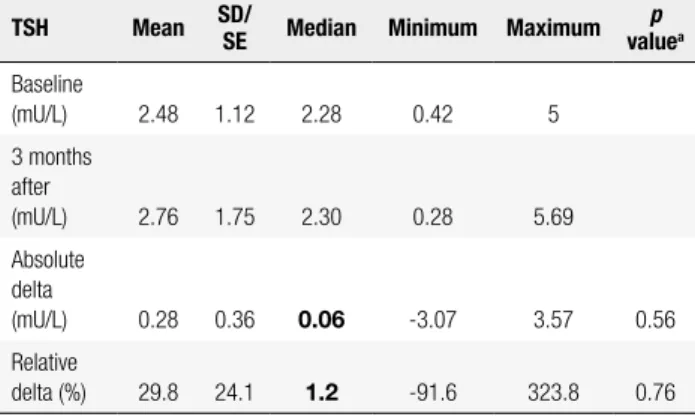
No signiicant variation in TSH levels before drug ad-ministration and three months after omeprazole treat-ment was found when all patients were analyzed (me-dian levels: 2.28 vs. 2.30 mU/L, respectively; p = 0.56) (Table 1 and Figure 1).
Table 1. Analysis of TSH levels at baseline and 3 months after omeprazole in the entire patient sample (19 patients)
TSH Mean SD/
SE Median Minimum Maximum
p
valuea Baseline
(mU/L) 2.48 1.12 2.28 0.42 5
3 months after
(mU/L) 2.76 1.75 2.30 0.28 5.69
Absolute delta
(mU/L) 0.28 0.36 0.06 -3.07 3.57 0.56
Relative
delta (%) 29.8 24.1 1.2 -91.6 323.8 0.76
SD: standard deviation; SE: standard error: only for the deltas.
a Wilcoxon-lagged posts test.
6
5
4
3
TSH (mU/L)
2
1
0
Baseline 3 months after
Figure 1. TSH levels before and 3 months after omeprazole treatment in the whole sample. Each box plot shows the median (horizontal line within the box) and the interquartile range (the horizontal lines at either end of the box). The ends of whiskers represent the minimum and maximum TSH levels.
Patient group given omeprazole 20 mg per day
Cop
yright
© ABE&M t
odos os dir
eit
os r
eser
vados
.
months of treatment. TSH levels after that period was below the lower limit of the normal range in only one patient. In this patient, the L-T4 dose was decreased by 16% and proton-pump-inhibitor therapy was extended for two additional months. The TSH levels after this period returned to normal.
Comparison between the two groups
Basal TSH levels between the two groups did not rea ch a statistically signiicant difference (median levels: 2.24
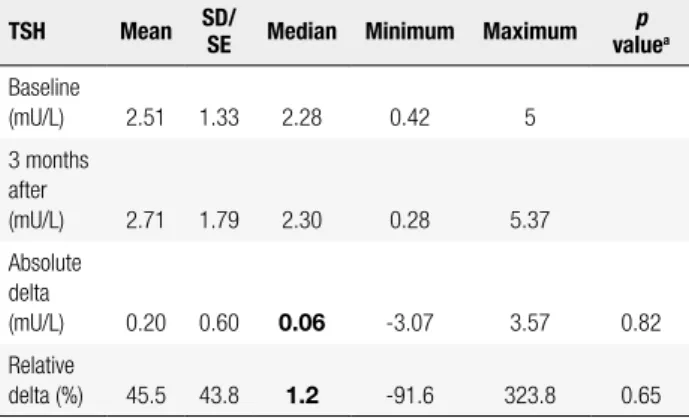
vs. 2.28 mU/L, respectively; p = 0.93), and the levels in both groups evolved in a similar way with no sig-niicant difference in the absolute delta (p = 0.93) or relative delta (p = 0.87) of TSH levels between the two groups (Tables 2 and 3 and Figure 2).
DISCUSSION
In this pilot study, we found that in patients with hy-pothyroidism under control, omeprazole did not affect treatment with L-T4, regardless of the dosage used. The study aimed to evaluate whether omeprazole usa-ge interfered with L-T4 action in patients with hypo-thyroidism, and if so, verify whether this interaction was dose dependent. This is the irst clinical study to evaluate the interaction between omeprazole and L-T4 in patients with hypothyroidism.
To date, two other clinical studies have explored this interaction, and the results of those studies seem to have conirmed the interaction between proton-pump inhibitors and L-T4. Nevertheless, the previous stu dies differed from our study in certain aspects that may ex-plain the apparent disparity.
Table 2. Analysis of TSH levels at baseline and 3 months after omeprazole in the 20 mg group
TSH Mean SD/
SE Median Minimum Maximum
p
valuea Baseline
(mU/L)
2.45 0.98 2.24 1.11 3.89
3 months after
2.80 1.80 2.42 0.67 5.69
Absolute delta (mUI/L)
0.35 0.46 -0.15 -1.27 2.92 0.62
Relative delta (%)
15.7 25.0 -14.3 -53.7 204.2 0.92
SD: standard deviation; SE: standard error: only for the deltas.
a Wilcoxon-lagged posts test.
Table 3. Analysis of TSH levels at baseline and 3 months after omeprazole in the 40 mg group
TSH Mean SD/
SE Median Minimum Maximum
p
valuea Baseline
(mU/L) 2.51 1.33 2.28 0.42 5
3 months after
(mU/L) 2.71 1.79 2.30 0.28 5.37
Absolute delta
(mU/L) 0.20 0.60 0.06 -3.07 3.57 0.82
Relative
delta (%) 45.5 43.8 1.2 -91.6 323.8 0.65
SD: standard deviation; SE: standard error: only for the deltas.
a Wilcoxon-lagged posts test.
By the end of the three-month follow-up, TSH le-vels remained within the normal range in 9 of the 10 patients using omeprazole 20 mg per day. The TSH levels were above the upper limit (5.69 mU/L) of the normal range in only one patient. In this patient, the L-T4 dose was increased by 17% and omeprazole ther-apy was extended for two additional months. The TSH levels after this period returned to normal.
Patient group given omeprazole 40 mg per day
In the 40 mg group, no signiicant variation in the TSH levels before and after three months of treatment was observed (median levels: 2.28 vs. 2.30 mU/L, res-pectively; p = 0.82) (Table 3).
From the 9 patients using omeprazole 40 mg per day, 8 had TSH levels within the normal range after 3
Figure 2. TSH levels before and 3 months after omeprazole treatment in each subgroup (20 mg and 40 mg). Each box plot shows the median (horizontal lines within the box) and the interquartile range (the horizontal lines at either end of the box). The ends of the whiskers represent the minimum and maximum TSH levels.
6
5
4
3
TSH (mUI/L)
2
1
0
Omeprazole 20 mg Omeprazole 40 mg
Cop
yright
© ABE&M t
odos os dir
eit
os r
eser
vados
.
Centanni and cols. studied a prospective cohort of pa-tients with atoxic multinodular goiter in which the L-T4 dosage (Eutirox®) required for suppression of TSH levels
was evaluated. In that study, 10 women with heartburn were administered omeprazole 40 mg per day and TSH levels before and after six months of omeprazole treat-ment were then compared (3). While the patients in our study had hypothyroidism in reposition therapy, Centan-ni and cols. studied euthyroid women with atoxic multi-nodular goiter in suppressive therapy with the hormone. Another important difference was the duration of time that the hypothyroidism had been under control before omeprazole therapy was initiated. Centanni and cols. did not describe the period of time in which the patients had normal TSH levels before enrollment in the study. In our study, only patients whose TSH levels remained normal with stabilized doses of L-T4 for at least one year were selected. In our patients, the mean time of normal TSH levels was 5.5 ± 2.7 years for patients in the 20 mg group and 3.1 ± 1.7 years for patients in the 40 mg group. It is reasonable to believe that individuals experiencing hy-pothyroidism that is under control for a short amount of time are more susceptible to the development of TSH oscillations for reasons not related to proton-pump-in-hibitor usage. In addition, these patients are more likely to be using inadequate doses of the hormone.
A clinical analysis based on a review of medical re-cords found that the use of lansoprazole, which is an-other proton-pump-inhibitor, was associated with a slight increase in TSH levels in hypothyroid patients (5). However, the limitation of this study is that it was based on a retrospective analysis. Another possible ex-planation for the different result could be the use of a different proton-pump inhibitor. Although diffe rent medications of this class have the same effect on gastric pH, pharmacokinetic differences among them could lead to various drug interaction proiles. On the other hand, two pharmacokinetics studies evaluating the L-T4 absorption proile before and after the usage of different proton-pump-inhibitors (esomeprazole and pantoprazole) found no difference in the hormone ki-netics, which is in agreement with our study (6,7).
Moreover, the hypothesis that pH interferes with L-T4 absorption has been speculated but not yet con-irmed. It is known that aluminum hydroxide lowers L-T4 absorption, but in vitro studies have shown that it has a considerable capacity for adsorption of the hor-mone (2), which might be the mechanism involved in this interaction instead of its antiacid effect. More
recent studies suggesting that patients with conditions associated with lower gastric acidity, such as atrophic gastritis (4) or Helicobacter pylori infection (3), need higher doses of L-T4 replacement reinforce the hy-pothesis that pH interferes with hormone absorption, but only in an indirect way. The interference of pH in the dissolution of L-T4 was objectively evaluated by Pabla and cols. in in vitro studies (8). In that study, which evaluated the brands Synthroid®, Tirosint® and
generic levothyroxine, it was demonstrated that the higher the pH, the lower the L-T4 dissolution mean rate. However, the brand Tirosint®, a soft capsule, was
minimally affected by pH, while Synthroid® exhibited
the higher dependency on pH. The effect of pH on the three L-T4 products studied was different, even
be-tween Syntroid® and generic levothyroxine, which are
both tablets. It is known that drug dissolution inter-feres directly with absorption and bioavailability. The fact that different L-T4 brand names are inluenced by pH at different levels is a possible explanation for the disparities observed in the results of various stu-dies evaluating the interaction of proton-pump-inhibi-tors and L-T4. In our study, all patients used the same
brand name of L-T4 (Puran T4®).
It is possible that a slight interference caused by omeprazole in the action of L-T4 would be detected if the sample size had been larger. On the other hand, if this interference exists, it is not clinically signiicant for the group of patients with hypothyroidism in replace-ment therapy using adequate doses of L-T4.
Therefore, based on our indings, we believe that if a patient with hypothyroidism that has remained under control for the past year needs to start treatment with omeprazole, then there is no need to modify the repo-sition dose of L-T4. Even if this patient faces increases in TSH levels, it is important to rule out other causes before attributing it to the proton-pump-inhibitor.
Cop
yright
© ABE&M t
odos os dir
eit
os r
eser
vados
.
Finally, more studies are needed for a better under-standing of the gastric pH inluence on L-T4 absorp-tion and to explore the interacabsorp-tion of proton-pump-inhibitors and the hormone.
Disclosure: no potential conlict of interest relevant to this article was reported.
REFERENCES
1. Brenta G, Vaisman M, Sgarbi JA, Bergoglio LM, Andrada NC, Bra-vo PP, et al. Clinical practice guidelines for the management of hypothyroidism. Arq Bras Endocrinol Metab. 2013;57(4):265-91. 2. Liel Y, Sperber AD, Shany S. Nonspeciic intestinal
adsorp-tion of levothyroxine by aluminum hydroxide. Am J Med. 1994;97(4):363-5.
3. Centanni M, Gargano L, Canettieri G, Viceconti N, Franchi A, Delle Fave G, et al. Thyroxine in goiter, Helicobacter pylori infection, and chronic gastritis. N Engl J Med. 2006;354(17):1787-95.
4. Checchi S, Montanaro A, Pasqui L, Ciuoli C, De Palo V, Chiappetta MC, et al. L-thyroxine requirement in patients with autoimmune hypothyroidism and parietal cell antibodies. J Clin Endocrinol Metab. 2008;93(2):465-9.
5. Sachmechi I, Reich DM, Aninyei M, Wibowo F, Gupta G, Kim PJ. Effect of proton pump inhibitors on serum thyroid-stimulating hormone level in euthyroid patients treated with levothyroxine for hypothyroidism. Endocr Pract. 2007;13(4):345-9.
6. Dietrich JW, Gieselbrecht K, Holl RW, Boehm BO. Absorption ki-netics of levothyroxine is not altered by proton-pump inhibitor therapy. Horm Metab Res. 2006;38(1):57-9.
7. Ananthakrishnan S, Braverman LE, Levin RM, Magnani B, Pearce EN. The effect of famotidine, esomeprazole and ezetimibe on le-vothyroxine absorption. Thyroid. 2008;18(5):493-8.
8. Pabla D, Akhlaghi F, Zia H. A comparative pH-dissolution proile study of selected commercial levothyroxine products using in-ductively coupled plasma mass spectrometry. Eur J Pharm Bio-pharm. 2009;72(1):105-10.