Cop
yright
© ABE&M t
odos os dir
eit
os r
eser
vados
.
The prevalence of glucose
metabolism disturbances in Chinese
Muslims and possible risk factors:
a study from northwest China
Prevalência e possíveis fatores de risco de distúrbios no metabolismo da glicose em chineses muçulmanos: um estudo no noroeste da China
Wei Liu1, Lin Hua2, Wan-Fu Liu3, Hui-Ling Song4, Xin-Wen Dai3, Jin-Kui Yang1
ABSTRACT
Objective: To survey the prevalence of diabetes mellitus (DM) and pre-diabetes mellitus (PDM) in the Muslim population in northwest China, and discuss the risk factor. Materials and metho-ds: According to the income and the population, we randomly selected 3 villages with stratiied and cluster sampling. The subjects were residents ≥ 20 years of age, and were from families which have been local for > 3 generations. The questionnaire and oral glucose tolerance test (OGTT) were completed and analyzed for 660 subjects. Results: The prevalence of DM and PDM between the Han and Muslim populations were different (P = 0.041). And the prevalence were also different with respect to age in the Han (P < 0.001) and Muslim population (P < 0.001) re-spectively. Except for the 20-year-old age group the prevalence of DM and PDM within the Mus-lim population was higher than the Han (P = 0.013), we did not ind any signiicant diffe rence for other age groups (P > 0.05). The intake of salt (P < 0.001) and edible oil (P < 0.001) in the Muslim population was higher than the Han, while cigarette smoking (P < 0.001) and alcohol consump-tion (P < 0.001) was lower. BMI (P < 0.001), age (P = 0.025), and smoking cigarettes (P = 0.011) were risk factors for DM and PDM, but alcohol consumption (P < 0.001) was a protective factor. Conclusions: In northwest China, the prevalence of DM was higher in the Muslim population, and it was special higher on the 20-year-old age compared to the Han. This might be explained by the potential genetic differences and poor dietary habits. Arq Bras Endocrinol Metab. 2014;58(7):715-23
Keywords
Risk factors; diabetes; Muslim population in China; northwest China
RESUMO
Objetivo: Avaliar a prevalência de diabetes melito (DM) e pré-diabetes melito (PDM) na popula-ção muçulmana no noroes te da China e discutir os fatores de risco. Materiais e métodos: Selec-ionamos três vilarejos de acordo com a renda e a população, usando uma amostra estratiicada e por cluster. Os sujeitos eram residentes com ≥ 20 anos de idade e de famílias que estavam no local há mais de três gerações. Foram feitos e analisados um questionário e o teste de tolerância oral à glicose (TTOG) para 660 sujeitos. Resultados: A prevalência do DM e PDM entre as popu-lações Han e muçulmana foi diferente (P = 0,041), e as prevalências também foram diferentes com relação à idade na população Han (P < 0,001) e muçulmana (P < 0,001), respectivamente. Exceto pela faixa etária de 20 anos de idade, a prevalência do DM e PDM na população muçul-mana foi maior do que na população Han (P = 0,013), não havendo diferenças signiicativas para as outras faixas etárias (P > 0,05). A ingestão de sal (P < 0,001) e óleos comestíveis (P < 0,001) na população muçulmana foi mais alta do que na população Han, enquanto o tabagismo (P < 0,001) e consumo de álcool (P < 0,001) foram mais baixos. O IMC (P < 0,001), a idade (P = 0,025) e o tabagismo (P = 0,011) foram fatores de risco para o DM e PDM, mas o consumo de álcool (P < 0,001) foi um fator protetor. Conclusões: No noroeste da China, a prevalência de DM é maior na população muçulmana e é especialmente mais alta na faixa etária de 20 anos de idade, quando comparada com a população Han. Isso pode ser explicado por diferenças genéticas potenciais e hábitos alimentares ruins. Arq Bras Endocrinol Metab. 2014;58(7):715-23
Descritores
Fatores de risco; diabetes; população muçulmana na China; noroeste da China
1 Department of Endocrinology,
Beijing Tongren Hospital, Capital Medical University, Beijing, China
2 Biomedical Engineering Institute,
Capital Medical University Beijing, China
3 Department of Medicine,
Ningxia Teachers’ University, Guyuan, China
4 Centers for Disease Control
and Prevention (CDC), Yuanzhou Region, Guyuan, China
Correspondence to:
Wei Liu, Lin Hua
Beijing Tongren Hospital, Capital Medical University,
Beijing 100730, China [email protected] [email protected]
Received on Feb/14/2014 Accepted on July/11/2014
Cop
yright
© ABE&M t
odos os dir
eit
os r
eser
vados
.
INTRODUCTION
D
iabetes mellitus (DM) is one of the most common diseases worldwide and may lead to micro- and macro-vascular complications. Common risk factors for the development of DM include central obesity, fami-ly history, and dyslipidemia (1,2). In many countries the prevalence of DM has shown an upward trend in recent years, which is affected by some known risk fac-tors, such as dyslipidemia, obesity, poor dietary habits, and exercise (1,3-6). However, few studies have focu-sed on the prevalence of DM in different races in the same geographic area. In China, the Han population is the largest majority group. It represents 92% of the inhabitants of China. Currently, the existing many stu-dies have described the social-demographic characteris-tics and the prevalence of DM in China, such as The Da Qing IGT and Diabetes Study (3). A recent study conducted in 2010 reported the age-standardized pre-valence of total DM and pre-diabetes mellitus (PDM) were 9.7% and 15.5% respectively in China (7,8). These indings supported that Han population can represent the indings of the Chinese population in general and can be used as a control group in relation to the indin-gs in Han population. The Han population is thus bet-ter characbet-terized and can be easier for the comparison of the indings in the other ethnicity populations. On the other hand, owing to the special characteristics of dietary habits, the Muslim population in China, one of the largest minority groups, has clear differences in the characteristics from other Chinese groups. Residents in the Ningxia Hui Autonomous Region, a major place of habitation for Chinese Muslims, make up > 40% of the Muslim population in China. Guyuan city, which is lo-cated in the southern mountain area of the Ningxia Hui Autonomous Region, is a small town in the northern route of Silk Road and inhabited by a traditional Mus-lim population (Hui). According to the 2008 demo-graphic statistics, population in Guyuan is 1.53 million, among them Muslim population are 0.65 million which is accounted for 44.1 percent of total population. The Muslim population in Guyuan city, whose ancestors were Muslim merchants of Persia and Arab, are diffe-rent from other local Chinese ancient Muslims, such as residents in Uygur, Kazak, and Kirgiz. Although Musli-ms live together with Han, intermarriage is uncommon due to economic backwardness. Moreover, most resi-dents lived in the same area for more than three gene-rations, and mobile populations are uncommon. Thereare no policies to control the Muslim population, so multiple pregnancies are common, which also leads to distinctive demographic characteristics. In addition to demographic characteristics, diet in the Muslim popu-lation is different from the Han popupopu-lation. The Han population subsists mainly on pork; however, beef and mutton are the main meats consumed by the Muslim population. In the winter, preserved food is the main non-staple food because there are almost no fresh vege-tables, which leads to high salt intake for people.
We have reviewed many papers which have ad-dressed DM in the Muslim population. Most of the studies have focused on glycemic trends during Rama-dan in fasting subjects with DM or the treatment of DM (9,10). Few studies regarding the prevalence of DM and PDM or risk factors in the Muslim population have been reported, especially comparisons with other non-Muslims in the same geographic areas (11,12). Within the same geographic environment, whether or not the distinctive demographic characteristics and special eat-ing habits are the intrinsic factors which result in some diseases, such as DM, is always our main concern. Our previous study showed that glucose metabolic disorders in Guyuan city, which was based on the subjects in the permanent population surrounding the rural area, was higher than other cities in Ningxia, China (13). It is necessary to perform further investigation and research of the population in this region, especially the Muslim population, because there are signiicant difference be-tween Han and Muslim populations, according to our previous study(13).
In the current study we determined the prevalence of DM and PDM in the Muslim population in China and determined the special risk factors in their race.
MATERIALS AND METHODS
Participants
Cop
yright
© ABE&M t
odos os dir
eit
os r
eser
vados
.
countryside from those countrysides around Guyuan city with the same income levels. After performing the stratiied sampling, three countrysides were selected. In the second stage, consider the population size and the economical situation of each subordinate village from the corresponding countryside is similar; we thus adop-ted the cluster sampling to extract one village from the selected each countryside in the irst stage. Finally, a total of 1,963 villagers from three villages were selec-ted. After excluding those samples with greater missing information, 660 participants ≥ 20 y of age (mean age = 45.79 ± 14.65 y; 288 males and 372 females) and residence in the village for ≥ 20 years of Guyuan, Nin-gxia were included in the study. The sample population was limited to families that had been local for greater than three generations. The current research planned to collect 800 responses. Participation in the survey was voluntary. If subjects declined to participate, the inves-tigators attempted to survey the neighbor. This process continued until the targeted number of surveys was re-ached. All of the participants signed informed consent. The study was approved by the Ethics Committee of Ningxia Teachers’ University.
Methods
The level of fasting blood glucose (FBG; fasting for at least 8 h), and 2-h postprandial blood glucose (PBG2h; after a normal meal) were measured for all of the rese-arch subjects using Roche’s superior blood glucose me-ter, which has an error < ± 15% compared with venous blood. With a fasting blood glucose cut-off of < 5.6 mmol/L, the diagnosis of IFG can signiicantly impro-ve the sensitivity of fasting glucose in predicting DM (5,6); thus, we chose a fasting plasma glucose level ≥ 5.6 mmol/L as the oral glucose tolerance test (OGTT) screening cut-off level. In participants who had a FBG ≥ 5.60 mmol/L (105 mg/dL) and a PBG2h ≥ 7.8 mmol/L (140 mg/dL), an extra 75 g oral glucose to-lerance test was performed (OGTT; Beckman-Unicel Dxc800 biochemistry analyzer; Beckman Ltd., Suzhou, Jiangsu, China) (16). The diagnosis was based on the results of the 75 g OGTT and World Health Organiza-tion criteria. Among all of the research subjects, those with a normal FBG (normal range, 4.4-6.1 mmol/L) and a PBG2h (normal range, 4.4-7.8 mmol/L) were diagnosed as normal glucose tolerance (NGT), and others who had a normal FBG and elevated PBG2h (> 7.8 and < 11.1 mmol/L) were diagnosed with im-paired glucose tolerance (IGT). The research subjects
with a normal PBG2h and an elevated FBG (> 6.1 and < 7.0 mmol/L) were diagnosed with impaired fasting glucose (IFG). The research subjects with an eleva-ted FBG (> 7.0 mmol/L) and an elevaeleva-ted PBG2h (> 11.1 mmol/L) were diagnosed with DM. The research subjects with a FBG > 7.0 mmol/L and a PBG2h < 11.1 mmol/L or a FBG < 7.0 mmol/L and a PBG2h > 11.1 mmol/L, the OGTT was measured repeatedly.
Questionnaires for the DM epidemiologic study were based on the Chinese Academy of Preventive Medicine, and consisted of ethnic, health status, medi-cal history, family history, physimedi-cal work, income, ciga-rette smoking and alcohol consumption habits, intake of oil and salt, and status of the subject’s awareness. During the survey, 836 questionnaires were used. Of the 836 questionnaires, 50 had missing information (e.g., oil and salt intake was not captured as well as in-formation on pregnancy and childbirth) and 126 only completed the questionnaire and did not have the in-tact blood glucose indicator because no OGTT was performed after the rapid inger-blood glucose proce-dure. The remaining 660 subjects who had matched completed questionnaire and intact blood glucose re-sults were included in the statistical analysis.
The Muslim and Han populations are differentiated by inheritance and identity. In this observation, the Muslim or Han population was identiied when they were in an ethnic group for greater than three genera-tions. In this area, because of tradition, inter-ethnic marriages do not occur. The few intermarriage couples migrated to other regions. The question regarding intermarriage was asked when the questionnaire was developed. People with an intermarriage history were excluded. The researchers searched three generations of the subjects to verify their ethnicity as Muslim (be-lieving in the religion) or Han (who can have or not).
Cop
yright
© ABE&M t
odos os dir
eit
os r
eser
vados
.
Based on the records, we determined whether or not the salt intake was excessive in the Muslim population.
The body mass index (BMI), waist and hip circum-ference, and blood pressure were measured and recor-ded. The researcher inquired about a history of hyper-tension and medication use and noted “hyperhyper-tension”, when indicated. Those who did not have a history of hy-pertension were examined in the seated position after 3 minutes for blood pressure measurement (both left and right. Researchers picked the arm with the highest blood pressure reading, and obtained 3 blood pressure readings every 2 minutes. The average of the three measurements was used to conirm a diagnosis of hypertension. If the systolic pressure was > 140 mmHg or the diastolic pres-sure was > 90 mmHg, the villager would be suspected to have hypertension and would re-visit to measure the blood pressure. If the result was the same, the diagnosis of hypertension was conirmed. If the result was diffe-rent, the blood pressure was measured for a third time and the diagnosis was based on the third result.
Gravidas were excluded from this study because preg-nancy, parturition times, and macrosomia were recorded in the medical history, and capillary glucose measure-ments and OGTT tests were performed. Macrosomia is deined as a fetus with a birth weight ≥ 8 kilograms.
This research was conducted by teachers and stu-dents in the Department of Medicine at Ningxia Teach-ers’ University and the staff in the Centers for Disease Control and Prevention of Yuanzhou District in Guyu-an City. They received proper training before the pro-ject began. The training included a physical examina-tion (height, weight, and waist circumference), blood pressure and glucose measurement, pre-survey prepara-tion before the procedures, the content and structure of the questionnaire, and surveys prompting and com-pletion of skills. Quality control was performed during the entire survey, and included the study design, survey staff training, ield survey, data collection, data entry,
summarization, statistics, and analysis. The quality con-trol in the ield survey was especially important and the supervisor in each team randomly examined 2% of the questionnaires and blood pressure as well as glucose by a second visit. This limited potential errors.
Statistical analysis
Data were analyzed using SPSS (version 17.0 for Win-dows; SPSS Inc., Chicago, IL, USA). The quantitative characteristics of the Han and Muslim population in China were expressed as the mean ± standard deviation, and were compared using a two-sample t-test. Chi--square tests were used to compare the categorical data and to determine the difference in prevalence in two race groups and in different age groups. Also, we used binary-logistic regression to detect potential risk factors of all the clinical characteristics on different OGTT re-sults. P values < 0.05 were considered signiicant.
RESULTS
Race-speciic characteristics of the Han and Muslim population in China
The two-sample t-tests and chi-square tests were used to compare the quantitative and categorical characte-ristics of the Han and Muslim populations in China. No signiicant difference was detected with respect to gender, age, BMI, WHR, SBP, and history of coronary heart disease between the Han and Muslim population (P > 0.05); however, there was a signiicant difference with respect to the DBP and history of hypertension between the two races. In summary, except the preva-lence of “history of hypertension” is higher (P = 0.007) and the DBP is lower (P = 0.037) in Han population, there were no signiicant difference between two races for other clinical characteristics (P > 0.05; Table 1).
Table 1. Characteristics of the Han people and Muslim population in China
Clinical characteristics
Number of patients
Gender (F/M)
Age (years)
BMI
(kg/m2)
Waist-to-hip ratio (WHR)
SBP (mmHg)
DBP (mmHg)
History of hypertension
(Y/N)
History of coronary heart disease (Y/N)
Han people 195 108/87 58.34 ± 14.16 23.62 ± 2.93 0.88 ± 0.06 160.00 ± 20.12 82.08 ± 8.88 21/42 12/51
Muslim population in China
465 264/201 61.00 ± 13.7 23.70 ± 3.23 0.87 ± 0.05 168.67 ± 9.90 94.00 ± 3.46 19/100 17/102
P-Value - 0.368 0.110 0.867 0.612 0.251 0.037* 0.007* 0.404
Cop
yright
© ABE&M t
odos os dir
eit
os r
eser
vados
.
P = 0.064
P = 0.166
P = 0.077
Frequency of pregnancy
Cases of histor
y of fatal macrosomia
Frequency of partuaition
Han people 8
6
4
2
0
80
60
No
Yes
40
20
0 6
4
2
0 Muslim population
in China
Han people Muslim population in China Han people Muslim population
in China
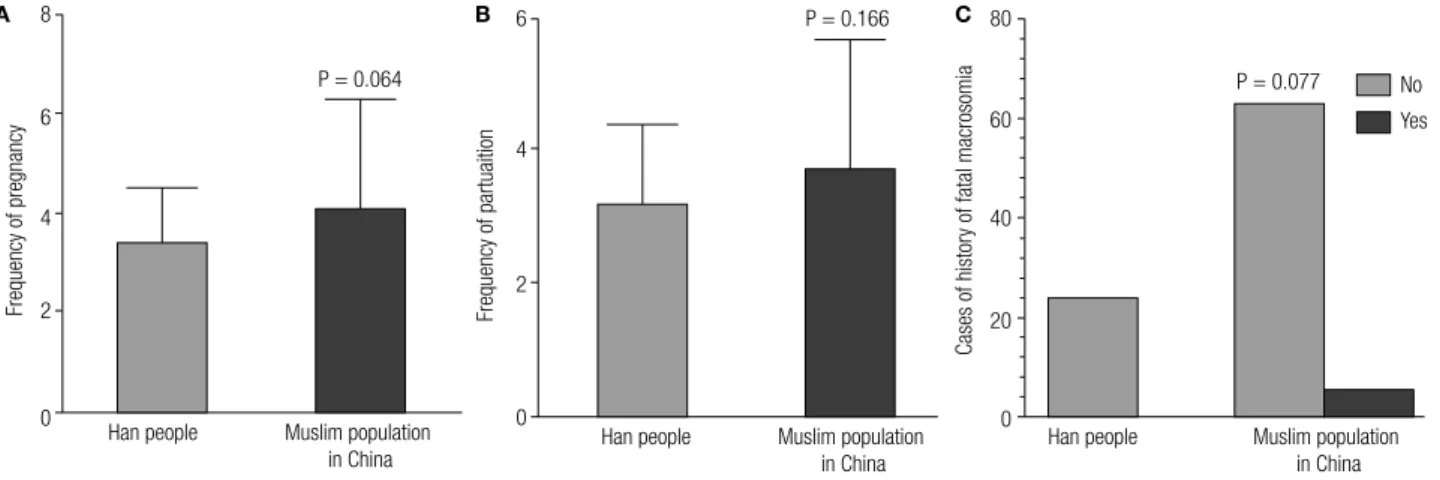
Based on the data elicited in the questionnaires, the intake of oil and salt, cigarette smoking, and drinking alcohol in the Muslim population were sig-niicantly different from the Han people (P < 0.001; Figure 1). No signiicant differences in the frequency of pregnancy (3.72 ± 1.71; P > 0.05) and frequency of parturition (3.34 ± 1.57; P > 0.05) existed
be-tween the Han and Muslim population. In addition, no signiicant difference in fetal macrosomia existed between the Han and Muslim population in China (P > 0.05; Figure 2), and the level of awareness of DM, PDM, and NGT was not signiicantly different between the Han and Muslim population using LR χ2
test (P = 0.152; Figure 3).
20
P < 0.001
P < 0.001
No smoking
Smoking
P < 0.001
Intake of oil (kg) Intake of salt (kg)
15
10
Han people Muslim population in China
Muslim population in China Han people
5
0
10
8
6
4
2
0
0 150
100
50
Han people Muslim population in China
Smoking cases
Alcohol drinking cases
P < 0.001
No alcohol drinking
Alcohol drinking
0 150
100
50
Han people Muslim population in China
Figure 1. Comparison of the differences in intake of oil (A) and salt (B), cigarette smoking (C), and alcohol consumption (D) between the Han and Muslim population in China.
A
C
B
D
A B C
Cop
yright
© ABE&M t
odos os dir
eit
os r
eser
vados
.
Race-speciic prevalence of DM and PDM among rustics
An age-adjusted Cochran–Mantel–Haenszel (CMH) test was used to analyze the differences in prevalence between the two race groups. Consider the most im-portant demographic change to DM prevalence across the world appears to be the increase in the proportion of people ≥ 65 years of age, we therefore performed the age stratiication (< 65y and ≥ 65y). The results showed that there was a signiicant difference in the prevalence of DM and PDM between the Han and Muslim po-pulations in China after adjusting the age (P = 0.041).
In the Muslim population, the prevalence of DM (5.8%), IGT (10.3%) were higher than the Han people, IFG (4.3%), and IFG + IGT (5.2%) were lower than the Han people (Table 2).
Prevalence of DM and PDM in the Muslim population in China and the risk factors
The prevalence of DM and PDM was signiicantly di-fferent among didi-fferent age groups in the Muslim po-pulation in China using the Pearson χ2 test (P < 0.001).
The IGT increased in those < 50-59 years of age and decreased in those > 50-59 years of age. DM increased in those < 49 years of and decreased in those > 40-49 years of age. The IFG + IGT had different upward trends in those 30-39 to 40-49 years and 50-59 to 60-69 years of age. Decreasing trends were found in those aged 20-29 to 30-39 years, 40-49 to 50-59 years, and 60-69 to > 70 years of age. The IFG increased in those 30-39 to 40-49 years and 50-59 to > 70 years of age. Decreasing trends existed in those 20-29 to 30-39 ye-ars and 40-49 to 50-59 yeye-ars of age. The prevalence of DM and PDM in the 20-year-old age group within the Muslim population was higher than the Han (P = 0.013), we did not ind any signiicant difference be-tween the Han and Muslim population for other age groups (P > 0.05; Figure 4 and Table 3).
Table 2. Prevalence of diabetes and pre-diabetes in the Han people and Muslim population in China
Race Prevalence of diabetes and pre-diabetes Age-adjustedCMH-χ2 Δ P
IFG (95%CI) IGT (95%CI) DM (95%CI) IFG + IGT (95%CI)
Han people 0.108
(0.064-0.152)
0.077 (0.040-0.114)
0.031 (0.007-0.055)
0.108 (0.064-0.152)
4.176 0.041* Muslim population in China 0.043
(0.025-0.061)
0.103 (0.075-0.131)
0.058 (0.037-0.079)
0.052 (0.032-0.072)
Δ An age-adjusted Cochran–Mantel–Haenszel (CMH) test was performed. Age was stratiied into two groups, < 65 years and ≥ 65 years. * P values < 0.05 were considered to be signiicant. Characters in brackets are the 95% CI of the prevalence of diabetes and pre-diabetes.
P = 0.054
P = 0.152
A
wareness cases
A
wareness cases
400
300
Unknown
Known 200
100
0
500
400
300
200
100
0
Unknown
Known
Han people
Diabetes and pre-diabetes
NGT Muslim population
in China
Figure 3. Awareness of diabetes and pre-diabetes, NGT (under) in the Han people and Muslim population in China (above).
Figure 4. Prevalence of diabetes and pre-diabetes in the Muslim population in northwest China.
IFG+IGT DM IGT IFG 15
Case
Prevalence of diabetes
and pre-diabetes in Muslims
10
5
0
Cop
yright
© ABE&M t
odos os dir
eit
os r
eser
vados
.
We used binary-logistic regression to detect the tra-ditional risk factors for DM and PDM, and the results showed that BMI, age, cigarette smoking, and alcohol consumption were related to the prevalence of DM and PDM. The risk of DM and PDM increased the preva-lence 2.196-fold (P < 0.001) and 1.186-fold (P = 0.025) when BMI and age increased, respectively. Cigarette smoking increased the risk of DM and PDM 3.41-fold over no-smoking (P = 0.011), while alcohol consump-tion was a protective factor (P < 0.001) (Table 4).
chuan (5.0% in a 2009 survey), in which the resident population was dominated by Han. The prevalence of IGT was higher than the Lingwu area (IGT standar-dized prevalence rate = 7.32%); the prevalence of IFG was close to Yinchuan (IFG prevalence rate = 4.0%), while there was a signiicant difference in the preva-lence of IFG, IGT, DM, and IFG + IGT between the Han and Muslim population (P = 0.002)(13). These results suggest that in Guyuan City (based on surroun-ding rural residents), the Muslim population has a high prevalence of glucose metabolism disturbance, thus it is necessary to perform further research in the Muslim population in the region.
We have shown that the prevalence of DM and IGT in the stratiied sampling of rural residents around Guyuan city were higher in the Muslim population than the Han population and also higher than the gen-eral prevalence in the area, and the prevalence of IFG and IFG + IGT was lower than the Han population and the general prevalence in the area (P = 0.002) (13,17). Based on an analysis of the questionnaires for the DM epidemiologic study, we showed that characteristics, such as gender (F/M), age, BMI, and WHR, were similar in the different race groups, which indicated that there was no signiicant difference in demographic characteristics, although the Han and Muslim popula-tion belonged to different races with different living habits. Thus, the differences in demographic character-istics were not the reason for the differences in preva-lence in DM and PDM. Ethnic and genetic differences may be an important reason for the high prevalence of DM and PDM.
Previous studies have shown that overweight and obese residents are uncommon in rural population in Table 4. Risk factors for diabetes and pre-diabetes in the Muslim
population in China
Variables Regression
coeficient χ
2 P OR 95%CI
Based on BMI 0.786 12.737 < 0.001* 2.196 (1.426, 3.382)
Based on ages 0.170 5.001 0.025* 1.186 (1.021, 1.377)
Smoking 1.224 6.421 0.011* 3.401 (1.320, 8.768)
Alcohol drinking -2.471 13.701 < 0.001* 0.084 (0.022, 0.323)
* P values < 0.05 were considered to be signiicant.
Table 3. Prevalence of normal, diabetes and pre-diabetes in three villages in northwest China n (%)
Diagnosis
Han Muslim population in China
Age (year) Age (year)
20- 30- 40- 50- ≥ 60 20- 30- 40- 50- ≥ 60
Normal 15 (100.0%) 27 (81.8%) 15 (62.5%) 42 (70.0%) 33 (52.4%) 71 (79.8%) 74 (83.1%) 79 (66.9%) 72 (79.1%) 50 (64.1%)
IFG 0 6 (18.2%) 0 3 (5.0%) 12 (19.0%) 6 (6.7%) 0 9 (7.6%) 0 5 (6.4%)
IGT 0 0 3 (12.5%) 6 (10.0%) 6 (9.5%) 4 (4.5%) 8 (9.0%) 12 (10.2%) 14 (15.4%) 10 (12.8%)
DM 0 0 0 0 6 (9.5%) 4 (4.5%) 5 (5.6%) 8 (6.8%) 5 (5.5%) 5 (6.4%)
IFG + IGT 0 0 6 (25.0%) 9 (15.0%) 6 (9.5%) 4 (4.5%) 2 (2.2%) 10 (8.5%) 0 8 (10.3%)
Total 15 33 24 60 63 89 89 118 91 78
χ2 P
57.583 < 0.001*
46.551 < 0.001*
* P values < 0.05 were considered to be signiicant.
DISCUSSION
Yin-Cop
yright
© ABE&M t
odos os dir
eit
os r
eser
vados
.
China. Risk factors for DM are mainly central obesity, family history, and dyslipidemia, rather than an elevated BMI. In our previous study we found that overweight subjects (28 > BMI ≥ 24 kg/m2) accounted for 27.7%
of the population, which was greater than the average prevalence of overweight subjects in rural areas (25.85% according to the Zhengzhou University School of Public Health [2007], China)(13). The BMI and WHR were not statistically different between the Muslim and Han populations in the region. BMI was a risk factor for glu-cose metabolism disturbance in the Muslim population; for each 1 kg/m2 increase in BMI, the prevalence risk
increased 2.196-fold and WHR is not a major factor. Thus, with improved living standards and reducing the urban-rural divide, the Muslim rural population of over-weight and obese subjects increased and glucose me-tabolism disturbance and DM risk factors have changed. Based on the analysis of the questionnaire survey for the DM epidemiologic study, we found that there were ethnic differences in blood pressure, oil and salt consumption, cigarette smoking, and drinking alcohol appetites. Oil and salt intake in the Muslim population of the survey was signiicantly higher than the Han, but the prevalence rate of hypertension was signiicantly lower than the Han; cigarette smoking and drinking alcohol in the Muslim population were signiicantly less than the Han. The amount of cigarette smoking as a risk factor and alcohol consumption as a protective factor for glucose metabolism disturbance were statis-tically signiicant in the Muslim population. All these characteristics, and whether or not the characteristics are related with genes in the Muslim population, are worth further study in the future(18,19).
We also found that most females in the area had many pregnancies and deliveries, but there were no sig-niicant differences in the Han and Muslim population. A history of fetal macrosomia is often considered a risk factor for DM, which was similar in the different race groups. When we estimated the risk for DM and PDM in the Muslim population, the frequency of pregnancy and parturition, and a history of fetal macrosomia were not risk or protective factors. Thus, the differences in the frequency of pregnancy, parturition, and fetal mac-rosomia were not affected the prevalence of DM and PDM in the Muslim population.
In epidemiologic studies, awareness is an important indicator of the disease detection rate and severity of dis-ease-related complications. In this study we found that awareness (only 25.34%) in the Muslim population was
slightly higher than the Han nationality, and NGT was slightly higher than glucose metabolism disturbance, but the difference was not signiicant. Due to remoteness, ethnic minorities, rural areas, and economic backward-ness in the region, the level of education was generally low and the relative isolation with the outside world, and the overall awareness of the disease was actually low. DM-related literacy work in this area is still important.
The study also found that there were signiicant dif-ferences in the prevalence of DM and PDM in the age distribution of Muslim and Han population. The pre-valence of DM and PDM in the 20-year-old age group in the Muslim population were higher than the Han. Whether or not the genetic and dietary habits of the Muslim population and this characteristic were relevant is worthy of further study.
Due to limited conditions we were unable to ob-serve more subjects in the study. The standard OGTT test was not carried out on the normal inger blood glucose (fasting and postprandial 2 hours). The dif-ferences in genetics between Muslim and Han popula-tions were not studied in depth. For these unresolved issues, we will continue to conduct in-depth research in the future.
Additional information: Liu W wrote the manuscript, contribu-ted to the discussion, researched data, and reviewed/edicontribu-ted the manuscript. Hua L researched data, and contributed to the dis-cussion. Liu WF, Song HL, and Dai XW researched data and contributed to the discussion. Yang JK reviewed the manuscript.
Ackonwledgements: Dr. Liu W (Department of Endocrino-logy, Beijing Tongren Hospital, Capital Medical University), Dr. Hua L (Biomedical Engineering Institute, Capital Medical University), and Dr. Liu WF (Department of Medicine, Ningxia Teachers’ University), are the guarantors of this work, had full access to all of the data, and take full responsibility for the inte-grity of the data and the accuracy of the data analysis. This work was partially supported by the Beijing Natural Science Founda-tion (Grant Nos. 7142015) and the Science Technology Deve-lopment Project of Beijing Municipal Commission of Education (SQKM201210025008) and the Science and Technology Rese-arch Project of Ningxia Higher School ([2010] 297). We give special thanks to Liu WF and to his memory with this paper.
Disclosure: no potential conlict of interest relevant to this article was reported.
REFERENCES
Cop
yright
© ABE&M t
odos os dir
eit
os r
eser
vados
.
2. Yang ZJ, Liu J, Ge JP, Chen L, Zhao ZG, Yang WY; China Natio-nal Diabetes and Metabolic Disorders Study Group. Prevalence of cardiovascular disease risk factor in the Chinese population: the 2007-2008 China National Diabetes and Metabolic Disorders Study. Eur Heart J. 2012;33(2):213-20.
3. Pan XR, Li GW, Hu YH, Wang JX, Yang WY, An ZX, et al. Effects of diet and exercise in preventing NIDDM in people with impaired glucose tolerance. The Da Qing IGT and Diabetes Study. Diabetes Care. 1997;20(4):537-44.
4. Yang ZJ, Yang WY, Li GW; National Diabetes Prevention and Con-trol Cooperative Group. The distributive characteristics of impai-red glucose metabolism subcategories in Chinese adult popula-tion. Zhonghua Yi Xue Za Zhi. 2003;83(24):2128-31.
5. King H, Albert RE, Henman WH. Global burden of diabetes, 1995-2025: prevalence, numerical estimates, and projections. Diabetes Care. 1998;21(9):1414-31.
6. Hu YH, Li GW, Pan XR. [Incidence of NIDDM in Daqing and fore-casting of NIDDM in China in 21st century]. Zhonghua Nei Ke Za Zhi. 1993;32(3):173-5.
7. Yang W, Lu J, Weng J, Jia W, Ji L, Xiao J, et al. Prevalence of diabetes among men and women in China. N Engl J Med. 2010;362(12):1090-101.
8. Yang ZJ, Yang WY, Xiao JZ, Li GW, Wang Y. [Impact of lowering the cut-point for impaired fasting glucose on the distribution of impaired glucose regulation subcategories in Chinese adult po-pulation]. Zhonghua Yi Xue Za Zhi. 2004;84(21):1773-6.
9. Ahmadani MY, Riaz M, Fawwad A, Hydrie MZ, Hakeem R, Basit A. Glycaemic trend during Ramadan in fasting diabetic subjects: a study from Pakistan. Pak J Biol Sci. 2008;11(16):2044-7.
10. Fernández Miró M, Goday A, Cano JF. [Treatment of diabetes mellitus during Ramadan]. Med Clin (Barc). 2007;129(8):303-8. 11. Dowse GK, Gareeboo H, Zimmet PZ, Alberti KG, Tuomilehto J,
Fa-reed D, et al. High prevalence of NIDDM and impaired glucose to-lerance in Indian, Creole, and Chinese Mauritians. Mauritius Non-communicable Disease Study Group. Diabetes. 1990;39(3):390-6. 12. King H, Rewers M. Global estimates for prevalence of diabetes mellitus and impaired glucose tolerance in adults. WHO Ad Hoc Diabetes Reporting Group. Diabetes Care. 1993;16(1):157-77. 13. Liu WF, Yin XL, Wang DK, Dai XW, Song HL, Liu W, et al. Screening
analysis of type 2 diabetes in Ningxia Guyuan city. Clinical Focus. 2011;26(10):870-2.
14. Fu C, Chen Y, Wang F, Wang X, Song J, Jiang Q. High prevalence of hyperglycemia and the impact of high household income in transforming rural China. BMC Public Health. 2011;11:862. 15. Chang JX, Sun L. The national salary difference in the rural
la-bors: a research from Guyuan, Ningxia Hui autonomous region [J]. Management World (Monthly). 2008(3):81-5.
16. Yang WY, Xing XY, Yang CJ, et al. Exploring the diagnostic level of fasting plasma glucose in Chinese diabetic population [J]. Chin J Endocrinol Metab. 1988;14(1):3-7.
17. Yang ZG, Liu L, Liu XY, Ma ZM, Li ZZ. The analysis of diabetic pre-valence and the possible risk factors in the residents of communi-ty in Yinchuan cicommuni-ty [J]. Ningxia Medical Journal. 2009;31(5):38-42. 18. Cullmann M, Hilding A, Östenson CG. Alcohol consumption and
risk of pre-diabetes and type 2 diabetes development in a Swe-dish population. Diabet Med. 2012;29(4):441-52.