TCD
9, 3055–3074, 2015Photopolarimetric retrievals of snow
properties
M. Ottaviani et al.
Title Page
Abstract Introduction
Conclusions References
Tables Figures
◭ ◮
◭ ◮
Back Close
Full Screen / Esc
Printer-friendly Version Interactive Discussion
Discussion
P
a
per
|
Discussion
P
a
per
|
Discussion
P
a
per
|
Discussion
P
a
per
|
The Cryosphere Discuss., 9, 3055–3074, 2015 www.the-cryosphere-discuss.net/9/3055/2015/ doi:10.5194/tcd-9-3055-2015
© Author(s) 2015. CC Attribution 3.0 License.
This discussion paper is/has been under review for the journal The Cryosphere (TC). Please refer to the corresponding final paper in TC if available.
Photopolarimetric retrievals of snow
properties
M. Ottaviani1, B. van Diedenhoven1,2, and B. Cairns1
1
NASA Goddard Institute for Space Studies, 2880 Broadway, New York, NY, USA
2
Center for Climate System Research, Columbia University, New York, NY, USA
Received: 28 March 2015 – Accepted: 6 May 2015 – Published: 29 May 2015
Correspondence to: M. Ottaviani ([email protected])
TCD
9, 3055–3074, 2015Photopolarimetric retrievals of snow
properties
M. Ottaviani et al.
Title Page
Abstract Introduction
Conclusions References
Tables Figures
◭ ◮
◭ ◮
Back Close
Full Screen / Esc
Printer-friendly Version Interactive Discussion
Discussion
P
a
per
|
Discussion
P
a
per
|
Discussion
P
a
per
|
Discussion
P
a
per
|
Abstract
Polarimetric observations of snow surfaces, obtained in the 410–2264 nm range with the Research Scanning Polarimeter onboard the NASA ER-2 high-altitude aircraft, are analyzed and presented. These novel measurements are of interest to the remote sensing community because the overwhelming brightness of snow plagues aerosol
5
and cloud retrievals based on air- and space-borne total reflection measurements. The spectral signatures of the polarized reflectance of snow are therefore worthwhile in-vestigating in order to provide guidance for the adaptation of algorithms currently em-ployed for the retrieval of aerosol properties over soil and vegetated surfaces. At the same time, the increased information content of polarimetric measurements allows for
10
a meaningful characterization of the snow medium. In our case, the grains are mod-eled as hexagonal prisms of variable aspect ratios and microscale roughness, yielding retrievals of the grains’ scattering asymmetry parameter, shape and size. The results agree with our previous findings based on a more limited dataset, with the majority of retrievals leading to moderately rough crystals of extreme aspect ratios, for each scene
15
corresponding to a single value of the asymmetry parameter.
1 Introduction
The development of accurate techniques for the retrieval of climatologically relevant pa-rameters in snow-covered regions is of obvious importance for the success of climate models predictions (Comiso, 2006; Zwally and Giovinetto, 2011; Zatko et al., 2013). For
20
instance, the retrieval of grain size and surface temperature leads to information that can be used to map the snow melting state, valuable to understand the mass balance of the ice sheets (Stamnes et al., 2007; Lyapustin et al., 2009). Passive optical sen-sors are employed in this regard to evince the optical and microphysical properties of snow grains from measurements of snow reflectance, and advanced algorithms have
25
TCD
9, 3055–3074, 2015Photopolarimetric retrievals of snow
properties
M. Ottaviani et al.
Title Page
Abstract Introduction
Conclusions References
Tables Figures
◭ ◮
◭ ◮
Back Close
Full Screen / Esc
Printer-friendly Version Interactive Discussion
Discussion
P
a
per
|
Discussion
P
a
per
|
Discussion
P
a
per
|
Discussion
P
a
per
|
(MODIS) and sensors with similar capabilities (Hori et al., 2007; Aoki et al., 2007; Jin et al., 2008; Stamnes et al., 2011). However, the limited information content of such measurements translates into uniqueness problems during the retrieval process, with the result that operational snow products are still limited to snow covered area and albedo (with the exception of the recent addition to MODIS of the dust radiative forcing
5
product as described in Painter et al., 2012). Polarimetric remote sensing (Diner et al., 2007; Cairns et al., 2009; Dubovik et al., 2011; Hasekamp et al., 2011; Chowdhary et al., 2012; Ottaviani et al., 2012a; Knobelspiesse et al., 2012) adds to the information contained in MODIS-type observations because it can provide information on the ice grain shape (van Diedenhoven et al., 2012; Ottaviani et al., 2012b) and an accurate
10
characterization of the optical and microphysical properties of aerosols present in the scene including possible impurities embedded in the snowpack. The benefits of pas-sive polarimetric observations originate from both their extreme sensitivity to particle microphysics and the specifics of surface polarized reflectance. For conventional land types (soil, vegetation), the latter can be effectively parameterized as a scaled Fresnel
15
reflection function with negligible spectral dependence. As a consequence, the sepa-ration of the signal into its surface and atmospheric contributions (i.e., the atmospheric correction procedure) is achieved with improved accuracy.
The NASA GISS Research Scanning Polarimeter (RSP, Cairns et al., 1999), born as an aerosol research instrument, collects a target’s total and polarized reflectance
20
with high accuracy in 9 bands between 410 and 2264 nm and at 152 viewing angles per scene. A recent deployment led to the first published study of the polarimetric signatures of snow reflectance from airborne observations (Ottaviani et al. (2012b), hereafter referred to as O12). In that case, the measurements were acquired over a topologically complex terrain in the Yosemite National Park region and processed with
25
TCD
9, 3055–3074, 2015Photopolarimetric retrievals of snow
properties
M. Ottaviani et al.
Title Page
Abstract Introduction
Conclusions References
Tables Figures
◭ ◮
◭ ◮
Back Close
Full Screen / Esc
Printer-friendly Version Interactive Discussion
Discussion
P
a
per
|
Discussion
P
a
per
|
Discussion
P
a
per
|
Discussion
P
a
per
|
retrieval scheme to a more recent dataset of improved quality, in terms of the flatness of the surveyed terrain.
In the next section we describe the data collection, and in Sect. 3 the processing scheme. In Sect. 4 we discuss the results obtained from the analysis. The conclusions are found in Sect. 5.
5
2 Data
The data analyzed here were collected onboard the high-altitude ER-2 aircraft during the POlarimeter Definition EXperiment (PODEX) mission, a NASA effort to ultimately
test and compare the performance of different polarimeters, as part of the Decadal
Survey activities and in preparation of the Studies of Emissions and Atmospheric
Com-10
position, Clouds and Climate Coupling by Regional Surveys (SEAC4RS) campaign. Compared to more traditional aircraft such as the King Air B200 used in O12, the ER-2 offers the advantages of a perspective more similar to that of a satellite. For example,
interference caused by cirrus clouds is readily assessed using the RSP 1880 nm chan-nel, which is usually very dark because of the strong absorption by tropospheric water
15
vapor that masks the surface, and is therefore very sensitive to high-altitude clouds. There is in fact interest in exploiting this wavelength as a cirrus screener in a broader context, since cold places tend to have dry atmospheres and the reflectance of snow at 1880 nm is much less than at, say, 1380 nm (the effective strength of absorption by
ice at 1880 nm is twice that exhibited at 1380 nm). Also, RSP operations on the ER-2
20
benefit from the stable attitude intrinsic to stratospheric flights, which enhances data quality since the RSP scans along the flight track (approximately 50◦on either side of
nadir) to assemble the multiangle view of a target’s reflectance from subsequent scans. About a dozen snow-covered targets were selected for the 6.8 h flight over Colorado and the Sierra Nevada range in California on 15 March 2012. Well-formed
snow-25
TCD
9, 3055–3074, 2015Photopolarimetric retrievals of snow
properties
M. Ottaviani et al.
Title Page
Abstract Introduction
Conclusions References
Tables Figures
◭ ◮
◭ ◮
Back Close
Full Screen / Esc
Printer-friendly Version Interactive Discussion
Discussion
P
a
per
|
Discussion
P
a
per
|
Discussion
P
a
per
|
Discussion
P
a
per
|
(39◦08′N, 108◦12′W,
∼3000 m a.s.l.) in Western Colorado exhibits remarkable flatness
and a consistent snowpack with a depth of greater than one meter from nearly simulta-neous in-situ surveys (Mesa Lakes SNOTEL site managed by the Natural Resources and Conservation Service of the US Department of Agriculture, and M. Skiles, personal communication, 2013). Lake Granby (40◦10′N, 105◦53′W,
∼2500 m a.s.l.), the third
5
largest body of water in Colorado and second largest reservoir, was frozen at the time of the overpass and covered with a thin layer of aged, likely metamorphosed snow (the SNOTEL site at Stillwater Creek reports a snow depth of∼0.5 m). The scene denoted by Derby Peak (39◦59′N, 107◦10′W,
∼3500 m a.s.l.) is another high-altitude rather flat
region (in fact belonging to the Flat Tops Wilderness Area). The closest SNOTEL site
10
at Trapper Lake, 2950 m a.s.l., reports a snow depth of 0.7 m.
3 Methodology
The details of the method employed for the atmospheric correction procedure are ex-plained in detail in O12. In short, the Jacobians generated from the linearization of the Doubling-Adding radiative transfer code in use at GISS (De Haan et al., 1987) are used
15
to separate the surface and atmospheric signals within an iterative scheme based on a general inversion and optimization procedure (Rodgers, 2000). This iterative scheme decouples the surface and the atmospheric contributions of the total signal measured at instrument altitude, while expressing the surface total reflectance as the weighted sum of three kernels as in the RossThick – LiSparse form (Wanner et al., 1995; Lucht
20
et al., 2000):
R(Θ)=f
iso+fvolKvol(Θ)+fgeoKgeo(Θ) (1)
whereΘis the scattering angle. The three terms on the right-hand side describe
dif-ferent scattering mechanisms: a Lambertian component for isotropic reflection, a vol-umetric term Kvol for scattering from small structures and a geometric term Kgeo for
TCD
9, 3055–3074, 2015Photopolarimetric retrievals of snow
properties
M. Ottaviani et al.
Title Page
Abstract Introduction
Conclusions References
Tables Figures
◭ ◮
◭ ◮
Back Close
Full Screen / Esc
Printer-friendly Version Interactive Discussion
Discussion
P
a
per
|
Discussion
P
a
per
|
Discussion
P
a
per
|
Discussion
P
a
per
|
a macroscopic shadowing from large objects. Although this model was created for re-flection from surfaces other than snow, its mathematical form adapts without problems to snowpacks, with the isotropic kernel systematically assuming the largest weight be-cause of the dominance of multiple scattering in the reflection of light from snow.
As far as the polarized reflectance is concerned, we instead employ a scaled Fresnel
5
kernel elsewhere used for vegetated surfaces (Nadal and Bréon, 1999):
Rp=
Fp(θi) 4[cos(θs)+cos(θ
v)]
(2)
with the fractional polarized reflectanceFp(θi) given by (Born and Wolf, 1999):
Fp(θi)= 1 2
" n
1cosθi−n2cosθt n1cosθi+n2cosθt
2
−
n
2cosθi−n1cosθt n2cosθi+n1cosθt
2#
(3)
where n1 and n2 are the indices of refraction of pure air and ice, and the angle of
10
refractionθtis connected to the angle of incidenceθiby Snell’s law.
Shifting the attention to the retrieval of crystal habit, the polarized reflectance at 864 nm is used because of the very weak ice absorption at this wavelength and the relatively weak Rayleigh scattering contribution. In these retrievals, the fit is sought to the RSP measurements by using a database of ice crystal properties to implement the
15
radiative transfer within the snow layer. Limited by the lack of constraints on the correct optical properties, very few studies have departed from the common practice of assum-ing spherical shapes for the snow grains, an approximation which can negatively impact the quality of the albedo products (Tedesco and Kokhanovsky, 2007; Aoki et al., 2000). In our case, the description of the snowpack is refined by treating it as a compact,
20
TCD
9, 3055–3074, 2015Photopolarimetric retrievals of snow
properties
M. Ottaviani et al.
Title Page
Abstract Introduction
Conclusions References
Tables Figures
◭ ◮
◭ ◮
Back Close
Full Screen / Esc
Printer-friendly Version Interactive Discussion
Discussion
P
a
per
|
Discussion
P
a
per
|
Discussion
P
a
per
|
Discussion
P
a
per
|
regardless of its capability to mimic the true shape of the crystals. There is recogni-tion that hexagonal plates and columns can be effectively used as radiative proxies for
more complex crystal habits (Fu, 2007; Baran, 2009; van Diedenhoven et al., 2012; Ottaviani et al., 2012a). As demonstrated by van Diedenhoven et al. (2012), matching measured polarized reflectances with simulated values by adjusting the aspect ratios
5
and roughness parameters of simple hexagonal particles yields an estimate of the asymmetry parameter of the more complex ice crystals within the top of the snowpack. Our database, initially created to be of use for the retrieval of ice clouds properties, con-tains 765 different combinations of aspect ratios and roughness parameters and was
computationally assembled by running Monte Carlo simulations based on geometric
10
optics (Macke et al., 1996). The use of conventional geometric optics and the simple parameterization of rough crystals were evaluated by van Diedenhoven et al. (2012).
The retrieval of grain size is instead based on the total reflectance at selected Short-Wave InfraRed (SWIR) bands where ice absorption is high. The total reflectance of an optically semi-infinite snow layer at 2264 and 1594 nm is effectively determined by the
15
asymmetry parameter and the single scattering albedo at the respective wavelength. The single scattering albedo at a given wavelength in turn is mainly determined by the effective diameter of the ice crystals. The grain diameter is not unequivocally
de-fined in the literature, which is understandable since the definition of snow grain itself is often ambiguous. There is a consensus for expressing grain effective diameter as
20
proportional to the ratio of crystal volume to projected area, but the value of the multi-plier can vary according to the specific choice of the author (Kokhanovsky et al., 2011; Kokhanovsky and Zege, 2004; Aoki et al., 2000). In line with several recent publications (see for example Zege et al., 2011; Jin et al., 2008), we define it as 3/2 times the ratio of their volume over the crystal surface area as outlined in the Appendix, which includes
25
the details of the relationship to geometric size. Here, we estimate the effective
TCD
9, 3055–3074, 2015Photopolarimetric retrievals of snow
properties
M. Ottaviani et al.
Title Page
Abstract Introduction
Conclusions References
Tables Figures
◭ ◮
◭ ◮
Back Close
Full Screen / Esc
Printer-friendly Version Interactive Discussion
Discussion
P
a
per
|
Discussion
P
a
per
|
Discussion
P
a
per
|
Discussion
P
a
per
|
this end, various modified gamma size distributions were applied to yield varying ef-fective diameters and the doubling-adding radiative transfer code was used to simulate the corresponding 1594 and 2264 nm reflectances (van Diedenhoven et al., 2014). For conditions equivalent to those found in snowpacks, Bi et al. (2014) showed that the errors in retrieved effective radius attributable to the use of the conventional
geomet-5
ric optics approach are below 5 %. In the analysis, it should be remembered that the 1594 and 2264 nm channels experience different penetration depths, with the former
weighted more towards the top layer while the latter probes deeper into the medium: as a consequence, the retrieved sizes contain information on the vertical structure of the snowpack (Wang et al., 2009; Li et al., 2001; Warren, 1982).
10
As far as the atmospheric component is concerned, the high elevation of these alpine scenes allowed us to assume negligible contributions from aerosols, so that in the ra-diative transfer code a standard Rayleigh atmosphere was used with a surface pres-sure extrapolated at the indicated altitude. Cirrus-free conditions were guaranteed from the screening procedure described earlier. The SWIR channels were corrected for the
15
minimal interference caused by absorption from a standard amount of trace gases. There certainly is debate on the applicability of the radiative transfer theory to a densely packed medium as snow. In any case, the formalism is recognized to model the total reflectance with sufficient accuracy for reasons likely associated with the large
number of scattering events taking place within the snowpack. Based on this
assump-20
tion, the method is expected to perform even better for the polarization component because the polarimetric signatures of a medium are known to originate from its top layer (van Diedenhoven et al., 2013): deeper into the medium (i.e., past the first units of optical depth) multiple scattering randomizes polarization.
4 Results and discussion
25
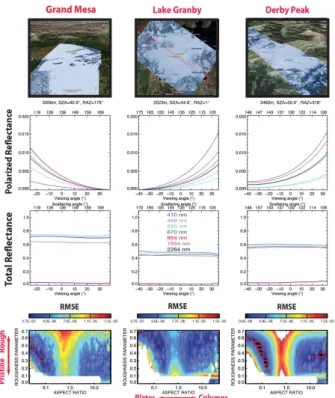
The core of our findings is condensed in Fig. 1. The analysis for each scene (different
spa-TCD
9, 3055–3074, 2015Photopolarimetric retrievals of snow
properties
M. Ottaviani et al.
Title Page
Abstract Introduction
Conclusions References
Tables Figures
◭ ◮
◭ ◮
Back Close
Full Screen / Esc
Printer-friendly Version Interactive Discussion
Discussion
P
a
per
|
Discussion
P
a
per
|
Discussion
P
a
per
|
Discussion
P
a
per
|
tial resolution of about 225 m, since averaging over a few adjacent aggregated scans did not show appreciable scan-to-scan variability, revealing more or less uniform snow conditions within the instrument instantaneous field of view. The upper panels show the results of the iterative correction scheme applied to the relevant RSP channels. With the exception of O12, the visible and SWIR behavior of the polarized reflectance
5
of snow has not been previously published. Real-time imagery from the high-resolution camera onboard the ER-2, overlaid to Google Earth, is included for context.
The total reflectance exhibits the familiar high spectral albedo in the visible, although with some expected scene-to-scene variability. Lake Granby in particular shows lower total reflectance than the other two scenes; in situ simultaneous surveys from the
per-10
sonnel at the US Forest Service in Arapaho National Forest reported a snow depth on the order of 5–8 cm. These values are close to the limit of thickness required to visually mask the underlying surface, leaving the possibility that the lake ice underneath the snow cover is darkening the reflectance. Nevertheless, it should be remembered that a layer of a few millimeters is sufficient to fulfill the semi-infinite approximation at the
15
long wavelengths used for the retrieval of grain size. Conversely, the SWIR channels at 1594 and 2264 nm are very dark as expected by the strong absorption of ice at these wavelengths. The polarized reflectance as a function of the scattering angle is very similar among the three scenes. Note that in the case of Derby Peak the flight track was oriented at about 45◦ with respect to the principal plane (i.e. the plane defined by
20
the solar azimuth and the normal to the surface), leading to a smaller range of scat-tering angles collected by the RSP. It has already been observed in O12 as the land model used for the polarized reflectance converges to zero toward backscatter (scat-tering angle>160◦), and in this region agreement with the data is not to be expected.
It is useful to quantify the spectral spread of the channels by examining the differences
25
TCD
9, 3055–3074, 2015Photopolarimetric retrievals of snow
properties
M. Ottaviani et al.
Title Page
Abstract Introduction
Conclusions References
Tables Figures
◭ ◮
◭ ◮
Back Close
Full Screen / Esc
Printer-friendly Version Interactive Discussion
Discussion
P
a
per
|
Discussion
P
a
per
|
Discussion
P
a
per
|
Discussion
P
a
per
|
wavelengths when aerosols retrievals are attempted. The residuals with respect to the 2264 nm polarized reflectance are found to be within 0.005, which as in O12 is larger than conventional land surfaces but still very small. The polarized reflectance is small too in absolute value.
Shifting the attention to the search of a snow model, the plots at the bottom contour
5
the Root Mean Square Error (RMSE) of the data fit to each combination of aspect ratio and roughness parameter in the database. Multiple combinations led to a satisfactory fit to each of the three polarized reflectance observations, so we considered as optimal all habits with an RMSE falling below a small threshold value (4.5×10⁻⁷). These minima,
marked with red circles, therefore correspond to those crystal habits that when used
10
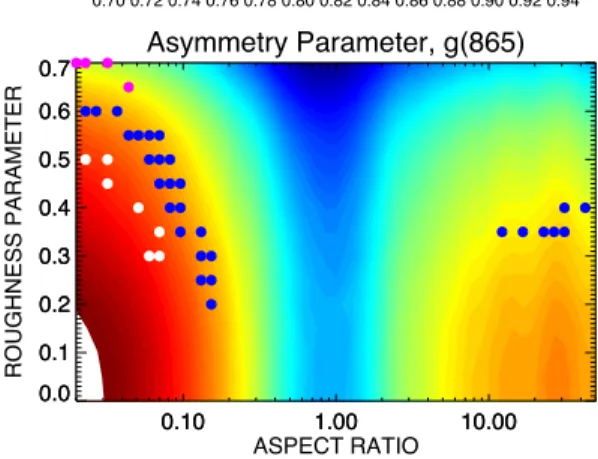
to model the snowpack at the bottom of the simulated atmosphere yield the best fits to the data. The analysis shows that the polarized reflectances are consistent with particles that have components that are like thin plates or like thin columns, a fact already observed in O12. Interestingly, the butterfly-like topology of the RMSE was recognized to closely resemble that obtained for the asymmetry parametergplotted vs.
15
the same coordinates (Fig. 2). In each scene, the optimal crystal habits are associated with very similar values of the asymmetry parameter (0.84 for Lake Granby, 0.876 for Derby Peak and 0.90 for Grand Mesa). This result is understood by considering that the asymmetry parameter is the main descriptor for the scattering properties. As demonstrated by van Diedenhoven et al. (2012) using a large variety of complex ice
20
crystal shapes, all the combinations of aspect ratio and roughness parameter fitting a polarized reflectance measurement are ultimately characterized by similar values of
g. Consequently, they will also yield similar particles size retrievals.
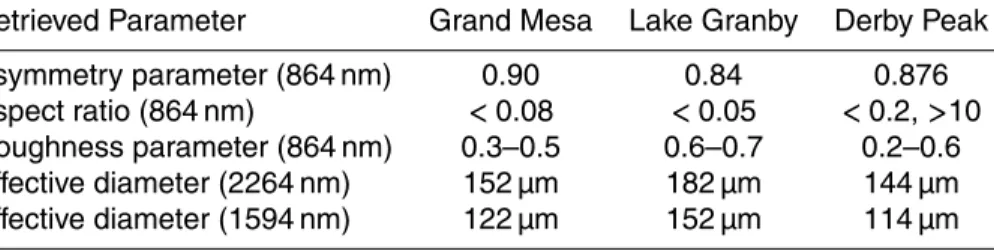
All retrieved parameters are conveniently reported for comparison in Table 1, to-gether with the results of the size retrievals. Using the simple approach outlined in
25
the previous section, we obtained effective diameters equal to 152, 182 and 144 µm
TCD
9, 3055–3074, 2015Photopolarimetric retrievals of snow
properties
M. Ottaviani et al.
Title Page
Abstract Introduction
Conclusions References
Tables Figures
◭ ◮
◭ ◮
Back Close
Full Screen / Esc
Printer-friendly Version Interactive Discussion
Discussion
P
a
per
|
Discussion
P
a
per
|
Discussion
P
a
per
|
Discussion
P
a
per
|
penetration depths of the two channels, indicating crystal size increasing with depth as expected (Hori et al., 2007; Li et al., 2001; Aoki et al., 2000; Warren, 1982). These values, at the lower end of common retrieval ranges, are normally associated with fresh snow conditions as found in studies based on other remote sensors in alpine regions (Negi and Kokhanovsky, 2011; Painter et al., 2009; Dozier and Painter, 2004;
5
Nolin and Dozier, 2000) and polar plateaus (Lyapustin et al., 2009; Hori et al., 2007). However, a direct comparison is challenged by differences in the definition of grain size,
assumptions on grain sphericity and different penetration depths achieved by the use
of selected instrument channels. The larger grain sizes obtained for the Lake Granby scene were attributed to the shallow aged snow over the lake, since metamorphized
10
snow is recognized to be composed of larger grains (Aoki et al., 2000; Warren, 1982).
5 Conclusions
We have presented the extension of a novel analysis described by Ottaviani et al. (2012b) to a dataset acquired with the high-accuracy RSP airborne instrument overfly-ing high-altitude snow fields. The data were processed within an automated retrieval
15
scheme capable of isolating the surface contribution. The spectral dependence of the polarized reflectance is larger than for soil or vegetated surfaces, but nonetheless small. This fact has important implications for the construction of advanced algorithms which aim at the retrieval of the microphysical properties of aerosols layers located over ice and snow fields.
20
Furthermore, we applied a retrieval procedure which is demonstrated to yield snow microphysical parameters of primary climatological interest. We retrieve snowpacks be-having as a collection of grains of extreme geometries (thin plates and/or long columns) and moderate to high microscale roughness. These results reinforce those of our pre-vious study based on a limited dataset acquired over very rugged terrain. For each
25
simi-TCD
9, 3055–3074, 2015Photopolarimetric retrievals of snow
properties
M. Ottaviani et al.
Title Page
Abstract Introduction
Conclusions References
Tables Figures
◭ ◮
◭ ◮
Back Close
Full Screen / Esc
Printer-friendly Version Interactive Discussion
Discussion
P
a
per
|
Discussion
P
a
per
|
Discussion
P
a
per
|
Discussion
P
a
per
|
lar values of the asymmetry parameter. Size retrievals were also tested, leading grain effective diameters in the 140–180 µm range.
Appendix: Size descriptors for hexagonal prisms
The results of Macke’s Geometric Optics code were tabulated with the choice of the radius of the sphere with equal surface area,rsph, as a size descriptor. This parameter
5
is linked to the geometric size of hexagonal prisms and to the grain effective diameter
by the following relations:
Ahex=4π rsph2 (Surface area of sphere and hexagonal prism) (A1)
Ap=Ahex/4=π rsph2 (Projected surface area of hexagonal prism) (A2)
rhex=
s
4Ap
3√3+12α
(Radius or side length of hexagonal prism) (A3)
10
V =3p3α r3
hex (Volume of hexagonal prism) (A4)
deff= 3 2
V Ap
= 6
√
3α
√
3+4αrhex (E
ffective diameter) (A5)
whereαis the aspect ratio, defined as the ratio of the cross section width of the prism to its length. The last expression is valid for a single particle of any solid shape. In case of a polydisperse collection of particles, the effective diameter is obtained through
15
integration over a size distribution:
Deff= 3 2
R∞
0 V(D)N(D) dD
R∞
0 Ap(D)N(D) dD
(A6)
TCD
9, 3055–3074, 2015Photopolarimetric retrievals of snow
properties
M. Ottaviani et al.
Title Page
Abstract Introduction
Conclusions References
Tables Figures
◭ ◮
◭ ◮
Back Close
Full Screen / Esc
Printer-friendly Version Interactive Discussion
Discussion
P
a
per
|
Discussion
P
a
per
|
Discussion
P
a
per
|
Discussion
P
a
per
|
Acknowledgements. This work was possible through the dedication of the ER-2 pilots Tom Ryan, Dean Neeley and Stu Broce. Their exceptional skills and proactive attitude towards the goals of the mission were critical to success. The assistance of personnel on the ground was invaluable, especially that of Hans Moosmüller from the Desert Research Institute, Davide Sar-toni from Mistras-Ropeworks, Rick Brinkam from Water Services at the City of Grand Junction, 5
Sam Williams and Aldin Strautins from NOAA, McKenzie Skiles from NASA JPL, Holly King from the Trappers Lake Lodge, and Dan Matthews and John Saye from the US Forest Service in Arapaho National Forest. We also thank Rose Dominguez and Dennis Gearhart from NASA GSFC for providing access to the ER-2 DCS camera imagery. The RSP data used for this anal-ysis are publicly available on the GISS server (http://data.giss.nasa.gov/pub/rsp/). The graphs 10
were produced with IDL©supplemented by David Fanning’s Coyote Graphics free library of rou-tines. Partial support from the Radiation Sciences Program managed by Hal Maring is gratefully acknowledged.
References
Aoki, T., Aoki, T., Fukabori, M., Hachikubo, A., Tachibana, Y., and Nishio, F.: Effects of snow 15
physical parameters on spectral albedo and bidirectional reflectance of snow surface, J. Geo-phys. Res., 105, 10219–10236, 2000. 3060, 3061, 3065
Aoki, T., Hori, M., Motoyoshi, H., Tanikawa, T., Hachikubo, A., Sugiura, K., Yasunari, T. J., Storvold, R., Eide, H. A., Stamnes, K., Li, W., Nieke, J., Nakajima, Y., and Takahashi, F.: ADEOS-II/GLI snow/ice products – Part II: Validation results using GLI and MODIS data, 20
Remote Sens. Environ., 111, 274–290, 2007. 3057
Baran, A.: A review of the light scattering properties of cirrus, J. Quant. Spectrosc. Ra., 110, 1239–1260, 2009. 3061
Bi, L., Yang, P., Liu, C., Yi, B., Baum, B. A., van Diedenhoven, B., and Iwabuchi, H.: Assessment of the accuracy of the conventional ray-tracing technique: Implications in remote sensing and 25
radiative transfer involving ice clouds, J. Quant. Spectrosc. Ra., 158–174, 2014. 3062 Born, M. and Wolf, E.: Principles of Optics, 7th (expanded) Edn., Cambridge University Press,
1999. 3060
TCD
9, 3055–3074, 2015Photopolarimetric retrievals of snow
properties
M. Ottaviani et al.
Title Page
Abstract Introduction
Conclusions References
Tables Figures
◭ ◮
◭ ◮
Back Close
Full Screen / Esc
Printer-friendly Version Interactive Discussion
Discussion
P
a
per
|
Discussion
P
a
per
|
Discussion
P
a
per
|
Discussion
P
a
per
|
ference Series, Vol. 3754, edited by: Goldstein, D. H. and Chenault, D. B., Denver, CO, USA, 18 July 1999, 186–196, 1999. 3057
Cairns, B., Waquet, F., Knobelspiesse, K., Chowdhary, J., and Deuzé, J.: Polarimetric remote sensing of aerosols over land surfaces, Chap. 10, Springer-Praxis Books in Environmental Sciences, Chichester, UK, 295–325, 2009. 3057
5
Chowdhary, J., Cairns, B., Waquet, F., Knobelspiesse, K., Ottaviani, M., Redemann, J., Travis, L., and Mishchenko, M.: Sensitivity of multiangle, multispectral polarimetric re-mote sensing over open oceans to water-leaving radiance: analyses of RSP data acquired during the MILAGRO campaign, Remote Sens. Environ., 118, 284–308, doi:10.1016/j.rse.2011.11.003, 2012. 3057
10
Comiso, J. C.: Arctic warming signals from satellite observations, Weather, 61, 70–76, 2006. 3056
De Haan, J., Bosma, P., and Hovenier, J.: The adding method for multiple scattering calculations of polarized light, Astron. Astrophys., 183, 371–391, 1987. 3059
Diner, D. J., Davis, A., Hancock, B., Gutt, G., Chipman, R. A., and Cairns, B.: Dual-photoelastic-15
modulator-based polarimetric imaging concept for aerosol remote sensing, Appl. Optics, 46, 8428–8445, 2007. 3057
Dozier, J. and Painter, T.: Multispectral and hyperspectral remote sensing of alpine snow prop-erties, Annu. Rev. Earth Pl. Sc., 32, 465–494, 2004. 3065
Dubovik, O., Herman, M., Holdak, A., Lapyonok, T., Tanré, D., Deuzé, J. L., Ducos, F., 20
Sinyuk, A., and Lopatin, A.: Statistically optimized inversion algorithm for enhanced retrieval of aerosol properties from spectral multi-angle polarimetric satellite observations, Atmos. Meas. Tech., 4, 975–1018, doi:10.5194/amt-4-975-2011, 2011. 3057
Fu, Q.: A new parameterization of an asymmetry factor of cirrus clouds for climate models, J. Atmos. Sci., 64, 4140–4150, 2007. 3061
25
Hasekamp, O. P., Litvinov, P., and Butz, A.: Aerosol properties over the ocean from parasol multiangle photopolarimetric measurements, J. Geophys. Res., 116, D14204, doi:10.1029/2010JD015469, 2011. 3057
Hori, M., Aoki, T., Stamnes, K., and Li, W.: ADEOS-II/GLI snow/ice products – Part III: Retrieved results, Remote Sens. Environ., 111, 291–336, 2007. 3057, 3065
30
TCD
9, 3055–3074, 2015Photopolarimetric retrievals of snow
properties
M. Ottaviani et al.
Title Page
Abstract Introduction
Conclusions References
Tables Figures
◭ ◮
◭ ◮
Back Close
Full Screen / Esc
Printer-friendly Version Interactive Discussion
Discussion
P
a
per
|
Discussion
P
a
per
|
Discussion
P
a
per
|
Discussion
P
a
per
|
Knobelspiesse, K., Cairns, B., Mishchenko, M., Chowdhary, J., Tsigaridis, K., van Dieden-hoven, B., Martin, W., Ottaviani, M., and Alexandrov, M.: Analysis of fine-mode aerosol re-trieval capabilities by different passive remote sensing instrument designs, Opt. Express, 20, 21457–21484, 2012. 3057
Kokhanovsky, A. and Zege, E.: Scattering optics of snow, Appl. Optics, 43, 1589–1602, 2004. 5
3061
Kokhanovsky, A., Rozanov, V., Aoki, T., Odermatt, D., Brockmann, C., Krüger, O., Bouvet, M., Drusch, M., and Hori, M.: Sizing snow grains using backscattered solar light, Int. J. Remote Sens., 32, 6975–7008, 2011. 3061
Li, W., Stamnes, K., Chen, B., and Xiong, X.: Snow grain size retrieved from near-infrared 10
radiances at multiple wavelengths, Geophys. Res. Lett., 28, 1699–1702, 2001. 3062, 3065 Lucht, W., Schaaf, C., and Strahler, A.: An algorithm for the retrieval of albedo from space using
semiempirical BRDF models, IEEE T. Geosci. Remote, 38, 977–998, 2000. 3059
Lyapustin, A., Tedesco, M., Wang, Y., Aoki, T., Hori, M., and Kokhanovsky, A.: Retrieval of snow grain size over Greenland from MODIS, Remote Sens. Environ., 113, 1976–1987, 2009. 15
3056, 3065
Macke, A., Mueller, J., and Raschke, E.: Single scattering properties of atmospheric ice crys-tals, J. Atmos. Sci., 53, 2813–2825, 1996. 3061
Nadal, F. and Bréon, F.-M.: Parameterization of surface polarized reflectance derived from POLDER spaceborne measurements, IEEE T. Geosci. Remote, 37, 1709–1718, 1999. 3060 20
Negi, H. S. and Kokhanovsky, A.: Retrieval of snow grain size and albedo of western Himalayan snow cover using satellite data, The Cryosphere, 5, 831–847, doi:10.5194/tc-5-831-2011, 2011. 3065
Nolin, A. and Dozier, J.: A hyperspectral method for remotely sensing the grain size of snow, Remote Sens. Environ., 74, 207–216, 2000. 3065
25
Ottaviani, M., Cairns, B., Chowdhary, J., Diedenhoven, B. V., Knobelspiesse, K., Hostetler, C., Ferrare, R., Burton, S., Hair, J., Obland, M. D., and Rogers, R.: Polarimetric retrievals of surface and cirrus clouds properties in the region affected by the Deepwater Horizon oil spill, Remote Sens. Environ., 121, 389–403, doi:10.1016/j.rse.2012.02.016, 2012a. 3057, 3061 Ottaviani, M., Cairns, B., Ferrare, R., and Rogers, R.: Iterative atmospheric correction 30
TCD
9, 3055–3074, 2015Photopolarimetric retrievals of snow
properties
M. Ottaviani et al.
Title Page
Abstract Introduction
Conclusions References
Tables Figures
◭ ◮
◭ ◮
Back Close
Full Screen / Esc
Printer-friendly Version Interactive Discussion
Discussion
P
a
per
|
Discussion
P
a
per
|
Discussion
P
a
per
|
Discussion
P
a
per
|
Painter, T., Rittger, K., McKenzie, C., Slaughter, P., Davis, R., and Dozier, J.: Retrieval of sub-pixel snow covered area, grain size, and albedo from MODIS, Remote Sens. Environ., 113, 868–879, 2009. 3065
Painter, T. H., Bryant, A. C., and Skiles, S. M.: Radiative forcing by light absorbing impu-rities in snow from MODIS surface reflectance data, Geophys. Res. Lett., 39, L17502, 5
doi:10.1029/2012GL052457, 2012. 3057
Rodgers, C.: Inverse methods for atmospheric sounding theory and practice, Vol. 2, in: Se-ries on Atmospheric, Oceanic and Planetary Physics, World Scientific Publishing Company, Singapore, 2000. 3059
Stamnes, K., Li, W., Eide, H., Aoki, T., Hori, M., and Storvold, R.: ADEOS-II/GLI snow/ice prod-10
ucts – Part I: Scientific basis, Remote Sens. Environ., 111, 258–273, 2007. 3056
Stamnes, K., Hamre, B., Stamnes, J., Ryzhikov, G., Biryulina, M., Mahoney, R., Hauss, B., and Sei, A.: Modeling of radiation transport in coupled atmosphere-snow-ice-ocean systems, J. Quant. Spectrosc. Ra., 112, 714–726, doi:10.1016/j.jqsrt.2010.06.006, 2011. 3057
Tedesco, M. and Kokhanovsky, A.: The semi-analytical snow retrieval algorithm and its applica-15
tion to MODIS data, Remote Sens. Environ., 111, 228–241, 2007. 3060
van Diedenhoven, B., Cairns, B., Geogdzhayev, I. V., Fridlind, A. M., Ackerman, A. S., Yang, P., and Baum, B. A.: Remote sensing of ice crystal asymmetry parameter using multi-directional polarization measurements – Part 1: Methodology and evaluation with simulated measure-ments, Atmos. Meas. Tech., 5, 2361–2374, doi:10.5194/amt-5-2361-2012, 2012. 3057, 20
3061, 3064
van Diedenhoven, B., Cairns, B., Fridlind, A. M., Ackerman, A. S., and Garrett, T. J.: Remote sensing of ice crystal asymmetry parameter using multi-directional polarization measure-ments – Part 2: Application to the Research Scanning Polarimeter, Atmos. Chem. Phys., 13, 3185–3203, doi:10.5194/acp-13-3185-2013, 2013. 3062
25
van Diedenhoven, B., Fridlind, A. M., Cairns, B., and Ackerman, A. S.: Variation of ice crystal size, shape, and asymmetry parameter in tops of tropical deep convective clouds, J. Geo-phys. Res.-Atmos., 119, 11–809, 2014. 3062
Wang, X., Liou, K., Ou, S. S., Mace, G., and Deng, M.: Remote sensing of cirrus cloud vertical size profile using MODIS data, J. Geophys. Res.-Atmos., 114, D09205, 30
doi:10.1029/2008JD011327, 2009. 3062
TCD
9, 3055–3074, 2015Photopolarimetric retrievals of snow
properties
M. Ottaviani et al.
Title Page
Abstract Introduction
Conclusions References
Tables Figures
◭ ◮
◭ ◮
Back Close
Full Screen / Esc
Printer-friendly Version Interactive Discussion
Discussion
P
a
per
|
Discussion
P
a
per
|
Discussion
P
a
per
|
Discussion
P
a
per
|
Warren, S.: Optical properties of snow, Rev. Geophys., 20, 67–89, 1982. 3062, 3065
Zatko, M. C., Grenfell, T. C., Alexander, B., Doherty, S. J., Thomas, J. L., and Yang, X.: The influence of snow grain size and impurities on the vertical profiles of actinic flux and asso-ciated NOxemissions on the Antarctic and Greenland ice sheets, Atmos. Chem. Phys., 13, 3547–3567, doi:10.5194/acp-13-3547-2013, 2013. 3056
5
Zege, E., Katsev, I., Malinka, A., Prikhach, A., Heygster, G., and Wiebe, H.: Algorithm for re-trieval of the effective snow grain size and pollution amount from satellite measurements, Remote Sens. Environ., 115, 2674–2685, 2011. 3061
Zwally, H. J. and Giovinetto, M. B.: Overview and assessment of Antarctic ice-sheet mass balance estimates: 1992–2009, Surv. Geophys., 32, 351–376, 2011. 3056
TCD
9, 3055–3074, 2015Photopolarimetric retrievals of snow
properties
M. Ottaviani et al.
Title Page
Abstract Introduction
Conclusions References
Tables Figures
◭ ◮
◭ ◮
Back Close
Full Screen / Esc
Printer-friendly Version Interactive Discussion
Discussion
P
a
per
|
Discussion
P
a
per
|
Discussion
P
a
per
|
Discussion
P
a
per
|
Table 1.List of ice crystals’ parameters retrieved for the three analyzed scenes. The value in
parentheses indicates the RSP band used in the retrieval. The effective diameter can be ob-tained using either the 2264 or the 1594 nm channel (see text), and a crystal habit characterized by the asymmetry parameter retrieved for the corresponding scene.
Retrieved Parameter Grand Mesa Lake Granby Derby Peak
TCD
9, 3055–3074, 2015Photopolarimetric retrievals of snow
properties
M. Ottaviani et al.
Title Page
Abstract Introduction
Conclusions References
Tables Figures
◭ ◮
◭ ◮
Back Close
Full Screen / Esc
Printer-friendly Version Interactive Discussion
Discussion
P
a
per
|
Discussion
P
a
per
|
Discussion
P
a
per
|
Discussion
P
a
per
|
Figure 1.Atmospherically corrected polarized (second row) and total (third row) reflectance for
TCD
9, 3055–3074, 2015Photopolarimetric retrievals of snow
properties
M. Ottaviani et al.
Title Page
Abstract Introduction
Conclusions References
Tables Figures
◭ ◮
◭ ◮
Back Close
Full Screen / Esc
Printer-friendly Version Interactive Discussion
Discussion
P
a
per
|
Discussion
P
a
per
|
Discussion
P
a
per
|
Discussion
P
a
per
|
0.10 1.00 10.00 0.0
0.1 0.2 0.3 0.4 0.5 0.6 0.7
0.10 1.00 10.00 ASPECT RATIO 0.0
0.1 0.2 0.3 0.4 0.5 0.6 0.7
ROUGHNESS PARAMETER
Asymmetry Parameter, g(865)
0.10 1.00 10.00 0.0
0.1 0.2 0.3 0.4 0.5 0.6 0.7
0.70 0.72 0.74 0.76 0.78 0.80 0.82 0.84 0.86 0.88 0.90 0.92 0.94
Figure 2.The “butterfly” pattern of the contour plot for the asymmetry parametergas a function