Intrinsic asymmetry parameter in nonmesonic hypernuclear decay: analytical proof of the
independence on hypernucleus within an independent particle shell model
C. Barbero
Departamento de F´ısica, Universidad Nacional de La Plata, C. C. 67, 1900 La Plata, Argentina
A. Mariano
Instituto de F´ısica La Plata, CONICET, 1900 La Plata, Argentina (Received on 05 December, 2008)
We derive general analytical expressions for the evaluation of the intrinsic asymmetry parameter in non-mesonic hypernuclear weak decay, within an independent particle shell model framework. Present formalism is valid for even-even, even-odd and odd-odd core hypernucleus. A standard strangeness-changing weak transi-tion potential with exchange of the complete meson octet (π,η,K,ρ,ω,K∗) is assumed. Very simple analytical formulas are obtained within thes-wave approximation when we restrict to theπandπ+Kexchange models, providing an useful and manageable tool to understand the origin of the discrepancies between theoretical and experimental results. Numerical values for4ΛHe,5ΛHe,11ΛB,12ΛC,16ΛO,17ΛOand28ΛSihypernuclei are exhibited. Present formalism could be used to understand why new contributions to the exchange potential allow to obtain good agreement with data, as indicated in very recent works. The necessity of a consistent inclusion of: i) differ-ent modifications of the exchange potdiffer-ential (two-pion exchange,a1meson,∆T=3/2 terms coming from vector mesons, etc); ii) final state interactions on primary nucleons inside the residual nucleus and also correlations between the free emitted ones; and iii) configuration mixing in the final system, is remarked.
Keywords: Hypernuclear decay; Asymmetry parameter; One-meson-exchange; Independent particle shell model
1. INTRODUCTION
The free decay of aΛ hyperon occurs almost exclusively through the mesonic mode, Λ→πN, emerging the nucleon with a momentum of about 100 MeV/c. Inside the nuclear medium (pF ∼270 MeV/c) this mode is Pauli blocked and the weak decay is dominated by the nonmesonic channel,
ΛN→NN. The transitions receive contributions either from neutrons (Λn→nn) and protons (Λp→np), with ratesΓnand
Γp, respectively. For a long time, the experimental data for this process were restricted to the total nonmesonic decay rate,
ΓNM, and the neutron to proton ratio,Γn/p=Γn/Γp. The dis-crepancies between the theoretical results,Γtheor
n/p ≃0.1−0.5, and the experimental data, Γexpn/p≃1, have constituted an in-teresting puzzle for many years. In the light of recent de-velopments [1, 2] and of new measurements [3]–[9] the ex-perimental value of this ratio seems to be small and close to 0.5, which could lead to think that the nonmesonic hypernu-clear decay (NMHD) problem has been solved. However, dis-crepancies still exist between theory and experiment and also among various set of data. In fact, for example, experimental proton spectra measured in different laboratories are incom-patible between them but also with those evaluated from theo-retical models, as discussed carefully in the very recent work of the FINUDA Collaboration [10].
Additionally, in the last years, the results obtained at KEK [11]–[15] for another important observable, namely, the in-trinsic asymmetry parameter,aΛ, have been available. This is experimentally more demanding, as it requires measuring the asymmetry in the angular distribution of protons emitted in the decay of polarized hypernuclei. On the theoretical side, how-ever, aΛ carries important new information, since it is deter-mined by the interference terms between the parity-conserving (PC) and the parity-violating (PV) proton-induced transitions to final states with different isospins. One expects, therefore, that the asymmetry parameter will have more discriminating
power to constrain the proposed mechanisms for NMHD. As known, the measurements ofaΛfavor a negative value for12ΛC and a positive value for5ΛHe[11]–[15]. On the other hand, ma-jority of the existing calculations based on strict one-meson ex-change models (OMEM) [16]–[26] find values between−0.73 and−0.19 for5
ΛHe[27, 28] and, when results are available in the same model, very similar values for12
ΛC. Thus, there is now a renewed interest to solve this NMHD puzzle. A first applica-tion of effective field theory (EFT) to nonmesonic decay [29] and the inclusion ofσmeson exchange plus direct-quark inter-action, which strongly violates the ∆T =1/2 rule [30], have stressed that the scalar-isoscalar type of interactions are spe-cially important in explaining the asymmetry. Quite recently, two relevant works have pointed to possible solutions via the inclusion of: i) a one-meson-exchange potential supplemented by a correlated plus uncorrelated chirally motivated two-pion (2π)-exchange mechanism [31], within a model including fi-nal state interactions (FSI) for different cuts on the kinetic en-ergy of the emitted nucleons; or ii) the a1 meson exchange
[32]. These works give some assessment in connection with the asymmetry problem. Nevertheless, due to the diversity of ways in which the puzzle seems that could be solved, it would be very useful to pursue in the analysis of the main degrees of freedom of finite hypernucleus nuclear structure models in or-der to establish a platform to study the mentioned new effects together and consistently.
even-even and even-even-odd core hypernucleus, and was applied specif-ically to5ΛHeand12ΛC.
Based in the actual status of NMHD problem it would be very useful to establish, within the SM framework, conclusions valid for all types of hypernuclei about theoretical predictions for asymmetry parameter. In particular, they could clearly give a guide to find the origin of discrepancies with experimental data. Motivated by this fact, we extend in the present work the formalism from [23] to the odd-odd core case, and obtain a very simple analytical expression foraΛvalid for all kind of hypernucleus. The aim of the present is not to solve the puzzle, but to explicitly remark the limitations of our formalism, and have certain control on it, to include consistently in the future the missing ingredients and decide which ones to add in order to obtain agreement with experiments.
This paper is organized as follows. In Sect. 2 the general formalism foraΛis summarized. In Sect. 3 numerical results for 4ΛHe, 5ΛHe, 11ΛB, Λ12C, 16ΛO, 17ΛOand 28ΛSihypernuclei are presented, and analytical formulas are obtained within thes -wave approximation, both forπandπ+K exchange models. Sect. 4 contains conclusions and final remarks.
2. FORMALISM
The intrinsic asymmetry parameter for the proton induced NMHD,−→Λp→np, of an initial polarized hypernucleus (with spinJIand energy
E
I) to a residual nucleus (with spinJFandenergy
E
F) plus two free nucleons (with momentap1andp2)will be calculated as [23]
aΛ= A
V, for JI=JC+1/2,
−JI+1
JI AV, for JI=JC−1/2,
(1)
where
AV =3 r
JI JI+1
σ1(JI)
σ0(JI)
, (2)
with
σκ(JI) = 1 2(4π)
4Jˆ3
Iκˆ−1
Z
dcosθp1
Z
dF
∑
ST T′
(−)T+T′
×
∑
lLλJ
∑
l′L′λ′J′
i−l′−L′−l−L(−)λ+S+J+J′+JI+JF lˆlˆ′LˆLˆ′λˆλˆ′JˆJˆ′
×
∑
kK
(l0l′0|k0)(L0L′0|K0) [Yk(θp,π)⊗YK(θP,0)]κ0
×
JI κ JI J JF J′
κ J′ J S λ λ′
l l′ k L L′ K λ λ′ κ
× hplPLλSJTνFJF;JI|V|JIi
× hpl′PL′λ′SJ′T′νFJF;JI|V|JIi∗. (3) We have defined
hplPLλSJTνFJF;JI|V|JIi=JˆI−1
∑
jNfJ(jN,νFJF)
M
(plPLλSJT;jΛjN), (4)with V being the transition potential, jΛ≡nΛlΛjΛtΛ and jN ≡nNlN jNtN the single-particle states for the lambda and nucleon, respectively (we assume that theΛparticle behaves as a|1
2,− 1
2iisospin particle in the 1s1/2level)pandPthe
rel-ative and center of mass momenta (see Eq. (15) from [23]) andνFspecifying the remaining quantum numbers in the final state besides the nuclear spin. The factors are defined as
fJ(jN,νFJF) = (−)2JFJˆJˆI
JC JI jΛ J jN JF
hJC||a†jN||νFJFi,
(5)
withJCbeing the core spin and the matrix element
M
(plPLλSJT;jΛjN) = 1√
2 h
1−(−)l+S+Ti(plPLλSJT|V|jΛj NJ). (6) Here, the compact notation has been introduced (~=c=1)
Z
dF. . . = 2π
∑
νFJF
Z p2
2d p2
(2π)3
Z p2
1d p1
(2π)3δ
p2 1
2M+ p22 2M+
|p1+p2|2
2MF −
∆νFJF
. . . , (7)
where∆νFJF =
E
I−E
F−2MN is the released energy, beingMN the nucleon mass. To get a formalism valid for all types of hypernucleus, we remark here that the difference between
them is contained in the matrix elementhJC||a†jN||νFJFi, and
in-dependent particle shell model (IPSM) the final state for the proton induced decay in the odd-odd case will be described as
|νFJFi=|[j−nc1(j−
1
pcj−
1
p )J1]JFi. Here|JCi=|(j−nc1j−
1
pc)JCi
repre-sents the core, withjnc≡nnclnc jnctnc (jpc≡npclpcjpctpc)
be-ing the sbe-ingle-particle state of the neutron (proton) hole, andjp that of the outgoing proton. Thus, the extra labelνFin the final states will be associated with the occupied single-proton states, jp, and the coupling quantum numberJ1. Consequently, for a
fixed single particle proton state, only one term contributes to the sum in Eq. (4), which suggests to rewrite our Eq. (7) as
Z
dF···= 1 (2π)5
∑
jp
Z
dFjp
∑
J1JF. . . , (8)
where
Z
dFjp···=
Z
p22d p2
Z
p21d p1
×δ
p2 1
2MN
+ p
2 2
2MN
+|p1+p2|
2
2MR −
∆jp
. . . , (9)
being MR the mass of the residual nucleus and ∆jp =MΛ−
MN+εjp+εjΛ, with the single particle energiesεjpandεjΛfor
proton and lambda particle (with massMΛ) respectively. Thus, from Eqs. (3), (4) and (8) we can write
σκ(JI) = 4
πJˆIκˆ−
1
∑
jp
Z
dcosθp1
Z
dFjp
∑
ST T′
(−)T+T′
×
∑
lLλJl′L
∑
′λ′J′i−l′−L′−l−L(−)λ+S+J+J′+JIlˆlˆ′LˆLˆ′λˆλˆ′JˆJˆ′
×
∑
kK
(l0l′0|k0)(L0L′0|K0) [Yk(θp,π)⊗YK(θP,0)]κ0
×
κ J′ J S λ λ′
l l′ k L L′ K λ λ′ κ
S
2(J,J′,jp,κ)×
M
(plPLλSJT;jΛjN)M
∗(pl′PL′λ′SJ′T′;jΛjN),(10) whereS
2(J,J′,jp,κ)≡∑
J1JF(−)JF
JI κ JI J JF J′
fJ(jp,J1JF)fJ′(jp,J1JF).
(11) For aA
ΛZ hypernucleus with odd-odd core, after some simple algebra we get1
fJ(jp,J1JF) = (−)jnc+jpc+JC+2JF[1+ (−)J1δjpjpc]
1/2JˆJˆ
IJˆCJˆ1JˆF
×
JC JI jΛ J jN JF
jnc jpc JC
jN JF J1
. (12)
Besides, noting that|JCi=|(j−nc1)JCiand|JFi=|(j−
1
ncj−
1
p )JFi for even-odd core hypernucleus, we observe that the results in this case can be obtained from those of odd-odd core by choos-ingjpc=0 (which meansjnc=JCandJ1=jp). Similarly, the
results for even-even core hypernucleus are reproduced with
1It is important to remark here that the allowed jvalues are limited by the fact that, in the j1j2-coupling we are using here, one needs to satisfy the conditionj+t=oddfor configurations withj1=j2[35].
jpc=jnc=0 (which means JC =0 and JF =jp) in odd-odd
core formulas. Thus, we have arrived to the general expression (12) for the fJ(jp,J1JF)coefficients of an odd-odd hypernu-clei, which includes the even-odd and even-even hypernuclei as particular cases.
Finally, using Eq. (35) from [23] we can rearrange the asymmetry parameter as
aΛ=ω1 ω0
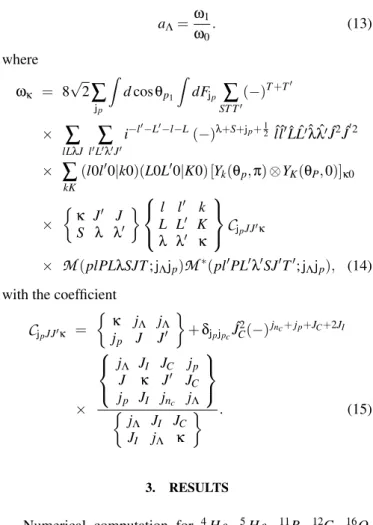
. (13)
where
ωκ = 8
√
2
∑
jpZ
dcosθp1
Z
dFjp
∑
ST T′(−)T+T′
×
∑
lLλJ
∑
l′L′λ′J′
i−l′−L′−l−L(−)λ+S+jp+12 lˆlˆ′LˆLˆ′λˆλˆ′Jˆ2Jˆ′2
×
∑
kK
(l0l′0|k0)(L0L′0|K0) [Yk(θp,π)⊗YK(θP,0)]κ0
×
κ J′ J S λ λ′
l l′ k L L′ K λ λ′ κ
C
jpJJ′κ
×
M
(plPLλSJT;jΛjp)M
∗(pl′PL′λ′SJ′T′;jΛjp), (14) with the coefficientC
jpJJ′κ =
κ jΛ jΛ jp J J′
+δjpjpcJˆ
2
C(−)jnc+jp+JC+2JI
×
jΛ JI JC jp J κ J′ JC jp JI jnc jΛ
jΛ JI JC JI jΛ κ
. (15)
3. RESULTS
Numerical computation for 4ΛHe, 5ΛHe, Λ11B, 12ΛC, 16ΛO,
17
ΛO and 28ΛSi hypernuclei has been performed. A standard strangeness-changing weak ΛN → NN transition potential comprising the exchange of the complete pseudoscalar and vector meson octets (π,η,K,ρ,ω,K∗) was adopted [18, 19]. In the calculation, corrections due to kinematical effects related to theΛ-nucleon mass difference and the first-order nonlocal-ity terms, carefully discussed in Ref. [20], have been taken into account. Also, in the present evaluation we include both: i) finite nucleon size effects which are phenomenologically im-plemented by a monopole form factor(Λ2
M−µ2M)/(Λ2M+q2), beingΛMthe cutoff for the mesonM[36]; and ii) initial and fi-nal short range correlations which are simulated, respectively, by means of the correlation functions
gΛN(r) = (1−e−r 2/α2
)2+βr2e−r2/γ2,
gNN(r) = 1−j0(qcr), (16) withα=0.5 fm,β=0.25 fm−2,γ=1.28 fm, andqc=3.93 fm−1.
independent of the considered hypernucleus, which is large and negative. This is in contradiction with data, which give a small and positive central value for5ΛHe. As discussed in Refs. [19, 21, 28] the inclusion of FSI effects (due to both, the propa-gation of primary emitted nucleons inside the residual nucleus, simulated through a Monte Carlo code, and the interaction be-tween the free emitted nucleons, treated through the solution of the scattering equation) could give certain dependence with the hypernucleus. In spite that they are not included within the present plain IPSM, it will be very useful to understand in detail the origin of this similarity between our theoretical predictions for all considered hypernuclei. This will provide a tool to discriminate in the future between different candidates (FSI, 2πexchange,a1meson, etc) to be relevant ingredients in
getting agreement with data. Thus, we follow the procedure adopted in Refs. [33, 36] to generate an approximated expres-sion for ωκ retaining only the dominant contribution coming from tensor (T20) scalar (S0) and PV (P10) matrix elements
withinπandπ+Kexchange models. After a very simple al-gebra we can rewrite Eq. (14) as
ωπ+K
κ =
8
√ π
Z
dcosθp1
Z
dFjp
I
π+Kκ (p,P)Yκ0(θp,0), (17) where
I
π+K0 = (c1+r1R+w1W)(S0K0) 2+ (c
2+r2R+w2W)(S01)2
+ (c3+r3R+w3W)S0K0S 0
1+ (c4+r4R+w4W)(T20K0) 2
+ (c5+r5R+w5W)(T201)2+ (c6+r6R+w6W)T20K0T 20 1
+ (c7+r7R+w7W)(P10K0) 2+ (c
8+r8R+w8W)(P10π )2
+ (c9+r9R+w9W)(P10K1) 2
+ (c10+r10R+w10W)P10K0P 10
π
+ (c11+r11R+w11W)P10K0P 10
K1
+ (c12r12R+w12W)P10π P10K1, (18)
and
I
π+K1 = (c1+r1R+w1W)S0K0P 10
K0+ (c2+r2R+w2W)S 0
K0P 10
K1
+ (c3+r3R+w3W)S0K0P 10
π + (c4+r4R+w4W)S01P10K0
+ (c5+r5R+w5W)S01P10K1+ (c6+r6R+w6W)S 0 1P10π
+ (c7+r7R+w7W)T20K0P 10
K0+ (c8+r8R+w8W)T 20
K0P 10
K1
+ (c9+r9R+w9W)T20K0P 10
π
+ (c10+r10R+w10W)T201 P10K0
+ (c11+r11R+w11W)T201 P10K1
+ (c12+r12R+w12W)T201 P10π . (19)
Here the nuclear moments S0, T20 and P10 depend on both
pandPmomenta (see Eqs. (4.11), (4.13), (4.14), (4.16) and appendix from [36] for the detailed definition) and we have
introduced the ratios between the center of mass matrix ele-ments:
R=
(P1|11) (P0|10)
2
=(bP)
2
3 , W =
(P2|12) (P0|10)
2
=(bP)
4
15 , (20) withbbeing the harmonic oscillator parameter (we employ the oscillator length corresponding to the energy~ω=45A−1/3− 25A−2/3MeV [36]).
The values of theL=0 coefficientsciandciare given in Table III, being the same for all hypernuclei.
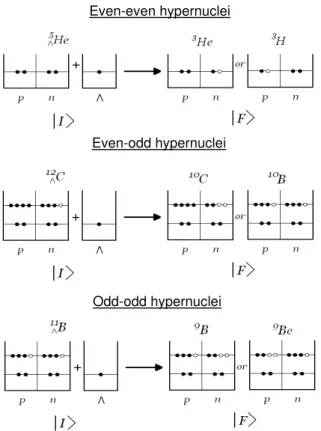
For hypernuclei with cores with full proton shells (see Fig. 1) we obtain
ri=
ci for12ΛC
3
2ci for 16
ΛO,17ΛOand28ΛSi
0 otherwise
;
ri=
ci for12ΛC
3
2ci for 16
ΛO,17ΛOand28ΛSi
0 otherwise
, (21)
forL=1 matrix elements, and wi=
3
4ci for28ΛSi
0 otherwise ; wi=
3
4ci for28ΛSi 0 otherwise ,
(22) for L=2 ones. These results show that ri/ci =rj/cj and wi/ci=wj/cj(independently of thei,jvalues) for each even-even or even-even-odd hypernuclei. One interesting question which has not been answered until this moment is: why is it so? To find the answer, we have evaluated separately the contribution of each single particle state to each one of the coefficients. We have found that the contribution of each single particle states is always a factor times the contribution of the 1s1/2 level. In fact, this factor holds 12 for 1p1/2, 1 for 1p3/2, and 34 for
1d5/2states, as can be also checked from our numerical results shown in Table I. Thus, because: i) we are working within the plain IPSM, in which the final states consist only of un-perturbedj−1
p hole states (without the inclusion of more com-plicated configurations taken into account excitations of the core); ii) we do not include FSI effects mentioned previously; and iii) we assume an exchange potential including only the contribution ofπ,η,K,ρ,ωandK∗ mesons, there is no in-terference between different single particle states, which leads directly to the results exhibit in Eqs. (21) and (22). As a con-sequence, the contribution of the 1s1/2 state factorizes, with
the same factor inω0andω1. Next, if we adopt thes-wave
approximation discussed in Ref. [33], which mainly consists in considering that: i) the liberated energy in (9) is approxi-mated by∆jp ≃∆≡MΛ−MN; ii) the decay is basically back
to back (Yκ0(0,0) = √κˆ4π); and iii) the matrix elementsT20,
S0andP10 are computed atp≃p
∆≡√MN∆and then when
I
π+Kκ (Eqs.(18) and (19)) is replaced in Eq.(17) they can be factorized out the integral, we arrive to
aπ+Λ K≃ − 2[2(3T
20
1 −T20K0)P 10
π −3(P
10
π −P10K0)S 0
1−(3P10K1+2P 10
π )S0K0] 6(3T20
1 −T20K0)
2+3(P10
π )2+3(P10K1) 2+2P10
π (2P10K1−P 10
K0) + (P 10
K0) 2+9(S0
for4ΛHe,5ΛHe,12ΛC,16ΛO,17ΛOand28ΛSi, which are all hypernu-clei with full proton shells.
On the other side, when we have an incomplete core proton shell, as happens with11
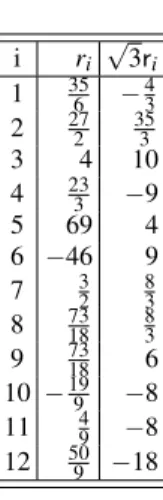
ΛB, we get the coefficients presented in Table IV. Following the same procedure as before for the even-even and even-even-odd core cases, we observe that there is not an exact factorization, due to the vacancies in the proton shell, i.e.,the value of the ratiosri/ciandrj/cjdepend now on the i,jindexes. To simplify still more the analysis, we will adopt now the one-pion-exchange model (OPEM) [41–43] which de-scribes qualitatively the physics involved in NMHD, in spite that the contribution of mesons heavier than pion are impor-tant in getting an accurate description of this decay. Within this model, thes-wave approximation leads to
aπΛ≃ − 4(1+
3
4R)Tπ20Pπ10 18(1+23
36R)(T 20
π )2+ (1+10873R)(P 10
π )2
. (23)
This result shows explicitly that the R-dependent factor is not exactly the same for all the terms, as was mentioned before, for11ΛB. This indicates that nuclear structure modifies the fac-torization, in spite that the final effect on the observables could be moderate mainly because of the rather high exchanged mo-mentum (∼400 MeV/c). With a good approximation we can consider that 34≃ 23
36≃ 73
108 (in agreement with this, from the
Table I we see that the 1p3/2 shell contribution is
approxi-mately 0.7 times the 1s1/2one) which leads to
aπΛ≃ − 4T
20
π Pπ10 18(Tπ20)2+ (P10
π )2
. (24)
This result is of general validity, in the sense that it holds for even-even, even-odd and odd-odd hypernuclei (see also our Eq. (23)). Thus, we have extended the results obtained in Ref. [33]: i) within the present IPSM formalism, which com-prises the exchange of the complete meson octet, the instrinsic asymmetry parameter will be roughly independent of the con-sidered hypernucleus; ii) the large and negative value foraΛis mainly due to the interplay between the PC tensor (T20π ) and PV dipole (P10π ) matrix elements. Our results indicate that an improvement of the IPSM is required. The present paper es-tablishes and analyzes the limitations of a shell model formal-ism for the evaluation ofaΛ, valid for all kind of hypernuclei, on which could be included missing ingredients in the future. Particularly, it will be interesting to analyze the effects of: i) mixing between the final states considered in the IPSM and/or with more complex configurations through the residual nuclear interaction; ii) modifications of the exchange potential, as for example including 2π-exchange [31], axial vector a1-meson
[32],∆T=3/2 terms coming from vector mesons, etc, and the interplay between them; iii) final state interactions. Referred to the first point, we expect only a moderate contribution be-cause of high momentum transferred. However, we believe that it would be interesting to study additional nuclear struc-ture effects in detail in the fustruc-ture. On the other side, in view of the recent relevant works from [31, 32], it would be very interesting and indispensable to decide which one of the pos-sible modifications to the exchange potential is more relevant, and what happens if one include both (2πanda1)
simultane-ously. As mentioned, this kind of studies could be performed with the present formalism as the starting in the future. Addi-tionally, in view of the large error bars exhibited by the data, it
will be very useful to have precise experimental values for dif-ferent hypernuclei (more than5ΛHe,11ΛBand12ΛC). Thus, it will be possible differentiate the effects resulting from the different modifications to the IPSM.
4. SUMMARIZING CONCLUSIONS
We have derived general analytical expressions for the evaluation of the intrinsic asymmetry parameteraΛin NMHD, within an IPSM framework, adopting the OMEM potential. Our formulae is valid for even-even, even-odd and odd-odd core hypernuclei. In agreement with other evaluations based in the OMEM, we have shown that the model predicts a large and negative value for this observable, independently of the considered hypernucleus. In order to understand the origin of this similarity in the theoretical results, we have obtained by the first time simple analytical expressions within thes-wave approximation, both forπandπ+Kexchange models, valid for all hypernucleus.
We conclude that to get compatibility between theoretical results and experimental data it will be necessary to improve the model adding other not included ingredients. Between them, we propose as an interesting issue the analysis, within a finite nucleus framework, of nuclear residual interactions ef-fects in the initial and final systems. This will allow interfer-ence terms between the contribution of different single particle states and probably will eliminate the factorization effect men-tioned above, leading to a dependence ofaΛwith the hyper-nucleus. Because we hope that this break of the factorization originated from nuclear structure effects will not have a rele-vant weight on the final value ofaΛdue to the high exchanged momentum, another possibilities should be also analyzed. Be-tween them and in agreement with recent contributions from Refs. [31, 32], a plausible possibility to avoid the mentioned simplification between the factorization inω0andω1could be
the modification of the exchange potential. This could be done, for example, adding 2π-exchange mechanism, and/or a1
me-son contribution and/or∆T=3/2 due to vector mesons to the exchange potential. Particularly, the 2πeffect on the asymme-try parameter has been recently analyzed in Ref. [31] where the authors show that an agreement between theoretical and experimental results is achieved. Also, in Ref. [32] has been shown that the contribution ofa1meson leads to numerical
Even-even hypernuclei
Odd-odd hypernuclei Even-odd hypernuclei
FIG. 1: Initial and final states contributing to the hypernuclear weak decay for even-even, even-odd and odd-odd core cases.
TABLE I: Numerical results for the intrinsic asymmetry parameter obtained within the full OMEM (ωκis given in units ofΓ0=2.5× 10⁻⁶eV). See text for detailed explanation.
4
ΛHe 5ΛHe 11ΛB 12ΛC 16ΛO 17ΛO 28ΛSi
ω0(1s1/2) 0.564 0.553 0.468 0.462 0.437 0.429 0.327
ω0(1p3/2) − − 0.340 0.508 0.481 0.471 0.359
ω0(1p1/2) − − − − 0.229 0.224 0.173
ω0(1d5/2) − − − − − − 0.281
ω0 0.564 0.553 0.808 0.970 1.148 1.124 1.140
ω1(1s1/2) −0.298 −0.297 −0.258 −0.255 −0.242 −0.233 −0.178
ω1(1p3/2) − − −0.169 −0.260 −0.248 −0.240 −0.186
ω1(1p1/2) − − − − −0.119 −0.114 −0.090
ω1(1d5/2) − − − − − − −0.139
ω1 −0.298 −0.297 −0.427 −0.515 −0.609 −0.587 −0.593 aΛ −0.529 −0.538 −0.529 −0.530 −0.530 −0.522 −0.520
5. ACKNOWLEDGMENTS
The authors are fellows of the CONICET, CCT La Plata (Argentina) and thank the support under grant PIP 06-6159.
TABLE II: Experimental data for the NMHD asymmetry parameter.
aexpΛ 4
ΛHe −
5
ΛHe 0.07±0.08+−0.080.00[14, 37] 0.11±0.08±0.04 [15, 38]
0.24±0.22 [39] 11
ΛB −0.16±0.28+−0.180.00[37] −0.20±0.26±0.04 [38]
0.28±0.14 [40] 12
ΛC −0.24±0.26+−0.080.00[14] −0.16±0.28+−0.180.00[37] −0.20±0.26±0.04 [15, 38]
0.02±0.20 [40] 16
ΛO −
17
ΛO −
28
ΛSi −
TABLE III: Numerical values of theL=0 coefficients contributing toω0andω1for all hypernuclei considered in the present work.
ω0 ω1
c1 6 √3c1 0
c2 18 √3c2 12
c3 0 √3c3 8
c4 12 √3c4 −12
c5 108 √3c5 0
c6 −72 √3c6 12
c7 2 √3c7 0
c8 6 √3c8 0
c9 6 √3c9 8
c10 −4 √3c10 0
c11 0 √
3c11 0
c12 8 √
3c12 −24
[1] G. Garbarino, A. Parre˜no and A. Ramos, Phys. Rev. Lett.91, 112501 (2003).
[2] G. Garbarino, A. Parre˜no and A. Ramos, Phys. Rev. C69, 054603 (2004).
[3] A. Feliciello, Nucl. Phys.A691, 170c (2001); P. Gianotti, Nucl. Phys.A691, 483c (2001).
[4] R.L. Gill, Nucl. Phys.A691, 180c (2001).
TABLE IV: Numerical values of theL=1 coefficients contributing toω0andω1for11ΛB hypernucleus.
i ri
√ 3ri
1 356 −43 2 272 353 3 4 10 4 233 −9 5 69 4 6 −46 9 7 32 83 8 7318 83 9 7318 6 10 −199 −8 11 49 −8 12 509 −18
[12] S. Ajimura et al., Phys. Rev. Lett.84, 4052 (2000).
[13] T. Maruta et al., Nucl. Phys.A754, 168c (2005). See also nucl-ex/0402017.
[14] H. Bhanget al., Nucl. Phys.A754, 144c (2005). [15] H. Outaet al., Nucl. Phys.A754, 157c (2005).
[16] K. Sasaki, T. Inoue and M. Oka, Nucl. Phys.A669, 331 (2000), Erratum-ibidA678, 455 (2000).
[17] J. F. Dubach, G. B. Feldman, B. R. Holstein and L. de la Torre, Ann. Phys. (N.Y.)249, 146 (1996).
[18] A. Parre˜no, A. Ramos and C. Bennhold, Phys. Rev.C56, 339 (1997) and references therein.
[19] A. Parre˜no and A. Ramos, Phys. Rev.C65, 015204 (2001). [20] C. Barbero, C. de Conti, A.P. Galeao and F. Krmpoti´c, Nucl.
Phys.A726, 267 (2003).
[21] K. Itonaga, T. Ueda and T. Motoba, Phys. Rev.C 65, 034617 (2002); K. Itonaga, T. Motoba and T. Ueda,Electrophoto Pro-duction of Strangeness on Nuand Nuclei(Sendai03), K. Maeda,
H. Tamura, S.N. nakamura and O. Hashimoto eds., World Sci-entific (2004) pp. 397-402.
[22] K. Sasaki, T. Inoue and M. Oka, Nucl. Phys.A702, 477 (2002). [23] C. Barbero, A.P. Galeao and F. Krmpoti´c, Phys. Rev. C72,
035210 (2005).
[24] C. Barbero and A. Mariano, Phys. Rev.C73, 024309 (2006). [25] C. Barbero, A.P. Galeao and F. Krmpoti´c, Braz. J. Phys.34, 822
(2004).
[26] C. Barbero, A.P. Galeao and F. Krmpoti´c, Braz. J. Phys.36, 1357 (2006).
[27] W. M. Alberico and G. Garbarino, Phys. Rep.369, 1 (2002). [28] W. M. Alberico, G. Garbarino, A. Parre˜no and A. Ramos, Phys.
Rev. Lett.94, 082501 (2005).
[29] A. Parre˜no, C. Bennhold and B.R. Holstein, Phys. Rev.C70, 051601 (2004) .
[30] K. Sasaki, M. Izaki and M. Oka, Phys. Rev.C71, 035502 (2005). [31] C. Chumillas, G. Garbarino, A. Parren˜o and A. Ramos, Phys. Lett.B657, 180 (2007); C. Chumillas, G. Garbarino, A. Parren˜o and A. Ramos, Nucl. Phys.A804, 162 (2008).
[32] K. Itonaga, T. Motoba and T. Ueda, Phys. Rev.C 77, 044605 (2008).
[33] C. Barbero, A.P. Galeao and F. Krmpoti´c Phys. Rev.C76054321 (2007).
[34] H. Nabetani, T. Ogaito, T. Sato and T. Kishimoto, Phys. Rev.
C60, 017001 (1999).
[35] A. de Shalit and I. Talmi,Nuclear Shell Theory,Academic Press New York and London, p. 189 (1963).
[36] C. Barbero, D. Horvat, F. Krmpoti´c, T.T.S. Kuo , Z. Naranˇci´c and D. Tadi´c Phys. Rev.C66055209 (2002).
[37] T. Maruta, Ph. D. thesis, KEK Report 2006-1, 2006.
[38] T. Maruta et al., nucl-ex/0402017; ibid, Nucl. Phys.A754, 168c (2005).
[39] S. Ajimura et al., Phys. Rev. Lett.84, 4052 (2000). [40] S. Ajimura et al., Phys. Lett.B282, 293 (1992).
[41] M. M. Block and H. H. Dalitz, Phys. Rev. Lett.11, 96 (1963). [42] J. B. Adams, Phys. Rev.156, 832 (1967). (Cf.correction pointed
out in Ref. [43].)