CPD
10, 665–687, 2014The role of the NwASC during the
8.2 ka Event
A. D. Tegzes et al.
Title Page
Abstract Introduction
Conclusions References
Tables Figures
◭ ◮
◭ ◮
Back Close
Full Screen / Esc
Printer-friendly Version
Interactive Discussion
Discussion
P
a
per
|
D
iscussion
P
a
per
|
Discussion
P
a
per
|
Discuss
ion
P
a
per
|
Clim. Past Discuss., 10, 665–687, 2014 www.clim-past-discuss.net/10/665/2014/ doi:10.5194/cpd-10-665-2014
© Author(s) 2014. CC Attribution 3.0 License.
Open Access
Climate of the Past
Discussions
This discussion paper is/has been under review for the journal Climate of the Past (CP). Please refer to the corresponding final paper in CP if available.
The role of the northward-directed
(sub)surface limb of the Atlantic
Meridional Overturning Circulation during
the 8.2 ka Event
A. D. Tegzes1, E. Jansen2, and R. J. Telford3
1
Uni Research and Bjerknes Centre for Climate Research, Allégaten 55, 5007 Bergen, Norway
2
Department of Earth Science and Bjerknes Centre for Climate Research, University of Bergen, Allégaten 55, 5007 Bergen, Norway
3
Department of Biology and Bjerknes Centre for Climate Research, University of Bergen, Thormøhlensgt. 53 A/B, 5006 Bergen, Norway
Received: 13 January 2014 – Accepted: 30 January 2014 – Published: 20 February 2014
Correspondence to: A. D. Tegzes ([email protected])
CPD
10, 665–687, 2014The role of the NwASC during the
8.2 ka Event
A. D. Tegzes et al.
Title Page
Abstract Introduction
Conclusions References
Tables Figures
◭ ◮
◭ ◮
Back Close
Full Screen / Esc
Printer-friendly Version
Interactive Discussion
Discussion
P
a
per
|
D
iscussion
P
a
per
|
Discussion
P
a
per
|
Discuss
ion
P
a
per
|
Abstract
The so-called “8.2 ka Event” has been widely regarded as a major climate perturba-tion over the Holocene. It is most readily identifiable in the oxygen-isotope records from Greenland ice cores as an approximately 160 yr-long cold interval between 8250– 8090 yr BP. The prevailing view has been that the cooling over Greenland, and
poten-5
tially over the northern North Atlantic at least, was triggered by the catastrophic final drainage of the Agassiz-Ojibway proglacial lake as part of the remnant Laurentide Ice Sheet collapsed over Hudson Bay at around 8420±80 yr BP. The consequent
freshen-ing of surface waters in the northern North Atlantic Ocean and the Nordic Seas resulted in weaker overturning, hence reduced northward heat transport. Here we present proxy
10
records from site JM97-MD95-2011 on the mid-Norwegian Margin indicating a (sharp) decline in the strength of the eastern branch of the Atlantic Inflow into the Nordic Seas immediatelyfollowinga uniquely large drop in (sub)surface ocean temperatures coeval with the lake outbursts. We propose that the final drainage of Lake Agassiz-Ojibway was accompanied by a major iceberg discharge from Hudson Bay, which resulted
15
in the cooling of the northward-directed northern Gulf Stream-North Atlantic Drift-Norwegian Atlantic Current system. Since our current-strength proxy records from the mid-Norwegian Margin donot evidence an exceptionally strong reduction in the main branch of the Atlantic Inflow into the Nordic Seas at the time, we argue that a chilled northward-directed (sub)surface-current system and an already colder background
cli-20
mate state could be the main factors responsible for the 8.2 ka climate perturbation.
1 Introduction
The so-called “8.2 ka Event” has been widely regarded as a major climate perturbation over the Holocene. It is most readily identifiable in the oxygen-isotope records (δ18OICE)
from Greenland ice cores (Fig. 1a and b) as an approximately 160 yr-long cold
in-25
CPD
10, 665–687, 2014The role of the NwASC during the
8.2 ka Event
A. D. Tegzes et al.
Title Page
Abstract Introduction
Conclusions References
Tables Figures
◭ ◮
◭ ◮
Back Close
Full Screen / Esc
Printer-friendly Version
Interactive Discussion
Discussion
P
a
per
|
D
iscussion
P
a
per
|
Discussion
P
a
per
|
Discuss
ion
P
a
per
|
abruptly (NGRIP1, DYE-3) or somewhat more gradually (GRIP) at around 8090±45 yr
BP (Rasmussen et al., 2006, 2007). The corresponding dates in the GISP2 ice core are 8296±166 yr BP and 8136±163 yr BP, respectively (Grootes and Stuiver, 1997;
Grootes et al., 1993; Meese et al., 1994; Steig et al., 1994; Stuiver et al., 1995). The prevailing view has been that the cooling over Greenland, and potentially over
5
the northern North Atlantic at least (Fig. 1a), was triggered by the catastrophic final drainage of the Agassiz-Ojibway meltwater lake as part of the remnant Laurentide Ice Sheet (LIS) collapsed over Hudson Bay (8470 yr BP, ±1σerror range: 8740–8160 yr
BP, Barber et al., 1999; 8420 yr BP,±1σ error range: 8500–8340 yr BP, Hillaire-Marcel
et al., 2007; Fig. 1a and b). This unleashed approximately 163 000–200 000 km3 of
10
freshwater in probably two phases (Barber et al., 1999; Teller et al., 2002) into the Labrador Sea and the northern North Atlantic Ocean (Fig. 1a and b) bringing about an abrupt slowing down of the Atlantic Meridional Overturning Circulation (AMOC), which had been dominating heat advection to high northern latitudes since the beginning of the Holocene (Risebrobakken et al., 2003c; Thomsen and Vorren, 1986).
15
Here we present new palaeoceanographic data, which show that while the eastern branch of the Atlantic Inflow into the Nordic Seas did weaken at the time, the advection of chilled waters towards high northern latitudes, due to a possible iceberg discharge from Hudson Bay (Fig. 1a and b), and an already colder background climate state (Rohling and Pälike, 2005) could be the main factors responsible for the 8.2 ka climate
20
perturbation.
2 Methods
Our interest in the strength of the eastern branch of the Atlantic Inflow (Fig. 1a) stems from the fact that at least in modern times it seems to be the main conduit for advected heat towards the Arctic (Orvik and Skagseth, 2003) and there is evidence for its
ex-25
CPD
10, 665–687, 2014The role of the NwASC during the
8.2 ka Event
A. D. Tegzes et al.
Title Page
Abstract Introduction
Conclusions References
Tables Figures
◭ ◮
◭ ◮
Back Close
Full Screen / Esc
Printer-friendly Version
Interactive Discussion
Discussion
P
a
per
|
D
iscussion
P
a
per
|
Discussion
P
a
per
|
Discuss
ion
P
a
per
|
2003c; Thomsen and Vorren, 1986; Vorren et al., 1984). Therefore, it must have played a key role in any AMOC-induced climate change.
Our choice of proxy is sortable silt, for the mean grain size of the 10–63 µm terrige-nous silt fraction (i.e. sortable silt) is thought to vary independently of sediment supply in current-sorted and deposited muds, with larger values representing relatively greater
5
near-bottom flow speeds (McCave and Hall, 2006; McCave et al., 1995). At present sortable silt offers only a qualitative record of the depositing current. It indicates when the flow might have been stronger or weaker, but it does not tell us anything about the magnitude of the changes in absolute terms. Yet, it can still provide invaluable insights into the behaviour of the eastern branch of the Norwegian Atlantic Current (NwAC,
10
Fig. 1a) preceding the “8.2 ka Event.”
IMAGES piston core MD95-2011 and box core JM97-948/2A (66◦58.19′N, 07◦38.36′E, water depth: 1048 m, Fig. 1b) were extracted from a Holocene high-accumulation area (HA) along the flow path of the eastern NwAC (Fig. 1a) at the Vøring Plateau on the mid-Norwegian Margin. Although the current has most probably not
15
been in direct contact with the HA, we think that it has indirectly influenced sedimenta-tion there and that past changes in its strength have been preserved by these deposits (Tegzes, 2013; Tegzes et al., 2014a).
The split cores were sampled at 1 cm intervals. Bulk samples were wet-sieved to sep-arate the fine (d <63 µm) from the coarse fraction (d >63 µm). The dried and
disaggre-20
gated fine fractions were subsampled and, in order to remove the biogenic component (McCave and Hall, 2006), were de-carbonated and de-silicated, using 1 M acetic acid and 2 M sodium carbonate solution, respectively. The de-carbonated and de-silicated fine fractions were stored in 0.02 M sodium polyphosphate solution in a cold room until measurement. They were then disaggregated, further subsampled and run on a
Beck-25
CPD
10, 665–687, 2014The role of the NwASC during the
8.2 ka Event
A. D. Tegzes et al.
Title Page
Abstract Introduction
Conclusions References
Tables Figures
◭ ◮
◭ ◮
Back Close
Full Screen / Esc
Printer-friendly Version
Interactive Discussion
Discussion
P
a
per
|
D
iscussion
P
a
per
|
Discussion
P
a
per
|
Discuss
ion
P
a
per
|
set to 10–63 µm, excluding the fine-silt and clay component (McCave and Hall, 2006; McCave et al., 1995).
The age-depth model was constructed using mixed-effect regression, which relies on the mid-point estimates of the calibrated ages (Heegaard et al., 2005). The two cores were treated independently. The age control for JM97-948/2A is based on nine210Pb
5
and two Accelerator Mass Spectrometry (AMS) 14C dates (Andersson et al., 2003); and it represents the last 582 yr. The age model for MD95-2011 rests on twenty-nine AMS14C dates and the presence of the Vedde ash layer (Berner et al., 2011; Dreger, 1999; Grönvold et al., 1995; Risebrobakken et al., 2011, 2003c); and covers the rest of the Holocene.
10
We present two alternative time series based on exactly the same set of measure-ments (Fig. 2). The traditionally used sortable-silt index is an arithmetic average com-puted from thedifferential volumedistribution of grains within a sample; while true mean grain size is the arithmetic average calculated from thedifferential number distribution of grains within a sample. We are inclined to think that true mean grain size is less
15
prone to random effects and better reflects changes in prevailing current conditions than the sortable-silt index (Tegzes, 2013; Tegzes et al., 2014b). Although the focus of the present study is the “8.2 ka Event,” considering the qualitative nature of sortable-silt records, in order to put the magnitude of current-strength changes at the time into a context we have also included the Late-Holocene sections of these time series for
20
reference (Tegzes, 2013; Tegzes et al., 2014a).
3 The weakening of the eastern NwAC concomitant with the lake outbursts
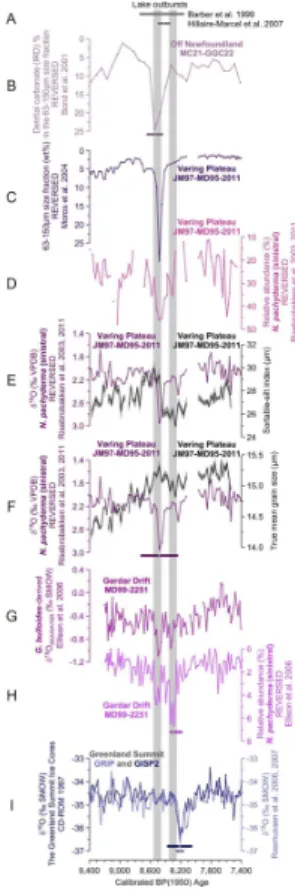
While the sortable-silt index from JM97-MD95-2011 (Vøring Plateau, mid-Norwegian Margin, Fig. 1b) shows a remarkably clear and abrupt drop between 8481–8447 yr BP (±1σerror range: 8725–8204 yr BP, Fig. 2), true mean grain size values exhibit a more
25
CPD
10, 665–687, 2014The role of the NwASC during the
8.2 ka Event
A. D. Tegzes et al.
Title Page
Abstract Introduction
Conclusions References
Tables Figures
◭ ◮
◭ ◮
Back Close
Full Screen / Esc
Printer-friendly Version
Interactive Discussion
Discussion
P
a
per
|
D
iscussion
P
a
per
|
Discussion
P
a
per
|
Discuss
ion
P
a
per
|
even more curious that the Late-Holocene segments of the respective records indicate comparable (sortable-silt index) or much larger (mean grain size) fluctuations in current strength (Fig. 2). Considering the above there exists the possibility that the change in ocean circulation preceding the “8.2 ka Event” might not have been uniquely dramatic in the context of post-deglacial conditions.
5
Nonetheless, both time series suggest that the eastern NwAC must have been over-all weaker in the Early Holocene than the Late Holocene and that it recovered much slower following the collapse of the ice dam over Hudson Bay than after much larger slowdowns over the past 4200 yr (Fig. 2). Whether this was due to the initial instability of the current in the Early Holocene or the nature of the forcing is difficult to tell.
10
We will first focus on the traditionally used sortable-silt-index time series and its relationship to other records from the same core.
4 The relative timing of events at the Vøring Plateau
Of the planktic foraminiferan species Neogloboquadrina pachydermahas been anal-ysed for oxygen isotopes (Risebrobakken et al., 2011, 2003c), but only its sinistral
15
(deep-dwelling) morphotype record (δ18ONPS) shows a uniquely large abrupt positive
excursion with respect to the entire Holocene within the interval of interest (Fig. 4b and c). This variant calcifies earlier in the season than its dextral morphotype and likely records winter-time or at least mean annual conditions (Andersson et al., 2010). We think that due to its depth habitat and reproductive seasonN. pachydermasinistral is
20
probably more sensitive to changes in the core temperatures of the eastern NwAC. JM97-MD95-2011 (Vøring Plateau, mid-Norwegian Margin, Fig. 1b) has been refer-enced in several papers (e.g. LeGrande and Schmidt, 2008; LeGrande et al., 2006; Rohling and Pälike, 2005) as one of the few “North-Atlantic” marine cores that ac-tually recorded the “8.2 ka Event.” However, it is important to note the timing of this
25
sharp and short-lived positive excursion in δ18ONPS (between 8516 and 8412 yr BP,
CPD
10, 665–687, 2014The role of the NwASC during the
8.2 ka Event
A. D. Tegzes et al.
Title Page
Abstract Introduction
Conclusions References
Tables Figures
◭ ◮
◭ ◮
Back Close
Full Screen / Esc
Printer-friendly Version
Interactive Discussion
Discussion
P
a
per
|
D
iscussion
P
a
per
|
Discussion
P
a
per
|
Discuss
ion
P
a
per
|
estimates for the timing of the final drainage of Lake Agassiz-Ojibway [8470 yr BP,
±1σerror range: 8740–8160 yr BP (Barber et al., 1999); and 8420 yr BP, ±1σerror
range: 8500–8340 yr BP (Hillaire-Marcel et al., 2007); Fig. 3a] than the cooling as recorded in Greenland ice (between 8250±49 and 8090±45 yr BP, Rasmussen et al.,
2006, 2007, Fig. 3i).
5
More importantly, the sortable-silt index from the same core (i.e. we cannot invoke age-model uncertainties) shows an abrupt drop succeeding the sharp increase in
δ18ONPS(Fig. 3e). Therefore, at least initially, the latter cannot indicate surface cooling
triggered by the slowing down of the current. Moreover, while it takes about a millen-nium for the current-strength proxy to recover, oxygen-isotope values need less than
10
a century.
The record of the relative abundance of N. pachyderma sinistral in the core has lower resolution over the interval of interest, thus we do not know whether it would show a short-lived anomaly around 8200 yr BP (Fig. 3d). Nonetheless, it seems that the
δ18ONPSspike coincides with a somewhat broader maximum in the relative abundance
15
of N. pachyderma sinistral (Fig. 3d and e). However, this is not unique with respect to the Holocene (Fig. 4a). Hence, the question remains what the sharp but transient increase inδ18ONPSvalues could represent.
5 The possibility of re-sedimentation
Rumohr et al. (2001) found evidence for older allochthonous specimens ofN.
pachy-20
dermasinistral indeglacial deposits at the peripheral parts of the HA. They were not able to correlate short-term oxygen-isotope signatures in adjacent cores tens of kilo-metres apart and what they considered anomalous values closely related to increased sand content.
The δ18ONPS spike in MD95-2011 (Fig. 4b) (Risebrobakken et al., 2011, 2003c)
25
CPD
10, 665–687, 2014The role of the NwASC during the
8.2 ka Event
A. D. Tegzes et al.
Title Page
Abstract Introduction
Conclusions References
Tables Figures
◭ ◮
◭ ◮
Back Close
Full Screen / Esc
Printer-friendly Version
Interactive Discussion
Discussion
P
a
per
|
D
iscussion
P
a
per
|
Discussion
P
a
per
|
Discuss
ion
P
a
per
|
weight percent of grains larger than 150 µm (Fig. 4f) is due to an abrupt increase in both the ice-rafted debris (IRD, Fig. 4g) and N. pachyderma sinistral (Fig. 4h) and
dextral (Fig. 4i) content of the sediment (B. Risebrobakken, personal communication, 2012; Risebrobakken et al., 2003c). Peak values in IRD count (B. Risebrobakken, per-sonal communication, 2012) are comparable to those in deposits of Last Glacial
Maxi-5
mum (LGM) age at a nearby site (MD95-2010, Vøring Plateau, mid-Norwegian Margin) (Dokken and Jansen, 1999). This could all be indicative of re-working at the HA.
Nevertheless, the sortable-silt index, which is the volume-percent-weighted arith-metic average of the 10–63 µm terrigenous silt fraction, does not show a significant increase coincident with the coarse fraction, only a marked drop 1 cm up in the core
10
(Fig. 4k). We would assume that if some process had transported allochthonous foraminiferans and coarser grains to our site, it would also have rendered the sortable-silt fraction much coarser. Since the two grain-size categories do not exhibit the same trend they must have been influenced by independent processes such as changes in the strength of the eastern NwAC (Fig. 1a) and ice rafting, as originally proposed by
15
Moros et al. (2004), and theδ18ONPSspike (Fig. 4b) should therefore represent a
cli-mate signal.
6 The lake-outburst theory
Model simulations can systematically reproduce a major reduction in the AMOC by in-jecting freshwater either into Hudson Bay or the Labrador Sea (Fig. 1a) (e.g. LeGrande
20
et al., 2006; Renssen et al., 2001). However, most experiments are initialised from a state where similarly to the present there is intermediate water formation in the Labrador Sea (for an exception see LeGrande and Schmidt, 2008). Yet, winter con-vection was unlikely to have occurred there before 7000 yr BP (Hillaire-Marcel et al., 2007). This means that if the final drainage of the proglacial lake did cause the AMOC to
25
CPD
10, 665–687, 2014The role of the NwASC during the
8.2 ka Event
A. D. Tegzes et al.
Title Page
Abstract Introduction
Conclusions References
Tables Figures
◭ ◮
◭ ◮
Back Close
Full Screen / Esc
Printer-friendly Version
Interactive Discussion
Discussion
P
a
per
|
D
iscussion
P
a
per
|
Discussion
P
a
per
|
Discuss
ion
P
a
per
|
deep-convection sites in the Nordic Seas (Fig. 1a) without being diluted, by mixing with ambient waters, to the extent that it could no longer affect the overturning circulation.
While most studies focus on the meltwater contained by Lake Agassiz-Ojibway (Fig. 1b), according to Barber et al. (1999) more than 50 % of the 500 000 km3of fresh-water displaced around the time of the lake outbursts had been locked up in the ice
5
dam over Hudson Bay (Fig. 1a and b). According to Dyke et al. (2004) the incursion of the Tyrrell Sea into southern Hudson Bay following the second drainage event was virtually instantaneous. Therefore, there exists the possibility that the ice dam did not simply melt away, but physically disintegrated concomitant with the lake outbursts and potentially large amounts of ice were exported via Hudson Strait and transported in the
10
Labrador Current into the northern North Atlantic Ocean (Fig. 1a and b). This could have relevance not only to the nature (icebergs vs. floodwaters) and magnitude, but also to the temporal evolution of the freshwater forcing as the ice could not have left Hudson Strait as rapidly as the meltwater from the lake (Fig. 1a and b) (Barber et al., 1999). In addition, if routed into the northern Gulf Stream-North Atlantic Drift system
15
(Fig. 1a), icebergs could ensure that the freshwater discharge survived further north as a concentrated pool, making it more likely that it could affect the high-latitude deep-convection sites.
7 Evidence for increased ice rafting offNewfoundland around 8500 yr BP
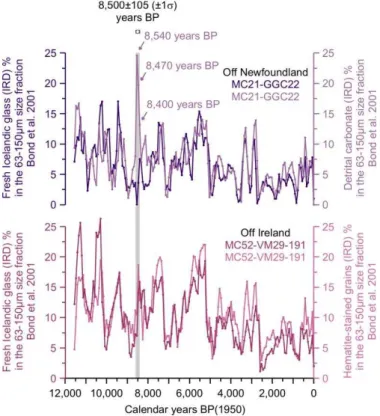
According to Bond et al. (2001) the percentages of certain lithic grain species, namely
20
of hematite-stained grains (HGS), fresh Icelandic volcanic glass (IG), and detrital car-bonate (DC), in the 63–150 µm size fraction of marine sediments in the northern North Atlantic are particularly sensitive indicators of the amounts and trajectories of glacial ice and/or sea ice circulating in surface waters. Such records from sediment cores VM28-14 (Denmark Strait, Fig. 1b), MC52-VM29-191 (Rockall Trough, off
Ire-25
CPD
10, 665–687, 2014The role of the NwASC during the
8.2 ka Event
A. D. Tegzes et al.
Title Page
Abstract Introduction
Conclusions References
Tables Figures
◭ ◮
◭ ◮
Back Close
Full Screen / Esc
Printer-friendly Version
Interactive Discussion
Discussion
P
a
per
|
D
iscussion
P
a
per
|
Discussion
P
a
per
|
Discuss
ion
P
a
per
|
quasi-synchronous multi-centennial fluctuations in drift ice across the region (Bond et al., 2001).
The large detrital-carbonate peak in MC21-GGC22 (44◦18′N, 46◦16′W, water depth: 3958 m, Fig. 1b, Fig. 5) at around 8500±105 (±1σ) yr BP (the closest dated horizon
in the core), however, breaks this pattern. We propose that this represents an interval
5
of increased ice rafting from Hudson Bay (Fig. 1a and b). The question is: could these icebergs drift towards the Nordic Seas (Fig. 1a) and affect the deep-convection sites there?
In a modern-day context site MC21-GGC22 is located east of the Newfoundland Shelf in the deep ocean right below the flow path of the northern Gulf Stream (Fig. 1a
10
and b). In addition, the prominent peak in the detrital-carbonate record from this loca-tion falls within dating uncertainties of theδ18ONPSspike in JM97-MD95-2011 (Vøring
Plateau, mid-Norwegian Margin, Figs. 1b, 3b and e). This could be indicative that as the ice dam over Hudson Bay was disintegrating the icebergs discharged were at least partly routed into the northern Gulf Stream-North Atlantic Current-Norwegian Atlantic
15
Current system (Fig. 1a and b). As they drifted north they not only freshened but also significantly cooled (sub)surface waters (Wiersma and Jongma, 2010).
As we have noted already in a different context the dry-weight percent of the coarse fraction in JM97-MD95-2011 (Fig. 1b) (Moros et al., 2004; M. Moros, personal com-munication, 2012) shows a unique, strikingly large maximum in perfect
synchrone-20
ity with δ18ONPS, meaning that it also increases sharply preceding the abrupt drop
in the sortable-silt index (Fig. 3c and e). X-ray diffractometry-based estimates of the quartz/plagioclase ratio (Moros et al., 2004) and IRD counts in the>150 µm size frac-tion (B. Risebrobakken, personal communicafrac-tion, 2012) confirm that the abrupt coars-ening of the sediment reflects an interval of increased ice rafting around 8481 yr BP
25
CPD
10, 665–687, 2014The role of the NwASC during the
8.2 ka Event
A. D. Tegzes et al.
Title Page
Abstract Introduction
Conclusions References
Tables Figures
◭ ◮
◭ ◮
Back Close
Full Screen / Esc
Printer-friendly Version
Interactive Discussion
Discussion
P
a
per
|
D
iscussion
P
a
per
|
Discussion
P
a
per
|
Discuss
ion
P
a
per
|
on the mid-Norwegian Margin (Fig. 3c) must have had a more local source. Neverthe-less, it could still be a consequence of the advection of colder waters to high northern latitudes.
A colder Atlantic Inflow (Fig. 1a) could initially significantly reduce the temperature gradient across the Nordic Seas (Fig. 1a) thus weakening the local anticyclonic
atmo-5
spheric circulation pattern centred on Greenland. This could result in a less directional southward transport of icebergs from the Arctic through the Fram Strait in the East Greenland Current (EGC, Fig. 1a), which could thus more easily drift into the eastern Nordic Seas (Fig. 1a). A colder NwAC (Fig. 1a) could ensure a greater survival rate of icebergs further south. However, as explained below, as the permanent ice cover
10
started extending southeastwards in the western Nordic Seas and as the iceberg dis-charge from Hudson Bay ceased the trend in atmospheric circulation around Green-land was reversed and the icebergs originating from the Arctic and the western Nordic Seas no longer affected the mid-Norwegian Margin. This could also explain the coinci-dence of theδ18ONPSspike with the maximum in the coarse fraction of the sediment in
15
JM97-MD95-2011 (Fig. 3c and e).
8 The double-pulse nature of (sub)surface-ocean cooling
We have argued, based on existing chronology, that the prominent spike in the foraminiferan oxygen-isotope time series from our site is likely not the cold event recorded in Greenland ice.δ18ONPSvalues from JM97-MD95-2011 do show a second
20
positive excursion (8269–8198 yr BP,±1σerror range: 8445–8029 yr BP) immediately
following the minimum in mean grain size (Fig. 3f). However, since this second spike does not exceed noise level in the oxygen-isotope record, it is defined by only a sin-gle data point and we cannot back it up with a synchronous increase in the relative abundance ofN. pachyderma sinistral because of an unfortunate gap in that time
se-25
ries (Fig. 3d), we cannot attribute any significance to this second positive excursion in
CPD
10, 665–687, 2014The role of the NwASC during the
8.2 ka Event
A. D. Tegzes et al.
Title Page
Abstract Introduction
Conclusions References
Tables Figures
◭ ◮
◭ ◮
Back Close
Full Screen / Esc
Printer-friendly Version
Interactive Discussion
Discussion
P
a
per
|
D
iscussion
P
a
per
|
Discussion
P
a
per
|
Discuss
ion
P
a
per
|
Nevertheless, Ellison et al. (2006b) identified two uniquely large, closely-paced (sub)surface ocean cooling events in the Early-Holocene part of their foraminiferan abundance record (Fig. 3h) from site MD99-2251 (Gardar Drift, Fig. 1b) in the sub-polar North Atlantic. The first of these coincides within dating uncertainties with the lake outbursts (Fig. 3a) and peak iceberg discharge (Fig. 3b) accompanying the
col-5
lapse of the ice dam over Hudson Bay, similarly to the cooling recorded in the oxygen-isotope composition ofN. pachydermasinistral in JM97-MD95-2011 (Vøring Plateau, mid-Norwegian Margin, Fig. 3f). The second (sub)surface ocean cooling event at site MD99-2251 (Gardar Drift, Fig. 3h) appears to be significantly younger (Hillaire-Marcel et al., 2007), and better corresponds with the cooling over Greenland (Fig. 3i).
There-10
fore, we propose that the first positive excursion in the relative abundance ofN. pachy-derma(sinistral) in MD99-2251 reflects only the initial change in upper-ocean condi-tions, which led to or at least played a role in the subsequent climate perturbation, while the second maximum reflects the climate perturbation itself.
Estimates of coeval seawater oxygen-isotope compositions (δ18OSEAWATER, Fig. 3g)
15
(Ellison et al., 2006b) suggest that in both cases upper-ocean cooling was accompa-nied by surface-water freshening at site MD99-2251 (Fig. 1b). The combined impact of floodwaters and melting icebergs originating from Hudson Bay (Fig. 1a and b) could easily explain the first minimum in δ18OSEAWATER. Although it is highly speculative,
concomitant with colder climate conditions, a potentially more southerly permanent
20
sea-ice extent and changed atmospheric circulation patterns, increased Arctic drift-ice export into the subpolar North Atlantic (Bond et al., 2001) could account for the second surface-water freshening event.
Kleiven et al. (2008) found that applying a marine reservoir age correction of zero (∆R=0) throughout the interval of interest when calibrating radiocarbon dates from
25
sediment core MD03-2665 (Eirik Drift, Fig. 1b) from the Labrador Sea south of the tip of Greenland led to reversals in their age model coincident with pronounced max-ima in planktonic δ18ONPS values (not shown). They attributed this to an increased
CPD
10, 665–687, 2014The role of the NwASC during the
8.2 ka Event
A. D. Tegzes et al.
Title Page
Abstract Introduction
Conclusions References
Tables Figures
◭ ◮
◭ ◮
Back Close
Full Screen / Esc
Printer-friendly Version
Interactive Discussion
Discussion
P
a
per
|
D
iscussion
P
a
per
|
Discussion
P
a
per
|
Discuss
ion
P
a
per
|
the second surface-water freshening event at site MD99-2251 (Gardar Drift, Fig. 1b). Stronger northerly winds could spread drift ice into the subpolar North Atlantic, which could both further cool (in addition to a general decrease in surface temperatures) and freshen the Subpolar Gyre (SPG). However, there exist no palaeo-salinity time series from MD03-2665 to confirm this.
5
Contrary to the unequivocal uniqueness of the twin-maxima in the relative abun-dance ofN. pachydermasinistral in MD99-2251 (Fig. 3h) the significance of the sec-ond δ18OSEAWATER minimum in particular is more difficult to judge due to the limited
length of the published record (Fig. 3g) (Ellison et al., 2006b). While the decrease in
δ18OSEAWATERvalues coincident with the first abrupt increase in the relative abundance
10
ofN. pachyderma sinistral is 0.75 ‰, it is “only” 0.41 ‰ concomitant with the second sharp positive excursion in the temperature proxy. It is also more difficult to pinpoint the start of the second event in the oxygen-isotope record (Fig. 3g). Hence, it could be less significant.
9 Concluding remarks
15
We propose that the final drainage of Lake Agassiz-Ojibway was accompanied by a major iceberg discharge from Hudson Bay (Bond et al., 2001), which resulted in the cooling of the northward-directed northern Gulf Stream-North Atlantic Drift-Norwegian Atlantic Current system. Since our current-strength proxy records from the mid-Norwegian Margin donot evidence an exceptionally strong reduction in the main
20
branch of the Atlantic Inflow into the Nordic Seas at the time, we argue that a chilled northward-directed (sub)surface-current system could ultimately be responsible for the 8.2 ka climate perturbation. It could contribute to the thickening and expansion of Arctic sea ice, leading to a faster increase in surface albedo and a more effective insulation of the ocean from the atmosphere. Furthermore, the colder initial background climate
25
CPD
10, 665–687, 2014The role of the NwASC during the
8.2 ka Event
A. D. Tegzes et al.
Title Page
Abstract Introduction
Conclusions References
Tables Figures
◭ ◮
◭ ◮
Back Close
Full Screen / Esc
Printer-friendly Version
Interactive Discussion
Discussion
P
a
per
|
D
iscussion
P
a
per
|
Discussion
P
a
per
|
Discuss
ion
P
a
per
|
event. With surface waters already closer to their freezing point a colder Atlantic Inflow could more easily trigger widespread sea-ice growth.
Acknowledgements. This research was carried out within the framework of the ESF Euro-MARC project AMOCINT funded by the Research Council of Norway under the NORKLIMA programme and by the Bjerknes Centre for Climate Research (BCCR). The authors would like
5
to thank Bjørg Risebrobakken, Carin Andersson, Claude Hillaire-Marcel, Matthias Moros, Dag Inge Blindheim and Tor Mjell for thoughtful discussions; Bjørg Risebrobakken and Carin Ander-sson for their constructive comments that led to an improved manuscript; Dag Inge Blindheim for laboratory assistance; Bjørg Risebrobakken, Carin Andersson, Matthias Moros and Helga Flesche Kleiven for making their data available and to all colleagues who published their data
10
via the IGBP PAGES/World Data Center for Paleoclimatology and the PANGAEA information system.
References
Andersson, C., Risebrobakken, B., Jansen, E., and Dahl, S. O.: Late Holocene surface ocean conditions of the Norwegian Sea (Vøring Plateau), Paleoceanography, 18, 1044,
15
doi:10.1029/2001PA000654, 2003.
Andersson, C., Pausata, F. S. R., Jansen, E., Risebrobakken, B., and Telford, R. J.: Holocene trends in the foraminifer record from the Norwegian Sea and the North Atlantic Ocean, Clim. Past, 6, 179–193, doi:10.5194/cp-6-179-2010, 2010.
Barber, D. C., Dyke, A., Hillaire-Marcel, C., Jennings, A. E., Andrews, J. T., Kerwin, M. W.,
20
Bilodeau, G., McNeely, R., Southon, J., Morehead, M. D., and Gagnon, J. M.: Forcing of the cold event of 8200 years ago by catastrophic drainage of Laurentide lakes, Nature, 400, 344–348, 1999.
Berner, K. S., Koç, N., Godtliebsen, F., and Divine, D.: Holocene climate variability of the Nor-wegian Atlantic Current during high and low solar insolation forcing, Paleoceanography, 26,
25
PA2220, doi:10.1029/2010PA002002, 2011.
CPD
10, 665–687, 2014The role of the NwASC during the
8.2 ka Event
A. D. Tegzes et al.
Title Page
Abstract Introduction
Conclusions References
Tables Figures
◭ ◮
◭ ◮
Back Close
Full Screen / Esc
Printer-friendly Version
Interactive Discussion
Discussion
P
a
per
|
D
iscussion
P
a
per
|
Discussion
P
a
per
|
Discuss
ion
P
a
per
|
Bond, G. C., Kromer, B., Beer, J., Muscheler, R., Evans, M. N., Showers, W., Hoffmann, S., Lotti-Bond, R., Hajdas, I., and Bonani, G.: North Atlantic Holocene Drift Ice Proxy Data, IGBP PAGES/World Data Center for Paleoclimatology, Data Contribution Series # 2008-018, NOAA/NCDC Paleoclimatology Program, Boulder CO, USA, 2008.
Dokken, T. M. and Jansen, E.: Rapid changes in the mechanism of ocean convection during
5
the last glacial period, Nature, 401, 458–461, 1999.
Dreger, D.: Decadal-to-Centennial-Scale Sediment Records of Ice Advance on the Barents Shelf and Meltwater Discharge Into the Northeastern Norwegian Sea Over the Last 40 kyr, Ph.D. thesis, Christian-Albrechts-Universität, Kiel, Germany, 80 pp., 1999.
Dyke, A. S., Ehlers, J., and Gibbard, P. L.: An outline of North American deglaciation with
em-10
phasis on central and northern Canada, in: Developments in Quaternary Sciences, Elsevier, Amsterdam, Boston, Heidelberg, London, New York, Oxford, Paris, San Diego, San Fran-cisco, Singapore, Sydney, Tokyo, 2004.
Ellison, C. R. W., Chapman, M. R., and Hall, I. R.: 8200 BP Event Foraminifer Data and Win-ter/Summer SST Reconstruction, IGBP PAGES/World Data Center for Paleoclimatology,
15
Data Contribution Series # 2006-065, NOAA/NCDC Paleoclimatology Program, Boulder CO, USA, 2006a.
Ellison, C. R. W., Chapman, M. R., and Hall, I. R.: Surface and deep ocean interactions during the cold climate event 8200 years ago, Science, 312, 1929–1932, 2006b.
Grönvold, K., Óskarsson, N., Johnsen, S. J., Clausen, H. B., Hammer, C. U., Bond, G., and
20
Bard, E.: Ash layers from Iceland in the Greenland GRIP ice core correlated with oceanic and land sediments, Earth Planet. Sc. Lett., 135, 149–155, 1995.
Grootes, P. M. and Stuiver, M.: Oxygen 18/16 variability in Greenland snow and ice with 10−3 to 105year time resolution, J. Geophys. Res., 102, 26455–26470, 1997.
Grootes, P. M., Stuiver, M., White, J. W. C., Johnsen, S., and Jouzel, J.: Comparison of
oxy-25
gen isotope records from the GISP2 and GRIP Greenland ice cores, Nature, 366, 552–554, 1993.
Heegaard, E., Birks, H. J. B., and Telford, R. J.: Relationships between calibrated ages and depth in stratigraphical sequences: an estimation procedure by mixed-effect regression, Holocene, 15, 612–618, 2005.
30
CPD
10, 665–687, 2014The role of the NwASC during the
8.2 ka Event
A. D. Tegzes et al.
Title Page
Abstract Introduction
Conclusions References
Tables Figures
◭ ◮
◭ ◮
Back Close
Full Screen / Esc
Printer-friendly Version
Interactive Discussion
Discussion
P
a
per
|
D
iscussion
P
a
per
|
Discussion
P
a
per
|
Discuss
ion
P
a
per
|
Holtedahl, H.: Distribution and origin of surface sediments on the Norwegian continental margin between 62◦N and 65◦N, with some remarks on the Late Quaternary litho- and
biostratig-raphy, in: The Norwegian Coastal Current, edited by: Sætre, R. and Mork, M., University of Bergen, Bergen, 1981.
Kleiven, H. F., Kissel, C., Laj, C., Ninnemann, U. S., Richter, T. O., and Cortijo, E.: Reduced
5
North Atlantic deep water coeval with the glacial Lake Agassiz freshwater outburst, Science, 319, 60–64, 2008.
LeGrande, A. N. and Schmidt, G. A.: Ensemble, water isotope-enabled, coupled gen-eral circulation modeling insights into the 8.2 ka event, Paleoceanography, 23, PA3207, doi:10.1029/2008PA001610, 2008.
10
LeGrande, A. N., Schmidt, G. A., Shindell, D. T., Field, C. V., Miller, R. L., Koch, D. M., Falu-vegi, G., and Hoffmann, G.: Consistent simulations of multiple proxy responses to an abrupt climate change event, P. Natl. Acad. Sci. USA, 103, 837–842, 2006.
McCave, I. N. and Hall, I. R.: Size sorting in marine muds: processes, pitfalls, and prospects for paleoflow-speed proxies, Geochem. Geophy. Geosy., 7, Q10N05,
15
doi:10.1029/2008PA001610, 2006.
McCave, I. N., Manighetti, B., and Robinson, S. G.: Sortable silt and fine sediment size/composition slicing: parameters for palaeocurrent speed and palaeoceanography, Pa-leoceanography, 10, 593–610, 1995.
Meese, D. A., Alley, R. B., Fiacco, R. J., Germani, M. S., Gow, A. J., Grootes, P. M., Illing,
20
M., Mayewski, P. A., Morrison, M. C., Ram, M., Taylor, K. C., Yang, Q., and Zielinski, G. A.: Preliminary depth-agescale of the GISP2 ice core, Special CRREL Report 94-1, USA, 1994. Moros, M., Emeis, K., Risebrobakken, B. R., Snowball, I., Kuijpers, A., McManus, J., and
Jansen, E.: Sea surface temperatures and ice rafting in the Holocene North Atlantic: cli-mate influences on northern Europe and Greenland, Quaternary Sci. Rev., 23, 2113–2126,
25
2004.
Orvik, K. A. and Niiler, P.: Major pathways of Atlantic water in the northern North Atlantic and Nordic Seas toward Arctic, Geophys. Res. Lett., 29, 1896, doi:10.1029/2002GL015002, 2002.
Orvik, K. A. and Skagseth, Ø.: The impact of the wind stress curl in the North Atlantic on
30
CPD
10, 665–687, 2014The role of the NwASC during the
8.2 ka Event
A. D. Tegzes et al.
Title Page
Abstract Introduction
Conclusions References
Tables Figures
◭ ◮
◭ ◮
Back Close
Full Screen / Esc
Printer-friendly Version
Interactive Discussion
Discussion
P
a
per
|
D
iscussion
P
a
per
|
Discussion
P
a
per
|
Discuss
ion
P
a
per
|
Rasmussen, S. O., Andersen, K. K., Svensson, A. M., Steffensen, J. P., Vinther, B. M., Clausen, H. B., Siggaard-Andersen, M. L., Johnsen, S. J., Larsen, L. B., Dahl-Jensen, D., Bigler, M., Röthlisberger, R., Fischer, H., Goto-Azuma, K., Hansson, M. E., and Ruth, U.: A new Greenland ice core chronology for the last glacial termination, J. Geophys. Res., 111, D06102, doi:10.1029/2005JD006079, 2006.
5
Rasmussen, S. O., Vinther, B. M., Clausen, H. B., and Andersen, K. K.: Early Holocene climate oscillations recorded in three Greenland ice cores, Quaternary Sci. Rev., 26, 1907–1914, 2007.
Renssen, H., Goosse, H., Fichefet, T., and Campin, J.-M.: The 8.2 ka BP event simulated by a Global Atmosphere-Sea-Ice-Ocean Model, Geophys. Res. Lett., 28, 1567–1570, 2001.
10
Risebrobakken, B., Jansen, E., Andersson, C., Mjelde, E., and Hevrøy, K.: Foraminifera abun-dance and sea-surface temperature of sediment core JM97-948/2A, PANGAEA/ICSU World Data System, Bremen, Bremerhaven, doi:10.1594/PANGAEA.510801, 2003a.
Risebrobakken, B., Jansen, E., Andersson, C., Mjelde, E., and Hevrøy, K.: Foraminiferal abun-dance and sea-surface temperature of sediment core MD95-2011, PANGAEA/ICSU World
15
Data System, Bremen, Bremerhaven, doi:10.1594/PANGAEA.510781, 2003b.
Risebrobakken, B., Jansen, E., Andersson, C., Mjelde, E., and Hevrøy, K.: A high-resolution study of Holocene paleoclimatic and paleoceanographic changes in the Nordic Seas, Paleo-ceanography, 18, 1017, doi:10.1029/2002PA000764, 2003c.
Risebrobakken, B., Jansen, E., Andersson, C., Mjelde, E., and Hevrøy, K.: Stable oxygen
iso-20
topes on foraminifera of sediment core JM97-948/2A, PANGAEA/ICSU World Data System, Bremen, Bremerhaven, doi:10.1594/PANGAEA.510799, 2003d.
Risebrobakken, B., Jansen, E., Andersson, C., Mjelde, E., and Hevrøy, K.: Stable oxygen iso-topes on planktic foraminifera of sediment core MD95-2011, PANGAEA/ICSU World Data System, Bremen, Bremerhaven, doi:10.1594/PANGAEA.510782, 2003e.
25
Risebrobakken, B., Dokken, T., Smedsrud, L. H., Andersson, C., Jansen, E., Moros, M., and Ivanova, E. V.: Early Holocene temperature variability in the Nordic Seas: the role of oceanic heat advection vs. changes in orbital forcing, Paleoceanography, 26, PA4206, doi:10.1029/2011PA002117, 2011.
Rohling, E. J. and Pälike, H.: Centennial-scale climate cooling with a sudden cold event around
30
CPD
10, 665–687, 2014The role of the NwASC during the
8.2 ka Event
A. D. Tegzes et al.
Title Page
Abstract Introduction
Conclusions References
Tables Figures
◭ ◮
◭ ◮
Back Close
Full Screen / Esc
Printer-friendly Version
Interactive Discussion
Discussion
P
a
per
|
D
iscussion
P
a
per
|
Discussion
P
a
per
|
Discuss
ion
P
a
per
|
Rumohr, J., Blaume, F., Erlenkeuser, H., Fohrmann, H., Hollender, F.-J., Mienert, J., and Schäfer-Neth, C.: Records and processes of near-bottom sediment transport along the Norwegian-Greenland Sea margins during Holocene and Late Weichselian (Termination I) times, in: The Northern North Atlantic: A Changing Environment, edited by: Schäfer, P., Ritzrau, W., Schlüter, M., and Thiede, J., Springer, Berlin, 2001.
5
Ryan, W. B. F., Carbotte, S. M., Coplan, J. O., O’Hara, S., Melkonian, A., Arko, R., Weis-sel, R. A., Ferrini, V., Goodwillie, A., Nitsche, F., Bonczkowski, J., and Zemsky, R.: Global multi-resolution topography synthesis, Geochem. Geophy. Geosy., 10, Q03014, doi:10.1029/2008GC002332, 2009.
Steig, E. J., Grootes, P. M., and Stuiver, M.: Seasonal precipitation timing and ice core records,
10
Science, 266, 1885–1886, 1994.
Stuiver, M., Grootes, P. M., and Braziunas, T. F.: The GISP2δ18O climate record of the past 16 500 years and the role of the Sun, ocean, and volcanoes, Quaternary Res., 44, 341–354, 1995.
Tegzes, A. D.: The Main Branch of the Atlantic Inflow into the Nordic Seas over the Holocene:
15
An Analysis of Its Longer-Term Behaviour and Its Potential Impact on Climate, Doctoral dis-sertation, University of Bergen, Bergen, 67 pp., 2013.
Tegzes, A. D., Jansen, E., and Telford, R. J.: Reconstructing variations in the strength of the main branch of the Norwegian Atlantic Current over the Late Holocene using grain-size pa-rameters, Paleoceanography, resubmitted, 2014a.
20
Tegzes, A. D., Jansen, E., and Telford, R. J.: The traditionally used sortable-silt index or true mean grain size is the better proxy for palaeo-current strength?, Sedimentology, in review, 2014b.
Teller, J. T., Leverington, D. W., and Mann, J. D.: Freshwater outbursts to the oceans from glacial Lake Agassiz and their role in climate change during the last deglaciation, Quaternary Sci.
25
Rev., 21, 879–887, 2002.
Thomsen, E. and Vorren, T. O.: Macrofaunal palaeoecology and stratigraphy in late quaternary shelf sediments offNorthern Norway, Palaeogeogr. Palaeocl., 56, 103–150, 1986.
Vorren, T. O., Hald, M., and Thomsen, E.: Quaternary sediments and environments on the continental shelf offnorthern Norway, Mar. Geol., 57, 229–257, 1984.
30
CPD
10, 665–687, 2014The role of the NwASC during the
8.2 ka Event
A. D. Tegzes et al.
Title Page
Abstract Introduction
Conclusions References
Tables Figures
◭ ◮
◭ ◮
Back Close
Full Screen / Esc
Printer-friendly Version
Interactive Discussion
Discussion
P
a
per
|
D
iscussion
P
a
per
|
Discussion
P
a
per
|
Discuss
ion
P
a
per
|
CPD
10, 665–687, 2014The role of the NwASC during the
8.2 ka Event
A. D. Tegzes et al.
Title Page
Abstract Introduction
Conclusions References
Tables Figures
◭ ◮
◭ ◮
Back Close
Full Screen / Esc
Printer-friendly Version
Interactive Discussion
Discussion
P
a
per
|
D
iscussion
P
a
per
|
Discussion
P
a
per
|
Discuss
ion
P
a
per
|
CPD
10, 665–687, 2014The role of the NwASC during the
8.2 ka Event
A. D. Tegzes et al.
Title Page
Abstract Introduction
Conclusions References
Tables Figures
◭ ◮
◭ ◮
Back Close
Full Screen / Esc
Printer-friendly Version
Interactive Discussion
Discussion
P
a
per
|
D
iscussion
P
a
per
|
Discussion
P
a
per
|
Discuss
ion
P
a
per
|
ars elo the re ords de ote the ± σ
Fig. 3. The possible sequence of events following the collapse of the ice dam over Hudson Bay.(A)Lake outbursts (Barber et al., 1999; Hillaire-Marcel et al., 2007);(B)ice rafting offNewfoundland (Bond et al., 2008);(C)ice rafting at the mid-Norwegian Margin (unknown source) (M. Moros, personal communication, 2012);(D)the broader (climate) anomaly with maximum (sub)surface ocean cooling at 8481±201 yr BP at the mid-Norwegian Margin (Risebrobakken et al., 2003a, b);(E)the unique, abrupt (sub)surface-ocean cooling event at 8481±201 yr BP at the mid-Norwegian Margin (Risebrobakken et al., 2003e) and the slowing down of the eastern NwAC as suggested by changes in thesortable-silt index;(F)the unique, abrupt (sub)surface-ocean cooling event at 8481±201 yr BP at the mid-Norwegian Margin (Risebrobakken et al., 2003e) and the slowing down of the eastern NwAC as suggested by variations
intrue mean grain size;(G)the twin surface-ocean freshening events at Gardar Drift in the subpolar North Atlantic (Ellison et al., 2006a);(H)the unique twin
CPD
10, 665–687, 2014The role of the NwASC during the
8.2 ka Event
A. D. Tegzes et al.
Title Page
Abstract Introduction
Conclusions References
Tables Figures
◭ ◮
◭ ◮
Back Close
Full Screen / Esc
Printer-friendly Version
Interactive Discussion
Discussion
P
a
per
|
D
iscussion
P
a
per
|
Discussion
P
a
per
|
Discuss
ion
P
a
per
|
CPD
10, 665–687, 2014The role of the NwASC during the
8.2 ka Event
A. D. Tegzes et al.
Title Page
Abstract Introduction
Conclusions References
Tables Figures
◭ ◮
◭ ◮
Back Close
Full Screen / Esc
Printer-friendly Version
Interactive Discussion
Discussion
P
a
per
|
D
iscussion
P
a
per
|
Discussion
P
a
per
|
Discuss
ion
P
a
per
|