AR
TICLE
1 Instituto Śrio-Liban̂s de Ensino e Pesquisa, Hospital Śrio-Liban̂s. R. Dona Adma Jafet 91, Bela Vista. 01308-050 São Paulo SP Brasil.
[email protected] 2 Centro de Cîncias Biológicas e da Saúde, Universidade Federal de São Carlos. São Carlos SP Brasil.
3 Escola Nacional de Saúde Pública, Fiocruz. Rio de Janeiro RJ Brasil.
Assessment of perceptions of clinical management
in courses oriented by competency
Abstract The study aims to assess perceptions of mastery of abilities in clinical management in participants of courses oriented by competency and based on active methodologies of teaching and learning, before and after the offered train-ing process. Three conceptual frameworks were utilized: clinical management, expectation of au-to-efficacy, and the holistic concept of competency. Methodologically, an electronic instrument was made available to students of the training courses, adapted to the Likert scale, in two stages: before the courses were undertaken and after their com-pletion. The group of subjects that participated simultaneously in both stages was comprised of 825 trainees. Average, mean, standard deviation, and the Wilcoxon test were utilized in the analy-sis. Generally, in terms of findings, the perception of mastery of abilities in clinical management in-creased after the courses, proving a positive con-tribution of the training process of the students. Among other aspects of their results, it is concluded that the educational initiatives studied, oriented by competency and based in active methodologies of teaching and learning, can obtain the increase in perception of their participants regarding the mastery of abilities present in the competency pro-file, confirming the study’s hypothesis.
Key words Assessment, Perception, Clinical
management, Competency Romeu Gomes 1
Roberto de Queiroz Padilha 2
Valéria Vernaschi Lima 2
Go
mes R
Introduction
The increased closeness of administration and education to the area of healthcare that has tak-en place in rectak-ent decades has betak-en supported by distinct suppositions and purposes that result in a polysemy of meanings attributed to these ar-ticulations. From a logic of cost reduction, asso-ciated with the standardization of practices and stemming from managed care, as well as a con-cept originating in clinical governance concerned with broadening the quality of health systems with eficiency and security, aspects of adminis-tration and education have been producing
ten-sions and changes in healthcare1-4.
In this ield, the terminology “clinical man-agement” was introduced to Brazil by Mendes, in the sense of “developing the technologies of administration of health condition, case
man-agement, clinical auditing, and waiting lists”5. In
this dialogical mode, the combination of these technologies with others, stemming from the organization of integrated health systems and from an approach to health administration that encourages autonomy, with co-responsibiliza-tion of professionals and the co-administraco-responsibiliza-tion
of health services6-10, has been broadening the
guidelines of clinical management, particularly by valuing the subjectivity in the interaction be-tween subjects in the health production process.
Beginning with this dialogue and the broad-ening of meanings within clinical management, a cluster of educational initiatives oriented toward combining new capacities in the ields of admin-istration and education for health professionals are being constructed, based on the demands of administrators of the Uniied Health System – SUS. In these initiatives, access, integrality, quali-ty of care, and safequali-ty of patients and professionals have come to be addressed in a manner oriented towards: (i) production of health improvement in people; (ii) maximum beneit within the avail-able resources (articulation and collaboration among services in order to obtain economies of scale and better cost-beneit relationship); (iii) transformation of practices with the establish-ment of quality standards, humanization, and safety in health care; and (iv) deepening the
de-gree of satisfaction and conidence in SUS11,12.
Considering this set of guidelines, the train-ing of health professionals to perform accordtrain-ing to this approach of clinical management cannot be reduced to a single disciplinary domain, and needs to be contextualized as much in relation to the characteristics of healthcare networks in
which the participating professionals are inserted, as in the singularities of the persons under care. In this sense, the development of strategic, critical, and relexive thought, geared toward the transfor-mation of actual contexts in health work, is a fun-damental element for a training process focusing
on this concept of clinical management11,12.
Thus, the educational initiatives concentrated in this investigation use competency proiles to select the content to be explored with the learn-ers. The teaching-learning process takes places using triggers presented in the format of real or simulated problem-situations. The educational goal of the processing of problem-situations is the development of capacities according to com-petency proiles.
The proiles are expressed in areas of compe-tency, key actions, and performances. The areas of competency characterize dimensions of pro-fessional practice that conform to a determined ield of activity. The grouping of performances into associated nuclei give rise to key actions that, for their part, characterize a given work process. As actions or activities related to a professional practice, they are grounded in combinations of cognitive, attitudinal, and psychomotor capaci-ties. These capacities should be mobilized by the professionals faced with a challenge in practice,
according to context and criteria of excellence11,12.
The educational initiatives in question uti-lized active methodologies, based on a construc-tivist approach to education, for the development of capacities that underpin the performances of the competence proile. By way of exploring the problem-situations, apart from the more speciic performances of clinical management, the active methodologies were chosen as a teaching method because they facilitated the following: the valo-rization of prior knowledge of the participants; the promotion of bridging everyday health work problems with the situations studied; the stim-ulation of the search for and critical analysis of scientiic information; and the promotion of
re-lection regarding the constructed knowledge11,12.
In the active methodologies, the learning needs of the pupils are placed at the center of the learning process and the representations constructed by them, in the way of living life and relating to others, are brought to the center of the educational process that begins with this
previous knowledge13. The teachers, unlike
trans-mitters of knowledge, come to support the de-velopment of students’ capacities, guided by the respective proile, considering the areas of
aúd
e C
ole
tiv
a,
23(1):17-28,
2018
It is worth emphasizing that, while the active methodologies use learning triggers contextual-ized in the social circumstances and in the prob-lems and challenges of health work, seeking to consider the complexity of the reality, there is a greater chance of professional development of the participants in this process if it occurs in a way compatible with a commitment to the
trans-formation of society14,15.
One of the ways we can evaluate if an edu-cational proposal managed to promote the de-velopment of the proposed competence proile consists in comparing the initial perception of the mastery of abilities of those who seek training with the perceptions of these participants in light of the results of training at the end of the course.
In this sense, we are not dealing with the as-sessment of performance, which would require an observation of speciic actions in a determined context, but of the perception of the learners about their mastery in relation to the capacities that underpin the performances.
From this point of view, the goal of this study is to evaluate perceptions of mastery of abilities in clinical management, considering the perspec-tive of participants of courses focused on compe-tency and based on active methodologies, before and after the offered training process.
The clinical administrative guidelines used in these courses, together with two other concep-tual guideposts, form the foundation of the dis-cussion of the indings. Orientations that qual-iied the competency proile in three major ar-eas of competence were identiied as guidelines: healthcare, health administration, and health education. The orientations found in the area of healthcare focused on: the improvement of quality of care in health system, expressed via (i) wholeness of healthcare, as much in biological, psychological, and social aspects as in relation to continuity of care, and (ii) articulation between the clinic, administration, and education in mi-cro, meso, and macro health events. In the area of health administration, the guidelines point to the organization of the production process in health care, in a manner oriented toward adding value to life and health, with quality, effectiveness, fea-sibility, eficacy, and eficiency of care. Finally, in the area of health education: the utilization of a constructivist educational approach to promote learning by people and organizations, in the sense of the transformation of practices.
The second conceptual frame is based on
the socio-cognitive theory of Bandura16,17. At the
center of this theory, an expectation of personal
eficacy is understood as the conviction that the subject has to carry out the required behavior with success to produce results. Bandura differ-entiates expectation of result from expectation of personal eficacy, in that the former is related to an expectation that a given behavior will lead to certain results, while the latter concerns the con-viction that the necessary behavior can be carried
out with success in order to produce the results17.
The third conceptual frame regards the concept of competency and the understand-ing of performances as actions contextualized and carried out according to criteria of excel-lence, in the face of a problem in professional practice. This focus of competency emphasizes the mobilization of abilities or attributes to re-solve problems and confront the unexpected in
a work situation18. Within this conception, the
holistic or integrated perspective of competen-cy maintains that the subjectivity of the worker, as much as their psychomotor and attitudinal abilities, assume equal importance in relation to the speciic knowledge in the respective area of
activity19. However, the dialogical approach to
competence, tied to the constructivist conception and the integrated perspective, considers that a competence proile in a determined era and soci-ety is the product of a social construction, woven from the tensions and contradictions resulting from the dialogical interaction, simultaneously ambiguous and complementary, between: indi-vidual-society; school-work; society-school and individual-profession; and workers-organizers, among others. In this sense, it is a construction
that results in a meta-perspective20. The
compe-tency proiles utilized in the courses studied were constructed according to holistic perspective and
the dialogical approach to competence11,12.
In relation to the concept of competence,
Schwartz18 points to the constant interaction
among the elements that constitute it, emphasiz-ing: scientiic knowledge, codiied or formal; and knowledge related to the singularity of each situ-ation. This author notes that the relation between “the scientiic” and “the situation” is mediated by values, by the context, and by collective work. In the competence proiles in the courses studied, the tension between the formal and the singular, as well as between the context and the interaction with others that are present in the performance of the three areas: administration, health, and education.
Go
mes R
methodologies of teaching-learning manage to promote, among their results, the increase of the perception of its participants regarding the mas-tery of abilities, in this case focused on clinical management.
Methodology
This study is part of a larger research project – approved by the Research Ethics Committee of the Syrian-Lebanese Hospital – that constitutes an ex ante and expost assessment with a target au-dience of specialization courses that have clinical management as one of their objectives. The anal-ysis turns to the difference of perceptions of the domains that the courses intend to modify in the target group. This is a non-experimental group, in that the study group cannot be compared to a
control group21. In the larger research project,
tri-angulation22 between quantitative and qualitative
methods is used, although in this text we work only with the quantitative approach.
The research involved trainees in eight cours-es of specialization, promoted by the Syrian-Leb-anese Institute of Teaching and Research of the Syrian-Lebanese Hospital, in partnership with the Ministry of Health. These courses occurred in the period of August 2013 to December 2014, happening non-simultaneously. The courses were the following: (1) Clinical management in
the Health Regions/2nd Edition (GCRS/2nd
Edi-tion); (2) Clinical management in the Health
Re-gions/3rd Edition (GCRS/3rd Edition); (3) Health
Regulation in the SUS/2nd Edition (RSUS/2nd
Edition); (4) Regulation in Health in the SUS/3rd
Edition (RSUS/3rd Edition); (5) Management in
Health Surveillance/2nd Edition (GVISA/2nd
Edi-tion); (6) Management in Public Health Emer-gencies (GESP); (7) Health Education for SUS
Preceptors/2nd Edition (RSUSPRECP/2nd
Edi-tion); and (8) Health Education for SUS
Precep-tors/3rd Edition (PRECP/3rd Edition).
In this study – the quantitative part of the aforementioned research – an electronic in-strument speciically constructed for the inves-tigated objectives was used, and applied in two moments: before the realization of the cours-es and at the end of them. The instrument was structured in three parts: characteristics of the research subjects (Part 1); open question about the concept of clinical management (Part II); and questions about the perception of mastery in clinical management (Part III). For this inal part, performances oriented to clinical
manage-ment were identiied in the competence proiles of the courses studied. From these were select-ed combinations of abilities that pointselect-ed to a competent practice in clinical management. The analysis of questions from the irst part of the instrument was presented in the form of tables with absolute and proportional distribution. The second part of the instrument, which is not the subject of this article, was given a treatment of Qualitative Research.
The assessment of perception of mastery (Part III) was carried out by way of an adaptation
of the Likert scale23. In this version of the scale,
the degree of mastery was expressed in positive or high values – associated with declarations of agreement – and negative or low values – related with declarations of disagreement. The mastery of capacities were established using actions com-mon to all of the courses. For each of the twenty questions or variables, relative to the mastery of capacities (Part III), there were ive options for answers: “Did not master”; “Mastered a little”; “Mastered”; “Mastered averagely”; and “Mas-tered with excellence.”
aúd
e C
ole
tiv
a,
23(1):17-28,
2018
patients, family members, caretakers, and other health professionals; (2) utilize day-to-day health work to contribute to the training of students and other health professionals; (3) access remote da-tabases and utilize virtual platforms for distance education; (4) base actions on scientiic evidence, and (5) listen to and tolerate ideas and opinions different from your own opinions.
Each one of these options was assigned val-ues, respectively, between 1 and 5. The total score was obtained by the sum of the values of the scores of twenty variables, and the summation measures were calculated (average, median, stan-dard deviation, among others).
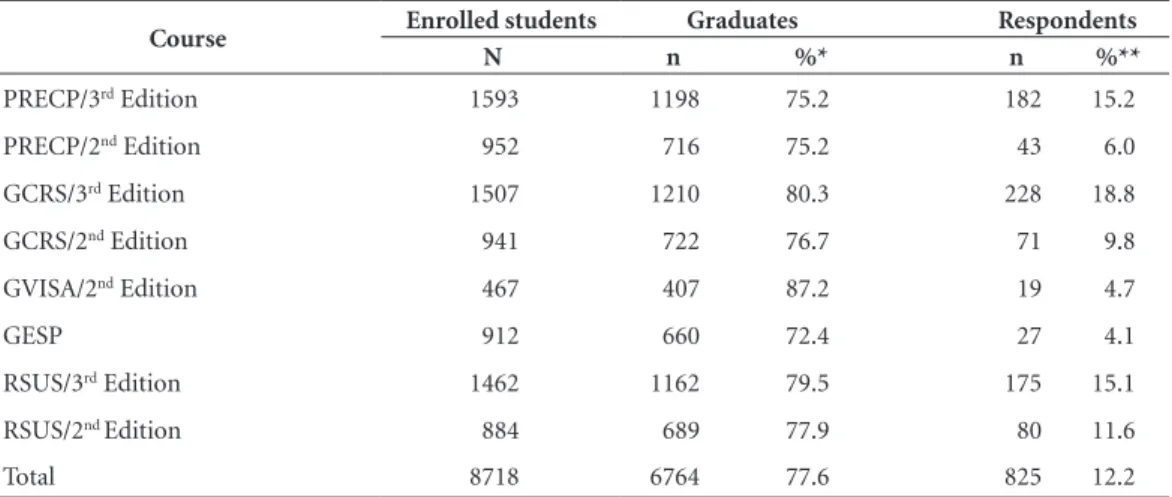
First, before the start of activities with spe-ciic course content, 2,016 trainees responded to the instrument, corresponding to 23.1% of those who matriculated. Second, after the completion of the courses, the quantity of responses was 2,386 students, corresponding to 35.3% of those that completed the course. In relation to those who participated in both stages, the quantity was 825 trainees, corresponding to 12.2 of those who concluded the courses (Table 1).
With the goal of verifying modiications in the evaluated abilities, the participants who re-sponded to the two stages of research, which correspond to the subjects investigated in this re-search, had their responses paired, and an analy-sis of these results was carried out. The Wilcoxon
signed-rank test for paired samples24 was used,
using a 5% level of signiicance, to verify possible differences in each of the twenty variables related to the abilities investigated in the data collection
instrument and also in the total score. First, the possible increase in the median score of these abilities after the course was evaluated. After-wards, possible differences in these scores were veriied, according to region of residence and the course taken.
Results
Table 1 presents the distribution of trainees ac-cording to the eight courses researched. It can be observed that 77.6% of those enrolled completed their courses. This percentage varied from 72.4% in the Course of Administration of Public Health Emergencies (GESP) to 87.2% in the Course of
Management of Health Surveillance (GVISA)/2nd
Edition. In relation to the students that partici-pated in the two stages of research, the low
per-centage of respondents in the courses GVISA/2nd
Edition (4.7%) and GESP (4.1%) is noteworthy. Perhaps this low percentage is due to the fact that, at the end of the courses, there had not been suficient dissemination that the inal stage of the research was available in the courses’ platforms.
Evans and Mathur25 observe that, to the contrary
to popular belief, online surveys do not always obtain a higher rate of response in relation to other types of surveys. Sometimes these surveys achieve worse rates than those of other types. The cited authors argue that the reasons for this oc-currence deserve to be studied further.
In relation to the respondents that participat-ed in the two stages of research, they were
pre-Table 1. Distribution of enrolled students, graduates, and those who participated in the two research phases per course.
Course Enrolled students Graduates Respondents
N n %* n %**
PRECP/3rd Edition 1593 1198 75.2 182 15.2
PRECP/2nd Edition 952 716 75.2 43 6.0
GCRS/3rd Edition 1507 1210 80.3 228 18.8
GCRS/2nd Edition 941 722 76.7 71 9.8
GVISA/2nd Edition 467 407 87.2 19 4.7
GESP 912 660 72.4 27 4.1
RSUS/3rd Edition 1462 1162 79.5 175 15.1
RSUS/2nd Edition 884 689 77.9 80 11.6
Total 8718 6764 77.6 825 12.2
Go
mes R
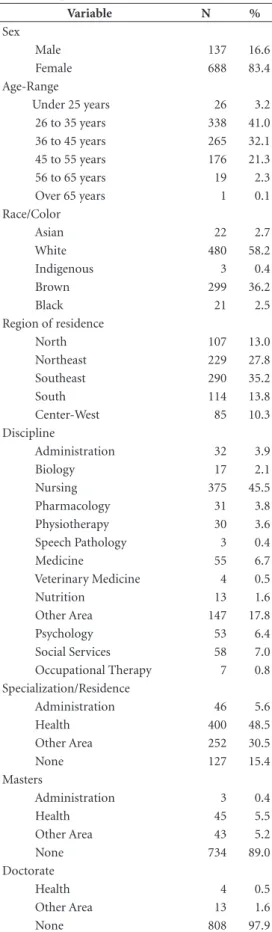
dominantly female (83.4%). The age range of 26 to 35 years was the most frequent (41.0%), fol-lowed by the age-range of 36 to 45 years (32.1%). More than half self-identiied as white (58.2%), and the most frequent region of residents was the Southeast (35.2%) (Table 2).
Regarding the background of the research subjects, the predominance of undergraduates and specializations/residencies in the area of health (78.3% and 48.5%, respectively) is note-worthy, especially Nursing (45.5% and 31.3%,
re-spectively). Regarding the courses stricto sensu, it
is observed that the great majority, at the time of data collection, did not possess masters (89.0%) or doctorates (97.9%) (Table 2).
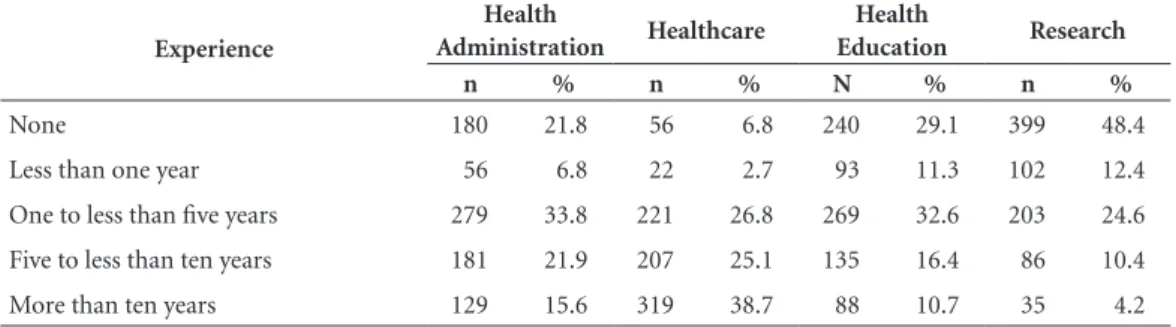
In relation to the time of experience in the area of health administration, it is observed that the majority of subjects possessed between one and less than ive years of experience (33.8%), followed by those that possessed from ive to less than ten years (21.9%), and those who did not possess this type of experience (21.8%). The ma-jority of subjects indicated more than ten years of experience in the area of health care (38.7%). Among these respondents, 29.1% stated they did not possess experience in the area of health edu-cation, while 32.6% stated a period of experience between one and less than ive years. Approx-imately half of the respondents did not possess research experience (48.4%) and 24.6% reported between one and less than ive years of research experience (Table 3).
Concerning the perception of mastery of abil-ities evaluated, the application of the Wilcoxon test for paired samples pointed to differences in the total scores in the two phases of the research, to the level of 5% signiicance. The same behav-ior was veriied for the twenty variables analyzed that yielded the total score (p < 0.001). The me-dian score of the differences was 9 units, and thus based on this information we can conclude that there was a signiicant increase in the perception of mastery of abilities evaluated (Table 4).
Signiicant differences were found in the to-tal scores of all the regions of residence, at the level of 5% signiicance. In analyzing each of the described variables in isolation, according to re-gion of residence, only two items did not present
signiicant differences: listen to and tolerate ideas
and opinions different from your own opinions in
the North Region (p = 0.073) and identify health
needs of a group of people or a population in the Center-West Region (p = 0.170) (Table 4). Based
on the ideas of Schwartz18, we can consider that
these combinations of abilities relate to the
in-Table 2. Absolute and proportional distribution of the interviewee proiles.
Variable N %
Sex
Male 137 16.6
Female 688 83.4 Age-Range
Under 25 years 26 3.2 26 to 35 years 338 41.0 36 to 45 years 265 32.1 45 to 55 years 176 21.3 56 to 65 years 19 2.3 Over 65 years 1 0.1 Race/Color
Asian 22 2.7
White 480 58.2 Indigenous 3 0.4 Brown 299 36.2
Black 21 2.5
Region of residence
North 107 13.0 Northeast 229 27.8 Southeast 290 35.2 South 114 13.8 Center-West 85 10.3 Discipline
Administration 32 3.9 Biology 17 2.1 Nursing 375 45.5 Pharmacology 31 3.8 Physiotherapy 30 3.6 Speech Pathology 3 0.4 Medicine 55 6.7 Veterinary Medicine 4 0.5 Nutrition 13 1.6 Other Area 147 17.8 Psychology 53 6.4 Social Services 58 7.0 Occupational Therapy 7 0.8 Specialization/Residence
Administration 46 5.6 Health 400 48.5 Other Area 252 30.5
None 127 15.4
Masters
Administration 3 0.4
Health 45 5.5
Other Area 43 5.2
None 734 89.0
Doctorate
Health 4 0.5
Other Area 13 1.6
aúd
e C
ole
tiv
a,
23(1):17-28,
2018
terventions that require exchanges of opinions/ ideas, approached in a direct way in the irst item and in an indirect way in the second. Both imply the confrontation between different values and perspectives, considering the involved subjects and their reading of a given situation. Although this is a dimension of fundamental importance in the conception of competence, it is also the most dificult one to access in the education-al initiatives. Even considering that the second item also implies a more speciic component of knowledge related to the area of health, the result found in this variable was not observed equally in others with the same characteristic. Taken to-gether, this can relect dificulties relative to the speciic training of the students.
In relation to the training (undergraduate in the area of the health or other areas) and expe-rience in health management, the graduates in Administration present differences among the total scores in the two phases of research. How-ever, only in eleven of the twenty evaluated abil-ities were such differences observed (p < 0.05). For graduates in the area of Health and also for
graduates in other areas different from Health or Administration, differences in the two phrases of research were observed (p < 0.05) in all of the abilities evaluated and also in the total score.
For all the categories in the variable related to time of experience in Health Administration, differences in the total scores and in each of the abilities evaluated were observed in both phases of the research. Signiicant differences were also found in the total scores and in each of the abil-ities evaluated in the male and female sex (p < 0.01).
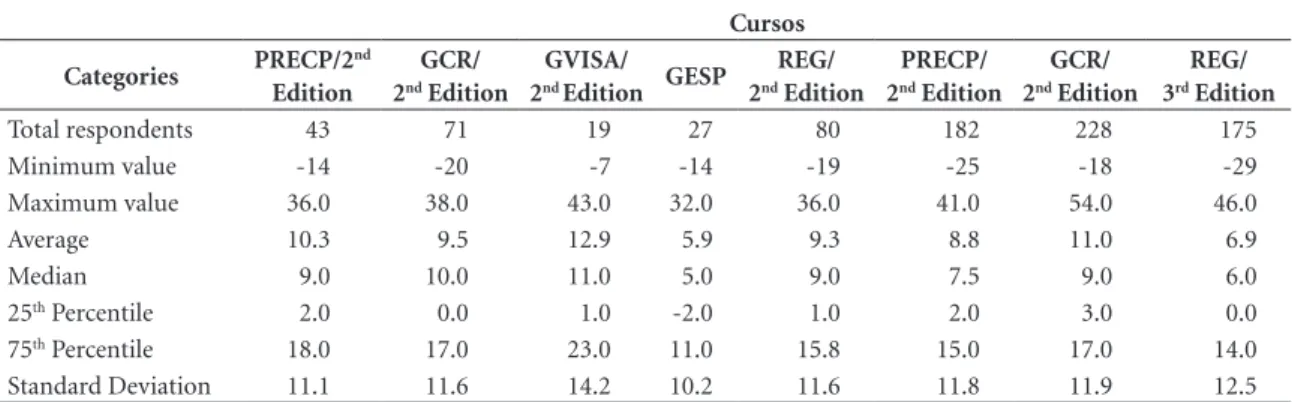
Finally, signiicant differences were found in the total scores in all of the courses, at the level of 5% signiicance (Table 5). The course of Ad-ministration of Public Health Emergencies, while showing an increase in abilities, presented a low-er numblow-er of items when the total score was ana-lyzed, with a signiicant increase in abilities after it was carried out, with between 7 and 20 items analyzed. Of the 20 variables analyzed, two of them demonstrated insigniicant results in four
courses each. These are: to participate in a team
for the development of health actions and to listen
Table 3. Absolute and proportional distribution of experience of respondents by area.
Experience
Health
Administration Healthcare
Health
Education Research
n % n % N % n %
None 180 21.8 56 6.8 240 29.1 399 48.4
Less than one year 56 6.8 22 2.7 93 11.3 102 12.4
One to less than ive years 279 33.8 221 26.8 269 32.6 203 24.6
Five to less than ten years 181 21.9 207 25.1 135 16.4 86 10.4
More than ten years 129 15.6 319 38.7 88 10.7 35 4.2
Table 4. Summary measures for the sample of differences (phase 2 – phase 1) of the total score* in the two phases of research according to Course and Total.
Categories North Northeast Southeast South Center-West Total
Total respondents 107 229 290 114 85 825
Minimum value -22 -20 -29 -19 -24 -29
Maximum value 43 54 41 41 35 54
Average 8.8 10.0 8.5 10.3 8.3 9.2
Median 9.0 9.0 8.0 10.0 6.0 9.0
25th Percentile 0.0 2.0 1.0 4.0 -0.5 2.0
75th Percentile 17.0 17.0 15.0 17.0 17.0 16.0
Standard Deviation 12.6 11.6 12.3 11.6 11.6 12.0
Go
mes R
and tolerate ideas and opinions different from your own opinions.
Discussion
It is worth emphasizing that, while the courses investigated have been oriented by competence, the investigative focus was not given to the assess-ment of performance that would require an
anal-ysis of actions. Apart from this aspect, Schwartz18
calls attention to the degree of dificulty in eval-uating competency, in light of the nature of the three dimensions that comprise it. These are: codiied knowledge, produced by science; his-torical knowledge, translated in the singularity of the situations; and relational knowledge, ex-pressed by the values constructed in the interac-tions of man with the environment. In spite of the dificulties, the author emphasizes the need for us to confront the challenge to attempt it.
In this sense, various studies have looked for a better translation of the competence proile in a way that can express activities of profession-al work that can be taken as representative of a competent practice, much more than educational intentionalities frequently reported as indicative
of a competence proile26. Considering the need
for a better expression of activities that translates what should really be done in a competent prac-tice, the twenty variables elaborated respond to this attempt and, initially, the perception of the trainees was investigated for each of these vari-ables in relation to the mastery of abilities at their foundation.
Thus, the investigated variables interpreted activities that represent the particular concept of clinical management, taking into account the
existing polysemy around this concept3. In this
way, as speciicities of the concept utilized, we can emphasize (i) in the area of healthcare: the orientation of care to the needs of individual and collective health, as much as the identiication of biological, psychological, and social dimensions as in the elaboration of care plans in line with the identiied needs, as well as the interaction of the different perspectives of those involved; (ii) in the area of health administration: facing problems and taking advantage of opportunities for the production of healthcare with integrality, quality, eficiency, eficacy, effectiveness, and safe-ty, giving emphasis to teamwork and healthcare networks; and (iii) in the area of health educa-tion: respect for the diversity of values and pre-vious knowledge of people, the problematization of challenges in health work, and the use of sci-entiic evidence and relexive spaces to promote the transformation of practices. Particularly, in the area of education we note a strong correspon-dence between the abilities in this area and those stimulated by the use of teaching and learning methodologies.
In focusing the opinion of the trainees on their mastery of abilities for a practice considered competent in clinical management, we seek to give visibility to their perceptions, before and af-ter courses oriented by a deaf-termined competence proile and teaching methodology. In this sense, by using a self-assessment of mastery and not a veriication of performance, we seek to identify, in the perspective of the trainee-evaluator them-selves, their perception of displacement, in light of the activities that were considered descriptors
of a competent act26.
In relation to the analyzed results, the percep-tion of mastery of abilities in clinical
manage-Table 5. Summary measures for the sample of differences (phase 2 – phase 1) of the total score* in the two phases of research according to Course.
Cursos
Categories PRECP/2 nd Edition
GCR/ 2nd Edition
GVISA/ 2nd Edition GESP
REG/ 2nd Edition
PRECP/ 2nd Edition
GCR/ 2nd Edition
REG/ 3rd Edition
Total respondents 43 71 19 27 80 182 228 175
Minimum value -14 -20 -7 -14 -19 -25 -18 -29
Maximum value 36.0 38.0 43.0 32.0 36.0 41.0 54.0 46.0
Average 10.3 9.5 12.9 5.9 9.3 8.8 11.0 6.9
Median 9.0 10.0 11.0 5.0 9.0 7.5 9.0 6.0
25th Percentile 2.0 0.0 1.0 -2.0 1.0 2.0 3.0 0.0
75th Percentile 18.0 17.0 23.0 11.0 15.8 15.0 17.0 14.0
aúd
e C
ole
tiv
a,
23(1):17-28,
2018
ment increased after the courses, proving a pos-itive contribution of the process in the training of the students. In this sense, with a basis in the
conceptual framework of Bandura16,17, it can be
said that the courses – oriented by competence and based on active methodologies of teaching and learning – contributed to the increase of the perception that the trainees had of mastering and mobilizing abilities related to a competent prac-tice in clinical management.
The increase of the perception about this mastery, in spite of there being a signiicant portion of trainees with a background outside the area of health, can possibly be attributed to the use of methodologies that promoted the en-gagement and commitment of these participants with their learning. Apart from this aspect, the utilization of these methodologies in the cours-es to promote greater interaction of the trainecours-es in small work groups tended to potentialize the inter-relation among different disciplinary back-grounds.
The research of Marins et al.27, which
evaluat-ed the indings of a multi-professional graduate program in health based on active methodolo-gies of teaching and learning, also concluded that these methodologies contributed to the exchange of experiences among nurses, doctors, and other professional categories. In the identiication of problems and in the formulation of questions, the participants shared knowledge and identiied
learning needs20. This can be potencialized when
there is dialogue between distinct perspectives, constructed from different backgrounds.
On the other hand, it can be argued from the aforementioned theoretical framework that the high perceptions before the courses were undertaken could have inluenced the high per-ceptions after the courses. This argument could be defended if it were understood that the high initial perceptions were the expression of a belief of auto-eficacy.
Another argument that can relativize the results, is that “a student that has more expecta-tions in relation to curricular and vocational
in-volvement has their performance augmented”28.
Thus, broadened for the case of perceptions, the high expectations in relation to the courses inlu-enced the high initial perceptions that, for their part, inluenced the high inal perceptions, con-irming the predictive aspect.
Nonetheless, these arguments can be an-swered in light of the indings of the present study that took into account the inluence of
active methodologies of teaching and learning. These methodologies, that begin with the previ-ous knowledge of the participants and stimulate the search for new information, are noted for the development of critical thought of the trainees. In this sense, even though the initial expectations were high, during the courses it was hoped that the participants would manage to think critically about the results achieved, including broadening the very concept of competence, which could re-duce the perception of displacement. Thus, the high perception of mastery of abilities in clinical management may express that the participants credited the courses with their shift in mastery. The same logic applies to auto-eficacy. When in-centivized to problematize different situations of learning, those trainees who may have believed in their self-eficacy were able to search for new forms of understanding that were not part of their accumulated knowledge in courses or pre-vious experiences, as well as resignify their past experiences.
It is worth noting that, in the perception of the trainees, the lesser mastery of abilities relat-ed to the desirrelat-ed competency proile was found in those variables that involved, to some degree, interaction with others, especially concerning the confrontation between different values and perspectives of the subjects involved and their interpretations of a given situation. This inding points to a frontier in the development of com-petence, regarding the challenge of accessing and exploiting, in the context of work situations, the abilities relative to the affective mastery. From the differences observed in the results according to course, regions, and training, the cultural aspects and repertoires accumulated by the participants in previous experiences may have been limiting factors in the construction of new abilities, espe-cially those that most strongly involved the ex-change of ideas and values. For these variables, the need for development of abilities, even mak-ing use of active methodologies, may have fallen short of the desired proile.
Finally, in light of the group of variables in-vestigated and results obtained, the increase in the perception of mastery may indicate a positive assessment of the courses. Based on their
ind-ings, Gonçalves and Mourão29 evaluated that the
Go
mes R
Conclusion
In summary, it was possible to assess that the educational initiatives studied, oriented by com-petence and based in active methodologies of teaching and learning, obtained in their results the increase of their participants’ perceptions regarding the mastery of clinical management abilities, conirming the study’s hypothesis. This increase was observed in the total score that was shown to be higher at the conclusion of all the courses, as well as in each of the twenty variables that comprise the total score. It is noteworthy that this perception relects the opinion of the trainees in relation to what they thought they mastered before and after the courses.
In terms of the obtained results, we emphasize that the coherence between the orientation of the various abilities in clinical management and the principles of the constructivist educational ap-proach and active methodologies may have had a favorable inluence on the increase of percep-tion of mastery. In this sense, relecpercep-tion on the work as a trigger of learning and the utilization of previous knowledge in dialogue with scientif-ic evidence are examples of this coherence. Aside from these aspects, the relation between teaching centered on the trainee and their learning needs also presents strong coherence with activities in clinical management when healthcare is oriented by the identiication of needs of people and pop-ulational groups.
The singularization of the educational pro-cess combines with that of healthcare, which in-tends to promote holistic assistance, as much by the articulation of biological, psychological, and social needs of the people under care, as by the
ac-tions and services offered in a healthcare network. In this context, the relexive and creative abilities, valorized in active methodologies, are fundamen-tal for the application of clinical guidelines and protocols, in a way that is critical and contextual-ized to the singularity of the work situations. They are equally fundamental for activity in healthcare networks that prioritize the commitment to use management to get results that add value to peo-ples’ lives and health, guaranteeing and improv-ing the quality of processes and products.
Finally, to investigate aspects that relate to competence involves a complexity relative to the articulation between scientiic standards, sin-gularities of work situations, and mobilized
val-ues18. Considering that this research focused on
the perception of the participants regarding the development of abilities related to the desired competence proile, the results add relexive ele-ments to the challenge of assessing competence. In the irst place, by the deinition of the activi-ties that might indicate a competent professional
practice26; and, second, by the need to consider
aúd
e C
ole
tiv
a,
23(1):17-28,
2018
Collaborations
R Gomes participated in all phases of the re-search and in the writing of the article. RQ Padil-ha, VV Lima and CMFP Silva participated in the analysis phase of the research and in the writing of the article.
References
1. Christensen CM, Grossman JH, Hwang J. Inovação na gestão da saúde: a receita para reduzir custos e aumentar
qualidade. Porto Alegre: Bookman; 2009.
2. Fairield G, Hunter DJ, Mechanic D, Rosleff F. Man-aged care: origins, principles, and evolution. BMJ 1997; 314(7097):1823-1826.
3. Gomes R, Lima VV, Oliveira JM, Schiesari LMC, So-eiro E, Damázio LF, Petta HL, Oliveira MS, Silva SF, Sampaio SF, Padilha RQ, Machado JLM, Caleman G. A polissemia da governance cĺnica: uma revisão da lite-ratura. Cien Saude Colet 2015; 20(8):2431-2439. 4. Scally G, Donaldson LJ. Clinical governance and the
drive for quality improvement in the new NHS in En-gland. BMJ 1998; 317(7150):61-65.
5. Mendes EV. As redes de atenção à saúde. Brasília:
Orga-nização Pan-Americana da Saúde, 2011. [acessado 2015
Jul 7]. Dispońvel em: http://apsredes.org/site2012/wp-content/uploads/2012/03/Redes-de-Atencao-mendes2. pdf
6. Ceccim RB e Merhy EE. Um agir micropoĺtico e peda-gógico intenso: a humanização entre laços e perspecti-vas. Interface (Botucatu) 2009; 13(Supl. 1):531-542. 7. Cećlio LCO. Autonomia versus controle dos
trabalha-dores: a gestão do poder no hospital. Cien Saude Colet
1999; 4(2):315-329.
8. Campos GWS. Um método para análise e cogestão de coletivos. São Paulo: Ed. Hucitec; 2000.
9. Feuerwerker LCM. Micropolítica e saúde: produção do
cuidado, gestão e formação. Porto Alegre: Rede UNIDA;
2014.
10. Onoko Campos R. O encontro trabalhador-usuário na atenção à saúde: uma contribuição da narrativa psi-canaĺtica ao tema do sujeito na saúde coletiva. Cien
Saude Colet 2005; 10(3):573-583.
11. Oliveira MS, Padilha RQ, Lima VV, Soeiro E, Olivei-ra JM, Silva SF. Gestão da clínica nas regiões de saúde:
caderno do curso 2013. São Paulo: Instituto
Śrio-Liba-n̂s de Ensino e Pesquisa - Ministério da Saúde; 2013. [acessado 2015 Set 4]. Dispońvel em: http://ensino. hospitalsiriolibanes.com.br/downloads/AF_Caderno_ GCSUS_2013_v2.pdf
12. Padilha RQ, Ramos L, Lima VV, Vecina Neto G, Cale-man G, Silva SF. Gestão da vigilância sanitária: caderno do curso 2013. São Paulo: Instituto Śrio-Liban̂s de En-sino e Pesquisa - Ministério da Saúde - Aĝncia Nacio-nal de Vigilância Sanitária; 2013. [acessado 2015 Set 4]. Dispońvel em: http://ensino.hospitalsiriolibanes.com. br/downloads/AF_Caderno_GVISA_2013_v2.pdf 13. Bruner J. Cultura da Educação. Lisboa: Edições 70;
1996.
14. Gauthier C, Tardiff M. A pedagogia: teorias e práticas da antiguidade aos nosso dias. Petrópolis: Vozes; 2010. 15. Perrenoud P. Formar professores em contextos sociais
em mudança: prática relexiva e participação cŕtica.
Rev. Bras. Educ. 1999; 12:5-21.
16. Bandura A. A evolução da teoria social cognitiva. In: Bandura A, Azzi RG, Polydoro S, organizadores. Teoria social cognitiva: conceitos básicos. Porto Alegre: Artmed; 2008, p. 15-42.
Go
mes R
18. Schwartz Y. Os ingredientes da compet̂ncia: Um exer-ćcio necessário para uma questão insolúvel. Educ. Soc. 1998; 19(65):101-139.
19. Gonczi A, Hager P. The Competency Model. In: Peter-son P, Baker E, McGaw B, editors. International Ency-clopedia of Education. Volume 8. Oxford: Elsevier; 2010. p. 403-410
20. Lima VV, Feuerwerker LCM, Padilha RQ, Gomes R, Hortale VH. Ativadores de processos de mudança: uma proposta orientada à transformação das práticas edu-cacionais e da formação de proissionais de saúde. Cien
Saude Colet 2015; 20(1):279-288.
21. Maia JAF. Metodologia para avaliação ex ante e expost da relevância social de poĺticas públicas. Sitientibus
2008; 38:35-56. 2008. [acessado 2013 Jul 24]. Dispoń-vel em: http://www2.uefs.br/sitientibus/pdf/38/3_me-todologia_para_avaliacao_ex_ante_e_ex_post.pdf 22. Gomes R, Souza ER, Minayo MCS, Silva CFR.
Organi-zação, processamento, análise e interpretação de dados: o desaio da triangulação. In: Minayo MCS, Assis SG, Souza ER, organizadoras. Avaliação por triangulação de
métodos: abordagem de programas sociais. Rio de
Janei-ro: Editora Fiocruz; 2005. p. 185-221.
23. Likert R. A technique for the measurement of attitudes.
Archives of Psychology 1932; 140:1 55.
24. Triola MF. Introdução à Estatística. Rio de Janeiro: LTC Editora; 2005.
25. Evans JR, Mathur A. The value of online surveys.
Inter-net Research 2005; 15(2):195 - 219
26. ten Cate O, Billett S. Competency-based medical edu-cation: origins, perspectives and potentialities. Medical
Education 2014; 48(3):325-332.
27. Marin MJS, Gomes R, Marvulo MML, Primo EM, Barbosa PMK, Druzian S. Pós-graduação multipro-issional em saúde: resultados de experîncias utili-zando metodologias ativas. Interface (Botucatu) 2010; 14(33):331-344.
28. Gomes G, Soares AB. Inteliĝncia, habilidades sociais e expectativas acad̂micas no desempenho de estudan-tes universitário. Psicologia: Reflexão e Crítica 2013; 26(4):780-789.
29. Gonçalves A, Mourão L. A expectativa em relação ao treinamento inluencia o impacto das ações de capaci-tação? RAP — Rio de Janeiro 2011; 45(2):483-513.
Article submitted 15/09/2015 Approved 11/01/2016