ABSTRACT
Objective: Post-infectious bronchiolitis obliterans (PIBO) is a clinical entity that has been classiied as constrictive, ixed obstruction of the lumen by ibrotic tissue. However, recent studies using impulse oscillometry have reported bronchodilator responses in PIBO patients. The objective of this study was to evaluate bronchodilator responses in pediatric PIBO patients, comparing different criteria to deine the response. Methods: We evaluated pediatric patients diagnosed with PIBO and treated at one of two pediatric pulmonology outpatient clinics in the city of Porto Alegre, Brazil. Spirometric parameters were measured in accordance with international recommendations. Results: We included a total of 72 pediatric PIBO patients. The mean pre- and post-bronchodilator values were clearly lower than the reference values for all parameters, especially FEF25-75%. There were post-bronchodilator improvements. When measured as mean percent increases, FEV1 and FEF25-75%, improved by 11% and 20%, respectively. However, when the absolute values were calculated, the mean FEV1 and FEF25-75% both increased by only 0.1 L. We found that age at viral aggression, a family history of asthma, and allergy had no signiicant effects on bronchodilator responses. Conclusions: Pediatric patients with PIBO have peripheral airway obstruction that is responsive to treatment but is not completely reversible with a bronchodilator. The concept of PIBO as ixed, irreversible obstruction does not seem to apply to this population. Our data suggest that airway obstruction is variable in PIBO patients, a inding that could have major clinical implications.
Keywords: Bronchiolitis obliterans; Infection/complications; Airway obstruction; Bronchodilator agents.
Evaluating bronchodilator response in
pediatric patients with post-infectious
bronchiolitis obliterans: use of different
criteria for identifying airway reversibility
Rita Mattiello1, Paula Cristina Vidal2, Edgar Enrique Sarria3,
Paulo Márcio Pitrez1, Renato Tetelbom Stein1, Helena Teresinha Mocelin4,
Gilberto Bueno Fischer4, Marcus Herbert Jones1, Leonardo Araújo Pinto1
Correspondence to:
Leonardo A. Pinto. Instituto de Pesquisas Biomédicas, Centro Infant, Avenida Ipiranga, 6690, 2º andar, CEP 90610-000, Porto Alegre, RS, Brasil. Tel.: 55 51 3320-3000 or 55 51 3320-2221. Fax: 55 51 3320-3000. E-mail: [email protected]
Financial support: This study received inancial support from the Brazilian Conselho Nacional de Desenvolvimento Cientíico e Tecnológico (CNPq, National Council for Scientiic and Technological Development), the Coordenação de Aperfeiçoamento de Pessoal de Nível Superior (CAPES, Ofice for the Advancement of Higher Education),
and the Fundação de Amparo à Pesquisa do Estado do Rio Grande do Sul (FAPERGS, Foundation for the Support of Research in the State of Rio Grande do Sul). INTRODUCTION
Bronchiolitis obliterans is a form of chronic obstructive lung disease secondary to a severe insult to the lower respiratory tract. The disease is characterized by the narrowing of the distal airways, which leads to a chronic obstructive disorder. In children, the most common form is post-infectious bronchiolitis obliterans (PIBO). (1,2) There are reports of PIBO secondary to infection with inluenza, parainluenza, respiratory syncytial virus, and Mycoplasma
pneumonia; however, certain adenovirus serotypes
seem to be the infectious agents most likely linked with PIBO. (2-4) Although PIBO has been reported in several
different regions in the world, South American countries have historically reported the highest numbers of cases. (1) In most of those reports, PIBO has been classiied as
constrictive airway disease, presenting some degree of
luminal occlusion by ibrous tissue, together with chronic inlammation. Total obliteration of the lumen by ibrotic
tissue has been observed in up to 23% of patients.(4,5)
A diagnosis of PIBO should be made not only on the basis of a suggestive clinical history and characteristic
HRCT indings but also on that of spirometric evidence
of moderate to severe obstructive impairment.(6,7) Some authors consider PIBO a disorder involving ixed
obstruction. However, there is some controversy in the aspect of pulmonary function in PIBO patients, which calls for further research at various levels.
The question of the response to the use of a broncho-dilator in patients with PIBO is an important one, given its potential impact in the clinical management of PIBO. Most authors believe that PIBO patients would not show
a signiicant bronchodilator response, since there is
considerable evidence that these subjects present with
ixed airway obstruction.(1,6-9) However, in one previous
study, it was reported that patients diagnosed with PIBO showed such a response.(7) In the present study, we
evaluated bronchodilator responses in a large sample of pediatric patients diagnosed with PIBO, comparing
different criteria to deine the signiicance of the response. 1. Centro Infant, Instituto de Pesquisas
Biomédicas, Pontifícia Universidade Católica do Rio Grande do Sul – PUCRS – Porto Alegre (RS) Brasil.
2. Universidade Regional Integrada do Alto Uruguai e das Missões – URI – Erechim (RS) Brasil.
3. Curso de Medicina, Universidade de Santa Cruz do Sul – UNISC – Santa Cruz do Sul (RS) Brasil.
4. Universidade Federal de Ciências da Saúde de Porto Alegre – UFCSPA – Porto Alegre (RS) Brasil.
Submitted: 6 April 2015. Accepted: 30 November 2015.
Study carried out at the Instituto de
METHODS
Patients and procedures
This was a cross-sectional study involving children and adolescents with PIBO, all of whom had previously been diagnosed with PIBO and were under follow-up treatment at pediatric pulmonology outpatient clinics at one of two university hospitals in the city of Porto Alegre, Brazil: the Hospital São Lucas, operated by the
Pontiical Catholic University of Rio Grande do Sul; or
the Santo Antônio Children’s Hospital, which is part
of the Santa Casa Hospital Complex. The mean age
of the patients was 10 years (range, 4-17 years). The
medical staff at both hospitals have clinical expertise in
diagnosing PIBO in pediatric patients. For the purposes of this study, we included spirometry results for all of the patients. All of the spirometry tests performed at the two hospitals met the American Thoracic Society/ European Respiratory Society (ATS/ERS) requirements for acceptability and reproducibility.(10)
The diagnosis of PIBO was based on a combination of clinical, epidemiologic, and imaging data, as previously described.(1) All diagnoses of PIBO were made on the
basis of the following criteria: having had acute, severe
bronchiolitis or viral pneumonia during the irst two years
of life after having previously been healthy; presenting with evidence of persistent airway obstruction after the
acute event (identiied either by physical examination
or by pulmonary function testing); presenting with
chest X-ray indings indicative of chronic lung disease (e.g., hyperinlation, atelectasis, airway wall thickening, and bronchiectasis); presenting with chest CT indings
of a mosaic pattern and air trapping. A diagnosis of PIBO was ruled out if the patient had any other condition that progresses to permanent respiratory symptoms, including chronic lung diseases such as
cystic ibrosis and bronchopulmonary dysplasia, as well as immunodeiciency disorders. Family histories
of asthma and allergy (rhinitis, eczema, etc.) were taken at regular clinical visits.
Spirometric parameters (FVC, FEV1, FEF25-75%, and the FEV1/FVC ratio) were measured in accordance with international recommendations for acceptability and reproducibility.(10) The pulmonary function parameters
were measured only if patients had been free of
res-piratory exacerbations and clinically stable for at least
two weeks. Prior to the tests, short- and long-acting β2 agonists were withheld for 12 and 48 h, respectively, although inhaled corticosteroids were maintained as prescribed. Spirometric values were chosen from the best three acceptable, reproducible FVC maneuvers, and the one with the greatest sum of FVC and FEV1 was selected. Reference values and equations employed for spirometry were those described by Stanojevic et al.(11) All pulmonary function data are expressed as
z-score values. The severity of functional impairment
was deined on the basis of the FEV1, in accordance
with the ATS/ERS recommendations.(10) The main
methods for analyzing bronchodilator responses are
described in Chart 1. In addition, we analyzed factors
that could have inluenced the bronchodilator response.
Statistical analysis
Continuous variables are expressed as mean ±
standard deviation or as median and interquartile
range, whereas categorical variables are expressed
as absolute and relative frequencies. Each pulmonary
function parameter was expressed as a z-score, using
the regression equation and variance derived from ref-erence population values.(8,11) To analyze bronchodilator
response data, we used the generalized estimating equation procedure(10-13) of a generalized linear model,
which allows the analysis of repeated measures; the
working correlation matrix was autoregressive.(14) A linear mixed model was used to determine whether
bronchodilator responses (outcomes) were affected by patient age at the time of viral aggression, by a family history of asthma, or by allergy. For all analyses, the
level of statistical signiicance was set at p < 0.05.
Data processing and analysis were performed with IBM SPSS Statistics software package, version 18.0
(IBM Corporation, Armonk, NY, USA).
The study was approved by the local research ethics committees of both institutions. All participating patients verbally consented to be included in the study, and the parents or legal guardians of the participants gave written informed consent.
RESULTS
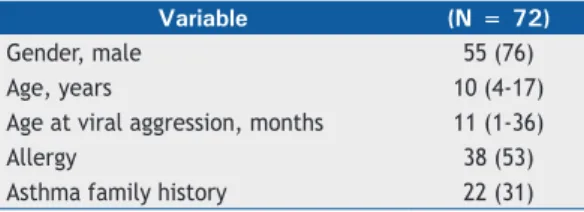
We evaluated a total of 72 pediatric patients with PIBO. The patients had been monitored periodically, from infancy, at outpatient clinics. The characteristics of the study sample are shown in Table 1. Of the 72 patients evaluated, 55 (76.4%) were male. Most of the patients had been diagnosed with PIBO during
the irst year of life.
The pulmonary function parameters of the patients,
expressed as z-score values, are presented in Table
2. The mean pre- and post-bronchodilator values for all parameters were abnormal, especially those for FEF25-75%. There were signiicant post-bronchodilator
improvements in expiratory flows, although the
values did not reach normality for age. As can be
seen in Table 3, the improvements were signiicant
when the mean percent variation from the previous measurement was calculated (increases of 11% and 20% for FEV1 and FEF25-75%, respectively). However,
Chart 1. Description of different methods (equations) for
calculating a bronchodilator response.
Percent variation from the previous (pre-bronchodilator) measurement:
(FEV1post − FEV1pre)/(FEV1pre × 100) Percent change in the percentage of the predicted
value:
(FEV1post − FEV1pre)/(FEV1 predicted × 100) Absolute volume change from the previous
(pre-bronchodilator) measurement: FEV1post − FEV1pre
when the mean absolute volume change was calculated, the improvements were more modest (only 0.1 L for FEV1 and FEF25-75% alike).
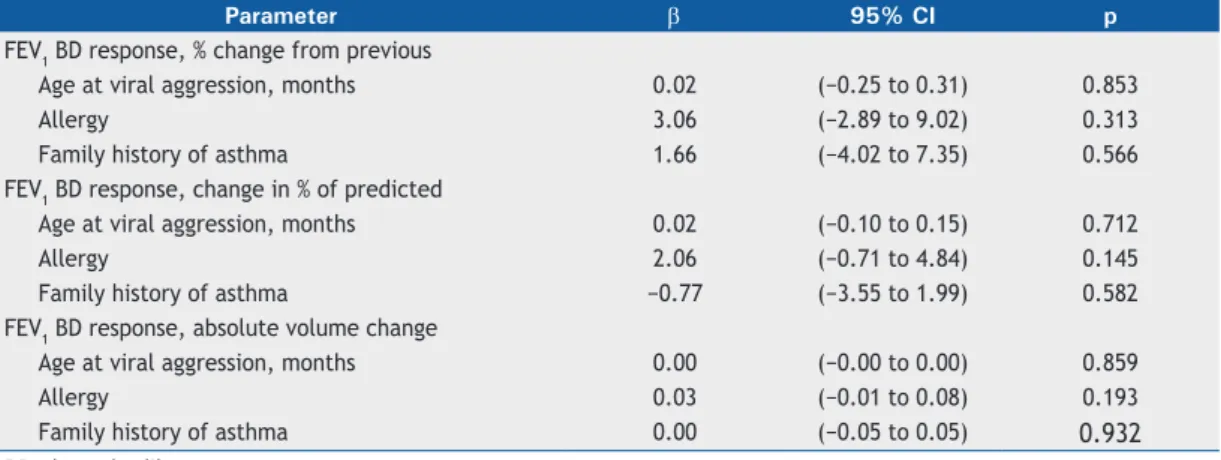
In the multivariate analysis of the outcome variables (Table 4), none of the predictor variables (age at viral aggression, allergy, and asthma family history) remained in the models. We found that age at viral aggression, a family history of asthma, and allergy had
no signiicant effect on the bronchodilator response.
DISCUSSION
Of the 72 pediatric PIBO patients, 42 (58.3%)
demonstrated a signiicant bronchodilator response
when the cut-off point was a percent change of 9%, as employed by Jones et al.(12) When we used a cut-off
point of 12%, as recommended by the ATS/ERS and in other studies,(10,13) the bronchodilator response was still signiicant in 34 patients (47.2%).
Although there is no consensus about what constitutes reversibility, the three most common methods of
expressing bronchodilator response are as a percent
change in relation to the initial spirometric value, as a percent change in the percentage of the predicted value, and as an absolute volume change. In the present study, we analyzed reversibility by all three methods
(Table 3). Expressing the change in FEV1 or FVC as a
percentage of the predicted value has been reported
to have advantages over expressing it as a percent
change from baseline.(15) The ATS/ERS guidelines
recommend using the percent change from baseline and the absolute change in FEV1 or FVC to characterize the bronchodilator response in an individual subject. According to Pellegrino et al., post-bronchodilator increases in FEV1 of 12% and 200 mL changes from baseline during a single spirometry session both suggest
that the degree of bronchodilation is “signiicant”.(13)
As a caveat, the authors stressed that the lack of a
response during bronchodilator testing does not exclude
the possibility of a subsequent clinical response to bronchodilator therapy.
In a study conducted in Argentina in 1999, Teper et
al. reported ixed bronchial obstruction in 13 infants
with chronic lung disease after severe adenovirus infection.(16) Since then, it has been accepted that PIBO
should be considered an irreversible COPD. However, that conclusion was based only on the fact that the degree of improvement in those infants failed to reach the 30% cut-off point considered the threshold for
conirming bronchodilation, which is different than
showing no response. More than two decades later, Castro-Rodriguez et al., using impulse oscillometry rather
than spirometry, observed a signiicant bronchodilator
response in children with PIBO in Chile.(8) The concept
that PIBO is characterized by irreversible obstruction
could be explained either by the small caliber of the airways in young children, which makes it dificult to
quantify bronchodilation in pulmonary function tests, or by acquired airway hyperreactivity later in life.
The percent change in FEV1 after bronchodilator administration in the general population varies across studies, depending on whether the study sample comprises adults or school-age children. In a study involving children between 5 and 10 years of age, the cut-off point that provided the best balance of sensitivity
and speciicity for a bronchodilator response was that
of a 9% change in FEV1, measured as a percentage of the predicted value.(15) A similar cut-off point was found
adequate to indicate bronchodilation in a population
of school-age children (≥ 6 years of age) in Spain. (17)
When we applied such a cut-off point, most of our
patients showed a signiicant bronchodilator response.
When we attempted to identify the factors associated with the high rate of bronchodilator response in our sample, we found that neither age at viral aggression, nor a family history of asthma, nor allergy had any
signiicant effect on the magnitude of the bronchodilator
response.
Reversibility of airway obstruction could indicate an innate predisposition to PIBO in children who have previously (prior to the triggering viral event) had a phenotype of airway hyperreactivity.(8) Alternatively,
children with PIBO might present with variable, rather
than ixed, airway obstruction, which would allow
different degrees of reversibility. It is important to note that when the measure was an absolute volume change, we observed a median increase of only 0.1
L, and the signiicance of such a small variation is
questionable. In children who develop PIBO, the most severe obstruction is at the level of lower airways,
which could explain the higher β2 agonist responses we
observed in terms of the FEF25-75%. However, FEF25-75% is considered highly variable in control groups, and such variation is therefore not easily interpreted.(13)
For FEV1, the determination of a percent change from
the initial value might relect airlow limitation, but it is
considered more dependent of the pre-bronchodilator FEV1 value than on other components of the process. (18)
In our PIBO subjects, the degree of bronchodilation was likely related to the degree of baseline obstruction
secondary to complex disrupted bronchiolar functioning, Table 1. Characteristics of pediatric patients with
post-infectious bronchiolitis obliterans.a
Variable (N = 72)
Gender, male 55 (76)
Age, years 10 (4-17)
Age at viral aggression, months 11 (1-36)
Allergy 38 (53)
Asthma family history 22 (31) aValues expressed as n (%) or as mean (range).
Table 2. Lung function parameters expressed as z-scores
for pediatric patients with post-infectious bronchiolitis obliterans (N = 72).a
Variable Pre-BD Post-BD
FVC (z-score) −2.47 ± 1.51 −2.07 ± 1.51
FEV1 (z-score) −4.00 ± 1.59 −3.52 ± 1.69
FEV1/FVC (z-score) −2.60 ± 0.88 −2.32 ± 1.02
FEF25-75% (z-score) −4.14 ± 1.35 −3.73 ± 1.59
which includes chronic inlammatory process, scarring,
altered bronchomotor tone, and air trapping.
It is dificult to estimate the impact of a median incre -ase in FEV1 of 0.1 L (11% over the pre-bronchodilator value) in pediatric patients with PIBO that have very
severe obstruction. However, in the context of a
baseline FEV1 z-score of −2.47, our inding should not be underestimated. There is controversy regarding
reversibility of airway obstruction in PIBO. Given
the variability of the within-individual bronchodilator response among healthy subjects, there is probably no single test or method that can properly assess this
complex response, especially in subjects with severely
obstruction, who might present greater variability. In addition, as the ATS/ERS guidelines recommend,(10) a
longitudinal assessment of the response over a period of several weeks should be preferred over single assessments.(19-21) A lack of improvement in FEV
1
after a bronchodilator test might be a disincentive to
performing a clinical trial with β2 agonists.
On the basis of our indings in the present study, we
conclude that pediatric PIBO patients have peripheral
airway obstruction that can improve with the use of β2
agonists. Although the lung function of such patients does not achieve normality after the use of a bronchodilator, it certainly shows a response that could provide a perceived
clinical beneit. For such knowledge to have therapeutic
applications, however, further clinical trials are needed in order to assess the true effectiveness of the long-term use of bronchodilators in patients diagnosed with PIBO.
Table 4. Analysis of factors with a potential inluence on bronchodilator responses in pediatric patients with
post-infectious bronchiolitis obliterans (general linear model-based approach).
Parameter β 95% CI p
FEV1 BD response, % change from previous
Age at viral aggression, months 0.02 (−0.25 to 0.31) 0.853
Allergy 3.06 (−2.89 to 9.02) 0.313
Family history of asthma 1.66 (−4.02 to 7.35) 0.566
FEV1 BD response, change in % of predicted
Age at viral aggression, months 0.02 (−0.10 to 0.15) 0.712
Allergy 2.06 (−0.71 to 4.84) 0.145
Family history of asthma −0.77 (−3.55 to 1.99) 0.582
FEV1 BD response, absolute volume change
Age at viral aggression, months 0.00 (−0.00 to 0.00) 0.859
Allergy 0.03 (−0.01 to 0.08) 0.193
Family history of asthma 0.00 (−0.05 to 0.05) 0.932
BD: bronchodilator.
REFERENCES
1. Castro-Rodriguez JA, Giubergia V, Fischer GB, Castaños C, Sarria EE, Gonzalez R, et al. Postinfectious bronchiolitis obliterans in children: the South American contribution. Acta Paediatr. 2014;103(9):913-21. http://dx.doi.org/10.1111/apa.12689
2. Fischer GB, Sarria EE, Mattiello R, Mocelin HT, Castro-Rodriguez JA. Post infectious bronchiolitis obliterans in children. Paediatr Respir Rev. 2010;11(4):233-9. http://dx.doi.org/10.1016/j.prrv.2010.07.005
3. Colom AJ, Teper AM, Vollmer WM, Diette GB. Risk factors for the development of bronchiolitis obliterans in children with bronchiolitis. Thorax. 2006;61(6):503-6. http://dx.doi.org/10.1136/thx.2005.044909
4. Zhang L, Silva FA. Bronchiolitis obliterans in children [Article in Portuguese]. J Pediatr (Rio J). 2000;76(3):185-92. http://dx.doi. org/10.2223/JPED.49
5. Mauad T, Dolhnikoff M; São Paulo Bronchiolitis Obliterans Study Group. Histology of childhood bronchiolitis obliterans. Pediatr Pulmonol. 2002;33(6):466-74. http://dx.doi.org/10.1002/ppul.10097
6. Mattiello R, Mallol J, Fischer GB, Mocelin HT, Rueda B, Sarria EE. Pulmonary function in children and adolescents with postinfectious bronchiolitis obliterans. J Bras Pneumol. 2010;36(4):453-9. http:// dx.doi.org/10.1590/S1806-37132010000400010
7. Mattiello R, Sarria EE, Stein R, Fischer GB, Mocelin HT, Barreto SS, et al. Functional capacity assessment in children and adolescents with post-infectious bronchiolitis obliterans. J Pediatr (Rio J). 2008;84(4):337-43. http://dx.doi.org/10.2223/jped.1807
8. Castro-Rodriguez JA, Daszenies C, Garcia M, Meyer R, Gonzales R. Adenovirus pneumonia in infants and factors for developing bronchiolitis obliterans: a 5-year follow-up. Pediatr Pulmonol. 2006;41(10):947-53. http://dx.doi.org/10.1002/ppul.20472
9. Cazzato S, Poletti V, Bernardi F, Loroni L, Bertelli L, Colonna S, et al. Airway inlammation and lung function decline in childhood post-infectious bronchiolitis obliterans. Pediatr Pulmonol. 2008;43(4):381-90. http://dx.doi.org/10.1002/ppul.20784
Table 3. Bronchodilator response in pediatric patients with post-infectious bronchiolitis obliterans, considering the different methods to deine reversibility.a
Variable BD response
FEV1 (% change from previous) 11.05 (4.40-19.85)
FEF25-75% (% change from previous) 20.00 (2.10-40.57)
FEV1 (change in % of predicted) 5.26 (2.47-10.33)
FEF25-75% (change in % of predicted) 3.85 (0.31-9.68)
FEV1 (absolute volume change, in L) 0.10 (0.04-0.18)
FEF25-75% (absolute volume change, in L) 0.10 (0.01-0.24)
10. Miller MR, Hankinson J, Brusasco V, Burgos F, Casaburi R, Coates A, et al. Standardisation of spirometry. Eur Respir J. 2005;26(2):319-38. http://dx.doi.org/10.1183/09031936.05.00034805
11. Stanojevic S, Wade A, Cole TJ, Lum S, Custovic A, Silverman M, et al. Spirometry centile charts for young Caucasian children: the Asthma UK Collaborative Initiative. Am J Respir Crit Care Med. 2009;180(6):547-52. http://dx.doi.org/10.1164/rccm.200903-0323OC
12. Jones M, Castile R, Davis S, Kisling J, Filbrun D, Flucke R, et al. Forced expiratory lows and volumes in infants. Normative data and lung growth. Am J Respir Crit Care Med. 2000;161(2 Pt 1):353-9. http://dx.doi.org/10.1164/ajrccm.161.2.9903026
13. Pellegrino R, Viegi G, Brusasco V, Crapo RO, Burgos F, Casaburi R, et al. Interpretative strategies for lung function tests. Eur Respir J. 2005;26(5):948-68. http://dx.doi.org/10.1183/09031936.05.00035205
14. Edwards LJ. Modern statistical techniques for the analysis of longitudinal data in biomedical research. Pediatr Pulmonol. 2000;30(4):330-44. http://dx.doi.org/10.1002/1099-0496(200010)30:4<330::AID-PPUL10>3.0.CO;2-D
15. Dundas I, Chan EY, Bridge PD, McKenzie SA. Diagnostic accuracy of bronchodilator responsiveness in wheezy children. Thorax. 2005;60(1):13-6. http://dx.doi.org/10.1136/thx.2004.029934
16. Teper AM, Kofman CD, Maffey AF, Vidaurreta SM. Lung function in infants with chronic pulmonary disease after severe adenoviral illness. J Pediatr. 1999;134(6):730-3. http://dx.doi.org/10.1016/ S0022-3476(99)70289-1
17. Pardos Martínez C, Fuertes Fernández-Espinar J, Nerín De la Puerta I, González Pérez-Yarza E. Cut-off point for a positive bronchodilation test [Article in Spanish]. An Esp Pediatr. 2002;57(1):5-11. http:// dx.doi.org/10.1016/S1695-4033(02)77885-5
18. Brand PL, Quanjer PH, Postma DS, Kerstjens HA, Koëter GH, Dekhuijzen PN, et al. Interpretation of bronchodilator response in patients with obstructive airways disease. The Dutch Chronic Non-Speciic Lung Disease (CNSLD) Study Group. Thorax. 1992;47(6):429-36. http://dx.doi.org/10.1136/thx.47.6.429
19. O’Donnell DE. Assessment of bronchodilator eficacy in symptomatic COPD: is spirometry useful? Chest. 2000;117(2 Suppl):42S-7S. http://dx.doi.org/10.1378/chest.117.2_suppl.42S
20. Wang W, Shen KL, Zeng JJ. Clinical studies of children with bronchiolitis obliterans [Article in Chinese]. Zhonghua Er Ke Za Zhi. 2008;46(10):732-8.