http://dx.doi.org/10.1590/s2175-97902017000215223
*Correspondence: S. D. Mandal. Faculty of Pharmacy. R. K. University. Rajkot, Gujarat, India. E-mail: [email protected]
Intranasal mucoadhesivemicroemulsion for neuroprotective effect
of curcuminin mptp induced Parkinson model
Snigdha Das Mandal
1*, Surjyanarayan Mandal
2, Jayvadan Patel
31Faculty of Pharmacy, R. K. University, Rajkot, Gujarat, India, 2Pharmacy Department, School of Pharmaceutical Sciences,
Siksha ‘O’ Anusandhan University, Khandagiri Square, Bhubaneswar, Orissa, India, 3Faculty of Pharmacy, Sankalchand Patel
University, Visnagar, Gujarat, India
This study was to investigate the neuroprotective efect of curcumin against inlammation-mediated dopaminergic neurodegeneration in 1-methyl-4-phenyl-1,2,3,6-tetrahydropyridine (MPTP) mice model of Parkinson’s disease (PD). Curcumin loaded sodium hyaluronate based mucoadhesive microemulsion (CMME) was developed by using Box Behnken design of Response surface method (RSM) and was characterized. Male C57BL/6 mice were irst treated with four intraperitoneal injections of MPTP (20 mg/kg of body weight) at 2 h intervals followed CMME intranasal administration for 14 days at 2.86 mg of curcumin/kg of body weight per once a day. Optimal CMME containing 3% Capmul MCM as oil phase, 37 % of Accenon CC and Transcutol HP at 2.5:1 ratio and 0.5% sodium hyaluronate was stable, non-ciliotoxic with 57.66 nm±3.46 as average globule size. PdI value (0.190 ± 0.19) and TEM result depicted the narrow size distribution of CMME.All three independent variables had a signiicant efect (p<0.05) on the responses and the designed model was signiicant for all taken responses. In-vivo results revealed signiicant reduction of MPTP-mediated dopamine depletion after nasal administration of CMME. MPTP intoxication signiicantly decreased striatal DA content to 21.29 % which was then elevated to 55.37% after intranasal curcumin treatment. Signiicant improvement in motor performance as well as gross behavioural activity of mice was observed from rota-rod and open ield test indings. Findings of the investigation revealed the symptomatic neuroprotection of curcumin against MPTP-induced neurodegradation in the striatum and hence could be considered as a promising approach to treat PD.
Uniterms: Curcumin/neuroprotective efect. Response surface methodology (RSM). Box-Behnken
design. Sodium hyaluronate. Neurodegradation. Parkinson’s disease/treatment. Male mice C57BL/6
INTRODUCTION
N e u r o i n f l a m m a t i o n m a y c o n t r i b u t e t o t h e progressive dopaminergic neuronal loss in substantia nigra pars compacta (SNPS) of brain that has been observed in some experimental models of Parkinson’s disease (PD), the second most common neurodegenerative disorder after Alzheimer’s disease characterised by a slow and progressive degeneration of dopaminergic neurons in the substantia nigra (Lindvall et al., 2003; Hirsch,
Hunot, 2009). Although the etiology of PD remains
inscrutable, but some recent advancement reveals the direct involvement of inflammation and oxidation of inflamed substantia nigra pars compacta (SNPS) on
the PD. PD pathogenesis specifically involved severe dopaminergic neuronal degeneration in the substantia nigra pars compacta (SNpc) and striatum.
In order to understand the pathophysiology of PD, neurotoxin, 1-methyl-4-phenyl-1,2,3,6-tetrahydropyridine (MPTP) which produces parkinsonian syndrome in humans, primates and rodents provides better can be used. MPTP is enzymatically converted into its toxic metabolite MPP+ (1-methyl-4-phenylpyridinium) by the
enzyme monoamine oxidase-B (MAO-B), primarily in
astrocytes of brain and is known to speciically damage
dopaminergic neurons in the SNpc (Reznichenko et al.,
2010). The neurotoxic efect of MPP+ primarily involves
the disruption of oxidative phosphorylation and redox homeostasis along with elevation of intra-cellular Ca2+
levels and inflammatory responses (Esposito et al.,
cell death is due to the inlammatory cascade including
microglial activation and excessive secretion of cytotoxic
agents like pro-inlammatory cytokines and free radicals. So, considering the importance of inlammation in PD
progression, neuroprotective and anti-inflammatory
strategies may ofer a promising therapeutic intervention
for the treatment and management of PD.
Curcumin, the principal curcuminoid of turmeric, has been shown to exhibit antioxidant as well as
anti-inlammatory. However, the clinical usefulness of curcumin is limited by its poor water solubility and high irst-pass
metabolism leading to low oral bioavailability and poor brain entry due to over expression of p-glycoprotein
(Brown et al., 2012; Miller, Bauer, Hartz, 2008).
Therefore, it is worthwhile to develop an alternative but
efective approach to improve therapeutic efect of this
nontoxic and potent phytoconstituent.
Recently, nasal route becomes one of the most
versatile routes of drug administration because it ofers
several advantages including rapid absorption of drug, avoidance of hepatic first-pass metabolism and more precisely drug delivery preferentially to brain via the olfactory region through nasal turbinates olfactory and
trigeminal nerve pathways (Barakat, Omar, Ahmed, 2006).
Therefore, the nasal route may provide a better alternative to oral or intravenous administration for the brain delivery of Curcumin.
However, nasal delivery of Curcumin may have
several challenges like efective nasal delivery volume and anti-inlammatory dose of Curcumin is very high i.e., 2.86
mg/kg of body. Secondly thenatural defense mechanism i.e., nasal mucociliary clearance and metabolism in nasal mucosa (Piaoa et al., 2010). So, formulation like
microemulsion may be efective which can improve the
solubility of poorly water-soluble Curcumin which can
accommodate the efective dose in human i.e., ≤400 μL
(200 μL/nostril). Viscosity of the formulation may play a vital role in prevention of its rapid nasal clearance.
Microemulsions are thermodynamically stable and isotropic systems of oil, water, surfactant and cosurfactant
mixture with a droplet size usually in the range of 10-100
nm. These systems, by virtue of their low globule size and ability of improving aqueous solubility of poor water soluble drug like Curcumin, are widely explored as nasal drug delivery system to enhance CNS uptake (Patel,
Mandal, Rajesh, 2012). Addition of mucoadhesive agent
such as a polyelectrolyte polymer further helps to increase the retention time due to the electronic interaction between mucin of nasal mucosa and the polymer of formulation which in turn further facilitates the absorption (Elshafeey,
Bendas, Mohamed, 2009; Harris et al., 1988). Evidences
of intranasal drug delivery systems formulated using
mucoadhesive agent and its beneits in enhancing
nose-to-brain drug transport have been reported in various literatures (Pathak et al., 2014; Mandal, Mandal, 2010).
Also, several literatures revealed that targeting brain through nasal route is possible due to the unique nose-to-brain connection (Tomoyuki et al., 2007). Also for the
intranasal delivery, an optimal formulation with minimum number of experiments and low globule size to provide higher % release, an adequate permeation rate in a short time is required.
Thus, RSM with Box-Behnken design was used in this study to obtain the optimal CME and evaluate the
inluence of formulation composition and their proportion
on drug permeation capacity through sheep nasal mucosa (Chopra et al., 2007; Gannu, Rao, 2012). In this study, the
amounts of oil (X1), mixture of surfactant and cosurfactant (X2) and aqueous solution of sodium hyaluronate (X3) were selected as independent variables. The Box-Behnken
design was used to investigate the main efects, interaction efects and quadratic efects of the individual independent
factors on average globule size (Y1), polydispersity index
(PdI) (Y2), lux (Y3), viscosity (Y4) and % drug release after 10 h (Y5). CMME may result in effective
nose-to-brain transport and greater distribution of curcumin within and into the brain which may help to maximize the therapeutic index of the drug and may open newer approach of treating PD.
In our previous study the dissolution of Curcumin was enhanced through the developed microemulsion
(Mandal, Mandal, Patel, 2013). Hence, the objective
of this investigation is to explore the unique nose to brain connection through the optimal CMME and also to perform the comparative neuroprotective effect of curcumin in MPTP induced mice model of Parkinson’s disease.
MATERIAL AND METHODS
Material
Curcumin was received as a gift sample from Arjuna Natural Extracts Pvt. Ltd., Hyderabad, India. Cremophor
RH 40 and Cremophor EL were obtained from Colorcon Asia (Mumbai, India). Labrafac CM10, Transcutol HP, Transcutol P, Maisine 35-1, Labrafil M 1944 CS and
Janesville, USA. Isopropyl myristate, Tween 60, Isopropyl
alcohol, Acetonitrile and Methanol wereboughtfrom Gujaratchemicalcorporations (Vadodara,India). Sodium
hyaluronate, Oleic acid, Tween-60, Ethyl oleate and PEG 400 were bought from Chemdyes (Mumbai, India). All
other chemicals were reagent grade.
METHODS
Selection of formulation compositions
For o/w microemulsion, selection of oil as internal phase was mainly based on the drug solubility capacity and biocompatibility as mentioned in the literature (Mandal,
Mandal, 2010). Diferent oils like isopropyl myristate,
Capmul MCM EP, Capmul MCM Labrafac PG, Oleic
acid, Labrail M 1944CS and Labrail M 2125CS were
screened for drug solubility study. Selection criteria for surfactant were its HLB value, drug solubility and non-toxic nature. Surfactants having HLB value ranging in
between 12 to 18 like Tween-60, Tween-80, Captex-355,
Accenon CC and Cremophor EL were screened for drug solubility study. Screening of co-surfactants was based on their ability to form stable and clear microemulsion at a minimum concentration and several co-surfactants like ethanol, Isobutyl alcohol, isopropyl alcohol and Transcutol HP were screened. The pseudo-ternary phase diagrams of oil, surfactant: co-surfactant (Smix) and water were developed using distilled water titration method (Mandal,
Mandal 2010). The mixture of oil and at diferent ratio of
Smix (1:1, 1.5:1, 2:1, 2.5:1, 3:1 and 3.5:1) at certain volume
ratio were titrated with distilled water in drop wise manner. Using Chemix software, microemulsion regions were
determined and Smix showing maximum microemulsion
region was used for the development of microemulsion
(Mandal, Mandal, 2010).
Preparation of formulations
Box-Behnken design was used to develop CMMEs
in which three diferent independent variables i.e., amount
of Capmul MCM (X1), Smix (Accenon CC: Transcutol HP, X2) and amount of sodium hyaluronate (X3, in terms of % w/v) with their levels was set according to the preliminary experiments. A suitable polynomial model was selected based on the significant terms (p<0.05), the least
signiicant lack of it, the multiple correlation coeicient
(R2) and adjusted multiple correlation coeicient (adjusted
R2) provided by Design-Expert® software (Stat-Ease, Inc.,
Minneapolis, Minnesota, USA) (Gannu et al., 2010). The
default model in the design of the experimental space was
quadratic and the upper and lower levels are demonstrated in Table I.
On the basis of the Box-Behnken design model
provided by Design-Expert® Software (Stat-Ease,
Inc., Minneapolis, Minnesota, USA), a total 15 model CMMEs were randomly arranged. The compositions
of all model CMMEs are summarized in Table I. Smix
(2.5:1 of Accenon CC and Transcutol HP) was mixed well with drug dissolved Capmul MCM part. The above
mixture was then titrated with diferent aqueous sodium
hyaluronate concentration with mild and continuous stirring by magnetic stirrer at room temperature (Mandal,
Mandal, Patel, 2013) and finally average globule size,
polydispersity index (PdI), Flux, viscosity and % drug
release after 10 h were determined. Curcumin solution
(CPG, 3 mg/mL) was prepared by addition of Curcumin
(30 mg) to 8 mL of distilled water and ethanol (6:4) with
continuous stirring. The pH was adjusted to 6.8 ± 0.25
using glacial acetic acid (approximately 0.06 mL/mL). The mixture was stirred for 10 min and a clear solution was obtained. Final volume was made up to 10 mL using
distilled water. pH of the final formulations was also checked.
Optimization
Responses like average globule size, polydispersity index (PdI), Flux, viscosity and % drug release after
10 h were selected for both numerical and graphical
optimization. It was decided to choose maximization for flux, % release and minimization for average globule size and PdI with suitable viscosity in order to obtain an optimized formulation. On a contour plot, visually search for the best compromise which stands for the formulation with desirable values for all responses were visually
searched. Finally, for veriication, three optimized CMME
batches were prepared experimentally and the responses i.e., average globule size, polydispersity index (PdI),
lux, viscosity and % drug release for all the batches were
determined. Flux i.e., amount of drug release per area of
permeation was quantiied from the ex vivo permeation study through sheep nasal mucosa.
Evaluation of dependent variables
Globule size and Zeta potential of CMMEs were
determined by Zetasizer (Nano ZS; Malvern Instruments
Inc, Malvern, UK). The viscosity of CMMEs determined using Brookfield viscometer (HVDVII, USA). The
measurement. All experiments were repeated three times
(Mandal, Mandal, 2010).
In vitro comparative release of Curcumin from CMME and CPG was performed using USP-II dissolution
apparatus. 10 ml of CMME (≈ 30 mg of curcumin) was taken in dialysis membrane (10,000 D) and was kept in 900 ml of the dissolution medium i.e., phosphate bufer
(pH-6.4) at 37 ± 0.5 °C and 50 rpm (Mandal, Mandal, Patel, 2013). At predetermined time interval, aliquots of
5ml in each test time point was withdrawn from receptor compartment and replaced with same amount of freshly prepared dissolution medium equilibrated at 37 ± 0.5 °C.
The samples were the analysed for drug release by UV-VIS
Spectrophotometer (Mandal, Mandal, Patel, 2013).
Comparative permeability of CMME and CPG through excised sheep nasal mucosa was determined
using Franz difusion cell having an efective difusion
area of 12.56 cm2 and volume 25 mL (Patel, Mandal, Rajesh, 2012). The prepared nasal mucosa of 12.56 cm2
was mounted on to the receptor compartment having 25
mL of difusion medium (Saline phosphate bufer, pH-6.4) for 15 min. The donor compartment was ixed to it and was
loaded with formulations (≈ 6 mg of curcumin). Difusion
was done at 37 ± 0.5 °C and 50 rpm. At predetermined intervals, up to 10 h, aliquot of 0.5 mL was withdrawn
from the receptor medium and was analyzed by UV-VIS
Spectrophotometer (Mandal, Mandal, 2010; Mandal, Mandal, Patel, 2013). Each data point represented the
average of three determinations. Flux i.e., % drug release per unit area of the sheep nasal mucosa per unit time was also determined.
Data analysis
The formulation variables i.e., Independent variables (X1, X2 and X3) and responses or dependent variables (average globule size, PdI, viscosity, flux and % drug release) of all CMMEs were treated by the Design-Expert®software. The linear, quadratic, and cubic models
was used to describe the relation between independent and dependent variables for the constrained mixture
designs consisting of three components. The signiicant
terms were set at a p- value of less than 0.05. The suitable
itting model was selected based on the comparisons of TABLE I - Details of the levels, compositions and responses of model formulations (CMME) provided by Box-Behnken design
Batch X1 X2 X3 Avg. Globule
Size (nm)
PdI
(µg/cm2. h) Flux
Viscosity (Ps)
% Release
F1 0.10 1.55 0.50 55.55 0.192 20.8 25.5 96.1
F2 0.50 1.55 0.50 64.29 0.204 16.2 30.6 83.1
F3 0.10 1.65 0.50 58.88 0.196 21.3 34.6 80.0
F4 0.50 1.65 0.50 54.46 0.302 17.4 31.9 86.2
F5 0.10 1.60 0.25 54.23 0.217 20.4 22.8 90.4
F6 0.50 1.60 0.25 65.78 0.193 22.3 31.7 76.4
F7 0.10 1.60 0.75 79.89 0.363 19.6 36.2 86.2
F8 0.50 1.60 0.75 88.79 0.382 19.1 39.3 79.3
F9 0.30 1.55 0.25 58.64 0.202 21.4 29.5 85.8
F10 0.30 1.65 0.25 52.61 0.198 27.2 35.5 90.4
F11 0.30 1.55 0.75 72.44 0.344 22.3 33.9 87.3
F12 0.30 1.65 0.75 61.16 0.264 26.0 34.1 85.7
F13 0.30 1.60 0.50 52.47 0.214 22.1 31.9 88.3
F14 0.30 1.60 0.50 53.11 0.201 22.3 31.8 88.6
F15 0.30 1.60 0.50 52.49 0.186 22.4 32.6 88.1
Low Medium High
X1= Capmul MCM (Oil) (mL) 0.1 0.3 0.5
X2= Acenon CC: Transcutol HP (Smix) 1.55 1.60 1.65
X3= % Sodium hyaluronate 0.3 0.5 0.7
several statistical parameters including the p- value of the model (p-value must be less than 0.05), p-value of lack of fit (p-value must be greater than 0.05), the multiple
correlation coeicient (R2), adjusted multiple correlation coeicient (adjusted R2), and the coeicient of variation
proved by the Design-Expert® software (Chopra et al., 2007; Gannu, Rao, 2012).
Nasal ciliotoxicity
Nasal ciliotoxicity studies were carried out using excised sheep nasal mucosa. In brief, excised sheep nasal mucosa except septum was collected from slaughter house in saline phosphate buffer (pH 6.4). Then three
diferent nasomucosal parts (S1, S2 and S3) having same
thickness were mounted on Franz diffusion cell and then were exposed with 2 ml of CMME (Test sample, 2.86 mg/mL curcumin), saline (Negative control) and isopropyl alcohol, a serious nasal mucociliary toxicity agent (Positive control) for 2 h respectively. All three nasal samples were rinsed with distilled water. The mucocilia was then examined with an optical microscope (Nikon Fx-35A, Japan) after the sample stained with hematoxylin
and eosin (Mandal, Mandal, 2010).
In-vitro mucoadhesion study
The mucoadhesive potential of developed nasal formulations in terms of residence time was evaluated by the reported method (Pathak et al., 2014). Briely, 100 mg
of CPG and CMME was placed at the center of separate agar plates (1% w/w, prepared in PBS, pH 6.4). After 5 min, the agar plates were attached to USP disintegration test apparatus and moved up and down in PBS at 37 °C
± 1. The time taken by the formulations to separate from the agar plates was noted visually as residence time of the formulations.
In vivo experimental study
All animal experiments were approved by the Institutional Animal Ethical Committee (CPCSEA No.
984/14/10/CPCSEA), Government of India, New Delhi, India. Male C57BL/6 mice (20-25 g; 8-12 weeks old) were
used in the present study. The mice were maintained at temperature (25 ± 2 °C) and humidity (45 ± 5%) and were
supplied with standard laboratory diet and reverse osmosis (RO) water ad libitum on a 12 h light/dark cycle. Mice were
assigned to ive groups with six animals in each group.
Group I - Saline treated (Normal control).
Group II - MPTP control (4×20 mg/kg/day). 0.2% of
MPTP-hydrochloride was prepared using 0.9 % w/v NaCl solution. Four doses of 20 mg/kg MPTP solution (total dose of 80 mg/kg of body weight) at two hour intervals
were administered through intraperitoneal route.
Group III- Intranasal administration of optimized
CMME at 2.86 mg of curcumin/kg of body weight for
14 consecutive days to already MPTP (4×20 mg/kg/day)
treated animal in the same above method (as described for Group II).
Group IV- Animals were irst treated with MPTP (4×20
mg/kg/day) in the same above method followed by intranasal applied plain drug solution (CPG) at 2.86 mg of curcumin/kg of body weight for 14 consecutive days.
Group V- Animals were treated with only 2.86 mg of
curcumin/kg of body weight for 14 consecutive days.
35-40 μL of the developed nasal formulations containing curcumin equivalent to 2.86 mg/kg were administered intranasally with the help of a micropipette
(200 μL) attached to low density polyethylene tubing with
internal diameter 0.1 mm at the delivery site (Elshafeey
et al., 2009). Ventral mid brain and striatum of the three
experimental animals was dissected on 15th day and 21st
day of study after euthanized with ketamine and then
the brain tissues were preserved at -80± 1 °C for further
investigation.
Determination of muscular coordination by Rota-rod test
The motor coordination activity was assessed by rota-rod apparatus (Baroda Pvt. Ltd. India) as described in the literature (Hiromi et al., 2010). The instrument was
divided into four compartments and has a rotating rod of
30 mm diameter. The rotation speed of the rod was set at 20 rpm and four mice at a time were tested for the total duration of 180 s. The apparatus was designed to record the time automatically when a mouse falls of from the rotating
shaft. The time in seconds spent on the rod was recorded (retention time) for each mice and the average was used as a measure of motor function at 15th and 21st day.
Assessment of gross behavioural activity by open field test
The open ield test was performed as described in the literature (Basso, Beathie, Bresnahan, 1995; Holcomb
et al., 2006). The open-ield apparatus consists of a box
(26×26×39 cm) with clear plexi-glass walls and floor.
with the loor lined by equal segments, and the motor (the
number of crossed segments) activity was monitored for 5 min. An automated sensor system, consisting of 16 photo
beams per side measured the ine movement, expressed
as total ambulation time at 15th and 21st day.
Quantification of dopamine and its metabolites in brain by HPLC
The assay of dopamine (DA) and its metabolites like dihydroxyphenyl acetic acid (DOPAC) and homovanillic
acid (HVA) was quantiied by using HPLC-luorescence
detection as described in the literature (Liu, Ma, Shi,
2006; Barbiero et al., 2011). Briely, striatum after was
homogenized in phosphate buffer (pH-6.4) in tissue homogeniser and the homogenate was centrifuged at
15,000 rpm (-4 °C) for 300 min. 20 μL samples i.e.,
filtered supernatant through 0.45 μm membrane filter was injected on the column. The mobile phase was
consisted of acetonitrile and 0.1% orthophosphoric acid (50:50 v/v). The mobile phase low rate was set at 1 mL/
min. The DA, DOPAC and HVA signals were detected at 282 nm and 324 nm as the excitation wavelength and an
emission wavelength respectively. The quantiication of
DA, DOPAC and HVA was carried out by measuring the chromatographic peak areas and results were expressed as micrograms per gram wet tissue at 7th day as well as
15th day.
Statistical analysis
All data are reported as mean ± SD and the diference between the groups were tested using Student’s t-test at
the level of P<0.05. More than two groups were compared using ANOVA and differences greater at P<0.05 were considered signiicant.
RESULTS AND DISCUSSION
Selection of formulation composition and formulation development
Capmul MCM was selected as internal phase due to its non-toxicity to nasal mucosa and relatively more Curcumin solubilising capacity. Accenon CC basing on its HLB value with minimum drug solubility was selected as surfactant. This was done with an intention to obtain
more traicking of drug to obtain more sustained release.
Transcutol HP was selected as cosurfactant since with minimum concentration it developed stable microemulsion and also due to the biocompatibility to nasal mucosa and compatibility to other formulation compositions including Curcumin as determined through FTIR.
Results of Pseudo-ternary phase diagrams showed that formulation with Smix (2.5:1) was having more microemulsion existing zone. Hence, from the drug solubilising and pseudo-ternary phase diagrams data, Capmul MCM, Transcutol HP and Accenon CC were selected as oil phase, co-surfactant and surfactant respectively to develop microemulsion.
In order to quantify the effect of independent variables on the permeation parameters and the properties of CMMEs, the values of the dependent variables (average
globule size, PdI, viscosity, lux and % release) and three
independent variables Capmul MCM concentration (X1), concentration of Smix (X2) and concentration of aqueous sodium hyaluronate solution (X3) were statistically analyzed based on the RSM, using a computer program provided by the Design- Expert® software. The results of
multiple regression analysis are summarized in Table II. The probability (p-value) of the models was less
than 0.05 and the p-value of the lack of fit was greater
than 0.05, indicating that the selected model could well
TABLE II - Statistical parameter of responses determined by multiple regression Regression Analysis
Regression Coeicient Coeicient Estimate
Globule size PdI Viscosity Flux % Release
Capmul MCM (X1) 5.14 2.38 0.87 0.87 -4.56
Smix (X2) -8.32 -1.23 -1.66 1.25 +1.87
% Sod. hyaluronate (X3) 7.77 4.23 2.33 -1.12 -2.77
Model (p Value) 0.0003 0.0014 <0.0001 0.0212 <0.0001
Coeicient of variation 2.28% 3.09% 1.33% 8.40% 0.86%
R2 0.987 0.977 0.999 0.928 0.999
Adjusted R2 0.964 0.935 0.998 0.799 0.997
describe the relationship between the independent and
dependent variables. The values of the coeicients X1, X2 and X3 were represented to the efect extent of these
independent variables on the response. The relationship between the independent and dependent variables was elucidated using response surface plots. It was also found
that average globule size, PdI, viscosity, lux and % release of Curcumin was remarkably inluenced by the main efect and interaction efect of various independent variables as
shown in Table II.
Analysis for all responses showed that quadratic model was the most suitable one (p<0.05). By running
ANOVA, the inal equations for all responses i.e., Globule
size, PdI, Viscosity, Flux and % Release in their respective coded values (A, B and C) were obtained as follows. The statistical analysis showed that A, B, C and their
interactions are signiicant model terms for response 1 (Globule size) and response 2 (PdI), C is signiicant model
terms for response 3 (viscosity) and B are significant model terms for response 4 (Flux) and A, C, AC are
signiicant model terms for response 5 (% Release).
Globule Size = + 154.84 + 5.14 × A – 8.32 × B + 7.77 × C + 1.86 × (A × B) + 1.79× (B × C) +
9.84 × (A × C) + 3.15 × A2 – 0.98 B2 + 5.47 × C2 (1)
The globule size of microemulsion formulation is a
crucial parameter as because it inluences drug release rate
and hence the in vivo proile of the drug. From equation 1,
globule size was inluenced by oil, Surfactant-cosurfactant
concentration ratio (Smix) and mucoadhesive polymer.
This may be due to the fact that Smix at its increased concentration could able to reduce the interfacial tension between oil and aqueous phase. But at higher amount of oil with same Smix concentration, the lipophilicity of
oil was not completely being masked by Smix resulting into more interfacial tension and increased globule size. Mucoadhesive polymer also found to increase the globule size which may be due to the fact that it was capable of absorbing water and swell which in turn disturb the hydrophilic-lipophilic balance of the system.
PdI Value = + 74.79 + 2.38 × A – 1.23 × B + 4.23 × C +
0.86 × (A × B) + 1.33 × (B × C) + 6.79 × (A × C) +
0.97 × A2 – 0.98 B2 + 0.86 × C2 (2)
Polydispersity index (PdI) indicates the particle size distribution of the formulation. Smix was capable reducing the interfacial tension between Capmul MCM and external aqueous phase as shown in equation 2. The
efect of stabilizers concentration on particle size and PdI
value of CMME is depicted in equation 2. Both the particle size and PdI value decreased first and then increased with the increase of Smix concentration which may be due
to destabilisation of the system due to the stabilization effect. However, the surface area of microemulsion particles is limited, resulting in a limited amount of stabilizer adsorbed. In addition, excess surfactants tend to form micelles and increase solubility of water insoluble Curcumin, which may lead to Ostwald ripening, resulting in an increase in particle size and PdI.
Viscosity = + 35.14 + 0.87 × A– 1.66 × B + 2.33 × C – 1.12 × (A × C) – 0.59 × A2 + 1.44 × C2 + 1.89 ×
(A × C) (3)
Microemulsion viscosity increased with an increase in oil and mucoadhesive polymer concentration as shown in equation 3. This may be due to the fact that mucoadhesive polymer absorbs aqueous part of the formulation and swelled. Free water concentration reduced and hence viscosity of the microemulsion automatically increased. Interaction effect of Capmul MCM and %
sodium hyaluronate got positive efect while interaction
of oil and mixture of surfactant and cosurfactant showed
opposite efect to that of mucoadhesive polymer alone.
Flux = + 45.61 + 0.87 × A + 1.25 × B – 1.12 × (C) +
0.78 (A × B)– 1.47 (A × C) (4)
Oil (A) and Smix (B) concentration showed relatively
signiicant efect on lux as shown in equation 4. Accenon
CC and Transcutol HP reduce the globule size and hence surface area increased which in turn increases the
permeation rate through nasal mucosa or lux by altering
the fluidization of lipid of the nasal mucosal layer. As mentioned above, the average globule size of CMME
inluences drug release rate and absorption.
% Release = + 134.4 – 4.56 × A + 1.87 × B – 2.77 × C
+ 0.55 × (A × B) – 1.83 × (A × C) + 0.71 × (B × C) +
1.41× A2 -0.89 × C2 (5)
Drug release from the formulation was heavily
but negatively inluenced by Capmul MCMand sodium
hyaluronate, while Accenon CC and Transcutol HP showed
positive efect as shown in the equation 5. Capmul MCM
solubility enhancing property of poorly water soluble drugs like curcumin. The aim of optimization was to
obtain the deined targets for all responses simultaneously with respect to the predeined constraints. Overlay plots
of all responses for predicted formulations are depicted in Figure 1.
The grey region stands for formulations with minimum globule size, maximum release and maximum flux. In order to confirm the desirability of provided
optimized formulations, ive formulations were prepared
experimentally and all five responses i.e., average globule size, PdI, viscosity, flux and % release were evaluated as given in Table III. It was observed that the experimentally obtained data and the predicted responses
were signiicantly same and therefore, the optimization process was veriied.
CMMEs developed with 0.5% w/v of sodium hyaluronate, 0.3 mL Capmul CMC, 3.70 mL of Smix
(Accenon CC and Transcutol HP at 2.5:1 ratio) showed
the lowest globule size and PdI, highest lux, optimum
viscosity and highest drug release as shown in Table IV and hence was considered as optimized formulation. This was also predicted by the application of experiment design methods since the developed CMME showed minimum
diference between the predicted and observed responses.
Evaluation of microemulsion formulation
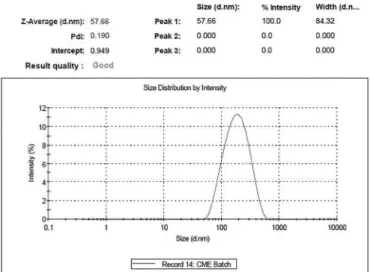
Optimal CMME was found to be transparent, stable
with viscosity ranging from 40.22×10³ cPs to 46.18×10³
cPs at 25 °C with globule size 57.6 ± 3.46 nm as shown
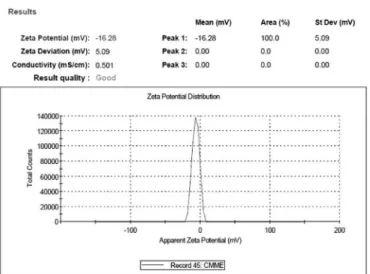
in Figure 2. Data of Zeta potential was -16.28±2.94 mV
as shown in Figure 3 indicates stability of formulation since no aggregation due to repulsion and attraction will be observed.
Results of globule size and PdI value (0.190±0.19)
indicates that the formulation was monodisperse and of nanosize which may help in the intranasal permeation
TABLE III - Desirability conirmation of Box-Behnken design through the comparision of predicted and observed results of size,
PdI, viscosity, lux and % release of CMME
Sr No. Component
Globule size
(nm) PdI
Flux
[µg/ (cm2h)] Viscosity (Ps)
% Release (After 10h)
O Smix P Pre. Obs. Pre. Obs. Pre. Obs. Pre. Obs. Pre. Obs.
1 0.30 3.80 0.50 58.6 57.4 0.198 0.208 21.0 19.4 39.8 38.2 95.9 92.6
2 0.31 3.80 0.52 58.4 57.5 0.205 0.216 20.9 20.0 39.5 37.1 91.3 93.0
3 0.31 3.75 0.50 58.9 58.0 0.198 0.202 20.8 20.2 39.5 38.0 94.4 91.6
4 0.30 3.70 0.50 56.7 56.3 0.198 0.195 20.6 21.8 39.3 38.7 92.1 91.8
5 0.30 3.80 0.50 56.6 58.1 0.212 0.227 22.0 2.89 40.2 42.1 87.5 88.9
(Pre.- Predicted and Obs.- Observed)
FIGURE 1 - Overlay plots of response (Globule size, PdI, Viscosity, Flux and % Release) of predicted formulation.
which is supported by the TEM results as shown in Figure 4.
Viscosity data also confirmed the residence of the microemulsion on the nasal mucosa. However, the obtained result indicated that the physical properties of
CMMEs were signiicantly inluenced by the combinations
of independent variables.
In vitro release and ex vivo permeation study
Release study showed that 93.81±2.68 % of drug was sustained released from CMME for 10 h. From the
data, it was observed that the release rate was decreased with increase amount of independent variables like oil and mucoadhesive polymer. This may be due to the fact that partitioning of drug was more profound when the amount
of the internal phase and mucoadhesive polymer were increased which in turn due to the solubility of drug in these vehicles. This can be explained by Noyes-Whitney equation, where the rate of dissolution increases with a decrease in the particle size, because of the resultant enhancement in the surface area and decrease in the
difusion layer thickness. The lux of 22.17 [µg/(cm2 h)]
revealed the quick permeation through nasal mucosa which may be due to the relatively smaller globule size and cumulative penetration action of oil, surfactant and co-surfactant. The effect of oil, mixture of surfactant and co-surfactant and sodium hyaluronate on physical properties and drug penetration capacity of microemulsion was evaluated by RSM with Box-Behnken design and
the results indicated that CMME system had a signiicant permeation enhancement efect for intranasal delivery of
Curcumin. Moreover, the developed system can reduce the interface tension between nasal mucosa and vehicle and thus, they can achieve a faster permeation which will be supported by the viscosity of the formulation.
Nasal ciliotoxicity
Results of nasal ciliotoxicity studies as shown in the
Figure 5 reveal the non-toxicityefect of the developed
CMME and hence it was found suitable for application on the nasal mucosa.
In-vitro mucoadhesion study
The observed retention time for CMME and CPG
were 17.0±1.5 and 1.5±0.55 min, respectively (n=3). The retention time on agar plate showed by CMME was
FIGURE 3 - Zeta potential of CMME showing its stability during storage.
FIGURE 4 - TEM result of the optimized CMME indicating the narrow particle size with uniform distribution.
FIGURE 5 - Result of nasociliotoxicity study showing the
non-toxicity of developed CMME.5[A], 5[B] and 5[C] are
signiicantly higher than CPG. Sodium hyaluronate after
hydration in the nasal ciliary microenvironment forms hydrogen bonds with the biological substrates through its carboxylic group (Morimoto et al., 1991). Thus, it can
be concluded that the developed CMME will be able to increase the residence time of the formulation on the nasal mucosa which can be attributed due to presence of sodium
hyaluronate (0.5 % w/w) (Horvat et al., 2009; Pathak et al., 2014).
In vivo study
Determination of muscular coordination and gross behavioural activity
Figure 6 depicted signiicant (p<0.05) reduction in
motor performance in MPTP group as compared to normal control group as well as CPG. Treatment with Curcumin (2.86 mg/kg) through CMME in third group of animals
signiicantly (p<0.05) improved the muscular coordination
activity as compared to MPTP-alone group.Further, MPTP
intoxication resulted in signiicant (p<0.05) decrease in
total gross activity as compared to normal control group. Intranasal administration of CMME (2.86 mg curcumin
per kg of body weight) signiicantly (p<0.05) improved
the total gross activity when compared to MPTP-alone group as shown in Figure 6. although CPG initially showed improved muscular coordination and gross behavioural activity but subsequently not sustained the proposed
beneicial efect since only mucoadhesive property of CPG
on nasal mucosal membrane not able to alter the aqueous solubility of curcumin.
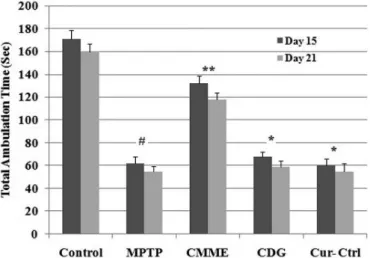
Protective efect of curcumin on gross neurological
activity as assessed through an open field test. Steep reduction in total ambulation time was observed in MPTP-intoxicated group as compared to normal controls. Curcumin treatment significantly improved the total ambulation time as shown in Figure 7.
Quantification of DA and its metabolites
MPTP intoxication signiicantly (p<0.05) decreased striatal DA content to 21.29% (6.53 ± 0.86 μg/g of brain
tissue) in comparison to normal control (21.29±1.54 μg/g of brain tissue ≅100%), which was then elevated to 55.37%
(13.67±0.58 μg/g of brain tissue) by curcumin treatment. In-addition, a concomitant elevation of DA turnover was also observed in MPTP induced mice which was
signiicantly prevented on curcumin treatment as shown
in Table IV.
Neuroprotective efect of curcumin against MPTP mediated dopaminergic neuroinlammation. Intranasal
administration of curcumin significantly protected dopamine depletion with concomitant elevation in DA turnover compared to MPTP-treated mice. Values are expressed as mean ± SD and statistically signiicant (#
P<0.05) for normal control V/s MPTP and (* P<0.05)
MPTP V/s curcumin treated groups (n=6).
These findings suggestive of neuroprotective efficacy of curcumin via developed CMME through intranasal route. Furthermore, curcumin concentration was high in brain tissue for CMME than that of CPG
(2007 ng/g±37.88 of brain tissue V/s 301.4 ng/g±21.21)
indicating the suitability of brain delivery of curcumin by CMME through nasal route over CPG. The mechanisms
FIGURE 7 - Protective efect of Ibuprofen on gross neurological activity as assessed through an open field test. Values are expressed as mean ± SD (n=06 per group.) Normal control v/s
MPTP (# P< 0.05) and MPTP v/s treated group (** P<0.05).
FIGURE 6 - Protective efect of CMME on motor coordination in rota-rod test. Data are expressed as mean ± SD (06 per group).
#P<0.05 normal control v/s MPTP and **P<0.05 MPTP v/s
of the protective efects curcumin have been linked with inhibition of inlammation coupled with anti-oxidation
property during the acute phase of MPTP injury. Reactive oxygen species (ROS) formation is suggested to be involved in progressive dopaminergic neuron damage in PD.
CONCLUSION
In the present investigation, a mucoadhesive microemulsion system for intranasal delivery of Curcumin was successfully developed and optimized using Box-Behnken experimental design. The design is valid for
predicting the globule size, PdI, viscosity, lux and % drug
release in the formulation optimization. From obtained results of above experiment, it can be concluded that 3% Capmul MCM, 37% of Accenon CC and Transcutol
HP at 2.5:1 ratio, 0.5% sodium hyaluronate and 30 mg
of Curcumin, provide optimal globule size of 57.66 nm with narrow size distribution and suitable zeta potential of –16.28 mV. In vivo studies indicate that mucoadhesive property of CMME comparatively helps to increase Curcumin uptake into the brain. Curcumin, through developed nasal mucoadhesive microemulsion system,
increases DA concentration signiicantly in brain which
in turn improves muscular coordination as well as gross behavioural activities of the test animal. Thus, intranasal formulation if properly formulated may be considered
as an efective alternative approach to treat Parkinson’s
disease.
ACKNOWLEDGEMENTS
The authors would like to thank Arjuna Natural Extracts Pvt. Ltd., Hyderabad, India for providing Curcumin as gift sample. The authors thank Abitec Corporation, Jackson St Janesville, USA and Gattefosse, France for gifting oils, surfactants and co-surfactants. The authors are also thankful to Institute of Nuclear Medicine
and Allied Sciences, Ministry of Defense, New Delhi, India for providing Male C57BL/6 mice. The authors are also grateful to Mrs. Kavitha Pillai for proof-reading the manuscript for grammatical and spelling errors.
REFERENCES
BARAKAT, N.S.; OMAR, S.A.; AHMED, A.A.E.
Carbamazepine uptake into rat brain followingintra-olfactory transport. J. Pharmacol. Pharmacother., v.58,
n.1, p.63-72, 2006.
BARBIERO, J.K.; SANTIAGO, R.M.; LIMA, M.M.; ARIZA, D.; MORAIS, L.H.; VITAL, M.A. Acute but not chronic
administration of pioglitazone promoted behavioral and neurochemical protective effects in the MPTP model of Parkinson’s disease. Behav. Brain. Res., v.216, n.1,
p.186-192, 2011.
BASSO, D.M.; BEATTIE, M.S.; BRESNAHAN, J.C. A sensitive and reliable locomotor rating scale for open ield
testing in rats. J. Neurotraum., v.12, n.1, p.21-26, 1995.
BROWN, S.M.; CAMPBELL, S.D.; CRAFFORD, A.; REGINA, K.J.; HOLTZMAN, M.J.; KHARASCH, E.D.
P-glycoprotein is a major determinant of norbuprenorphine brain exposure and antinociception. J. Pharmacol. Exp. Ther., v.343, n.1, p.53-61, 2012.
CHOPRA, S.; MOTWANI, S.K.; IQBAL, Z.; TALEGAONKAR, S.; AHMAD, F.J.; KHAR, R.K. Optimisation of polyherbal
gels for vaginal drug delivery by Box-Behnken statistical design. Eur. J. Pharm. Biopharm., v.67, n.1, p.120-131,
2007.
DOUNA, H.; BAVELAAR, B.M.; PELLIKAAN, H.; OLIVIER, B.; PIETERS, T. Neuroprotection in Parkinson’s disease: a
systematic review of the preclinical data. Open. Pharmacol. J., v.6, n.1, p.12-26, 2012.
TABLE IV - Comparative neuroprotective efect of CMME in animal models
Groups DA DOPAC HVA Turnover
(DOPAC+HVA/DA)
(μg/g tissue)
Gr 1(Normal control) 21.29±1.54 3.84±0.38 2.01±0.43 0.27±0.08
Gr II (MPTP control) 6.53±0.86# 1.37±0.21# 0.38±0.21# 0.24±0.05#
Gr III (MPTP-MME) 13.67±0.58* 2.63±0.19* 0.92±0.33* 0.26±0.08*
Gr IV (MPTP-CPG) 8.67±0.63 1.41±0.15 0.67±0.17 0.24±0.08
ELSHAFEEY, A.H.; BENDAS, E.R.; MOHAMED, O.H.
Intranasal microemulsion of sildenafil citrate: in vitro evaluation and in vivo pharmacokinetic study in rabbits. AAPS Pharm. Sci. Tech., v.10, n.2, p.361-367, 2009.
ESPOSITO, E.; DI MATTEO, V.; BENIGNO, A.; PIERUCCI, M.; CRESCIMANNO, G.; DI GIOVANNI, G. Non-steroidal anti-inlammatory drugs in Parkinson’s disease. Exp. Neurol., v.205, n.2, p.295-312, 2007.
GANNU, A.R.; RAO, Y.M. Formulation optimization and
evaluation of microemulsion based transdermal therapeutic system for nitrendipine. J. Dispersion Sci. Technol., v.33,
n.2, p.223-233, 2012.
GANNU, R.; PALEM, C.R.; YAMSANI, V.V.; YAMSANI, S.K.;
YAMSANI, M.R. Enhanced bioavailability of lacidipine via microemulsion based transdermal gels: formulation optimization, ex vivo and in vivo characterization. Int. J. Pharm., v.388, n.1-2, p.231-241, 2010.
HARRIS, A.S.; SVENSSON, E.; WAGNER, Z.S.; LETHAGEN, S.; NILSSON, I.M. Effect of viscosity on particle size,
deposition, and clearance of nasal delivery systems containing desmopressin. J. Pharm. Sci., v.77, n.5,
p.405-408, 1988.
HIROMI, S.; KENJI, Y.; YASUSHI, S.; MANABU, F.; YUKIO, T.; KAZUTAKA, I.; RYOSUKE, T. A rotarod test for
evaluation of motor skill learning. J. Neurosci. Meth., v.189,
n.2, p.180-185, 2010.
HIRSCH, E.C.; HUNOT, S. Neuroinlammation in Parkinson’s
disease: a target for neuroprotection. Lancet. Neurol., v.8,
n.4, p.382-397, 2009.
HOLCOMB, L.A.; DHANASEKARAN, M.; HITT, A.R.; YOUNG, K.A.; RIGGS, M.; MANYAM, B.V.
Bacopamonniera extract reduces amyloid levels in PSAPP mice. J. Alzheim. Dis., v.9, n.3, p.243-251, 2006.
HORVAT, S.; FEHER, A.; WOLBUG, H.; SIPOS, P.; VESZELKA, S.; TOTH, A. Sodium hyaluronate as a
mucoadhesive component in nasal formulation enhances delivery of molecules to brain tissue. Eur. J. Pharm. Biopharm., v.72, n.1, p.252-259, 2009.
LINDVALL, O.; EKDAHL, C.T.; CLAASEN, J.H.; BONDE, S.; KOKAIA, Z.; LINDVALL O. Inlammation is detrimental
for neurogenesis in adult brain. Proc. Natl. Acad. Sci. USA,
v.100, n.23, p.13632-13637, 2003.
LIU, G.P.; MA, Q.; SHI, N. Tyrosine hydroxylase as a target
for deltamethrin in the nigrostriatal dopaminergic pathway. Biomed. Env. Sci., v.19, n.1, p.27-34, 2006.
MILLER, D.S.; BAUER, B.; HARTZ, A.M.S. Modulation of
p-glycoprotein at the blood-brain barrier: opportunities to improve CNS pharmacotherapy. Pharmacol. Rev., v.60,
n.2, p.196-209, 2008.
MANDAL, S.; MANDAL, S.D. Design and development of
Carbamazepine mucoadhesive microemulsion for intranasal delivery: an ex-vivo study. Int. J. Pharm. Sci. Rev. Res., v.3,
n.1, p.56-60, 2010.
MANDAL, S.D.; MANDAL, S.; PATEL, J. Development of
curcumin loaded microemulsion drug delivery system for
improving its dissolution proile. IJPFA., v.4, p.101-107,
2013.
MORIMOTO, K.; YAMAGUCHI, H.; IWAKURA, Y.; MORISAKA, K.; OHASHI, Y.; NAKAI Y. Effects
of viscous hyaluronate-sodium solution on the nasal absorption of vasopressin and an analogue. Pharm. Res.,
v.8, n.4, p.471-479, 1991.
PATEL, M.B.; MANDAL, S.; RAJESH, K.S. Formulation
and kinetic modeling of curcumin loaded intranasal mucoadhesive microemulsion. J. Pharm. Bioallied. Sci.,
v.4, n.5, p.81-83, 2012.
PATHAK, R.; DASH, R.P.; MISRA, M.; NIVSARKAR, M.
Role of mucoadhesive polymers in enhancing delivery of nimodipinemicroemulsion to brain via intranasal route. Acta. Pharm. Sin. B., v.4, n.2, p.151-160, 2014.
PIAOA, H.; BALAKRISHNANA, P.; CHOA, H.; KIMB, H.; KIMB, Y.; CHUNGA, S.; SHIMA, C.; KIM, D. Preparation
and evaluation of fexofenadine microemulsions for intranasal delivery. Int. J. Pharm., v.395, n.1-2, p.309-316,
REZNICHENKO, L.; KALFON, L.; AMIT, T.; YOUDIM, M.B.H.; MANDEL, S.A. Low dosage of rasagiline
and epigallocatechin gallate synergistically restored the nigrostriatal axis in MPTP-induced parkinsonism. Neurodegener. Dis., v.7, n.4, p.219-231, 2010.
TOMOYUKI, F.; DAISUKE, I.; AKIKO, K.; YUTAKA, H.; TOSHIYASU, S. Inluence of formulation viscosity on drug
absorption following nasal application in rats. Drug. Metab. Pharmacokinet., v.22, n.3, p.206-211, 2007.
Received for publication on 09th November 2015