Arq Neuropsiquiatr 2005;63(3-B):772-775
1D e p a rtment of Neurology; 2Hemotherapy Center, Faculty of Medical Sciences, Campinas State University, Campinas SP, Brazil (UNI-CAMP): 1aMD; 1bMD, PhD; 2MD, PhD.
Received 26 January 2005, received in final form 28 April 2005. Accepted 28 May 2005
Dra. Anamarli Nucci - Departamento de Neurologia / Faculdade de Ciências Médicas (UNICAMP) - Caixa Postal 6111 - 13083-970 Campinas SP - Brasil. E-mail: [email protected]
GUILLAIN-BARRÉ SYNDROME IN THE ELDERLY
Clinical, electrophysiological, therapeutic
and outcome features
M a rcondes C. França Jr
1 a, Leonardo Deus-Silva
1 a, Rafael de Castro
1 a, Solange G. Garibaldi
1 b,
Beatriz H.M. Pfeilsticker
1b, Anamarli Nucci
1b, José F.C. Marques Jr
2ABSTRACT - There are few papers devoted to geriatric Guillain-Barré (GBS) and many related issues re m a i n u n a n s w e re d . Objective: To describe clinical, electrophysiological and therapeutic features in this age. Method: Clinico-epidemiological data and therapy of GBS patients older than 60 years were reviewed. Hu-ghes scores were used to quantify neurological deficit and define outcome. Results: Among 18 patients (mean age 64.8 years), 9 had evident pro d rome and 80% noticed initially sensory-motor deficit. Demy-elinating GBS was found in 8 and axonal in 6 subjects. There was one Miller-Fisher and 3 unclassified cas-es. Plasmapheresis (PFX) was single therapy in 12 patients and intravenous immunoglobulin (IVIg) in 2. Di-sability scores just before therapy were similar in both groups, so as short and long term outcome. C o n c l u -sion: Axonal GBS seems to be more frequent in the elderly and this may have prognostic implications. PFX and IVIg were suitable options, but complications were noticed with PFX. Prospective studies are needed to better understand and manage GBS in the elderly.
KEY WORDS: Guillain-Barré syndrome, plasmapheresis, intravenous immunoglobulin, elderly.
S í n d rome de Guillain-Barré no idoso: aspectos clínico-eletrofisiológicos, terapêutico e pro g n ó stico
RESUMO - Publicações sobre a síndrome de Guillain-Barré (SGB) no idoso são escassas e várias questões s o b re o tema estão abert a s . O b j e t i v o :D e s c rever aspectos clínico-eletrofisiológicos, terapêuticos e pro g n ó s-tico no idoso. Método: Revisamos os prontuários de pacientes acima de 60 anos com SGB. A escala de Hughes foi usada para quantificar os déficits iniciais e finais. Resultados: No total de 18 pacientes (média de idade 64,8 anos), 50% tiveram pródromo e 80% tiveram déficit sensitivo-motor no início. SGB desmieli-nizante foi encontrada em 8 pacientes, axonal em 6 e uma síndrome de Miller- F i s h e r. Três casos não pude-ram ser classificados. Plasmaférese (PFX) foi empregada isoladamente em 12 pacientes e imunoglobulina endovenosa (IVIg) em 2. A disfunção inicial nos dois grupos tratados era semelhante, assim como a evolução a curto e longo prazo. Conclusão: A forma axonal da SGB parece ser mais freqüente no idoso e isto pode ter implicações prognósticas. PFX e IVIg foram eficazes, mas complicações ocorreram apenas no gru p o tratado com PFX. Estudos prospectivos são necessários para um melhor entendimento e manejo da SGB no idoso.
PALAVRAS-CHAVE: síndrome de Guillain-Barré, plasmaférese, imunoglobulina endovenosa, idosos.
G u i l l a i n - B a rré syndrome (GBS) is an immune-mediated neuropathy characterized by the acute onset of symmetric weakness with areflexia and s e n-s o ry deficitn-s1. It has been described worldwide with similar annual incidence rates ranging from 0.4 to 4.0 per 100.000 inhabitants and slight male pre d o-m i n a n c e2. In most countries, GBS is now the most f requent etiology of acute flaccid paralysis and s t i l l
an important cause of severe disability, part i c u l a r-ly among aged patients2.
uni-Arq Neuropsiquiatr 2005;63(3-B) 773
versal acceptance as a first line therapy and severa l trials have shown the effectiveness of plasmaphe-resis (PFX)4 - 8 and intravenous immunoglobulin (IVIg)9,10. Both approaches have similar results9,10
Despite this, some management issues remain u n a n s w e red. There are few papers specifically ad-d ressing clinical features anad-d therapy among elad-d- eld-erly people1 1 - 1 4. Most available data do not take into account peculiarities of the geriatric gro u p . In this setting, the present study was undertaken t o evaluate the clinical findings of GBS and the tre a t-ment approaches among older patients.
METHOD
We re t rospectively reviewed medical re c o rds of pa-tients older than 60 years meeting standard diagnostic criteria for GBS1 5admitted to UNICAMP Hospital
bet-ween 1990 and 2004. This unit is a tert i a ry university c e n-ter in southern Brazil, which provides specialized neuro-logical care for approximately 5000000 inhabitants. The-re weThe-re 18 cases, including 8 women and 10 men. They w e re followed at regular appointments after the onset of GBS (range 6 to 36 months).
We re c o rded epidemiological and laboratorial data, namely sex, age on onset, pro d romal events, initial symp-toms, cere b rospinal fluid (CSF) findings and electro n e u-romyographic studies (ENMG). In accordance with a pre-vious report 16, patients were classified into four clini-c o - e l e clini-c t rophysiologiclini-c subtypes of GBS: aclini-cute inflammato-ry demyelinating polyneuropathy (AIDP), axonal GBS, Miller Fisher syndrome (MFS), and unclassified cases (the ones without ENMG). MFS necessarily presented ataxia, areflexia and ophthalmoplegia.
Clinical features and neurological deficits were re-c o rded during the re-course of the illness. A disability sre-cale modified from Hughes et al.1 7was used to quantify the
functional status of patients on admission, at nadir of de-ficits previously to institution of treatment, and at 7, 60 and 365 days after therapy. Median times to peak disabili-ty and duration of hospitalization were also identified.
PFX and IVIg were the usual therapeutic options. PFX was perf o rmed by the same apheresis team on auto-mated machines with continuous flow. Normal saline 0 . 9 % plus 5% albumin was the replacement solution. Appro x i-mately 30 ml/kg of plasma was cleared in each session a n d a central venous line was the usual vascular access. The number of pro c e d u res for each patient ranged from 1 t o 5 on an alternate day schedule. IVIg in a total dose of 2g/Kg was infused along 5 consecutive days. Obvious contra-indications both for PFX (infected patients, hemo-dynamic instability, extremely low weight) and IVIg (eg, IgA deficiency) precluded their use. We re c o rded the time before onset of treatment and the frequency of c o m-plications.
Demographical and clinical features on admission w e-re displayed as mean ± one standard deviation.
RESULTS
Mean age of the whole group was 64.8 years (range 60 to 79 years) with a slight male pre d o m i-nance. Half of the patients had a preceding event within the 4 weeks before onset of GBS, such as up-per re s p i r a t o ry tract infection (6 cases) and acute g a s t roenteritis (3 cases). Limb sensory complaints and weakness were the initial symptoms in more than 80% of cases. Cranial nerve involvement was found in 8 subjects, 5 of which had facial diplegia. Gait and limb ataxia at examination were pre s e n t in 2 patients. Autonomic failure, manifested by fluc-tuating blood pre s s u re and cardiac rhythm, was noticed in 6 patients and one presented atonic ileus.
A c c o rding to ENMG features, there were 8 pa-tients presenting AIDP, 6 axonal GBS and one MFS. T h ree patients had no ENMG evaluation (unclas-sified cases). CSF analysis revealed mean white blo-od cell count of 2 cells/mm3and protein concentra-tion of 138.9 mg/dL. Two patients presented init i a l-ly normal CSF findings, but ENMG supported GBS diagnosis. Basic clinical data of patients are resu-med in Table 1.
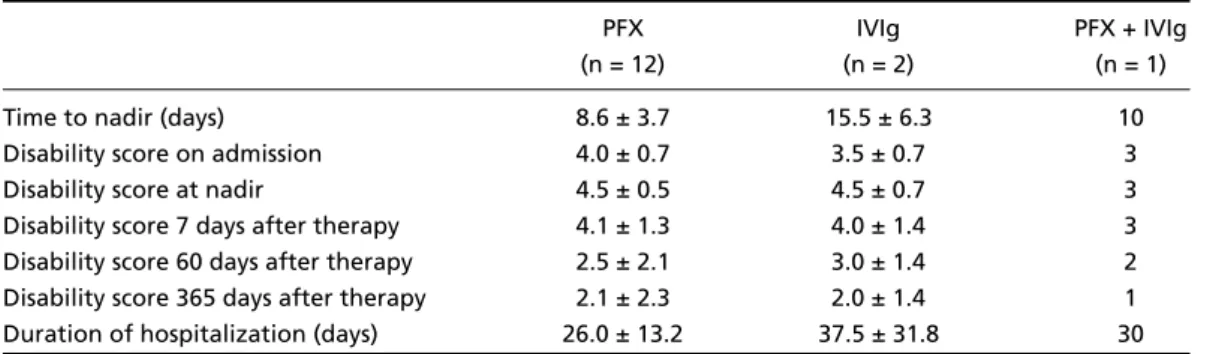
PFX and IVIg were the sole therapy in 12 and 2 patients, re s p e c t i v e l y. The MFS patient had both PFX and IVIg. Three patients were not treated with either option. This last group included two patients with mild forms of GBS, which first came for evalu-ation already in the recovery phase and one who had cardiac arrest and died in the 5t hday of illness. Mean age of patients in the PFX group was 64.1 years and in the IVIg 63.5. In the PFX group, there w e re 5 axonal GBS, 6 AIDP and one unclassified. In the IVIg group, there were one axonal GBS and o n e A I D P. Mean times before treatment onset in PFX w a s 6.1 days and in IVIg 11.5 days. Mean times from o n-set of symptoms to nadir of deficits in both gro u p s w e re 8.6 and 15.5 days, re s p e c t i v e l y. On admission, n a d i r, 7, 60 and 365 days after treatment, disabili-ty scores are resumed in Table 2. Duration of hospi-talization was also shown in this Table.
774 Arq Neuropsiquiatr 2005;63(3-B)
DISCUSSION
Major clinical and epidemiological features in our patients, such as pro d romal events, initial coplaints, frequency of autonomic and re s p i r a t o ry c o m-p romise, were in accordance to m-previous rem-p o rt s1 1 , 1 2. Distinctly to Sridharan et al.1 1, we found cranial n e r-ves to be involved quite fre q u e n t l y. Although there is no separate geriatric unit in UNICAMP Hospital, we had only three individuals older than 70 years and none in the 80’s. This finding is in accord a n c e with a recent paper from São Paulo1 8and is best ex-plained as we notice that people older than 80 years account for only 1% of the Brazilian popula-tion in striking contrast to most European count r i e s . In our surv e y, axonal GBS was identified in one
t h i rd of cases, all of which had exclusive motor in-volvement. Similarly, Rana and Rana1 4found a high p ro p o rtion of axonal GBS in older patients. Such f o rms supposedly have a worse outcome part i c ul a r-ly among aged patients1 9 , 2 0and indeed three de-ceived patients were in this group.
Patients were eligible for treatment whenever their Hughes disability score was higher than two or deficits worsened fast. When obvious contra-indications for PFX existed, IVIg was employed and vice-versa. Of these 18 patients, 10 were diagnosed b e f o re 1996, when IVIg first became available in our service. As PFX was already proven effective f o r GBS and easily perf o rmed at our Hemotherapy U n i t , it was the usual option for most cases.
Table 1. Basic clinical data of patients.
AIDP Axonal GBS MFS Unclassified
(n = 8) (n = 6) (n = 1) (n = 3)
Mean age (years) 65.0 ± 6.4 66.0 ± 2.5 65 62.0 ± 2.0
Sex (Male/Female) 5/3 3/3 0/1 2/1
Preceding evens
Upper respiratory tract infection 2 4 0 0
Acute gastroenteritis 2 1 0 0
Initial symptom
Limb numbness 3 3 0 1
Limb weakness 4 3 0 1
Pain 1 0 0 1
Gait ataxia 0 0 1 0
Cranial nerve deficit n (%) 3 (37%) 2 (66%) 1 (100%) 2 (66%)
Respiratory failure n (%) 3 (37%) 3 (50%) 0 (0%) 2 (66%)
Autonomic dysfunction n (%) 3 (37%) 2 (33%) 0 (0%) 2 (66%)
CSF cell / mm3 1.8 ± 1.3 2.5 ± 1.7 2.0 1.3 ± 1.1
CSF proteins (mg/dL) 190 ± 89.8 70.4 ± 28.0 69.5 104 ± 55.1 AIDP, Acute inflamatory demyelimating polyneuriphathy; CBS, Guillain-Barré syndrome; MFS, Miller Fisher syndrome; CSF, cerebrospinal Fluid.
Table 2. Outcome of treated patients.
PFX IVIg PFX + IVIg
(n = 12) (n = 2) (n = 1)
Time to nadir (days) 8.6 ± 3.7 15.5 ± 6.3 10
Disability score on admission 4.0 ± 0.7 3.5 ± 0.7 3
Disability score at nadir 4.5 ± 0.5 4.5 ± 0.7 3
Arq Neuropsiquiatr 2005;63(3-B) 775
In both groups, disability scores at the diff e rent moments disclosed clear improvement. IVIg-tre a t-ed individuals had a trend toward longer duration of hospitalization. However, adverse events were only re c o rded in PFX-treated cases. Hypotension has been already identified as a major problem in this age and is possibly related to decreased card i o-vascular re s e rv e1 4. Complications related to central venous access (local infection, pneumothorax and pleural effusion) were also hazardous in this series.
As a tert i a ry hospital-based series including only elderly people, we found a high mortality rate. In fact, one patient had early cardiac arrest. In the oth-er 3 cases, deaths occurred aftoth-er prolonged hos-pitalization due to sepsis. In two of these, nosoco-mial pneumonia was the source of infection and in the other Staphylococcus aure u swas isolated (ca-theter infection). Besides, two patients pre s e n t e d significant co-morbidity (heart failure and diabetes mellitus), which further worsened their pro g n o s i s . These findings are in striking contrast with those re-p o rted in a Brazilian survey of GBS among child re n2 1. Our study was a re t rospective one, there f o re p re-senting clear limitations. Despite this, it may yield some meaningful insight into geriatric GBS. Fre-quency of axonal GBS seems to be higher in the el-derly and this may have prognostic implications. B e-sides, PFX and IVIg were both suitable options in this age group, but complications were noticed w i t h PFX. Further prospective studies are needed to bet-ter understand and manage GBS in the elderly.
REFERENCES
1. Kuwabara S. Guillain-Barré syndrome: epidemiology, pathophysiolo-gy and management. Drugs 2004;64:597-610.
2. Hughes RAC, Rees JH. Clinical and epidemiological features of Guillain-Barré syndrome. J Infect Dis 1997;176(Suppl 2):S92-S98.
3. Hartung HP, Willison HJ, Kieseier BC. Acute immunoinflammatory n e u ropathy: update on Guillain-Barré syndrome. Curr Opin Neuro l 2002;15:571-577.
4. F rench Cooperative Group in Plasma Exchange in Guillain-Barré Syn-d rome. Efficiency of plasma exchange in Guillain-Barré synSyn-drome: ro l e of replacement fluids. Ann Neurol 1987;22:753-761.
5. G reenwood RJ, Newsom Davis JM, Hughes RAC, et al. Controlled tri-al of plasma exchange in acute inflammatory polyradiculoneuro p a t h y. Lancet 1984;1:877-879.
6. Osterman PO, Lundemo G, Pirskanen R, et al. Beneficial effects of plas-ma exchange in acute inflamplas-matory polyradiculoneuro p a t h y. Lancet 1984;2:1296–1299.
7. The Guillain-Barré Syndrome Study Group. Plasmapheresis and acute Guillain-Barré syndrome. Neurology 1985;35:1096-1104.
8. F rench Cooperative Group on Plasma Exchange in Guillain-Barré Syn-d rome. Plasma exchange in Guillain-Barré synSyn-drome: one-year follow-up. Ann Neurol 1992;32:94-97.
9 . Van der Meché FGA, Schmitz PIM, Dutch Guillain-Barré Study Group. A randomized trial comparing intravenous immune globulin and plasma exchange in Guillain-Barré syndrome. N Engl J Med 1992;326:11 2 3 - 11 2 9 . 10. Plasma Exchange/Sandoglobulin Guillain-Barré Syndrome Trial Gro u p . Randomised trial of plasma exchange, intravenous immunoglobulin, and combined treatments in Guillain-Barré syndrome. Lancet 1997; 349:225-230.
11 . Sridharan GV, Tallis RC, Gautam PC. Guillain-Barré syndrome in the elderly: a re t rospective comparative study. Gerontology 1993;39:170-175. 12. Winner SJ, Evans JG. Guillain-Barré syndrome in Oxford s h i re: clinical
features in relation to age. Age Ageing 1993;22:164-170.
13. Yamashita S, Morinaga T, Matsumoto K, Sakamoto T, Kaku N, Mat-sukura S. Severe Guillain-Barré syndrome in aged patients: the eff e c t of plasmapheresis. Intern Med 1992;31:1313-1316.
14. Rana SS, Rana S. Intravenous immunoglobulins versus plasmaphere-sis in older patients with Guillain-Barré syndrome. J Am Geriatr Soc 1999;47:1387-1388.
15. Asbury AK, Cornblath DR. Assessment of current diagnostic criteria for Guillain-Barré syndrome. Ann Neurol 1990;27(Suppl):S21-S24. 1 6 . Seneviratne U. Guillain-Barré syndrome. Postgrad Med J 2000;76:774-82. 17. Hughes RAC, Newsom-Davis JM, Perkin GD, Pierce JM. Contro l l e d trial of prednisolone in acute polyneuropathy. Lancet 1978;2:750-753. 18. Rocha MSG, Brucki SMD, Carvalho AAS, Lima UWP. Epidemiologic f e a t u res of Guillain-Barre syndrome in São Paulo, Brazil. A rq Neuro-psiquiatr 2004;62:33-37.
19. Van der Meche FG, Visser LH, Jacobs BC, Endtz HP, Meulstee J, van Doorn PA. Guillain-Barré syndrome: multifactorial mechanisms ver-sus defined subgroups. J Infect Dis 1997;176 (Suppl 2):S99-S102. 20. Sheth RD, Riggs JE, Hobbs GR, Gutmann L. Age and Guillain-Barré
syndrome severity. Muscle Nerve 1996;19:375-377.