Tribology in Industry
www.tribology.fink.rs
Effects of Viscosity Variation and Surface Roughness
on the Couple stress Squeeze Film Characteristics of
Short Journal Bearings
G.H. Ayyappa
a, N.B. Naduvinamani
b, A. Siddangouda
c, S.N. Biradar
daDepartment of Mathematics, Poojya Doddappa Appa College of Engineering, Kalaburagi, India, bDepartment of Mathematics, Gulbarga Univesity, Kalaburagi, India,
cDepartment of Mathematics, Appa Institute of Engineering & Technology, Kalaburagi, India, dDepartment of Mathematics, C.B. College, Bhalki, India.
Keywords:
Short Journal bearing Squeeze film
Couple stress Viscosity variation Randomized roughness
A B S T R A C T
The theoretical analysis of the combined effects of surface roughness and viscosity variation on the couple stress squeeze film characteristics of short journal bearings is presented. The modified stochastic Reynold’s equation accounting for the viscosity variation of couple stresses fluid and randomized surface roughness structure on bearing surface is mathematically derived using the Christensen stochastic theory. It is observed that, the transverse roughness pattern improves the squeeze film characteristics whereas the bearing performance is affected due to the presence of one dimensional longitudinal surface roughness. Further, it is observed that, the effect of viscosity variation is to reduce the load carrying capacity and squeeze film time as compared to the case of constant viscosity.
© 2015 Published by Faculty of Engineering
Corresponding author:
N.B. Naduvinamani
Department of Mathematics,
Gulbarga Univesity, Kalaburagi, India. Email: [email protected]
1. INTRODUCTION
The technology of squeeze film are widely applied in many engineering applications, such as gears, disk clutches, machine tools, dampers, aircraft engines and human joints. The squeeze film behaviour arises from the phenomenon of two lubricated surfaces approaching each other with a normal velocity. Newtonian lubricants are conventionally used in the squeeze film bearings [1-3], with the development of modern machine equipments, the increasing use of fluids containing microstructures, such as additives suspensions, granular matter has received great
interest. These kinds of lubricants exhibit the rheological behaviours of non-Newtonian fluids. A number of micro continuum theories have been developed to explain the peculiar behaviour of fluids containing a structure such as polymeric fluids [4, 5]. The micro continuum theory derived by Stokes [6] is the simplest generalization of the classical theory of fluids, which allows for the polar effects such as the presence of couple stress and body couples. By applying this couple stress fluid model, a number of researches in various squeeze film problems have been presented. The typical studies are the squeeze film behaviour between
R
E
S
E
A
R
C
finite plates of various shapes [7], the squeeze film configuration with reference to synovial joints [8, 9], the squeeze film partial journal bearings [10] and squeeze film performance between a sphere and flat plate [11]. Generally speaking, a higher film pressure and larger load carrying capacity as well as long response time are obtained for the squeeze films by the use of fluids with couple stress.
The effect of surface roughness on the hydrodynamic lubrication of bearings has been studied by several investigators. The random character of the surface roughness prompted many researchers to adopt a stochastic approach for the study of surface roughness [12-14]. The stochastic model developed by Christensen [12] for the study of hydrodynamic lubrication of rough surfaces formed the basis for several studies [15-17]. The effect of surface roughness on the performance of short porous journal bearings is studied by Naduvinamani et.al. [18]. Lin et.al. [19] studied the effect of surface roughness on the oscillating squeeze film behaviour of a long partial journal bearings. Since the effect of couple stress is significant and the roughness cannot be avoided, it is worth to investigate the combined effect of both on the bearing performance. Although the isotropic rough plates with non-Newtonian couple stress fluid in the squeeze film has been studied by Lin et.al. [20], the study of journal bearing system is absent. Earlier theories were based on the assumptions that the viscosity is constant, although it is a function of both pressure and temperature. The variation in viscosity with temperature is important in many practical applications, where lubricants are required to function over a wide range of temperature [21]. To study the effect of viscosity variation, one has to consider a typical viscosity film thickness relation with thermodynamic problems [22-24].
A generalised form of Reynold s equation for stochastic lubrication applicable to rough bearings was derived by considering the viscosity variation and surface roughness in short journal bearings and slider bearings by Kumar and Sachidanand [25] and Kumar and Shukla [26] respectively. The effect of viscosity variation on the squeeze film performance of narrow journal bearing with couple stress fluid
is studied by Reddy et.al. [27] by assuming bearing surfaces are smooth.
In this paper an attempt has been made to study the combined effect of viscosity variation and surface roughness on the couple stress squeeze film lubrication of narrow journal bearing.
2. MATHEMATICAL FORMULATION OF THE PROBLEM
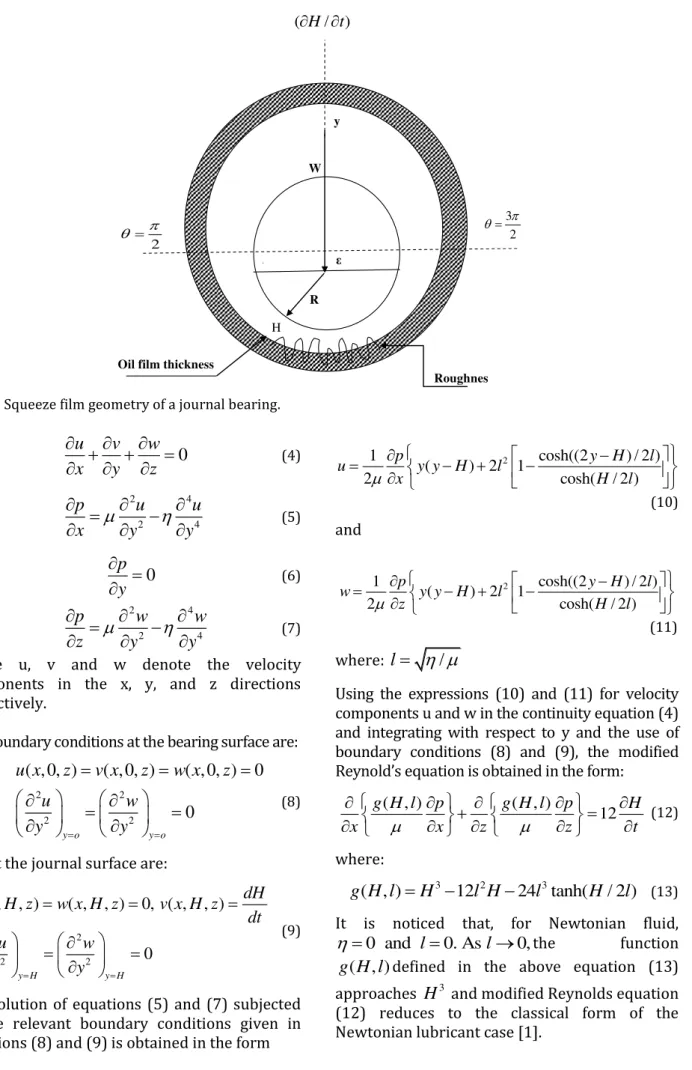
Figure 1 shows the physical configuration of a squeeze film journal bearing. The shaft of radius R approaches the bearing surface with velocity
dH dt
. The lubricant in the system is taken to be Stokes couple stress fluid.
To represent the surface roughness the mathematical expression for the film thickness is considered to be made of two parts:
( , , )
s
H h h
z(1) Where
h
c e
cos
denote the nominal smooth part of the film geometry with c being the radial clearance and e is the eccentricity, whileh
s( , , )
z
is the part due to the surface asperities measured from the nominal level and is a randomly varying quantity of zero mean,
is an index determining definite roughness arrangements. Further,
x R
/
with R being the radius of the journal.The basic equations derived by Stokes [6] for the motion of an incompressible couple stress fluid, in the absence of body forces and body couples are:
.
V
0
(2)2 4
0 p
V
V
(3)
Where the vector V represents the velocity
vector, p is the pressure, µ is the shear viscosity
and
is the new material constant responsible for the couple stress fluid property.
2
3 2
H
R W (H/t)
y
Roughnes
s
Oil film thickness
ε
Fig. 1. Squeeze film geometry of a journal bearing.
0
u
v
w
x
y
z
(4)2 4
2 4
p
u
u
x
y
y
(5)0
p
y
(6)2 4
2 4
p
w
w
z
y
y
(7)where u, v and w denote the velocity components in the x, y, and z directions respectively.
The boundary conditions at the bearing surface are:
2 2
2 2
( , 0, )
( , 0, )
( , 0, )
0
0
y o y o
u x
z
v x
z
w x
z
u
w
y
y
(8)
and at the journal surface are:
2 2
2 2
( , , ) ( , , ) 0, ( , , )
0
y H y H
dH
u x H z w x H z v x H z
dt
u w
y y
(9)
The solution of equations (5) and (7) subjected to the relevant boundary conditions given in equations (8) and (9) is obtained in the form
2
1 cosh((2 ) / 2 )
( ) 2 1
2 cosh( / 2 )
p y H l
u y y H l
x H l
(10)
and
2
1 cosh((2 ) / 2 )
( ) 2 1
2 cosh( / 2 )
p y H l
w y y H l
z H l
(11)
where:
l
/
Using the expressions (10) and (11) for velocity components u and w in the continuity equation (4) and integrating with respect to y and the use of boundary conditions (8) and (9), the modified
Reynold s equation is obtained in the form:
( , ) ( , )
12
g H l p g H l p H
x x z z t
(12)
where:
3 2 3
( , ) 12 24 tanh( / 2 )
g H l H l H l H l (13)
It is noticed that, for Newtonian fluid,
0 and l 0. As l 0,
the function( , )
g H l defined in the above equation (13)
Now it is assumed that, the Newtonian viscosity
µ is varying along the fluid film thickness H according to the relation given below [22].
1 1 Q H h
(14)
where
1is the inlet viscosity at:1
(1
)
H
h
c
.The parameter Q ≤Q≤ depends on the particular lubricant used, for perfect Newtonian fluids Q=0, whereas for perfect gases Q=1. For mathematical simplicity, the couple stress parameter l is assumed to be independent of viscosity variation, this can be done by assuming that
is varying in the same way as µ.2.1 Stochastic Reynolds equation
Let f h( )s be the probability density function of the stochastic film thickness hs. Taking the stochastic
average of equation (12) with respect to f h( )s , the
stochastic Reynolds equation is obtained:
( , )
( )
( , )
( ) ( ) 12E g H l E p E g H l E p E H
x z z z t
(15) where:
(.)
(.) ( )
s sE
f h dh
(16)In accordance with Christensen [12], it is assumed that:
2 2 3
7
35
( ) ,
( ) 32
0 elsewhere
s s
s
C h C h C
f h C
(17)
where
C
/ 3
is the standard deviation.Longitudinal roughness pattern
For the one dimensional longitudinal roughness pattern, the roughness striations are in the form of ridges and valleys in the x-direction, in this case film thickness assumes the form:
( ) s( , )
Hh z h z
(18)and the stochastic modified Reynold s equation
(15) takes the form
1
1 ( )
(( ( , )) )
( , ) ( ) ( )
12 E p
x E g H l z
E g H l E p E H
z z t
(19)Transverse roughness pattern
For one dimensional transverse roughness striations are in the form of ridges and valleys in the y-direction in this case the film thickness assumes the form:
( ) s( , )
H h
h
(20)The modified Reynold s type equation 5 takes
the form:
1
( , ) ( )
1 ( ) ( )
12 (( ( , )) )
E g H l E p
x z
E p E H
z E g H l z t
(21)Equations (19) and (21) together can be written as:
( , , ) ( )
( , , ) ( ) ( )
12
G H l c E p
x z
G H l c E p E H
z z t
(22)
1
( , ) for logitudinal roughness
where ( , , ) 1
for transeverse roughness E ( ( , ))
E g H l
G H l C
g H l
2.2 Short bearing approximation
In order to simplify the problem and to obtain a closed form solution for the fluid pressure, a narrow bearing approximation is assumed. That is the circumferential variation of pressure can be neglected as compared to the axial variation,
then the modified stochastic Reynold s equation
(22) reduces to:
( , , )
( )
( )
12
G H l C
E p
E H
z
z
t
(23)Substituting 1
1
Q
H h
1 1 ( , , ) ( ) ( ) 12 Q h
G H l c E p E H
z
H z t
(24)
Integrating twice with respect to z and applying the following boundary conditions:
( )
( ) 0, at and 0, at 0
2
L dE p
E p z z
dz
(25)
The fluid film pressure is given by:
2 2 1 1 6 ( )
( , , ) 4
Q
H dH L
E p z
G H l c h dt
(26)
Introducing the non-dimensional variables:
2
2 1
, , , cos ,
2
( )
1 cos ,
L z l dH d C
z l c c
R L c dt dt c
H E p c
H p d c R dt (27)
On substituting equation (27) into above equation (26) the non-dimensional fluid film pressure is given in a closed form is obtained as
2
2
24
cos
1
( , , )(1
)
4
Q
Q
H
p
z
G H l c
(28)
1
( , ) for logitudinal roughness
where ( , , ) 1
for transeverse roughness E ( ( , ))
E g H l
G H l c
g H l
3 2 3
( , )=H 12 24 tanh
2 H
g H l l H l
l
2.3 Load carrying capacity
The load carrying capacity is evaluated by integrating the squeeze film pressure acting on the journal shaft is given by:
/ 2 3 / 2
0 / 2
( ) 2 ( ) cos
z L
z
E w R E p d dz
(29)Introducing the non-dimensional quantity:
2
2 1
( )
( / )
E w c w
R L d dt
(30)
The load carrying capacity can be expressed in non-dimensional form as:
3 / 2 2
2
/ 2
4 (1 cos )
cos
(1 ) ( , , )
Q
Q
w d
G H l c
(31)The non-dimensional load carrying capacity w in the above equation (31) cannot be obtained by direct integration. It can be numerically evaluated by the method of Gaussian quadrature.
2.4 Squeeze time eccentricity ratio relationship
For constant load E(w), the time taken by the
journal to move from ε= to ε= ε1 can be
obtained by integrating equation (30) with respect to time. Introducing the non-dimensional response time:
2
3 1
( )
E w c
t
t
R L
(32)We have the time-height relationship expressed as:
1
d
dt
w
(33)with initial condition of
0 at =0
t
. In the limiting case of c0 equations (28), (31) and (33) reduce to that of smooth case studied by Reddy [27].3. RESULTS AND DISCUSSIONS
This paper predicts the combined effects of surface roughness and viscosity variation on the couple stress squeeze film characteristics of short journal bearings. These effects are analyzed on the basis of various dimensionless parameters such as the viscosity variation parameter Q, roughness parameterc, couple stress parameter l and the eccentricity ratio parameter
.In the present analysis, we choose the parameters,
0.5
3.1 Squeeze film pressure
Figure 2 shows the variation of non-dimensional pressure
p
as a function of circumferential coordinate
(in degrees) on the mid-planez
0
at the eccentricity ratio
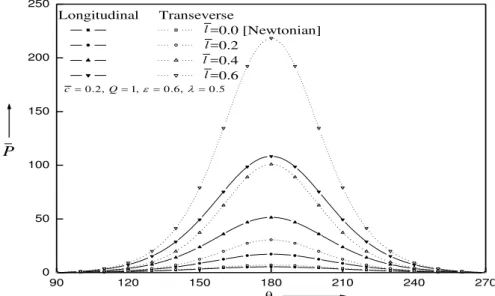
=0.6, couple stress parameter l =0.4 and roughness parameterc =0.2 for both longitudinal and transverse roughness patterns. It is observed that, the effect of viscosity variation parameter is to decreases the squeeze film pressure for both longitudinal as well as transverse roughness patterns. Figure 3 shows the variation non-dimensional pressure
p
as a function of circumferential coordinate
(in degrees) on the mid-planez
0
at the eccentricity ratio
=0.6 and Q=1 for different values of l for both longitudinal and transverseroughness pattern. It is observed that, the pressure
p
increases for increasing values of l for both longitudinal as well as transverse roughness patterns. The presence of couple stress parameter provides an increase in squeeze film pressure. As the viscosity variation factor increases the squeeze film pressure decreases rapidly for couple stress fluid than Newtonian fluid. Thus the viscosity variation effect is significantly for couple stress fluid. The effect of c on the variation ofp
with
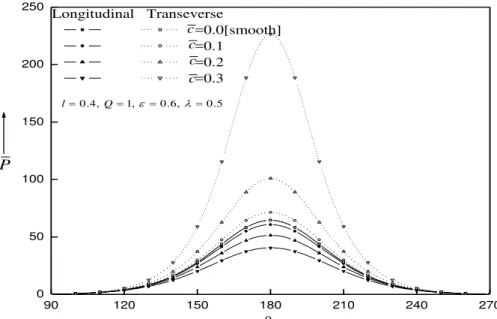
is depicted in the Fig. 4. It is observed that, the pressurep
decreases with increase in c for longitudinal roughness pattern, whereasp
increases with increase in the values of c for transverse roughness pattern.
90 120 150 180 210 240 270
0 50 100 150 200 250 300 350 400 450
Fig.2 Dimensionless pressure versus bearing circumferential angle for
0.4, 0.2, 0.6 0.5 l c
P
Longitudinal Transeverse
Q=0.0 [constant viscosity] Q=0.5
Q=1
Fig. 2. Dimensionless pressure verses bearing circumferential angle for different viscosity variation parameters.
90 120 150 180 210 240 270
0 50 100 150 200 250
0.2, 1, 0.6, 0.5 c Q
l l l l
P
Longitudinal Transeverse
=0.0 [Newtonian] =0.2
90 120 150 180 210 240 270 0
50 100 150 200 250
0.4, 1, 0.6, 0.5 l Q
c c c c
P
Longitudinal Transeverse
=0.0[smooth] =0.1
=0.2 =0.3
Fig. 4. Dimensionless pressure verses bearing circumferential angle for different roughness parameters.
0.2 0.3 0.4 0.5 0.6 0.7 0.8
10 100 1000
0 . 1, 0 . 4 , 0 . 5
c l
w
Longitudinal Transeverse
Q=0.0[constant viscosity] Q=0.25
Q=0.5 Q=0.75 Q=1
Fig. 5. Dimensionless load verses eccentricity ratio with different viscosity variation parameters.
3.2 Load carrying capacity
The variation of dimensionless load carrying capacity w with the eccentricity ratio
for different values of viscosity variation factor Q for both longitudinal and transverse pattern is depicted in Fig.5. It is observed that, the load carrying capacity decreases for increasing values of viscosity variation parameter for both the types of roughness patterns. The variation of dimensionless load carrying capacity w witheccentricity ratio
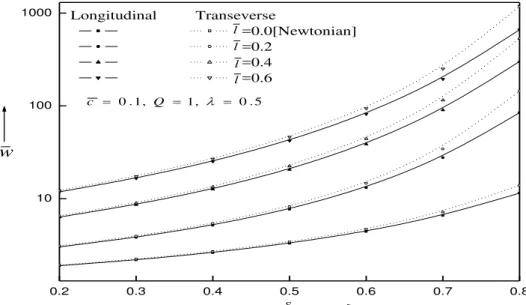
for different values of l is shown in Fig.6. It is observed that the load carrying capacity increases for the increasingvalues of l . The curve corresponding to l 0
represents the Newtonian case. Figure 7 shows the variation of dimensionless load w with eccentricity ratio
for different values of the roughness parameter, c for both the types of roughness patterns. It is observed that, w increases (decreases) for increasing values of c for the transverse (longitudinal) roughness case.3.3 Squeeze time eccentricity ratio relationship
Figure 8 shows the variation of dimensionless
0.2 0.3 0.4 0.5 0.6 0.7 0.8 10
100 1000
0 . 1, 1, 0 . 5
c Q
w
l l l l
Longitudinal Transeverse
=0.0[Newtonian] =0.2
=0.4 =0.6
Fig. 6. Dimensionless load verses eccentricity ratio with different coupe stress parameters.
0.2 0.3 0.4 0.5 0.6 0.7 0.8
10 100 1000 10000
0 . 4 , 1, 0 . 5
l Q
w
c c c c
Longitudinal Transeverse
=0.0[smooth] =0.1
=0.2 =0.3
Fig. 7. Dimensionless load verses eccentricity ratio with different roughness parameters.
0.1 0.2 0.3 0.4 0.5 0.6 0.7 0.8
0.1 1 10 100 1000
t
0.4, 0.2, 0.25 l c
Longitudinal Transverse
Q=0.0[constant viscosity] Q=0.5
0.1 0.2 0.3 0.4 0.5 0.6 0.7 0.8
0.01 0.1 1 10 100
0 . 2 , 1, 0 . 2 5
c Q
ig.9 Dimensionless time verses eccentricity ratio for different couple stress param
t
l l
l
l
Longitudinal Transverse
=0.0[Newtonian] =0.2
=0.4 =0.6
Fig. 9. Dimensionless time verses eccentricity ratio with different coupe stress parameters.
0.1 0.2 0.3 0.4 0.5 0.6 0.7 0.8
0.1 1 10 100
0 . 4 , 1 , 0 . 2 5
l Q
ig.10 Dimensionless time verses eccentricity ratio for different roughness parame t
c
c c
Longitudinal Transverse =0 =0.1 =0.2
Fig. 10. Dimensionless time verses eccentricity ratio with different roughness parameters.
It is observed that the effect of variation of viscosity is to decrease the squeeze film time for both types of roughness patterns. The variation
t
with
for different values ofl
for both thetypes of roughness pattern is shown in Fig. 9. It is observed that, the effect of couple stress fluids
is to increase
t
as compared to the corresponding Newtonian case (l
0
) for both types of roughness patterns. The variationt
with
for different roughness parameters c for both longitudinal and transverse roughness pattern is depicted in the Fig.10. It is observedthat,
t
increase (decrease) for the increasing values of c for the transverse (longitudinal) roughness patterns.4. Conclusions
The present investigation reveals the effect of viscosity variation and surface roughness on the couple stress squeeze film characteristics of short journal bearings. The modified stochastic
Reynold s equation is solved for the squeeze film
and squeeze film time. According to the results presented in the above section the following conclusions can be drawn:
1. The effect of viscosity variation is to decreases the squeeze film pressure, load carrying capacity and squeeze film time for both the types of roughness patterns.
2. The effect of couple stresses is to increases load carrying capacity and to lengthen the squeeze film time as compared to the corresponding Newtonian case for both types of roughness patterns.
3. The effect of transverse (longitudinal) roughness pattern is to increase (decrease) the load carrying capacity and squeeze film time as compared to the corresponding smooth case.
NOMENCLATURE
c radial clearance C roughness parameter
c dimensionless roughness parameter
C c/
E expectancy operator
h film thickness 1
h fluid film thickness at the inlet
hs random variable
H film thickness, h + hs
H dimensionless film thickness
l couple stress parameter 1/ 2
l dimensionless couple stress parameter (l/c) L Length of the bearing
p film pressure
p dimensionless film pressure
2
2 1
( ) E p c
d R
dt
Q viscosity variation parameter R radius of the journal
u,v,w fluid velocity components in the x, y, z
directions respectively
t response time
t dimensionless response time
2
3 1
( )
E w c
t
r L
V velocity vector
w load carrying capacity
w dimensionless load carrying capacity 2
2 1
( )
(
/
)
E w c
R L d
dt
Δ gradient operator
ε eccentricity ratio (e/c)
η material constant responsible for the couple stress property
µ1 viscosity of the lubricant at the inlet
REFERENCES
[1] O. Pinkus and B. Sternlicht, Theory of hydrodynamic lubrication, McGraw-Hill, New York, 1961.
[2] J. Prakash and S.K. Vij, 'Squeeze film in porous metal bearings', J Lubr Tech, vol. 94, pp. 302-305, 1972. [3] J.R. Lin, R.F. Lu, W.H. Liao and C.C. Kuo, 'Effect of
couple stress and convective inertia forces in parallel circular squeeze film plates', J Indust Lubr and Tribol, vol. 56, no.6, pp. 318-323, 2004. [4] T.T. Ariman and N.D. Sylvester, 'Micro continuum fluid mechanic, a review', Int J Engg Sci, vol. 11, pp. 905-930, 1973.
[5] T.T. Ariman and N.D. Sylvester, Applications of Micro continuum fluid mechanic', Int J Engg Sci,
vol. 12, pp. 273-293, 1974.
[6] V.K. Stokes, 'Couple stresses in fluids', J Phys Fluids, vol. 9, pp. 1709-1715, 1966.
[7] G. Ramanaih, 'Squeeze film between finite plates lubricated by fluids with couple stress', Wear, vol. 54, pp. 315-320, 1979.
[8] N.M. Bujurke and G. Jayaraman, 'The influence of couple stresses in squeeze films', Int J Mech Sci, vol. 24, pp. 369-376, 1982.
[10] J.R. Lin, 'Squeeze film characteristics of long partial journal bearings lubricated with couple stress fluids', Tribol Intnl, vol.30, pp. 53-58, 1997.
[11] J.R. Lin, 'Squeeze film characteristics between sphere and a flat plate couple stress fluid model', Computers and Structures, vol. 75, pp. 73-80, 2000.
[12] H. Christensen, 'Stochastic models for hydrodynamic lubrication of rough surfaces', Proc
Inst Mech Engg, vol. 184, pp. 1013-1022, 1969. [13] H. Christensen and K. Tonder, 'The
hydrodynamic lubrication of rough bearing surfaces of finite width', J Lub Tech, vol. 93, pp. 324-330, 1971.
[14] H. Christensen and K. Tonder, 'The hydrodynamic lubrication of rough journal bearings', J Lubr Tech, vol. 95, pp. 162-172, 1971. [15] J. Prakash and Tiwari, 'Roughness effects in porous circular squeeze plates with arbitrary wall thickness', J Lubr Tech, vol. 105, pp. 90-95, 1983. [16] R. Turaga, A.S. Sekhar and B.C. Majumdar,
'Stochastic FEM model of one dimensional hydrodynamic bearing with rough surfaces',
Wear, vol. 197, pp. 221-227, 1996.
[17] R. Turaga, A.S. Sekhar and B.C. Majumdar, 'The effect of roughness parameter of hydrodynamic journal bearing with rough surfaces', Tribol Intnl,
vol. 32, pp. 231-236, 1999.
[18] N.B. Naduvinamani, P.S. Hiremath and G. Gurubasavaraj, 'Surface roughness effects in short porous journal bearings with couple stresses', J Fluid Dynamics Research, vol. 31, pp. 333-354, 2002.
[19] J.R.Lin, 'Surface roughness effects on the oscillating squeeze film behaviour of long partial journal bearings', Comp and Struct, vol. 80, pp. 297-303, 2002.
[20] J.R. Lin, 'The effect of couple stresses in the squeeze film behaviour between isotropic rough rectangular plates', Int J Appl Mech Engg, vol. 6,no. 4, pp. 1007-1024, 2001.
[21] P. Freeman, Lubrication and Friction, Pitman, London, 1962.
[22] N. Tipei, Theory of lubrication, Stanford University press, Stanford, CA, 1962.
[23] N. Tipei, 'On the field of temperature in lubricating films', J Basic Engg, vol. 89, pp. 483-486, 1967.
[24] N. Tipei and Daguerre, 'A solution of thermodynamics problems for exponential lubricating films', Trans ASLE, vol. 17, pp. 84-91, 1974.
[25] S. Kumar and S.V. Sachidanand, 'Effect of viscosity variation and surface roughness in short journal bearings', Wear, vol. 52, pp. 341-346, 1979.
[26] S. Kumar and J.B. Shukla, 'Effect of viscosity variation and surface roughness in the lubrication of slider bearing', Wear, vol. 52, pp. 235-242, 1979.
[27] G.J.C. Reddy, C.E. Reddy and K.R. Prasad, 'Effect of viscosity variation on the squeeze film performance of a narrow hydrodynamic journal bearings operating with couple stress fluid',