April, 2012 PROGRESS IN PHYSICS Volume 2
A Model Third Order Phase Transition in Fe – Pnictide Superconductors
Chinedu E. Ekuma and Ephraim O. Chukwuocha
Department of Physics, University of Port Harcourt, PMB 053 Choba, Port Harcourt, Rivers, Nigeria E-mail: [email protected]
By identifying the orders of phase transition through the analytic continuation of the functional of the free energy of the Ehrenfest theory, we have developed a theory for studying the dependence of the local magnetic moment,Mon the Fe – As layer sep-aration in the third order phase transition regime. We derived the Euler – Lagrange equation for studying the dynamics of the local magnetic moment, and tested our model with available experimental data.
1 Introduction
Since the discovery of superconductivity in Fe – based pnic-tides oxides [1], there has been enormous research activities to understand the origin of their superconductivity. This im-mense interest in the physics and chemistry communities is reminiscent of the excitement that accompanied the discov-ery of high – Tccuprate superconductors in the early 1980s.
Normally, in Fe – based superconductors, antiferromagnetic (AFM) order is suppressed by charge (hole) doping but spin interactions still exist [2]. It should be noted that supercon-ductivity can still be induced in the pnictides without charge doping through either isoelectric doping, non-stoichiometry, or by use of non-thermal control parameters such as applica-tion of non-hydrostatic pressure. Also it should be noted that the parent compounds of the iron pnictides are metallic, albeit highly dissipative, bad metals [3]. Most striking is the spec-troscopy evidence that Fe based superconductors are weakly correlated electronic system [4, 5]. Thus, the origin of the observed superconductivity may not be due to Mott physics. Put differently, for the fact that spin is relevant in Fe pnic-tide superconductors, they are basically itinerant magnetism suggesting that the Mott – Hubbard physics may be irrele-vant in physics of Fe pnictide superconductors. We can thus speculate that the superconductivity observed in Fe pnictides are locally and dynamically spin polarized due to strong Fe spin fluctuations with the itinerant nature of Fe providing the “glue”. Hence, spin-fluctuation mediated through the spin channel may be relevant in understanding the origin and na-ture of the observed superconductivity in Fe pnictide.
Fe pnictide superconductors have layered structure. The Fe atom layers of these pnictide systems are normally sand-wiched by pnictogen, for example, Arsenic (As). Hence, the magnetic moment of Fe depends strongly on the inter-layer distances of Fe-As [6]. The magnetic moment of transition metals also depends on volume [7]. This leads to the so-called lattice anharmonicity.
In quasi 2D layered materials, a state with some rather unexpected properties (new mean field solution) is observed at non-zero [8]. This new mean field property observed in these layered systems cannot be described by the ordinary
phenomenological Ginzburg – Landau theory. Also, the ther-modynamic relation∫Tc
0 [δCe(H,T)/T]dT=0 which holds for
2nd order phase transition is violated in some materials with Bose – Einstein condensate (BEC)-like phase transition (see for example as in spin glasses [9], ferromagnetic and anti-ferromagnetic spin models with temperature driven transi-tions [10]). We speculate that the normal Landau theory de-veloped for 2ndorder phase transition may not adequately ac-count for the physics of the phase transitions and associated phenomena, for example, magneto-volume effect due to lat-tice anharmonicity in Fe pnictide superconductors. This mo-tivated us to develop a new Landau-like mean field theory for studying Fe-pnictide superconductors. The theory is based on the Ehrenfest classification of orders of phase transitions [11]. Specifically, we will study the dependence of the local mag-netic moment,Mon the Fe-As layer separation,z.
2 Theoretical Framework
According to Hilfer [12], rewriting the singular part of the local free energy within a restricted path through the critical point in terms of the finite difference quotient, and analyti-cally continuing in the orders, allows one to classify continu-ous phase transitions precisely according to their orders. We speculate that there exist phase transition of orders greater than two as there is no known physical reason why such tran-sitions should not exist in nature since they certainly exist in a number of theoretical models like quantum chromodynam-ics (QCD), lattice field theory and statistical physchromodynam-ics [13]. At least, higher order phase transitions (≥2) are tenuous at best and their non-detection might have been due to the hasty generalization that all that departs from phase transition of order two can always be explained in terms of field fluctua-tion [13, 14].
The dependence of the magnetic moment,Mon the Fe-As layer separation is completely determined by the functional (the magnetic free energy functional),F[z,⟨M⟩] where⟨M⟩
is the local magnetic moment. However,Fmust be invariant under the symmetry group (e.g. Abelian Higg’s model) [15] of the disordered phase in order to minimize the total energy [13]. In general,Fis a very complex functional of⟨M⟩. To
Volume 2 PROGRESS IN PHYSICS April, 2012
make ⟨M⟩ to be spatially continuous in equilibrium, in the ordered phase, we essentially for all cases, redefine it. This suggests thatF be expressed in terms of a local free energy density, f[z,⟨M⟩] (the local magnetic free energy) which is a function of the field at the point “z”. After coarse graining, in its simplest form [13, 14], F is give (for orders of phase transition>2) by,
Fp(M,z) =
∫
ddr|M|2(p−2){−ap|M|2+bp|M|4+
cp|∇M|2+|M|2α(z−zc)2(p−2)},∀p>2 (1)
wherepis the order of the phase transition,ap=ao(1−H/Hc),
bp≫1,zis the Fe-As layer distance (inter-atomic separation),
zcis the critical point, andα <0 (a typical material dependent parameter).
Equation 1 is the model equation we are proposing for studying the dependence ofMon the Fe-As inter-atomic sep-aration. For 3rdorder phase transition,p=3, Eq. 1 reduces to,
F3(M,z) =
∫
ddr|M|2{−a3|M|2+b3|M|4+
c3|∇M|2+|M|2α(z−zc)2}
(2)
If we neglect the gradient term, and minimize the local magnetic free energy with respect toM, Eq. 2 reduces to
M2= 2
3b3
[a3+|α|(z−zc)2] (3)
which basically leads (i.e., substituting Eq. 3 into 2) to the local free energy
⟨f3⟩=[
2 3b3
(a3+|α|(z−zc)2)]2{
5
3 |α|(z−zc)
2−1
3a3}. (4) In the presence of the gradient term to the local magnetic free energy, using variational principle, after scaling, we ob-tain the Euler – Lagrange equation forMas,
ϕ5−ϕ3[1−α(z−zc)2]−ϕ|∇2ϕ|=0. (5) 3 Model Application
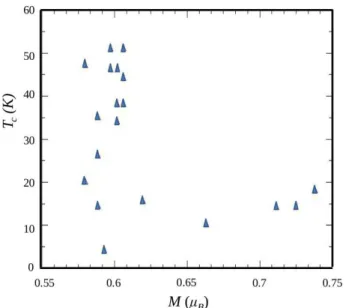
Using the data of Egami et al. [16], we calculated the mag-netic moment, M using our model Eq. 3. The plot of ex-perimentally determined critical temperature against our cal-culated M (µB) are as shown in Fig. 1. Observe that there is strong correlation between Tc andM. Most significantly,
our model predicted correctly the range of values of magnetic moment of Fe, in Fe pnictide superconductors. As it is evi-dence from the plot, the magnetic moment range from 0.59 to 0.73µB. The experimentally measured value for the magnetic moment of Fe in LaOFeAs for instance, range from 0.30 to 0.64µB[17, 18].
We speculate that the observed strong correlation between TcandM stems from the fact that the superconducting
criti-cal temperature Tcdepends very sensitively on the iron
pnic-togen (i.e., Fe-As-Fe) bond angle which in turn, depends on
Fig. 1: Color-online. Superconducting experimental critical tem-perature, Tcfrom Ref. [16] against the calculatedMobtained using
Eq. 3 at the critical point.
the Fe-As layer separation [19]. This present observation is in tandem with the understanding that the bonding of the ar-senic atoms changed dramatically as a function of magnetic moment [20] and the core-level spectroscopy measurements on CeFeAsO0.89F0.11[21] which showed very rapid spin
fluc-tuation dependent magnetic moment. Since from our model Eq. 3,Mis proportional toz(fora3≪1), the observed strong
correlation is to be expected. This observation confirms our earlier assertion that spin mediated fluctuations may be the major dominant mediator in the superconductivity of Fe pnic-tide superconductors. However, electron-phonon coupling through the spin-channel is also to be expected.
Acknowledgment
This work is supported by the Government of Ebonyi State, Federal Republic, Nigeria.
Submitted on March 24, 2012/Accepted on April 2, 2012
References
1. Kamihara Y., Watanabe T., Hirano, M. and Hosono, H. Iron-based lay-ered superconductor La[O(1-x)F(x)]FeAs (x=0.05-0.12) with T(c)=
26 K.Journal of the American Chemical Society, 2008, v. 130 (11), 3296 – 3297.
2. Haule K., Shim J. H., and Kotliar, G. Correlated Electronic Structure of LaO1−xFxFeAs.Physical Review Letters, 2008, v. 100, 226402.
3. Si Q. and Abrahams A. Strong Correlations and Magnetic Frustration in the High TcIron Pnictides.Physical Review Letters, 2008, v. 101 , 076401.
4. Ren Z. A., Lu W., Yang J., Yi W., Shen X. L., Li Z. C., Che G. -C., Dong X. -L., Sun L. -L., Zhou F. and Zhao Z. -X. Superconduc-tivity at 55 K in Iron-Based F-Doped Layered Quaternary Compound Sm[O1−xFx]FeAs.Chinese Physics Letters, 2008, v. 25 , 2215.
April, 2012 PROGRESS IN PHYSICS Volume 2
5. Yang W. -L., Sorini W. A., Chen C. -C., Moritz B., Lee W. -E., Ver-nay F., Olalde-Velasco P., Denlinger J. -D., Delley B, Chu F. G., Ana-lytis J. -G., Fisher I. -R., Ren Z. -A., Yang J., Lu W., Zhao Z. -X., van den Brink J., Hussain Z., Shen Z. -X. and Devereaux T. -P. Evidence for weak electronic correlations in iron pnictides.Physical Review B., 2009, v. 80 , 014508.
6. Yin Z. -P., Lebegue S., Han M. -J., Neal B. P., Savrasov S. -Y. and Pick-ett W. -E. Electron-Hole Symmetry and Magnetic Coupling in Antifer-romagnetic LaFeAsO.Physical Review Letters, 2008, v. 101 , 047001.
7. Chikazumi S. Physics of Magnetism. John Wiley & Sons, New York, NY, USA, 1964.
8. Cronstr¨om C. and Noga M. Third-order phase transition and supercon-ductivity in thin films.Czechoslovak Journal of Physics, 2001, v. 51 (2), 175 – 184.
9. Stanley H. E. Introduction to Phase Transition and Critical Phenomena. Clarendon Press, London, 1971.
10. Campostrini M., Rossi P. and and Vicar E. Large-N phase transition in lattice two-dimensional principal chiral models.Physical Review D, 1995, v. 52 , 395.
11. Kumar P., Hall D. and Goodrich R. G. Thermodynamics of the Super-conducting Phase Transition in Ba0.6K0.4BiO3.Physical Review Let-ters, 1991, v. 82 , 4532.
12. Hilfer R. Multiscaling and the classification of continuous phase tran-sitions.Physical Review Letters, 1992, v. 68 , 190.
13. Ekuma E. C., Asomba G. C. and Okoye C. M. I. Thermodynamics of third order phase transition: A solution to the Euler-Lagrange equa-tions.Physica B: Condensed Matter, 2010, v. 405 , 2290 – 2293.
14. Ekuma E. C., Asomba G. C. and Okoye C. M. I. Ginzburg–Landau the-ory for higher order phase transition.Physica C: Superconductivity, 2012, v. 472 , 1 – 4.
15. Callaway D. J. E. and Carson L. J. Abelian Higgs model: A Monte Carlo study.Physical Review D, 1982, v. 25 , 531 – 537.
16. Egami T., Fine B. V., Parshall D., Subedi A. and Singh D. J. Spin-Lattice Coupling and Superconductivity in Fe Pnictides.Advances in Condensed Matter Physics, 2010, v. 2010 , 164916.
17. Ishida K., Nakai Y. and Hosono H. To What Extent Iron-Pnictide New Superconductors Have Been Clarified: A Progress Report. Journal Physical Society of Japan, 2009, v. 78 , 062001.
18. de la Cruz C., Huang Q., Lynn J. W., Li J., RatcliffII W., Zarestky J. L., Mook H. A., Chen G. F., Luo J. L., Wang N. L. and Dai P. Magnetic or-der close to superconductivity in the iron-based layered LaO1−xFxFeAs
systems.Nature, 2008, v. 453 (7197), 899 – 902.
19. Lee C. -H., Iyo A., Eisaki H., Kito H., Fernandez-Dia M. T., Ito T., Kihou K., Matsuhata H., Braden M. and Yamada K. Effect of Structural Parameters on Superconductivity in Fluorine-Free LnFeAsO1−y(Ln=
La, Nd).Journal Physical Society of Japan, 2008, v. 77 , 083704. 20. Yildirim T. Strong Coupling of the Fe-Spin State and the As-As
Hy-bridization in Iron-Pnictide Superconductors from First-Principle Cal-culations.Physical Review Letters, 2009, v. 102 , 037003.
21. Kreyssig A., Green M. A., Lee Y., Samolyuk G. D., Zajdel P., Lynn J. W., Bud’ko S. L., Torikachvili M. S., Ni N., Nandi S., Le˜ao J. B., Poulton S. J., Argyriou D. N., Harmon B. N., Mc-Queeney R. J., Canfield P. C. and Goldman A. I. Pressure-induced volume-collapsed tetragonal phase of CaFe2As2 as seen via neutron
scatteringPhysical Review B, 2008, v. 78 , 184517