HESSD
8, 9089–9112, 2011A porewater – based stable isotope
approach
J. Garvelmann et al.
Title Page
Abstract Introduction
Conclusions References
Tables Figures
◭ ◮
◭ ◮
Back Close
Full Screen / Esc
Printer-friendly Version Interactive Discussion
Discussion
P
a
per
|
Dis
cussion
P
a
per
|
Discussion
P
a
per
|
Discussio
n
P
a
per
|
Hydrol. Earth Syst. Sci. Discuss., 8, 9089–9112, 2011 www.hydrol-earth-syst-sci-discuss.net/8/9089/2011/ doi:10.5194/hessd-8-9089-2011
© Author(s) 2011. CC Attribution 3.0 License.
Hydrology and Earth System Sciences Discussions
This discussion paper is/has been under review for the journal Hydrology and Earth System Sciences (HESS). Please refer to the corresponding final paper in HESS if available.
A porewater – based stable isotope
approach for the investigation of
subsurface hydrological processes
J. Garvelmann, C. K ¨ulls, and M. Weiler
Institute of Hydrology, Freiburg im Breisgau, Germany
Received: 30 September 2011 – Accepted: 5 October 2011 – Published: 11 October 2011 Correspondence to: J. Garvelmann ([email protected])
HESSD
8, 9089–9112, 2011A porewater – based stable isotope
approach
J. Garvelmann et al.
Title Page
Abstract Introduction
Conclusions References
Tables Figures
◭ ◮
◭ ◮
Back Close
Full Screen / Esc
Printer-friendly Version Interactive Discussion
Discussion
P
a
per
|
Dis
cussion
P
a
per
|
Discussion
P
a
per
|
Discussio
n
P
a
per
|
Abstract
Predicting and understanding subsurface flowpaths is still a crucial issue in hydrological research. We present an experimental approach to reveal present and past subsurface flowpaths of water in the unsaturated and saturated zone. Two hillslopes in a humid moutainous catchment have been investigated. The H2O(liquid)– H2O(vapor)equilibration
5
laser spectroscopy method was used to obtain high resolutionδ2H vertical depth
pro-files of porewater at various points along a fall line of a pasture hillslope in the southern Black Forest, Germany. The Porewater Stable Isotope Profile (PSIP) approach was de-veloped to use the integrated information of several vertical depth profiles of deuterium along two transects at the hillslopes.
10
Different shapes of depth profiles were observed in relation to hillslope position. The statistical variability (inter-quartile range and standard deviation) of each profile was used to characterize different types of depth profiles. The profiles upslope or with a weak affinity for saturation as indicated by a low topographic wetness index preserve the isotopic input signal by precipitation with a distinct seasonal variability. These ob-15
servations indicate mainly vertical movement of soil water in the upper part of the hillslope before sampling. The profiles downslope or at locations with a strong affinity for saturation do not show a similar seasonal isotopic signal. The input signal is erased in the foothills and a large proportion of pore water samples are close to the isotopic values ofδ2H in stream water during base flow. Near the stream indications for efficient
20
mixing of water from lateral subsurface flow paths with vertical percolation are found.
1 Introduction
The stable isotope ratios of deuterium (2H) to hydrogen (1H) and of oxygen-18 (18O) to oxygen-16 of water have been used as natural tracers in many studies in order to explore hydrological processes at the hillslope and catchment scale (e.g. McDon-25
HESSD
8, 9089–9112, 2011A porewater – based stable isotope
approach
J. Garvelmann et al.
Title Page
Abstract Introduction
Conclusions References
Tables Figures
◭ ◮
◭ ◮
Back Close
Full Screen / Esc
Printer-friendly Version Interactive Discussion
Discussion
P
a
per
|
Dis
cussion
P
a
per
|
Discussion
P
a
per
|
Discussio
n
P
a
per
|
Tetzlaff et al., 2009). As the stable isotope ratios of precipitation are strongly cor-related with air temperature, a distinct seasonal pattern of rainfall more enriched in heavy isotopes during summer and more depleted in winter is found in humid climates (Dansgaard, 1964). In the absence of kinetic fractionation this variability determines the atmospheric boundary condition for hydrological stable isotope studies at the plot 5
scale. The propagation and attenuation of the seasonal isotope signal with increasing depth allows for an investigation of vertical water movement in the unsaturated zone at the plot scale (Zimmermann et al., 1967; Maloszewski et al., 1983; Stewart and McDonnell, 1991; Gehrels et al., 1998). Vertical stable isotope pore water profiles in the unsaturated zone have also been used to investigate recharge mechanisms and 10
recharge rates in the vadose zone (e.g. McConville et al., 2001; Saxena, 1984). The water isotopes in soil water fractionate only slightly in humid climates. An enrich-ment of heavy isotopes in the subsurface may occur in the uppermost part of the soil column due to evaporation. Evaporation from plant interception or from ponding water in filled surface depressions entails kinetic fractionation effects, however transpiration is 15
a non-fractionating process from a hydrological perspective (Zimmermann et al., 1967; Allison et al., 1984). Mixing, water uptake by plants and hydrodynamic dispersion alter the meteoric input signal in the unsaturated zone of humid environments (Barnes and Turner, 1998). As a result of these processes an increased attenuation of the isotopic precipitation signal with increasing soil depth can be observed regularly. Time series 20
of the stable isotope signature of pore water derived with suction lysimeters at different soil depth show this damping behavior (Maloszewski et al., 1983, 2002; Stewart and McDonnell, 1991; DeWalle et al., 1997; Asano et al., 2002; Wenninger, 2007).
McDonnell et al. (1991) showed that the age of subsurface water along a hillslope characterized by an almost impermeable bedrock base and shallow soil increases con-25
HESSD
8, 9089–9112, 2011A porewater – based stable isotope
approach
J. Garvelmann et al.
Title Page
Abstract Introduction
Conclusions References
Tables Figures
◭ ◮
◭ ◮
Back Close
Full Screen / Esc
Printer-friendly Version Interactive Discussion
Discussion
P
a
per
|
Dis
cussion
P
a
per
|
Discussion
P
a
per
|
Discussio
n
P
a
per
|
found downslope. Uchida et al. (2006) integrated these findings and summarized that bedrock permeability and soil depth have an effect on the direction of increases of residence time in the unsaturated zone.
Stewart and McDonnell (1991) identified a mean residence time of more than 100 days for soil water near streams and 14 days for soil water upslope. Soil water 5
at shallow depth in unsaturated soil responded to recent rainfall input, whereas deeper soil water and water near the stream showed much less variation compared to local precipitation and was considerably delayed and attenuated by ongoing mixing and pro-gressive displacement of subsurface water. This behavior has also been shown by Horton and Hawkins (1965) and Zimmermann et al. (1966) with tritiated (3H) water. 10
There are numerous techniques for extracting porewater from soil for stable isotope analysis (e.g. suction lysimeter, centrifugation of soil samples, distillation techniques). These methods are technically complex and time-consuming. Comparisons of pore-water extraction techniques reveal large variations in the obtained data and the results appeared not very accurate (Ingraham and Shadel, 1992; Walker et al., 1994). Nev-15
ertheless these techniques have often been used to extract pore water from soil in certain temporal intervals to gain subsurface information in hillslope studies. Therefore there is a need for experimental techniques that can be fast and efficiently applied at the hillslope scale and that provide useful information about subsurface processes and hydrological hillslope behavior. In this study we present the Porewater Stable Isotope 20
Profile (PSIP) approach and explore the potential of this approach for the investigation of subsurface hydrological processes at the hillslope scale. We hypothesize that there are locations along the hillslope where the isotopic precipitation input signal is pre-served in the unsaturated zone and locations that show an attenuation of the meteoric isotope input signal due to mixing and hydrodynamic dispersion.
HESSD
8, 9089–9112, 2011A porewater – based stable isotope
approach
J. Garvelmann et al.
Title Page
Abstract Introduction
Conclusions References
Tables Figures
◭ ◮
◭ ◮
Back Close
Full Screen / Esc
Printer-friendly Version Interactive Discussion
Discussion
P
a
per
|
Dis
cussion
P
a
per
|
Discussion
P
a
per
|
Discussio
n
P
a
per
|
2 Materials and methods
2.1 Study site
The study area is a 0.9 km2, humid catchment in the southern Black Forest, Ger-many (48◦1′45′′N, 7◦53′27′′E). Mean annual precipitation amounts to approximately 1070 mm for the study area (Trenkle, 1988), the mean annual temperature is about 5
9◦C and the mean annual actual evapotranspiration is around 600 mm (WaBoa, 2007).
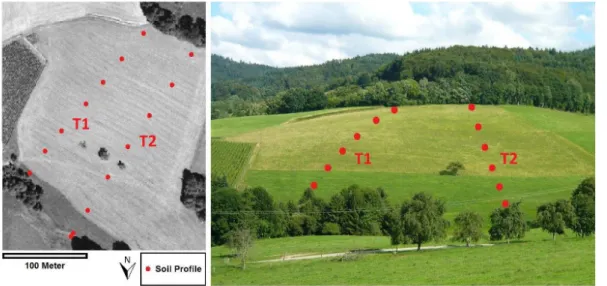
The study was conducted on a northwest facing hillslope covered with pasture and at an elevation of 290 m a.s.l. at the stream and 360 m a.s.l. at the water divide. There are only a few trees at the watershed divide and a solitary tree on the hillslope (Fig. 1). The length of the hillslope is about 300 m and the mean slope is 23◦. The soil at the 10
hillslope site is a cambisol with a sandy texture. The soil in the riparian zone is an al-luvial soil with a sandy-loamy texture. The bedrock is a paragneiss with a fine-grained configuration (Groschopf and Schreiner, 1980).
2.2 Fieldwork
The field work was conducted in August 2009. It was warm and sunny and no consider-15
able precipitation was observed in the weeks prior to the field campaign. 15 soil profiles with a depth between 90 cm and 250 cm and a vertical spacing of approximately 40 m were extracted with a gas-powered soil core drill along two hillslope catenas, labeled as transect T1 and transect T2 (Fig. 1). Since the hillslope has no clear planar topog-raphy, transect T1 was sampled on a convex part of the hillslope and transect T2 in 20
a concave situation. The soil cores were divided in the field into subsamples of 8 cm length, packed into plastic Ziplock bags and stored in a cool box in order to determine the stable isotopic composition of the porewater and the gravimetric soil moisture in the lab. Streamwater and groundwater stable isotope samples were also collected within the catchment at the same day.
HESSD
8, 9089–9112, 2011A porewater – based stable isotope
approach
J. Garvelmann et al.
Title Page
Abstract Introduction
Conclusions References
Tables Figures
◭ ◮
◭ ◮
Back Close
Full Screen / Esc
Printer-friendly Version Interactive Discussion
Discussion
P
a
per
|
Dis
cussion
P
a
per
|
Discussion
P
a
per
|
Discussio
n
P
a
per
|
2.3 Stable isotope analysis
The stable isotope signature of the porewater was determined by the H2O(liquid) –
H2O(vapor) equilibration and laser spectroscopy method. This technique provides the possibility to obtain δ-values of the porewater by measuring the stable isotopic
composition of the headspace water vapor in a bag with the sampled soil material 5
(Wassennaar, 2008).
After breaking the soil samples into smaller aggregates the Ziplock backs were filled with completely dehumidified air and heat sealed in another plastic back to reduce dif-fusion as much as possible. For calibration two samples with completely dried soil ma-terial from the experimental hillslope were moistened with different water isotope stan-10
dards of known isotopic composition and treated the same way as described above. After 15 h in a temperature controlled and air-conditioned room an isotopic equilibrium between the headspace water vapor and the liquid pore water of the soil material in the plastic bags was assumed (Wassennaar, 2008). The stable isotope analysis of the headspace water vapor of the soil samples and the calibration standards was con-15
ducted with aPicarroWavelength-Scanned Cavity Ring Down Spectroscopy analyzer. The measurement accuracy for this analysis was 0.16 ‰ forδ18O and 0.6 ‰ forδ2H,
respectively. Since the WS-CRDS analyzer measuresδ-values relative to an interior
standard we used the calibration standard to calculated δ-values of the headspace water vapor relative to the Vienna Standard Mean Ocean Water (VSMOW). Under the 20
assumption of isotopic equilibrium the phase change in the water liquid – water va-por system can be calculated with the fractionation factorα. Since α is temperature dependent we used the equilibration coefficients according to Majoube (1971) for the measured equilibration temperature (25◦C) of the 15 h equilibration period. The δ2H
values of the headspace vapor were subsequently converted via the fractionation fac-25
HESSD
8, 9089–9112, 2011A porewater – based stable isotope
approach
J. Garvelmann et al.
Title Page
Abstract Introduction
Conclusions References
Tables Figures
◭ ◮
◭ ◮
Back Close
Full Screen / Esc
Printer-friendly Version Interactive Discussion
Discussion
P
a
per
|
Dis
cussion
P
a
per
|
Discussion
P
a
per
|
Discussio
n
P
a
per
|
2.4 Additional data analysis
The distribution of collected data can be used to characterize the variability of hydrolog-ical time series, space processes and time-space processes (Gottschalk, 2005). For this purpose we show the deuterium data per site as boxplots. The inter quartile range (IQR) of the data describes the variability between the 25th and the 75th percentiles. 5
The standard deviation (SD) of the deuterium profile data were calculated as additional statistical indices describing the variability of each vertical depth profile. As a result of dispersion the variability of isotope values along a depth profile is in inverse proportion to the residence time of water.
To describe the topographic location of each profile along the transects a LiDAR 10
derived DEM with a resolution of 1 m was resampled to a spatial resolution of 5 m. The higher resolution appears too susceptible to micro-topographic influences and a slightly lower resolution yields more realistic results for hydrological landscape anal-ysis (Jensco et al., 2009). The topographic wetness index (TWI) was calculated for every profile position along the study hillslope according to the approach described by 15
Beven and Kirkby (1979) with the multiple triangular flow direction algorithm (Seibert and McGlynn, 2007).
3 Results
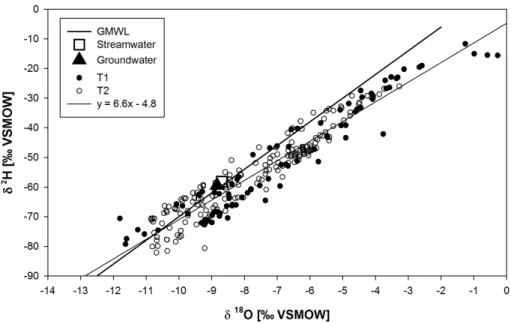
The relation between18O and2H of pore water, streamwater and groundwater is pre-sented in Figure 2. Porewater samples range fromδ18O −12.0 ‰ V-SMOW to about
20
0 ‰ and from−85 ‰δ2H V-SMOW to about−10.0 ‰. Streamwater and groundwater
samples plot close to the global meteoric water line (GMWL) and within a very narrow range isotopically close to each other. A linear regression of pore water samples from T1 and T2 has a slope of 6.6 and deviates from the global meteoric water line with slope 8 and intercept 10. This is an indication of a weak isotopic enrichment of some 25
HESSD
8, 9089–9112, 2011A porewater – based stable isotope
approach
J. Garvelmann et al.
Title Page
Abstract Introduction
Conclusions References
Tables Figures
◭ ◮
◭ ◮
Back Close
Full Screen / Esc
Printer-friendly Version Interactive Discussion
Discussion
P
a
per
|
Dis
cussion
P
a
per
|
Discussion
P
a
per
|
Discussio
n
P
a
per
|
conditions and soil characteristics (Gonfiantini et al., 1998) the observed enrichment of heavy isotopes may have occurred by evaporation of soil water in the uppermost soil layers. Most care was taken to avoid kinetic fractionation during sampling and transport, still a weak secondary enrichment cannot be strictly excluded.
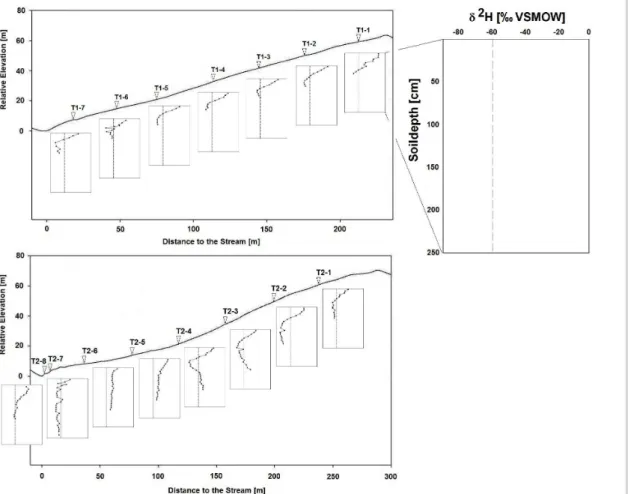
Figures 3 show the vertical depth profiles for deuterium of the pore water along the 5
studied hillslope transects. On the x-axis theδ2H values in per mill relative to VSMOW
and on the y-axis the soildepth in cm of the deuterium profiles is given. The vertical dashed line highlights theδ2H value of the sampled streamwater (−58.15 ‰).
All vertical depth profiles at transect T1 show a similar characteristic. Theδ2H values
are getting continuously lighter with increasing soil depth. The soil depth with the 10
lightest deuterium value can be interpreted as the precipitation falling during the winter with the lightest deuterium values. In most profiles the winter minimum is observed at a depth of 45 to 65 cm. Below this peak there is a trend towards heavierδ2H values
again. Thus, the vertical depth deuterium profiles along transect T1 show a typical seasonal pattern: soil water stemming from summer rainfall near the surface and an 15
increasing proportion of soil water from winter rainfall with increasing soil depth. In contrast to hillslope transect T1, the deuterium profiles at T2 show a partly diff er-ent behavior. The deuterium profiles T2-1, T2-2, T2-3 and T2-4 also still exhibit the seasonal variation described before. The values are getting more depleted with depth and the peak of the winter precipitation is found between 62 cm and 87 cm from the soil 20
surface. Below the winter-peak values are getting isotopically enriched again. Deu-terium profile T2-5 shows a continuous decline of deuDeu-terium values with increasing soil depth down to 50 cm without any indication of a clear peak. Deuterium profile T2-6 is characterized by similarδ2H values throughout the whole sampling depth. Profile
T2-7 is the deepest profile and it has a relatively small variation in δ2H values close
25
HESSD
8, 9089–9112, 2011A porewater – based stable isotope
approach
J. Garvelmann et al.
Title Page
Abstract Introduction
Conclusions References
Tables Figures
◭ ◮
◭ ◮
Back Close
Full Screen / Esc
Printer-friendly Version Interactive Discussion
Discussion
P
a
per
|
Dis
cussion
P
a
per
|
Discussion
P
a
per
|
Discussio
n
P
a
per
|
Boxplots and standard deviations of data from each vertical depth deuterium profile were calculated in order to quantify deuterium variability at each profile position along the experimental hillslope (Fig. 4). The 2nd to 4th downslope profile of transect T2 indicate a clear deviation from the other profiles with a lower standard deviation and also have a different range and median highlighted by the boxplots.
5
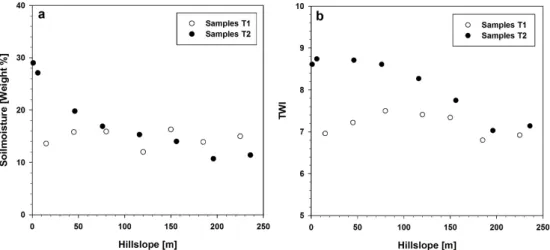
Figure 5a shows the mean gravimetric soil moisture of the vertical depth profiles along the two experimental transects. At transect T2 there is an increase of soil mois-ture in down slope direction. The soil moismois-ture is highest near the stream and lowest in upslope positions close to the watershed divide. The observed soil moisture at the T1 profiles is very similar to values between 12 and 17 % along the whole transect. A 10
similar pattern can be observed when plotting the TWI along the experimental hillslope (Fig. 5b). At transect T2 there is a distinct increase of the TWI in downslope direction, whereas at transect T1 there is no continuous trend along the hillslope. The TWI is very similar along the whole transect.
A positive correlation with R2=0.55 between mean gravimetric soil moisture and
15
TWI supports the observed similarity among the two variables. Since, the Topographic Wetness Index (TWI) can be interpreted as a relative wetness index it can be used to indicate the landscape position wetness affinity. We did not observe saturated condi-tions along the two transects. However, there is still a tendency for wetter soils and in average a lower depth to groundwater in downslope direction (especially at the concave 20
transect T2) indicated by the calculated TWI.
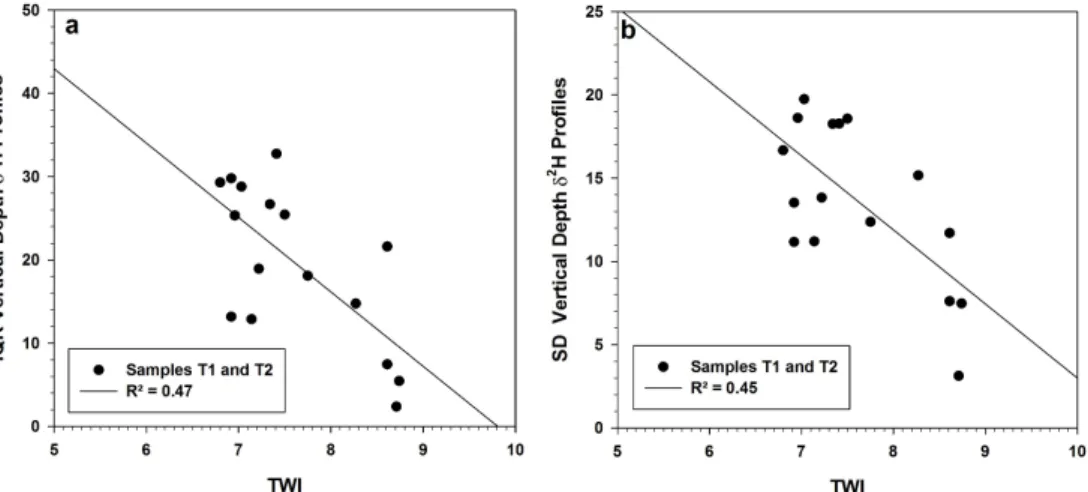
The observed deuterium variability along the hillslope as described by the SD has a negative correlation (R2=0.45) with the relative wetness index TWI (Fig. 6). A similar
result is obtained using IQR as a variability indicator (R2=0.47). In other words, the
variability within the vertical depth profiles of deuterium is decreasing as a function of 25
increasing wetness or relative saturation along the experimental hillslopes.
Figure 7 shows the difference between the vertical depth profile δ2H data and the
sampled stream water δ2H as a function of soildepth and distance to the stream. A
HESSD
8, 9089–9112, 2011A porewater – based stable isotope
approach
J. Garvelmann et al.
Title Page
Abstract Introduction
Conclusions References
Tables Figures
◭ ◮
◭ ◮
Back Close
Full Screen / Esc
Printer-friendly Version Interactive Discussion
Discussion
P
a
per
|
Dis
cussion
P
a
per
|
Discussion
P
a
per
|
Discussio
n
P
a
per
|
indicates depletion of porewater δ2H, compared to the sampled streamwater. The
percentage of data points with a difference between+10 ‰ and−10 ‰ to streamwater δ2H was calculated (Table 1).
As a result of this classification we found an high percentage of similar isotope values (within±10 ‰ from streamwaterδ2H) as profiles got deeper and closer to the stream.
5
The pore water deuterium signature of the soil samples at the foot of the experimental hilllsope and in the riparian zone was very similar to the observed streamwater deu-terium signature.
4 Discussion
In several studies time series of the stable isotope signature of porewater in different 10
soil depths has been collected with suction lysimeters in order to use the variability of the stable isotope time series signal for the investigation of subsurface hillslope pro-cesses and behavior (McDonnell et al., 1991; Steward and McDonnell, 1991; Asano et al., 2002). However, the suction lysimeter technique is very time consuming and a useful dataset needs a sampling period of at least one year. The presented approach 15
allows to collect comparable stable isotope data within one or few field working days. The vertical depth profiles of the porewater deuterium signature presented in this study provide time series information because one can see precipitation water from different seasons. With this information it is possible to explore the history of subsurface flow-paths at the hillslope scale within the timeframe of the observed isotopic signal. 20
Altitude effects could be negleted in the study because of a limited elevation range of the hillslope. Therefore, one can expect a spatially uniform stable isotope precip-itation signal along the whole hillslope. In a completely flat environment with homo-geneous soil properties and only vertical water movement, all vertical depth profiles of deuterium should be relatively similar. This behavior could not be observed on the 25
HESSD
8, 9089–9112, 2011A porewater – based stable isotope
approach
J. Garvelmann et al.
Title Page
Abstract Introduction
Conclusions References
Tables Figures
◭ ◮
◭ ◮
Back Close
Full Screen / Esc
Printer-friendly Version Interactive Discussion
Discussion
P
a
per
|
Dis
cussion
P
a
per
|
Discussion
P
a
per
|
Discussio
n
P
a
per
|
the upslope profiles still reflect the seasonal variability of the meteoric input signal of about one year with isotopically enriched summer rainfall in the upper soil profile and isotopically depleted winter rainfall in the lower profile. This variability was not observed for the deuterium profiles in the lowest part of the hillslope. This also entailed a lower statistical variability of the deuterium vertical depth profiles. Both observations indicate 5
that the variability of seasonal stable isotope input is modified by other processes. A comparison of the porewater deuterium signature and the observed streamwater deu-terium value showed that the percentage of pore water soil samples with a very similar streamwater deuterium signature is increasing towards the stream channel. Further-more we observed that the streamwater isotope value was comparable to the ground-10
water deuterium signature within the catchment. This would imply that the catchment was in baseflow conditions during the sampling campaign. Baseflow usually reflects a stable isotope signature if the mean residence time is long enough to fully attenu-ate and disperse the seasonal and recharge-weighted input. Figure 8 summarizes the findings of this study in a perceptual model. The deuterium pore water profiles at ups-15
lope positions reflect the variability of the meteoric input signal. At these positions the history of the soil water movement is dominated by vertical infiltration (dashed vertical arrows). Contrary to this the observed pore water deuterium profiles at positions along the hillslope foot and close to the stream with a high affinity for saturation (TWI) do not reflect this signal and it seems that the input signal is destroyed at these positions. 20
This observation supports the idea of a subsurface mixing zone characterized by a long transit time history of the flowpaths (dashed horizontal arrows).
The data collected in this study could also be used to benchmark hydrological hills-lope models like HYDRUS-2D (Simunek et al., 1996) and HillVi (Weiler and McDonnell, 2004) that are able to simulate the observed porewater stable isotope signatures. But 25
HESSD
8, 9089–9112, 2011A porewater – based stable isotope
approach
J. Garvelmann et al.
Title Page
Abstract Introduction
Conclusions References
Tables Figures
◭ ◮
◭ ◮
Back Close
Full Screen / Esc
Printer-friendly Version Interactive Discussion
Discussion
P
a
per
|
Dis
cussion
P
a
per
|
Discussion
P
a
per
|
Discussio
n
P
a
per
|
level was not monitored at the hillslope site. In future, it would also be interesting to compare the stable isotope data of sampled profiles with groundwater level data at the base of a hillslope in order to improve the understanding of the dynamic of the saturated zone along the hillslope.
5 Conclusions
5
The porewater-based stable Isotope Profile (PSIP) approach presented in this study was applied to an experimental hillslope in order to cover the variability of possible stable isotope profiles from the watershed divide to the stream. 15 vertical soil pro-files were extracted along two catenas at the experimental hillslope. The collected soil samples were used to analyze the pore water deuterium signature with an innovative 10
measurement technique obtaining vertical depth deuterium profiles of the porewater to investigate subsurface hydrological processes. The results suggest a vertical move-ment of soil water at upslope positions indicated by a preservation of the seasonal precipitation trend in the subsurface. This characteristic signal is destroyed for the isotope profiles at the hillslope foot and close to the stream. The topographic wetness 15
index provided a good influence for the relative influence of direct vertical recharge and indirect lateral subsurface (groundwater) flow.
The presented approach is less time consuming than conventional techniques used in hillslope and catchment hydrology to observe subsurface processes (soil moisture and groundwater observations and isotope time series). The approach is suited to 20
investigate and characterize subsurface hydrological processes at the hillslope scale and could be used to verify the performance of hydrological hillslope models. We could show that the PSIP approach could be used to determine dominant flow pathways of the last several month in a hillslope and potentially also for a catchment by only collecting soil water samples of stable isotopes at a high vertical resolution.
25
HESSD
8, 9089–9112, 2011A porewater – based stable isotope
approach
J. Garvelmann et al.
Title Page
Abstract Introduction
Conclusions References
Tables Figures
◭ ◮
◭ ◮
Back Close
Full Screen / Esc
Printer-friendly Version Interactive Discussion
Discussion
P
a
per
|
Dis
cussion
P
a
per
|
Discussion
P
a
per
|
Discussio
n
P
a
per
|
References
Allison, G. B., Barnes, C. J., Hughes, M. W., and Leaney, F. W. J.: Effect of climate and vege-tation on oxygen-18 and deuterium profiles in soils, in: Proceedings of the IAEA Symposium on Isotope Hydrology 1983, edited by: IAEA, IAEA, Vienna, Austria, 105–122, 1984. Asano, Y., Uchida, T., and Ohte, N.: Residence times and flow paths of water in steep
un-5
chaneled catchments, Tanakami, Japan, J. Hydrol., 261, 173–192, 2002.
Barnes, C. J. and Turner, J. V.: Isotopic Exchange in Soil Water, in: Isotope Tracers in Catch-ment Hydrology, edited by: Kendall, C. and McDonnell, J. J., Elsevier, Amsterdam, Lausanne, New York, Oxford, Shannon, Singapore, Tokyo, 137–163, 1998.
Beven, K. J. and Kirkby, M. J.: A physically based variable contributing area model of basin
10
hydrology, Hydrol. Sci. Bull., 24, 43–69, 1979.
Dansgaard, W.: Stable isotopes in precipitation, Tellus,16, 436–468, 1964.
DeWalle, D. R., Edwards, P. J., Swistock, B. R., Aravena, R., and Drimie, R. J.: Seasonal isotope hydrology of three Appalachian forest catchments, Hydrol. Process., 11, 1895–1906, 1997.
15
Gehrels, J. C., Peeters, J. E. M., de Vries, J. J., and Dekkers, M.: The mechanism of soil water movement as inferred from oxygen-18 stable isotope studies, Hydrol. Sci. J., 43, 579–594, 1998.
Gonfiantini, R., Fr ¨ohlich, K., Araguas-Araguas, L., and Rozanski, K.: Isotopes in Groundwater Hydrology, in: Isotope Tracers in catchment Hydrology, edited by: Kendall, C. and McDonnell,
20
J. J., Elsevier, Amsterdam, Lausanne, New York, Oxford, Shannon, Singapore, Tokyo, 203– 245, 1998.
Gottschalk, L.: Methods of Analyzing Variability, in: Encyclopedia of Hydrological Sciences, edited by: Anderson M. G. and McDonnell, J. J., John Wiley & Sons, Ltd., The Atrium, Southern Gate, Chichester, West Sussex, England, 94–122, 2005.
25
Groschopf, R. and Schreiner, A.: Geological Map of Baden-W ¨urttemberg 1:25000 – Expla-nations for map 7913 Freiburg i. Br. – NO (in German), Landesvermessungsamt Baden-W ¨urttemberg, Stuttgart, 112 pp., 1980.
Horton, J. H. and Hawkins, R. H.: Flowpath of rain from the soil surface to the water table, Soil Sci. J., 100, 377–383, 1965.
30
HESSD
8, 9089–9112, 2011A porewater – based stable isotope
approach
J. Garvelmann et al.
Title Page
Abstract Introduction
Conclusions References
Tables Figures
◭ ◮
◭ ◮
Back Close
Full Screen / Esc
Printer-friendly Version Interactive Discussion
Discussion
P
a
per
|
Dis
cussion
P
a
per
|
Discussion
P
a
per
|
Discussio
n
P
a
per
|
Jencso, K. G., McGlynn, B. L., Goose, M. N., Wondzell, S. M., Bencala, K. E., and Mar-shall, L. A.: Hydrologic connectivity between landscapes and streams: Transferring reach-and plot-scale understreach-anding to the catchment scale, Water Resour. Res., 45, W04428, doi:10.1029/2008WR007225, 2009.
Kendall, C. and McDonnell, J. J.: Isotope Tracers in Catchment Hydrology, Elsevier,
Amster-5
dam, Lausanne, New York, Oxford, Shannon, Singapore, Tokio, 839 pp., 1998.
Majoube, M.: Fractionement en oxygen-18 et en deuterium entre l’eau et sa vapeur, J. Chem. Phys., 68, 1423–1436, 1971.
Maloszewski, P., Rauert, W., Stichler, W., and Hermann, A.: Application of flow models in an alpine catchment area using tritium and deuterium data, J. Hydrol., 140, 343–360, 1983.
10
Maloszewski, P., Stichler, W., Zuber, A., and Rank, D.: Identifying the flow systems in a karstic-fissure-porous aquifer, the Schneealpe, Austria, by modelling of environmental oxygen-18 and tritium isotopes, J. Hydrol., 256, 48–59, 2002.
McConville, C., Kalin, R. M., Johnston, H., and McNeil, G. W.: Evaluation of recharge in a small temperate catchment using natural and applied oxygen-18 profiles in the unsaturated zone,
15
Ground Water, 39, 616–623, 2001.
McDonnell, J. J.: A Rationale for Old Water Discharge Through Macropores in a Steep, Humid Catchment, Water Resour. Res., 26, 2821–2832, 1990.
McDonnell, J. J., Stewart, M. K., and Owens, I. F.: Effect of Catchment-Scale Subsurface Mixing on Stream Isotopic Response, Water Resour. Res., 27, 3065–3073, 1991.
20
Saxena, R. K.: Seasonal variations of oxygen-18 in soil moisture and estimation of recharge in esker and moraine formations, Nord. Hydrol., 15, 235–242, 1984.
Seibert, J. and McGlynn, B. L.: A new triangular multiple flow direction algorithm for computing upslope areas from gridded digital elevation models, Water Resour. Res., 43, WR04501, doi:10.1029/2006WR005128, 2007.
25
Stewart, M. K. and McDonnell, J. J.: Modeling Base Flow Soil Water Residence Times from Deuterium Concentrations, Water Resour. Res., 27, 2681–2693, 1991.
Simunek, J., Sejna, M., and van Genuchten, M. T.: HYDRUS-2D. Simulating water flow and solute transport in two-dimensional variability saturated media, US Salinity Laboratory, USDA/ARS Riverside, California, Distributed by International Ground Water Modelling
Cen-30
ter, 167 pp., 1996.
HESSD
8, 9089–9112, 2011A porewater – based stable isotope
approach
J. Garvelmann et al.
Title Page
Abstract Introduction
Conclusions References
Tables Figures
◭ ◮
◭ ◮
Back Close
Full Screen / Esc
Printer-friendly Version Interactive Discussion
Discussion
P
a
per
|
Dis
cussion
P
a
per
|
Discussion
P
a
per
|
Discussio
n
P
a
per
|
provinces?, Hydrol. Process., 23, 945–953, 2009.
Trenkle, H.: Das Klima, In: Breisgau-Hochschwarzwald - Land vom Rhein ¨uber den Schwarzwald zur Baar, Schillinger Verlag GmbH, Freiburg i. B., 83–95, 1988.
Uhlenbrook, S., Frey, M., Leibundgut, C., and Maloszewski, P.: Hydrograph separations in a mesoscale mountainous basin at event and seasonal timescales, Water Resour. Res., 38,
5
WR000938, doi:10.1029/2001WR000938, 2002.
Uchida, T., McDonnell, J. J., and Asano, Y.: Functional intercomparison of hillslopes and small catchments by examining water source, flowpath and mean residence time, J. Hydrol., 327, 627–642, 2006.
Vitvar, T., Aggarwal, P. K., and McDonnell, J. J.: A Review of Isotope Applications in Catchment
10
Hydrology, in: Isotopes in the Water Cycle: Past, Present and Future of a Developing Sci-ence, edited by: Aggarwal, P. K., Gat, J. R., and Froehlich, K. F. O., Springer, Dordrecht, The Netherlands, 151–169, 2005.
WaBoa: Water and Soil Atlas Baden-W ¨urttemberg, Digital Version, 2007 (in German).
Walker, G. R., Woods, P. H., and Allison, G. B.: Interlaboratory comparison of methods to
15
determine the stable isotope composition of soil water, Chem. Geol., 111, 297–306, 1994. Wassenaar, L. I., Hendry, M. J., Chostner, V. L., and Lis, G. P.: High resolution pore water delta
deuterium and oxygen-18 measurements by water (liquid)-water (vapor) equilibration laser spectroscopy, Environ. Sci. Technol., 42, 9262–9267, 2008.
Weiler, M. and McDonnell, J.J.: Virtual Experiments: a new approach for improving process
20
conceptualization in hillslope hydrology, J. Hydrol., 285, 3–18, 2004.
Wenninger, J.: Investigation of hydrological processes in the system soil – vegetation – at-mosphere, Freiburger Schriften zur Hydrologie, Band 25, Inst. of Hydrology, University of Freiburg, Freiburg, Germany, 151 pp., 2007 (in German).
Zimmermann, U., Munnich, K. O., Roether, W., Kreuzt, W., Schubach, K., and Siegel, O.:
25
Tracers determine movement of soil moisture and evaporation, Sci. J., 152, 346–347, 1966. Zimmermann, U., Ehhalt, D., and Munnich, K. O.: Soil-water movement and evapotranspiration:
HESSD
8, 9089–9112, 2011A porewater – based stable isotope
approach
J. Garvelmann et al.
Title Page
Abstract Introduction
Conclusions References
Tables Figures
◭ ◮
◭ ◮
Back Close
Full Screen / Esc
Printer-friendly Version Interactive Discussion
Discussion
P
a
per
|
Dis
cussion
P
a
per
|
Discussion
P
a
per
|
Discussio
n
P
a
per
|
Table 1. Percentage of the vertical depth deuterium profile data along T1 and T2 between
+10 ‰ and−10 ‰ difference to streamwaterδ2H.
HESSD
8, 9089–9112, 2011A porewater – based stable isotope
approach
J. Garvelmann et al.
Title Page
Abstract Introduction
Conclusions References
Tables Figures
◭ ◮
◭ ◮
Back Close
Full Screen / Esc
Printer-friendly Version Interactive Discussion
Discussion
P
a
per
|
Dis
cussion
P
a
per
|
Discussion
P
a
per
|
Discussio
n
P
a
per
|
HESSD
8, 9089–9112, 2011A porewater – based stable isotope
approach
J. Garvelmann et al.
Title Page
Abstract Introduction
Conclusions References
Tables Figures
◭ ◮
◭ ◮
Back Close
Full Screen / Esc
Printer-friendly Version Interactive Discussion
Discussion
P
a
per
|
Dis
cussion
P
a
per
|
Discussion
P
a
per
|
Discussio
n
P
a
per
|
HESSD
8, 9089–9112, 2011A porewater – based stable isotope
approach
J. Garvelmann et al.
Title Page
Abstract Introduction
Conclusions References
Tables Figures
◭ ◮
◭ ◮
Back Close
Full Screen / Esc
Printer-friendly Version Interactive Discussion
Discussion
P
a
per
|
Dis
cussion
P
a
per
|
Discussion
P
a
per
|
Discussio
n
P
a
per
|
HESSD
8, 9089–9112, 2011A porewater – based stable isotope
approach
J. Garvelmann et al.
Title Page
Abstract Introduction
Conclusions References
Tables Figures
◭ ◮
◭ ◮
Back Close
Full Screen / Esc
Printer-friendly Version Interactive Discussion
Discussion
P
a
per
|
Dis
cussion
P
a
per
|
Discussion
P
a
per
|
Discussio
n
P
a
per
|
HESSD
8, 9089–9112, 2011A porewater – based stable isotope
approach
J. Garvelmann et al.
Title Page
Abstract Introduction
Conclusions References
Tables Figures
◭ ◮
◭ ◮
Back Close
Full Screen / Esc
Printer-friendly Version Interactive Discussion
Discussion
P
a
per
|
Dis
cussion
P
a
per
|
Discussion
P
a
per
|
Discussio
n
P
a
per
|
HESSD
8, 9089–9112, 2011A porewater – based stable isotope
approach
J. Garvelmann et al.
Title Page
Abstract Introduction
Conclusions References
Tables Figures
◭ ◮
◭ ◮
Back Close
Full Screen / Esc
Printer-friendly Version Interactive Discussion
Discussion
P
a
per
|
Dis
cussion
P
a
per
|
Discussion
P
a
per
|
Discussio
n
P
a
per
|
HESSD
8, 9089–9112, 2011A porewater – based stable isotope
approach
J. Garvelmann et al.
Title Page
Abstract Introduction
Conclusions References
Tables Figures
◭ ◮
◭ ◮
Back Close
Full Screen / Esc
Printer-friendly Version Interactive Discussion
Discussion
P
a
per
|
Dis
cussion
P
a
per
|
Discussion
P
a
per
|
Discussio
n
P
a
per
|
HESSD
8, 9089–9112, 2011A porewater – based stable isotope
approach
J. Garvelmann et al.
Title Page
Abstract Introduction
Conclusions References
Tables Figures
◭ ◮
◭ ◮
Back Close
Full Screen / Esc
Printer-friendly Version Interactive Discussion
Discussion
P
a
per
|
Dis
cussion
P
a
per
|
Discussion
P
a
per
|
Discussio
n
P
a
per
|