Article
J. Braz. Chem. Soc., Vol. 23, No. 10, 1895-1899, 2012. Printed in Brazil - ©2012 Sociedade Brasileira de Química 0103 - 5053 $6.00+0.00
A
*e-mail: [email protected]
A Simple Method to Evaluate, Correlate and Predict Boiling and
Flash Points of Alkynes
Justin M. Godinho,a Felix A. Carrolla and Frank H. Quina*,b
aDepartment of Chemistry, Davidson College, 28035 Davidson, NC, USA
bInstituto de Química, Universidade de São Paulo, CP 26077, 05513-970 São Paulo-SP, Brazil
Pontos de ebulição (TB) de alcinos acíclicos são preditos a partir de seus números de ponto de
ebulição (YBP) com a relação: TB(K) = –16,802YBP2/3 + 337,377YBP1/3 – 437,883. Os valores de YBP,
por sua vez, são calculados a partir da estrutura dos compostos utilizando a equação: YBP = 1,726 +
Ai + 2,779C + 1,716M3 + 1,564M + 4,204E3 + 3,905E + 5,007P – 0,329D + 0,241G + 0,479V +
0,967T + 0,574S. O valor de Ai depende do padrão de substituição do alcino e o restante da
equação é o mesmo relatado anteriormente para alcanos. Para um conjunto de dados de 76 alcinos acíclicos, a correlação entre os valores de TB previstos e da literatura apresentou um desvio médio
absoluto de 1,46K com um valor de R2 de 0,999. Além disso, os valores de Y
BP também podem
ser utilizados para prever os pontos de fulgor dos alcinos.
Boiling points (TB) of acyclic alkynes are predicted from their boiling point numbers (YBP) with
the relationship TB(K) = –16.802YBP
2/3 + 337.377Y BP
1/3 – 437.883. In turn, Y
BP values are calculated
from structure using the equation YBP = 1.726 + Ai + 2.779C + 1.716M3 + 1.564M + 4.204E3 +
3.905E + 5.007P – 0.329D + 0.241G + 0.479V + 0.967T + 0.574S. Here Ai depends on the
substitution pattern of the alkyne and the remainder of the equation is the same as that reported earlier for alkanes. For a data set consisting of 76 acyclic alkynes, the correlation of predicted and literature TB values had an average absolute deviation of 1.46 K, and the R
2 of the correlation
was 0.999. In addition, the calculated YBP values can be used to predict the flash points of alkynes.
Keywords: alkynes, boiling point, flash point, correlation, prediction
Introduction
Boiling point (TB) is arguably the most important physical property of an organic compound that is liquid at room temperature. Chemists intuitively assume a direct relationship between molecular structure and the boiling point of a substance, but expressing this relationship with a simple mathematical formula is challenging. Therefore, methods to predict TB values continue to attract wide interest.1 As is often the case in chemistry, however, it is
usually necessary to choose between simple relationships with limited accuracy and more complex methods that can be more accurate.2
The prediction of boiling point from molecular structure is complicated by the fact that the TB values of homologous organic compounds increase nonlinearly with the incremental addition of repeat units. For example,
Figure1showsthecurvaturewhenboilingpoints(•)of
linear 1-alkynes, from 1-hexyne to 1-triacontyne, are plotted against the number of carbon atoms in the chain. For this reason, methods to predict boiling points directly from simple structure counts can be reasonably accurate over the narrow range of molecular sizes for which the methods were developed, but they become increasingly inaccurate as the structures become larger. Therefore, most of the recently reported methods for calculating boiling points incorporate a series of topological functions or theoretical parameters that, taken together, can yield curvature when predicted boiling points are plotted against chain length.
values of the new parameter are used to predict values of the physical property of interest for other homologous compounds. For boiling points, the new parameter is the boiling point number, YBP. Values of TB relate to values of
YBPvia equation 1, where a = −16.802, b = 337.377, and
c = −437.833.3 As shown in Figure 1, there is an excellent
correlation of YBP values calculated in this way with the
number of carbon atoms in the unbranched 1-alkynes.
(1)
Our initial investigation of the relationship between YBP
values and molecular structure was carried out with acyclic alkanes (this work was based on an early report by Kinney,4
who introduced the concept of a boiling point number, Y, as a measure of TB values).Their YBP values could be
predicted quite accurately from molecular structure, as is shown in equation 2.3
YBP = 1.726 + 2.779C + 1.716M3 + 1.564M + 4.204E3 +
3.905E + 5.007P – 0.329D + 0.241G + 0.479V +
0.967T + 0.574S (2)
Here, C is the number of carbon atoms in the longest chain, M3 is the number of methyl substituents on carbon 3
of this chain (counting from either end), M is the number of methyl substituents elsewhere on the chain, E3 and E are the
number of corresponding ethyl substituents, P is the number of propyl substituents, D is the number of 2,2-dimethyl groupings (counting from either end), G is the number of geminal substitutions at other positions, V is the number of vicinal alkyl relationships, T is the number of instances of two methyl substituents on both carbons one and three of a three-carbon segment of the parent chain, and S is the square of the ratio of total number of carbons to the number of carbons in the longest chain. This approach gave a correlation of experimental and predicted boiling points having R2 = 0.999 for 198 acyclic alkanes containing from
six to 30 carbons.3
Based on the success of this approach for alkanes, we have begun to explore the prediction of TB values
of other organic compounds. Recently we reported excellent correlations for the boiling points of alkenes5
and alkylbenzenes.6 Here we extend this approach to the
calculation of boiling points of acyclic alkynes. A prediction method is needed for this class of compounds because surprisingly few experimental TB values are available for
alkynes. The method we report here not only provides a convenient boiling point prediction capability, but it also can be used to predict the flash points of the alkynes.
Method
We compiled a data set containing the literature boiling points for 66 linear and 10 branched acyclic alkynes containing from six to 30 carbon atoms in the main chain (the alkynes, their boiling points, flash points, and literature references are provided in the Supplementary Information).
Next we modified equation 2, which was originally developed for alkanes, so that the YBP values of alkynes
could also be calculated directly from molecular structure. In doing so, we wished to change equation 2 as little as possible, because the structural parameters responsible for intermolecular attractions of alkanes should influence the intermolecular attractions of the aliphatic portions of alkynes in the same way. Thus we modified equation 2 only by adding the parameter Ai, which reflects the difference
in intermolecular attraction resulting from the substitution of a –C≡C– unit for a CH3–CH2– or –CH2–CH2– segment
at different locations along the carbon chain of an alkane. The resulting expression is shown in equation 3.
YBP = 1.726 + Ai + 2.779C + 1.716M3 + 1.564M +
4.204E3 + 3.905E + 5.007P – 0.329D + 0.241G +
0.479V + 0.967T + 0.574S (3)
Other than the term Ai, the parameters and coefficients
in equation 3 are identical to those in equation 2. However, Figure 1. Nonlinear relationship of literature TB values (, left axis)
and linear relationship of YBP values (, right axis) with the number of carbon atoms in a series of unbranched 1-alkynes ranging from 1-hexyne to 1-triacontyne. The solid line shows the linear correlation (R2 = 0.9999)
we did make a slight change in the interpretation of one parameter. For steric reasons, a methyl substituent on C3 of a 1-alkyne was counted as M instead of M3. A
similar interpretation of the M3 parameter was made for
the alkenes.5 We should note that, for lack of literature
values, our data set does not include compounds with ethyl or propyl groups, nor do any structures have V, G, or T substitution patterns. We have retained those parameters in equation 3, however, so that it can be used to predict boiling points of compounds having those structural features.
To evaluate this approach, we used initial guesses for the Ai values associated with different patterns of acetylenic
substitution in equation 3 to estimate YBP values of the
alkynes. Using the Solver add-in of Microsoft Excel, we then determined the values of Ai that produced the
lowest average absolute deviation (AAD) between the YBP
values determined from experimental boiling points with equation 1 and those predicted from molecular structure using equation 3.
Results and Discussion
The best values of Aifor different alkyne bonding
patternsare shown in Table 1.
Although these values forAi are empirical, they are
chemically reasonable. They can be rationalized as the net effect of the loss of dispersion resulting from the removal of four hydrogen atoms from the corresponding alkane and the increase in intermolecular attraction made possible by the greater linearity of a structure with a carbon-carbon triple bond. Only three carbons are necessarily collinear in a 1-alkyne, so the overall effect is a slight decrease in intermolecular attraction. A 2-alkyne has four collinear carbon atoms at one end of the chain, so intermolecular attraction is much greater than in the corresponding alkane. A 3-alkyne also has four collinear carbon atoms, but now there are non-collinear segments at each end of that four-carbon segment. As a result, the total increase in intermolecular attraction is less than for a 2-alkyne, so the Ai value for a 3-alkyne is less positive than that of
a 2-alkyne. The non-collinear segments are even longer for a 4- or higher alkyne, so the Ai value for a 4-alkyne is
smaller still. An even better correlation between literature and predicted values can be obtained by use of separate parameters for 4-alkynes and 5- or higher alkynes. We judged the improvement insufficient to justify addition of another parameter, however.
As an example of the application of equation 3, consider the calculation of YBP for 2-methyl-3-octyne. This is a
3-alkyne, so the Ai value is 0.298 from Table 1. There is
one methyl substituent on C2, so M is 1. The longest chain has eight carbon atoms, and the total number of carbons in the molecule is nine. Therefore, S = (9/8)2 = 1.27. The
M3, E, E3, P, D, G, V, and T parameters are all 0. For this
compound, therefore, YBP = 1.726 + 0.298 + (8 × 2.779) +
1.564 + (1.27 × 0.574) = 26.55. The YBP value calculated
from equation 1 is 26.48.
The YBP values of the other alkynes were calculated
from equation 3 in the same way, and these YBP values
were then used to predict TB values with equation 4. 3 This
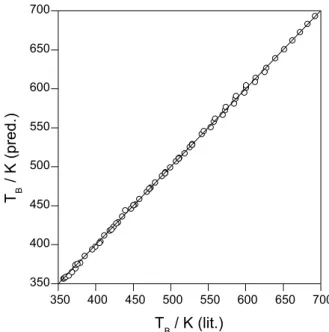
produced a very good correlation of literature and predicted boiling points, as is shown in Figure 2. Here R2 = 0.999, the
standard error is 1.99 K, and the AAD between literature and predicted TB values is 1.46 K.
TB(K) = –16.802YBP
2/3 + 337.377Y BP
1/3 – 437.883 (4)
The correlation presented here is more accurate than any alkyne boiling point method previously reported. The Table 1. Ai values for use in equation 3
Alkyne position Ai
1-alkyne –0.324
2-alkyne 1.261
3-alkyne 0.298
4- or higher alkyne 0.211
Figure 2. Correlation of literature boiling points of 76 linear and branched acyclic alkynes with predicted values based on YBP values calculated from structure via equation 3. The diagonal line represents perfect correlation of literature TB values. For better visibility, the data points are sized to
Joback-Reid approach7 gave an AAD of 27.1 K for the
76 alkynes in our data set. A group contribution method for non-electrolytes, which was based on counts of molecular fragments and a steric factor plus consideration of group interactions, gave an AAD of 3.01 K for a data set having 25 alkynes.8 Another method used a six-variable linear
model incorporating molecular connectivity and computed values of electron density surfaces to predict the boiling points of hydrocarbons. It gave an AAD of 6.29 K for a set of 12 acyclic alkynes containing up to eight carbon atoms.9
A method for predicting boiling points of hydrocarbons in general, which incorporated group contributions and topological parameters, produced an AAD of 3.59 K for a group of 47 alkynes.10 Thus, the method we report is
significantly more accurate than any of these other methods, even though it was evaluated on a much larger data set. Additionally, the correlation reported here is based directly on structure counts, so it does not require specialized software for implementation.
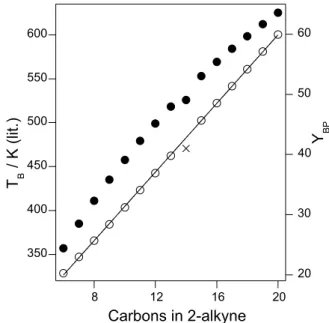
Not only does the method presented here allow the prediction of boiling points for compounds that have not yet been characterized, but it also can be used to evaluate literature boiling point data. As shown in Figure 3, the reported boiling point of 2-tetradecyne (525.7 K)11
is qualitatively inconsistent with the boiling points of homologous compounds. For this reason, we had concluded that the reported TB value of 2-tetradecyne is likely to be
in error and excluded this compound from the data set. That assessment is validated by the YBP values shown in
Figure 3. There is no obvious chemical reason why the YBP value of 2-tetradecyne (indicated with the symbol ×)
should deviate from the excellent linear trend exhibited by so many homologous compounds, so we suggest that the experimental boiling point of 2-tetradecyne be redetermined.12
The results of the present study can be extended to the prediction of flash points of alkynes. The flash point (TFP)
of a liquid is the lowest temperature at which the mixture of vapor and air above the substance can be ignited. For this reason, flash points are the standard measure of the fire hazard associated with the storage, transport, and use of flammable compounds. Experimental flash points are often unavailable for alkynes, however, and we could locate experimental TFP values for only about half of the alkynes
in our data set.
Recently we introduced the flash point number, NFP, as
a new measure of the flammability of organic liquids. The relationship reported between flash points and NFP values
is shown in equation 5.13
TFP(K) = 23.369NFP2/3 + 20.010NFP1/3 + 31.901 (5)
We also demonstrated that there is a strong relationship between the NFP and YBP values of hydrocarbons, as shown
in equation 6.14 Here D is the number of olefinic double
bonds in the structure, T is the number of triple bonds, and B is the number of aromatic rings.
NFP = 0.987YBP + 0.176D + 0.687T + 0.712B – 0.176 (6)
For monoalkynes, T is 1, and both D and B are 0, so equation 6 reduces to equation 7.
NFP = 0.987YBP + 0.511 (7)
We used equation 7 and YBP values predicted with
equation 3 to calculate the NFP values of the compounds in
our data set. Then we used those NFP values in equation 5
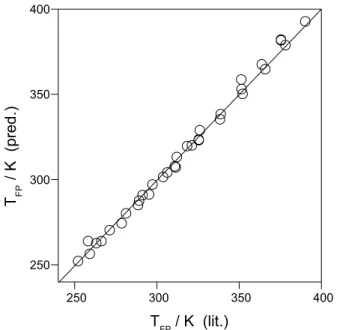
to predict their flash points. There was a good correlation (Figure 4) between these predicted TFP values and the
reported TFP values for 39 alkynes boiling below 550 K
for which reported TFP values were found. Equation 5 was
developed with a data set of linear and branched alkanes having boiling points of 589 K or lower and flash points of 438 K or less.13 In the alkenes study,5 there was an
increasing deviation between reported and predicted TFP
values for compounds that boil above 550 K. A similar pattern was observed in the current study, so the limit of applicability of equation 5 seems to be TB values below
550 K. Further work will be necessary to determine a more accurate correlation of NFP and TFP values for higher boiling
Figure 3. Nonlinear relationship of literature TB values (, left axis)
and linear relationship of YBP values (, right axis) with the number of carbon atoms in a series of unbranched 2-alkynes ranging from 2-hexyne to 2-icosyne. The solid line shows the linear correlation (R2 = 0.9999) of
alkynes. The R2 of the correlation was 0.995, and the AAD
between literature and predicted values was 2.51 K. This result compares favorably with those of other methods for predicting hydrocarbon flash points from structure, which give AADs of 6-12 K.14,15 Thus, the Y
BP values calculated
from equation 3 can be used to predict the flash points of acyclic alkynes more accurately than with previous methods.
Conclusions
The boiling point prediction method presented here is not only very easy to apply to acyclic alkynes, but it is also more accurate than previous methods. Comparison of reported alkyne boiling points with those predicted using equation 4 offers a simple means to identify literature TB values that
should be redetermined. In addition, the YBP values calculated
with equation 3 are useful for the prediction of the flash points of alkynes. Efforts to develop similar correlations for other families of organic compounds are underway.
Supplementary Information
The data set of alkynes along with their literature boiling points, YBP values, counts of the structural parameters used
in equation 3, reported flash points, literature references, and predicted TFP values are provided in the Supplementary
Information. This material is available free of charge at http://jbcs.sbq.org.br as a PDF file.
Acknowledgments
Financial and fellowship support from Davidson College and from Conselho Nacional de Desenvolvimento Científico e Tecnológico (CNPq) are gratefully acknowledged. F. H. Q. is affiliated with the Brazilian National Institute for Catalysis in Molecular and Nanostructured Systems (INCT-Catalysis) and with NAP-PhotoTech, the USP Research Consortium for Photochemical Technology.
References
1. For a discussion and leading references, see Katritzky, A. R.; Kuanar, M.; Slavov, S.; Hall, C. D.; Karelson, M.; Kahn, I.; Dobchev, D. A.; Chem. Rev. 2010, 110, 5714.
2. Carroll, F. A.; Perspectives on Structure and Mechanism in
Organic Chemistry, 2nd ed.; John Wiley & Sons: Hoboken, NJ,
2010, ch. 1.
3. Palatinus, J. A.; Sams, C. M.; Beeston, C. M.; Carroll, F. A.; Argenton, A. B.; Quina, F. H.; Ind. Eng. Chem. Res. 2006, 45, 6860.
4. Kinney, C. R.; J. Am. Chem. Soc. 1938, 60, 3032; ibidem Ind.
Eng. Chem. 1940, 32, 559.
5. Carroll, F. A.; Godinho, J. M.; Quina, F. H.; Ind. Eng. Chem.
Res. 2011, 50, 14221.
6. Godinho, J. M.; Lin, C.-Y.; Carroll, F. A.; Quina, F. H.; Energy
Fuels 2011, 25, 4972.
7. Joback, K. G.; Reid, R. C.; Chem. Eng. Commun. 1987, 57, 233.
8. Nannoolal, Y.; Rarey, J.; Ramjugernath, D.; Cordes, W.; Fluid
Phase Equilib. 2004, 226, 45.
9. Wessel, M. D.; Jurs, P. C.; J. Chem. Inf. Comput. Sci. 1995, 35, 68. (The AAD value cited here was computed from data in Table 1 of this reference).
10. Li, H.; Higashi, H.; Tamura, K.; Fluid Phase Equil. 2006, 239, 213.
11. http://ull.chemistry.uakron.edu/erd/ accessed in June 2012. 12. The value of YBP predicted for 2-tetradecyne using equation 3
is 42.47, which can be used in equation 4 to predict a boiling point of 534.7 K. That is 9 K higher than the reported TB value.
13. Carroll, F. A.; Lin, C.-Y.; Quina, F. H.; Energy Fuels 2010, 24, 392.
14. Carroll, F. A.; Lin, C.-Y.; Quina, F. H.; Energy Fuels 2010, 24, 4854.
15. Carroll, F. A.; Lin, C.-Y.; Quina, F. H.; Ind. Eng. Chem. Res. 2011, 50, 4796.
Submitted: July 10, 2012
Published online: October 23, 2012
FAPESP has sponsored the publication of this article. Figure 4. Correlation of reported flash points of 39 linear and branched
acyclic alkynes with TFP values calculated using YBP values predicted with