Article
J. Braz. Chem. Soc., Vol. 24, No. 9, 1504-1511, 2013. Printed in Brazil - ©2013 Sociedade Brasileira de Química 0103 - 5053 $6.00+0.00
A
*e-mail: [email protected]
Determination of Propylthiouracil in Pharmaceuticals by Differential Pulse
Voltammetry Using a Cathodically Pretreated Boron-Doped Diamond Electrode
Elen Romão Sartori,a,b Aline Barrios Trench,a Romeu C. Rocha-Filho,a and
Orlando Fatibello-Filho*,a
aDepartamento de Química, Universidade Federal de São Carlos,
C.P. 676, 13560-970 São Carlos-SP, Brazil
bDepartamento de Química, Universidade Estadual de Londrina,
C.P. 10.011, 86057-970 Londrina-PR, Brazil
Um procedimento simples é descrito para a determinação de propiltiouracil (PTU) por voltametria de pulso diferencial (DPV) usando um eletrodo de diamante dopado com boro (BDD) pré-tratado catodicamente. Estudos por voltametria cíclica indicam que a oxidação do PTU é irreversível a um potencial de pico de 1,42 V (vs. Ag/AgCl (KCl 3,0 mol L−1)) em uma solução
tampão de Britton-Robinson (BR) (pH 2,0). Sob condições otimizadas, a curva analítica obtida foi linear (r = 0,9985) na faixa de concentração de PTU de 1,0 a 29,1 µmol L−1 em solução tampão
BR (pH 2,0), com um limite de detecção de 0,90 µmol L−1. O método proposto foi aplicado com
sucesso na determinação de PTU em amostras farmacêuticas, com resultados concordantes (a um nível de 95% de confiança) com aqueles obtidos empregando um método titulométrico oficial.
A simple procedure is described for the determination of propylthiouracil (PTU) by differential pulse voltammetry (DPV) using a cathodically pretreated boron-doped diamond (BDD) electrode. Cyclic voltammetry studies indicate that the oxidation of PTU is irreversible at a peak potential of 1.42 V (vs. Ag/AgCl (3.0 mol L−1 KCl)) in a Britton-Robinson (BR) buffer solution (pH 2.0).
Under optimized conditions, the obtained analytical curve was linear (r = 0.9985) for the PTU concentration range of 1.0 to 29.1 µmol L−1 in a BR buffer solution (pH 2.0), with a detection limit
of 0.90 µmol L−1. The proposed method was successfully applied in the determination of PTU in
pharmaceutical samples, with results in agreement at a 95% confidence level with those obtained using an official titration method.
Keywords: propylthiouracil determination, 6-propyl-2-thiouracil, BDD electrode, cathodic pretreatment, differential pulse voltammetry
Introduction
Propylthiouracil (PTU; 6-propyl-2-thiouracil, Figure 1) is widely used in the treatment of hyperthyroidism, a disease caused by overactivity of the thyroid gland. This drug inhibits the activity of the thyroid gland peroxidase and blocks the conversion of tetraiodothyronine (T4) to triiodothyronine (T3).1 Therefore, the development of a
sensitive and selective method for the determination of PTU in pharmaceuticals is highly desirable, especially for quality control purposes.
Several methods for the determination of PTU have been reported in the literature for pharmaceutical formulations and biological samples, such as high-performance liquid chromatography (HPLC) with post column iodine-azide reaction monitored at UV2 or HPLC with
chemiluminescence detection,3 spectrophotometric
kinetic method based on the PTU inhibitory effect of the Pd(II)-catalyzed reaction between pyronine G and
the hypophosphite anion,4 titration,5 and electrochemical
techniques, such as potentiometric and coulometric titration6 and voltammetry.7-11
Sarna and Fijalek7 determined PTU in 0.1 mol L−1 NaOH
by cyclic voltammetry (CV) using a gold electrode; the obtained analytical curve was linear for the concentration range of 0.10 to 0.50 mmol L−1. Kasprzak et al.8 used a
hanging mercury drop electrode for the determination of PTU in pharmaceutical formulations by cathodic stripping voltammetry (CSV). The obtained analytical curve was linear for the concentration range of 0.020 to 0.24 µmol L−1
in an acetate buffer solution (pH 3.9), with detection limit of 0.0010 µmol L−1. Shahrokhian and Jannat-Rezyani9
developed a differential pulse voltammetric method for PTU determination in pharmaceutical preparations using a carbon-paste electrode modified with a Schiff-base complex of cobalt (Co(II)-4-chlorosalophen). A linear response was attained for the concentration range of 5.0 to 750 µmol L−1, with a detection limit of 2.0 µmol L−1.
Shahrokhian and Saberi10 developed an indirect method
(using catechol as redox mediator) for the determination of PTU in pharmaceutical and biological fluids by differential pulse voltammetry (DPV) using a glassy-carbon (GC) electrode. A linear analytical curve was obtained for the concentration range of 0.1-10 µmol L−1, with a detection limit
of 0.05 µmol L−1. More recently, Oliveira et al.11 used a GC
electrode modified with multiwalled carbon nanotubes within a poly(allylamine hydrochloride) film for the determination of PTU in pharmaceuticals by CSV. The obtained analytical curve was linear for concentrations in the range of 5.0 to 58.0 µmol L−1 in a Britton-Robinson (BR) buffer solution
(pH 2.0), with a detection limit of 1.0 µmol L−1, applying an
accumulation potential of 1.0 V for 60 s.
Boron-doped diamond (BDD) has been widely used in electroanalytical determinations of organic compounds in pharmaceutical formulations.12-23 BDD
electrodes present several advantages compared to other conventional electrodes (e.g., GC or Pt electrodes), such as stability against corrosion in very aggressive media, very low and stable background current, extreme electrochemical stability in both alkaline and acidic media, high response sensitivity, and a very wide working potential window.24-26 Previously, these unique properties of BDD
allowed the direct determination of acetylsalicylic acid in pharmaceutical formulations,12 without the previous
alkaline hydrolysis step that is necessary when other types of electrodes are used.
In this article, we report on the development of a novel method for the determination of PTU in pharmaceutical formulations by DPV using a cathodically pretreated BDD electrode. We show that the voltammetric responses are
much better than those obtained using a GC electrode. The proposed method is simple, rapid, precise, and accurate for quantitative determinations of PTU. Moreover, the obtained results are statistically equal to those from the official British Pharmacopoeia method.5
Experimental
Reagents and solutions
All chemicals were of analytical grade: PTU (Sigma-Aldrich) and boric acid, acetic acid, orthophosforic acid, and methanol (Merck). The PTU pharmaceutical samples were purchased from a local drugstore.
A 0.1 mol L−1 PTU methanolic stock solution was prepared
before use. All PTU working solutions were prepared by dilution of this stock solution with a Britton-Robinson (BR) buffer solution (pH 2.0). This BR buffer was prepared by mixing 0.04 mol L−1 acetic, orthophosphoric, and boric
acid solutions; the final pH was adjusted by adding suitable amounts of a 2.0 mol L−1 sodium hydroxide solution.
Equipments and electrodes
Voltammetric measurements and electrochemical pretreatments of the BDD electrode were carried out using an Autolab PGSTAT-30 (Ecochemie) potentiostat/ galvanostat controlled with the GPES 4.0 software. The voltammetric experiments were conducted in a three-electrode single-compartment glass cell at room temperature (25.0 ± 0.5 °C), including a Pt wire as the auxiliary electrode, an Ag/AgCl (3.0 mol L−1 KCl) as the
reference electrode (to which all potentials hereinafter will be referred to), and BDD (8000 ppm; 0.36 cm2 exposed area;
Adamant, Switzerland) or GC (Tokay Carbon Co., Japan) as working electrode. Detailed information on the preparation of the BDD films is reported elsewhere.27 Prior to the
experiments, the BDD electrode was electrochemically pretreated in a 0.5 mol L−1 H
2SO4 solution: first an anodic
pretreatment (0.5 A cm−2, 30 s), which was followed by a
cathodic one (−0.5 A cm−2, 150 s); thus, the BDD surface
was first rid of any impurities and then made predominantly hydrogen terminated.28 The selection of this pretreatment
procedure is discussed in detail in section 3.1.
The pH was measured at 25.0 ± 0.5 °C using an Orion pH-meter, Expandable Ion Analyser, model EA-940, employing a combined glass electrode with an Ag/AgCl (3.0 mol L−1 KCl) external reference electrode.
Analytical procedures
CV, DPV, and square-wave voltammetry (SWV) were employed to investigate the electrochemical behavior or the quantification of PTU. Analytical curves were obtained by adding small volumes of the PTU methanolic stock solution to the BR buffer solution (pH 2.0). DP and SW voltammograms were obtained after each aliquot addition. Thus, the analytical parameters were compared and the best results were used to quantify PTU in the commercial samples.
To prepare solutions of the PTU commercial samples, ten tablets (100 mg of PTU per tablet) were accurately weighed and then reduced to a homogeneous fine powder in a mortar with a pistil. A suitable amount of this powder, corresponding to a methanolic 0.1 mol L−1 PTU stock solution, was weighed,
transferred to a 5 mL calibrated flask and dissolved to volume. After, suitable aliquots of the supernatant were transferred to 10 mL calibrated flasks and completed to volume with the BR buffer solution (pH 2.0). An aliquot of each sample solution was directly transferred to the electrochemical cell containing the supporting electrolyte, after which the DP voltammograms were obtained. The PTU concentration in each sample solution was determined using the regression equation of the previously plotted analytical curve obtained with standard solutions.
For the recovery studies, aliquots of the PTU standard solution were added to real samples prepared from pharmaceutical tablets. Sets of triplicate enrichments were carried out with increasing PTU concentration. The recovery of PTU was calculated using the corresponding regression equation of the previously plotted analytical curve.
The results obtained with the proposed DPV method were compared with those obtained with the titration method of the British Pharmacopoeia.5 Thus, an accurate
representative amount of powder of each PTU sample was dissolved in a sodium hydroxide solution with the aid of gentle heating. This solution was acidified with acetic acid and titrated with mercury nitrate until a pinkish violet color was obtained using 1,5-diphenylcarbazone as indicator.
Results and Discussion
PTU electrochemical behavior
Initially, the cyclic voltammogram for 1.0 mmol L−1
PTU in the BR buffer (pH 2.0) was obtained using the
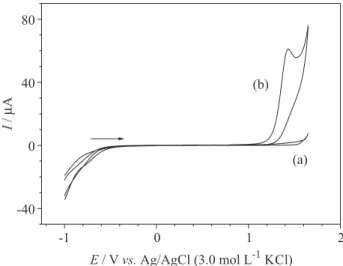
BDD electrode. As can be seen in Figure 2, an anodic current peak is present at a potential of 1.42 V due to the oxidation of PTU. No reduction peaks were observed on the reverse scan, indicating that on BDD this is an irreversible charge-transfer process.
Taking into account that the analytical performance of BDD electrodes depends on their surface termination (e.g., hydrogen or oxygen terminated),28-29 the effect of different
electrochemical pretreatments of the BDD electrode on its analytical response for a 1.0 mmol L−1 PTU solution in
the BR buffer (pH 2.0) was investigated. Thus, the BDD electrode was anodically (+0.5 A cm2, 20 s) or cathodically
(−0.5 A cm2, 80 s) pretreated in a 0.5 mol L−1 H
2SO4 solution,
and then its analytical response was assessed (see Figure 3). As can be seen in this figure, the cathodic pretreatment led to a less positive PTU oxidation potential and a better current peak definition (a better repeatability was also found), indicating that this pretreatment of the electrode led to a higher electrochemical activity for PTU oxidation, as previously observed for several other analytes.12-17,30-35 Next,
the influence of the duration (120 to 180 s) of the cathodic pretreatment of the BDD electrode on its analytical signal was investigated; a less positive PTU oxidation potential along with a higher current peak magnitude was attained with the 150 s pretreatment. Thus, all subsequent PTU analytical determinations were carried out with the BDD electrode cathodically pretreated (−0.5 A cm−2, 150 s),
which ensured a predominantly hydrogen-terminated electrode surface. This pretreatment, which was carried out daily before starting the voltammetric measurements, was always preceded by an anodic pretreatment (0.5 A cm−2,
30 s) that cleaned the electrode surface by oxidizing any contaminant present on it. This coupled pretreatment
Figure 2. Cyclic voltammograms (50 mV s−1) obtained using a
procedure led to an excellent repeatability in the PTU determinations.
The number of electrons (n) transferred in the
electrooxidation of PTU on the BDD electrode can be estimated by Ep−Ep/2 = 47.7 mV/αn.
36 In the voltammogram
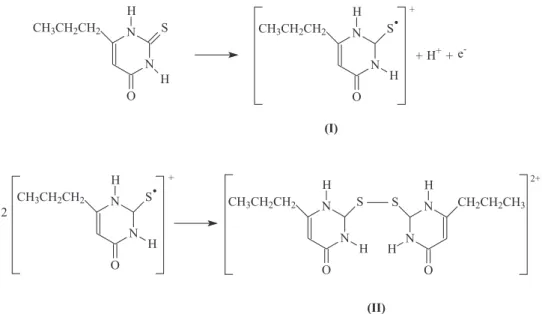
for PTU oxidation obtained using a cathodically pretreated BDD electrode (Figure 3), the Ep and Ep/2 values are 1.42 V and 1.32 V, respectively. If the value of the transfer coefficient(α) is assumed as equal to 0.5, n can be estimated as 0.95, i.e., approximately 1. Consequently, assuming n = 1, we propose that the oxidation of PTU is represented by the reaction shown in Figure 4. This result indicates that PTU is oxidized to its corresponding free-radical product via a one-electron transfer process (Figure 4, step (I)),
followed by its dimerization to a disulfide compound (−S−S−) (Figure 4, step (II)), as reported or discussed in previous studies with same and similar molecules.11,37,38 It
should be noted that no adsorption of the disulfide formed in the PTU oxidation was observed on the surface of the BDD electrode, as it occurs on a GC electrode,11 which led to an
improvement of the repeatability between measurements.
Effects of pH, supporting electrolyte composition, and scan rate
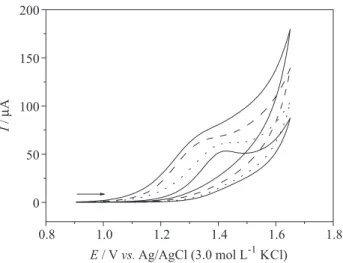
The effect of the BR buffer pH on the voltammetric response of a 1.0 mmol L−1 PTU solution was investigated
in the pH range of 2.0 to 6.0, at the scan rate of 50 mV s−1
(Figure 5). We found that the current magnitude decreased and the peak potential shifted to less positive values as the pH was increased. Hence, the best voltammetric response using the BR buffer occurred when its pH was 2.0.
Next, the effect of the composition of the supporting electrolyte was comparatively investigated for sulfuric acid and phosphate or BR buffer solutions at pH 2.0. The BR buffer yielded the best response: less positive oxidation peak potential and higher peak current magnitude; hence, this buffer solution was used as the supporting electrolyte for all the additional studies.
Once again using a 1.0 mmol L−1 PTU solution in the
BR buffer (pH 2.0), CV scan rate (0.005-0.500 V s−1)
studies were carried out to assess whether the electrodic processes at the BDD electrode were under diffusion or adsorption control. We found that the PTU oxidation peak potential shifted toward more positive values as the scan rate increased, a characteristic of irreversible electrochemical reactions.39 At the same time, a linear
Figure 3. Cyclic voltammograms (50 mV s−1) obtained for a
1.0 mmol L−1 PTU solution in the BR buffer (pH 2.0) using a BDD
electrode after it underwent an anodic (dashed line) or cathodic (solid line) pretreatment (see text).
dependence of the peak current with the square root of the scan rate was found (Figure 6). On the other hand, a plot of the logarithm of the oxidation peak current vs. the logarithm of the scan rate yielded a straight line with a slope of 0.47, close to the theoretically expected value (0.5) for a diffusion-controlled behavior.39 The number of
electrons (n) transferred in the electrooxidation of PTU on the BDD electrode may also be estimated by applying Laviron’s equation for an irreversible electrode process.40
The obtained αn value was 0.673; hence, assuming
that α is equal to 0.5, n can be estimated as 1.3, i.e., approximately 1, in reasonable agreement with the value obtained above from the Ep−Ep/2 = 47.7 mV/αn equation
and confirming the involvement of one electron per molecule in the oxidation of PTU, as shown in Figure 4.
Analytical curves
First, the influence of the values of the operational parameters associated to each voltammetric technique (SWV and DPV) was investigated using the cathodically pretreated BDD electrode and a 100 µmol L−1 PTU solution
in the BR buffer (pH 2.0).
For SWV, the investigated value ranges were: 10-150 Hz, for the square-wave frequency (f); 10-60 mV, for the pulse amplitude (a); 1-8 mV, for the scan increment (∆ES). The obtained optimized values were f = 50 Hz, a = 40 mV, and ∆ES = 3 mV.
For DPV, the investigated value ranges were: 10-250 mV, for the pulse amplitude (a); 2.5-50 mV s−1, for the scan
rate (ν); 2-10 ms, for the modulation time (t). The obtained optimized values were a = 150 mV, ν = 40 mV s−1, and t = 3 ms.
After optimization of these operational parameters, the analytical curves for PTU in the BR buffer solution (pH 2.0) were obtained for both voltammetric techniques. The analytical parameters associated to these curves are summarized in Table 1. As can be inferred from the values of these parameters, especially from those of the peak potential and sensitivity (slope), DPV yielded the best results and, hence, was selected for the determination of PTU. Despite the higher slope value, the DPV calculated detection limit (LOD) value (0.90 µmol L−1) was similar
to the SWV one (0.92 µmol L−1); this occurred because the
standard deviation of the blank solution was higher for DPV.
The DP voltammograms obtained for PTU reference solutions at different concentrations (1.0 to 29.1 µmol L−1)
in the BR buffer solution (pH 2.0) are presented in Figure 7. The insert in this figure depicts the respective analytical curve obtained for PTU (r = 0.9985), whose corresponding regression equation is
Figure 5. Cyclic voltammograms (50 mV s−1) of 1.0 mmol L−1 PTU
solutions in BR buffers of different pH values: 2.0 (solid thick line), 3.0 (dotted line), 4.0 (dashed line), and 5.0 (solid line) using a cathodically pretreated BDD electrode.
Figure 6. Linear dependence of the peak current (Iap) with the square root
of the scan rate (v1/2) for cyclic voltammograms of a 1.0 mmol L−1 PTU
solution in the BR buffer (pH 2.0) using a cathodically BDD electrode at different scan rates (0.005-0.500 V s−1).
Table 1. Analytical parameters for the voltammetric determination of PTU in the BR buffer solution (pH 2.0) by square-wave voltammetry (SWV) and differential pulse voltammetry (DPV), using a cathodically pretreated BDD electrode.
SWV DPV
Peak potential / V 1.37 1.30
Linear range / (µmol−1 L) 1.0-29.1 1.0-29.1
Correlation coefficient, r 0.9989 0.9985
Slope / (µA µmol−1 L) 0.13 0.49
Intercept / µA 0.079 −0.62
Detection limita / (µmol−1 L) 0.92 0.90 aCalculated as equal to three times the standard deviation of the blank
Iap / µA = −0.62 + 0.49 {[PTU] / (µmol L−1)} (1)
where Iap is the anodic peak current.
The intra-day repeatability of the magnitude of Iap was determined by successive measurements (n = 10) of a 7.0 µmol L−1 PTU solution in the BR buffer (pH 2.0), where
a relative standard deviation (RSD) of 0.84% was obtained. The inter-day repeatability of the magnitude of Iap was evaluated by measuring its value for similar fresh solutions over a period of 5 days, resulting in an RSD of 3.6%.
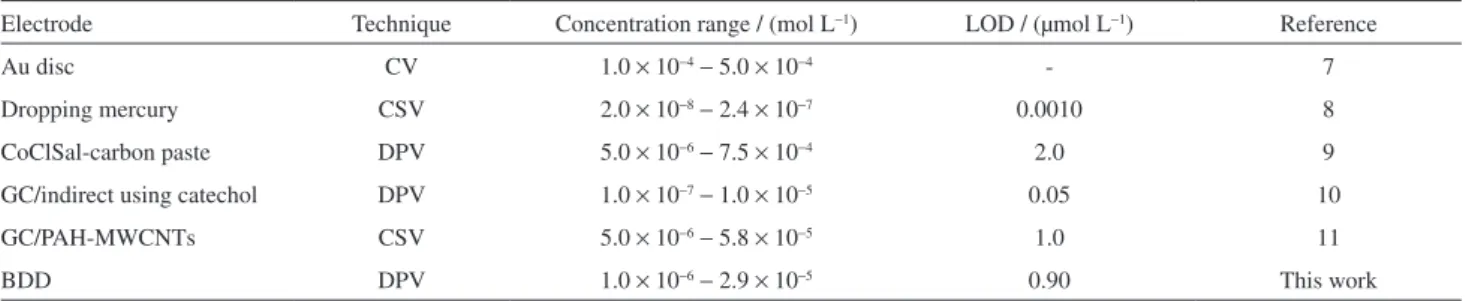
Table 2 presents a comparison between the analytical performances of the here-reported method and other voltammetric methods for the determination of PTU previously reported in the literature. These results reveal that the LOD value for PTU obtained in this work is lower than that obtained with a modified carbon paste electrode,9
but higher than those obtained by CSV using a mercury electrode7 and by DPV with a GC electrode using catechol
as redox mediator.10 However, the use of the cathodically
pretreated BDD electrode for the determination of PTU is direct, with no need for renewal of the electrode surface;
moreover, adsorption on the BDD surface of PTU oxidation products was not observed. On the other hand, the other procedures reported in the literature using solid electrodes require either mechanical polishing or surface renewal prior to the experiments to assure a reproducible electrode surface.
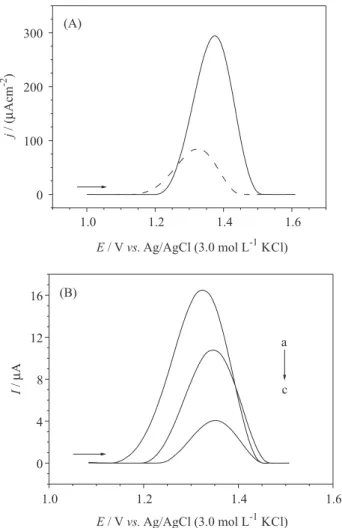
Next, the voltammetric response of the cathodically pretreated BDD electrode was compared to that of a GC electrode. Figure 8A shows the DP voltammograms obtained on these electrodes for a 500 µmol L−1 PTU
solution in the BR buffer solution (pH 2.0). As can be seen, a higher magnitude of the PTU oxidation peak current was obtained on the BDD electrode, with an excellent repeatability (RSD < 1.0%, for n = 6; data not shown). Furthermore, the magnitude of the PTU oxidation peak current obtained on the GC electrode decreases with successive measurements (see Figure 8B), clearly indicating that the disulfide adsorbs on the surface of the GC electrode.
Determination of PTU in pharmaceutical formulations
The effect of some possible interferent compounds (starch, magnesium stearate, povidone, and calcium carbonate) was investigated for a 7.0 µmol L−1 PTU
solution in the BR buffer (pH 2.0) at the concentration ratios (standard solution:interferent compound) 1:1, 1:10, and 10:1 (m/m). The corresponding current signals were compared with that obtained in the absence of any interferent compound. The obtained responses (data not shown) allowed to conclude that these compounds do not interfere with the determination of PTU at the used working conditions.
Next, PTU was determined in three different commercial pharmaceutical samples (tablets) by their dissolution in the BR buffer solution (pH 2.0) and using the cathodically pretreated BDD electrode. The results obtained employing the here-proposed method and the official titration method of the British Pharmacopoeia5 for the determination of PTU
in several commercial tablets are presented in Table 3. As can be inferred from the data in this table, no significant
Figure 7. Differential pulse voltammograms obtained using the cathodically pretreated BDD electrode for (1) 1.0, (2) 2.0, (3) 3.2, (4) 4.3, (5) 5.3, (6) 6.3, (7) 7.5, (8) 8.5, (9) 9.5, (10) 14.0, (11) 20.0, and (12) 29.1 µmol L−1 PTU solutions in the BR buffer (pH 2.0). Insert:
corresponding analytical curve.
Table 2. Comparison of the analytical parameters obtained using different electrodes and/or techniques for the determination of PTU
Electrode Technique Concentration range / (mol L−1) LOD / (µmol L−1) Reference
Au disc CV 1.0 × 10⁻⁴− 5.0 × 10⁻⁴ - 7
Dropping mercury CSV 2.0 × 10⁻⁸− 2.4 × 10⁻⁷ 0.0010 8
CoClSal-carbon paste DPV 5.0 × 10⁻⁶− 7.5 × 10⁻⁴ 2.0 9
GC/indirect using catechol DPV 1.0 × 10⁻⁷− 1.0 × 10⁻⁵ 0.05 10
GC/PAH-MWCNTs CSV 5.0 × 10⁻⁶− 5.8 × 10⁻⁵ 1.0 11
differences were observed between the values found for the amounts of PTU in the tablets using the proposed DPV method and the standard titration method. Besides, considering that the paired t-test41 was applied to these
results and the calculated t value (0.242) is smaller than the critical value (4.303, α = 0.05), the results obtained with either method are not statistically different, at a 95% confidence level.
Finally, an addition and recovery study was carried out. Known amounts of standard solutions were added to a given sample and the resulting solution was analyzed by the here-proposed method. The obtained results yielded adequate average recoveries, ranging from 93.3% to 108% for the commercial tablets, indicating that there were no matrix interferences for these samples when analyzed by the proposed DPV method.
Conclusions
The results here reported demonstrate that a cathodically pretreated BDD electrode along with the DPV technique can be used to determine PTU in pharmaceutical formulations. After optimization of all the experimental parameters using a BR buffer solution (pH 2.0), a PTU detection limit of 0.90 µmol L−1 was attained. Furthermore, adequate relative
standard deviations for 7.0 µmol L−1 PTU solutions of
0.84% and 3.6% were attained for intra-day (n = 10) and inter-day (n = 10) repeatability, respectively. On the other hand, an addition-recovery study yielded results statistically equal to those of a reference titration method. Moreover, the use of the cathodically pretreated BDD electrode did not lead to any adsorption effect, which allowed the use of the electrode for a long time with the same response. Clearly, the here-proposed method is simple, rapid, precise, and accurate for analytical determinations of PTU. Furthermore, the proposed voltammetric method does not involve the inconvenient use of mercury nitrate, as is the case with the official method of the British Pharmacopoeia.
Acknowledgements
The authors gratefully acknowledge financial support and scholarships from the Brazilian funding agencies FAPESP (Proc. No. 2009/14454-8), CAPES, and CNPq.
References
1. Hardman, J. G.; Limbird, L. E.; Gilman, A. G.; Goodman & Gilman’s-The Pharmacological Basis of Therapeutics, 9th ed.;
McGraw-Hill: New York, 1996.
2. Zakrzewski, R.; J. Pharm. Biomed. Anal. 2008, 48, 145. 3. Wei, Y.; Zhang, Z.; Zhang, Y.; Sun, Y.; J. Chromatogr., B:
Biomed. Sci. Appl. 2007, 854, 239.
4. García, M. S.; Albero, M. I.; Sánchez-Pedreño, C.; Tobal, L.;
Analyst 1995, 120, 129.
5. British Pharmacopoeia, HMSO: London, 1998. 6. Ciesielski, W.; Zakrzewski, R.; Analyst 1997, 122, 491. 7. Sarna, K.; Fijalek, Z.; Chem. Anal. (Warsaw, Pol.) 1997, 42,
425. Figure 8. Differential pulse voltammograms for a 500 µmol L−1 PTU
solution in the BR buffer (pH 2.0) obtained on: (A) GC (dashed line) and BDD (solid line) electrodes; (B) a GC electrode for the (a) first, (b) second, and (c) third scans.
Table 3. Results (n = 3) obtained for the determination of PTU in pharmaceutical formulations (tablets) using the here-proposed DPV method with a cathodically pretreated BDD electrode and a reference titration method5
Samples PTU / mg REa / %
Label value Reference method DPV method
A 100 98.7 ± 0.9 99.8 ± 0.3 1.1
B 100 102.8 ± 0.8 104.6 ± 0.4 1.8
C 100 101.4 ± 0.9 97.1 ± 0.2 −4.2
aRelative error = [100 × (DPV method − reference method)] / reference
8. Kasprzak, M.; Ciesielski, W.; Skrzypek, S.; Collect. Czech. Chem. Commun. 2005, 70, 188.
9. Shahrokhian, S.; Jannat-Rezyani, M. J.; Microchim. Acta 2005,
151, 73.
10. Shahrokhian, S.; Saberi, R.; Int. J. Electrochem. Sci. 2007, 2, 158.
11. Oliveira, G. G.; Sartori, E. R.; Tanaka, F. Y.; Fatibello-Filho, O.;
Chem. Sens. 2012, 2, 1.
12. Sartori, E. R.; Medeiros, R. A.; Rocha-Filho, R. C.; Fatibello-Filho, O.; J. Braz. Chem. Soc. 2009, 20, 360. 13. Batista, E. F.; Sartori, E. R.; Medeiros, R. A.; Rocha-Filho,
R. C.; Fatibello-Filho, O.; Anal. Lett. 2010, 43, 1046. 14. Sartori, E. R.; Medeiros, R. A.; Rocha-Filho, R. C.;
Fatibello-Filho, O.; Talanta 2010, 81, 1418.
15. Lourenção, B. C.; Medeiros, R. A.; Rocha-Filho, R. C.; Mazo, L. H.; Fatibello-Filho, O.; Talanta 2009, 78, 748.
16. Andrade, L. S.; de Moraes, M. C.; Rocha-Filho, R. C.; Cass, Q. B.; Fatibello-Filho, O.; Anal. Methods 2010, 2, 402. 17. Lourenção, B. C.; Medeiros, R. A.; Rocha-Filho, R. C.;
Fatibello-Filho, O.; Electroanalysis 2010, 22, 1717.
18. Andrade, L. S.; de Moraes, M. C.; Rocha-Filho, R. C.; Cass, Q. B.; Fatibello-Filho, O.; Electroanalysis 2009, 21, 1475. 19. Gimenes, D. T.; de Freitas, J. M.; Munoz, R. A. A.; Richter,
E. M.; Electroanalysis 2011, 23, 2521.
20. de Miranda, J. A. T.; Cunha, R. R.; Gimenes, D. T.; Muñoz, R. A. A.; Richter, E. M.; Quim. Nova 2012, 35, 1459. 21. Stefano, J. S.; de Lima, A. P.; Montes, R. H. O.; Richter, E. M.;
Muñoz, R. A. A.; J. Braz. Chem. Soc. 2012, 23, 1834. 22. Faria, E. O.; Lopes Junior, A. C. V.; Souto, D. E. P.; Leite,
F. R. F.; Damos, F. S.; Luz, R. C. S.; dos Santos, A. S; Franco, D. L.; dos Santos, W. T. P.; Electroanalysis 2012, 24, 1141. 23. Pecková, K.; Musilová, J.; Barek, J.; Crit. Rev. Anal. Chem.
2009, 39, 148.
24. Pleskov, Y. V.; Russ. J. Electrochem. 2002, 38, 1275.
25. Compton, R. G.; Foord, J. S.; Marken, F.; Electroanalysis 2003,
15, 1349.
26. Hupert, M.; Muck, A.; Wang, R.; Stotter, J.; Cvackova, Z.; Haymond, S., Show, Y.; Swain, G. M.; Diamond Relat. Mater.
2003, 12, 1940.
27. Gandini, D.; Michaud, P.; Duo, I.; Mache, E.; Haenni, W.; Perret, A.; Conminellis, C.; New Diamond Front. Carbon Technol. 1999, 9, 303.
28. Suffredini, H. B.; Pedrosa, V. A.; Codognoto, L.; Machado, S. A. S.; Rocha-Filho, R. C.; Avaca, L. A.; Electrochim. Acta
2004, 49, 4021.
29. Granger, M. C.; Witek, M.; Xu, J. S.; Wang, J.; Hupert, M.; Hanks, A.; Koppang, M. D.; Butler, J. E.; Lucazeau, G.; Mermoux, M.; Strojek, J. W.; Swain, G. M.; Anal. Chem. 2000,
72, 3793.
30. Medeiros, R. A.; Lourenção, B. C.; Rocha-Filho, R. C.; Fatibello-Filho, O.; Anal. Chem. 2010, 82, 8658.
31. Medeiros, R. A.; Rocha-Filho, R. C.; Fatibello-Filho, O.; Food Chem. 2010, 123, 886.
32. Medeiros, R. A.; Lourenção, B. C.; Rocha-Filho, R. C.; Fatibello-Filho, O.; Talanta 2012, 97, 291.
33. Pereira, G. F.; Andrade, L. S.; Rocha-Filho, R. C.; Bocchi, N.; Biaggio, S. R.; Electrochim. Acta 2012, 82, 3.
34. Medeiros, R. A.; Lourenção, B. C.; Rocha-Filho, R. C.; Fatibello-Filho, O.; Talanta 2012, 99, 883.
35. Ardila, J. A.; Sartori, E. R.; Rocha-Filho, R. C.; Fatibello-Filho, O.; Talanta 2013, 103, 201.
36. Bard, A. J.; Faulkner, L. R.; Electrochemical Methods: Fundamentals and Applications, 2nd ed.; John Wiley & Sons:
New York, 2001, p. 236.
37. Goyal, R. N.; Singh, U. P.; Abdullah, A. A.; Bioelectrochemistry
2005, 67, 7.
38. Spataru, N.; Spataru, T.; Fujishima, A.; Electroanalysis 2005,
17, 800.
39. Gosser, D. K.; Cyclic Voltammetry; VCH Publishers: New York, 1994.
40. Laviron, E.; J. Electroanal. Chem. 1979, 101, 19.
41. Anderson, R. L.; Practical Statistics for Analytical Chemists; Van Nostrand Reinhold: New York, 1987.
Submitted: May 4, 2013 Published online: August 16, 2013