Article
J. Braz. Chem. Soc., Vol. 24, No. 9, 1396-1402, 2013.Printed in Brazil - ©2013 Sociedade Brasileira de Química 0103 - 5053 $6.00+0.00
A
http://dx.doi.org/10.5935/0103-5053.20130177*e-mail: [email protected]
A Straightforward and Efficient Method for the Synthesis of Diversely Substituted
β-Aminoketones and γ-Aminoalcohols from 3-(
N,N
-Dimethylamino)propiophenones
as Starting Materials
Rodrigo Abonia,* Danny Arteaga, Juan Castillo, Braulio Insuasty, Jairo Quiroga and Alejandro Ortíz
Research Group of Heterocyclic Compounds, Department of Chemistry, Universidad del Valle, A. A. 25360, Cali, Colombia
Bibliotecas de novos β-aminocetonas e γ-aminoálcoois que mostram uma grande diversidade estrutural foram facilmente obtidas a partir de uma abordagem simple, utilizando os derivados da 3-(N,N-dimetilamino)propiofenona como material de partida chave. O procedimento envolveu inicialmente a N-alquilação de benzilaminas secundárias com derivados de propiofenona produzindo as desejadas β-aminocetonas. A redução química ou catalítica dos grupos carbonilo atinge a obtenção dos γ-aminoálcoois em bons rendimentos. Este protocolo mostrou ser uma via alternativa conveniente para a síntese do anestésico local Falicain® e para a droga tópica antifúngica
Naftifina®.
Libraries of novel β-aminoketones and γ-aminoalcohols showing a wide structural diversity were easily obtained from a simple approach, using 3-(N,N-dimethylamino)propiophenone derivatives as key starting material. The procedure involved initially an N-alkylation of secondary benzylamines with propiophenone salts yielding the desired β-aminoketones. Chemical or catalytic reduction of their carbonyl groups provided the final γ-aminoalcohols in good yields. This protocol proved to be convenient as an alternative route for the synthesis of the local anesthetic Falicain® and
for the topic antifungal drug Naftifine®.
Keywords: benzylamines, propiophenones, β-aminoketones, γ-aminoalcohols, Mannich type reaction
Introduction
Amino-ketones and aminoalcohols are compounds with superior importance not only for their practical applications displayed by themselves but also because they have been found forming part of the structure of synthetic and naturally occurring compounds of diverse practical interest.1 Thus, Falicain® (a local anesthetic and
bronchomotor),2 compound BE-2254 (antihypertensive and
very selective α1-adrenoceptor antagonist, precursor of
the 3-125I-derivative),3 Moban (a neuroleptic)4 and the
benzylamine derivative 1 (a potent Jak3 kinase inhibitor),5
are representative examples of this large family of amino-compounds (Figure 1), as well as the naturally occurring aminoalcohols Anisomycin (a potent activator of stress-activated protein kinases (JNK/SAPK) and
p38 MAP kinase)6 and Castanospermine (a potent
inhibitor of α- and β-glucosidases inhibits HIV syncytium formation and replication),7 the synthetic aminoalcohols
Salbutamol (a non-selective β-adrenergic agonist, more potent for β2 than β1 receptors)
8 and the
phenyl/thienyl-γ-aminoalcohols 2 (direct precursors for the synthesis of Fluoxetine (Ar = Ph) and Duloxetine (Ar = 2-thyenyl), selective serotonin reuptake inhibitors).9
Particularly, Guarna et al.10 reported the synthesis
of new γ-aminoalcohols 7 as potential 125I-radioligands
for dopamine and serotonin receptors. The synthesis of these compounds was achieved in a four-step sequence as described in Scheme 1. Continuing with our studies toward the synthesis and functionalization of benzylamine derivatives,11-13 herein, we report our results
Abonia et al. 1397 Vol. 24, No. 9, 2013
related to the active compounds 1, 2 and 7, from secondary benzylamines and 3-(N,N-dimethylamino)propiophenone derivatives, as easily accessible starting materials (Scheme 2).
Experimental
Melting points were determined on a Büchi B-450 melting point apparatus and are uncorrected. Infrared (IR) spectra were recorded on a Shimadzu FTIR 8400 spectrophotometer in KBr
disks and films. 1H and 13C nuclear magnetic resonance (NMR)
spectra were recorded on a Bruker Avance 400 spectrometer operating at 400 and 100 MHz, respectively, using CDCl3 as
solvent and tetramethylsilane as internal standard for 1H NMR.
Mass spectra were run on a Shimadzu 2010-DI-2010 GC-MS apparatus (equipped with a direct inlet probe) operating at 70 eV. Microanalyses were performed on an Agilent elemental analyzer and the results are within ± 0.4% of the theoretical values. Silica gel plates (Merck 60 F254) were
used for analytical TLC. The starting amines 8a-d and
8f-h (Figure 2) were purchased from Aldrich, Fluka and Acros and were used without further purification. Owing that benzylamine 8e is commercially unavailable, it was synthesized by a reductive amination from benzylamine and 3,4,5-trimethoxybenzaldehyde, following a similar procedure as described previously.11,12 The 3-(N,N-dimethylamino)
propiophenone hydrochlorides 9a-d were synthesized from their respective acetophenones by following a procedure similar to that described in the literature.14
General procedure for the synthesis of the β-aminoketones (10)
A mixture of amine 8 (500 mg) and the corresponding 3-(N,N-dimethylamino)propiophenone hydrochloride 9
(1 mmol) was dissolved in a mixture of 1,4-dioxane (5 mL) and triethylamine (TEA, 1 mL). The solution was stirred at reflux for 0.5-2 h until the starting materials were not further detected by TLC. After cooling, the solvent was removed under reduced pressure and the crude was purified by column chromatography on silica gel, using a mixture of CH2Cl2:AcOEt (5:1) as eluent.
Figure 1. Some amino-ketones and aminoalcohols of biological interest.
Scheme 1. Four-step synthesis of the 125I-radioligands 7 for dopamine and serotonin receptors (X, Y = H, F, Br, I); (i) NaBH
4, MeOH, 0 oC; (ii) phthalimide, KF,
DMF, 120 oC, 8 h; (iii) H
2N−NH2, H2O-MeOH-HCl, reflux, 3 h; (iv) 4-R-C6H4CHO (R = H, F), NaBH3CN, MeOH, 24 h, temperature. Adapted from reference 10.
A Straightforward and Efficient Method for the Synthesis of Diversely Substituted β-Aminoketones and γ-Aminoalcohols J. Braz. Chem. Soc.
1398
General procedure for the synthesis of γ-aminoalcohols (11)
Approach A: Raney-nickel was added (100 mg) to a sample of aminoketone 10 (300 mg) dissolved in ethanol (15 mL), and then was stirred for 3-4 h at room temperature under hydrogen pressure (50 psi) in a Parr apparatus. When the starting material was not detected by TLC and by the IR spectrum, the catalyst was filtered off, the solvent was removed under reduced pressure and the residue was purified by column chromatography on silica gel, using a mixture of CH2Cl2:MeOH (20:1) as eluent.
Approach B: Solid NaBH4 (2 mmol) was added
portionwise to a sample of aminoketone 10 (300 mg, 1 mmol) dissolved in methanol (5 mL), and then was stirred for 0.5-1 h at room temperature. When the starting material 10 was not further detected by TLC, the volume of the reaction mixture was reduced to 1 mL under reduced pressure, and water (5 mL) was added. The aqueous solution was extracted with ethyl acetate (2 × 5 mL), and the combined organic extracts were dried with Na2SO4.
After removal of the solvent, the residue was purified by column chromatography on silica gel, using a mixture of CH2Cl2:MeOH (20:1) as eluent.
Results and Discussion
Initially, a mixture of benzylmethylamine 8a (R = Me,
1 mmol) and N,N-dimethylaminopropiophenone
hydrochloride 9a (Ar = Ph, 1 mmol)14 was subjected to
reflux for 4 h in ethanol (step i, Scheme 2). This (approach 1)
provided the corresponding β-aminoketone 10a (R = Me, Ar = Ph) as a pale yellow oily material in only 30% isolated yield. Repeating the same reaction but using a 4:1 ethanol:TEA mixture (approach 2), afforded 10a in 68% isolated yield, after 2 h of heating. Pursuing to improve the efficiency of the formation of ketone 10a, the reaction was repeated but using a 5:1 v/v mixture of 1,4-dioxane:TEA (approach 3). After heating for 1 h and verifying complete consumption of the starting materials (TLC control), product 10a was obtained in 88% isolated yield.
Once established the better reaction conditions and in order to determine its scope and general character, the approach 3 was extended to the benzylamine chemset
8a-e and propiophenone chemset 9a-d (Figure 2). To our satisfaction, the corresponding β-aminoketones 10a-k were fairly obtained in 0.5-2 h reaction times and 62-90% isolated yields, as shown in Table 1. The IR spectra of compounds
10 showed absorption bands corresponding to the C=O moiety in the range of 1671-1696 cm-1. In the case of 10f, an
additional hydroxyl broad band was observed at 3426 cm-1
corresponding to the OH group. The main signals in the
1H NMR spectra corresponded to a triplet integrating for 2H
in the range of 2.70-3.01 ppm, assigned to the H-2 protons, a triplet for 2H in the range of 3.08-3.22 ppm, assigned to the H-3 protons, and a singlet for 2H (or 4H) in the range of 3.56-3.98 ppm, assigned to the benzylic protons. The more relevant features in the 13C NMR spectra of compounds 10
corresponded to signals in the ranges 36.4-36.9, 48.5-52.4, 58.2-62.5 and 197.9-199.6 ppm, which were assigned to the C-2 carbon atoms, the C-3 carbons, the methylene carbon atom of the benzyl functionality and the C=O carbon atoms, respectively.
Most of the mass spectra of compounds 10 are
characterized by low-intensity peaks for their molecular ions and base peaks at m/z 91, corresponding to the tropylium ion resulting from the benzyl functionality. In the case of structures 10j and 10k, which possess two possible tropylium ions, the base peak appears at m/z 181 due to the higher stability of its trimethoxy analogue than the proper tropylium ion.
Once the β-aminoketones 10 were efficiently obtained, reduction of their carbonyl groups was undertaken (step ii, Scheme 2). Recently, Cho and Kang15 reported an efficient
chemical reduction of carbonyl derivatives by grinding a mixture of the respective carbonyl compound and NaBH4
in the presence of benzoic acid in a mortar. Unfortunately, the extension of this procedure to β-aminoketone 10a was unsuccessful and no product 11a was formed. Moreover, this reaction was difficult to handle. In a second approach, compound 10a was dissolved in methanol and subjected to a catalytic hydrogenation at room temperature in a Parr
Abonia et al. 1399 Vol. 24, No. 9, 2013
Table 1. Synthesis of the β-aminoketones (10a-k) and γ-aminoalcohols (11a-k)
Entry Yield / %
10 / 11a,b
1 8a 9a 88c,d / (84)82d
2 8a 9b 78e / (86)96
3 8a 9d 62f / 57g
4 8b 9b 74 / (93)83
5 8b 9c 90 / (78)89
6 8c 9b 65 / (72)61
7 8d 9a 68h / (81)85i
8 8d 9b 77j / (85)92
9 8d 9c 69j,k / (81)93
10 8e 9b 79/(88)91
Table 1. Synthesis of the β-aminoketones (10a-k) and γ-aminoalcohols (11a-k)
Entry Yield / %
10 / 11a,b
1 8a 9a 88c,d / (84)82d
2 8a 9b 78e / (86)96
3 8a 9d 62f / 57g
4 8b 9b 74 / (93)83
5 8b 9c 90 / (78)89
6 8c 9b 65 / (72)61
7 8d 9a 68h / (81)85i
8 8d 9b 77j / (85)92
9 8d 9c 69j,k / (81)93
A Straightforward and Efficient Method for the Synthesis of Diversely Substituted β-Aminoketones and γ-Aminoalcohols J. Braz. Chem. Soc.
1400
Scheme 3. Proposed mechanisms for the formation of the β-aminoketones (10).
Entry Yield / %
10 / 11a,b
11 8e 9c 62/(80)67
aIsolated yields of alcohols from the catalytic hydrogenation between parentheses. bIsolated yields of alcohols from chemical reduction with NaBH 4. cPreviously obtained by hydrolysis of an acetylenic derivative; yield not supplied.17dPreviously obtained by LiAlH
4 reduction of the amide and carboxymethyl
functionalities of the respective perhydrooxazinone; yield not supplied. Also obtained from acetophenone, benzylmethylamine hydrochloride and paraformaldehyde; yield not supplied.18ePreviously obtained from the corresponding phenacyl bromide and benzylmethylamine (63%).19fPreviously
obtained from 4-nitroacetophenone, paraformaldehyde and benzylmethylamine hydrochloride (70%).20gOnly chemical reduction is reported; the catalytic
hydrogenation afforded a mixture containing the p-amino-derivative. hPreviously obtained from 1,3-dimethyl-imidazoline, acethophenone and dibenzylamine
in AcOH (55%).21iPreviously obtained by reduction of 10g with NaBH
4 at 60 oC (72%).22jKnown compound.23kPreviously reported.24 Table 1. continuation
apparatus in the presence of Raney nickel as catalyst,16
affording the corresponding γ-aminoalcohol 11a as a light oily material in 84% isolated yield. Trying to simplify the reduction procedure, aminoketone 10a was treated with NaBH4 in methanol at room temperature, affording
the γ-aminoalcohol 11a in 82% isolated yield. At this point, it is worth mentioning that catalytic hydrogenation provided a slightly better yield and an easier work-up than the borohydride-mediated reduction. According to these results, the reduction of the remaining aminoketones 10
either by catalytic hydrogenation or chemical reduction afforded the corresponding γ-aminoalcohols 11 in 72-93 or 57-96% isolated yields, respectively (Table 1).
The absence of the C=O absorption bands and the observation of new O–H absorption broad bands in the range of 3218-3409 cm-1 were the main features of the
IR spectra of compounds 11. The main signals in the
1H NMR spectra corresponded to a multiplet integrating
for 2H in the range of 1.73-2.04 ppm, assigned to the H-2 protons, a double-double-doublet for 1H in the range of 2.56-2.68 ppm, assigned to a diastereotopic H-3 proton, a double-double-doublet for 1H in the range of 2.69-3.64 ppm, assigned to the other H-3 proton, a pair of doublet (1H each) in the ranges 3.29-3.64 and 3.61-3.88 ppm, assigned to both diastereotopic benzylic methylene protons (PhCH2), and a double-doublet for 1H
in the range of 4.71-5.00 ppm assigned to the H-1 proton. Some hydroxyl protons appeared as broad singlets in the range of 5.42-6.46 ppm. Likewise, the more relevant feature in the 13C NMR spectra of compounds 11 was
the appearance of a new aliphatic signal in the range of 73.7-75.6 ppm, assigned to the C-1 carbon atom. The disappearance of the C=O signals are also in agreement with the assigned structures. The mass spectra also showed the tropylium ions as base peaks and as the main signals.
According to the results, the formation of the
β-aminoketones 10 should proceed via two possible processes, either a SN2 type reaction or alternatively through
a Michael type addition, as shown in Scheme 3.
A SN2 process is more likely to proceed under neutral
or acidic conditions, in which the dimethyl ammonium moiety of the aminoketone salt (9) should behave as a good leaving group.25,26 In this sense, the formation of
the product 10a under approach 1 should be governed mainly by this mechanistic pathway. Meanwhile, when the reaction was carried out in basic media (approaches 2 and 3), a Michael type addition should be the more likely mechanistic pathway, mediated by an arylvinyl ketone (12).27 Formation of this intermediate
should be facilitated by the action of TEA via a Hofmann type β-elimination.26 The detection of this intermediate
in the reaction media and some reports of the literature
Entry Yield / %
10 / 11a,b
11 8e 9c 62/(80)67
aIsolated yields of alcohols from the catalytic hydrogenation between parentheses. bIsolated yields of alcohols from chemical reduction with NaBH 4. cPreviously obtained by hydrolysis of an acetylenic derivative; yield not supplied.17dPreviously obtained by LiAlH
4 reduction of the amide and carboxymethyl
functionalities of the respective perhydrooxazinone; yield not supplied. Also obtained from acetophenone, benzylmethylamine hydrochloride and paraformaldehyde; yield not supplied.18ePreviously obtained from the corresponding phenacyl bromide and benzylmethylamine (63%).19fPreviously
obtained from 4-nitroacetophenone, paraformaldehyde and benzylmethylamine hydrochloride (70%).20gOnly chemical reduction is reported; the catalytic
hydrogenation afforded a mixture containing the p-amino-derivative. hPreviously obtained from 1,3-dimethyl-imidazoline, acethophenone and dibenzylamine
in AcOH (55%).21iPreviously obtained by reduction of 10g with NaBH
Abonia et al. 1401 Vol. 24, No. 9, 2013
support this proposal,27 which is also reinforced by the
relative acidity of the α-hydrogen atoms in 9, which should be relatively easy to be removed by TEA as the initial step for the elimination process (Scheme 3).
To evaluate the scope of this two-step protocol, the heterocyclic derivatives 11l and 11m were efficiently obtained by treatment of propiophenones 9a and 9b, respectively, with morpholine 8f and the subsequent reduction of their carbonyl groups. Likewise, the
β-aminoketone 10n was fairly obtained from the reaction of propiophenone 9c with piperidine 8g. Interestingly, the piperidine derivative 10n is structurally close to the anesthetic Falicain® (Scheme 1); Therefore, this
approach could become an alternative synthetic route for Falicain® and derivatives (Scheme 4).
To further confirm the practical scope of our two-step protocol, we envisioned the possibility of developing
an alternative synthetic route towards Naftifine,® a
recognized and highly active antifungal agent.31 Initially,
the commercially available naphthylamine 8h was treated with propiophenone 9a to afford the aminoketone 10o in 89% isolated yield. Then, reduction of 10o with NaBH4/MeOH
at room temperature afforded the aminoalcohol 11o in 98% isolated yield, which was dehydrated by treatment with refluxing 5 eq-g L-1 HCl to afford the expected product in
86% isolated yield (Scheme 5).
Conclusion
In summary, we developed a straightforward, versatile and simple approach for the synthesis of new β-aminoketones (10) and their corresponding
γ-aminoalcohols (11), structurally related to relevant active compounds, by reaction of secondary benzylamines with 3-(N,N-dimethylamino)propiophenone salts. Several of the obtained compounds 10 and 11 have previously been reported elsewhere; however, under our modified conditions they have been obtained in better or at least comparable yields. Finally, the usefulness of the procedure as an alternative synthesis of biologically active products like Falicain® and Naftifine® was explored.
Supplementary Information
Supplementary data are available free of charge at http://jbcs.sbq.org.br as PDF file.
Acknowledgments
Authors thank COLCIENCIAS and Universidad del Valle for financial support.
Scheme 4. Synthesis of novel β-aminoketones (10l, 10m and 10n) and γ-aminoalcohols (11l and 11m) from the reaction of propiophenones (9a, 9b and 9c) with morpholine (8f) and piperidine (8g). aPreviously obtained from acetophenone, paraformaldehyde and morpholine hydrochloride (63%).28bYield of
the original synthesis not supplied.29cPreviously obtained from 4-methoxyacetophenone, formaldehyde and piperidine (70%).30dPreviously obtained by
reduction of 10l with NaBH4 at 60 oC (84%).22ePreviously obtained by reduction of 10m with NaBH
4 at 60 oC (70%).22
Scheme 5. Alternative synthetic route for the antifungic Naftifine®. aPreviously obtained from acetophenone, formaldehyde and N-methyl(naphthalen-5-yl)methanamine (55%).32bPreviously obtained by
reduction of 10o with NaBH4 (quant.).32cPreviously obtained by reductive
A Straightforward and Efficient Method for the Synthesis of Diversely Substituted β-Aminoketones and γ-Aminoalcohols J. Braz. Chem. Soc.
1402
References
1. Tanaka, N.; Tamai, T.; Mukaiyama, H.; Hirabayashi, A.; Muranaka, H.; Ishikawa, T.; Akahane, S.; Akahane, M.;
Bioorg. Med. Chem. 2001, 9, 3265; Korošec, T.; Ačimovič, J.; Seliškar, M.; Kocjan, D.; Fon-Tacer, K.; Rozman, D.; Urleb, U.;
Bioorg. Med. Chem. 2008, 16, 209; Roman, G.; Nanu, D.; Comanita, E.; Comanita, B.; Turk. J. Chem. 2000, 24, 67; Kim, Y.; Ha, H.-J.; Yun, H.; Lee, B. K.; Lee, W. K.; Tetrahedron 2006, 62, 8844; Bhandari, K.; Srivastava, S.; Shanker, G.; Nath, C.; Bioorg. Med. Chem. 2005, 13, 1739.
2. Marcus, R.; Gloye, E.; Florance, E.; Comput. Chem.1977, 1, 235.
3. Pupo, A.; Uberti, M.; Minneman, K.; Eur. J. Pharmacol.2003,
462, 1.
4. Alper, K.; Barry, J.; Balabanov, A.; Epilepsy Behav.2002, 3, 13; Szeszko, P.; Bilder, R.; Dunlop, J.; Walder, D.; Lieberman, J.;
Biol. Psychiat.1999, 45, 680.
5. Brown, B.; Bamford, A.; Bowyer, J.; James, D.; Rankine, N.; Tang, E.; Torr, V.; Culbert, E.; Bioorg. Med. Chem. Lett.2000,
10, 575.
6. Kyriakis, J.; Banerjee, P.; Nikolakaki, E.; Dai, T.; Rubie, E.; Ahmad, M.; Avruch, J.; Woodgett, J.; Nature1994, 369, 156. 7. Gruters, R.; Neefjes, J.; Tersmette, M.; De Goede, R.; Tulp, A.;
Huisman, H.; Miedema, F.; Ploegh, H.; Nature1987, 330, 74. 8. Carter, W.; Lynch, M.; Metabolism1994, 43, 1119; Uzkeser, H.;
Cadirci, E.; Halici, Z.; Odabasoglu, F.; Polat, B.; Yuksel, T.; Ozaltin, S.; Atalay, F.; Mediat. Inflamm.2012, 2012, 1. 9. Liu, D.; Gao, W.; Wang, C.; Zhang, X.; Angew. Chem., Int. Ed.
2005, 44, 1687; Pinder, R. M.; Wieringa, J. H.; Med. Res. Rev. 1993, 13, 259.
10. Guarna, A.; Menchi, G.; Berti, G.; Cini, N.; Bottoncetti, A.; Raspanti, S.; Politi, A.; Pupi, A.; Bioorg. Med. Chem. 2001, 9, 3197.
11. Abonia, R.; Castillo, J.; Insuasty, B.; Quiroga, J.; Nogueras, M.; Cobo, J.; Eur. J. Org. Chem.2010, 33, 6454.
12. Santacruz, L.; Abonia, R.; Low, J.; Cobo, J.; Acta Crystallogr. 2006, E62, 5027.
13. Castillo, J.; Abonia, R.; Cobo, J.; Glidewell, C.; Acta Crystallogr. 2009, C65, o303; Abonia, R.; Castillo, J.; Insuasty, B.; Quiroga, J.; Nogueras, M.; Cobo, J.; ACS Comb. Sci.2013, 15, 2.
14. Jeffery, G. H.; Bassett, J.; Mendham, J.; Denney, R. C.; Vogel’s Textbook of Practical Organic Chemistry, 4th ed.; Longman Inc.:
New York, USA, 1978, p. 815.
15. Cho, B. T.; Kang, S. K.; Tetrahedron2005, 61, 5725. 16. Rylander, P. N.; Hydrogenation Methods; Academic: New York,
USA, 1985; Tarasevich, V. A.; Kozlov, N. G.; Russ. Chem. Rev. 1999, 68, 55.
17. Brooks, J. R.; Harcourt, D. N.; J. Chem. Soc. C1969, 625. 18. Panunzio, M.; Tamanini, E.; Bandini, E.; Campana, E.;
D’Aurizio, A.; Vicennati, P. Tetrahedron 2006, 62, 12270; Bhandari, K.; Srivastava, S.; Shanker, G.; Nath, C.; Bioorg. Med. Chem.2005, 13, 1739.
19. Lutz, R. E.; Allison, R. K.; Ashburn, G.; Bailey, P. S.; Clark, M. T.; Codington, J. F.; Deinet, A. J.; Freek, J. A.; Jordan, R. H.; Leake, N. H.; Martin, T. A.; Nicodemus, K. C.; Rowlett Jr., R. J.; Shearer Jr., N. H.; Smith, J. D.; Wilson III, J. W.; J. Org. Chem. 1947, 12, 617.
20. Wheatley, W. B.; Fitzgibbon Jr., W. E.; Cheney, L. C.; J. Am. Chem. Soc. 1954, 76, 4490.
21. Gu, H.; Guo, Y.; Shi, Z.; Synth. Commun.2006, 36, 3335. 22. Ueno, S.; Usui, K.; Kuwano, R.; Synlett2011, 1303.
23. Chaturvedi, S. C.; Patnaik, G. K.; Dhawan, B. N.; Dixit, V. K.;
Indian J. Pharm.1985, 17, 155.
24. Selvamurugan, V.; Singh-Aidhen, I.; Synthesis2001, 2239. 25. Aggarwal, V.; Harvey, J.; Robiette, R.; Angew. Chem., Int. Ed.
2005, 44, 5468.
26. Smith, M.; March, J.; Advanced Organic Chemistry: Reactions, Mechanisms, and Structure, Part 2, 6th ed.; John Wiley and Sons,
Inc.: New Jersey, USA, 2007; Alunni, S.; Tijskens, P.; J. Org. Chem. 1995, 60, 8371; Cope, A. C.; Trumbull, E. R.; Org. React. 2011, 317.
27. Shi, M.; Li, C.-Q.; Jiang, J.-K.; Molecules 2002, 7, 721. 28. Biradar, D. B.; Zhou, S.; Gau, H.-M.; Org. Lett. 2009, 11, 3386. 29. Weigel, W.; Schiller, S.; Reck, G.; Henning, H.-G.; Tetrahedron
Lett. 1993, 34, 6737.
30. Muthumani, P.; Neckmohammed; Meera, R.; Venkataraman, S.; Chidambaranathan, N.; Devi, P.; Suresh Kumar, C. A.; Int. J. Pharm. Biomed. Res. 2010, 1, 78.
31. Petranyi, G.; Georgopoulos, A.; Mieth, H.; Antimicrob. Agents Chemother.1981, 19, 390; Gupta, A. K; Ryder, J. E.; Cooper, E. A.; J. Cutan. Med. Surg.2008, 12, 51; Berney, D.; Schuh, K.;
Helv. Chim. Acta 1978, 1262; Petranyi, G.; Ryder, N. S.; Stütz, A.; Science 1984, 224, 1239.
32. Stütz, A.; Georgopoulos, A.; Granitzer, W.; Petranyi, G.; Berney, D.; J. Med. Chem.1986, 29, 112.
Submitted: March 11, 2013
Supplementary Information
S
I
J. Braz. Chem. Soc., Vol. 24, No. 9, S1-S68, 2013. Printed in Brazil - ©2013 Sociedade Brasileira de Química 0103 - 5053 $6.00+0.00
*e-mail: [email protected]
A Straightforward and Efficient Method for the Synthesis of Diversely Substituted
β
-Aminoketones and
γ
-Aminoalcohols from 3-(
N,N-
Dimethylamino)propiophenones
as Starting Materials
Rodrigo Abonia,* Danny Arteaga, Juan Castillo, Braulio Insuasty, Jairo Quiroga and Alejandro Ortíz
Research Group of Heterocyclic Compounds, Department of Chemistry, Universidad del Valle, A. A. 25360, Cali, Colombia
General procedure for the synthesis of Naftifine®
A solution of γ-aminoalcohol 11o (200 mg) in 5 mol L-1 HCl (5 mL) was stirred at reflux for 3 h until starting material was not detected by TLC (thin layer chromatoghaphy). Then the mixture was neutralized with 10 eq-g L-1 NaOH until pH 7.0, the aqueous solution was extracted with ethyl acetate (2 × 5 mL) and the combined organic extracts were dried with anhydrous Na2SO4. After removal of the solvent, the residue was purified by column chromatography on silica gel, using a mixture of CH2Cl2/MeOH (20:1) as eluent.
Characterization data for β-aminoketones 10
3-(N-Benzyl-N-methylamino)-1-phenylpropan-1-one
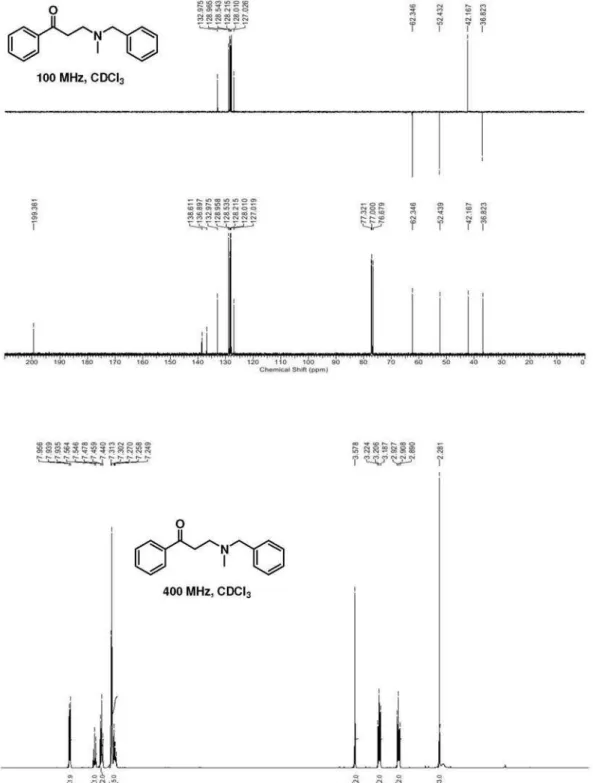
(10a):following the general procedure for the formation of β-aminoketones, the reaction of benzylmethylamine (300 mg, 2.48 mmol) and 3-(N,N-dimethylamino)-1-phenylpropan-1-one hydrochloride (531 mg, 2.49 mmol) in a mixture of 1,4-dioxane (5 mL) and TEA (1 mL) afforded compound 10a as a yellow oil. Yield: 88% (552 mg). Data: FTIR (film) ν/cm-1 2922, 2845, 1684 (C=O), 1598; 1H NMR (400 MHz, CDCl
3) d 2.28 (s, 3H, NCH3), 2.91 (t, 2H, J 7.4 Hz, H-2), 3.21 (t, 2H, J 7.4 Hz, H-3), 3.58 (s, 2H, Bn-H), 7.23-7.31 (m, 5H, Ph-H), 7.46 (t, 2H, J 7.6 Hz, Ph-H), 7.56 (td, 1H, J 7.6, 1.2 Hz, Ph-H), 7.92-7.97 (m, 2H, Ph-H) ppm; 13C NMR (100 MHz, CDCl
3)
d 36.8 (CH2), 42.2 (NCH3), 52.4 (NCH2), 62.3 (PhCH2), 127.0 (CH), 128.0 (CH), 128.2 (CH), 128.5 (CH), 129.0 (CH), 133.0 (CH), 136.9 (Cq), 138.6 (Cq), 199.4 (C=O)
ppm; MS (70 eV, EI) m/z (%) 162 [M-91]+ (17), 134 (32), 91 (100) [PhCH2], 77 (50); C17H19NO (253.15): calcd. C 80.60, H 7.56, N, 5.53; found: C 80.31, H 7.23, N, 5.72.
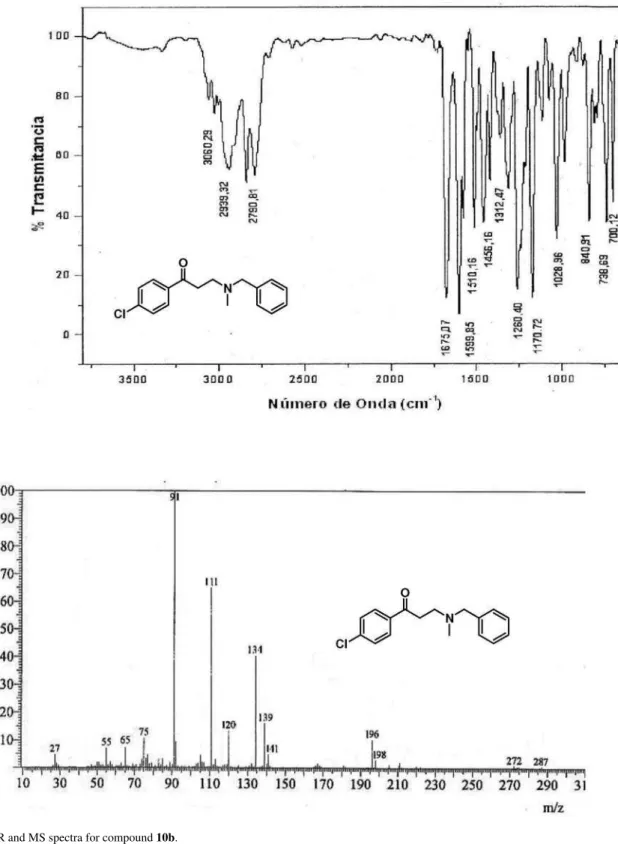
3-(N-Benzyl-N- methylamino)-1-(4-chlorophenyl)propan-1-one (10b):following the general procedure for the formation of β-aminoketones, the reaction of benzylmethylamine (291 mg, 2.40 mmol) and 1-(4-chlorophenyl)-3-(N,N-dimethylamino)propan-1-one hydrochloride (596 mg, 2.41 mmol) were dissolved in a mixture of 1,4-dioxane (5 mL) and TEA (1 mL) afforded compound
10b as a yellow oil. Yield: 78% (539 mg). Data: FTIR (film)
ν/cm-1 2939, 2842, 1675 (C=O), 1600; 1H NMR (400 MHz, CDCl3) d 2.28 (s, 3H, NCH3), 2.88 (t, 2H, J 7.6 Hz, H-2), 3.16 (t, 2H, J 7.2 Hz, H-3), 3.56 (s, 2H, Bn-H), 7.25-7.49 (m, 7H, Ph-H, Ar-H), 7.88 (d, 2H, J 8.4 Hz, Ar-H) ppm; 13C NMR (100 MHz, CDCl3) d 36.9 (CH2), 42.2 (NCH3), 52.3 (NCH2), 62.4 (PhCH2), 127.0 (CH), 128.2 (CH), 128.8 (CH), 128.9 (CH), 129.4 (CH), 135.2 (Cq), 138.7 (Cq), 139.4 (Cq), 198.2 (C=O) ppm; MS (70 eV, EI) m/z (%) 289/287 [M]+ (0.1 /0.3), 274/272 (0.1/0.3), 198/196 (3/10), 141/139 (5/16), 134 (40), 120 (14), 111 (65), 91 (100) [PhCH2]; C17H18ClNO (287.11): calcd. C 70.95, H 6.30, N 4.87; found: C 71.11, H 6.52, N 4.90.
3-(N-Benzyl-N-
A Straightforward and Efficient Method for the Synthesis of Diversely Substituted β-Aminoketones and γ-Aminoalcohols J. Braz. Chem. Soc.
S2
2.39 mmol) were dissolved in a mixture of 1,4-dioxane (5 mL) and TEA (1 mL) afforded compound 10c as a yellow oil. Yield: 62% (440 mg). Data: FTIR (film)
ν/cm-1 2950, 2844, 1696 (C=O), 1603, 1529 (NO
2), 1348 (NO2);
1H NMR (400 MHz, CDCl
3) d 2.29 (s, 3H, NCH3), 2.89 (t, 2H, J 7.2 Hz, H-2), 3.21 (t, 2H, J 7.2 Hz, H-3), 3.56 (s, 2H, Bn-H), 7.24-7.30 (m, 5H, Ph-H), 8.06 (d, 2H, J 8.8 Hz, Ar-H), 8.30 (d, 2H, J 8.8 Hz, Ar-H) ppm; 13C NMR (100 MHz, CDCl
3) d 37.7 (CH2), 42.3 (NCH3), 52.1 (NCH2), 62.5 (PhCH2), 123.8 (CH), 127.1 (CH), 128.2 (CH), 128.9 (CH), 129.0 (CH), 138.6 (Cq), 141.3 (Cq), 150.2 (Cq), 197.9 (C=O) ppm; MS (70 eV, EI) m/z (%) 120 [M-178]+ (100), 106 (4), 91 (66) [PhCH
2], 65 (22); C17H18N2O3 (298.13): calcd. C 68.44, H 6.08, N 9.39; found: C 68.60, H 6.11, N 9.20.
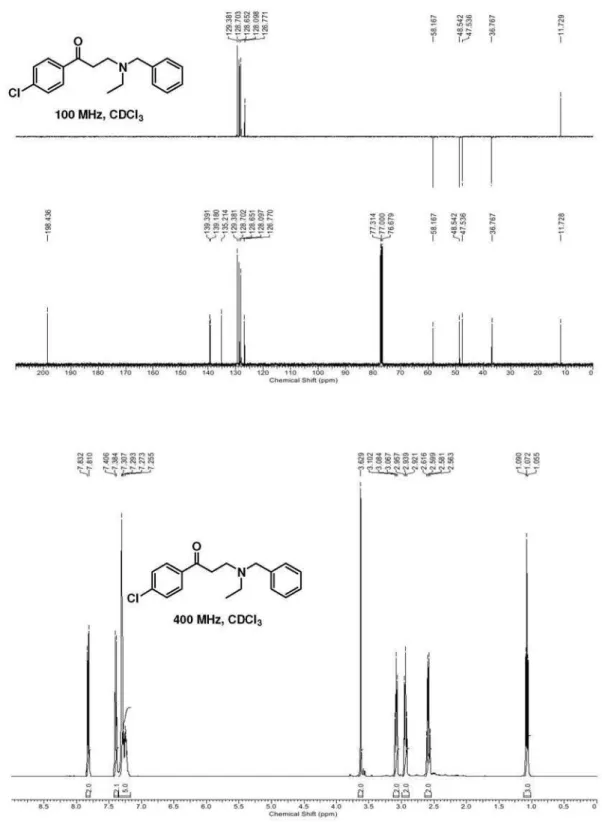
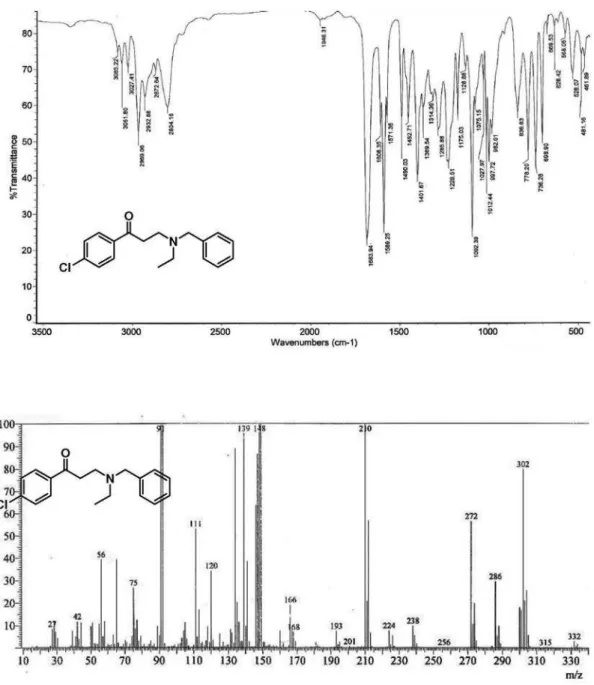
3-(N-Benzyl-N-ethylamino)-1-(4-chlorophenyl)propan-1-one (10d):following the general procedure for the formation of
β-aminoketones, the reaction of benzylethylamine (302 mg, 2.24 mmol) and 1-(4-chlorophenyl)-3-(N,N-dimethylamino) propan-1-one hydrochloride (555 mg, 2.25 mmol) were dissolved in a mixture of 1,4-dioxane (5 mL) and TEA (1 mL) afforded compound 10d as a yellow oil. Yield: 74% (498 mg). Data: FTIR (film) ν/cm-1 2969, 2873, 1684 (C=O), 1608, 1589; 1H NMR (400 MHz, CDCl
3) d 1.07 (t, 3H, J 7.0 Hz, CH3), 2.59 (q, 2H, J 7.0 Hz, NCH2), 2.94 (t, 2H, J 7.3 Hz, H-2), 3.08 (t, 2H, J 7.3 Hz, H-3), 3.63 (s, 2H, Bn-H), 7.22-7.32 (m, 5H, Ph-H), 7.39 (d, 2H, J 8.5 Hz, Ar-H), 7.82 (d, 2H, J 8.5 Hz, Ar-H) ppm; 13C NMR (100 MHz, CDCl3) d 11.7 (CH3), 36.8 (CH2), 47.5 (NCH2), 48.5 (NCH2), 58.2 (PhCH2), 126.8 (CH), 128.1 (CH), 128.6 (CH), 128.7 (CH), 129.4 (CH), 135.2 (Cq), 139.2 (Cq), 139.4 (Cq), 198.4 (C=O) ppm; MS (70 eV, EI) m/z (%) 304/302 [M+1]+ (25/79), 274/272 (19/56), 212/210 (36/100), 168/166 (7/19), 141/139 (38/95), 113/111 (17/53), 91 (65) [PhCH2]; C18H20ClNO (301.12): calcd. C 71.63, H 6.68, N 4.64; found: C 71.87, H 6.55, N 4.80.
3-(N-Benzyl-N- ethylamino)-1-(4-methoxyphenyl)propan-1-one (10e):following the general procedure for the formation of β-aminoketones, the reaction of benzylethylamine (295 mg, 2.18 mmol) and 3-(N,N-dimethylamino)-1-(4-methoxyphenyl)propan-1-one hydrochloride (535 mg,
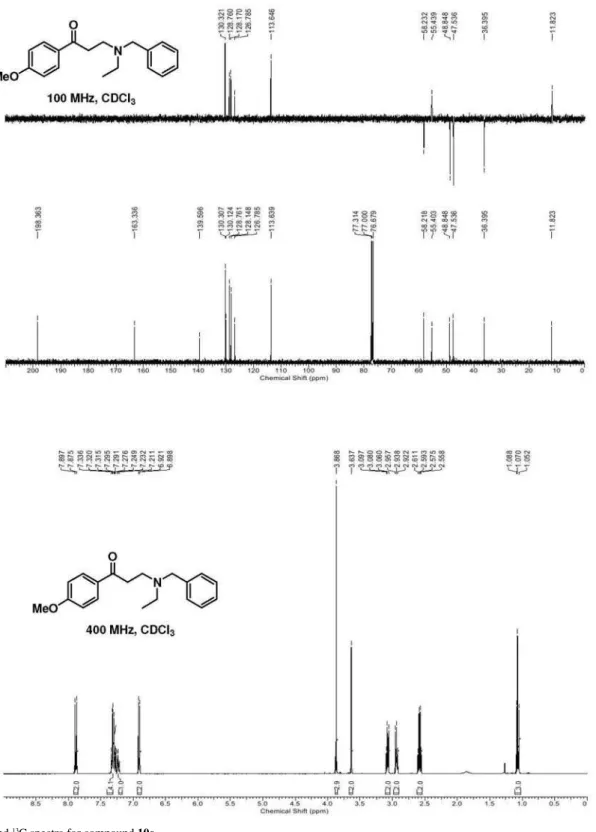
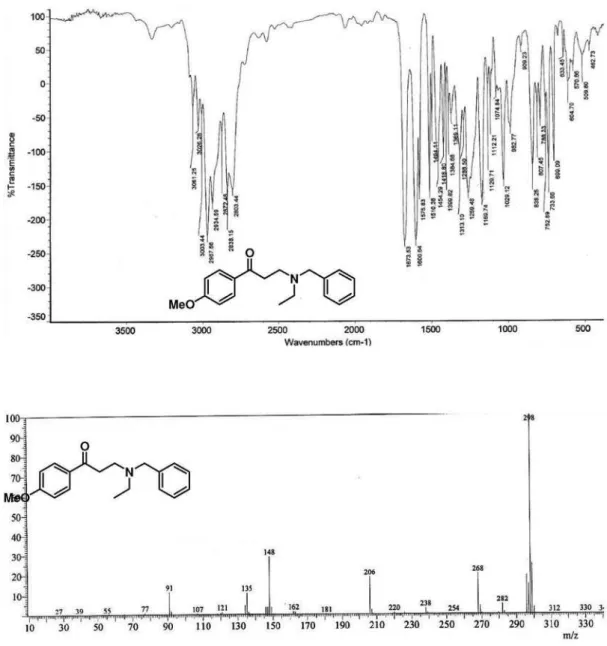
2.20 mmol) were dissolved in a mixture of 1,4-dioxane (5 mL) and TEA (1 mL) afforded compound 10e as a yellow oil.Yield: 90% (584 mg). Data: FTIR (film) ν/cm-1 2968, 2838, 1674 (C=O), 1601, 1170 and 1029 (C−O);1H NMR (400 MHz, CDCl3) d 1.07 (t, 3H, J 7.0 Hz, CH3), 2.58 (q, 2H, J 7.0 Hz), 2.94 (t, 2H, J 7.8 Hz, H-2), 3.08 (t, 2H, J 8.0 Hz, H-3), 3.64 (s, 2H, Bn-H), 3.87 (s, 3H, OCH3), 6.91 (d, 2H, J 8.8 Hz, Ar-H), 7.23 (td, 1H, J 7.0, 1.8 Hz, Ph-H), 7.27-7.35 (m, 4H, Ph-H), 7.89 (d, 2H, J 8.8 Hz, Ar-H) ppm; 13C NMR (100 MHz, CDCl
3) d 11.8 (CH3), 36.4 (CH2), 47.5 (NCH2), 48.8 (NCH2), 55.4 (OCH3), 58.2 (PhCH2), 113.6 (CH), 126.8 (CH), 128.1 (CH), 128.8 (CH), 130.1 (Cq), 130.3 (CH), 139.6 (Cq), 163.3 (Cq), 198.4 (C=O) ppm; MS (70 eV, EI) m/z (%) 298 [M+1]+ (100), 268 (20), 206 (18), 148 (29), 135 (11), 91 (11) [PhCH2]; C19H23NO2 (297.17): calcd. C 76.73, H 7.80, N 4.71; found: C 76.42, H 7.91, N 4.93.
3-(N-Benzyl-N-(2-hydroxyethyl)amino)-1-(4-chlorophenyl)
propan-1-one (10f): following the general procedure
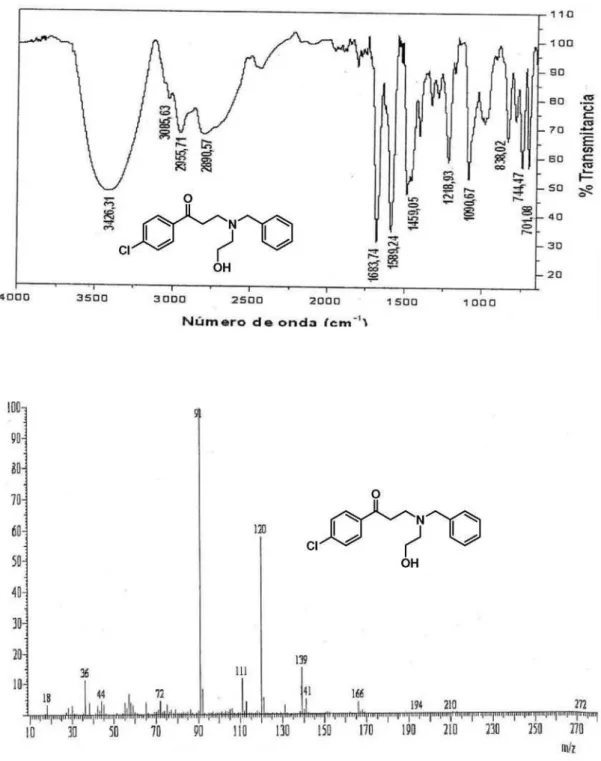
for the formation of β-aminoketones, the reaction of benzylethanolamine (301 mg, 1.99 mmol) and 1-(4-chlorophenyl)-3-(N,N-dimethylamino)propan-1-one hydrochloride (495 mg, 2.00 mmol) were dissolved in a mixture of 1,4-dioxane (5 mL) and TEA (1 mL) afforded compound 10f as a yellow oil.Yield: 65% (411 mg). Data: FTIR (film) ν/cm-1 3426 (O–H), 2955, 2811, 1683 (C=O), 1589; 1H NMR (400 MHz, CDCl
3) d 2.42 (bs, 1H, OH), 2.70 (t, 2H, J 5.2 Hz, NCH2), 2.98 (t, 2H, J 6.6 Hz, H-2), 3.09 (t, 2H, J 6.6 Hz, H-3), 3.62 (t, 2H, J 5.2 Hz, OCH2), 3.66 (s, 2H, Bn-H), 7.20-7.29 (m, 5H, Ph-H), 7.40 (d, 2H, J 8.8 Hz, Ar-H), 7.80 (d, 2H, J 8.8 Hz, Ar-H) ppm; 13C NMR (100 MHz, CDCl
3) d 36.6 (CH2), 48.9 (NCH2), 56.0 (NCH2), 59.0 (PhCH2 + OCH2), 127.2 (CH), 128.4 (CH), 128.8 (CH), 128.9 (CH), 129.4 (CH), 135.0 (Cq), 138.6 (Cq), 139.6 (Cq), 198.3 (C=O) ppm; MS (70 eV, EI) m/z (%) 141/139 [M-178]+ (5/14), 120 (57), 113/111 (3/11), 91 (100) [PhCH2]; C18H20ClNO2 (317.12): calcd. C 68.03, H 6.34, N 4.41; found: C 68.10, H 6.52, N 4.51.
Abonia et al. S3 Vol. 24, No. 9, 2013
and 3-(N,N-dimethylamino)-1-phenylpropan-1-one hydrochloride (348 mg, 1.63 mmol) in a mixture of 1,4-dioxane (5 mL) and TEA (1 mL) afforded compound
10g as a colorless oil. Yield: 68% (365 mg). Data: FTIR (film) ν/cm-1 2927, 2849, 1682 (C=O), 1598; 1H NMR (400 MHz, CDCl3) d 2.98 (t, 2H, J 7.3 Hz, H-2), 3.16 (t, 2H, J 7.3 Hz, H-3), 3.67 (s, 4H, Bn-H), 7.25 (t, 2H, J 7.3 Hz), 7.32 (t, 4H, J 7.3 Hz, Ph-H), 7.37 (d, 4H, J 7.0 Hz, Ph-H), 7.42 (t, 2H, J 7.6 Hz, Ph-H), 7.55 (t, 1H, J 7.3 Hz, Ph-H), 7.86 (d, 2H, J 7.3 Hz, Ph-H) ppm; 13C NMR (100 MHz, CDCl3) d 36.9 (CH2), 49.3 (NCH2), 58.5 (PhCH2), 126.9 (CH), 128.0 (CH), 128.2 (CH), 128.5 (CH), 128.7 (CH), 132.8 (CH), 136.8 (Cq), 139.4 (Cq), 199.6 (C=O) ppm; MS (70 eV, EI) m/z (%) 238 [M-91]+ (16), 210 (12), 118 (10), 105 (26), 91 (100) [PhCH2]; C23H23NO (329.18): calcd. C 83.85, H 7.04, N 4.25; found: C 83.93, H 7.11, N 4.19.
1-(4-Chlorophenyl)-3-(dibenzylamino)propan-1-one (10h): following the general procedure for the formation of
β-aminoketones, the reaction of dibenzylamine (353 mg, 1.79 mmol) and 1-(4-chlorophenyl)-3-(N,N-dimethylamino) propan-1-one hydrochloride (445 mg, 1.80 mmol) were dissolved in a mixture of 1,4-dioxane (5 mL) and TEA (1 mL) afforded compound 10h as a yellow oil. Yield: 77% (501 mg). Data: FTIR (film) ν/cm-1 2939, 2851, 1683 (C=O), 1591; 1H NMR (400 MHz, CDCl
3) d 3.00 (t, 2H, J 7.3 Hz, H-2), 3.13 (t, 2H, J 7.3 Hz, H-3), 3.69 (s, 4H, Bn-H), 7.26-7.41 (m, 12H, Ph-H, Ar-H), 7.78 (d, 2H, J 8.5 Hz, Ar-H) ppm; 13C NMR (100 MHz, CDCl
3) d 36.9 (CH2), 49.2 (NCH2), 58.5 (PhCH2), 126.8 (CH), 128.1 (CH), 128.6 (2 × CH), 129.3 (CH), 135.0 (Cq), 139.1 (Cq), 139.2 (Cq), 198.1 (C=O) ppm; MS (70 eV, EI) m/z (%) 274/272 [M-91]+ (10/30), 210 (26), 141/139 (10/33), 91 (100) [PhCH2]; C23H22ClNO (363.14): calcd. C 75.92, H 6.09, N 3.85; found: C 75.73, H 6.21, N 3.90.
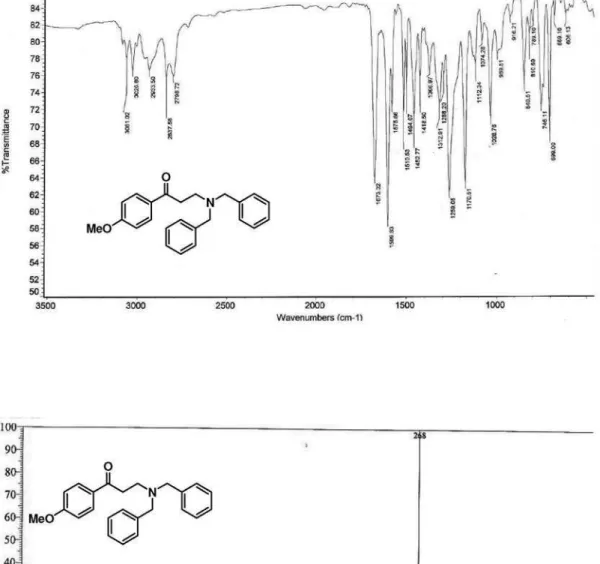
3-(Dibenzylamino)-1-(4-methoxy phenyl)propan-1-one (10i):following the general procedure for the formation of β-aminoketones, the reaction of dibenzylamine (306 mg, 1.55 mmol) and 3-(N,N-dimethylamino)-1-(4-methoxyphenyl)propan-1-one hydrochloride (380 mg, 1.56 mmol) were dissolved in a mixture of 1,4-dioxane (5 mL) and TEA (1 mL) afforded compound 10i as a yellow
oil. Yield: 69% (385 mg). Data: FTIR (film) ν/cm-1 2933, 2838, 1673 (C=O), 1600, 1171, 1112 and 1029 (C−O); 1H NMR (400 MHz, CDCl
3) d 2.97 (t, 2H, J 7.3 Hz, H-2), 3.12 (t, 2H, J 7.2 Hz, H-3), 3.67 (s, 4H, Bn-H), 3.86 (s, 3H, OCH3), 6.89 (d, 2H, J 8.8 Hz, Ar-H), 7.25 (t, 2H, J 7.0 Hz, Ph-H), 7.32 (t, 4H, J 7.0 Hz, Ph-H), 7.38 (d, 4H, J 7.0 Hz, Ph-H), 7.84 (d, 2H, J 8.8 Hz, Ar-H) ppm; 13C NMR (100 MHz, CDCl
3) d 36.5 (CH2), 49.4 (NCH2), 55.3 (OCH3), 58.4 (PhCH2), 113.6 (CH), 126.8 (CH), 128.1 (CH), 128.7 (CH), 129.9 (Cq), 130.2 (CH), 139.4 (Cq), 163.3 (Cq), 198.1 (C=O) ppm; MS (70 eV, EI) m/z (%) 360 [M+1]+ (8), 268 (100), 210 (23), 135 (6), 91 (11) [PhCH2]; C24H25NO2 (359.19): calcd. C 80.19, H 7.01, N 3.90; found: C 80.01, H 7.13, N 3.74.
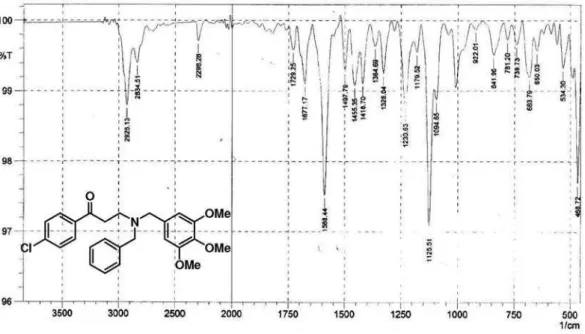
3-(N-(3,4,5-Trimethoxy benzyl)-N- benzylamino)-1-(4-chloro-phenyl)propan-1-one (10j):following the general procedure for the formation of β-aminoketones, the reaction of N-(3,4,5-trimethoxybenzyl)(phenyl)methanamine (363 mg, 1.26 mmol) and 1-(4-chlorophenyl)-3-(N,N-dimethylamino) propan-1-one hydrochloride (315 mg, 1.28 mmol) were dissolved in a mixture of 1,4-dioxane (5 mL) and TEA (1 mL) afforded compound 10j as a yellow oil. Yield: 79% (453 mg). Data: FTIR (film) ν/cm-1 2937, 2835, 1671 (C=O), 1609, 1589, 1127 and 1093 (C−O); 1H NMR (400 MHz, CDCl3) d 2.95 (t, 2H, J 7.0 Hz, H-2), 3.08 (t, 2H, J 7.1 Hz, H-3), 3.57 (s, 2H, Bn-H), 3.60 (s, 2H, Bn-H), 3.81 (s, 3H, OCH3), 3.83 (s, 6H, OCH3 × 2), 6.57 (s, 2H, H), 7.21-7.30 (m, 5H, Ph-H), 7.36 (d, 2H, J 8.5 Hz, Ar-H), 7.74 (d, 2H, J 8.5 Hz, Ar-H) ppm; 13C NMR (100 MHz, CDCl3) d 36.9 (CH2), 49.5 (NCH2), 56.0 (OCH3 × 2), 58.6 (PhCH2), 58.8 (PhCH2), 60.8 (OCH3), 105.4 (CH), 127.0 (CH), 128.2 (CH), 128.7 (CH), 128.8 (CH), 129.4 (CH), 135.1 (Cq), 135.2 (Cq), 136.9 (Cq), 139.2 (Cq), 139.4 (Cq), 153.1 (Cq), 198.3 (C=O) ppm; MS (70 eV, EI) m/z (%) 456/454 [M+1]+ (2/6), 364/362 (8/23), 181 (92), 139 (25), 91 (100) [PhCH2]; C26H28ClNO4 (453.17): calcd. C 68.79, H 6.22, N 3.09; found: C 68.75, H 6.11, N 3.21.
A Straightforward and Efficient Method for the Synthesis of Diversely Substituted β-Aminoketones and γ-Aminoalcohols J. Braz. Chem. Soc.
S4
(321 mg, 1.12 mmol) and 3-(N,N-dimethylamino)-1-(4-methoxyphenyl)propan-1-one hydrochloride (275 mg, 1.13 mmol) were dissolved in a mixture of 1,4-dioxane (5 mL) and TEA (1 mL) afforded compound 10k as a yellow oil. Yield: 62% (312 mg). Data: FTIR (film) ν/cm-1 2928, 2842, 1681 (C=O), 1588, 1206, 1123 and 1093 (C−O); 1H NMR (400 MHz, CDCl
3) d 2.98 (t, 2H, J 7.3 Hz, H-2), 3.09 (t, 2H, J 7.3 Hz, H-3), 3.59 (s, 2H, Bn-H), 3.64 (s, 2H, Bn-H), 3.83 (s, 3H, OCH3), 3.84 (s, 6H, OCH3 × 2), 3.86 (s, 3H, OCH3), 6.60 (s, 2H, Ar-H), 6.88 (d, 2H, J 8.8 Hz, Ar-H), 7.23 (td, 1H, J 7.0, 1.5 Hz, Ph-H), 7.28 (d, 2H, J 6.3 Hz, Ph-H), 7.33 (t, 2H, J 7.0 Hz, Ph-H), 7.83 (d, 2H, J 8.8 Hz, Ar-H) ppm; 13C NMR (100 MHz, CDCl
3) d 36.5 (CH2), 49.8 (NCH2), 55.4 (OCH3), 56.0 (OCH3 × 2), 58.5 (PhCH2), 58.7 (PhCH2), 60.8 (OCH3), 105.4 (CH), 113.6 (CH), 126.9 (CH), 128.2 (CH), 128.7 (CH), 130.0 (Cq), 130.3 (CH), 135.3 (Cq), 136.8 (Cq), 139.3 (Cq), 153.0 (Cq), 163.4 (Cq), 198.1 (C=O) ppm; MS (70 eV, EI) m/z (%) 450 [M+1]+ (4), 358 (41), 268 (55), 181 (100), 148 (13), 135 (50), 91 (55) [PhCH2]; C27H31NO5 (449.22): calcd. C 72.14, H 6.95, N 3.12; found: C 72.30, H 6.73, N 3.30.
3-Morpholino-1-phenylpropan-1-one (10l): following the general procedure for the formation of b-aminoketones, the reaction of morpholine (309 mg, 3.55 mmol) and 3-(N,N-dimethylamino)-1-phenylpropan-1-one hydrochloride (755 mg, 3.54 mmol) in a mixture of 1,4-dioxane (5 mL) and TEA (1 mL) afforded compound
10l as a yellow oil. Yield: 63% (490 mg). Data: FTIR (film):
ν = 2955, 2855, 1683 (C=O), 1217, 1116 and 1070 (C−O); 1H NMR (400 MHz, CDCl
3) d 2.52 (t, 4H, J 4.5 Hz, NCH2), 2.84 (t, 2H, J 7.3 Hz, H-2), 3.19 (t, 2H, J 7.3 Hz, H-3), 3.72 (t, 4H, J 4.6 Hz, OCH2), 7.47 (t, 2H, J 7.5 Hz, Ph-H), 7.57 (t, 1H, J 7.3 Hz, Ph-H), 7.96 (d, 2H, J 7.3 Hz, Ph-H) ppm; 13C NMR (100 MHz, CDCl
3) d 36.0 (CH2), 53.5 (NCH2), 53.7 (NCH2), 66.9 (OCH2), 128.0 (CH), 128.6 (CH), 133.1 (CH), 136.9 (Cq), 198.9 (C=O) ppm; MS (70 eV, EI) m/z (%) 132 [M-87]+ (25), 105 (36), 100 (100); C
13H17NO2 (219.13): calcd. C 71.21, H 7.81, N 6.39; found: C 71.10, H 7.94, N 6.15.
1-(4-Chlorophenyl)-3-morpholinopropan-1-one (10m):
following the general procedure for the formation of
β-aminoketones, the reaction of morpholine (301 mg, 3.46 mmol) and 1-(4-chlorophenyl)-3-(N,N-dimethylamino)
propan-1-one hydrochloride (854 mg, 3.46 mmol) were dissolved in a mixture of 1,4-dioxane (5 mL) and TEA (1 mL) afforded compound 10m as a yellow oil. Yield: 53% (464 mg). Data: FTIR (film) ν/cm-1 2958, 2834, 1682 (C=O), 1204, 1114 and 1013 (C−O); 1H NMR (400 MHz, CDCl3) d 2.50 (t, 4H, J 4.5 Hz, NCH2), 2.81 (t, 2H, J 7.3 Hz, H-2), 3.14 (t, 2H, J 7.3 Hz, H-3), 3.70 (t, 4H, J 4.6 Hz, OCH2), 7.44 (d, 2H, J 8.5 Hz, Ar-H), 7.89 (d, 2H, J 8.5 Hz, Ar-H) ppm; 13C NMR (100 MHz, CDCl
3) d 36.0 (CH2), 53.4 (NCH2), 53.7 (NCH2), 66.9 (OCH2), 128.9 (CH), 129.4 (CH), 135.1 (Cq), 139.5 (Cq), 197.7 (C=O) ppm; MS (70 eV, EI) m/z (%) 168/166 [M-87]+ (5/15), 141/139 (20/63), 100 (100), 75 (25); C13H16ClNO2 (253.09): calcd. C 61.54, H 6.36, N 5.52; found: C 61.71, H 6.50, N 5.30.
1-(4-methoxyphenyl)-3-(piperidin-1-yl)propan-1-one (10n): following the general procedure for the formation of
β-aminoketones, the reaction of piperidine (298 mg, 3.51 mmol) and 3-(N,N-dimethylamino)-1-(4-methoxy-phenyl)propan-1-one hydrochloride (852 mg, 3.51 mmol) were dissolved in a mixture of 1,4-dioxane (5 mL) and TEA (1 mL) afforded compound 10n as a yellow solid. Yield: 72% (624 mg). Mp 204-205 ºC. Data: FTIR (KBr):
ν/cm-1 2953, 2842, 1669 (C=O), 1601, 1178 and 1026 (C−O); 1 H NMR (400 MHz, CDCl
3) d 1.47-1.52 (m, 2H), 1.68-1.74 (m, 4H), 2.59-2.63 (m, 4H, NCH2), 2.94 (t, 2H, J 7.4 Hz, H-2), 3.30 (t, 2H, J 7.3 Hz, H-3), 3.86 (s, 3H, OCH3), 6.92 (d, 2H, J 8.8 Hz, Ar-H), 7.95 (d, 2H, J 8.8 Hz, Ar-H) ppm; 13C NMR (100 MHz, CDCl
3) d 23.6 (CH2), 25.1 (CH2), 35.2 (CH2), 53.6 (NCH2), 54.3 (NCH2), 55.4 (OCH3), 113.7 (CH), 129.6 (Cq), 130.4 (CH), 163.6 (Cq), 197.0 (C=O) ppm; MS (70 eV, EI) m/z (%) 247 [M]+ (2), 162 (29), 135 (100), 98 (39); C15H21NO2 (247.16): calcd. C 72.84, H 8.56, N 5.66; found: C 72.93, H 8.62, N 5.51.
3-(N-Methyl-N-
((naphthalen-5-yl)methyl)amino)-1-phenyl-propan-1-one (10o): following the general procedure
for the formation of β-aminoketones, the reaction of N-methyl(naphthalen-5-yl)methanamine (309 mg, 1.81 mmol) and 3-(N,N-dimethylamino)-1-phenylpropan-1-one hydrochloride (390 mg, 1.83 mmol) in a mixture of 1,4-dioxane (5 mL) and TEA (1 mL) afforded compound
Abonia et al. S5 Vol. 24, No. 9, 2013
Data: FTIR (KBr) ν/cm-1 2946, 2844, 1683 (C=O), 1596; 1H NMR (400 MHz, CDCl
3) d 2.31 (s, 3H, NCH3), 3.01 (t, 2H, J 7.3 Hz, H-2), 3.22 (t, 2H, J 7.3 Hz, H-3), 3.98 (s, 2H), 7.37-7.45 (m, 4H, Ph-H, Naph-H), 7.47-7.50 (m, 2H, Naph-H), 7.54 (t, 1H, J 7.3 Hz, Ph-H), 7.78 (d, 1H, J 7.5 Hz, Naph-H), 7.83-7.86 (m, 1H, Naph-H), 7.91 (d, 2H, J 7.3 Hz, Ph-H), 8.25-8.28 (m, 1H, Naph-H) ppm; 13C NMR (100 MHz, CDCl
3) d 36.8 (CH2), 42.2 (NCH3), 53.0 (NCH2), 61.0 (PhCH2), 124.6 (CH), 125.0 (CH), 125.5 (CH), 125.8 (CH), 127.3 (CH), 127.9 (CH), 128.0 (CH), 128.3 (CH), 128.5 (CH), 132.4 (Cq), 132.9 (CH), 133.8 (Cq), 134.6 (Cq), 136.9 (Cq), 199.5 (C=O) ppm; MS (70 eV, EI) m/z (%) 303 [M]+ (2), 170 (21), 141 (100), 105 (34), 77 (27); C21H21NO (303.16): calcd. C 83.13, H 6.98, N 4.62; found: C 83.21, H 6.89, N 4.50.
Characterization data for g-aminoalcohols 11 and Naftifine®
(±)-3-(N-Benzyl-N-methylamino)-1-phenylpropan-1-ol
(11a): following the approach B for the formation of
γ-aminoalcohols, the reaction of β-aminoketone 10a
(293 mg, 1.16 mmol) and sodium borohydride (78 mg, 2.06 mmol) in 5 mL of methanolafforded compound 11a as a yellow oil.Yield: 82% (242 mg). Data: FTIR (film) ν/cm-1 3400 (O–H), 2923, 2849, 1066 and 1026 (C−O); 1H NMR (400 MHz, CDCl3) d 1.87-1.96 (m, 2H, H-2), 2.31 (s, 3H, NCH3), 2.64 (ddd, 1H, J 12.6, 4.4, 4.4 Hz, H-3a), 2.86 (ddd, 1H, J 12.7, 9.1, 3.9 Hz, H-3b), 3.52 (d, 1H, J 12.8 Hz, Bn-H), 3.69 (d, 1H, J 12.8 Hz, Bn-H), 4.95 (dd, 1H, J 7.6, 4.0 Hz, CH−O), 7.27 (t, 1H, J 7.2 Hz, Ph-H), 7.32-7.42 (m, 9H, Ph-H) ppm, OH is absent; 13C NMR (100 MHz, CDCl
3)
d 34.4 (CH2), 41.7 (NCH3), 56.4 (NCH2), 62.7 (PhCH2), 75.6 (CH−O), 125.5 (CH), 126.8 (CH), 127.3 (CH), 128.1 (CH), 128.4 (CH), 129.2 (CH), 137.7 (Cq), 144.9 (Cq) ppm; MS (70 eV, EI) m/z (%) 255 [M]+ (3), 134 (56), 121 (7), 91 (100) [PhCH2]; C17H21NO (255.16): calcd. C 79.96, H 8.29, N 5.49; found: C 79.73, H 8.18, N 5.60.
(±)-3-(N-Benzyl-N-methylamino)-1-(4-chloro phenyl)propan-1-ol (11b): following the approach B for the formation of γ-aminoalcohols, the reaction of β-aminoketone 10b
(299 mg, 1.04 mmol) and sodium borohydride (75 mg, 1.98 mmol) in 5 mL of methanolafforded compound 11b
as a colorless oil.Yield: 96% (289 mg). Data: FTIR (film)
ν/cm-1 3402 (O–H), 2925, 2846, 1086 and 1014 (C−O); 1H NMR (400 MHz, CDCl
3) d 1.82-1.87 (m, 2H, H-2), 2.28 (s, 3H, NCH3), 2.60 (ddd, 1H, J 12.6, 4.4, 4.4 Hz, H-3a), 2.82 (ddd, 1H, J 13.1, 6.7, 6.7 Hz, H-3b), 3.49 (d, 1H, J 12.8 Hz, Bn-H), 3.65 (d, 1H, J 12.8 Hz, Bn-H), 4.88 (dd, 1H, J 5.8, 5.8 Hz, CH−O), 7.27-2.37 (m, 9H, Ph-H, Ar-H) ppm, OH is absent; 13C NMR (100 MHz, CDCl
3) d 34.4 (CH2), 41.8 (NCH3), 56.2 (NCH2), 62.8 (PhCH2), 75.1 (CH−O), 126.9 (CH), 127.5 (CH), 128.2 (CH), 128.5 (CH), 129.2 (CH), 132.4 (Cq), 137.6 (Cq), 143.5 (Cq) ppm; MS (70 eV, EI) m/z (%) 291/289 [M]+ (0.6/1.8), 134 (28), 120 (8), 105 (2), 91 (100) [PhCH2]; C17H20ClNO (289.12): calcd. C 70.46, H 6.96, N 4.83; found: C 70.31, H 6.79, N 4.79.
(±)-3-(N-Benzyl-N- methylamino)-1-(4-nitrophenyl)propan-1-ol (11c): following the approach B for the formation of γ-aminoalcohols, the reaction of β-aminoketone 10c
(287 mg, 0.96 mmol) and sodium borohydride (68 mg, 1.80 mmol) in 5 mL of methanolafforded compound 11c
as a yellow oil. Yield: 57% (165 mg). Data: FTIR (film)
ν/cm-1 3382 (O–H), 2922, 2846, 1602, 1526 (NO
2), 1349 (NO2), 1081 and 1043 (C−O);
1H NMR (400 MHz, CDCl 3)
d 1.79-1.94 (m, 2H, H-2), 2.31 (s, 3H, NCH3), 2.61 (ddd, 1H, J 12.7, 5.5, 3.2 Hz, H-3a), 2.84 (ddd, 1H, J 12.8, 9.8, 3.1 Hz, H-3b), 3.51 (d, 1H, J 12.8 Hz, Bn-H), 3.64 (d, 1H, J 12.8 Hz, Bn-H), 5.00 (dd, 1H, J 8.2, 3.4 Hz, CH−O), 7.32-7.39 (m, 5H, Ph-H), 7.49 (d, 2H, J 8.8 Hz, Ar-H), 8.16 (d, 2H, J 8.8 Hz, Ar-H) ppm, OH is absent; 13C NMR (100 MHz, CDCl3) d 34.0 (CH2), 41.8 (NCH3), 56.0 (NCH2), 62.8 (PhCH2), 75.0 (CH−O), 123.4 (CH), 126.2 (CH), 127.6 (CH), 128.6 (CH), 129.2 (CH), 137.3 (Cq), 146.8 (Cq), 152.4 (Cq) ppm; MS (70 eV, EI) m/z (%) 300 [M]+ (6), 134 (61), 91 (100) [PhCH
2], 65 (10); C17H20N2O3 (300.15): calcd. C 67.98, H 6.71, N 9.33; found: C 67.69, H 6.69, N 9.51.
(±)-3-(N-Benzyl-N- ethylamino)-1-(4-chlorophenyl)propan-1-ol (11d): following the approach B for the formation of γ-aminoalcohols, the reaction of β-aminoketone 10d
(305 mg, 1.01 mmol) and sodium borohydride (74 mg, 1.96 mmol) in 5 mL of methanolafforded compound 11d
A Straightforward and Efficient Method for the Synthesis of Diversely Substituted β-Aminoketones and γ-Aminoalcohols J. Braz. Chem. Soc.
S6
ν/cm-1 3218 (O–H), 2970, 2826, 1599, 1090, 1058 and 1014 (C−O); 1H NMR (400 MHz, CDCl
3) d 1.15 (t, 3H, J 7.0 Hz, CH3), 1.77-1.87 (m, 2H, H-2a, H-2b), 2.44-2.53 (m, 1H), 2.64 (ddd, 1H, J 12.9, 4.9, 3.5 Hz, H-3a), 2.68-2.77 (m, 1H), 2.85 (ddd, 1H, J 13.0, 9.4, 3.1 Hz, H-3b), 3.43 (d, 1H, J 13.3 Hz, Bn-H), 3.84 (d, 1H, J 13.3 Hz, Bn-H), 4.82 (dd, 1H, J 8.2, 3.6 Hz, CH−O), 7.22-7.42 (m, 9H, Ph-H, Ar-H) ppm, OH is absent; 13C NMR (100 MHz, CDCl
3)
d 11.2 (CH3), 34.4 (CH2), 47.0 (NCH2), 52.3 (NCH2), 58.3 (PhCH2), 75.0 (CH−O), 126.9 (CH), 127.4 (CH), 128.2 (CH), 128.5 (CH), 129.3 (CH), 132.3 (Cq), 137.8 (Cq), 143.5 (Cq) ppm; MS (70 eV, EI) m/z (%) 306/304 [M+1]+ (2/6), 148 (79), 134 (11), 91 (100) [PhCH2]; C18H22ClNO (303.14): calcd. C 71.16, H 7.30, N 4.61; found: C 71.01, H 7.15, N 4.60.
(±)-3-(N-Benzyl-N-ethylamino)-1-(4-methoxyphenyl)
propan-1-ol (11e): following the approach B for the formation of γ-aminoalcohols, the reaction of β-aminoketone 10e
(289 mg, 0.97 mmol) and sodium borohydride (70 mg, 1.85 mmol) in 5 mL of methanolafforded compound 11e
as a yellow oil.Yield: 89% (259 mg). Data: FTIR (film)
ν/cm-1 3223 (O–H), 2934, 2833, 1172, 1058 and 1036 (C−O); 1H NMR (400 MHz, CDCl
3) d 1.14 (t, 3H, J 7.0 Hz, CH3), 1.75-1.82 (m, 1H, H-2a), 1.86-1.96 (m, 1H, H-2b), 2.43-2.52 (m, 1H), 2.65 (ddd, 1H, J 12.9, 4.9, 3.5 Hz, H-3a), 2.69-2.78 (m, 1H), 2.85 (ddd, 1H, J 13.2, 10.2, 3.1 Hz, H-3b), 3.42 (d, 1H, J 13.3 Hz, Bn-H), 3.81 (s, 3H, OCH3), 3.86 (d, 1H, J 13.1 Hz, Bn-H), 4.81 (dd, 1H, J 8.8, 2.8 Hz, CH−O), 5.42 (bs, 1H, OH), 6.87 (d, 2H, J 8.5 Hz, Ar-H), 7.27 (d, 2H, J 8.5 Hz, Ar-H), 7.30-7.38 (m, 5H, Ph-H) ppm; 13C NMR (100 MHz, CDCl
3) d 11.5 (CH3), 34.6 (CH2), 46.9 (NCH2), 52.4 (NCH2), 55.1 (OCH3), 58.2 (PhCH2), 75.1 (CH−O), 113.5 (CH), 126.6 (CH), 127.2 (CH), 128.4 (CH), 129.2 (CH), 137.2 (Cq), 137.9 (Cq), 158.4 (Cq) ppm; MS (70 eV, EI) m/z (%) 299 [M]+ (47), 148 (100), 134 (47), 120 (18), 109 (19), 91 (35) [PhCH2]; C19H25NO2 (299.19): calcd. C 76.22, H 8.42, N 4.68; found: C 76.30, H 8.21, N 4.76.
(±)-3-(N-Benzyl-N-
(2-hydroxyethyl)amino)-1-(4-chloro-phenyl) propan-1-ol (11f): following the approach B
for the formation of γ-aminoalcohols, the reaction of
β-aminoketone 10f (296 mg, 0.93 mmol) and sodium borohydride (68 mg, 1.80 mmol) in 5 mL of methanol afforded compound 11f as a colorless oil. Yield: 61% (182 mg). Data: FTIR (film) ν/cm-1 3409 (O–H), 2948, 2826, 1598, 1086 and 1014 (C−O); 1H NMR (400 MHz, CDCl3) d 1.89-1.91 (m, 2H, H-2), 2.67-2.85 (m, 4H, NCH2, H-3a, H-3b), 3.13 (bs, 1H, OH), 3.64 (d, 1H, J 13.6 Hz, Bn-H), 3.68-3.71 (m, 2H, OCH2), 3.78 (d, 1H, J 13.2 Hz, Bn-H), 4.81 (dd, 1H, J 6.8, 6.8 Hz, CH−O), 7.24-7.35 (m, 9H, Ph-H, Ar-H) ppm, OH is absent; 13C NMR (100 MHz, CDCl3) d 36.0 (CH2), 52.7 (NCH2), 56.7 (NCH2), 59.9 (PhCH2), 60.2 (OCH2), 73.7 (CH−O), 127.1 (CH), 127.5 (CH), 128.5 (CH), 128.6 (CH), 129.2 (CH), 133.1 (Cq), 138.5 (Cq), 143.6 (Cq) ppm; MS (70 eV, EI) m/z (%) 290/288 [M-31]+ (5/15), 164 (6), 134 (38), 91 (100) [PhCH2]; C18H22ClNO2 (319.13): calcd. C 67.60, H 6.93, N 4.38; found: C 67.79, H 6.70, N 4.51.
(±)-3-(Dibenzylamino)-1-phenylpropan-1-ol (11g):following the approach B for the formation of γ-aminoalcohols, the reaction of β-aminoketone 10g (279 mg, 0.85 mmol) and sodium borohydride (63 mg, 1.66 mmol) in 5 mL of methanolafforded compound 11g as a colorless oil.Yield: 85% (239 mg). Data: FTIR (film) ν/cm-1 3396 (O–H), 2943, 2827, 1603, 1129, 1059 and 1031 (C−O); 1H NMR (400 MHz, CDCl3) d 1.83-1.90 (m, 1H, H-2a), 1.94-2.04 (m, 1H, H-2b), 2.67 (ddd, 1H, J 13.0, 5.4, 3.4 Hz, H-3a), 2.88 (ddd, 1H, J 13.0, 10.0, 3.2 Hz, H-3b), 3.44 (d, 2H, J 13.1 Hz, Bn-H), 3.88 (d, 2H, J 13.1 Hz, Bn-H), 4.75 (dd, 1H, J 8.8, 2.8 Hz, CH−O), 6.32 (bs, 1H, OH), 7.23-7.41 (m, 15H, Ph-H) ppm; 13C NMR (100 MHz, CDCl
3) d 34.8 (CH2), 52.3 (NCH2), 58.5 (PhCH2), 75.2 (CH−O), 125.5 (CH), 126.8 (CH), 127.4 (CH), 128.1 (CH), 128.5 (CH), 129.4 (CH), 137.8 (Cq), 144.7 (Cq) ppm; MS (70 eV, EI) m/z (%) 331 [M]+ (6), 240 (6), 210 (64), 181 (5), 120 (9), 91 (100) [PhCH2]; C23H25NO (331.19): calcd. C 83.34, H 7.60, N 4.23; found: C 83.20, H 7.72, N 4.19.
(±)-1-(4-Chlorophenyl)-3-(dibenzylamino)propan-1-ol (11h): following the approach B for the formation of
γ-aminoalcohols, the reaction of β-aminoketone 10h
Abonia et al. S7 Vol. 24, No. 9, 2013
as a yellow oil. Yield: 92% (288 mg). Data: FTIR (film)
ν/cm-1 3243 (O–H), 2934, 2825, 1599, 1089, 1074 and 1013 (C−O); 1H NMR (400 MHz, CDCl
3) d 1.83-1.92 (m, 2H, H-2a, H-2b), 2.66 (ddd, 1H, J 12.9, 5.6, 3.5 Hz, H-3a), 2.84 (ddd, 1H, J 13.1, 9.1, 3.9 Hz, H-3b), 3.45 (d, 2H, J 13.1 Hz, Bn-H), 3.82 (d, 2H, J 13.1 Hz, Bn-H), 4.71 (dd, 1H, J 8.0, 3.5 Hz, CH−O), 6.46 (bs, 1H, OH), 7.15 (d, 2H, J 8.5 Hz, Ar-H), 7.24 (d, 2H, J 8.3 Hz, Ar-H), 7.30-7.42 (m, 10H, Ph-H) ppm; 13C NMR (100 MHz, CDCl
3) d 34.6 (CH2), 52.0 (NCH2), 58.6 (PhCH2), 74.5 (CH−O), 126.9 (CH), 127.4 (CH), 128.2 (CH), 128.5 (CH), 129.4 (CH), 132.3 (Cq), 137.7 (Cq), 143.2 (Cq) ppm; MS (70 eV, EI) m/z (%) 367/365 [M]+ (8/23), 276/274 (10/32), 210 (100), 120 (49), 91 (48) [PhCH2]; C23H24ClNO (365.15): calcd. C 75.50, H 6.61, N 3.83; found: C 75.31, H 6.82, N 3.60.
(±)-3-(Dibenzylamino)-1-(4-methoxyphenyl)propan-1-ol (11i): following the approach B for the formation of
γ-aminoalcohols, the reaction of β-aminoketone 10i
(290 mg, 0.81 mmol) and sodium borohydride (59 mg, 1.56 mmol) in 5 mL of methanolafforded compound 11i
as a yellow oil.Yield: 93% (271 mg). Data: FTIR (film)
ν/cm-1 3275 (O–H), 2942, 2832, 1611, 1176, 1075 and 1034 (C−O); 1H NMR (400 MHz, CDCl
3) d 1.81-1.86 (m, 1H, H-2a), 1.95-2.03 (m, 1H, H-2b), 2.64-2.68 (m, 1H, H-3a), 2.87 (m, 1H, H-3b), 3.43 (d, 2H, J 13.1 Hz, Bn-H), 3.81 (s, 3H, OCH3), 3.88 (d, 2H, J 13.1 Hz, Bn-H), 4.72 (dd, 1H, J 8.3, 2.7 Hz, CH−O), 6.06 (bs, 1H, OH), 6.85 (d, 2H, J 8.3 Hz, Ar-H), 7.20 (d, 2H, J 8.3 Hz, Ar-H), 7.33-7.43 (m, 10H, Ph-H) ppm; 13C NMR (100 MHz, CDCl
3)
d 34.8 (CH2), 52.2 (NCH2), 55.1 (OCH3), 58.5 (PhCH2), 74.7 (CH−O), 113.4 (CH), 126.6 (CH), 127.3 (CH), 128.4 (CH), 129.3 (CH), 136.9 (Cq), 137.8 (Cq), 158.4 (Cq) ppm; MS (70 eV, EI) m/z (%) 361 [M+] (78), 270 (11), 252 (26), 211 (23), 210 (100), 91 (24) [PhCH2]; C24H27NO2 (361.20): calcd. C 79.74, H 7.53, N 3.87; found: C 79.61, H 7.60, N 3.71.
(±)-3-(N-(3,4,5-Trimethoxybenzyl)-N-
benzylamino)-1-(4-chlorophenyl)propan-1-ol (11j):following the approach B for the formation of γ-aminoalcohols, the reaction of
β-aminoketone 10J (300 mg, 0.66 mmol) and sodium borohydride (48 mg, 1.27 mmol) in 5 mL of methanol
afforded compound 11J as a yellow oil. Yield: 91% (274 mg). Data: FTIR (film) ν/cm-1 3247 (O–H), 2929, 2837, 1591, 1126 and 1010 (C−O); 1H NMR (400 MHz, CDCl3) d 1.80-1.97 (m, 2H, H-2a, H-2b), 2.64 (ddd, 1H, J 13.1, 9.3, 3.3 Hz, H-3a), 2.86 (ddd, 1H, J 13.0, 9.8, 3.3 Hz, H-3b), 3.33 (d, 1H, J 13.3 Hz, Bn-H), 3.42 (d, 1H, J 13.3 Hz, Bn-H), 3.78 (d, 1H, J 13.1 Hz, Bn-H), 3.85-3.89 (m, 10H, OCH3 × 3, Bn-H), 4.73 (dd, 1H, J 8.6, 2.8 Hz, CH−O), 6.38 (bs, 1H, OH), 6.60 (s, 2H, Ar-H), 7.17 (d, 2H, J 8.5 Hz, Ar-H), 7.24 (d, 2H, J 8.5 Hz, Ar-H), 7.30-7.39 (m, 5H, Ph-H) ppm; 13C NMR (100 MHz, CDCl
3) d 34.8 (CH2), 52.4 (NCH2), 56.2 (OCH3 × 2), 58.8 (PhCH2), 59.1 (PhCH2), 60.9 (OCH3), 74.8 (CH−O), 106.0 (CH), 126.9 (CH), 127.5 (CH), 128.3 (CH), 128.6 (CH), 129.4 (CH), 132.5 (Cq), 133.6 (Cq), 137.2 (Cq), 137.6 (Cq), 143.2 (Cq), 153.3 (Cq) ppm; MS (70 eV, EI) m/z (%) 457/455 [M]+ (2/6), 276/274 (3/10), 181 (100), 120 (24), 91 (24) [PhCH2]; C26H30ClNO4 (455.19): calcd. C 68.49, H 6.63, N 3.07; found: C 68.60, H 6.41, N 3.13.
(±)-3-(N-(3,4,5-Trimethoxybenzyl)-N-
benzylamino)-1-(4-methoxyphenyl)propan-1-ol (11k): following the
approach B for the formation of γ-aminoalcohols, the reaction of β-aminoketone 10k (291 mg, 0.65 mmol) and sodium borohydride (45 mg, 1.19 mmol) in 5 mL of methanolafforded compound 11k as a yellow oil. Yield: 67% (196 mg). Data: FTIR (film) ν/cm-1 3259 (O–H), 2937, 2836, 1591, 1174, 1128, 1034 and 1009 (C−O); 1H NMR (400 MHz, CDCl3) d 1.73-1.83 (m, 1H, H-2a), 1.93-2.03 (m, 1H, H-2b), 2.62 (ddd, 1H, J 13.0, 4.8, 3.8 Hz, H-3a), 2.87 (ddd, 1H, J 13.1, 10.3, 3.1 Hz, H-3b), 3.29 (d, 1H, J 13.3 Hz, Bn-H), 3.40 (d, 1H, J 13.3 Hz, Bn-H), 3.79 (s, 3H, OCH3), 3.82 (d, 1H, J 13.1 Hz, Bn-H), 3.86 (s, 3H, OCH3), 3.88 (s, 6H, OCH3 × 2), 3.92 (d, 1H, J 13.1 Hz, Bn-H), 4.71 (dd, 1H, J 9.2, 2.8 Hz, CH−O), 6.22 (bs, 1H, OH), 6.61 (s, 2H, Ar-H), 6.83 (d, 2H, J 8.5 Hz, Ar-H), 7.19 (d, 2H, J 8.5 Hz, Ar-H), 7.28-7.40 (m, 5H, Ph-H) ppm; 13C NMR (100 MHz, CDCl
A Straightforward and Efficient Method for the Synthesis of Diversely Substituted β-Aminoketones and γ-Aminoalcohols J. Braz. Chem. Soc.
S8
(±)-3-Morpholino-1-phenylpropan-1-ol (11l): following
the approach B for the formation of γ-aminoalcohols, the reaction of β-aminoketone 10l (279 mg, 1.27 mmol) and sodium borohydride (94 mg, 2.48 mmol) in 5 mL of methanolafforded compound 11l as a colorless oil. Yield: 72% (203 mg). Data: FTIR (film) ν/cm-1 3413 (O–H), 2953, 2854, 1604, 1203, 1116, 1090 and 1029 (C−O); 1H NMR (400 MHz, CDCl3) d 1.88 (q, 2H, J 5.8 Hz, H-2), 2.48-2.70 (m, 6H, H-3, NCH2), 3.75 (t, 4H, J 4.6 Hz, OCH2), 4.94 (dd, 1H, J 5.8, 5.8 Hz, CH−O), 7.25 (td, 1H, J 6.9, 2.1 Hz, Ph-H), 7.32-7.39 (m, 4H, Ph-H) ppm, OH is absent; 13C NMR (100 MHz, CDCl3) d 33.4 (CH2), 53.6 (NCH2), 57.4 (NCH2), 66.9 (OCH2), 75.4 (CH−O), 125.4 (CH), 126.9 (CH), 128.2 (CH), 144.6 (Cq) ppm; MS (70 eV, EI) m/z (%) 221 [M]+ (15), 104 (38), 100 (100); C13H19NO2 (221.14): calcd. C 70.56, H 8.65, N 6.33; found: C 70.61, H 8.40, N 6.50.
(±)-1 -(4-Ch lo rophe nyl)-3-mo r pholin opropa n-1-ol (11m): following the approach B for the formation of
γ-aminoalcohols, the reaction of β-aminoketone 10m
(306 mg, 1.21 mmol) and sodium borohydride (89 mg, 2.35 mmol) in 5 mL of methanolafforded compound 11m
as a yellow oil. Yield: 89% (275 mg). Data: FTIR (film)
ν/cm-1 3428 (O–H), 2957, 2818, 1597, 1119, 1086, 1030 and 1011 (C−O); 1H NMR (400 MHz, CDCl
3) d 1.80-1.85 (m, 2H, H-2), 2.47-2.71 (m, 6H), 3.75 (t, 4H, J 4.5 Hz, OCH2), 4.91 (dd, 1H, J 5.7, 5.7 Hz, CH−O), 7.26-7.33 (m, 4H, Ar-H) ppm, OH is absent; 13C NMR (100 MHz, CDCl
3)
d 33.3 (CH2), 53.6 (NCH2), 57.5 (NCH2), 66.8 (OCH2), 74.9 (CH−O), 126.8 (CH), 128.3 (CH), 132.5 (Cq), 143.2 (Cq) ppm; MS (70 eV, EI) m/z (%) 257/255 [M]+ (2/8), 140/138 (4/13), 100 (100), 77 (19); C13H18ClNO2 (255.10): calcd. C 61.05, H 7.09, N 5.48; found: C 61.16, H 7.21, N 5.59.
(±)-3-(N-Methyl-N-
((naphthalen-5-yl)methyl)amino)-1-phenylpropan-1-ol (11o): following the approach B
for the formation of γ−aminoalcohols, the reaction of
β-aminoketone 10o (336 mg, 1.11 mmol) and sodium borohydride (80 mg, 2.11 mmol) in 5 mL of methanol afforded compound 11o as a yellow solid. Yield: 98% (332 mg), mp 76-77 ºC. Data: FTIR (KBr) ν/cm-1 3374
(O–H), 2949, 2843, 1598, 1129, 1047 and 1024 (C−O); 1H NMR (400 MHz, CDCl
3) d 1.89-1.98 (m, 2H, H-2a, H-2b), 2.40 (s, 3H, NCH3), 2.70 (ddd, 1H, J 12.5, 5.7, 4.0 Hz, H-3a), 2.85 (ddd, 1H, J 12.6, 8.4, 4.4 Hz, H-3b), 3.94 (d, 1H, J 13.1 Hz), 4.03 (d, 1H, J 13.1 Hz), 4.83 (dd, 1H, J 7.0, 4.3 Hz, CH−O), 7.18-7.28 (m, 5H, Ph-H, Naph-H), 7.45-7.47 (m, 2H, Ph-H, Naph-H), 7.55 (td, 1H, J 7.4, 1.0 Hz, Naph-H), 7.63 (td, 1H, J 7.6, 1.2 Hz, Naph-H), 7.85-7.88 (m, 1H, Naph-H), 7.92 (d, 1H, J 8.3 Hz, Naph-H), 8.24 (d, 1H, J 8.3 Hz, Naph-H) ppm, OH is absent; 13C NMR (100 MHz, CDCl
3) d 34.6 (CH2), 42.1 (NCH3), 56.2 (NCH2), 61.1 (NaphCH2), 75.2 (CH−O), 124.0 (CH), 125.1 (CH), 125.4 (CH), 125.8 (CH), 126.3 (CH), 126.7 (CH), 127.9 (CH), 128.0 (CH), 128.3 (CH), 128.6 (CH), 132.3 (Cq), 133.5 (Cq), 133.9 (Cq), 144.8 (Cq) ppm; MS (70 eV, EI) m/z (%) 287 [M-18]+ (23), 196 (30), 141 (100), 115 (49), 91 (14) [PhCH2]; C21H23NO (305.18): calcd. C 82.58, H 7.59, N 4.59; found: C 82.45, H 7.38, N 4.67.
(E)-N-methyl-N- ((naphthalen-5-yl)methyl)-3-phenylprop-2-en-1-amine: a solution of γ-aminoalcohol 11o (200 mg) in 5 mol L-1 HCl (5 mL) afforded Naftifine® as a yellow oil. Yield: 86% (162 mg). Data: FTIR (film) ν/cm-1 2943, 2835, 1596, 1589 cm-1. The NMR signals corresponding to the Naftifine® obtained by Lipshutz et al.1 are given in square brackets, which are compared with the signals assigned to the product obtained by us. 1H NMR (400 MHz, CDCl3) δ 2.34 (s, 3H, NCH3) [2.29 (s, 3H)], 3.34 (d, 2H, J 6.0 Hz, H-1) [3.29 (d, 2H, J 6.4 Hz)], 4.01 (s, 2H) [3.96 (s, 2H)], 6.43 (dt, 1H, J 15.6, 6.4 Hz, H-2) [6.38 (dt, 1H, J 16.0, 6.4 Hz)], 6.63 (d, 1H, J 15.6 Hz, H-3) [6.60 (d, 1H, J 16.0 Hz)], 7.25-7.62 (m, 9H, Ph-H, Naph-H) [7.23-7.57 (m, 9H)], 7.83 (d, 1H, J 8.0 Hz, Naph-H) [7.81 (d, 1H, J 8.0 Hz)], 7.90 (d, 1H, J 8.0 Hz, Naph-H) [7.88 (d, 1H, J 8.0 Hz)], 8.36 (d, 1H, J 8.4 Hz, Naph-H) [8.31 (d, 1H, J 8.2 Hz] ppm; 13C NMR (100 MHz, CDCl
3) d 42.4 (NCH3), 60.0 (CH2), 60.3 (CH2), 124.6 (CH), 125.1 (CH), 125.5 (CH), 125.8 (CH), 126.3 (CH), 127.3 (CH), 127.4 (CH), 127.9 (CH), 128.4 (CH), 132.5 (Cq), 132.6 (CH), 133.9 (Cq), 134.8 (Cq), 137.1 (Cq); MS (70 eV, EI) m/z (%) 287 [M]+ (42), 196 (42), 141 (100), 115 (48), 91 (15) [PhCH2]; C21H21N (287.17): calcd. C 87.76, H 7.36, N 4.87; found: C 87.65, H 7.30, N 5.01.
Reference
Abonia et al. S9 Vol. 24, No. 9, 2013
A Straightforward and Efficient Method for the Synthesis of Diversely Substituted β-Aminoketones and γ-Aminoalcohols J. Braz. Chem. Soc.
S10
Abonia et al. S11 Vol. 24, No. 9, 2013
A Straightforward and Efficient Method for the Synthesis of Diversely Substituted β-Aminoketones and γ-Aminoalcohols J. Braz. Chem. Soc.
S12
Abonia et al. S13 Vol. 24, No. 9, 2013
A Straightforward and Efficient Method for the Synthesis of Diversely Substituted β-Aminoketones and γ-Aminoalcohols J. Braz. Chem. Soc.
S14
Abonia et al. S15 Vol. 24, No. 9, 2013
A Straightforward and Efficient Method for the Synthesis of Diversely Substituted β-Aminoketones and γ-Aminoalcohols J. Braz. Chem. Soc.
S16
Abonia et al. S17 Vol. 24, No. 9, 2013
A Straightforward and Efficient Method for the Synthesis of Diversely Substituted β-Aminoketones and γ-Aminoalcohols J. Braz. Chem. Soc.
S18
Abonia et al. S19 Vol. 24, No. 9, 2013
A Straightforward and Efficient Method for the Synthesis of Diversely Substituted β-Aminoketones and γ-Aminoalcohols J. Braz. Chem. Soc.
S20
Abonia et al. S21 Vol. 24, No. 9, 2013
A Straightforward and Efficient Method for the Synthesis of Diversely Substituted β-Aminoketones and γ-Aminoalcohols J. Braz. Chem. Soc.
S22
Abonia et al. S23 Vol. 24, No. 9, 2013
A Straightforward and Efficient Method for the Synthesis of Diversely Substituted β-Aminoketones and γ-Aminoalcohols J. Braz. Chem. Soc.
S24
Abonia et al. S25 Vol. 24, No. 9, 2013
A Straightforward and Efficient Method for the Synthesis of Diversely Substituted β-Aminoketones and γ-Aminoalcohols J. Braz. Chem. Soc.
S26
Abonia et al. S27 Vol. 24, No. 9, 2013
A Straightforward and Efficient Method for the Synthesis of Diversely Substituted β-Aminoketones and γ-Aminoalcohols J. Braz. Chem. Soc.
S28
Abonia et al. S29 Vol. 24, No. 9, 2013
A Straightforward and Efficient Method for the Synthesis of Diversely Substituted β-Aminoketones and γ-Aminoalcohols J. Braz. Chem. Soc.
S30
Abonia et al. S31 Vol. 24, No. 9, 2013
A Straightforward and Efficient Method for the Synthesis of Diversely Substituted β-Aminoketones and γ-Aminoalcohols J. Braz. Chem. Soc.
S32
Abonia et al. S33 Vol. 24, No. 9, 2013
A Straightforward and Efficient Method for the Synthesis of Diversely Substituted β-Aminoketones and γ-Aminoalcohols J. Braz. Chem. Soc.
S34
Abonia et al. S35 Vol. 24, No. 9, 2013
A Straightforward and Efficient Method for the Synthesis of Diversely Substituted β-Aminoketones and γ-Aminoalcohols J. Braz. Chem. Soc.
S36
Abonia et al. S37 Vol. 24, No. 9, 2013
A Straightforward and Efficient Method for the Synthesis of Diversely Substituted β-Aminoketones and γ-Aminoalcohols J. Braz. Chem. Soc.
S38
Abonia et al. S39 Vol. 24, No. 9, 2013
A Straightforward and Efficient Method for the Synthesis of Diversely Substituted β-Aminoketones and γ-Aminoalcohols J. Braz. Chem. Soc.
S40
Abonia et al. S41 Vol. 24, No. 9, 2013
A Straightforward and Efficient Method for the Synthesis of Diversely Substituted β-Aminoketones and γ-Aminoalcohols J. Braz. Chem. Soc.
S42
Abonia et al. S43 Vol. 24, No. 9, 2013
A Straightforward and Efficient Method for the Synthesis of Diversely Substituted β-Aminoketones and γ-Aminoalcohols J. Braz. Chem. Soc.
S44
Abonia et al. S45 Vol. 24, No. 9, 2013
A Straightforward and Efficient Method for the Synthesis of Diversely Substituted β-Aminoketones and γ-Aminoalcohols J. Braz. Chem. Soc.
S46
Abonia et al. S47 Vol. 24, No. 9, 2013
A Straightforward and Efficient Method for the Synthesis of Diversely Substituted β-Aminoketones and γ-Aminoalcohols J. Braz. Chem. Soc.
S48
Abonia et al. S49 Vol. 24, No. 9, 2013
A Straightforward and Efficient Method for the Synthesis of Diversely Substituted β-Aminoketones and γ-Aminoalcohols J. Braz. Chem. Soc.
S50
Abonia et al. S51 Vol. 24, No. 9, 2013
A Straightforward and Efficient Method for the Synthesis of Diversely Substituted β-Aminoketones and γ-Aminoalcohols J. Braz. Chem. Soc.
S52
Abonia et al. S53 Vol. 24, No. 9, 2013
A Straightforward and Efficient Method for the Synthesis of Diversely Substituted β-Aminoketones and γ-Aminoalcohols J. Braz. Chem. Soc.
S54
Abonia et al. S55 Vol. 24, No. 9, 2013
A Straightforward and Efficient Method for the Synthesis of Diversely Substituted β-Aminoketones and γ-Aminoalcohols J. Braz. Chem. Soc.
S56