Effect of prophylactic treatments on the superficial roughness of dental tissues
and of two esthetic restorative materials
Efeito de tratamentos profiláticos na rugosidade superficial de tecidos dentais e
de dois materiais restauradores estéticos
Da ni e le Sa la mi*
Ma ria Apa re ci da Alves de Cer que i ra Luz**
AB STRACT: Dental prophylaxis is a common way to remove dental plaque and stain, both undesirable factors in most dentistry procedures. However, besides cleaning the tooth surface, prophylactic techniques may increase the surface roughness of restorations and dental tissues, which, in turn, may result in plaque accumulation, superficial staining and superficial degradation. This study evaluated the effect of three prophylactic techniques – sodium bicarbonate jet, pumice paste and whiting paste – on the superficial roughness of two restorative materials – a composite resin and a compomer – and on the superficial roughness of two dental surfaces – enamel and cementum/dentin – through rugosimetric and scanning electron mi cros copy (SEM) analysis. Statistical analysis of the rugosimetric data showed that the use of pumice paste on enamel produced a significantly smoother surface than the natural surface. However, comparing the effect of the three techniques, prophylaxis with the pumice paste produced a rougher surface than did the other techniques as regards enamel and cementum/dentin probably due to its abrasiveness. On composite resin, the pumice paste only produced a rougher surface than did the whiting paste. On compomer, all of the applied treatments produced similar results. Based on rugosimetric and SEM analysis, we could conclude that the prophylactic treatments employed did not improve roughness of the studied sur faces. As to the ef fects of the tech -niques, they were dif fer ent de pend ing on the sur faces on which the pro phy lac tic treat ments were ap plied.
DESCRIPTORS: Den tal pro phy laxis; Com pos ite resin; Compomers; Den tal enamel; Dentin.
RESUMO: A pro fi la xia den tal é uma prá ti ca co mum para a re mo ção de pla ca bac te ri a na e ou tros in du tos que di fi cul tam a re a li za ção dos pro ce di men tos res ta u ra do res. Entre tan to, como efe i to se cun dá rio à lim pe za, podese ter uma su per fí cie mais ru go sa e su je i ta a man cha men tos e de gra da ções. O pre sen te es tu do ava li ou os efe i tos de três téc ni cas de pro fi la xia – jato de bi car bo na to de só dio, pas ta de pe drapo mes e pas ta de bran co de es pa nha – so bre a ru go si da de su per -fi ci al de dois ma te ri a is res ta u ra do res – re si na com pos ta e com pô me ro – e de duas su per fí ci es den ta is – es mal te e ce men to/den ti na – atra vés da aná li se ru go si mé tri ca e de mi cros co pia ele trô ni ca de var re du ra. A aná li se es ta tís ti ca dos re sul ta dos ru go si mé tri cos mos trou que a pro fi la xia com pe drapo mes so bre o es mal te pro du ziu uma su per fí cie es ta tis ti ca men te mais lisa do que a na tu ral. Entre tan to, com pa ran dose o efe i to dos três tra ta men tos, a ru go si da de su per -fi ci al pro du zi da pela pe dra-po mes foi ma i or do que a pro du zi da pelos ou tros tra ta men tos tan to para es mal te quan to para ce men to/den ti na, pro va vel men te por ser mais abra si va, sen do que para a su per fí cie de re si na com pos ta a ru go si -da de pro du zi -da pela pe dra-po mes foi ma i or ape nas do que a pro du zi -da pelo bran co de es pa nha. Já para o com pô me ro, os três tra ta men tos se com por ta ram de ma ne i ra se me lhan te. Po de mos afir mar, ba se an donos na aná li se de ru go si me tria e nas ima gens das mi cro gra fi as ele trô ni cas de var re du ra das su per fí ci es es tu da das, que os tra ta men tos pro fi lá ti -cos em pre ga dos não au men ta ram a ru go si da de das su per fí ci es tra ta das. Com pa ran do-se os efe i tos das três téc ni cas, es tes fo ram di fe ren tes, de pen den do das su per fí ci es em que fo ram em pre ga das.
DESCRITORES:Pro fi la xia den tá ria; Re si nas com pos tas; Com pô me ros; Esmal te den tá rio; Den ti na.
IN TRO DUC TION
The re moval of den tal plaque and stain are re -quired in most op er a tive den tistry pro ce dures. In ad he sive re stor ative pro ce dures, den tal clean ing be fore etch ing is es sen tial for a full re stor ative tech nique5,11
. The pres ence of or ganic de bris cov er -ing the enamel sur face, for ex am ple, hin ders the com plete etch ing of enamel, pre vent ing the cre -ation of a uni form pat tern of de min er al iza tion1
.
Sev eral in ves ti ga tions have shown that a so -dium bi car bon ate jet is more ef fec tive in re mov ing den tal stain than the ap pli ca tion of abra sive pastes with rub ber cups7,13
. This con ven tional clean ing tech nique does not re move all or ganic de -bris from fis sures whereas the so dium bi car bon ate jet re moves the or ganic de bris over the en tire sur -face of fis sures, en abling etchants and seal ants to fully pen e trate them6,10,13,14,16,17
. Some stud ies have
shown that the so dium bi car bon ate jet could cause clin i cally sig nif i cant loss of enamel and root struc ture. How ever, re cent stud ies have dem on -strated that this kind of pro phy lac tic tech nique did not re sult in a rough ened enamel sur face9,13,14.
So dium bi car bon ate jet treat ment pro duces a smoother radicular sur face free of plaque, but it causes ac cen tu ated root ero sion even af ter a short pe riod of ap pli ca tion2,3,9
. Scanning elec tron mi cros -copy re vealed the pres ence of a well-formed smear layer pro duced by the ac tion of the so dium bi car -bon ate jet dur ing dentin abra sion. It has been dem on strated that when the dentinal tu bules are oc cluded with a smear layer, pa tients have less dentin sen si tiv ity than when the tu bules are pat -ent9
. This fact and the pos si bil ity of re ac tive dentin for ma tion caused by the ap pli ca tion of a so dium bi car bon ate jet15
may ex plain why it can be used for the treat ment of dentin hy per sen si tive ness.
A com pos ite resin and a compomer are in cluded in this study be cause these aes the tic re stor ative ma te ri als are com monly used in cer vi cal ar eas, in vari ably more sus cep ti ble to the ac tion of pro phy -lac tic treat ments. Rugosimetric anal y sis is one of the most ac cu rate quan ti ta tive meth ods for eval u -at ing su per fi cial rough ness8
.
The aim of this re search was to as sess the ef -fects of some com monly em ployed pro phy lac tic tech niques on the su per fi cial rough ness of den tal sur faces – enamel and ce men tum/dentin – and on the su per fi cial rough ness of two aes the tic re stor -ative ma te ri als – com pos ite resin and compomer – through rugosimetric anal y sis. Scanning Elec tron Mi cros copy (SEM) was used to elu ci date the re -sults ren dered by the rugosimetric tests.
MA TE RIALS AND METHODS
Twenty-three ex tracted third mo lars from young adult pa tients were used with their con sent and with the ap proval of the Eth i cal Com mit tee, School of Den tistry, Uni ver sity of São Paulo. The teeth were ex am ined to as cer tain enamel sound -ness. Their roots were cut off 5.0 mm short of the cementoenamel junc tion. They were then halfsec -tioned and both frag ments were em bed ded in acrylic resin so as to leave enamel and radicular sur faces ex posed .
Using com pos ite resin (Z 100®
, 3M, St. Paul, USA) and compomer (Dyract®
, Dentsply, Konstanz, Germany), 45 discshaped spec i mens of each ma -te rial were made with 7.0 mm di am e -ter and 3.0 mm thick ness. The discs were em bed ded in
acrylic resin leav ing 1.0 to 1.5 mm of one of their sur faces ex posed. They were then sub mit ted to se -quen tial Sof-lex® (3M, St. Paul, USA) disc fin ish ing.
Be fore any treat ment was ap plied, each spec i men of com pos ite resin and compomer was sub -mit ted to a first rugosimetric read ing in 5 dif fer ent ar eas; each spec i men of the den tal frag ments (enamel and ce men tum/dentin) were also sub mit ted to a rugosimetric read ing, only now in 3 dif fer ent ar eas. Rough ness of these sur faces was mea -sured with the Surftest 211 (Mitutoyo, São Paulo, Brazil) rugosimetric equip ment. The point of the rugosimeter de vice was set at a 0.8 mm dis lo ca tion and to read mil li me ter units. Af ter these first read -ings, 15 spec i mens of each ma te rial (com pos ite resin and compomer) and of each den tal frag ment (enamel and ce men tum/dentin) re ceived one out of three kinds of pro phy lac tic treat ments:
• so di um bi car bo na te jet (SBJ) (Pro fi II Ce ra mic, Dabi Atlan te, Ri be i rão Pre to, Brazil) - the nozz le ori fi ce was po si ti o ned at a 90-de gree an gle and 5.0 mm away from the sur fa ces, du ring 20 se -conds;
• pu mi ce pas te (PP), ap pli ed with a rub ber cup di -rectly on the sur fa ces, du ring 20 se conds; • whi ting pas te (WP), ap pli ed with a rub ber cup
di rectly on the sur fa ces, du ring 20 se conds; The wa ter/pow der pro por tion of the pastes was stan dard ized in or der to ob tain a firm con sis tency so as not to al low dis per sion of the ma te rial on the sur face dur ing ap pli ca tion. Af ter treat ments were ap plied, the sur faces were washed with an air/wa -ter spray for 20 sec onds, and each spec i men was sub mit ted to a new rugosimetric read ing. The sur face rough ness val ues were sub mit ted to sta tis ti -cal anal y ses (ANOVA and t-test). Two sam ples of
each kind of spec i men were pro cessed for SEM anal y sis. The spec i mens were mounted on alu mi -num stubs and air dried. Af ter sput ter ing with a 40 nm layer of gold in a Balzers SCD050 ap pa ra tus (Balzers, Liech ten stein, Ger many), the sur faces were ex am ined in a Jeol 6100 scan ning elec tron mi cro scope (Jeol, To kyo, Ja pan) op er at ing at 10-15 kV.
RE SULTS
The sta tis ti cal t-test was used to com pare the
p = 0.087 and p = 0.669 re spec tively for PP, WP and SBJ); and root sur face (p = 0.282, p = 0.582 and p = 0.879 re spec tively for PP, WP and SBJ), The sta tis ti cal anal y sis showed no dif fer ences be tween val ues of treated and nontreated sur faces. Nev er the -less, on enamel, the PP pro duced a sta tis ti cally smoother sur face than that of the nat u ral con trol sam ple (p < 0.001, p = 0.989 and p = 0.798 re spec -tively for PP, WP and SBJ).
The ef fects of the three pro phy lac tic treat ments were com pared with each other through the sta tis -ti cal ANOVA test (Table 1). The sta -tis -ti cal anal y sis showed that the PP pro duced a rougher sur face than did the oth ers as re gards enamel and root
sur faces, prob a bly due to its abra sive ness. On com pos ite resin, the PP only pro duced a rougher sur face than did the WP. On the compomer sur face all treat ments ap plied pro duced sim i lar re sults.
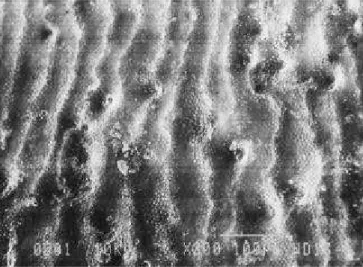
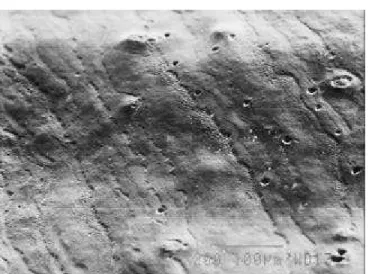
Fig ures 1 through 6 show the ef fects of some of the pro phy lac tic treat ments em ployed.
DIS CUS SION
The ne ces sity to carry out den tal pro phy laxis be fore clin i cal pro ce dures in op er a tive den tistry fol low ing one of the tech niques used in this study has been proven by dif fer ent studies11,13,15,17
. The enamel sur face pres ents a nat u ral rough -ness due to the pres ence of Retzius grooves, pits and small deffects, be sides min eral de po si tion that may take place in the oral en vi ron ment. The lat ter,
TA BLE 1 - Mul ti ple com pa ri son of sur fa ce ef fects pro du -ced by the dif fe rent tre at ments ap pli ed.
Surfaces treated Group Group Significance
(ANOVA)
Compomer
PP WP p = 0.328
SBJ p = 0.293
WP PP p = 0.328
SBJ p = 0.997
SBJ PP p = 0.293
WP p = 0.997
Composite resin
PP WP p = 0.010
SBJ p = 0.415
WP PP p = 0.010
SBJ p = 0.185
SBJ PP p = 0.415
WP p = 0.185
Enamel
PP WP p < 0.001
SBJ p < 0.001
WP PP p < 0.001
SBJ p = 0.639
SBJ PP p < 0.001
WP p = 0.639
Cementum/dentin
PP WP p < 0.001
SBJ p = 0.001
WP PP p < 0.001
SBJ p = 0.883
SBJ PP p = 0.001
WP p = 0.883
FIGURE 1 - Scan ning elec tron micro graph of the ena mel sur fa ce wit hout su per fi ci al tre at ment (200 X).
how ever, was not pres ent in the ex per i men tal con -di tions of this study since the teeth used were unerupted. On enamel sur faces, the PP caused enamel ero sion, re sult ing in a smoother sur face than the nat u ral one. The sur face thus ob tained, how ever, was rougher than that pro duced by the other pro phy lac tic treat ments. The sta tis ti cal anal y sis showed that the PP has an ero sion power ca pa ble of smooth ing out the nat u ral enamel sur -face, and the scan ning elec tron mi cro graphs also showed that the ero sion power of the PP al tered the enamel, leav ing a more ho mo ge neous sur face than the nat u ral one, in spite of the pres ence of marks pro duced by it. This as pect problably ex plains the lower rugosimetric val ues of the enamel sur face treated with the PP as com pared to the non-treated sur faces (con trol). The other treat ments ap plied (WP and SBJ) were not able to cause a com pa ra ble ero sion on the enamel sur faces, thus their rugosimetric val ues were not sta tis ti cally dif fer ent from those of the nontreated sur faces (con -trols)9,13
.
The scan ning elec tron mi cro graphs also showed that the enamel sur faces treated with WP and the SBJ have a smoother ap pear ance than the nontreated sur faces (con trol). As these treat -ments main tained the gen eral mor phol ogy of the enamel sur face, they did not pro duce sta tis ti cally sig nif i cant dif fer ences when com pared to each other and when com pared with the non-treated sur faces (con trols)10,13,17.
On ce men tum/dentin sur faces the PP pro duced rougher sur faces than did oth ers treat -ments, al though it did not pro duce sta tis ti cally sig nif i cant dif fer ences when com pared with the
non-treated sur faces (con trols). Spe cial in ter est on the ef fects of these treat ments on ce men -tum/dentin sur faces is jus ti fied by cases of
FIGURE 3 - Scan ning elec tron micro graph of the ena mel tre a ted with whi ting pas te (200 X).
FIGURE 4 - Scan ning elec tron micro graph of the ena mel tre a ted with so di um bi car bo na te jet (200 X).
gingival re trac tion in aged pa tients, where radicular dentin is ex posed. In such cases, ce men tum is ini tially ex posed and then quickly lost, re sult ing in dentin ex po sure on the radicular sur -face. In ad di tion, these ar eas re tain more plaque and stain more than other ar eas of the tooth be -cause of the po ros ity of the re gion’s dentin and cementum2
.
Thus, the ef fects of the pro phy lac tic tech niques em ployed in this study did not mod ify the su per fi -cial rough ness of the den tal sur face, al low ing their ap pli ca tion with out col lat eral ef fects. The ap pli ca tion of the pro phy lac tic tech niques on the ex per i -men tal re stor ative ma te ri als did not pro duce rougher sur faces than the pol ished ones (con trols). This fact also makes the use of these tech niques safe when res to ra tions are pres ent. We must em -pha size, how ever, that on com pos ite resin, the PP pro duced a rougher sur face than did the WP. This prob a bly means that the PP eroded the or ganic com po nent more than the ex posed in or ganic par ti cles which are harder and, con se quently, more re -sis tant to erosion8
.
The sta tis ti cal re sults were con firmed by the scan ning elec tron mi cro graphs as the spec i mens sub mit ted to the SEM anal y sis did not re ceive any treat ment to re move the smear layer. The smear layer pre sented dif fer ent char ac ter is tics de pend
-ing on which pro phy lac tic treat ment was ap plied and de pend ing on the treated substrate12
. The smear layer was main tained be cause its re moval would have al tered the sur face char ac ter is tics re vealed when the rugosimetric read ings were car ried out. The SEM im ages showed only slight su -per fi cial al ter ations of the sur face rough ness of the treated spec i mens when com pared with the nat u -ral tis sues or with the pol ished ma te ri als stud ied.
CON CLU SIONS
Based on the meth od ol ogy used in this study we could con clude that:
• the proph ylac tic tech ni ques stu di ed did not in -cre a se the su per fi ci al rough ness of the stu di ed sur fa ces, and the pu mi ce pas te was able to smo oth out the ena mel sur fa ce;
• com pa ring the tech ni ques’ ef fects, the pu mi ce pas te pro du ced a roug her sur fa ce than did ot -her tre at ments on den tal tis su es; on com po si te re sin it pro du ced a roug her sur fa ce than did the whi ting pas te. On com po mer, the tre at ments ap pli ed did not pro du ce sta tis ti cally dif fe rent ef -fects on sur fa ce rough ness.
AC KNOWL EDGE MENTS
FAPESP – Pro cess num ber: 00/09239-6.
REFERENCES
1. Armas-Vega AC. Avaliação da influência de diferentes técnicas de limpeza da superfície do esmalte na resistência adesiva em dentes bovinos [Dissertação de Mestrado]. São Paulo: Universidade de São Paulo; 2001.
2. Atkin son DR, Cobb CM, Kil loy NJ. The ef fect of an airpow -der abra si ve system on in vi tro root sur fa ces. J Pe ri o don tol 1984;55:13-18.
3. Berk ste in S, Re iff RC, Mckin ney JF, Kil loy NJ. Su pra gin gi -val root sur fa ce re mo -val du ring ma in te nan ce pro ce du res uti li zing an air po wer abra si ve system or hand sca ling. J Pe ri o don tol 1987;58:327-30.
4. Boy de A. Air po lis hing ef fects on ena mel, den ti ne, ce ment and bond. Br Dent J 1984;156:287-91.
5. Brenner Jr AJ. Resistência ao cisalhamento da colagem de braquetes ortodônticos, relacionada com o preparo profilá -tico do esmalte dentário e o tempo de condiciona mento ácido. Ortodont Paranaen 1990;11:63-69.
6. Brock le hurst PR, Jos hi RI, Nort he ast SE. The ef fect of air po lis hing oc clu sal sur fa ces on the pe ne tra ti on of fis su res by a se a lant. Int J Ped Dent 1992;2:157-62.
7. Chambrone LA, Antonneli RH, Lascala NT - Estudo clínico comparativo da remoção da placa bacteriana supragen -gival com taça de borracha ver sus Profident – avaliação da eficiência e receptividade dos métodos. Rev Paul Odontol 1988;10:47-53.
8. Fossen AM. Estudo in vi tro da rugosidade su per fi cial de resinas compostas do tipo híbrida e de micropartículas submetidas a diversas técnicas de polimento [Dissertação de Mestrado]. São Paulo: Universidade de São Paulo; 1994.
9. Gal lo way SE, Pash ley DH. Rate of re mo val of root struc tu re by the use of Prophy-jet de vi ce. J Pe ri o don tol 1987; 58:464-69.
10. Gar cia-Go doy F, Med lock JW. An SEM study of the ef fects of air-po lis hing on fis su re sur fa ces. Qu in tes sen ce Int 1988;19:465-7.
11. Hoeppner MG, Sundfeld RH, Hol land Jr C, Sundfeld MLMM. Análise microscópica da penetração in vi tro de um selante de fóssulas e fissuras no esmalte den tal humano: efeitos da profilaxia e dos tem pos de condicionamento ácido do esmalte den tal. Rev Bras Odontol 1998; 55:258-64.
12. Luz MAAC, Ga ro ne Net to N, Ara na-Cha vez VE, So bral MA, Sin ger JM. Che mi cal and/or me cha ni cal tre at ments of sme ar la yer as re ve a led by scan ning elec tron mi cros copy. A blind study. Pes qui Odon tol Bras 2000;14:101-6.
13. Marta SN, Lima JEO, Silva SMBA, Vono BG. Avaliação quantitativa do efeito do jato de bicarbonato de sódio no esmalte de dentes permanentes jovens. Rev Odontol Univ São Paulo 1999;13:19-24.
14. Nuti Sobrinho A, Lima SNM, Watanabe I. Estudo da ação do Profident sobre a placa bacteriana den tal através da microscopia eletrônica de varredura. Rev Paul Odontol 1984;6:34-59.
15. Orrico SRP, Chierici RA, To ledo BEC, Sampaio JEC, Onofre MA. Efeitos da ação do jato de bicarbonato de sódio (sistema Profident), sobre os tecidos gengivais. Análise histológica. RGO 1989;37:467-72.
16. Strand GV, Ra a dal M. The ef fi ci ency of cle a ning fis su res with an air-po lis hing ins tru ment. Acta Odon tol Scand 1988;46:113-7.
17. Will mann DE, Nor ling BK, John son WN. A new proph yla xis ins tru ment: ef fect on ena mel al te ra ti ons. J Am Dent Assoc 1980;101:923-25.